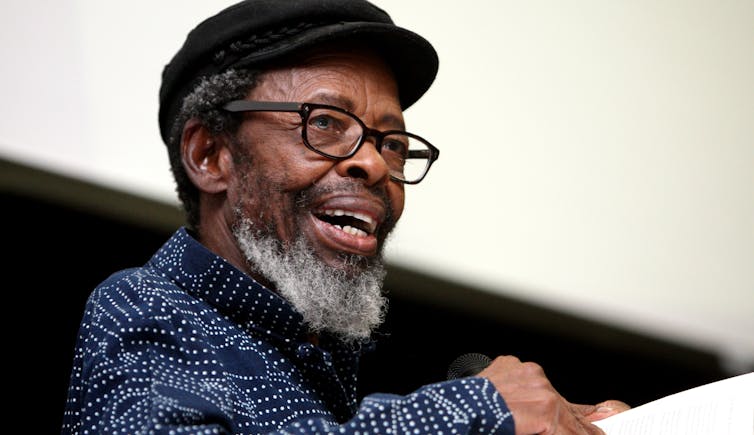
Memories of Keorapetse Kgositsile (1938-2017), or Bra Willie, as he was affectionately known, are of a poet who always had a smile on his face, who exuded gentleness, and was soft-spoken. He died on Wednesday.
In his schooldays Bra Willie (78) managed to get access to African American poets Langston Hughes’ and Richard Wright’s poems. This was no mean feat in apartheid South Africa when schools for African children either didn’t have libraries or they were poorly-stocked, and African students were denied access to literature deemed to be “seditious”. Even my “whites only” school library had no books with African-American poems, still less the apartheid English setwork books.
His first job was working for a 1950s left newspaper, the New Age, which had strong links to the African National Congress. The apartheid regime banned it in 1962.
In 1962 Kgositsile went into exile in the US. His career flourished in Harlem; he gave numerous readings at African-American jazz clubs, and graduated with a Master of Fine Arts from Columbia University.
In 1975 Kgositsile sacrificed his flourishing career to return to Africa to work for the ANC in Dar es Salaam, Tanzania. In 1977 he founded the ANC’s Department of Education in exile, and in 1983 its Department of Arts and Culture in 1983.
He continued to produce poetry and music, melding African and diasporic poetry influenced by jazz.
Kgositsile’s impact on a generation of South African left literary activists during the 1970s and 1980s was immense. Tattered photostats of his work passed from hand to hand were the samizdat of the oppressed under apartheid, which is how we learnt of his poems.
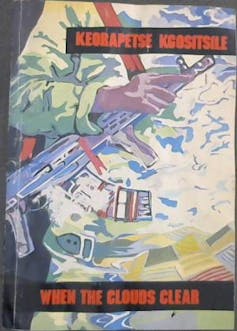
As soon as apartheid censorship ended in 1990, the Congress of South African Writers brought out a selection of his poems When the Clouds Clear. Willie returned to South Africa from exile, and was elected vice-president of the organisation.
Kgositsile wrote of the 1976 Soweto generation who revolted against apartheid, following the imposition of Afrikaans as a medium of instruction.
In our land fear is dead
The young are no longer young …
South Africa’s youth reciprocated this admiration: again and again a youthful poet would recite from memory a Kgositsile poem, mimicking his voice to perfection. They enjoyed doing this to his face as much as in his absence.
In today’s literary establishment, none of the country’s literati command this sort of respect.
He was honoured with the South African Poet Laureate Prize in 2006.
Kgositsile won several literary awards including the Harlem Cultural Council Poetry Award and in South Africa the Herman Charles Bosman Prize, and in 2008 the Order of Ikhamanga (Silver) for
excellent achievements in the field of literature and using these exceptional talents to expose the evils of the system of apartheid.
He was married four times. His wives included Baleka Mbete, a fellow poet and currently Speaker of the National Assembly. He is survived by his fourth wife, Baby Dorcas Kgositsile, as well as seven children and grandchildren.
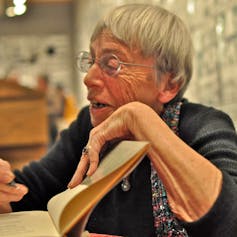
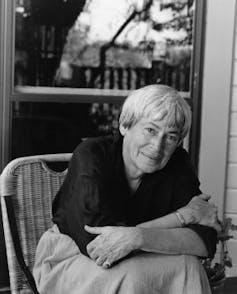
Hermaphrodite beings, dragon women, ambivalent utopias and sympathetic magic. Just a tiny taste of the fantasy and science fiction worlds created by Ursula K Le Guin, who has died at the ripe age of 88.
Le Guin challenged everything that came before and opened up new ways of doing fantasy and science fiction, but she was also a poet, essayist, historical fiction writer, and children’s writer. In 2017 she was voted into the American Academy of Arts and Letters after having won numerous awards, including the Hugo (voted by fans) and Nebula (voted by writers) awards for a single science fiction book twice.
She submitted her first short story for publication at the age of 11, and continued writing prolifically until recently. Her latest book, No Time to Spare: Thinking About What Matters, a collection of essays about everything, from writing to ageing, was published in December 2017.
She was a strong female voice of dissent within male-dominated genres. She challenged race stereotypes in fantasy and science fiction. She had a long-lasting influence on a younger generation of writers. Le Guin’s work has been iconic for a while, studied at universities, loved by readers, praised by critics.
Le Guin’s parents were anthropologists. Her father, Alfred Kroeber, established the Anthropology Department at Berkeley and her mother, Theodora Kroeber, wrote the biography of the last remaining “wild Indian” in the US. Le Guin’s alternative worlds were anthropological at their core. Instead of medievalesque hierarchies and politics, kings, knights and “small folk”, her worlds are populated by societies that seem tribal. In her Earthsea cycle, magic is “primitive”, ritualistic and shamanic, connected to the power of language. “True names” can summon and control people, animals, matter, and knowing them gives access to power that can become perilous.
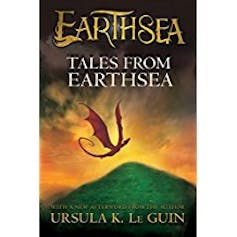
Celebrated: Le Guin’s Earthsea cycle. Amazon
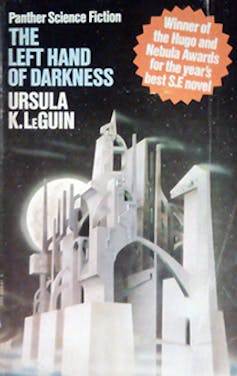
In The Left Hand of Darkness, society on the ice planet of Gethen revolves around partly familial, partly tribal groups called “hearths” – and expulsion means sure death from cold. In Always Coming Home, alongside the main narrative, we get ethnographic notes about the customs, myths and rituals of the Kesh tribe.
Principles and beliefs associated with Taoism were also central to Le Guin’s imaginative fiction: non-action, living harmoniously with the self and the universe, respecting the natural rhythms of life. The ying-yang symbol of the balance of opposites is reflected in the “equilibrium” which holds everything together in Earthsea. As Master Hand says: “To light a candle is to cast a shadow.” The same symbol is a powerful metaphor in the harmonious symmetries of The Left Hand of Darkness: male and female, hot and cold, fear and courage.
These elements make Le Guin’s worlds less binary, less based on conflict and resolution, and more mystical, spiritual and – ultimately – refreshingly different to expected norms in science fiction and fantasy. My students often arrive at the surprising realisation that “nothing much happens” in The Left Hand of Darkness. Equally, the Earthsea books don’t focus so much on the standard fantasy trope of defeating a Dark Lord in a great battle, but on changing attitudes and prejudices. The slower pace of Le Guin’s books are part of their success. In a world of fast rhythms and small attention spans, this is a major achievement.
Challenging race and gender norms
But Le Guin’s beautifully crafted prose also had a sharp edge. She consciously set off to question what came before her in fantasy and science fiction, especially in terms of race and gender. She was outspoken about the “colour scheme” of her Earthsea series. She wrote:
I didn’t see why everybody in science fiction had to be a honky named Bob or Joe or Bill. I didn’t see why everybody in heroic fantasy had to be white (and why all the leading women had “violet eyes”). It didn’t even make sense. Whites are a minority on Earth now.
Ged, the main protagonist of the Earthsea cycle, has copper-brown colouring (emulating the Native American complexion), while the white-skinned Kargs are the main antagonists for most of the series. Similarly, in The Left Hand of Darkness the only character from Earth is a black man, and everybody else in the book is “Inuit (or Tibetan) brown”.
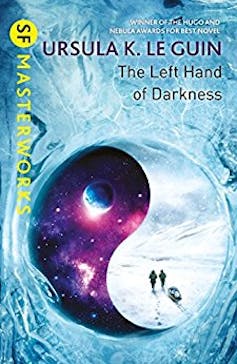
Left Hand of darkness: multi award-winner. Amazon
As for gender, is there a better example of a “thought experiment” in challenging norms in science fiction than the genderless world of Gethen in The Left Hand of Darkness? Creating an androgynous people, who only become male or female once a month in order to procreate, gave Le Guin the opportunity to write the iconoclastic sentence: “The king was pregnant”, and to also question how language shapes our prejudices.
Even when many later feminist critics claimed that the book hadn’t gone far enough in interrogating sexism, Le Guin publicly admitted in a revised essay that they were right, and that she had not allowed space for homosexuality in her fictional world. To criticise your own work 20 years after publication takes guts and a unflinching belief in your principles.
As for Earthsea, she took it one step further. When it dawned on her that
female magic had been excluded from Earthsea, she returned to her earlier work and changed everything, but without disrupting the coherence and consistency of her originally conceived imaginary world. That is a sure sign of a master in the genre who was able to see her own younger self as entrapped in the cultural and historical moment of writing.
Ursula K Le Guin has taught us a different way of reading, a different way of thinking. If you haven’t read Le Guin yet, may I suggest a short story that encapsulates a lot of her political and social concerns, the masterful (if rather disturbing) The Ones Who Walk Away From Omelas. An imaginary world in miniature, and simultaneously a powerful and memorable “thought experiment”. A micro-capsule of Le Guin’s brilliance. She will be missed.
Author Ursula Kroeber Le Guin has been the subject of critical debate, analysis and discussion for generations. She died this week at the age of 88.
Le Guin published her first paid work April in Paris in the September 1962 issue of the magazine Fantastic Stories of the Imagination – and I am the proud owner of an original copy. I am a lifelong Le Guin fan, but also an academic exploring how science fiction is a cultural artefact that acts as a lens on changing attitudes and specific issues of its time. For me, Le Guin hit the sweet spots of her time powerfully and frequently.
Le Guin explored what it is to be human, faults and all, and the impact and influence of her work is undeniable in the world of fantasy and science fiction.
I first encountered Le Guin as a child through the Earthsea Cycle, and it set the bar high for what I considered ever after to be good fantasy literature, leaving me disappointed by many otherwise quite respectable authors.
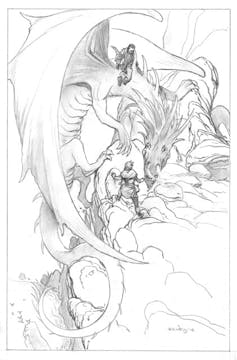
A Wizard of Earthsea, published in 1968, was the first of three books exploring the life of Ged, a young wizard. Spoiler alert: Ged grows and matures into an adult, starting with his attendance at a secretive wizarding school, where he is scarred on the face by a dark power (which he discovered is inextricably linked to him) and that he later defeats.
If this sounds familiar, you’re not the first to note it. Regarding the story of Ged in A Wizard of Earthsea, Le Guin didn’t say that J.K. Rowling “ripped me off” in her Harry Potter series, but felt that Rowling should have been “more gracious about her predecessors”.
In the Earthsea series, we are introduced to the complex responsibilities of becoming an adult, and asked to consider the values of life and the nature of death. It’s heavy, but significant and humanly realistic reading for a teenager.
Professionalism and style
Le Guin was fiercely protective and supportive of other authors. In 1973, she made a humorous critique of the problems faced by writers trying to make their worlds fantastical and strange in From Elfland to Poughkeepsie, encouraging and emphasising the importance of appropriate style.
Style is something Le Guin seemed to be able to master effortlessly and consistently. I consider her short story Semley’s Necklace – first published in 1964 and later included in The Wind’s Twelve Quarters – to be the finest of its kind in fantasy writing, its crystalline prose equal to Semley’s tragic fate.
Le Guin maintained an interest in encouraging writers and sharing her art. I have an original and much-thumbed copy of the elegantly titled (and naturally masterfully written) Steering the Craft: a 21st Century Guide to Sailing the Sea of Story, published in 1998: it didn’t make me a better writer, but it made me respect and appreciate the craft of writing.
For me, Le Guin has been such a powerful influence in science fiction and fantasy literature that I can’t imagine how it might have developed without her.
My own much loved, much lent copy of The Left Hand of Darkness (Granada Publishing, 1973). Christopher Benjamin Menadue, Author provided
The Left Hand of Darkness, published in 1969, inspired and informed a generation of gender writing in fantasy and science fiction. Yet, in her 1976 introduction to this novel, Le Guin maintained that androgyny was not what she considered the theme of the book – it was more to do with essential human feelings about fidelity and betrayal. Her employment of what were to become tropes of science fiction and fantasy was in service of the story, not the other way around, and this was a characteristic of her work.
More than many other author, she employed language, culture and concept in service of writing significant stories about the condition of being human.
Where writer Philip K Dick might be considered the expert of the “what if” scenario in science fiction, for me Le Guin is the expert at “what is?” She asked questions about our nature, aims and desires. She was consistently writing at the coalface of cultural change, or anticipating it.
Her short story The Ones Who Walk Away From Omelas, written in 1973 is a devastating, slow-burn exposition of the implications of taking the utilitarian route in our exploitative relationships with other people.
The power of this writing has only increased with time, as we become more aware of “ethical outsourcing” and labour inequalities. These are portrayed in the film The Last Train Home, where the lives of those in the “developed world” become more comfortable, but at the expense of people we don’t know and can’t see.
The Dispossessed, published in 1974, was my introduction to a reader-friendly explanation of comparative ideologies – I suspect it was the same for many people.
But it was also a story about scientists, and the duty they have to be responsible, ethical and honest. It is another very human story in which Le Guin skillfully portrays the difficulties of presenting complex concepts to an unwelcoming world – something that is still pertinent in an age of climate change denial, anti-vaccination lobbying and fake news.
Le Guin was not a universal fan of scientific progress, but always took a human perspective. She was horrified by the “deal with the devil” of the Google book digitisation project, which although a great technological innovation, she recognised as a potential assault on the rights of authors.
Le Guin was a prolific novelist, and I only realise how small a proportion of her work my collection includes when I look look her up on the Internet Science Fiction Database.
Unlike many of her contemporaries, Le Guin consistently wrote thoughtful and artful science fiction and fantasy throughout her life, without becoming fixed in any particular style.
Like Ged in Earthsea, she matured gracefully and elegantly with age, and continued to be powerful force and influence in the world of science fiction and fantasy writing.
The world has lost a great and influential writer and humanist. When I heard the news of her death I was heartbroken.
However, there’s another side to North Korean political messaging, one directed at the domestic population.
Difficult to access and written in a highly stylized, dogmatic prose, North Korea’s domestic propaganda is not only largely ignored abroad, but it’s also difficult for even South Koreans to understand. It includes state-sponsored Chosun Central TV broadcasts, state-produced films, and revolutionary operas and ballads.
But one of the more illuminating forms of internal propaganda is the regime’s state-produced fiction. Published in monthly literary journals, these stories are distributed by the ruling Korean Workers’ Party to select schools and offices around the country.
In an effort to make this internal propaganda more accessible to non-Koreans, I have been translating and blogging about selected works of North Korean fiction as part of my research on North Korean cultural politics.
These stories can offer outsiders revealing insights into the regime’s shifting concerns and priorities, which include a recent campaign to reinforce the legitimacy of their young leader, Kim Jong Un.
Penning tales for the regime
No other autocratic regime today has such a well-developed stable of artists and writers producing works aligned with the party’s ideological needs. The ruling Korean Workers’ Party has an extensive bureaucracy in charge of training talent, defining standards and commissioning projects in literature and other branches of the arts.
Like most professionals within North Korea, fiction writers belong to their own organization within the ruling Korean Worker’s Party: the Chosŏn Writer’s Union. The Party, therefore, has direct control over what gets written about and which themes get emphasized.
Works of fiction are published in one of a handful of monthly literary journals, the most prestigious of which is Korean Literature, produced by Chosŏn Literature and Art Union Publishing. Other journals include Children’s Literature, Youth Literature and Literary Newspaper.
Within the Chosŏn Writer’s Union, the most elite authors comprise the April 15 Literary Production Unit. This group has produced all the major works dramatizing the personal histories of the leaders, including the “Immortal History” (Pulmyŏl ŭi Yŏksa) and “Immortal Leadership” (Pulmyŏl ŭi Hyangdo) series, which constructed the official hagiography of Kim Il Sung and Kim Jong Il, respectively.
The list of authorship of new fiction about Kim Jong Un reveals many well-known names from these series, including Kim Sam Bok, Baek Bo Hŭm and Chŏng Ki Jong. Chŏng, one of North Korea’s most well-known contemporary authors, passed away in 2016, but not before penning the short story “Sky, Earth and Sea,” which details Kim Jong Un’s role in the Ŭnha and Gwangmyŏngsŏng satellite launches.
Since consumer demands and preferences are irrelevant to the creation of North Korean fiction, it cannot be evaluated as a reflection of the average North Korean’s underlying social anxieties (which is how a cultural anthropologist might study literature). Through interviews with North Korean defectors living in Seoul, I found that most North Koreans don’t spend their leisure time reading these journals for fun. Many, however, told me that they had been exposed to these stories at some point in school.
The anthropologists’ loss, however, is the political scientists’ gain. North Korean fiction offers a window into the ruling party’s priorities that’s just as informative as its official, externally directed propaganda.
Reading between the lines
Many of these stories dramatize events in the leaders’ lives. Some are morality tales that showcase characters who embody certain socialist ideals. Others reflect concerns about the geopolitical landscape – and, not surprisingly, American leaders sometimes make guest appearances.
Chŏng Ki Jong’s most famous novel, “Ryŏksa ui Taeha,” depicts President Bill Clinton cowering under blankets during the 1994 nuclear crisis. Another short story from around that time, “Maehok,” tells the story of President Jimmy Carter’s famous 1994 visit from the perspective of his wife Rosalynn, as she meets (and is smitten with) the Great Leader Kim Il Sung.
More recently, however, stories have centered on one subject: Kim Jong Un.
Kim was formally designated as successor in September 2010. Prior to that, his very existence had been virtually unknown to the general public within the country. In a country where schoolchildren ritualistically memorize idealized accounts of their leader and his ancestors, it must have been mind-boggling to see a new leader on TV that they knew almost nothing about.
The regime had to rush to put together a personal legend worthy of the grandson of the nation’s founder. The first works of fiction to mention Kim by name appeared in early 2013, over a year after he succeeded his late father as leader. In these stories, there’s a marked thematic shift, with an emphasis on youth, creativity and innovation.
For example, the 2017 short story “Blossoming Dreams,” by Kim Il Su, depicts the young leader as a talent scout of sorts. He finds gifted young artists and architects and encourages them to participate more fully in various national construction projects. At one point he pontificates to one of his advisers about the value of youthful thinking:
“Our future as a socialist nation of culture will not be built by architects and experts alone. It will require all our citizens to become gardeners and creators adorning our country with beauty. And it is the young generation that must stand up to bring about this bright future. Lately, I hear the saying ‘everything’s getting younger,’ but isn’t that wonderful? This era is young, and our people are getting younger … ”
References to new luxuries and recreational facilities are another notable feature of recent stories. Since Kim became supreme leader, he has poured resources into developing Western-style amusements such as water parks and ski resorts.
One such site, the Rungna People’s Pleasure Ground, attracted international media attention after Kim Jong Un toured the facility in 2012 on his first official photo op with his new wife. An ode to the Rungna park appeared in Literary Newspaper in October 2012, celebrating it as “the creation of heaven and earth following the leader’s path.” In “Blossoming Dreams,” Kim Jong Un’s faithful minister of architecture recalls how the young leader “suffered in the summer heat and fierce winds” when touring the site of the soon-to-be-opened theme park.
A similar prestige project is the new Changjŏn Street complex in Pyongyang, which features gleaming, high-rise apartment buildings and sports facilities.
In “Teacher,” a short story published in 2013, a family of schoolteachers is thrilled to receive notice that they have been given a spacious new apartment in the Changjŏn complex. The family is surprised to learn they made the list: It’s well known that the first apartments were supposed to go to “workers and innovators.” Later it becomes clear that Kim Jong Un personally directed that some apartments be set aside for educators as well, as part of a general priority for “cultivating the next generation.”
North Korean fiction, of course, shouldn’t be interpreted as a realistic depiction of actual conditions within the country.
But by reading between the lines, one may discern clues to the regime’s internal concerns, along with the messages it is most eager to convey to its captive domestic audience.
Mary Wollstonecraft Shelley’s Frankenstein, or the Modern Prometheus was published anonymously 200 years ago in January, 1818. It has since become the most analysed and contested novel of all time.
It is cited today in debates on the ethics of scientific progress. The “Frankenstein effect” has become synonymous with questionable advances in genetics, in vitro fertilisation and artificial intelligence, evoking the spectre of dangerous science. It has become an example of what goes wrong when science goes too far.
When we return to Frankenstein’s origins, however, we uncover a different story. As Shelley was later to document, the story was forged during the Summer of 1816 in debates that took place between herself, her partner (later husband) Percy Bysshe Shelley, Lord Byron, her stepsister Claire Clairmont and John Polidori at the Villa Diodati on the shores of Lake Geneva.
There, she records, the group was debating the arguments of poet and chemist Sir Humphry Davy and discussed “the nature of the principle of life, and whether there was any probability of its ever being discovered and communicated”.
Shelley had accompanied her father William Godwin to hear Davy give his lectures on chemistry at the Royal Institution in 1812, and later, in 1816, she read his Elements of Chemical Philosophy as she was composing Frankenstein.
Davy’s account of science was mesmerising for the sheer excitement that it conveyed: “Science has … bestowed upon [man] powers which may be called almost creative,” he declared. Frankenstein, drawing upon the scientific advancements of its age, Erasmus Darwin’s early theory of evolutionary development in the 1790s, vitality, galvanism and Davy’s quest to determine the “hidden origins” of nature, partakes of the fascination and anxiety about scientific progress. But it is wrong to read the novel as being straightforwardly sceptical of scientific advancement.
‘A torrent of light’
Victor Frankenstein’s aims in creating new life are, after all, commendable. Reflecting the mixed aspirations of his mythological counterpart Prometheus, Frankenstein wishes to “pour a torrent of light into our dark world” and in so doing “renew life where death had apparently devoted the body to corruption”. He seeks to eradicate diseases which corrupt the human frame before its time.
These are not bad ambitions. But it is the way in which he pursues nature to “her hiding places” that makes his quest so fatal. Ventriloquising Shelley’s views, Frankenstein later observes that:
A human being in perfection ought always to preserve a calm and peaceful mind, and never to allow passion or a transitory desire to disturb his tranquillity. I do not think that the pursuit of knowledge is an exception to this rule.
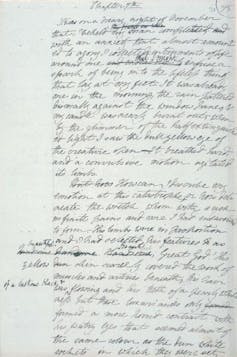
A manuscript page from Frankenstein by Mary Shelley. Wikimedia Commons
Knowledge, Shelley argued, should always be pursued in tranquillity; creation should always be the intellectual fruit of a “peaceful mind”.
The words that Frankenstein utters can be read, too, as an expression of Shelley’s approach to authorship. Much has been made of her comparative youth when she wrote Frankenstein. The novel was begun when she was 18.
Despite the fact that Matthew Gregory Lewis, known to both Shelleys, published his own Gothic tale – The Monk (1796) – at the age of 21, some ask how such a young woman could have composed Frankenstein, and falsely ascribe authorship to Percy Bysshe Shelley.
Sir Walter Scott, reviewing Frankenstein for Blackwood’s Magazine, was the first to commit this error, commenting that it “is said to be written by Percy Bysshe Shelley, who, if we are rightly informed, is son-in-law to Mr Godwin”.
Shelley’s response to Scott’s review of her novel was swift. Writing to Scott on June 14, 1818, she pointed out his error, noting, “I am anxious to prevent your continuing in the mistake of supposing Mr Shelley guilty of a juvenile attempt of mine.”
Shelley’s response to Scott’s mistake was decisive in her assertion of authorship. Her journal further illustrates the intensive work that she invested in her manuscript.
Percy Bysshe Shelley may have edited her work, but this was the gesture of one who wished to support and encourage another’s authorial career. Frankenstein was the first in a line of seven novels by Shelley that she published across three decades.
It may be the one for which we now celebrate Shelley, but all of her works reveal an assertion of women’s rights to create as authors and artists, associating these rights with a calm pursuit of knowledge. Shelley, author of Frankenstein, cautious supporter of scientific advancement, was much, much more than the sum of the parts of her first monster.
Dorothea MacKellar’s My Country, with its paen to a sunburnt landscape, excoriated Australians for their nostalgic love of English ‘grey-blue’ countryside and English weather. Mark Wassell/flickr, CC BY-NC
A young woman of 23, Dorothea MacKellar (1885-1968), had a poem published in the London Spectator in 1908, titled Core of My Heart. She was the daughter of a wealthy pastoral family, educated privately, a graduate of the University of Sydney. She is said to have written the first draft of the poem in 1905 in response to the breaking of a prolonged drought on the family cattle and tobacco farming property, Torryburn, near Maitland in NSW. The poem was also written in protest against the anti-Australianism of many Australians at that time, excoriating them for their nostalgic love of English “grey-blue” landscapes and English weather.
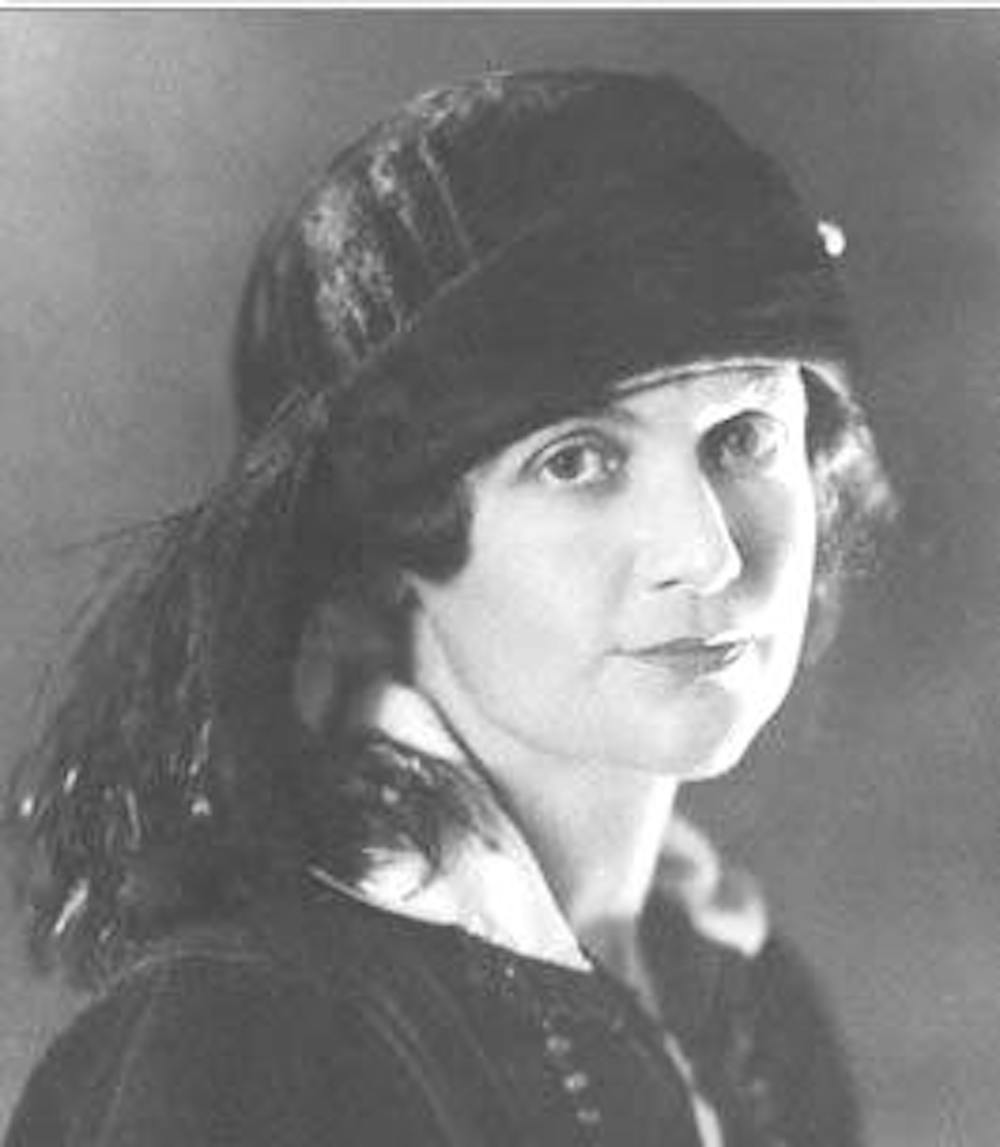
Dorothea Mackellar. Wikimedia commons
Later, she re-titled the poem My Country and its second stanza remains the best known most quoted stanza of poetry in Australia, beginning with that belligerent, youthful and anthemic cry of “I love a sunburnt country”. She declared she could not share a love of “coppice”, “field”, “ordered woods” or “soft dim skies” because “My love is otherwise”.
She was in effect working to create not only pride at being here in such a raw and dramatic and vast place, but to make a new vernacular against the prissiness of English idioms of paradise. She even declared, defiantly, a love for the “stark white ring-barked forest” so common to Australia’s landscapes. We have forgotten how much of a rant this anthemic poem was in its time. It was a poem openly turning truisms on their head, giving a new generation its new native voice.
And of course, the poem exaggerated its argument, and opened itself to ongoing arguments over what it might mean to be in Australia, to be Australian, to find an identity in triumphant harmony with this place.
Kevin Gilbert (1933-1993), born on the banks of the Lachlan (Kalara) River at Condobolin, the youngest of eight children, found himself on the receiving end of, as he put it, “White Australia’s apartheid system”. In hospitals, Kevin Gilbert and his people were confined to verandahs and given blankets with “Abo” stamped on them. In his New True Anthem, he found his own moment of protest in the undiminished arguments over nationalism:
Despite what Dorothea has said
about the sun scorched land
you’ve never really loved her
nor sought to make her grand
you pollute all the rivers
and litter every road
Your barbaric graffiti
cut scars where tall trees grow
the beaches and the mountains
are covered with your shame
injustice rules supremely
despite your claims to fame
the mud polluted rivers
are fenced off from the gaze
of travellers and the thirsty
for foreign hooves to graze
a tyranny now rules your soul
to your own image blind
a callousness and uncouth ways
now hallmarks of your kind
Australia oh Australia
you could stand proud and free
we weep in bitter anguish
at your hate and tyranny
the scarred black bodies writhing
humanity locked in chains
land theft and racial murder …
It’s not so much MacKellar he had in his sights, for she was a fellow poet of protest, and a fellow poet in love with the land, but it was the profiteers, the racist systems, polluters and exploiters of every kind he wanted to expose. How that word “grand” has been mis-used and degraded, how far we are from being “proud and free”. No punches are pulled in this anti-anthem, and all the necessary questions are asked. Kevin Gilbert’s poem participates in the tradition of the corrective poem of insult, adopting the anthem as an anti-starting point.
Anti-anthems
Alec Hope (1907-2000) similarly used the moment of Australia’s commitment of troops to the Second World War to write his famous poem, Australia, allowing himself to speak over the top of Dorothea MacKellar to paint Australia as “drab green and desolate grey”.
Her rivers of water drown among inland sands,
The river of her immense stupidity
Floods her monotonous tribes from Cairns to Perth.
In them at last the ultimate men arrive
Whose boast is not: ‘we live’ but ‘we survive’.
A type who will inhabit the dying earth.
And her five cities like five teeming sores,
Each drains her: a vast parasite robber-state
Where second-hand Europeans pullulate
Timidly on the edge of alien shores.
There is nothing in Australia to celebrate and very little to admire in European modernism. Our only hope (Hope?), he ends gloomily, from a place we might call “love-hate”, is to remember that from such deserts as we have in abundance, prophets do come.
And now, the new voices of new poets come to this troubled tradition and make a claim to a voice, a language, an imagery that might wake us up to who we are and where we might be going. Omar Musa, raised as a Muslim, whose heritage is Irish-Malaysian, inspired by his poet father and the example of Muhammed Ali, is more famous as a novelist, a rapper, a slam performer and a You Tube sensation than as a poet to be read in a slim volume of verse.
His new book, Millefiori, is a solid and powerful and sometimes heartfelt incursion into poetry publishing, a book quickly read, but one that needs to be lived with and read over a number of times if the inner voice is to come through and the imagery work on its reader.
The longest poem in the book is Ranthem, an anti-anthemic poem in the tradition of Dorothea MacKellar’s and Alec Hope’s outspoken, youthful defiance and Kevin Gilbert’s hard won anger:
The people tell me love it or leave it. Fuck that.
How about love-hate it and stay? I’ll carry the flame.
They try to disqualify everything that I say
Cos I’m a big brown brother with an Arabic name.
They call me ungrateful and unpatriotic.
Sheeeeit! That attitude is straight idiotic.
If loving your country means wanting change for the better
That means criticizing the ugly
Side of society ASAP.
We need this kind of poetry to be published, to be happening, to be out there provoking us and projecting images of ourselves that might push us, in Musa’s phrases, to be “nuanced, shift the lens, be brave and consider again”. There might be more accomplished poets, more worthy commentators, but it’s clear that this one’s got a voice that says a lot of what needs to be said just now, and we’re interested.
Musa comes to his poems as both himself and, like Hope and MacKellar and Gilbert, as a voice made by a generation:
But do I have the right to commentate at all?
A middle-class Aussie man, that’s a lot of gall.
Cos this isn’t about me, so maybe adding my voice
Is just making the debate more cloudy …
but part of me feels it’s way worse if I don’t say shit.
You can’t help but admire the ways he catches phrases and phrasing, but you listen too to what he’s saying, hearing the reframing of the whole country going on inside those Ranthems.


 The author is a published poet.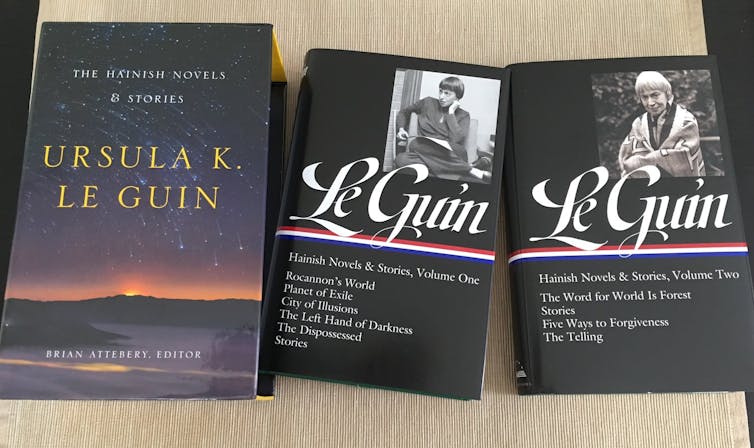
 Ursula K Le Guin has taught us a different way of reading, a different way of thinking. If you haven’t read Le Guin yet, may I suggest a short story that encapsulates a lot of her political and social concerns, the masterful (if rather disturbing)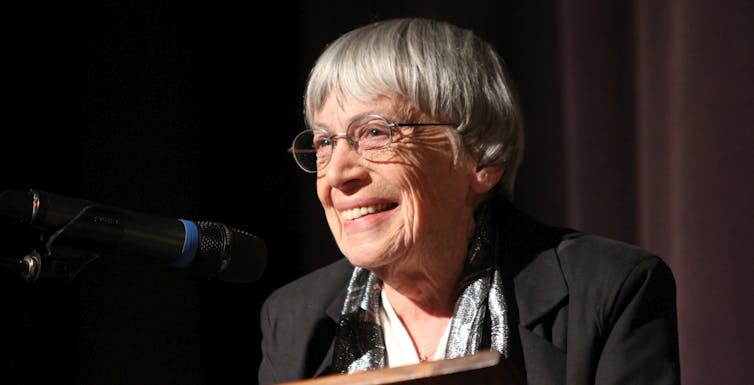
 The world has lost a great and influential writer and humanist. When I heard the news of her death I was heartbroken.
 But by reading between the lines, one may discern clues to the regime’s internal concerns, along with the messages it is most eager to convey to its captive domestic audience.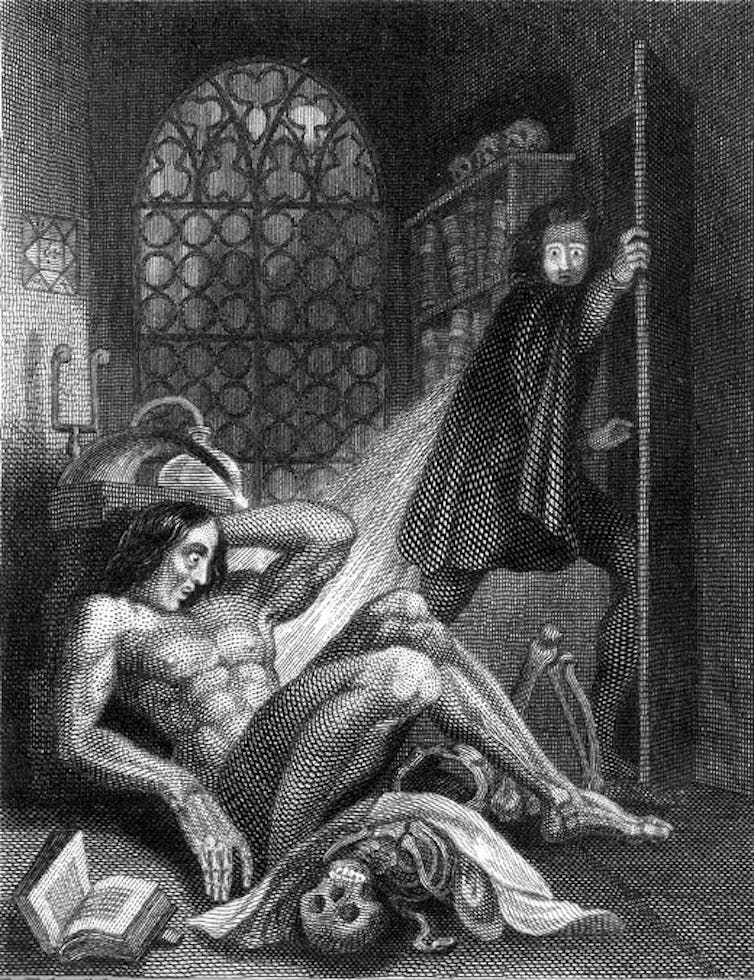
 It may be the one for which we now celebrate Shelley, but all of her works reveal an assertion of women’s rights to create as authors and artists, associating these rights with a calm pursuit of knowledge. Shelley, author of Frankenstein, cautious supporter of scientific advancement, was much, much more than the sum of the parts of her first monster.

 You can’t help but admire the ways he catches phrases and phrasing, but you listen too to what he’s saying, hearing the reframing of the whole country going on inside those Ranthems.
 At the BookShelf


You must be logged in to post a comment.