Unknown's avatar

How fairy tales have stood the test of time


File 20180606 137291 gkez6w.jpg?ixlib=rb 1.1
An illustration of the Brothers Grimm fairy tale “The Brave Little Tailor.
shutterstock

Adam Ganz, Royal Holloway

The Brothers Grimm have been dead more than 150 years, but they recently released a new story with a little help from artificial intelligence.

The Princess and the Fox was created after a group of writers, artists and developers used a program inspired by predictive text on phones to scan the collected stories of the Brothers Grimm to suggest words and similar phrases. Human writers then took over, to help shape the AI’s algorithmic suggestions into the latest Grimm fairy tale.

The new tale tells the story of a talking fox who helps a lowly miller’s son rescue a beautiful princess from the fate of having to marry a horrible prince she does not love.

But here’s the thing, the Brothers Grimm didn’t actually write their fairy tales in the first place. They collected them – from friends, servants, workers and family members. Fairy tales, of course, have always been retold. They come alive in the telling – whether that’s a child listening to an audio book in the car, watching Snow White and the Huntsman on DVD or singing along to Shrek The Musical in the theatre.

The Grimms’ fairy stories were first published in 1812 and have never gone out of print. The Grimm Brothers were involved in the struggle for German independence. As part of the case for nationhood, they wanted to prove that Germans, as a distinct people, had their own folklore. They were political campaigners too, and among the Göttingen Seven who refused to take an oath of loyalty to the new King of Hanover when he rejected a more liberal constitution. They lost their jobs as a result and Jakob Grimm – like many characters in the fairy tales – had to go into exile.

Since then Grimms’ Fairy Tales have been translated into a hundred languages and retold again and again. They have inspired thousands of other works, from Angela Carter’s The Bloody Chamber to The Simpsons’ Treehouse of Horror.
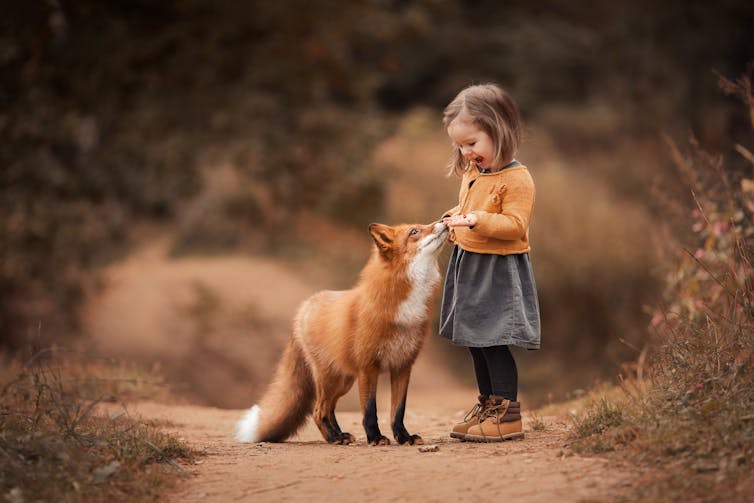
The princess and the Fox was written in part by AI.
Shutterstock

Jakob Grimm wasn’t just a collector of folk tales either. He was also a philologist (someone who studies language) and lexicographer whose work is still influential today. As well as being a master storyteller, the ideas he developed are still being researched in universities.
Grimm’s Law, named after Jakob Grimm, looks at how sounds change as they pass from one language to another – “P” tends to become “F”, while “G” becomes “W” and so on.

Happily ever after

The Grimms’ fairy stories are still passed down through generations. And even though the cast of princesses and swineherds seem a very long way away from the world most of us inhabit, the stories are still a crucial part of our cultural heritage. The stories the brothers found in Northern Germany at the beginning of the 19th-century now belong to everyone.

As a child growing up in Oxford my father – a refugee from Germany and, like Jakob, a philologist – used to tell me the Grimm’s story of The Frog Prince on our Sunday walks in the grounds of Blenheim Palace.

Blenheim Palace Gateway.
CC BY

In my father’s version of the tale, the princess first met the frog by the lake – in reality built by Capability Brown for the first Duke of Marlborough – when she dropped her favourite plaything, a golden ball, into the water. When they lived happily ever after, the couple commemorated their meeting by putting golden balls on the top of Blenheim Palace. Now when I think of the story I think of Blenheim Palace, and I hear the splash of the frog in the lake, just as I thought I heard it long ago as a child.

The ConversationThis is exactly what stories can do, they fold all of their tellers and places together – and therein lies their mystery and their magic – once a story exists, it changes how we experience the world. And that will be the only test of “the new Grimm’s tale”, The Princess and the Fox – whether it will be retold and come to life in the telling.

Adam Ganz, Reader Department of Media Arts, Royal Holloway

This article was originally published on The Conversation. Read the original article.
Unknown's avatar

Haitch or aitch? How a humble letter was held hostage by historical haughtiness


File 20180601 88504 r1kay1.png?ixlib=rb 1.1
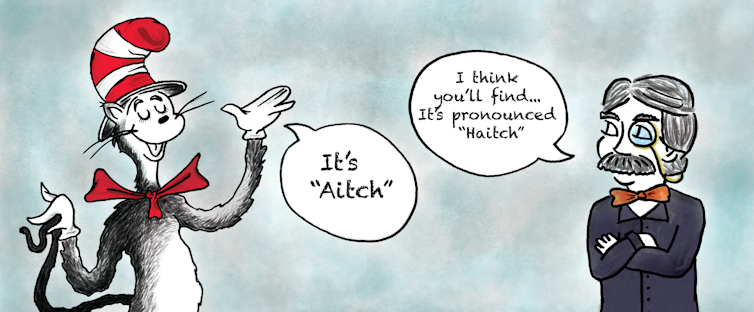
“Aitch” or “Haitch”? It’s long been a point of contestation among English speakers.
Felicity Burke/The Conversastion with apologies to Dr. Suess

Kate Burridge, Monash University and Catherine McBride, Chinese University of Hong Kong

Like Dr. Seuss’ Star-Belly Sneetches and Plain-Belly Sneetches, there are two types of creatures — haitchers with H on their 8th letter name and aitchers with “none upon thars”.

That H isn’t so big. It’s really so small
You might think such a thing wouldn’t matter at all.

But it does — the tiny H on “(h)aitch” divides the nation. The pronunciation has become something of a social password, a spoken shibboleth distinguishing in-groupers from out-groupers. Those with social clout set the standards for what’s “in” and what’s “out” — no H has the stamp of approval.

The best kind of people are people without!

Shibboleths die hard — the opprobrium attached to haitch probably derives from its long association with Irish Catholic Education. There’s no real evidence for this, mind, as Sue Butler points out, but never let facts get in the way of a good shibboleth.


Read more:
War of words: why journalists need to understand grammar to write accurately about violence


Aitchers’ reactions are often visceral. Someone once reported to us an encounter with haitch is like an encounter with fire ants. We’ve no doubt that psycho-physiological testing would show that haitch can raise goosebumps. Linguistic pinpricks are established early on in the acquisition process (“Don’t say ‘haitch’”!) and they arouse emotions like other childhood reprimands (including swearwords).

The ins and outs of H

The story of the weakly articulated H is murkily entwined with the story of its name. Long gone from Old English words like hring “ring”, hnecca “neck” and hlūd “loud”, it would have disappeared entirely if writing hadn’t thrown out a lifejacket.

It was once usual for speakers to drop aspirates at the beginning of words — in fact up until the 1700s, it was fashionable to do so. But a spelling-obsessed 18th century stigmatised the loss of many consonants, including H.

R-less pronunciations of arm and car might have snuck under the radar, but H-dropping fell well and truly from grace.

In 1873, Thomas Laurence Kington-Oliphant wrote about this “revolting habit” in his chapter “Good and Bad English”, advising:

Few things will the English youth find in after-life more pro-fitable than the right use of the aforesaid letter.

And so, the English youth restored H to words like hat, and even at the start of many French words like humble, which had entered English H-less (the Romans pronounced their Hs, but the French dropped theirs). Spellers who weren’t quite sure whether or not to include H added a few extras along the way — umble pie (“offal pie”) turned into humble pie.

Haitch has the pedigree

There’s an ironic wrinkle to this story. The name aitch might be a sign of high education in some circles, but is itself an example of H-dropping. Deriving from medieval French hache or “axe” (hatchet and hashtag are relatives), it also arrived in English H-less (like humble and herb).

It’s a curious letter name being, as the Oxford English Dictionary describes, “so remote from any connection with the sound”. In fact there’s solid evidence supporting haitch as the better option. To understand why, we need to appreciate the primacy of initial letter sounds in words.

Learning and alliteration

English speakers find it easiest to attend to and manipulate the beginning sounds of words. For example, it’s easier for us (orally, that is – by sound, not spelling) to take away the “b” sound in beat (to make it eat) or to replace the “b” with a “p” to make it Pete than it is to take away the “t” sound in beat (to make it be) or to replace it with a “k” to make it beak.

It’s more natural for us to focus on initial sounds, especially for children.

We often make use of alliteration in names and tongue twisters. Dr. Seuss (think Aunt Annie’s Alligator or The Butter Battle Book), Walt Disney (such as Donald Duck; Mickey Mouse), and J.K. Rowling (Godric Gryffindor; Helga Hufflepuff; Rowena Ravenclaw; Salazar Slytherin) all capitalised on this phenomenon.

Tongue twisters highlight the special quality of alliteration for learning as well; who can forget Peter Piper and his pickled peppers, Silly Sally and her sheep, or Betty Botter and her butter?

The ABCs of the ABC

Many letters of the alphabet are phonetically iconic; their names represent the sound they make. In places where letter names are learned before letter sounds, such as Australia and the US, these letter names can facilitate children in learning letter sounds and, ultimately, word reading. The letter sounds that are easiest to remember are those that begin with their corresponding letter, such as B, D, J, K, P, or T.


Read more:
Get yer hand off it, mate, Australian slang is not dying


Research shows it’s more difficult to learn sounds made by letters that end with their letter sound, such as F, L, and M. Those that have no correspondences to the letter sound are the most difficult. Logically, W should make the “d” sound (or change its name to wubble-u).

Haitch vs. aitch, round 2

Whatever your visceral reaction to pronouncing H one way or the other, haitch has definite benefits for letter sound learning.

So it’s not surprising it’s taking off in some parts of the English-speaking world. When the letter H is pronounced beginning with the letter sound it makes, children have an easier time learning its correspondence as they learn to read.

The ConversationDr. Seuss implicitly understood this. We suggest that a follow-up primer for young readers will one day include Horton hearing a Haitch.

Kate Burridge, Senior Fellow at the Freiburg Institute for Advanced Studies and Professor of Linguistics, Monash University and Catherine McBride, Marie Curie Fellow of the European Union Freiburg Institute for Advanced Studies, University of Freiburg, and Professor of Psychology, Chinese University of Hong Kong

This article was originally published on The Conversation. Read the original article.

Unknown's avatar

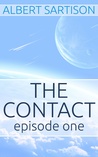
Finished Reading: The Contact – Episode 1 by Albert Sartison


The Contact Episode OneThe Contact Episode One by Albert Sartison
My rating: 3 of 5 stars

View all my reviews

Unknown's avatar

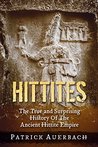
Finished Reading: Hittites – The True and Surprising History of the Ancient Hittite Empire by Patrick Auerbach


Hittites: The True and Surprising History Of The Ancient Hittite EmpireHittites: The True and Surprising History Of The Ancient Hittite Empire by Patrick Auerbach
My rating: 2 of 5 stars

This book serves as a reasonable introduction to the Hittites but is let down by its poorly edited and written content.

View all my reviews

Unknown's avatar

Not My Review: Elmet by Fiona Mozley


Unknown's avatar

2018 Man Booker International Prize Winner


Unknown's avatar

iBooks is Now Apple Books


The links below are to articles reporting on the renaming of iBooks to Apple Books. The site is also getting a reboot with iOS 12.

For more visit:
https://the-digital-reader.com/2018/06/04/ibooks-renamed-to-apple-books-gains-reading-now-tab-bookstore-audiobook-section/
https://goodereader.com/blog/e-book-news/ibooks-has-been-rebranded-as-apple-books

Unknown's avatar

Fire and Fury Sequel


The link below is to an article reporting on Michael Wolff writing a sequel to ‘Fire and Fury.’

For more visit:
https://www.theguardian.com/books/2018/jun/08/michael-wolff-fire-and-fury-book

Unknown's avatar

5 Latino authors you should be reading now


File 20180504 166900 1adqmcy.jpg?ixlib=rb 1.1
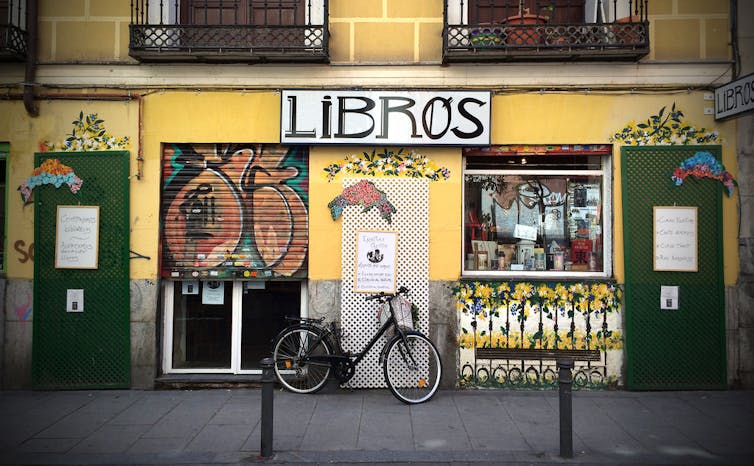
Many authors born in Latin America have produced some of their finest work while living in the United States.
Alvy Libros/flickr, CC BY-SA

Laura Lomas, Rutgers University Newark

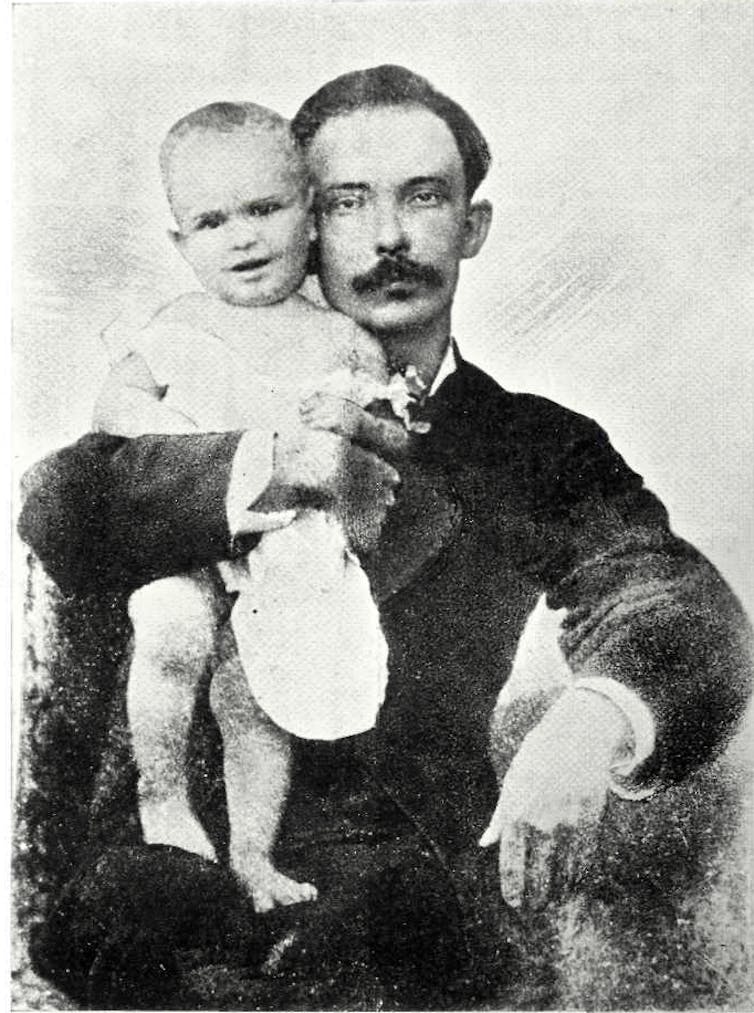
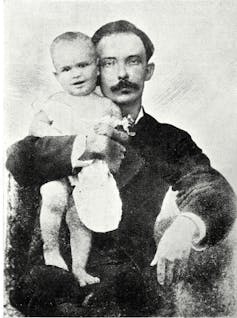
José Martí and his son in New York in 1880.
Wikipedia

You likely recognize that the depiction of Latin American immigrants in politics today – as a menacing mass of recalcitrant Spanish-speaking invaders – is overwhelmingly negative.

What you may not know is that stereotypes suggesting that Latin Americans represent a threat to United States culture are not just morally repugnant – they’re also historically inaccurate. Spanish-language literature actually predates the Puritans’ writing in English by nearly a century.

As my research reveals, many renowned Latin American writers actually produced some of their finest work while living in the United States. Latina and Latino writers have made exceptional contributions to American literary history.

For a fresh take on what it means to be a Latina or Latino in the U.S. today, check out these five literary luminaries.

1. José Martí (Cuba, 1853-1895)

For Cubans, José Martí is the equivalent of George Washington, Ralph Waldo Emerson and Walt Whitman combined. Born in 1853 in Havana, Cuba, Martí wrote the bulk of his 28 volumes of prose, poetry and speeches in late 19th-century New York.

Working as a diplomat, translator, Spanish teacher and journalist, Martí interpreted current events and cultural questions from his office on Front Street, in lower Manhattan’s South Street Seaport.

José Martí and his son in New York in 1880.
Wikipedia

He witnessed immigrants arriving by the boatload to New York – except the Chinese, who were banned in 1882. He knew about the lynching of black Americans and of atrocities against Native Americans. These stories found their way into Martí’s thinking about Latin America and its diaspora in the United States.

Martí also wrote dazzling accounts of New York, his adopted hometown, likening the cables of the brand-new Brooklyn Bridge to sated “colossal boa constrictors” resting atop towers.

Upon the unveiling of the Statue of Liberty in 1886, Martí alluded to the fact that his distant island home, Cuba, remained a Spanish colony: “Those who have you, O Liberty, do not know you. Those deprived of you must not merely talk about, they must win you.”

Martí died in 1895, fighting for Cuba’s independence. In 2018, he was inducted into the New York State Writers Hall of Fame, alongside local luminaries Colson Whitehead and Alexander Hamilton.

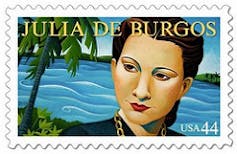
2. Julia de Burgos (Puerto Rico, 1914-1953)

Puerto Rico’s greatest poet also migrated from her Caribbean home island, where she was a teacher, to the isle of Manhattan. Julia de Burgos recounts this literary journey in one of her most famous poems, “Yo misma fui mi ruta” – “I was my own route.”

De Burgos’ inventive, daring poetry did indeed forge a new path for feminists, Latina and otherwise, in the early 20th century.

Against pressure to identify as white, the mixed-race de Burgos proclaimed her African heritage, calling herself “Black, of pure tint.”

A postage stamp honoring de Burgos.
William Arthur Fine Stationery/flickr, CC BY-ND

In one experimental 1938 poem, de Burgos addresses the distance between her liberated identity as a writer and her constricted role as a woman.

“You in yourself have no say; everyone governs you; your husband, your family,” she writes in “To Julia de Burgos.” “In me only my heart governs, only my thought; who governs in me is me.”

In 1953, de Burgos was found dead, without identification, in uptown Manhattan and buried anonymously in a potter’s field on Manhattan’s Hart Island. A month later, her compatriots retrieved her remains and reburied her in Puerto Rico.

The New York Times featured de Burgos – a “poet who helped shape Puerto Rico’s identity” – in its overlooked women’s obituary series in May.

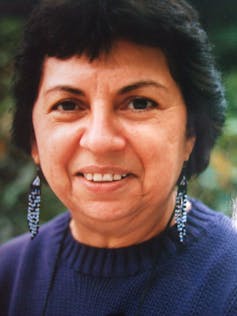
3. Gloria Anzaldúa (Texas, 1942-2004)

The poet and essayist Gloria Anzaldúa came from a family of Mexican-American farm laborers.

Anzaldúa’s work celebrated bilingualism.
Sandstein/flickr, CC BY

Her ancestors had for generations lived in Texas’ Rio Grande Valley, near the border that Anzaldúa memorably defined as “an open wound where the Third World grates against the first and bleeds.”

Anzaldúa’s work often celebrates her community’s bilingualism. She portrays it as an act of survival against the “linguistic terrorism” of the U.S. public school system, which required English-only teaching and offered “accent elimination” classes in a part of the U.S. that used to be Mexico.

Anzaldúa found such insults to her nonstandard way of speaking excruciating. “Until I can take pride in my language,” she once wrote, “I cannot take pride in myself.”

Anzaldúa is increasingly recognized as one of the 20th century’s most influential feminist and anti-racist essayists.

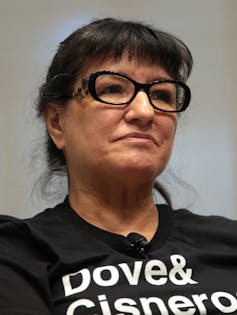
4. Sandra Cisneros (Chicago, 1954-present)

No list of Latino authors is complete without Sandra Cisneros, author of the beloved “The House on Mango Street,” which has sold nearly 6 million copies and has been translated into over 20 languages.

Why Cisneros has not received the same acclaim as Junot Díaz – a childhood sexual assault survivor who was recently accused of his own sexual impropriety – is perplexing.

Sandra Cisneros.
Gage Skidmore, CC BY-SA

My favorite of her novels is “Caramelo.” In this transnational coming-of-age story, a Mexican-American woman digs into her family history.

Learning from her abuela, Soledad, she discovers hidden truths about family tensions, border crossings and why her doting migrant papá, Inocencio, is not so innocent after all.

5. Cristina Henríquez (Delaware, 1971-present)

Cristina Henríquez, who was born in the U.S. after her Panamanian father went there to pursue graduate studies, is the best novelist you’ve never heard of.

Featuring first-person perspectives of Central and South Americans and Caribbean migrants, her books dramatically expand the popular conception of the U.S. Latino, long centered on Mexican-Americans and Puerto Ricans.

The best book you haven’t read.

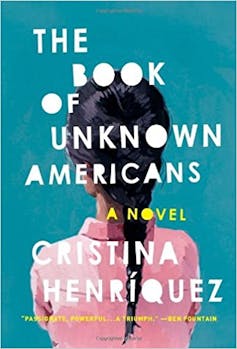
The Book of Unknown Americans” tells the story of recent arrivals from Paraguay, Nicaragua, Guatemala, Panama, Puerto Rico and Mexico who live in a dingy apartment complex, enduring the back-breaking labor of harvesting mushrooms. Sometimes, after a 12-hour shift in the dark, they eat only oatmeal for dinner.

The teenage love story between the characters Maribel and Mayor – written in prose that The Washington Post says rises “to the level of poetry” – may help American readers appreciate the myriad reasons why Latin Americans migrate north, including dictatorships, a lack of specialized health care and violence.

That is, I think, Henríquez’s hope. As one Mexican character angrily states, in the U.S. he feels both invisible and vilified.

The Conversation“I want them to see a guy who works hard, or a guy who loves his family,” he says. “I wish just one of those people, just one, would actually talk to me. … But none of them even want to try. We’re the unknown Americans.”

Laura Lomas, Associate Professor of English, Rutgers University Newark

This article was originally published on The Conversation. Read the original article.

Unknown's avatar

Children’s books can do more to inspire the new generation of Earth warriors


File 20180601 142066 1aneosc.jpg?ixlib=rb 1.1
shutterstock.

Gary Haq, University of York

A changing climate means the frequency of extreme weather events such as heat waves, flooding, hurricanes and wildfires has become a common occurrence. Temperatures are increasing on the land and in the ocean, the sea level is rising and amounts of snow and ice are diminishing, as greenhouse gas emissions and concentrations have increased. Unfortunately, children and young people are taking the brunt of climate change and this will continue into the future.

Doctors are seeing the serious effects of global warming on children’s health and are concerned that it could reverse the progress made over the past 25 years in reducing global child deaths. Not only that, children are at risk of mental health issues such as depression and anxiety due to natural disasters caused by climate change.

A UNICEF survey of children aged nine to 18 in 14 countries showed that children are deeply concerned about global issues affecting their peers and them personally, including climate change. Children across all countries feel marginalised because their voices are not being heard nor that their opinions considered.

Environmental diversity

Given the enormity of the climate challenge, it is surprising how limited coverage of our changing climate receives in current children’s fiction. The children’s publishing sector is booming. UK sales of children’s books rose by 16% in 2016 with sales totalling £365m. Globally, children’s book sales have risen steadily across all age categories.

Some picture books do explain climate change (such as The Magic School Bus and Climate Change by Joanne Cole and Bruce Degen). And there are plenty of young adult novels that feature dystopian climate futures (such as Carbon Diaries by Saci Lloyd). But few fiction books for eight to 11-year-olds discuss the issue.

In my view, the lack of “environmental diversity” in children’s literature is just as important as the debate about the lack of cultural and social diversity. After all, children will be responsible for the future protection of our fragile planet, and so their knowledge and engagement are critical.

Connecting with nature.
Angelo lano/Shutterstock.com

Stories not only develop children’s literacy but convey beliefs, attitudes and social norms which, in turn, shape children’s perceptions of reality. They allow children to move from a position of powerlessness to a position of possibility. Through fiction, children are able to explore different perspectives and actions beyond what they know by living in the story world of characters for whom they care.

Through literature, children can develop a better understanding of global issues and engage in critical inquiry about themselves in the world. And so combining narrative structure with factual information has the power to take children beyond what is on the page. This could allow them to expand their understanding of difficult scientific concepts such as climate change.

Earth warriors

As children engage in the printed word, they can be inspired to make a difference in the real world. This is what a group of Portuguese children is doing after watching their district burn because of the worst forest fires in their country’s history. The fires that occurred in June 2017 have been linked to climate change, and killed over 60 people. The children are now seeking crowdfunding to take a major climate change case to the European Court of Human Rights alleging that the states’ failure to tackle climate change threatens their right to life.

When I decided to write my first children’s novel, I never intended it to be an eco-themed book. But given that I am an environmental researcher, it seemed the most natural thing to do. The result is My Dad, the Earth Warrior, a funny story about the relationship between a boy called Hero and his dad who have grown apart since the death of his mother. Then one day dad has a freak accident and wakes up claiming to be an Earth warrior sent to protect Mother Earth. This plunges Hero into an increasingly bizarre and dangerous world.

Climate change can be a dark, apocalyptic issue to discuss in a story to overcome this, I did not make it a central topic but used the changing weather as an underlying theme throughout this book. The persona of the Earth warrior provides an alternative perspective on our relationship with the natural world. At the end of the book, I encourage readers to join the tribe and become Earth warriors. I hope by taking a humorous approach to a serious topic, I can not only engage and entertain children but also inspire them to think beyond the book. This is something that writer and illustrator Megan Herbert has done by teaming up with climatologist, Michael Mann, for their crowdfunded picture book The Tantrum that Saved the World.

The ConversationWe need children to care about the planet if they are to the tackle climate challenge that lies ahead. Storytelling can play a part in raising awareness and inspiring children and young adults to take action and become the next generation of Earth warriors.

Gary Haq, SEI Associate, Stockholm Environment Institute, University of York

This article was originally published on The Conversation. Read the original article.