
The link below is to an article in which the writer states ‘I Have Forgotten How to Read.’
For more visit:
https://www.theglobeandmail.com/opinion/i-have-forgotten-how-toread/article37921379/

The link below is to an article in which the writer states ‘I Have Forgotten How to Read.’
For more visit:
https://www.theglobeandmail.com/opinion/i-have-forgotten-how-toread/article37921379/
Laura Scholes, Queensland University of Technology
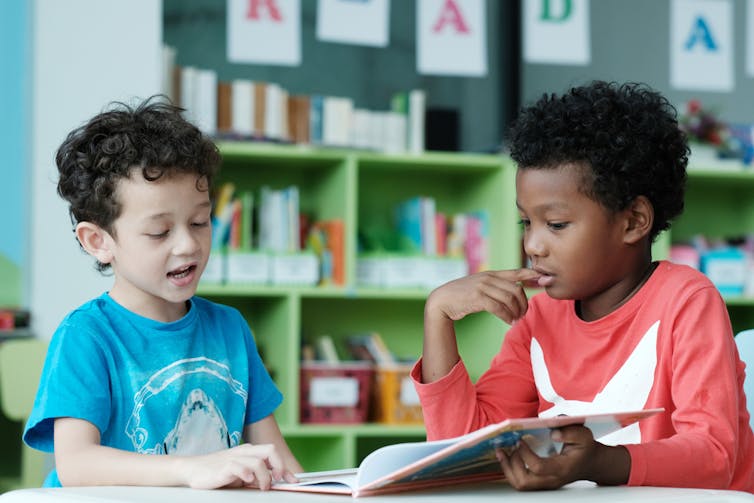
Year 3 reading outcomes of 2017 NAPLAN testing once again demonstrate a gender gap, with boys underachieving compared to girls. A focus on teaching for the test has not closed the gender gap and only reduced student motivation and well-being.
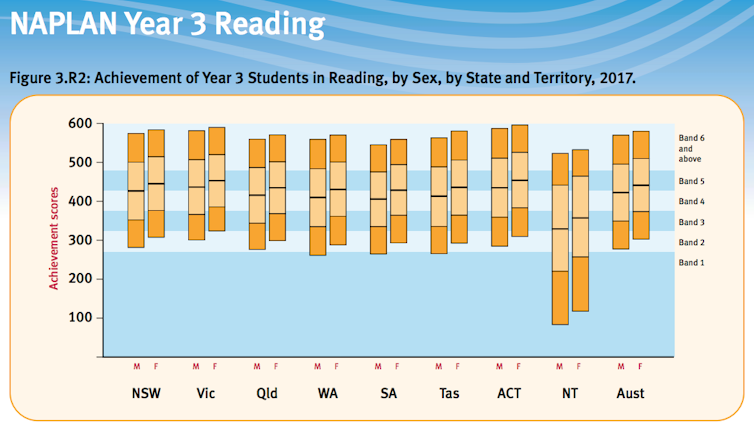
Calls for a review of NAPLAN ten years on are timely. But as well as looking at how high-stakes testing is narrowing the curriculum and causing student stress, we need to consider the testing regime’s influence on boys’ attitudes towards reading.
Read more:
NAPLAN 2017: results have largely flat-lined, and patterns of inequality continue
Reports increasingly highlight how negative attitudes towards reading constrain experiences for some boys. In the United Kingdom, a National Literacy Trust survey of 21,000 children aged eight to 16 found boys were more likely than girls to believe someone who reads is boring and a geek.
This attitude is believed to be related to deep-seated cultural issues that lead many boys to believe reading is feminine and “uncool”. Reluctance to read then translates into less time reading and lower achievement.
There is now a call in the UK for schools to have a policy of promoting enjoyment of reading rather than just a focus on effective teaching of phonics skills.
We have known for a long time that positive attitudes towards reading influence boys’ engagement with reading. Engagement influences practice, resulting in the Matthew Effect as cumulative exposure to print accelerates development of reading processes and knowledge.
Attitudes towards reading are not innate; they are learned predispositions in response to favourable or unfavourable experiences. In this way, a boys’ attitude towards reading develops over time as the result of beliefs about reading and, importantly, specific reading experiences.
In Australia, the focus on NAPLAN has changed the landscape of teaching and literacy experiences for students.
As part of this change, didactic teaching of reading for NAPLAN can compound negative attitudes about the nature of reading at school. Reading is seen as a passive (feminine) endeavour associated with boring schoolwork (preparing for the test).
While teaching phonics is already embedded in good teaching practice, the introduction of the Year 1 phonics check will potentially further narrow the curriculum as teachers are pressured to teach for yet another test. This initiative could also impact on teaching practices for reading in the early years.
Read more:
Explainer: what is phonics and why is it important?
If we are interested in enhancing reading outcomes for underachieving boys, we need to foster positive attitudes towards reading that translate into practice. The change needs to be from a focus on teaching reading to helping boys become successful and satisfied readers.
My recent survey of 320 Year 3 children from 14 schools in Queensland identified their self-reported enjoyment of story books, non-fiction books, magazines and comics, and self-reported reading frequency.
Students coloured in a box to reflect an emotive face on a Likert scale to indicate their level of enjoyment and their frequency of reading. Students’ Year 3 NAPLAN reading outcomes were also collected.
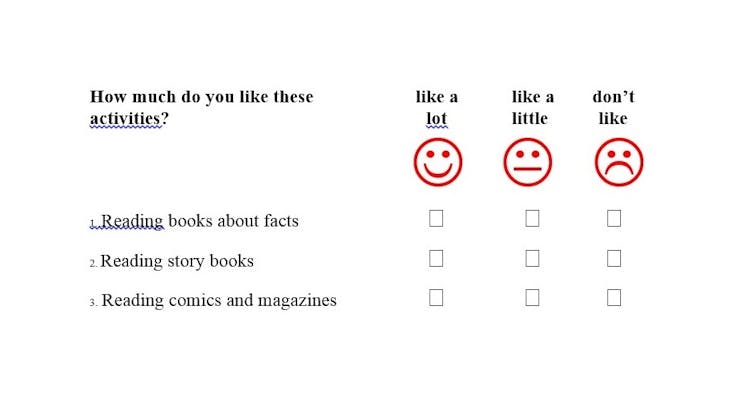
Findings from the Pearson test of correlation between survey variables indicated correlation between higher student NAPLAN reading scores and higher levels of enjoyment for reading story books/non-fiction books and higher reading frequency. There was a statistically significant positive correlation between reading scores and reading frequency, and reading scores and reading enjoyment.
Even when teachers are supporting specific learning difficulties (such as dyslexia), it’s important to expand boys’ repertoire of positive reading experiences. This requires a shift from the exclusive teaching of the mechanics of reading to teaching practices that contextualise experiences and encourage enjoyment of reading.

Expand school reading cultures. Directly challenge beliefs about reading being a feminine pursuit. Teachers can select and use texts that challenge what it means to be male and the power structures that exist in school and society.
Focus on the arts. Include artists-in-residence schemes, poetry weeks, dance sessions run by professional dancers, and drama productions that allocate lead roles to disengaged boys. Boys often enjoy working with “readers’ theatre” scripts, which allow them to feel like active participants in a story.
Leave reading choices up to students 50% of the time. Provide a wide range of texts to stimulate interest and build confidence through paired reading schemes and teacher decisions to give students space to talk about and reflect on what was enjoyable.
Promote male mentoring. Include parent-mentors and vertical mentoring with older boys mentoring younger boys in the school.
Let them talk! Boys who are reluctant readers need to have successful reading experiences. Use literature circles with mixed-ability grouping, providing boys with the support they need to focus on the “big ideas” in the story, as well as on the words and structure of the texts.
Include variety. Use interactive classroom activities fit for purpose so that both short, specific focused activities and more sustained, ongoing activities are used, as and when appropriate.
Risk-taking in teacher practice. Bring more creativity and variety. Expose students to new and novel reading experiences.
Implement teaching practices that encourage discussion. Based on Philosophy for Children, enhance reading comprehension as students explore different answers, examine the strengths and weaknesses for each, and critically reflect on assumptions along the way.
Read more:
Research shows the importance of parents reading with children – even after children can read
 When the focus is on teaching for the test, direct instruction and an exclusive focus on phonics, there is a narrowing of curriculum and teaching practice. Strategies can be easily implemented in the classroom. We need to move from teaching reading for NAPLAN testing, to teaching boys to enjoy reading to ensure their success.
Laura Scholes, Research Fellow, Australian Research Council (DECRA), School of Early Childhood and Inclusive Education, Queensland University of Technology
This article was originally published on The Conversation. Read the original article.

Andrew Elfenbein, University of Minnesota
When I was researching and writing my new book, “The Gist of Reading,” I wanted to explore long-held assumptions about reading and how we process what we read.
Some of these assumptions have changed through time. For example, as novels became popular in the 18th century, many warned that they were dangerous and had the potential to cultivate ignorance and immorality in readers, especially female ones.
Today, many would consider that view antiquated. People probably think that reading a narrative – fiction or otherwise – might be able to influence a reader’s opinions or personal beliefs. But their prior knowledge of real-world facts should be safe.
For example, readers might read a story in which a character mentions in passing that Hillary Clinton, rather than Donald Trump, won the 2016 election. This shouldn’t influence readers’ ability to quickly respond that Trump was the real winner, right?
And yet I came across a substantial amount of psychology work that has demonstrated how reading stories – both nonfiction and fiction – has a powerful ability to distort readers’ prior knowledge.
In psychologist Richard Gerrig’s 1989 study “Suspense in the Absence of Uncertainty,” Gerrig developed short, nonfictional narratives about well-known events, such as the election of George Washington as president of the United States, that he gave to participants.
Some participants read a version of the narrative that foregrounded facts that made it doubtful Washington would become the president; others read a narrative that made his presidency seem likely.
Readers who read the doubtful version took longer to verify that he had indeed become president (or to recognize that a sentence denying that he had become president was not true).
Even though they knew Washington eventually became president, simply reading a very short narrative had enough power to make readers significantly less sure of what they already knew.
While Gerrig’s experiment presented readers with nonfictional stories about real events, another study demonstrated that reading a short fictional story containing falsehoods presented as facts can make readers more likely to treat them as facts, even if readers have previously shown that they know the truth.
In the study, participants took an online survey that quizzed them on their world knowledge – for example, identifying the world’s largest ocean (the Pacific) – and then had them rate how confident they were in their answer.
Two weeks later, the same participants read two fictional stories and were warned that these stories might contain some false information. The stories actually contained inaccurate versions of the very facts that the readers had been tested on two weeks earlier. For example, in one story, a character (incorrectly) mentioned, in passing, that the Indian Ocean was the world’s largest.
After reading the stories, the participants took the same world knowledge test they had taken two weeks earlier. The inaccurate information turned out to have a serious effect: Readers did worse on the world knowledge test after reading the stories than they had done two weeks before. In particular, questions they had gotten right two weeks earlier they now got wrong – even for the questions that they had answered most confidently on the earlier test.
And remember: All of this happened despite the fact that readers had been explicitly told that the stories would contain inaccurate information.
Given our struggle to discern misinformation from fiction, psychologists have been interested in exploring how it to combat it. It seems especially vital to develop strategies that make people smarter about what they are gleaning from what they read, and to encourage ways to become more skeptical.
In a 2016 article,
psychologist David N. Rapp outlines how to defeat, or at least reduce, the misinformation effect.
Rapp describes four key strategies that have proven especially effective.
First, when readers actively tag information as accurate or inaccurate while they read, inaccuracies lose much of their effect. It’s not enough to know that something you read is incorrect: Unless you actively tag it as wrong while reading it, you may suffer the misinformation effect.
Second, the further removed fiction is from everyday reality, the less vulnerable readers are to believe false facts that may be embedded in it. Rapp and his colleagues found that misinformation in fantasy stories had much less effect on readers’ knowledge than misinformation in more realistic stories. Rapp argues that this could mean readers are able to compartmentalize their response to fiction. Fantasy stories like “The Hobbit” probably have less of an ability to alter real-world knowledge than, say, a piece of historical fiction, like Philippa Gregory’s “The Other Boleyn Girl,” which is grounded in historical events but nonetheless riddled with historical inaccuracies.
Third, Rapp found that some inaccuracies are so flagrant that readers do notice them. They may be persuaded that St. Petersburg, rather than Moscow, is the capital of Russia. But it’s much harder to persuade them that Russia’s capital is Brasilia. Brasilia is just too different from anything that readers associate with Russia to make it a convincing capital.
Finally – and perhaps most importantly in today’s climate of “fake news” – readers may be sensitive to the authority of a source. False facts from a generally credible source seem to have more effect than false facts from a disreputable one. The challenge, of course, is that what counts as a credible source to one reader may count as the opposite to another reader.
I find all these psychological experiments telling precisely because they generally avoid having participants read about hot-button issues that may make them feel defensive or partisan.
The traditional suspicion of fiction arose from its ability to excite and engage. Yet the materials in these experiments are comparatively dry – and the fictional information was nonetheless able to cast a spell on the reader.
In other words, even without emotional appeals, by warping the most neutral of facts, readers can easily be persuaded to question or even reverse what they already know.
 Such work underscores more than ever that suspicion of reading is not entirely ungrounded. Today, not only is the internet filled with dubious information but there are also deliberate attempts to spread misinformation via social media channels. In this era of “fake news,” scrutinizing the sources of our knowledge has become more critical than ever.
Andrew Elfenbein, Professor of English, University of Minnesota
This article was originally published on The Conversation. Read the original article.
The link below is to an article that looks at why men should read more fiction.
For more visit:
https://www.artofmanliness.com/2012/04/29/why-men-should-read-more-fiction/
The links below are to two articles on audiobooks that tell the story of two very different experiences with audiobooks.
For more visit:
– http://lithub.com/do-audio-books-count-as-reading/
– https://themillions.com/2014/10/the-curious-kick-of-hearing-an-actor-reading-your-writing.html
The link below is to an article that takes a look at machines that read.
For more visit:
https://www.theverge.com/2018/1/17/16900292/ai-reading-comprehension-machines-humans
The link below is to an article that takes a look at how you can increase the amount of reading you do each year.
For more visit:
https://qz.com/895101/in-the-time-you-spend-on-social-media-each-year-you-could-read-200-books/
The link below is to an article that considers that difficult question, ‘when should I just give up on this terrible book?’
For more visit:
https://bookriot.com/2018/01/05/the-value-of-abandoning-a-book/
The link below is to an article that considers what the future may bring for reading when combined with virtual reality.
For more visit:
https://goodereader.com/blog/e-book-news/will-vr-be-the-future-of-reading

Catherine Wade, Parenting Research Centre
The recently released NAPLAN 2017 results and findings from the latest Progress in International Reading Literacy Study (PIRLS) have got Australia talking again about how our children are faring when it comes to literacy.
Read more: NAPLAN 2017: results have largely flat-lined, and patterns of inequality continue
We know from PIRLS, while most Australian children are meeting international benchmarks for reading at year 4, nearly one in five are not meeting these benchmarks. Australia has one of the largest proportions of students who fall below the “intermediate” benchmark into the “low” or “below low” categories, compared to other English-speaking countries, including the US, Canada, and England.
Despite the range of steps that have been taken to address literacy levels across Australia, a large proportion of children are still not meeting international standards for reading. So what other approaches could we try?
New research from the Parenting Research Centre highlights an area ripe for intervention: better supporting parents in reading to their children.
Our findings from a study of 2,600 parents showed more than half of children under two and nearly half of children aged three to five are not being read to every day.
https://datawrapper.dwcdn.net/ciPKO/1/
We found, while most children were being read to by an adult in the household four to five days a week, a concerning proportion were not being read to at all or very infrequently. Specifically, 13% of 0–2-year-olds and 4% of 3–5-year-olds were not read to at all by an adult at home in the previous week.
Our research also looked at how important parents’ educational values and aspirations for their children were and how they felt about their interactions with their children’s educators. The survey has national relevance, as most of the findings relate to broader parenting issues.
We know from decades of international research that what parents do at home with their children has a profound effect on children’s learning outcomes. Children who experience enriched, cognitively stimulating home environments are at an advantage in the learning process because they have had exposure to many more words.
The evidence in support of providing a language-rich environment to children is vast. Children with language delays at school entry are at greater risk for academic difficulties. With flow-on effects to later academic and socio-emotional challenges, the imperative to tackle language and literacy problems early is paramount.
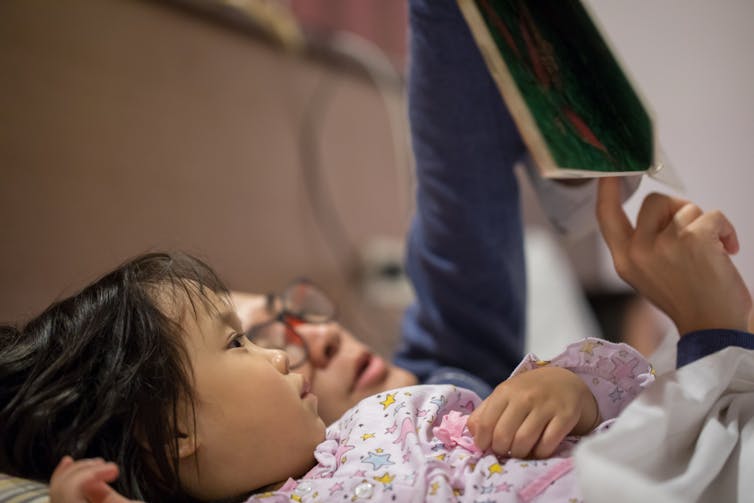
A number of high-quality reviews of the scientific literature show good evidence for the benefits of parental shared reading for children’s literacy.
And while older children typically need less input from parents when it comes to actually looking at words on the page, that doesn’t mean the parents’ role in supporting reading diminishes. Creating a home environment that encourages time and space for books is key.
Read more: Research shows the importance of parents reading with children – even after children can read
The message that simply sitting together, opening a book, and reading and pointing to words can be incredibly helpful in building the foundations of good literacy has certainly cut through with many parents of young children.
But there are many reasons parents don’t read at home. As we know from sectors such as health, simply telling people what needs to be done – such as exercising more – does not take their personal context into consideration. Alone, it’s not enough to motivate people to adopt new patterns of behaviour.
Considering how best to support parents to read more often to their children is an important question and will depend on a thorough understanding of the barriers that are preventing them from doing so. Family and work pressures and parental confidence around reading books are some possible factors that could be further explored as barriers.
Children’s literacy is not the sole responsibility of parents, but it’s clearly an area where parents and schools can work together. This parent-educator partnership featured in our survey, which explored parents’ views about their interactions with kindergarten, child care and school teachers.
https://datawrapper.dwcdn.net/1bDZe/3/
Most parents (92%) felt comfortable communicating with their children’s teachers. Although 21% did not think or were unsure if their child’s teacher understood their child.
https://datawrapper.dwcdn.net/rK1uG/2/
Also, 20% did not agree they were able to participate in decisions that affected their child at kinder or school.
Of note, fathers tended to feel less comfortable talking with their child’s teachers than mothers did.
While 82% of parents felt their opinions were valued in discussions with their child’s educators, 11% had mixed feelings about this and 7% felt their opinions weren’t valued.
https://datawrapper.dwcdn.net/ILYt4/1/
Given what we know from research about the value of parents being connected with their children’s educational settings, it follows that parent-teacher partnerships are important for children’s educational outcomes.
Consequently, it’s important issues like literacy are looked at holistically. Literacy is not just as an education system issue, and not just a parenting issue. It’s a societal issue.
We found the vast majority of parents (93%) see their own contribution to their children’s learning in the early years as important. This supports the view that today’s parents are generally well placed for taking on information about how to improve their children’s literacy and educational outcomes.
It’s encouraging that most children are being read to at home – even if not every day. But in the context of concerns about Australia’s position in international literacy rankings there’s more to be done.
 The message to parents is clearly “read early and read often”. The message for policy makers and professionals is “support parents to better engage with their children’s learning”. This could take many forms and is dependent on context. It could include strategies such as building literacy messages and materials into existing parenting support services and promoting online resources for parents, given our survey found 79% of parents look for answers online about parenting issues.
Catherine Wade, Principal Research Specialist, Parenting Research Centre
This article was originally published on The Conversation. Read the original article.
 At the BookShelf
You must be logged in to post a comment.