Unknown's avatar

First World War poet Wilfred Owen, treated for shell shock, carried readers into the horror of war


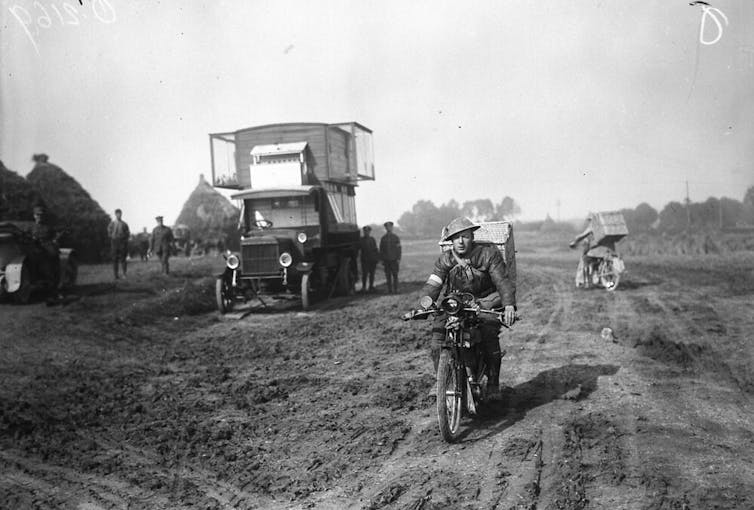
Dispatch rider with pigeons leaving for firing line, His Majesty’s Pigeon Service, November 1917, location unknown.
(William Rider-Rider. Canada. Department of National Defence. Library and Archives Canada, PA-002034), CC BY-SA

Mark Libin, University of Manitoba

Remembrance Day commemorates the end of the First World War on Nov. 11, 1918, and the poppy is the abiding symbol of Remembrance Day in Great Britain and the Commonwealth countries, including Canada.
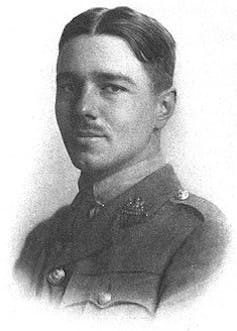
Wilfred Owen
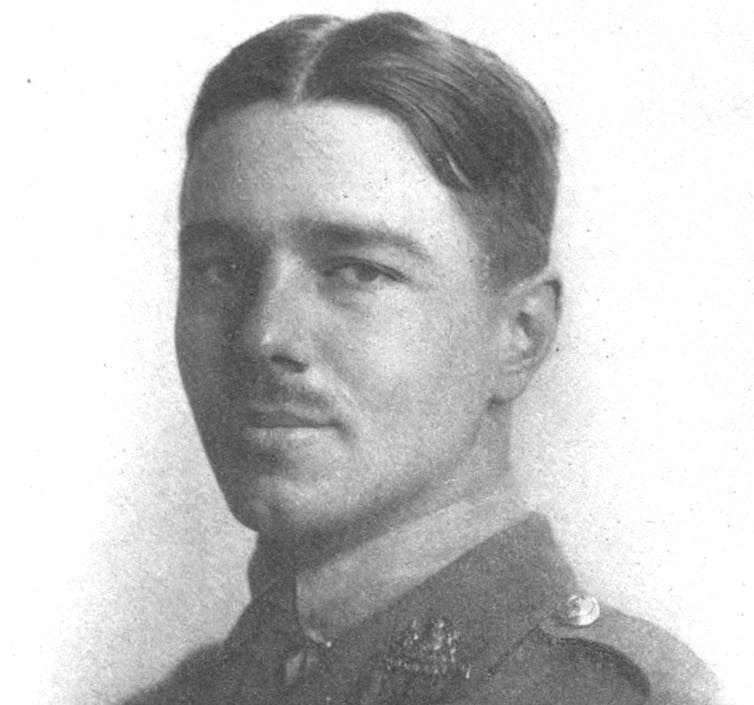
Wilfred Owen, photograph published in a 1920 anthology of his poems.
(Wikimedia Commons), CC BY

The poppy has been associated with war remembrance in a variety of ways. But
as many who attended elementary school in Canada may remember, the poppy’s iconic popularity is often attributed to the poem by Canadian physician and poet, John McCrae, “In Flanders Fields.”

I would like to submit for consideration a different poem as a more suitable and ultimately more resonant poem to guide our reflections this Remembrance Day: Wilfred Owen’s “Dulce et Decorum Est.”

‘In Flanders Fields’

“In Flanders Fields” begins with a haunting evocation of poppies growing between marked graves of the war dead in Belgium, a description delivered by those very dead. In Canada and beyond, the poem has become a mainstream literary representation of all the wars and casualties remembered on Remembrance Day.

I have always found McCrae’s poem unsuitable to commemorate the war or Remembrance Day. Its appeal may be attributed to its melancholy focus on the makeshift graves of the dead and its earnest attempt to create an empathetic connection with the reader:

“ … Short days ago

We lived, felt dawn, saw sunset glow,

Loved, and were loved, and now we lie,

In Flanders Fields.”

What follows from this poignant memory of being alive, however, is a command to “Take up our quarrel with the foe,” and a warning that these dead will not sleep until we, the readers, avenge their death on the battlefield.

The directive to continue the war until the foe is vanquished is antithetical to the spirit of Remembrance Day as I conceive of it. It’s similarly antithetical to the finest British poetry of the First World War, including that penned by Wilfrid Owen.
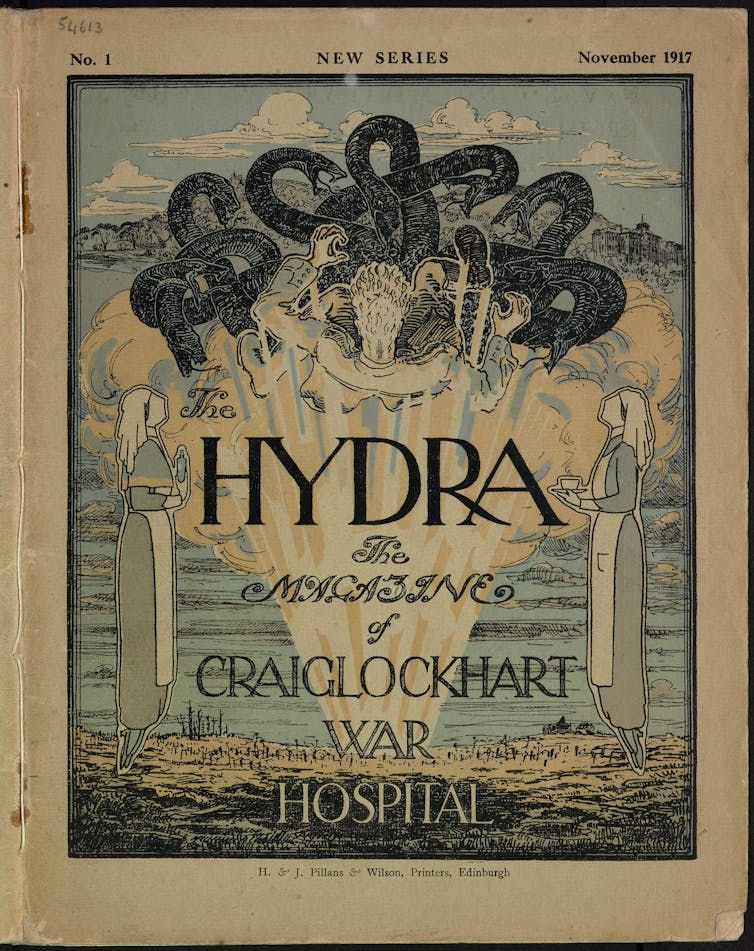
Cover of 'The Hydra' magazine.
Wilfred Owen edited six issues of the Craiglockhart War Hospital magazine, ‘The Hydra,’ while being treated for shell shock, including the July 21, 1917, issue.
(The First World War Poetry Digital Archive, English Faculty Library, University of Oxford)

Poetry & shell-shock

Owen’s “Dulce et Decorum Est” has an unambiguous anti-war message, and it works skillfully to immerse the reader in a subsuming, visceral representation of the lived experience of the frontline soldier.

Unlike McCrae, Owen never identifies the “foe” as the German soldiers in their trenches, but rather directs his ire at those at the home front who perpetuate, or simply believe in, the propaganda glorifying the war. The same can be said for Owen’s compatriot writer and friend, Siegfried Sassoon.


Read more:
Owen, Sassoon and Graves: how a golf club in Scotland became the crucible for the greatest war poetry


Both Sassoon and Owen — who met in 1916 while they were both recovering from shell shock at the Craiglockhart Medical Hospital in Edinburgh — felt that young men like themselves had been betrayed as objects of hero worship by their country.

The title “Dulce et Decorum Est,” is from Horace’s epigrammatic line “Dulce et decorum est pro patria mori” (it is sweet and proper to die for one’s country), which is still inscribed on many war memorials. At the end, the poem excoriates this motto as “the old Lie.”

Angry rebuke
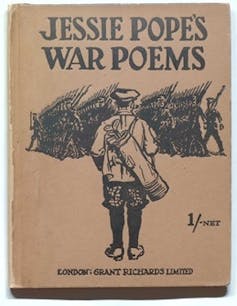
Book cover with a sketch of a soldier.
Jessie Pope’s War Poems, published 1915 by Grant Richards.
(British Library)

Owen’s poem is an angry rebuke to jingoistic poets of his time, such as Jessie Pope, whose wartime poems aimed to rally and entice new recruits and lift up “war girls.”

In 28 lines, Owen strives to convey, as accurately and brutally as possible, the daily horror experienced by front-line soldiers. At once, his poem is conventional — adhering to iambic pentameter and a strict rhyme scheme — and highly innovative. His language is designed to provoke emotion in the reader, as we see from the opening four lines:

“Bent double, like old beggars under sacks,

Knock-kneed, coughing like hags, we cursed through sludge,

Till on the haunting flares we turned our backs,

And towards our distant rest began to trudge.”

The similes comparing the soldiers to “beggars” and “hags” are striking, but so too is the use of the first-person plural to describe the soldiers.

The words “sludge” and “trudge” stand out in this stanza for being distinctly vulgar in their context, while exemplifying the onomatopoeic language that Owen uses to help us experience the soldiers’ fatigue. The elongated vowel sound — “uh” — perfectly mimics the weary drag of the soldiers’ feet as they “trudge” through the muck.

The lethargic pace of the first lines swiftly accelerates when the soldiers are subjected to a gas attack:

“Gas! GAS! Quick, boys! — An ecstasy of fumbling

Fitting the clumsy helmets just in time.”

The reader must accelerate their reading pace and perhaps even experience a quickening heart rate alongside the soldiers.
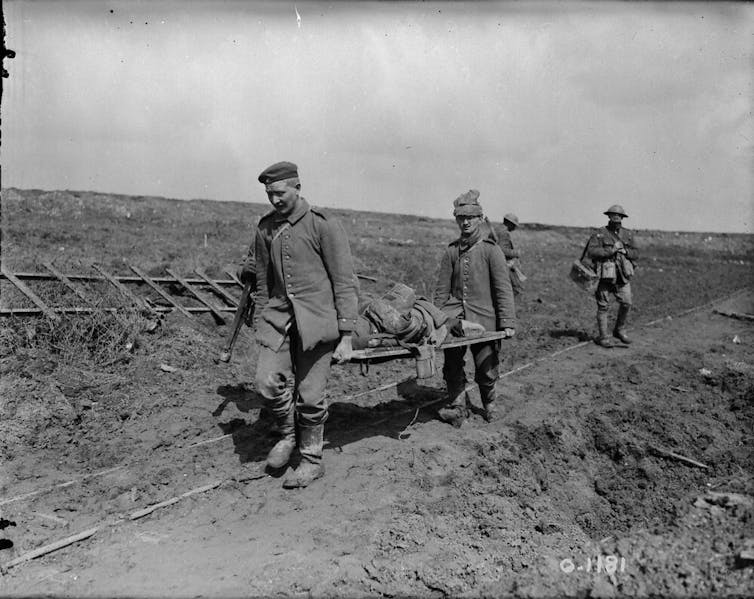
Two men carry a wounded soldier.
Bringing in the wounded, Vimy Ridge, April 1917.
(Canada. Department of National Defence. Library and Archives Canada, PA-001042/Flickr), CC BY

‘I saw him drowning’

The rest of the poem is focused on the lone man who didn’t secure his helmet in time, and who the narrator is forced to watch entering his death throes:

“But someone still was yelling out and stumbling

And flound’ring like a man in fire or lime.—

Dim through the misty panes and thick green light,

As under a green sea, I saw him drowning.”

In all my dreams before my helpless sight,

He plunges at me, guttering, choking, drowning.“

These lines are thick with active verbs; the suffix “ing” dominates the description of the gas attack, and the lines that follow conclude the poem:

“If in some smothering dreams, you too could pace

Behind the wagon that we flung him in,

And watch the white eyes writhing in his face …

My friend, you would not tell with such high zest

To children ardent for some desperate glory …”

No peace for the dying

In these final twelve lines of the poem the “we” shifts to “you,” when Owen attacks the notion of glorifying war without any direct experience. The “you” may be both a direct reference to Pope and the kind of audience she sought to capture: Owen originally dedicated the poem in his original manuscript “To Jessie Pope, etc.,” and then in another version “To a Certain Poetess.”

The biggest shock produced by “Dulce et Decorum Est,” though, is when we realize the victim is still alive at the poem’s end — or, still dying.

Owen does not allow this man to slip off into the ruminative afterlife experienced by McCrae’s war dead. He keeps his victim suspended in the act of dying as a way of preserving the poem’s fraught message. There is no peace for this man, until “you,” the reader, reject the “old Lie” and fight to end the war.

Owen was killed in action a week before the war’s end, on Nov. 4, 1918.

Owen’s “Dulce et Decorum Est” is a meticulously crafted poem of shock and haunting. It might do us good to feel such haunting, such shock, every Nov. 11.The Conversation

Mark Libin, Associate Professor, Department of English, Theatre, Film & Media, University of Manitoba

This article is republished from The Conversation under a Creative Commons license. Read the original article.
Unknown's avatar

Wilfred Owen 100 years on: poet gave voice to a generation of doomed youth


File 20181104 83641 1klrd4i.jpg?ixlib=rb 1.1
Wilfred Owen was killed in action on November 4, 1918.
Frontispiece from Poems of Wilfred Owen (1920)

Wim Van Mierlo, Loughborough University

For many people, most of what they know about the futility, sacrifice and tragedy of World War I, they learned through reading the poetry of Wilfred Owen. But what they may not be aware of is how close the Armistice was when Owen was killed at the age of 25.

On November 4 1918, the 2nd Manchester Regiment received orders to cross the Sambre and Oise Canal near the village of Ors to capture German positions at the opposite side. But as the troops attempted to build a pontoon bridge, they came under heavy machine gun fire. Against the odds, they forced a crossing and routed the enemy, but in so doing they suffered more than 200 casualties.

The attack was one of multiple attempts made up and down the canal to push back the Germans, all with similar consequences. But what made the crossing at Ors different however was the death of its most celebrated officer – Lieutenant Wilfred Owen – who was hit while helping the men who were building the bridge.

The tragedy of Owen’s end, just seven days before the guns fell silent, stands out in the cultural memory ahead of the thousands of men who died – or were yet to die – during the final moments of World War I. As a poet, Owen understood the irony of heroism very well. He resisted giving concrete identities to the soldiers who populate his poems to stop their experiences from becoming mere anecdotes. One man’s suffering is not more tragic than that of another.

In a provisional preface, written for a collection of his verse he would never see published, he set down his belief in what poetry could do – or could not do – to appropriately remember the atrocity of war:

This book is not about heroes. English poetry is not yet fit to speak of them. Nor is it about deeds, or lands, nor anything about glory, honour, might, majesty, dominion, or power, except War.
Above all I am not concerned with Poetry.
My subject is War, and the pity of War.
The Poetry is in the pity.
Yet these elegies are to this generation in no sense consolatory. They may be to the next. All a poet can do today is warn.

The sentiment here echoes a shift in war poetry, away from the jingoistic tenor of Rupert Brooke’s sonnets from 1914 about “some corner of a foreign field/That is for ever England” and the men that gave their life for “immortality” to Siegfried Sassoon’s defiant denunciations of the evils of war.

The “big” words “War” and “Poetry” were ultimately not important for Owen – the more humane invocation of “pity” was poignantly written in lowercase. What the country needed, what the world needed, was empathy and regret, not hero worship – there was nothing glorious in being dead. But the time for this was not now. He disbelieved whether his own generation would ever be able to deal truthfully with the trauma. He was probably correct.

Early promise

Owen had aspired to become a poet since boyhood. His early lyric verse written before the war showed promise, but it didn’t set him apart. The effects of war, and of his reading Sassoon, would change all that. Traditional lyricism gave way to starker rhythms, direct imagery and extensive use of assonance and half rhyme, which at once created sonic cohesion within a broken, phantasmagoric world. The protagonists in Owen’s poems are often no more than a spectre of themselves, mere voices who have lost all sense of their surroundings –- “unremembering” souls “[o]n dithering feet” who have “cease[d] feeling | Even themselves or for themselves”.

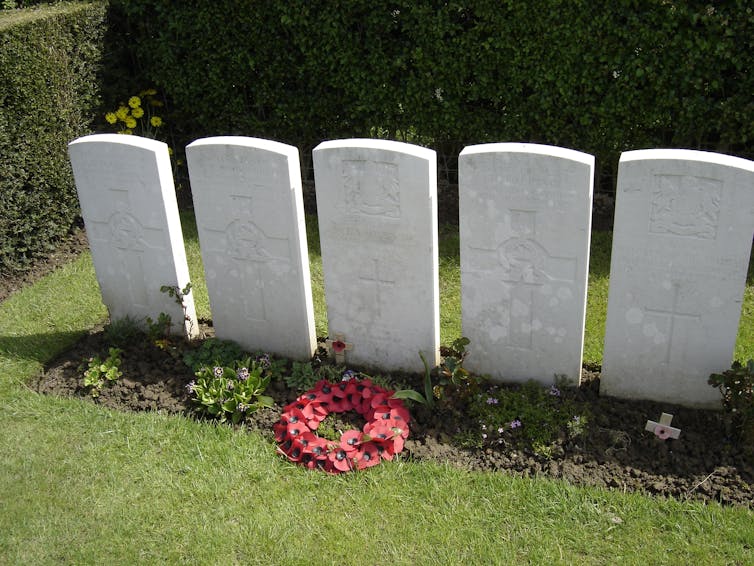
Wilfred Owen’s grave at Ors Cemetery in France.
Hektor via Wikimedia Commons, CC BY-ND

These poetic phantoms, spectres, ghosts were not shaped by the fighting alone; more than the trenches, it was Owen’s experiences at the Craiglockhart War Hospital for Officers, near Edinburgh, that coloured his vision. The four months spent there convalescing from shell shock would prove highly significant. Not only did he meet Sassoon there, who encouraged his poetic sensibilities, it was conducive to his creativity.

As part of their treatment, patients were subjected to ergotherapy, a behavioural therapy developed by Dr Arthur Brock, who believed that through useful work and activity patients would regain healthy links with the world around them. Owen was put in charge of The Hydra, the hospital’s literary magazine, and encouraged to write poetry. But his surroundings also furnished Owen with something more valuable: a space to process the suffering he had seen and was seeing around him. This emotion, recollected in tranquillity, is crystallised in the subject matter of some of his best known poems – characterised by an evocation of the sick, the wounded and the dying.

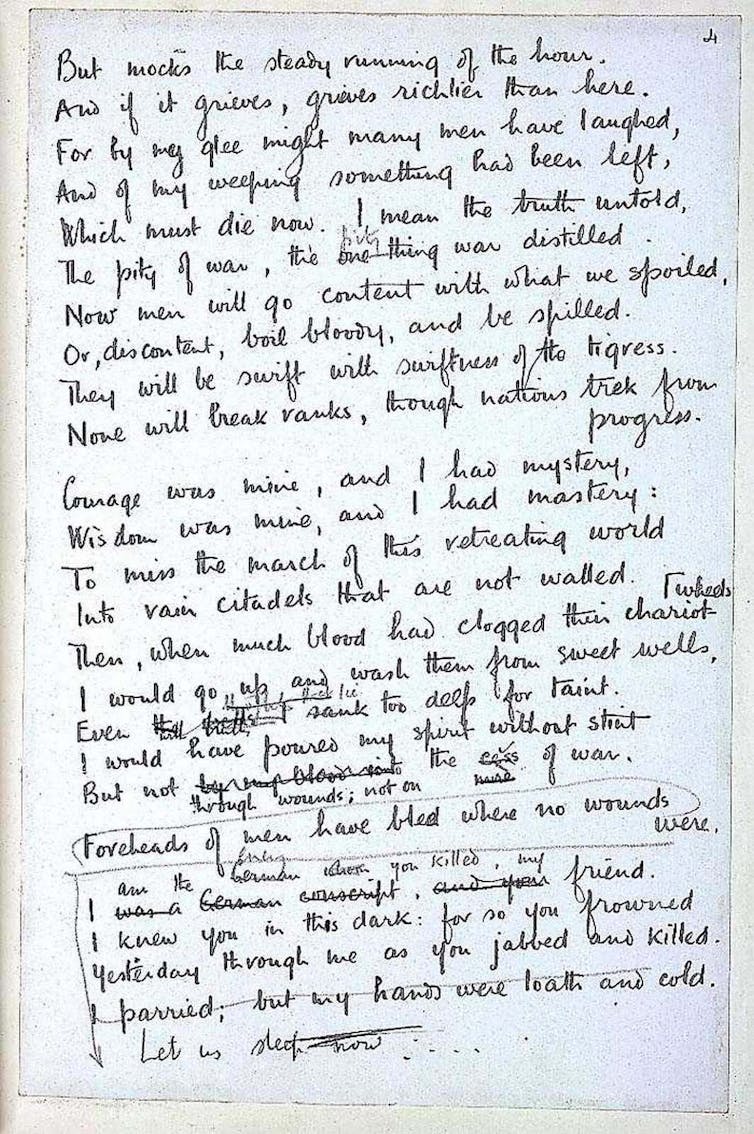
His manuscripts reflect that state of mind. Composition for Owen was neither frenzied nor easy, but rather it involved a steady process of probing words and phrases from which he manufactured the emotional intensity in his poetry. Differences in pen and ink show how Owen revisited his drafts and touched them up at different moments in time, at Craiglockhart and also afterwards when awaiting medical clearance at Scarborough Barracks.

In May 1918, C K Scott-Moncrief, who had tried and failed to secure Owen a Home posting as cadet instructor, told the young poet he ought to send his work to the publisher Heinemann. Owen was enthused by the encouragement. He drafted his Preface and hastily drew up a table of contents.

Strange Meeting by Wilfred Owen.
This item is from The First World War Poetry Digital Archive, University of Oxford (www.oucs.ox.ac.uk/ww1lit); © University of Oxford

But it is likely that getting his work in order led to more writing and rewriting. Two poems, Hospital Barge and Futility (one revised, the other new), appeared in The Nation a month later – in August he received his embarkation orders to return to France. On September 17, at 7.35am, he boarded a military train to Folkestone from where he crossed the English Channel. With the exception of just five poems published in magazines, he never prepared any of his poems for the press, leaving the bulk of his work in various stages of completion.

Reluctant posthumous hero

In 1920, his friend Sassoon published a slim volume from the surviving manuscripts with Chatto & Windus, soon followed by a reprint in 1921, which indicates reasonable sales. (A more complete edition appeared in 1931.) The critical response, however, was mixed. Writing in The Athenaeum, John Middleton Murray praised Owen for achieving “the most magnificent expression of the emotional significance of the War”.

The hidebound Basil de Selincourt, on the other hand, dismissed Owen’s “soothing bitterness” in the Times Literary Supplement. He countered that “[t]he only glory imperishably associated with war is that of the supreme sacrifice which it entails; the trumpets and the banners are poor humanity’s imperfect tribute to that sublime implication”.

Owen’s posthumous reputation, however, owes much to the way that first volume introduced his work to the public. “All that was strongest in Wilfred Owen survives in his poems”, Sassoon wrote in his introduction. Unwittingly, perhaps, that phrase – and the frontispiece of Owen in his regimental uniform – entailed an act of monumentalisation that went against Owen’s preface that his book was “not about heroes”.

Owen’s legacy is inscribed into a culture of remembrance (that persists to this day) which seems to go against his own views. By 1920 the nation was in the grip of commemoration as it began the erection of monuments to the war dead all across the country – and the language adopted was the language of glory, honour, dominion and power which Owen had found repugnant:

The old Lie: Dulce et decorum est
Pro patria mori.The Conversation

Wim Van Mierlo, Lecturer in Publishing and English, Loughborough University

This article is republished from The Conversation under a Creative Commons license. Read the original article.