Unknown's avatar

P is for Pandemic: kids’ books about coronavirus


NSW Health

Shih-Wen Sue Chen, Deakin University; Kristine Moruzi, Deakin University, and Paul Venzo, Deakin University

With remarkable speed, numerous children’s books have been published in response to the COVID-19 global health crisis, teaching children about coronavirus and encouraging them to protect themselves and others.

Children’s literature has a long history of exploring difficult topics, with original fairy tales often including gruesome imagery to teach children how to behave. Little Red Riding Hood was eaten by the wolf in a warning to young ladies to be careful of men. Cinderella’s stepsisters had their eyes pecked out by birds as punishment for wickedness.

More recently, picture books have dealt with issues including September 11, the Holocaust, environmental issues and death.

But this wave of coronavirus books is unique, being produced during a crisis rather than in its aftermath.

Many have been written and illustrated in collaboration between public health organisations, doctors and storytellers, including Hi. This is Coronavirus and The Magic Cure both produced in Australia.

These books explore practical ways young children can avoid infection and transmission, and provide strategies parents can use to help children cope with anxiety. Some books feature adult role models, but the majority feature children as heroes.

The best of these books address children not just as people who might fall ill, but as active agents in the fight against COVID-19.

Our top picks

Coronavirus: A Book for Children
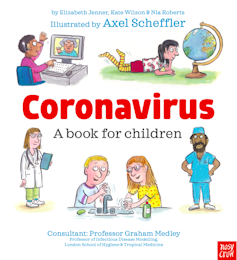
Written in consultation with an infectious diseases specialist and illustrated by Axel Scheffler of The Gruffalo, this nonfiction picture book offers children information about transmission, symptoms and the possibility of a cure, reassuring readers that doctors and scientists are working on developing a vaccine.

The last few pages answer the question “what can I do to help?”

Coronavirus: A Book for Children shows a diversity of characters taking action to manage the effects of the virus. Children are told to practice good hygiene, not to disturb their parents while they are working from home and keep up with their schoolwork.

It is also hopeful: reinforcing the idea that the combination of scientific research and practical action will lead to a point when “this strange time will be over”.

My Hero is You! How kids can fight COVID-19
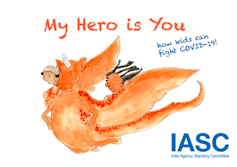
Written and illustrated by Helen Patuck, My Hero is You! is an initiative of a global reference group on mental health, and is a great book for parents to read with their children.

Sara, daughter of a scientist, and Ario, an orange dragon, fly around the world to teach children about the coronavirus.

Ario teaches the children when they feel afraid or unsafe, they can try to imagine a safe place in their minds.

Based on a global survey of children and adults about how they were coping with COVID-19, My Hero is You! translates the results of this comprehensive survey into a reassuring story for kids experiencing fear and anxiety. It also acknowledges the global nature of the health crisis, showing children they are not alone.

The Princess in Black and the Case of the Coronavirus
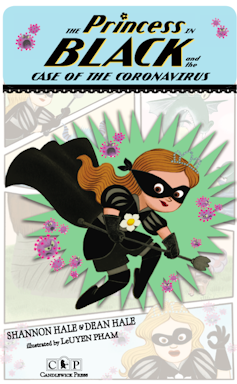
The Princess in Black is an existing series, with seven books published since 2014 and over one million copies sold. In the books, Princess Magnolia enlists children to help with a problem she cannot defeat alone: here, of course, that problem is coronavirus.

For fans of the series, Magnolia and her pals are familiar characters encouraging readers to solve the problem of coronavirus by washing their hands, staying at home, and keeping their distance.

The Princess in Black shows a deft use of humour to introduce children to complex ideas in a familiar and friendly manner.

Little heroes

Children’s books have often sought to entertain and educate children at the same time. The immediacy of these books, with their practical solutions and strategies for children to manage fears and anxieties about sickness and isolation, is a phenomenon we haven’t seen before.

With free online distribution and simple messages, these books present children with individual actions that have both personal and collective benefits.

Importantly, the heroes identified in these stories include children themselves. Their fears are acknowledged, but at the same time they are told they can fight the virus successfully.


A frequently updated list of children’s books on the pandemic is available from the New York School Library System’s COVID-19 page.The Conversation

Shih-Wen Sue Chen, Senior Lecturer in Writing and Literature, Deakin University; Kristine Moruzi, Research fellow in the School of Communication & Creative Arts, Deakin University, and Paul Venzo, , Deakin University

This article is republished from The Conversation under a Creative Commons license. Read the original article.
Unknown's avatar

Missing the Library


The link below is to an article that looks at how one person is missing libraries during the current coronavirus pandemic.

For more visit:
https://humanparts.medium.com/i-miss-libraries-53138f959b6e

Unknown's avatar

A thousand yarns and snapshots – why poetry matters during a pandemic


Kenrick Mills/Unsplash

Christopher Wallace-Crabbe, University of Melbourne

Why do we have the arts? Why do they seem to matter so much? It is all very well muttering something vague about eternal truths and spiritual values. Or even gesturing toward Bach and Leonardo da Vinci, along with our own Patrick White.

But what can the poets make of, and for, our busy, present lives? What do they have to say during grave crises?

Well, they can speak eloquently to their readers for life, in writing from the very base of their own experiences. Every generation has laid claim, afresh, to its vital modernity. In the 17th century, Andrew Marvell did so with witty lyrical elegance in his verse To a Coy Mistress. Three centuries later, the French poet René Char thought of us as weaving tapestries against the threat of extinction. Accordingly, he wrote:

The poet is not angry at the hideous extinction of death, but confident of his own particular touch, he transforms everything into long wools.

In short, the poet will, at best, weave lasting, memorable, salvific tapestries out of words. The poems in question will come out live, if the poet is lucky, and possibly as disparate as the sleepy, furred animals caged in Melbourne Zoo.


Read more:
A beginner’s guide to reading and enjoying poetry


What is truly touching or intimate need not be tapped by elegies, for all that they can fill a mortal need. Yet the great modern poet W. H. Auden wrote in memory of poet, writer and broadcaster John Betjeman:

There is one, only one object in his world which is at once sacred and hated, but it is far too formidable to be satirizable: namely Death.

As William Wordsworth and Judith Wright both well knew, in their separate generations – and quite polar cultures – the best poetry grasps moments of our ordinary lives, and renders them memorable.

Poetry can give us back our dailiness in musical technicolour: in a thousand yarns or snapshots. Poems sing to us that life really matters, now. That can emerge as songs or satires, laments, landscapes or even somebody’s portrait done in imaginative words.

Yes, verse at its finest is living truth “done” in verbal art. The great Russian playwright Anton Chekhov once insisted “nothing ever happens later”, and the point of poetry in our own time – as always, at its best – is surely to shine the light of language on what is happening now. The devil is in the detail, yes. But so is the redemptive beauty, along with “the prophetess Deborah under her palm-tree” in the words of the Australian poet, Peter Steele.

Poetry sees the palm tree, and the prophetess herself, vividly, even in the middle of a widespread epidemic.


Read more:
Ode to the poem: why memorising poetry still matters for human connection


Modern poetry is an art made out of living language. In these times, at least, it tends to be concise, barely spilling over the end of the page: too tidy for that, unlike the vast memorised narratives of the Israelites, the Greeks or even the Icelanders. But what it shares with the ancient, oral cultures is its connection with wisdom, crystallising nodes of value, fables of the tribe, moments or decades that made us all.

In the brief age of a national pandemic, poetry’s role and its duties may come to seem all the more important: all the more civil and politically sane. The poem – even in the case when it is quite a short lyric, even if comic – carries the message of moral responsibility in its saddle bag. Perhaps all poets do, even when they are also charming the pants off their willing readers.


Christopher Wallace-Crabbe is judge of the ACU Prize for Poetry. Entries close July 6.The Conversation

Christopher Wallace-Crabbe, Emeritus Professor in the Australian Centre, University of Melbourne

This article is republished from The Conversation under a Creative Commons license. Read the original article.
Unknown's avatar

Coronavirus and Reading Focus


The link below is to an article that looks at the coronavirus pandemic and how it is impacting on reading focus.

For more visit:
https://www.chronicle.com/article/A-Side-Effect-of-the-Covid-19/248568

Unknown's avatar

‘Iso’, ‘boomer remover’ and ‘quarantini’: how coronavirus is changing our language


Wes Mountain/The Conversation, CC BY-ND

Kate Burridge, Monash University and Howard Manns, Monash University

People love creating words — in times of crisis it’s a “sick” (in the good sense) way of pulling through.

From childhood, our “linguistic life has been one willingly given over to language play” (in the words of David Crystal). In fact, scientists have recently found learning new words can stimulate exactly those same pleasure circuits in our brain as sex, gambling, drugs and eating (the pleasure-associated region called the ventral striatum).


Read more:
The shelf-life of slang – what will happen to those ‘democracy sausages’?


We’re leximaniacs at heart and, while the behaviour can occasionally seem dark, we can learn a thing or two by reflecting on those playful coinages that get us through “dicky” times.

Tom, Dick and Miley: in the ‘grippe’ of language play

In the past, hard times birthed playful rhymes. The 1930s Depression gave us playful reduplications based on Australian landmarks and towns – “ain’t no work in Bourke”; “everything’s wrong at Wollongong”; “things are crook at Tallarook”.

Wherever we’re facing the possibility of being “dicky” or “Tom (and) Dick” (rhyming slang for “sick”), we take comfort in language play. It’s one thing to feel “crook”, but it’s another thing again to feel as “crook as Rookwood” (a cemetery in Sydney) or to have a “wog” (synonymous with “bug”, likely from “pollywog”, and unrelated to the ethnic slur “wog”).

Remedies may be found in language’s abilities to translate sores into plasters, to paraphrase William Gouge’s 1631 sermon on the plague. New slang enables us to face our fears head-on — just as when the Parisians began calling a late-18th century influenza “la grippe” to reflect the “seizing” effect it had on people. The word was subsequently taken up in British and American English.

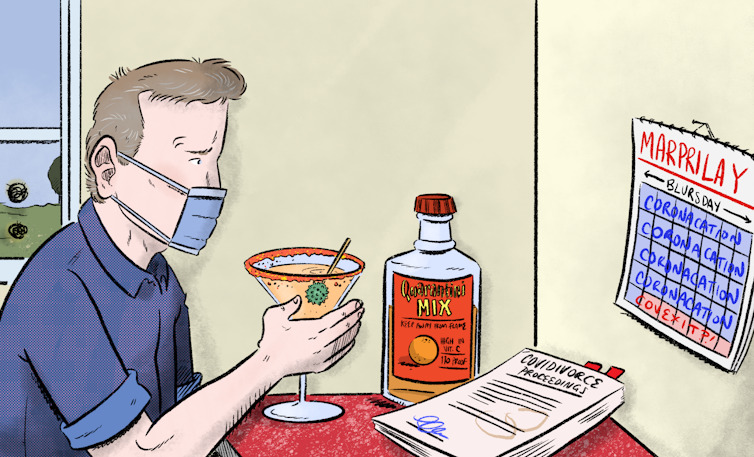
In these times of COVID-19, there are the usual suspects: shortenings like “sanny” (hand sanitizer) and “iso” (isolation), abbreviations like BCV (before corona virus) and WFH (working from home), also compounds “corona moaner” (the whingers) and “zoombombing” (the intrusion into a video conference).

Plenty of nouns have been “verbed” too — the toilet paper/pasta/tinned tomatoes have been “magpied”. Even rhyming slang has made a bit of a comeback with Miley Cyrus lending her name to the virus (already end-clipped to “the Miley”). Some combine more than one process — “the isodesk” (or is that “the isobar”) is where many of us are currently spending our days.

Slanguage in the coronaverse: what’s new?

What is interesting about COVID-lingo is the large number of creations that are blended expressions formed by combining two existing words. The new portmanteau then incorporates meaningful characteristics from both. Newly spawned “coronials” (corona + millennials) has the predicted baby boom in late 2020 already covered.

“Blursday” has been around since at least 2007 but originally described the day spent hung over — it’s now been pressed into service because no one knows what day of the week it is anymore. The official disease name itself, “COVID”, is somewhere between a blend and an acronym because it takes in vowels to make the abbreviation pronounceable (CO from corona, VI from virus and D from disease).

True, we’ve been doing this sort of thing for centuries — “flush” (flash + gush) dates from the 1500s. But it’s never been a terribly significant method of coinage. John Algeo’s study of neologisms over a 50-year period (1941–91) showed blends counting for only 5% of the new words. Tony Thorne’s impressive collection of over 100 COVID-related terms has around 34% blends, and the figure increases to more than 40% if we consider only slang.

Not only have blends become much more common, the nature of the mixing process has changed too. Rather than combining splinters of words, as in “coronials”, most of these corona-inspired mixes combine full words merged with parts of others. The “quarantini” keeps the word “quarantine” intact and follows it with just a hint of “martini” (and for that extra boost to the immune system you can rim the glass with vitamin C powder). Many of these have bubbled up over the past few weeks — “lexit” or “covexit” (the strategies around exiting lockdown and economic hardship), “coronacation” (working from home) and so on.

Humour: from the gallows to quarantimes

Humour emerges as a prevailing feature of these blends, even more so when the overlap is total. In “covidiot” (the one who ignores public health advice and probably hoards toilet paper), both “covid” and “idiot” remain intact. There’s been a flourishing of these types of blend — “covideo party”, “coronapocalypse”, “covidivorce” to name just a few.

Clearly, there is a fair bit of dark comedy in the jokes and memes that abound on the internet, and in many of these coinages too — compounds like “coronacoma” (for the period of shutdown, or that deliciously long quarantine sleep) and “boomer remover” (used by younger generations for the devastation of the baby boomer demographic).


Read more:
Oi! We’re not lazy yarners, so let’s kill the cringe and love our Aussie accent(s)


Callous, heartless, yes. But humour is often used as a means of coming to terms with the less happy aspects of our existence. People use the levity as a way of disarming anxiety and discomfort by downgrading what it is they cannot cope with.

Certainly, gallows humour has always featured large in hospital slang (diagnoses like GOK “God only knows” and PFO “pissed and fell over”). For those who have to deal with dying and death every day, it is perhaps the only way to stay sane. COVID challenges us all to confront the biological limits of our own bodies – and these days humour provides the much-needed societal safety valve.

So what will come of these creations? The vast majority will fall victim to “verbicide”, as slang expressions always do.The Conversation

Kate Burridge, Professor of Linguistics, Monash University and Howard Manns, Lecturer in Linguistics, Monash University

This article is republished from The Conversation under a Creative Commons license. Read the original article.

Unknown's avatar

Reading Poetry in the Morning and Your Health


The link below is to an article that looks at whether reading poetry in the morning helps your health or not.

For more visit:
https://bookriot.com/2020/04/10/poetry-and-health/

Unknown's avatar

The Immediate Future of the Novel


The link below is to an article that looks at the future of the novel in the wake of the current COVID-19 coronavirus pandemic.

For more visit:
https://lithub.com/what-will-happen-to-the-novel-after-this/

Unknown's avatar

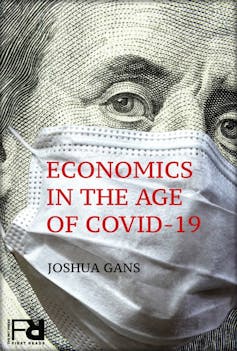
How I wrote and published a book about the economics of coronavirus in a month


Shutterstock

Joshua Gans, University of Toronto

Just out.
MIT Press First Reads

I just published a book, Economics in the Age of COVID-19.

It was written over the last month or so, peer-reviewed, edited and released by MIT Press.

This is the thoroughly-2020 story of how it happened.

Like many academics who entered our present period of isolation in mid-March, I was not at all concerned about my job and how to continue doing it.

To be sure, I would have to deal with purely online interactions with some 300 plus students but fortunately I twigged to the value of virtual lectures a few years ago.

Of course I would have to cancel all travel and conferences for the foreseeable future, but in some ways that thought was liberating.

And I would have to deal with motivating a teenager to learn at home, and with two annoyed college students who had been forced to return home.

Obsession

For the first week I got nothing done, despite being free to do anything.

I couldn’t help but obsess over what was happening in the world.

At first it was frustration at the slow pace of government action as I constantly refreshed scant data on rising infections.

Then it was panic that those actions wouldn’t be enough.

The economic changes were unprecedented. The stock market gyrated and convulsed in tune with fear and other motives that none of us could understand.


Read more:
This coronavirus share market crash is unlike those that have gone before it


What was clear was that if I was home, then so were most other people.

That would leave stores empty, factories shut, and services unnecessary. The vast majority of businesses rely on cash flow to keep things operating, and the cash was most definitely going to stop flowing.

While there were public health pandemic playbooks that were being followed with varying degrees of adherence, there was no economic playbook for this.

Playbook

No one had, to my knowledge, written a paper on how to shut down an economy and then simply restart it again at some unspecified time.

In my mind, the analogy was that we would have to pause things.

We happily shut down most economies each Christmas and no one screams “depression.” The easiest way to do this was to just delay bill payments without consequence.

I could think of ways to do it: loan guarantees, wage subsidies, straight out cash, moratoriums on evictions and foreclosures.

I started to write up my thoughts as if that were original and insightful. And then I saw all of my economics colleagues doing the same thing.


Read more:
How economies can survive a period of ‘suspended animation’ to deal with coronavirus


Everyone had simultaneously come to the same conclusion. A new playbook was being invented at the same time, all over the world.

Trillions of dollars were being spent, but it was clear to me that non-economists were somewhat dumbfounded.

Hadn’t economists warned for years against the perils of deficits? Would our children be paying for this? And what was the plan? How long was this going to last and how sure were we that we could just get things back to normal?

We economists had some answers to these questions, but not all of them.

Sharing

Like public health officials who needed to explain in far more detail what was going on with COVID-19, economists needed to explain what they were thinking when they were taking such unusual and exceptional steps.

A week into my isolation, I decided I would write a book.

It would cover all of the economic issues, conundrums and controversies that were emerging. It would put what we knew together with what we did not know and try to help people process what was happening.

It would help me get a handle it as well.

I have written popular economics books before, but never as quickly.

My plan was to write 10 chapters – one a day – and then publish. In terms of that last step, I could self-publish, but, given the speed at which I was working, I couldn’t be confident I wouldn’t miss things. It had to be peer-reviewed.


Read more:
Open letter from 265 Australian economists: don’t sacrifice health for ‘the economy’


Most academic publishers work slowly but I contacted MIT Press and asked if they could do things differently. They came through in ways that I did not anticipate.

As it turns out MIT Press had recently collaborated with the MIT Media Lab on a platform called PubPub. It is built to allow public comment and review. The plan was for me to write the book and after an editorial review, post the entire thing to PubPub for open review by members of the public.

It was posted on April 7, just 19 days after I first had the idea to write a book.

There were only 8 chapters, but they were longer than I had anticipated – 30,000 words in all. You can see that version here.

Feedback

Then MIT Press sent it out to peer reviewers whom they pushed to return comments within a week.

In the meantime, I kept writing. Things were evolving quickly. More critically, economic research was flooding in as economists from all over the world diverted their energies from what they had been doing to researching different aspects of the crisis.

In the end, my guess is that 80% of the citations in the book were from two months in one year – March and April, 2020!

Finally, I had to incorporate a wealth of comments from open and peer review. The former (public comments) were actually more detailed and useful than the latter (peer comments), which raises issues for the future.

In the end, on April 22 (one week ahead of schedule), the electronic version of my book was published globally.

It was 40,000 words long and hopefully would remain relevant for a few months. It’s for sale here.

Do I recommend undertaking this type of challenge?

Next book

Overall, I am pleased there is something out there for people to read and digest.

But personally, it was more gruelling than I had anticipated. That wasn’t because of the intensity of the work, but because of its subject matter.

My other books were positive and optimistic. This one was, for the most part, depressing. The first words were “everything is awful”, and it didn’t get better.

My editor called the first version of the ending bleak. There were days in which I was overwhelmed by my own words and had to retire to a couch until I could pick myself up again.

Thankfully, despite my own feelings, most of those who have read the book have come away concerned and informed, rather than lost and hopeless. That’s something.


Read more:
Is your mental health deteriorating during the coronavirus pandemic? Here’s what to look out for


The journey isn’t over. MIT Press will publish the usual version of the book in November. I will update it continually for a month or so before then.

There is still so much we do not know. We are learning more about COVID-19 and producing lots of studies, but I think the actual flow of knowledge has been disappointingly slow.

That’ll be the theme of the followup.The Conversation

Joshua Gans, Professor of Strategic Management, University of Toronto

This article is republished from The Conversation under a Creative Commons license. Read the original article.
Unknown's avatar

Poetry has linked war and disease for centuries


Julia M. Wright, Dalhousie University

War has been widely used — and criticized — as a metaphor for dealing with COVID-19. But the metaphor didn’t come out of nowhere. Writers have long linked war and disease, and not only because war often contributes to the spread of disease.

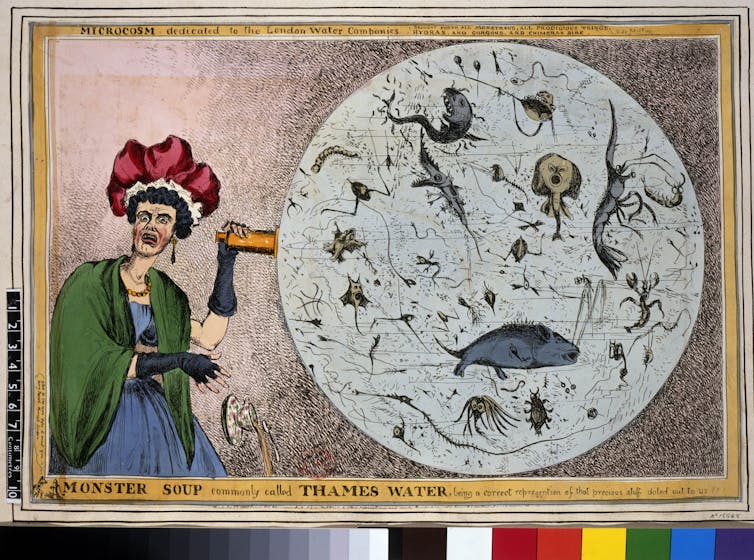
In my study of British and Irish literature from around 1800, including writing about medicine, it’s clear that people struggled to understand disease without having evidence of bacteria or viruses. In a chapter on “Contagion” in his 1797 handbook on medicine, the physician Thomas Trotter even laughed at the suggestion that diseases were spread by “little animals.”

William Heath’s satirical drawing ‘Monster Soup’ in the British Museum shows artists in the early 1800s understood medicine and disease before technology.
(British Museum.), CC BY-NC-SA

Yet the idea persisted. In 1828, cartoon satirist William Heath imagined river water as “Monster Soup.” In 1854, English physician John Snow used what we might now call contact tracing to show that a London water pump was at the centre of a cholera outbreak. The same year, Italian physician Filippo Pacini used a microscope to identify the cause of the disease.

An easy step from disease to war

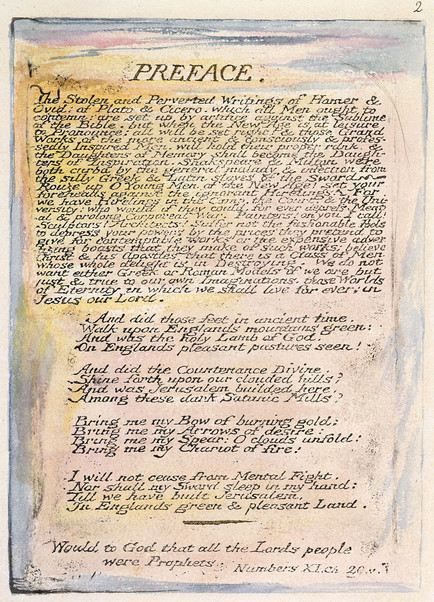
Writers were aware of public and research interests in medicine and drew on them, as in the familiar example of Mary Shelley’s Frankenstein in 1818. Writers also used medical metaphors: for instance, William Blake called the influence of Greek and Latin literature a “general malady and infection.”

These writers are using figures of speech to link concepts together: war is like a storm, disease is like war, and disease is like a storm, spread through clouds of bad air, raining contagion.


Read more:
Apocalyptic fiction helps us deal with the anxiety of the coronavirus pandemic


Metaphors aren’t simply decorative. They help explain unfamiliar ideas, and help us remember them by making them vivid or surprising. When Shakespeare had Hamlet talk about picking up weapons to fight “a sea of troubles,” he was communicating a sense of overwhelming odds. The metaphor was good enough to stick and is still widely used. Metaphors can also pass judgement, like Blake associating Greek and Latin literature with disease because it promoted war.

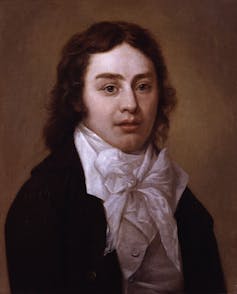
Writer and poet Samuel Taylor Coleridge was one of many British writers who used storms as metaphors for battles which were, in turn, used as metaphors for diseases.
(National Portrait Gallery, London), CC BY-NC-SA

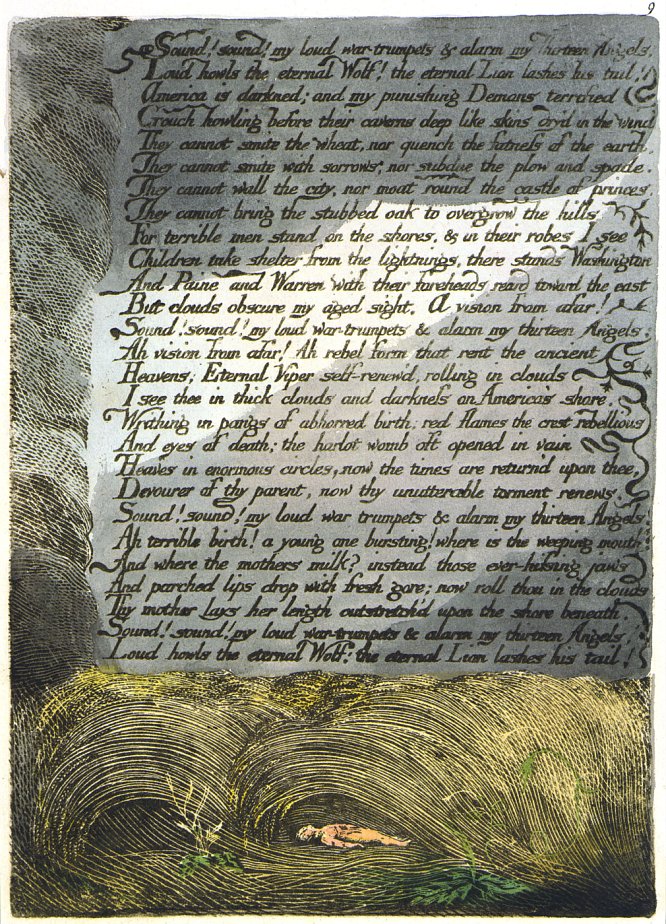
War was almost constant for Britain at this time, and writers often turned to thunderstorms to capture the terrible sound of battles. Blake’s 1793 poem about the American Revolutionary War describes the new United States as “darkned” by storm clouds while “Children take shelter from the lightnings” and leaders speak “in thunders.” A few years later, in his poem “Fears in Solitude,” Samuel Taylor Coleridge wrote about “Invasion, and the thunder and the shout.”

Medical writers of the era thought that bad air carried disease because they didn’t have the technology to see further. But they were able to connect the spread of disease with soldiers and ships. This made it an easy step from disease to war — with weather still in the mix.

In “Fears in Solitude,” Coleridge associated British imperialism with a spreading infection, carrying “to distant tribes slavery and pangs” “Like a cloud that travels on, / Steamed up from Cairo’s swamps of pestilence.” In “Adonais,” P.B. Shelley wrote of “vultures to the conqueror’s banner true … whose wings rain contagion.”

King Cholera goes to war

Two hundred years ago, disease wasn’t an “Invisible Enemy” or a “little animal”. It had power to kill, much like the kings who sent armies around the globe.

In her influential 1792 essay, Vindication of the Rights of Woman, English writer Mary Wollstonecraft wrote that “despots” are the source of a “baneful lurking gangrene” and lead to “contagion.” A quarter of a century later, the cholera pandemics began.

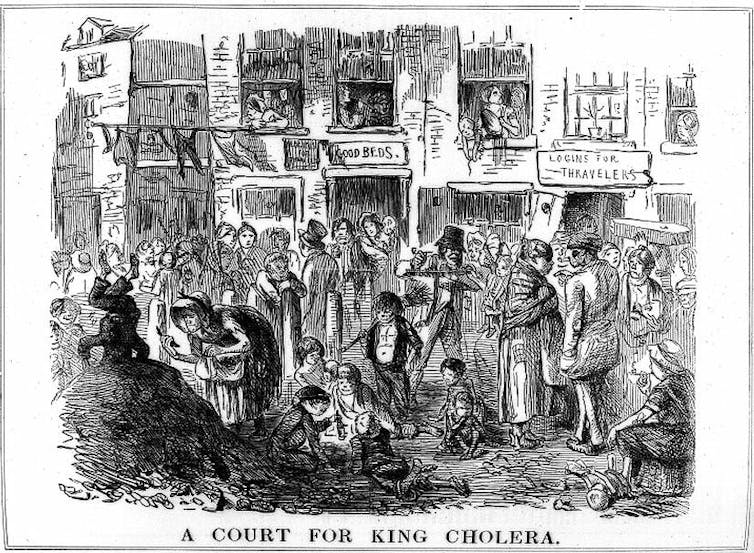
In John and Michael Banim’s 1831 poem “The Chaunt of the Cholera,” cholera doesn’t just “Breathe out the breath which maketh / A pest-house of the place.” It is a mercenary working for Europe’s monarchs: “Kings!–tell me my commission, / As from land to land I go.” Others, like English cartoonist John Leech, called the disease Lord Cholera or King Cholera.

John Leech’s cartoon showing the association of cholera with squalor. A child stands on his head on top of a rubbish heap in the left-hand corner. An old woman scavenges from the heap, another child shows off his own find, and washing flutters in the breeze overhead.
(Wellcome Library), CC BY

John Leech’s 1852 cartoon, “A Court for King Cholera,” relayed a message we’re hearing now: inequality feeds pandemics. The 1853 poem “King Cholera’s Procession” also details the unsanitary conditions of the urban poor while condemning “Those that rule” for being King Cholera’s “friends.”

In her 1826 novel about a devastating pandemic, The Last Man, Mary Shelley also links rulers, war, and disease. The plague “shot her unerring shafts over the earth,” a shower of arrows, and becomes “Queen of the World.” Shelley idealizes the leader “full of care” who doesn’t want victory — only “bloodless peace.”

The coming storm

To these writers, war was a metaphor for the problem, not the solution.

In our time, business media suggest “battle metaphors” are overused. We have television shows like Robot Wars and Storage Wars, training sessions called “bootcamps” and elections in “battleground states.”

War is all too real and devastating in many parts of our world. But as a metaphor it is worn out — perhaps no longer vivid, no longer explanatory. Writers such as Coleridge, the Shelleys, and Blake may have seen close connections between war and disease, but their work also hints at another possibility.

Instead of talking about a war on COVID-19, let’s consider those storm metaphors. We need to stay inside and wait for it to pass.

And, while we are, perhaps we can also look to the past for help in understanding our present. Before they had evidence of germs, they could see that war and inequality spread disease.The Conversation

Julia M. Wright, University Research Professor, Dalhousie University

This article is republished from The Conversation under a Creative Commons license. Read the original article.
Unknown's avatar

Are Books Essential?


The link below is to an article that considers whether books are essential items during the coronavirus pandemic or not.

For more visit:
https://www.latimes.com/opinion/story/2020-03-31/coronavirus-essential-business-bookstore