
Unknown's avatar

Cancel culture, cleanskin, hedonometer … I’m not sure I like any of Macquarie Dictionary’s words of the year


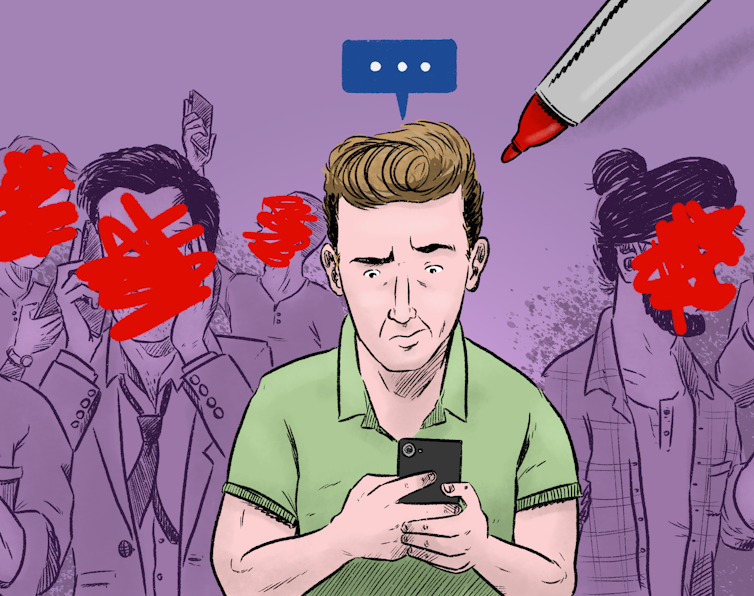
‘Cancel culture’ has been nominated Word of the Year by The Macquarie Dictionary, for reflecting the zeitgeist.
Wes Mountain/The Conversation, CC BY-ND

Roslyn Petelin, The University of Queensland

How many of these words, shortlisted by The Macquarie Dictionary in its search for the 2019 Word of the Year, have you used? Anecdata, big minutes, cancel culture, cheese slaw, cleanskin, drought lot, eco-anxiety, flight shaming, healthwashing, hedonometer, mukbang, ngangkari, robodebt, silkpunk, thicc, and whataboutism?

I confess the only one on this list (whittled down from 75 words), that has passed my lips has been “cleanskin”, but I wasn’t referring to someone with no tattoos – the new definition.

I may not have used these shortlisted words, but I have certainly experienced the effect of some of them and can appreciate the value of others. (“Whataboutism”, for instance, a technique used “in responding to an accusation, criticism or difficult question in which an opposing accusation or criticism is raised”, will come in very handy when describing many politicians. )

I doubt, though, whether I’ll be able to remember and use many of these words, colourful and tinged with negativity as many are.


Read more:
When we needed a new word, Twitter gave us ‘milkshake duck’


The Macquarie Dictionary committee has chosen “cancel culture” as its Word of the Year. The term is used to describe community attitudes that

…call for or bring about the withdrawal of support from [for] a public figure, such as cancellation of an acting role, a ban on playing an artist’s music, removal from social media, etc., usually in response to an accusation of a socially unacceptable action or comment by the figure.

Unfortunately, there have been any number of recent examples in Australia of ostracism through “cancel culture”, whose cases have progressed to the courts. I hesitate to mention Geoffrey Rush here.


Read more:
Tarantino has a questionable record in the #MeToo context, so should we boycott his new film?


‘The zeitgeist’

The committee chose “cancel culture” because it believes the term “captures an important aspect of the past year’s zeitgeist”.

In looking over the list, I’m not sure that I like any of these words. I think a couple of them are ridiculous, in particular “hedonometer”, an algorithm using language data from Twitter to analyse levels of happiness.

To qualify as Macquarie’s word of the year, a word must be newly added to the dictionary in that year or, as is the case with “cleanskin”, an old word with an additional new meaning.

Macquarie points out that it differs from other dictionaries, as some simply choose the most common word being searched, or most topical word, regardless of its status as “new”. The people at Cambridge Dictionary, which chose “upcycling” for 2019, relied on their Instagram account to make the call.

If the Macquarie committee had done this, its 2019 Word of the Year would have been “cheese slaw” (a salad of grated carrot, grated cheese, and mayonnaise), which it admits would have been a “niche and controversial” choice.

Macquarie has posted a photo on its website of a cheese slaw (stuffed into a sandwich), as well as an equally unappetising photo of a companion food word “mukbang”. A mukbang, by the way, describes a live online broadcast in which someone eats, often a large amount, while simultaneously speaking to their audience.

Criteria apart from “new” for Macquarie appear to be that a word is ubiquitous, timely, influential, and makes a valuable contribution to Australian English. So, does “cancel culture” qualify? Kind of.

Macquarie sorts the year’s new words into 15 categories, and one could spend an enjoyable time and several hours cruising through them: agriculture, arts, business, communications, eating and drinking, environment, fashion, health, politics, sport, and technology.

ngangkari and thicc

Two of the most interesting new additions – both runners-up as word of the year (along with eco-anxiety) – are “ngangkari”, adopted unaltered from Pitjantjatjara, for an Indigenous practitioner of bush medicine, and “thicc” from African American English, which “celebrates body positivity that does not conform to conventional white standards of beauty”.

The environment figures strongly in this year’s shortlist, in “eco-anxiety”, “flight shaming”, and “drought lot”. Still, the folk at Collins Dictionary named their Word of the Year for 2019 as “climate strike”. The Oxford Dictionary chose “climate emergency” as its Word of the Year.


Read more:
Why declaring a national climate emergency would neither be realistic or effective


Flight shaming is an anti-flying movement that originated in Sweden last year, which encourages people to stop taking flights to lower carbon emissions.
shutterstock

The Macquarie Committee has now opened the voting for People’s Choice Word of the Year 2019. Only once in the past five years has the committee’s and the people’s choice aligned. In 2015, “captain’s call” won both categories.

You may wonder why the competition is even called “word of the year” when it comprises two words, or even three. In 2016 the people’s choice was “halal snack pack”. As the website points out, it’s the lexical unit of meaning that the committee considers, what’s called the “headword” in a dictionary.

In the meantime, if you are interested in chasing up the Macquarie shortlist and maybe voting, you have until midnight on Sunday December 8 to do so.The Conversation

Roslyn Petelin, Course coordinator, The University of Queensland

This article is republished from The Conversation under a Creative Commons license. Read the original article.

Unknown's avatar

How Words are Added to the Dictionary


The link below is to an article that takes a look at how words are added to the dictionary.

For more visit:
https://bookriot.com/2019/10/23/how-are-words-added-to-the-dictionary/

Unknown's avatar

Free Dictionary and Thesaurus Tools (Online and Software)


The link below is to an article that takes a look at 25 free dictionary and thesaurus tools (online and software).

For more visit:
https://www.getfreeebooks.com/25-free-dictionary-thesaurus-online-softwares/

Unknown's avatar

Oxford Dictionaries Word of the Year: Toxic


The links below are to articles reflecting on the Oxford Dictionaries 2018 Word of the Year – toxic.

For more visit:
https://en.oxforddictionaries.com/word-of-the-year/word-of-the-year-2018
https://www.npr.org/2018/11/15/668041894/toxic-is-oxford-dictionaries-word-of-2018
https://bookriot.com/2018/11/15/toxic-2018-oxford-english-dictionary-word/

Unknown's avatar

A History of the Dictionary


The link below is to an article that takes a look at the history of the dictionary.

For more visit:
https://www.theatlantic.com/technology/archive/2018/08/the-draconian-dictionary-is-back/566660/

Unknown's avatar

Origins of the Merriam-Webster’s Dictionary


The link below is to an article that takes a look at the origins of the Merriam-Webster’s Dictionary.

For more visit:
https://www.theparisreview.org/blog/2018/03/30/noah-websters-american-english/

Unknown's avatar

Dictionaries


The link below is to an article that takes a look at the power of dictionaries.

For more visit:
https://www.chronicle.com/article/The-Magical-Power-of/242513

Unknown's avatar

The Oxford English Dictionary in the Digital Age


The link below is to an article that considers the role of the Oxford English Dictionary in the digital age – can it survive?

For more visit:
https://www.theguardian.com/news/2018/feb/23/oxford-english-dictionary-can-worlds-biggest-dictionary-survive-internet

Unknown's avatar

Here’s one to gymnologize over: the case for bringing back snollygostery, trumpery and humbuggery


File 20170605 20608 6fa0bk
The Oxford English Dictionary overflows with words that have been created (most during the 1800s) to tilt at governments of various sorts.
Africa Studio/Shutterstock

Kate Burridge, Monash University

Words and expressions come and go. Sometimes you can understand why they don’t linger. It’s hard to imagine there was ever much call for peristeronic, “suggestive of pigeons” – and there’s no evidence that gymnologize, “to argue whilst naked”, or decacuminated, “having the tops cut off”, have even been used.

Words of such spectacular pomp and pointlessness only ever had lives inside dictionaries (early lexicographers were notorious for making them up).

But sometimes we seem to let extremely useful expressions drop by the wayside. Humans suffer from a kind of congenital leximania, an irresistible passion for creating new words (such as leximania). In our lust for neologisms we lose sight of those expressions already doing a very fine job.

Here is a handful of such words – they have political applications and are today as apt and as ept as they ever were.

Political smutting and besmearing

Now is not the time to let roorback go – a neatly packaged expression that covers any false report, or slander, propagated for political purposes.

It derives from the name of a fictitious author Baron von Roorback. Published in 1844, his account of a gang of slaves destined for the Louisiana sugar mills was intended to disgrace James K. Polk, the Democratic candidate for president of the United States. The humbug was exposed, but usually the timing of roorbacks is such that they can’t be detected before voters go to the polls.

Clearly, spreading disparaging furphies for political gain is not new. The word was popular throughout the 19th century, even used a little into the 20th century, before it quietly shuffled off the lexical coil.

But today’s digital world is providing the perfect ecosystem for the roorback to flourish. A word for “political dirty tricks” – how could we let that one go?

Monumental talknophical assumnacy

Snollygoster is another wonderful creation to come out of the USA (around the same time as roorback). It could refer generally to smart people without principles, but its reference narrowed rather quickly to the crafty and unprincipled politician. The definition provided by the Columbus Dispatch (October 28, 1895) is worth repeating in full:

A snollygoster is a fellow who wants office, regardless of party, platform or principles, and who, whenever he wins, gets there by the sheer force of monumental talknophical assumnacy.

Whenever I ponder the phrase “monumental talknophical assumnancy”, I’m reminded of Alice’s words on hearing the poem Jabberwocky: “Somehow it seems to fill my head with ideas – only I don’t exactly know what they are.” Talknophical assumnancy – there’s a lot of it about.

The delightful name snollygoster conceals its nasty origins. The word is probably connected to snallygaster, a reshaping of Pennsylvania German schnelle Geister (“quick spirits”) – dragon-like creatures which, as folklore describes, made a practice of stealing children and chickens from unsuspecting farm folk.

The shift from “grotesque gargantua” to “political shyster” is telling. But it’ll take more than a hex sign on a building or rabbit’s-foot talisman to keep these modern-day snollygosters at bay.

A flourishing of ocracies

The Oxford English Dictionary overflows with words that have been created (most during the 1800s) to tilt at governments of various sorts. One stands out and that is kakistocracy, the creation of English writer Thomas Love Peacock for “government by its most unprincipled citizens” (from Greek kakistos “the worst”). In fact little needs to be done to rehabilitate his word.

Its comeback of late has been spectacular, with headlines heralding a new era of kakistocratical rule.

So will we be seeing a reappearance of other “ocracies”? Foolocracy and kleptocracy spring to mind.

Trumpery and puffery

Though strictly not a political term, the old word trumpery has always had close links with political shenanigans, even before it acquired its extra significance today.

The word appeared in English in the 1400s, meaning “deception; fraud”. It derives from the verb trump “to deceive; cheat” – not to be confused with the other trump verb around at that time meaning “to blow a trumpet” or “break wind audibly” (though it seems to me these trumps have always been tightly linked).

Trumpery then shifted to mean “something of less value than it seems” before extending to “something of no value at all” (applied to abstract things, objects and people).

Of course, trumpery has deception at its root, but the -ery ending adds that extra layer of unscrupulousness (bringing to mind trickery, humbuggery, jiggery-pokery and a pile of other seedy “ery” words).

And while there is the other positive trump (that appears in expressions like turn up trumps), it’s worth highlighting that this trump is nothing more than a corrupted form of triumph (an alternative pronunciation that appeared in the 1500s).

The two trumps are currently on a collision course, and we know from experience that rarely do positive meanings prevail when senses coincide in this way. Besides, there’s always been a dishonest whiff around even the trump card in its extended uses — and, as the behaviour of words over time shows, dishonest whiffs will just get whiffier.

The ConversationTrumpery, kakistocracy, snollygoster and roorback are words worthy of a phoenix-like re-application — let’s pick them up, dust them off and put them to work.

Kate Burridge, Professor of Linguistics, Monash University

This article was originally published on The Conversation. Read the original article.

Unknown's avatar

How the dictionary is totes taking up the vernacular


Kate Burridge, Monash University

There’s a new arrival on the dictionary scene – the much-anticipated second edition of the Australian National Dictionary, known fondly as AND.

As I recently wrote, these beautiful two volumes should certainly put to rest any fears people might have about the continued place of “tree-dictionaries” in an age of e-books and digital libraries.

These more than 16,000 Australianisms have generated lots of excitement – and not surprisingly. Words are the most observable part of any language and English-speakers seem fascinated by the ins and outs of expressions.

Look at the media attention when dictionaries announce the winner of their Word of the Year competition. There’s nowhere near the same excitement with other aspects of the language.

There were no breaking news stories when linguists announced developments affecting the conjunction “because” (for example, “I’ve been missing out on sleep because binge-watching Game of Thrones” or “I missed the ending because fell asleep”).

Dictionary editors are among the new celebrities, answering questions like: what is the longest word in the language? Is there a word to describe those who drink their own bathwater? How many words do speakers know? And, perhaps the thorniest question of all – when should new expressions enter the dictionary?

Vocabulary changes more than other aspects of language and lexicographers are constantly redrawing the exclusion boundary for marginal vocabulary items. “Yeah-no” has been around since the 1990s, but is only now appearing in dictionaries.

And while many original misspellings now have entries, such as “miniscule” (with its erroneous “i”) and even “nucular”, an entry for “accomodation” (with one “m”) seems a long way off.

It’s not easy for dictionary-makers. They are seen as the guardians of the language and when they take on board expressions like “yeah-no” and “nucular”, we hear howls about declining standards. Yet people will usually discard dictionaries if they don’t keep up-to-date.

Dictionary-making was more straightforward for early lexicographers, who sourced words almost exclusively from books. So, it was formal written language that typically made it into dictionaries.

Words were written on cards each time they were used and, when there was a substantial collection of cards, it could be established that a word was in general usage. So, they were largely respectable expressions, and anything that snuck under the radar would be well and truly branded (originally with symbols like asterisks or daggers, and later with more precise usage labels like “low”, “barbarous”, “vulgar”, as appeared in Samuel Johnson’s 1755 dictionary).

These days it’s all very different. Lexicographers consider an array of different language forms, including newspapers, magazines, pamphlets, menus, memos, TV and radio broadcasts and, of course, emails, chat-room discussions and blogs.

So it’s not surprising to find that the informal aspect has been significantly boosted in the new-look AND. Of course, this reflects the strong attachment to the vernacular in Australia, but it’s also in keeping with the marked shift towards informal ways of speaking and writing generally – even public language is becoming progressively more casual and everyday.

So dictionaries are now much faster to take up “slanguage”. In the Collins Official Scrabble Words, even “innit” (“isn’t it”), “grrl” (“feisty female”) and “thang” (“thing”) have the stamp of approval. Once it could take years and years for such colloquialisms to appear in print, perhaps then to be picked up by lexicographers and placed in some dictionary — or perhaps never.

So like many other dictionaries these days, AND shows an assortment of distinguished entries and boisterous slang. Additions from the world of economics and politics, for example, include sedate terms-of-art (“aspirational voter”, “economic rationalism”, “negative gearing”, “scrutineer”) as well as colloquialisms (“keep the bastards honest”, “Hawkespeak”, “hip-pocket nerve”, “wombat trail”).

And the current editorial team has continued the AND tradition and not tagged these entries with labels like “colloquial” or “slang” (though “-ist” language is occasionally labelled derogatory).

So don’t believe the concerned hype that accompanied the 2014 edition of Tony Thorne’s Dictionary of Contemporary Slang. It added only three new Australianisms (“tockley” for “penis”, “ort” for “buttocks” and “unit” for “bogan”), prompting a frenzy of headlines like:

The rise and fall of Australian slang.

I’m not sure how Thorne missed “selfie”, Australia’s contribution to the international lexicon – after all, it was the Oxford Dictionaries’ Word of the Year in 2013.

Articles expressed the fear that the glory days of Australian slang were over. AND should help to quell such fears – “hornbag”, “budgie smugglers”, “grey nomad”, “chateau cardboard” are among the many treasures you will find there.

Some of these entries appear so scruffy that you might wonder at the wisdom of the editors including them at all (“snot block”, “ranga”, “reg grundies”, “ambo”, “rurosexual”, “seppo”, “trackie daks”, “spunk rat”, “goon of fortune” come to mind). Of course, slang is in the eye of the beholder – even Samuel Johnson included a few (unbranded) personal favourites, like “belly timber” for “food”.

But in this case, you can take comfort in the fact that these expressions will have been tracked and meticulously analysed. They aren’t newly minted coinages and wouldn’t be there unless they “had legs”.

It seems to me almost impossible for printed dictionaries to keep up with the changing nature of vocabulary these days. People just love creating words.

In fact, scientists have recently discovered that learning the meaning of new words can stimulate exactly those same pleasure circuits in our brain as sex, gambling, drugs and eating, the pleasure-associated region called the ventral striatum.

The surge of excitement when we encounter a new word is the recently coined “neologasm”. And that really says it all.

The Conversation

Kate Burridge, Professor of Linguistics, Monash University

This article was originally published on The Conversation. Read the original article.