
 Credlin & Co.: How the Abbott Government Destroyed Itself by Aaron Patrick
My rating: 3 of 5 stars

 I have not watched the Reese Witherspoon movie based on this book – I’m not sure that I will to be honest. The hype, however, was enough to get me to actually read the book (or ebook in my case). I had also seen an interview on Australian television with the author in which this book and the author’s experience were discussed. I, therefore, had some idea of what to expect with the book and approached it with a measure of reticence. It still was not quite what I expected, though I expect this was more of a case of what I had hoped to see in the book than what it actually sought to be itself.
This book is a personal memoir, not just of Cheryl Strayed’s trek along portions of the Pacific Crest Trail from the Mojave Desert through California, Oregon and Washington State (which actually doesn’t feature greatly in the book in any leading way really), but of her personal journey from a time just prior to her mother’s tragic death with cancer, through a period of self-destructive behavior that impacted on her family and what Strayed would have you believe was her healing. It is in your face at times and quite confronting. At other times there are periods of humour and human warmness.
This book has the potential to polarise sentiment, with some believing Strayed’s journey to be inspirational and even heroic, while others will inevitably move to the other end of the spectrum. I confess to being closer to the latter grouping of readers. To me, this is a self-indulgent whine-fest, from someone ill prepared for her trek and seemingly for life itself. Certainly there appears to be significant personal growth by the end of the book and this is a wonderful thing. If you can get past the initial early chapters, which can be difficult if you aren’t impressed with the seeming constant whining and whinging, the reading experience does improve along the way.
I think I would give it 3 out of 5 as a rating.
Buy this book at Amazon:
http://www.amazon.com/Wild-Journey-Found-Cheryl-Strayed-ebook/dp/B0082FPIY8/
Michelle Smith, Deakin University
Last week on Facebook, a friend declared she will now abandon plans to name any future son of hers Atticus. She is not alone among fans of Harper Lee’s To Kill a Mockingbird (1960), including thousands of parents of young Attici who are dismayed that the legacy of a heroic character who – so it goes – stood against the tide of racism in 1930s Alabama, is now revealed as a bigot in Go Set a Watchman, published last week, 55 years after its predecessor.
In newspaper reports, the draft that Lee allegedly wrote prior to her classic novel is described as potentially horrifying in its revision of a “literary saint”.
Go Set a Watchman’s Atticus Finch, now aged 72, keeps a lurid pamphlet – The Black Plague – among his reading material and once attended a Ku Klux Klan meeting. He welcomes racist, pro-segregation speakers at the Maycomb County Citizens’ Council meetings. In heated conversations with his daughter Jean Louise (the adult Scout, who was the child narrator of To Kill a Mockingbird), he warns about a future in which there might be “negroes by the carload in our schools and churches and theaters” and in which full civil rights might see white southerners politically “outnumbered”.
The anxiety about how this depiction of Atticus Finch might taint his saintly status, which was especially fostered by his filmic portrayal by Gregory Peck in 1962, is summed up by a New Yorker cartoon published last week. It shows a metallic Terminator lined up outside a book store with the caption:
I’ve been sent from the future to stop Harper Lee from complicating the legacy of a beloved fictional character.
Michigan bookseller Brilliant Books is offering “refunds and apologies” to customers who have bought Go Set a Watchman. The store has even published an opinion piece discouraging readers who are looking for a “nice summer novel” from purchasing it, and suggest the book is best suited for “academic insight”.
Though the novel has received a number of scathing reviews, it still has the potential to not only allow readers to encounter other facets of Jean Louise as an adult through her narration, but to be forced to rationalise a story in which there is no reassuring resolution to racial inequality.
In To Kill a Mockingbird, Atticus Finch explains that “Every mob in every little Southern town is always made up of people”. In Go Set a Watchman, Atticus loses his distinctive identity to become a member of the mob.
We might be shocked by an Atticus Finch who supports racial segregation, but the flawed Atticus might not be as fraught as his initial infallible depiction, or at least Scout’s – and most readers’– belief in it. The heroism of Atticus might never have issued from his being an exceptional man immune to the racism that permeated the American south.
To Kill a Mockingbird has always been a problematic novel with respect to race. While several generations have read Lee’s novel in high school as a way to discuss the history of racial prejudice, it does not mean that the story was not also influenced by the racist culture into which it was written.
This is not to charge Lee with racism, but to note that many people, including African-American author Toni Morrison consider Mockingbird to be a “white saviour narrative”. Such stories might be well-intentioned, but as Morrison pointed out, they sideline people of colour from playing any role in fighting for equal rights or defending themselves.
To Kill a Mockingbird presents racism from a white perspective and, like Atticus’s courtroom defence, gives little voice to and insight from its tragic victim, Tom Robinson.
Moreover, Atticus Finch never defends Tom because of his interest in civil rights or countering racial discrimination. He was assigned the case, rather than making a choice to represent Tom. He is largely motivated by the principle of equality and fairness before the law, noting that a man of “any color of the rainbow […] ought to get a square deal in the courtroom”.
In Go Set a Watchman, the focalising view of Scout Finch, a six-year-old child, is replaced by the adult perspective of Jean Louise, which necessarily brings with it a more sophisticated understanding of events and the potential for inner contradictions. After she has her illusions of her father shattered, Jean Louise is surprised to see that he still looks the same; she doesn’t know why “she expected him to be looking like Dorian Gray or somebody”.
Lee is thought to have based the character of Atticus upon her own lawyer father. Amasa Coleman Lee had comparatively liberal views on race. He defended two black men accused of murder, and had a verbal confrontation with members of the Ku Klux Klan. Yet he was also a segregationist and resisted integrated schools.

John Perivolaris
The Atticus Finch produced by the combined picture of To Kill a Mockingbird and Go Set a Watchman is a similar figure in his progressiveness, in some respects, and susceptibility to inherited views about racial hierarchy. Lee’s father and Atticus are also not unusual in being highly respected men, with a reputation for compassion, who also subscribed to racist ideology.
In To Kill a Mockingbird, Atticus Finch tells Scout’s brother Jem that there was once a Klan in Maycomb in 1920, but that it was “a political organization more than anything” and that they “couldn’t find anybody to scare”.
In Go Set a Watchman, Atticus Finch has attended one KKK meeting, ostensibly to discover the men behind the masks. As Jean Louise’s suitor, Henry, explains, the organisation was once “respectable, like the Masons” and the Wizard of the chapter was actually the Methodist preacher.
Atticus Finch’s disturbing views on race accord with the worldviews that enabled the founding of the United States and other British colonies. One of the most quoted examples so far of Atticus’ racist turn is his claim that “The negroes down here are still in their childhood as a people”. Derivatives of recapitulation theory held that civilisations passed through stages of development much as a child develops into an adult.
In his 1904 book Adolescence, American psychologist G Stanley Hall ranked races on an evolutionary chain. He placed Christians of the Western World at the adult pinnacle and regarded the “primitive” races as “adolescent”, among which he included Hawaiians, South and North American Indians, the Irish and Africans.
Hierarchical ideas about race, and the infantilisation of non-white races, underpinned the founding of white settler colonies and justified genocide and slavery.
Racial prejudice was embedded in every element of the world in which Atticus Finch would have been raised. Go Set a Watchman notes that the picnic grounds at the historical Finch family property, the Landing, was used for “negroes [who] played basketball there” and that “the Klan met there in its halcyon days”.
The dilemma that Go Set a Watchman confronts us with is that a “good”, educated man, committed to upholding the right for all people to be equal before the law could also hold racist views that are almost universally understood as abhorrent today. And he is not alone. The men Atticus Finch sits alongside while listening to racist speakers are “[m]en of substance and character, responsible men, good men”.
Historically, we know that the hagiographic account of Atticus Finch, narrated by Scout in To Kill a Mockingbird, describes a man who is very unlikely to have been produced by the society in which he lived. Yet as a character he was eminently reassuring.

MarioMancuso
The nature of Atticus Finch also relates to the questions being raised about the provenance of Go Set a Watchman. There has been enormous speculation about when the novel was actually written. The official account from publisher HarperCollins holds that the work is Lee’s long-lost first manuscript of what was to become To Kill a Mockingbird.
It is accepted that editor Tay Hohoff read Lee’s initial manuscript and worked with her to recast the original story to focus on Scout’s life as a child. Go Set a Watchman itself, however, does not read like it was written prior to To Kill a Mockingbird.
In Go Set a Watchman, the central plot point of Atticus Finch’s defence of a black man against false rape charges occupies only three paragraphs. As Jean Louise observes the racist discussion of the Citizens’ Council in the county courtroom, she fleetingly remembers Atticus’ defence of an innocent black boy, who is successfully acquitted. His past statement “equal rights for all, special privileges for none” springs into her mind to interrupt the hateful chorus of voices:
kinky woolly heads…still in the trees….greasy smelly…marry your daughters…mongrelize the race…mongrelize…mongrelize….save the South”.
While it is certainly possible that Hohoff recognised the potential that Lee’s three paragraphs held as the lynchpin for a publishable novel, Go Set a Watchman seems to rely on a reader who is already familiar with Atticus Finch.
As Adam Gopnik wrote recently for the New Yorker, “it’s difficult to credit that a first novel would so blithely assume so much familiarity with a cast of characters never before encountered.”
In particular, a reader who was not aware of To Kill a Mockingbird would be hard-pressed to share “color blind” Jean Louise’s heightened reaction to her father’s complicity with the overarching current of racism in the south in the face of organised movements for racial equality, such as the NAACP.
Go Set a Watchman has little plot movement and turns on Jean Louise’s realisation on one of her annual visits from New York that her father – and other respectable men in her hometown – have changed as race relations have deteriorated.
Atticus Finch’s brother, Dr Jack Finch, eventually tells Jean Louise that she confused her father “with God”, never seeing him “as a man with a man’s heart, and a man’s failings”. Her struggle to accept a multi-dimensional, flawed Atticus is now mirrored in the cultural and critical reaction to the less palatable aspects of his character.
Readers are struggling to integrate Atticus Finch’s heroism in his spirited defence of a black man with his support of segregation and belief in the “backwardness” of African Americans.
Can Atticus’ beloved status endure after a novel that acknowledges that racism is often cloaked by respectability, or has Go Set a Watchman helped to topple the notion of the white saviour?
We’ll have to check on the popularity of “Atticus”, which has shot to the top of baby name lists in 2015, in a few year’s time.

Michelle Smith is Research fellow in English Literature at Deakin University.
This article was originally published on The Conversation.
Read the original article.
The link below is to a book review of ‘The Picture of Dorian Gray,’ by Oscar Wilde.
For more visit:
http://www.theguardian.com/books/2014/mar/24/100-best-novels-picture-dorian-gray-oscar-wilde
Many years ago on the Emmaus Road (Luke 24:13-27), two of Jesus’ disciples came upon Jesus but did not recognise him. A discussion soon began between the two disciples and Jesus concerning what had been happening over the last couple of days and in the course of the discussion Jesus, ‘begining at Moses and all the prophets, he expounded unto them in all the scriptures the things concerning himself (Luke 24:27). In every believer’s life there is an Emmaus Road event – sometimes it is a short journey, for others the journey is a lot longer, yet at some point we come to see Jesus ‘in all the Scriptures.’
Now, David Murray takes the reader of his book on a new adventure down the Emmaus Road in which he shares his own experience of discovering Jesus ‘in all the Scriptures,’ allowing us to discover this same Jesus whom he has come to know and trust ‘in all the Scriptures.’ It is a journey through history – Israel’s history, yet Jesus is there through it all. In this book David Murray seeks to enable each believer who reads it to experience their own journey on the ‘Emmaus Road,’ with the benefit of a tour guide pointing out all of the attractions along the way. This is the ‘Jesus Road’ and it is the Old Testament, described by one who has travelled it many times and who is therefore qualified to assist others along that road.
This book is especially geared for the young Christian (even if aged in years) and as such is extremely easy to read. It comes in readily available packaged sizes (chapters), which is great as most young Christians these days are generally not readers of good food and find it difficult to consider weighty matters. But these especially prepared meals are easily consumed and equally easily digested. Even Christians not accustomed to any reading will find these meals palatable. They come in manageable portions and are made up of prime, quality cuts. Read rightly, this excellent book has the potential to revolutionise the way we approach the Old Testament, yet in exactly the manner it was meant to be read.
This is not a dry read, but a very personalised read as the reader enters into the process of discovery that David Murray himself experienced and now shares with the reader of his book. Take up this book and begin a journey along the Emmaus Road with an experienced guide, it is a journey not to be forgotten or regretted.
The Book’s Webpage:
http://jesusoneverypage.com/
Buy this book at Amazon:
http://www.amazon.com/Jesus-Every-Page-Testament-ebook/dp/B00B7QRAMM/
Purchase before 31st August 2013 and get $100 of free Old Testament resources:
http://headhearthand.org/blog/2013/08/12/100-of-free-old-testament-resources/
Like many I have watched the hugely popular television series ‘A Game of Thrones,’ except that I have viewed the the first two seasons on DVD and not on Pay TV as it is currently in Australia. With that said, I am an entire season behind most who have watched via Pay TV/Cable. Of course there are aspects of the series that I could do without, but overall I have enjoyed watching the show, which brought me to the point of wanting to read the books behind it. This is the first novel in the ‘A Song of Ice and Fire’ series and the only one I have read so far. I was expeting it to be quite different to the television series, yet the reality was that it wasn’t too different at all, which I was pleased to see – unlike The Hunger Games, the Jason Bourne novels, etc.
This is a fantasy novel, with inspiration taken from Middle Ages England. Yet there is much about Westeros that is different to England in the Middle Ages. You have a fantastical plethora of difference with the presence of White Walkers, magical intrusions, fire-breathing dragons and more. Yet the intrigue, the weaponry, the buildings and more reminds one of Middle Ages England. It is a setting one can picture from our past, yet it is also a setting that cannot be imagined in our past, except that past be some alternative universe featuring powers and beings beyond our own reality.
There is much in this novel not to like, particularly in the natures of many of the characters about whom the novel is about. Yet it is a novel that is so very easy to read and carries you along and into this world of incredible adventure and herosim, yet so full of moral corruption and violence. There is always some surprise in the plot of the novel (unless you have seen the television series of course) and usually just when you think you know what the result of a certain action or actions will be.
It is difficult to write too much here without giving the game away, though I suspect that most people who would want to view the television series have done so by now. This novel captures the attention and runs with it. It is difficult to put the book (or ebook reader) down and very easy to get caught up in the world that is ‘A Game of Thrones.’ When the novel ends, it leaves you wanting to go straight on to the next in the series and that is perhaps one of its strengths – especially for marketing purposes. It is not a stand alone work, but the first in a series of fantasy novels in which the plot is constantly developing. It’s a great read.
I think I would give it 4 out of 5 as a rating.
Buy this book at Amazon:
http://www.amazon.com/gp/product/B004GJXQ20
I first came across this book at a book shop a number of years ago now – but no more than 5 years ago I would say. It caught my attention immediately, as the subject matter of the King James Version of the Bible is one that I am most passionate about, being a Christian who loves the King James Version, despite a short fling with the New King James Version and an enforced effort with the New International Version some years ago. I have always come back to the King James Version as my preferred choice. So seeing this book when I did, I thought ‘I must read that.’
I immediately started to read it after I purchased it but never finished it. I suppose I got about halfway through it and never took it back up again until recently. I expect the consequence of trying to read a multitude of books at the same time as the ultimate reason for my failure to complete the book back then, as well as perhaps the desire to read others that came across my desk. So when I saw it again recently, while doing some much needed cleaning and organising of my personal library, I thought ‘I must read that’ and took it up again.
The book left me disappointed, but not surprised. It was written by someone well and truly outside of my Particular Baptist and Reformed understanding, so I wasn’t surprised that it didn’t live up to what I had thought the book might be like – or perhaps hoped it would be like. So I was disappointed with its lack of understanding concerning the Christian faith, especially viewed from my Particular Baptist and Reformed perspective. It is certainly a very interesting read in providing some great background to the period of the translation, yet it really is very light on the actual translation of the Bible into what is now known as the King James Version or Authorised Version of the Bible. It is not light on dishing out plenty of criticism on those that did the work and plenty of that is undoubtedly warranted, yet there is I believe, a poor understanding of these men, particularly those branded as ‘Puritans’ – as there was back in their own day.
I think I would give it a 2 out of 5 as a rating.
Buy this book at Amazon:
http://www.amazon.com/gp/offer-listing/0007108931/
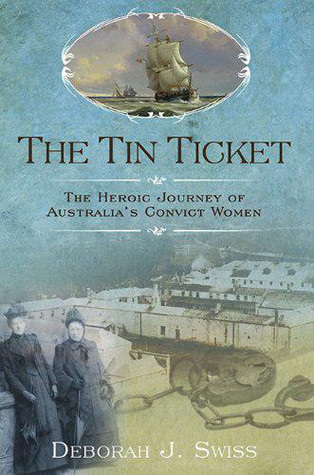
Chapter 10: Bendigo’s Gold
Bendigo’s Gold is the story of the families now being followed in The Tin Ticket as they move toward the gold rush in the gold fields of Victoria. It provides a short, almost rushed account, of life for those heading off to make their fortune in the gold fields. As always, an insight into this period is provided, right down to various incidentals of what life was like for these prospectors. There was the very real prospect of being robbed, both by bushrangers on the roads leading to the gold fields and the inspectors on the gold fields. Life was a difficult prospect for most during the gold rushes and especially so for those with young families.
Included in this chapter is an account of events leading up to the rebellion that has come down to us in history as the Eureka Stockade, which began as the fight for miners rights and finished with that bloody battle and the crushing of the miners rebellion.
There are further brief descriptions of what the lives of each of the three women and their descendants brought for them. The narrative though is quickly brought to a conclusion toward the end of chapter 10 and there is a sense that more could have been told regarding the stories of these remarkable women and their thirst for freedom in the Australian bush.
Chapter 10 is essentially the end of the book proper, though there are a number of appendixes following the end of this chapter. Overall, I think the book tends to be a bit rushed in sections, though well written. I have a bit of a thing for detail and appreciate more thorough investigations within nonfiction works, yet still found this book to be a very valuable contribution to the written history of early colonial Australia. I would highly recommend The Tin Ticket to anyone with an interest in Australian history and our convict past.
I think I would give it somewhere between a 3.5 and 4 out of 5 as a rating.
Buy this book at Amazon:
http://www.amazon.com/gp/product/B0043RSIWI/
Chapter 9: Flames of Love
‘Flames of Love’ begins a new chapter of life and love for each of the three main women characters and convicts of the book. Each of the three women – Agnes McMillan, Janet Houston and Ludlow Tedder – are now free and each fall in love and marry as they start new lives in Van Dieman’s Land. The narrative presents the reader with a different picture from that which has gone before. Prior to chapter 9 the stories for all three women were dominated by affliction and sadness, now there is joy and great hope. There is a measure of sadness though in the realisation that these firm friends will not see each other again, as they each go about living their new lives.
Interwoven into the narrative of the three women and the new lives that each are now pursuing, are the winds of change in Van Dieman’s Land and indeed Australia as a whole. That dreadful punishment of transportation is coming to an end and the process of how that came about in Van Dieman’s Land and the long enduring consequences of transportation on the colony are highlighted throughout the chapter.
Also of great interest in this chapter are the stories of the men that have entered the lives of each of the three women, providing further insight into the lives of those living in this period of Tasmania’s and Australia’s development and growth. Australia does present itself as a far more attractive prospect for all three women and their partners than Britain ever did. There are still many horrific experiences in the everyday happenings of colonial Van Dieman’s Land which play a role in the lives of The Tin Ticket’s main characters – bushrangers, the wholesale extermination of Aboriginal people, etc.
Buy this book at Amazon:
http://www.amazon.com/gp/product/B0043RSIWI/
 At the BookShelf
You must be logged in to post a comment.