Unknown's avatar

Booker Prize 2018: Anna Burns wins, but the big publishers are the real victors


Leigh WIlson, University of Westminster

In the literary world and among those for whom fiction is an interest beyond simply reading books, a great deal of attention will be given to the winner of 2018’s Man Booker Prize, Milkman, by Anna Burns. The chair of the judges, philosopher Kwame Anthony Appiah, said Burns’ novel, about a young woman being sexually harassed by a menacing older man and set in Northern Ireland, “is a story of brutality, sexual encroachment and resistance threaded with mordant humour”.

Of course, each year, following the announcement of the longlist in July, the shortlist in September and finally the winner in October, a discussion takes place as to what each announcement might mean. As the Man Booker is the most prestigious, remunerative and talked about literary prize in the UK, this “what does it mean?” can be made to reach into just about every crevice of contemporary culture.
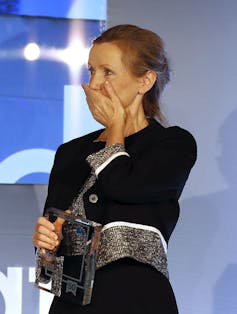
Anna Burns wins the 2018 Man Booker for Milkman.
Frank Augstein/PA

This year has been no exception – discussion of the longlist was dominated by the inclusion of a graphic novel, Nick Drnaso’s Sabrina, and discussion of the shortlist by the presence or absence of millennial writers. Discussion of Milkman will no doubt be dominated by the history of Northern Ireland, by #MeToo and by the fact that Burns is the first UK-born winner for six years.

In these accounts, the significance of the prize is restricted to thinking about those novels that reach the long or shortlist or the one that is declared the final winner. But a range of work from various wings of literary studies over the past few years can help us to answer the question of what winning means in other, perhaps more challenging, ways.

1. It’s a competition

The underlying claim of James F. English’s pioneering 2009 work in the sociology of literature, The Economy of Prestige: Prizes, Awards and the Circulation of Cultural Value, is that both the power of and the problem with prizes consists in the way they equate “the artist with the boxer or discus thrower”. Prizes are competitions.

But while the publicity might go to the winning writers, the real winners are the publishers, who need not just the increased sales and chances of film and TV adaptations that are likely to follow, but also the less tangible boost to their authority and prestige given by a prize. The real winners are also more likely to be not just any publishers, but those that have already been successful. As the novelist Joanna Walsh, among others, has noted, the Man Booker rules make submissions from small publishers very tricky because of the size of the print run required and the amount of money that involves. Because of this, a win can be a drain rather than a boost, and costs can outstrip sales if you don’t win.

2. A competition that maintains a monopoly

It’s not just that the competition is hard for small presses to enter – the big publishers have an near monopoly. In the 50 years that the prize has existed, literary publishing in English has been transformed from being made up of numerous independent companies, often family run, to being almost entirely dominated by the “big five”. These are Penguin Random House, Hachette, HarperCollins, Macmillan and Simon & Schuster. And, further, each of these is itself owned by a multinational media conglomerate.

As the sociologist John Thompson noted in his book, Merchants of Culture: The Publishing Business in the Twenty-First Century, the economies of scale made possible through mergers and acquisitions have created this almost complete monopoly. But through publishing via supposedly “separate” imprints, the big five have maintained an aura of smallness which is more conducive to the “creativity” on which their profits are ostensibly based.

Over the past 20 years, while 12 different publishers appear to have published the novels which were awarded the Prize, six of these wins were for imprints belonging to Penguin Random House. This monopoly is maintained through the prize’s rules for submissions – the number of novels a publisher can submit is directly tied to the number of longlisted novels they have had over the past few years. An imprint already marked as prestigious is more likely to win again.

3. It maintains a certain model of publishing

In his article about Amazon and its relation to contemporary literary fiction, US literary scholar Mark McGurl suggests the extent to which reading of material normally scorned by the literary critic can deliver new insights.

And close reading of the Man Booker’s rules of eligibility – while perhaps dry in comparison to reading the winner on the bus or with a reading group – is also revealing. It shows that it is not just a competition for a small number of large publishers, but that the prize is largely about the maintenance of a certain idea of publishing, too.

The rules of eligibility are almost entirely now about the publisher, rather than the novel or novelist – and key to them is the exclusion of anything with a whiff of self-publishing about it. In order to be eligible, a publisher has to prove that they are based in the UK or Ireland, but the only way of proving this is by having the accoutrements of the conventional publisher. Eligible submissions must come from publishers with ISBNs and head offices who use retail outlets for print books and who publish at least two literary novels a year. Rule 1g, through its strange, uncomfortable tautology, betrays something of just what is at stake in this: “Self-published novels are not eligible where the author is the publisher.”

What the various methods of literary studies can suggest, then, is that, contrary to nearly everything written elsewhere about the Man Booker Prize, it arguably doesn’t really matter which novel wins. Whichever wins, I’d suggest that the real winner is an intensely conventional notion of publishing. It’s an idea of publishing where sales and prestige are the most important consequences of winning prizes and where a few very large publishers dominate.

And, to continue that domination, the most novel uses of contemporary technology, which can open up spaces for the most innovative aesthetic forms become illegitimate. If you want to see examples of this kind of work, look to the recently published novel, Gaudy Bauble, by Isabel Waidner (published by Dostoyevsky Wannabe) – a book of experimental writing published in an innovative way. Under the current rules, such novels could never gain the coverage and attention offered by the Booker. And that’s a great pity.The Conversation

Leigh WIlson, Professor of English Literature, University of Westminster

This article is republished from The Conversation under a Creative Commons license. Read the original article.
Unknown's avatar

Man Booker Prize: Various Articles


The links below are to various articles related to the Man Booker Prize, including this year’s winner.

For more visit:
https://lithub.com/anna-burns-wins-the-2018-man-booker-prize/
https://bookmarks.reviews/every-man-booker-prize-winner-of-the-21st-century/
https://www.nytimes.com/2018/10/14/books/how-to-judge-booker-prize-val-mcdermid.html

Unknown's avatar

2018 Man Booker Prize Shortlist


The link below is to another article reporting on the 2018 Man Booker Prize shortlist.

For more visit:
https://www.npr.org/2018/09/20/649853483/from-everything-under-to-overstory-the-2018-man-booker-prize-shortlist

Unknown's avatar

2018 Man Booker Prize Shortlist


Unknown's avatar

2018 Man Booker Shortlist


The links below are to articles that look at the 2018 Man Booker Prize shortlist.

For more visit:
https://www.booktopia.com.au/blog/2018/09/20/2018-man-booker-shortlist-announced/
https://publishingperspectives.com/2018/09/man-booker-prize-fiction-names-2018-shortlist/
https://www.theguardian.com/books/2018/sep/20/man-booker-2018-shortlist-daisy-johnson-anna-burns-rachel-kushner-richard-powers-esi-edugyan-robin-robertson
https://bookriot.com/2018/09/20/the-man-booker-prize-shortlist-is-here/

Unknown's avatar

Best Man Booker Prize Winner According to Public Vote – The English Patient, by Michael Ondaatje


The link below is to an article reporting on the best Man Booker Prize winner as voted by the public.

For more visit:
https://www.theguardian.com/books/2018/jul/08/the-english-patient-wins-public-poll-of-best-man-booker-in-50-years

Unknown's avatar

More on the IKEA Reading Rooms in London


The link below is to another article reporting on the IKEA reading rooms in London associated with the Man Booker Award.

For more visit:
https://publishingperspectives.com/2018/07/ikea-wembley-uk-and-man-booker-prize-create-reading-rooms/

Unknown's avatar

‘Graphic novels are novels’: why the Booker Prize judges were right to choose one for its longlist


File 20180726 106517 614tnv.jpg?ixlib=rb 1.1
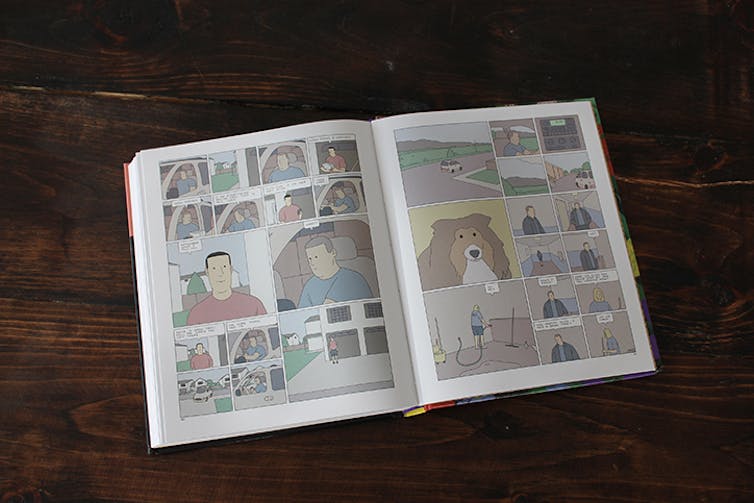
Illustration from NickDrnaso’s Sabrina.
ItsNiceThat

Claire Nally, Northumbria University, Newcastle

Following the announcement that Nick Drnaso’s Sabrina is the first graphic novel ever to be longlisted for the Man Booker Prize, Joanne Harris (the author of Chocolat) tweeted #TenThingsAboutGraphicNovels and stated simply: “graphic novels are novels”.

Once upon a time, graphic novels may have been viewed as disposable – and not especially literary – but such a value judgement has long since been challenged.

The graphic autobiography has become especially visible in recent years, with a noteworthy example being Persepolis by Marjane Satrapi (2000) – which details her experiences as a young woman during and after the Iranian revolution in 1979. The novel was adapted into a film in 2007.

A woman’s voice: Persepolis by Marjane Satrapi.
Pantheon Books

The comic book has a long and rich history, as Scott McCloud’s 1993 book Understanding Comics explains. He looks at a pre-Columbian text from the Codex Nuttall about 8-Deer “Tiger’s Claw”, discovered by the Spanish conquistador Hernan Cortés around 1519. McCloud argues we can think about such early texts as comics.

Terminology is important here, too. The word “comics” usually refers to serialised publications – whereas “graphic novels” are issued as books. That said, they share many artistic and literary characteristics. Author Alan Moore has rejected the term “graphic novel” (along with the film versions of his work), suggesting it is nothing more than a marketing term. So, in no particular order – and with that caveat in mind – here are my top five literary reads in graphic novel and comic book genres.

Grandville (2009)

Author Bryan Talbot is well-known to comic and graphic novel fans, having penned The Adventures of Luther Arkwright in the 1970s and 1980s. Grandville is the first volume in a series of five, which tells the investigative story of a badger detective, Detective Inspector LeBrock, accompanied by his trusty sidekick, Roderick the Rat.

In this anthropomorphic universe, humans feature in servile roles as an underclass, with some critical comparisons to post-9/11 racial stereotypes. The Grandville of the title is an alternative history Paris, lovingly characterised with steampunk details and Belle Époque style. The city of Grandville takes its name from the pseudonym of a French artist, Gérard Grandville, famed for his satire of French politics and society.

An illustration by celebrated 19th-century caricaturist Gérard Grandville.

The book wears its intellectualism lightly – but, for those with a keen eye, look out for cultural references to Édouard Manet, Augustus Egg, Sarah Bernhardt, and intertexts such as Conan Doyle’s Sherlock Holmes stories, as well as children’s classics including Wind in the Willows, Tintin and Rupert the Bear.

From Hell (1999)

Alan Moore needs little introduction to cult readers or the academic community. He has amassed a wealth of literary criticism about his work, including plenty of material about the title I have chosen, From Hell. This was originally issued in serial form and later published as a single-volume collected work – the version with which most readers will be familiar.

From Hell was made into a film with Johnny Depp and Heather Graham. The author disapproved.
Twentieth Century Fox

From Hell is not for the squeamish: it retells in gruesome detail the Whitechapel murders of the late 19th century, speculating Jack the Ripper was Sir William Gull, Queen Victoria’s royal physician. Gull’s murder spree, seeking to suppress an illegitimate heir to the throne and filtered through a lens of masonic imagery and misogyny, takes us through a psychogeographic tour of London.

Eddie Campbell’s exquisite illustrations contrast the privileged suburbs in which Gull lives with the poverty-stricken degradation of Whitechapel’s citizens.

Partly fictional and partly factual, the book is a wonderful parody of the dark tourist interest in the murders, with the careful reader becoming increasingly self-conscious of their own uncomfortable complicity in the narrative.

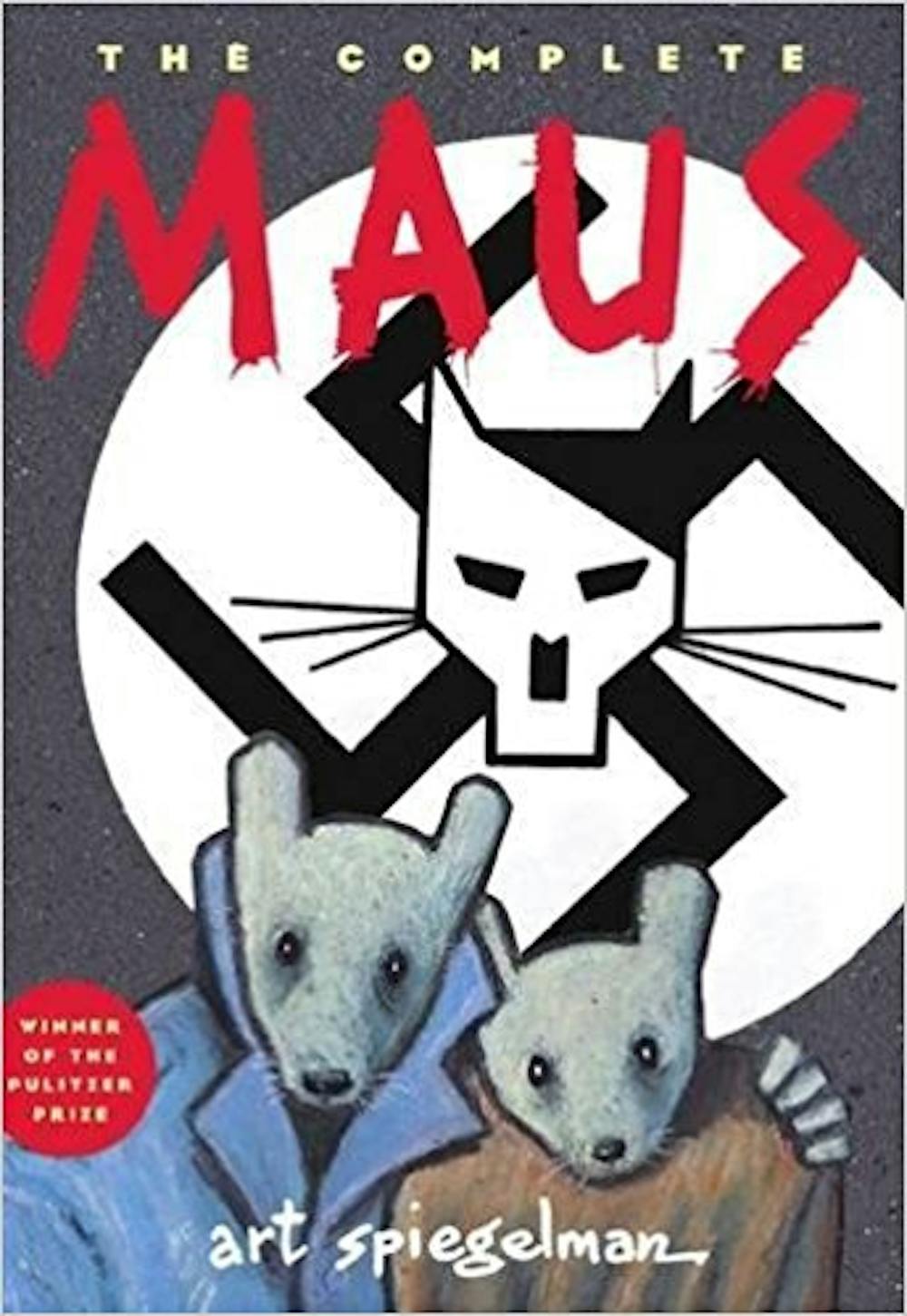
Maus (1991)

Like From Hell, Art Spiegelman’s Maus was originally published in serial form. Spiegelman began writing in 1978, telling the story of his father, Vladek Spiegelman, a Holocaust survivor.

In many ways, the text defeats simplistic categories and genres: it is a fiction, an autobiography and a history.

Powerful and moving: Art Spiegelman’s Maus.
Amazon

It is also another anthropomorphic story in which Nazis are cats and the Jewish community are characterised as mice. The reader is placed in the unenviable but important position of bearing after-witness to the trauma of the Nazi regime, a point enhanced by the use of literary devices such as the framing narrative.

Spiegelman uses the more recent moment of the late 1970s and interviews with his elderly, widowed father as a departure point to revisit the 1930s through to the end of the Holocaust in 1945.

Spiegelman’s book won a Pulitzer Prize in 1992.

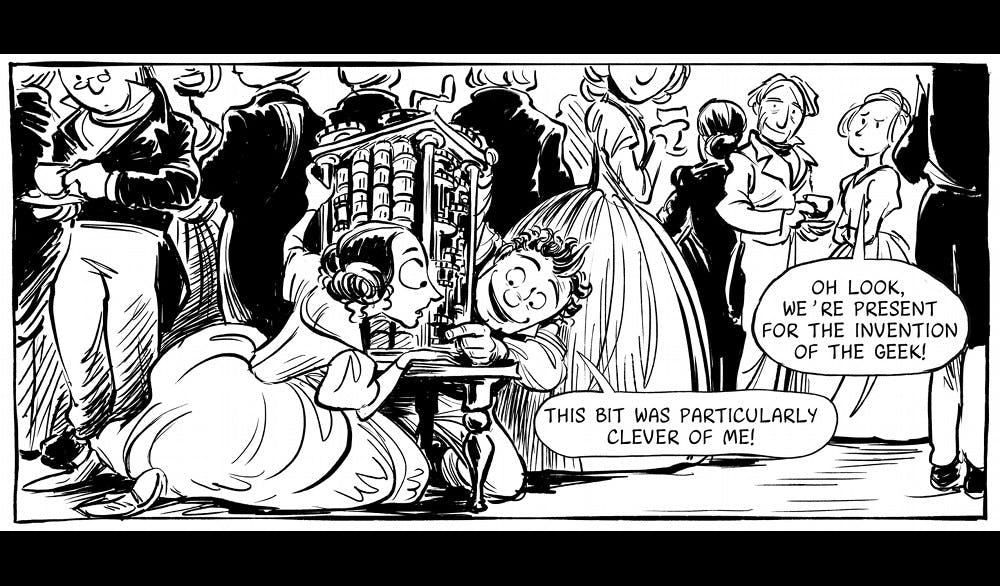
The Thrilling Adventures of Lovelace and Babbage (2015)

Sydney Padua’s witty black-and-white graphic novel describes itself as “an imaginary comic about an imaginary computer”. It foregrounds Ada Lovelace’s contribution to Charles Babbage’s Difference Engine, the herald of our modern computers.

Fun with history’s greatest geeks.
ScienceFriday.com

Like other examples here, the narrative is situated in an alternative universe, which offers a view of what would happen if the Difference Engine had been built. Along with an adventure plot, the graphic novel features references to a wealth of 19th–century characters such as Samuel Taylor Coleridge and the Duke of Wellington. It has elaborate pseudo-factual footnotes and endnotes of which writers such as Flann O’Brien or Mark Z. Danielewski would be proud.

Dotter of Her Father’s Eyes (2012)

It would be very remiss of me, as a longstanding aficionado of James Joyce, to omit reference to this Costa award-winning graphic memoir by Mary M. Talbot (with illustrations by Bryan Talbot, the writer’s husband), which follows Lucia Joyce’s troubled relationship with her father, and draws parallels with the author’s own relationship with her father, the eminent Joyce scholar James S. Atherton.


Read more:
Guilty Pleasures: an English literature professor’s secret stash of graphic novels


Lucia’s tragic love for Samuel Beckett – and her thwarted ambition to become a dancer – are beautifully juxtaposed with Talbot’s recollections of her upbringing, alongside the difficulties experienced by both talented women growing up with writerly fathers. Strategic use of colour, sepia tones and the frequent use of the Courier typeface (as well as Talbot’s own personal lettering font which features throughout his work), make this book an aesthetically delightful read.

So many masterpieces, so little time

Of course, there are many artists and writers I have omitted from this list – not least figures such as Neil Gaiman, whose work The Sandman (1989-) has been critically acclaimed, pushing as it does the Gothic tropes and metaphysical reflections of the genre.

For those of a humorous inclination, Kate Beaton’s webcomic Hark, A Vagrant (published as a book in 2011) is an affectionately irreverent look at literature and history, including the hilarious Dude Watchin’ With the Brontës.

The ConversationThere are also the recent works lauded in the Will Eisner Comic Awards, held earlier this month in San Diego as part of Comic-Con. Further reading can be found on that list.

Claire Nally, Senior Lecturer in Twentieth-Century English Literature, Northumbria University, Newcastle

This article was originally published on The Conversation. Read the original article.

Unknown's avatar

IKEA ‘Reading Rooms’


The link below is to an article reporting on ‘reading rooms’ being set up by IKEA in London to celebrate the announcement of the Nam Booker Prize longlist.

For more visit:
https://www.thebookseller.com/news/ikea-creates-reading-rooms-celebrate-man-booker-longlist-833651

Unknown's avatar

The Guardian on the 2018 Man Booker Longlist


The links below are to articles by The Guardian on the 2018 Man Booker Longlist.

For more visit:
https://www.theguardian.com/books/2018/jul/23/new-voices-but-less-global-the-man-booker-longlist-overturns-expectations
https://www.theguardian.com/books/gallery/2018/jul/24/man-booker-prize-2018-longlist-in-pictures
https://www.theguardian.com/books/2018/jul/24/man-booker-prize-2018-longlist-nick-drnaso-sabrina-ondaatje-graphic-novel
https://www.theguardian.com/books/audio/2018/jul/24/michael-ondaatje-and-the-booker-longlist-books-podcast