
The link below is to an article reporting on the 2018 Beijing International Book Fair.
For more visit:
https://publishingperspectives.com/2018/07/beijing-international-book-fair-2018-anticipates-93-countries/

The link below is to an article reporting on the 2018 Beijing International Book Fair.
For more visit:
https://publishingperspectives.com/2018/07/beijing-international-book-fair-2018-anticipates-93-countries/
The link below is to an article that looks at the missing booksellers of Hong Kong.
For more visit:
https://www.nytimes.com/2018/04/03/magazine/the-case-of-hong-kongs-missing-booksellers.html
The link below is to an article that takes a look at the rise of South Korean authors and thrillers.
For more visit:
https://www.theguardian.com/books/2018/mar/03/the-new-scandi-noir-the-korean-writers-reinventing-the-thriller
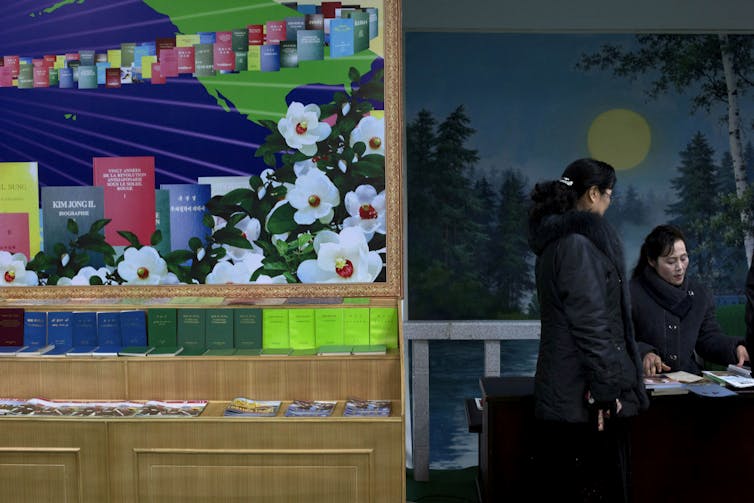
Meredith Shaw, University of Southern California – Dornsife College of Letters, Arts and Sciences
With colorful rhetoric about dotards and nuclear buttons, North Korean propaganda is attracting attention around the world.
Outside observers can now easily access some of this propaganda by visiting regime-sponsored websites. These have, in turn, spawned foreign feeds like the excellent KCNA Watch media aggregator and satirical sites such as “Kim Jong Un Looking at Things.”
However, there’s another side to North Korean political messaging, one directed at the domestic population.
Difficult to access and written in a highly stylized, dogmatic prose, North Korea’s domestic propaganda is not only largely ignored abroad, but it’s also difficult for even South Koreans to understand. It includes state-sponsored Chosun Central TV broadcasts, state-produced films, and revolutionary operas and ballads.
But one of the more illuminating forms of internal propaganda is the regime’s state-produced fiction. Published in monthly literary journals, these stories are distributed by the ruling Korean Workers’ Party to select schools and offices around the country.
In an effort to make this internal propaganda more accessible to non-Koreans, I have been translating and blogging about selected works of North Korean fiction as part of my research on North Korean cultural politics.
These stories can offer outsiders revealing insights into the regime’s shifting concerns and priorities, which include a recent campaign to reinforce the legitimacy of their young leader, Kim Jong Un.
No other autocratic regime today has such a well-developed stable of artists and writers producing works aligned with the party’s ideological needs. The ruling Korean Workers’ Party has an extensive bureaucracy in charge of training talent, defining standards and commissioning projects in literature and other branches of the arts.
Like most professionals within North Korea, fiction writers belong to their own organization within the ruling Korean Worker’s Party: the Chosŏn Writer’s Union. The Party, therefore, has direct control over what gets written about and which themes get emphasized.
Works of fiction are published in one of a handful of monthly literary journals, the most prestigious of which is Korean Literature, produced by Chosŏn Literature and Art Union Publishing. Other journals include Children’s Literature, Youth Literature and Literary Newspaper.
Within the Chosŏn Writer’s Union, the most elite authors comprise the April 15 Literary Production Unit. This group has produced all the major works dramatizing the personal histories of the leaders, including the “Immortal History” (Pulmyŏl ŭi Yŏksa) and “Immortal Leadership” (Pulmyŏl ŭi Hyangdo) series, which constructed the official hagiography of Kim Il Sung and Kim Jong Il, respectively.
The list of authorship of new fiction about Kim Jong Un reveals many well-known names from these series, including Kim Sam Bok, Baek Bo Hŭm and Chŏng Ki Jong. Chŏng, one of North Korea’s most well-known contemporary authors, passed away in 2016, but not before penning the short story “Sky, Earth and Sea,” which details Kim Jong Un’s role in the Ŭnha and Gwangmyŏngsŏng satellite launches.
Since consumer demands and preferences are irrelevant to the creation of North Korean fiction, it cannot be evaluated as a reflection of the average North Korean’s underlying social anxieties (which is how a cultural anthropologist might study literature). Through interviews with North Korean defectors living in Seoul, I found that most North Koreans don’t spend their leisure time reading these journals for fun. Many, however, told me that they had been exposed to these stories at some point in school.
The anthropologists’ loss, however, is the political scientists’ gain. North Korean fiction offers a window into the ruling party’s priorities that’s just as informative as its official, externally directed propaganda.
Many of these stories dramatize events in the leaders’ lives. Some are morality tales that showcase characters who embody certain socialist ideals. Others reflect concerns about the geopolitical landscape – and, not surprisingly, American leaders sometimes make guest appearances.
Chŏng Ki Jong’s most famous novel, “Ryŏksa ui Taeha,” depicts President Bill Clinton cowering under blankets during the 1994 nuclear crisis. Another short story from around that time, “Maehok,” tells the story of President Jimmy Carter’s famous 1994 visit from the perspective of his wife Rosalynn, as she meets (and is smitten with) the Great Leader Kim Il Sung.
More recently, however, stories have centered on one subject: Kim Jong Un.
Kim was formally designated as successor in September 2010. Prior to that, his very existence had been virtually unknown to the general public within the country. In a country where schoolchildren ritualistically memorize idealized accounts of their leader and his ancestors, it must have been mind-boggling to see a new leader on TV that they knew almost nothing about.
The regime had to rush to put together a personal legend worthy of the grandson of the nation’s founder. The first works of fiction to mention Kim by name appeared in early 2013, over a year after he succeeded his late father as leader. In these stories, there’s a marked thematic shift, with an emphasis on youth, creativity and innovation.
For example, the 2017 short story “Blossoming Dreams,” by Kim Il Su, depicts the young leader as a talent scout of sorts. He finds gifted young artists and architects and encourages them to participate more fully in various national construction projects. At one point he pontificates to one of his advisers about the value of youthful thinking:
“Our future as a socialist nation of culture will not be built by architects and experts alone. It will require all our citizens to become gardeners and creators adorning our country with beauty. And it is the young generation that must stand up to bring about this bright future. Lately, I hear the saying ‘everything’s getting younger,’ but isn’t that wonderful? This era is young, and our people are getting younger … ”
References to new luxuries and recreational facilities are another notable feature of recent stories. Since Kim became supreme leader, he has poured resources into developing Western-style amusements such as water parks and ski resorts.
One such site, the Rungna People’s Pleasure Ground, attracted international media attention after Kim Jong Un toured the facility in 2012 on his first official photo op with his new wife. An ode to the Rungna park appeared in Literary Newspaper in October 2012, celebrating it as “the creation of heaven and earth following the leader’s path.” In “Blossoming Dreams,” Kim Jong Un’s faithful minister of architecture recalls how the young leader “suffered in the summer heat and fierce winds” when touring the site of the soon-to-be-opened theme park.
A similar prestige project is the new Changjŏn Street complex in Pyongyang, which features gleaming, high-rise apartment buildings and sports facilities.
In “Teacher,” a short story published in 2013, a family of schoolteachers is thrilled to receive notice that they have been given a spacious new apartment in the Changjŏn complex. The family is surprised to learn they made the list: It’s well known that the first apartments were supposed to go to “workers and innovators.” Later it becomes clear that Kim Jong Un personally directed that some apartments be set aside for educators as well, as part of a general priority for “cultivating the next generation.”
North Korean fiction, of course, shouldn’t be interpreted as a realistic depiction of actual conditions within the country.
 But by reading between the lines, one may discern clues to the regime’s internal concerns, along with the messages it is most eager to convey to its captive domestic audience.
Meredith Shaw, Ph.D. Candidate in the Politics and International Relations, University of Southern California – Dornsife College of Letters, Arts and Sciences
This article was originally published on The Conversation. Read the original article.
Manneke Budiman, University of Indonesia
Indonesia is the world’s fourth most populous country and among the most culturally diverse. Yet not many people are familiar with literary works by Indonesian writers. Why is that? Well …
Indonesian literature plunged into obscurity following an anti-communist massacre in 1965-1966 that brought Suharto’s repressive New Order regime to power.
As we enter the 50th year of the communist purge, this is about to change. Indonesia is the Guest of Honour in this year’s Frankfurt Book Fair, taking place from October 14 to 16.
That means, for the first time, Indonesian literature is in the global spotlight at the world’s largest book festival.
Below, Manneke Budiman, of the University of Indonesia’s literature department, gives an introduction to Indonesian literature and explains how colonial legacy plays a part in determining “Third World” authors’ place on the international literary stage.
Indonesian literature is not widely known compared to works from other countries. Writings of Indonesian authors do not get translated as much as works by other authors of “Third World” countries. Colonial legacy plays a part in this.

Penguin
Authors from the former colonies of France and England have the attention of French or British publishers that own a large international market share. Big publishing houses such as Heinemann and Penguin have translated and published authors from India, Kenya, Senegal, Egypt, and Morocco.
In contrast, Dutch publishers rarely publish literary works from their former colonies, which includes Indonesia. Except for academic publishers, there are only few, if any, Dutch publishers with international access to global market.
Pramoedya Ananta Toer’s Buru Quartet, published by Penguin, are the rare works that got translated into foreign languages during Suharto’s rule. His tetralogy eventually caught the attention of the Noble Prize Committee, which nominated him several times for the Noble Prize in Literature.
The Nobel Prize nominations show that Indonesian literature is not inferior to the literature of other countries. But there are questions as to whether it was his works or his status as political prisoner that made the Nobel Committee nominated Pramoedya. Some wondered whether the Committee nominated Pramoedya to pressure the Indonesian government to release him from prison.

Equinox Publishing Indonesia
Literary production remained consistently high even during the repressive era of Suharto.
In the 1970s and 1980s, works by women authors – such as Mira W., Marga T., La Rose, Ike Supomo, Titi Said, Nh. Dini, and Marianne Katoppo – dominated the scene. But many male critics tended to brush them aside as “women’s fiction”, which carries a negative connotation of having low literary quality.
After Suharto’s regime collapsed, the atmosphere changed dramatically. More women began to write. Very soon there was an “explosion” of titles by a new generation of female authors such as Ayu Utami, Linda Christanty, Nukila Amal, Fira Basuki, and Dewi Lestari. Ayu Utami’s Saman, for instance, has been translated into several Asian and European languages.
The styles and characteristics of Indonesian literature change from time to time. They sometimes follow the political dynamics of the country and the region.
In the colonial era, local authors were heavily inspired by Western novels and poetry. Many writers produced adaptations of Western fiction in their local setting or even “plagiarised” works produced by their Western counterparts. Popular works such as Robinson Crusoe, The Count of Monte Cristo, and Sherlock Holmes were translated and adapted in Malay, Sundanese and Javanese languages in the late 19th century in the Netherlands Indies by Dutch, Chinese and indigenous translators.
In the 1920s and 1930s authors were preoccupied in finding the “right” language. Writers such as Sutan Takdir Alisjahbana and Sanusi Pane debated whether Indonesia had to abandon its traditional values and fully embraced Western modernity or vice versa.

Dalang Publishing
In the 1940s, as the nation struggled to free itself from colonial rule, authors became more straightforward and blunt. As the Japanese invaded and defeated the Dutch, a spirit of nationalism and militancy grew among authors. They also experimented with forms that were “borrowed” from the West – such as English war poems and works of fiction by European writers. Chairil Anwar and Idrus are examples par excellence of this instance.
Chairil’s poem, Antara Kerawang dan Bekasi (Between Kerawang and Bekasi) is suspected to be an adaptation of Sir Archibald Clark Kerr’s poem, whereas Idrus’ short-stories show striking similarities with works written by European writers in terms of the modernist ideas in his works, as discussed by Indonesian studies expert Keith Foulcher.
The Golden Age of Indonesian literature, according to many scholars, was the period between the 1950s and 1960s. Authors were working out how to connect traditions and local flavors with modern trends in literature.
In that period, the Cold War was raging. Many authors were fiercely involved in ideological tug of wars among themselves. Authors also began to seriously search for a distinct Indonesian identity through their works that could become part of the world culture. Unfortunately, that vibrancy had to abruptly end with the take over of power from Sukarno to Suharto.
After Suharto stepped down in 1998, there was a brief moment of euphoria among authors as freedom of speech and democratisation began to flourish. But the 32-year authoritarian rule seemed to have taught them not to be too optimistic. This is clearly reflected in the works of the post-Suharto writers, which are strongly marked by doubt and ambiguity about the future.
In those works, readers may sense a yearning for freedom from the haunting legacy of Suharto’s rule.
Realism remains to be the dominant style, although sometimes it also blends with some kind of romanticism – a nostalgia for the lost past – and a sense of disillusionment that replaces it.

Dalang Publishing
There is also a trend of looking outward to what happens in other parts of the globe. Contemporary Indonesian writers are curious and adventurous in embracing cosmopolitanism and transcending national boundaries.
That’s particularly visible in the works of many current women authors. At the same time, their works also rebel against customary laws and traditions that marginalise women.
Young authors are not oblivious to the conditions of their country. They show genuine concern about what has happened in outer islands outside the primary island of Java.
Amid the relatively meagre attention from big international publishers to Indonesian authors, a foundation and a small publishing house in the US are working to bring more English translations of Indonesian literature to international readers.
Lontar Foundation, founded by American John McGlynn, has done extraordinary work translating and publishing Indonesian literature in English. Lontar regularly publishes the Menageries Series containing translated works by Indonesian authors. It also published a collection of poems written by Indonesians about their American experience (On Foreign Shore) and a series of Indonesian classics.

Lontar
California-based Dalang Publisher, owned by Lian Gouw, a Chinese-American who spent her childhood in Indonesia before her family migrated to the US, has published several works of contemporary Indonesian writers in high-quality translation.
Some of the works that have been published by Dalang in translation are Remy Silado’s My Name Is Mata Hari (Namaku Mata Hari), Lan Fang’s novel Potions and Paper Cranes (Perempuan Kembang Jepun), Erni Aladjai’s Kei, Anindita S. Thayf’s Daughters of Papua (Tanah Tabu), Ahmad Tohari’s The Red Bekisar (Bekisar Merah), and Hana Rambe’s Cloves for Kolosia (Aimuna dan Sobori).
That list is by no means exhaustive, and it keeps on growing. Gouw seems to have a sharp sense of knowing which works may appeal to non-Indonesian audience. Her choices include works that are concerned with pluralism, ethnic and religious conflicts, colonialism, and injustice.
McGlynn, meanwhile, prefers choosing works of established or well-known authors, such as the poet Sapardi Djoko Damono, short-story writer Seno Gumira Ajidarma, and novelist Oka Rusmini.
There are other small-scale publishers that have published Indonesian works in German, Dutch, and French. But in general those publishers do not have the requisite international stature to draw a significant attention.

Lontar
Pramoedya’s tetralogy – The Earth of Mankind, The Child of All Nations, Glass House, and Footsteps – remain the most important books for foreign readership. Mangunwijaya’s The Weaverbirds is another classic that has become a must-read. These two senior authors are the best introduction to the dynamics and complexities of Indonesian society.
Oka Rusmini (Earth Dance), Seno Gumira Ajidarma (Jazz, Perfume & the Incident), Nukila Amal (Cala Ibi), Ayu Utami (Saman), belong to the generation that follows; and then young writers such as Erni Aladjai (Kei), Lan Fang (Potions and Paper Cranes), Anindita Thayf (Daughters of Papua), and Okky Madasari (Maryam).
The works of the new generation of writers works contain rich panorama of Indonesian social, cultural, and political dynamics viewed from different generational lenses.
The Frankfurt Book Fair runs until October 16. Details here.

Manneke Budiman, Lecturer at the Literature Department, University of Indonesia
This article was originally published on The Conversation. Read the original article.
The link below is to an article that looks at the rebuilding process for libraries following the earthquakes in Nepal.
For more visit:
http://www.worldbulletin.net/?aType=haber&ArticleID=159429
 At the BookShelf
You must be logged in to post a comment.