It started when an American academic noticed how frequently the acknowledgements sections of weighty academic tomes featured a male author thanking his nameless wife for typing.
The academic, Bruce Holsigner, began sharing the screenshots on Twitter under the hashtag #ThanksforTyping.
And the response was stupendous. As the screenshots flooded in, a veritable army of unpaid women suddenly became visible. Not only were they typing, and retyping, but translating and editing and – um – doing the actual research.
Of course #ThanksForTyping is not a practice that’s confined to academics. A considerable portion of the western canon is built on the unpaid labour of women.
So here’s my top ten list of the male writers who thanked – or failed to thank – their long-suffering wives.
1) Leo Tolstoy
Sophia Tolstaya not only gave birth to Leo’s 13 children, she also published his books and took care of the family’s financial interests. She acted as her husband’s secretary, famously copying out War and Peace – including multiple revisions – seven times. In the age before the typewriter, the writing was all done by hand. Leo, as scholars have established, was a lot less than grateful. At age 82, following the legendary act of renunciation in which Leo gave away significant amounts of the couple’s property to roam the country with a begging bowl, his family was left impoverished.
Stenography, or writing in shorthand, was a popular occupation for writer’s wives. In 1866, Fyodor Dostoyevsky employed a stenographer named Anna Grigoryevna to help him finish his novel The Gambler, for which he had signed a risky contract. If he did not deliver by November his publisher F. T. Stellovsky would acquire the right to publish Dostoyevsky’s works for a further nine years without any compensation. Fyodor dictated The Gambler, and Anna wrote it down in shorthand, then copied it out neatly. Fyodor proposed to Anna within eight weeks, and married her two months later. Anna took over her husband’s financial affairs, made Fyodor give up gambling, and stopped him from signing further dodgy contracts.
3) T.S. Eliot
As well as being the most influential poet of his time, T.S. Eliot was a director of Faber & Faber, in which capacity he employed a typist named Esme Valerie Fletcher as his assistant. Towards the end of 1956, the 68-year-old poet proposed marriage. He wrote the poem A Dedication to My Wife, which is filled with lines like “To whom I owe the leaping delight” and other adoring phrases which are almost un-Eliot-like in their warmth and sentimentality. After his death, Valerie became the editor and annotator of Eliot’s works.
4) Vladimir Nabokov
Nabokov’s wife, Vera, was her husband’s sternest critic and biggest fan. Vera acted as his typist, editor and literary agent, and did all the driving. Vera was vigilant in making Vladimir rewrite his fastidious prose if it wasn’t up to scratch. There’s also a story that she saved Lolita from the flames, when the manuscript was abandoned in a bout of frustrated rage.
5) William Wordsworth
Not only did William Wordsworth’s sister Dorothy produce the fair copies of her brother’s work, but his wife and sister-in-law also helped out with the transcribing. Rumour has it that Dorothy did far more than simply transcribe: she also acted as his literary executor after his death, and edited his unpublished works.
6) F. Scott Fitzgerald
Fitzgerald was more indebted to his wife Zelda than he ever let on. As Zelda scathingly announced, after the publication of This Side of Paradise:
I recognize a portion of an old diary of mine which mysteriously disappeared shortly after my marriage, and also scraps of letters which, though considerably edited, sound to me vaguely familiar. In fact, Mr. Fitzgerald—I believe that is how he spells his name—seems to believe that plagiarism begins at home.
In a recently published book The Subversive Art of Zelda Fitzgerald, by my colleague Deborah Pike, you can finally read some of these stolen passages and their sources side by side.
The French novelist Colette, 1890. Wikimedia Commons
7) “Willy” aka Henry Gauthier-Villars
“Willy” was the pen name of the once famous but now forgotten writer Henry Gauthier-Villars, a tremendously successful self-promoter and author of 50 novels penned by a stable of ghostwriters, including his wife. The apocryphal story goes that Henry would go so far as to lock his wife in a room until she had produced the desired quantity of prose. One day his wife, deciding she had finally had enough, left. She published the rest of her work under a surname you might recognise: Colette.
8) Peter Carey
Alison Summers was Peter Carey’s wife and editor for 20 years. She’s been thanked for a lot more than typing in all of Carey’s best known books, such as The True History of the Kelly Gang, where he thanks Summers for her “clear literary intelligence and flawless dramatic instinct”. This all changed following their famously acrimonious divorce, after which Summers claimed she had been transformed into a minor character – described as the “Alimony Whore” – in Theft: A Love Story. Carey denied the link.
9) Mark Twain
On a happier note, Samuel Clemens – better known as Mark Twain – met Olivia Langdon in 1867, and took her to a reading by Charles Dickens. They married, and Olivia almost inevitably became her husband’s editor, assisting him with his books, and also with his journalism, until her death in 1904.
10) John Stuart Mill
Of course, if you want to thank your wife, and do the job properly, there’s no better example than John Stuart Mill. His effusive thanks to his wife Harriet is exemplary. Mill wrote, in the dedication to On Liberty, that Harriet had been responsible for all of the “great thoughts” he ever had. More than a few churlish critics have taken issue with Mill’s claim, arguing that more than a few of these thoughts got published before John and Harriet even met.
Of course, there have been times when the hard work has also run in the other direction. George Eliot’s portrait of Dorothea Brooke in Middlemarch, slaving away as an assistant for her strikingly untalented husband, Edward Casaubon, writing his unfinished book Key to All Mythologies, is not a portrait of her own relationship. Her soulmate George Henry Lewes never faltered in his admiration for his far more famous partner, and even, legend has it, went to fetch her library books.
Leonard Woolf, husband to Virginia, the author of A Room of One’s Own – perhaps the most famous argument for a space for women writers in a male dominated tradition – also gave up much to comfort his finally inconsolable wife. He took her on trips to Harley Street, and long cures in the country. As Virginia wrote in her fateful suicide note of 1941,
You have been entirely patient with me, and incredibly good … I don’t think two people could have been happier than we have been.
There is a wonderful scene in the film Amadeus that depicts Wolfgang Amadeus Mozart dictating, from his death bed, the words and music of his Requiem mass – a piece thought of as a requiem for the composer’s death which is now regarded as one of the greatest pieces of music ever written. Mozart dictates to the rival composer Salieri, who in equal measure admires and hates Mozart. A central theme of Peter Schaffer’s original play, which the film is based on, is the originality of genius versus “mediocrities everywhere”.
Building on my recent work on the philosophy and history of writing, I’ve been trying to work out what constitutes “world-leading” writing, and effective writing more generally. Over the past three years I’ve analysed interviews with the world’s greatest writers as well as examined renowned guides to writing styles and standards of language. I’ve also been studying young people’s creativity and writing. And, throughout my work, the composition of music has been compared with the composition of written text.
World leading is a big claim. Perhaps we would agree, just as the Nobel Prize committee did, that Peter Higgs’s and François Englert’s work in physics on the Higgs boson particle was world leading. How about Virginia Wolfe’s contribution to literature? Or Andrew Wiles’s mathematical proof that solved the 300-year riddle of Fermat’s last theorem?
In addition to the work of people such as Mozart, Higgs/Englert, Wolfe and Wiles, a sense of what is “world leading” is also fundamental to assessing research more generally. For example in the UK’s 2014 Research Excellence Framework (REF) exercise, an assessment of research in all the UK’s universities that takes place every few years, 30% of research outputs across all academic disciplines were rated as world leading. These outputs included musical compositions and performances, artefacts and exhibitions, and, of course, journal articles, chapters and books. Across all these different outputs the most important criterion to demonstrate world-leading research quality was “originality”.
But what is originality? And how do people write something original?
How to be original
With regard to writing, one source of information about originality is in the words of world-leading writers themselves. For the Nobel Prize-winning author Ernest Hemingway, writing involved the creation of a whole new thing, a “birth” that – if it succeeded – would be immortal. Hemingway suggested that originality draws from things that already exist but also that the creation must be genuinely new, and even “alive”.
Originality is not just the preserve of fiction writers. The biographer Michael Holroyd said he disliked the “non” in non-fiction, preferring instead the descriptions “re-creative writing” or with an addition: “non-fiction stories”. Holroyd felt that there can be originality in the primary research that underpins an outstanding biography as well as the ways in which the story is ultimately told. Primary research is also part of the work of novelists. Marilyn Robinson’s first book, Housekeeping, was revered by critics. This success was achieved in part, according to Robinson, through careful scholarship including reading of primary historical sources.
Another source of information about originality can be found in psychological research on creativity. Soviet psychologist Lev Vygotsky saw originality emerging from particular kinds of thinking that combined unknown conditions with experiences recorded in memory. And psychologist Morris Stein’s definition of creativity included the idea that “the creative work is a novel work that is accepted as tenable or useful or satisfying by a group in some point in time”. So a feature of originality, in writing or other creative outputs, is that ultimately it can only be determined through the judgements of others.
A writerly ear
Comparison of musical composition with the composition of words can teach us more about writing. Melodies in music are like themes or lines of argument in writing. And musical metaphors are common in writers’ attempts to explain the more ethereal aspects of creativity. Jack Kerouac spoke of “blowing like the tenor man”, describing the improvisation of the saxophonist when playing jazz music, to elucidate his understanding of the improvisational qualities of fiction writing.
The ears and the mind engage with one another in the composition of music. This is also true of the composition of written text. My hypothesis, inspired by my research, is that the “the writer’s ear” is equally as important as that of the musician.
The writer’s ear explains the ability to “read like a writer”, which involves not only admiring writing, and engaging emotionally, but also perceiving the techniques that writers use. The ear of the writer is instrumental in the initial attention to a wide range of relevant sources for writing: for example the previous research in the field. This consideration of previous work is part of the writer’s drive for originality – the writer’s ear supports the selection of the original idea for research. The writer’s ear also ultimately attunes the rhythms of the specific written language, in a paper or book, that is also needed to convince people that the output is world leading.
But even those authors with a good ear for writing would never say the process is easy. When American novelist and essayist William Styron was asked if he enjoyed writing, he replied:
I certainly don’t. I get a fine, warm feeling when I’m doing well, but that pleasure is pretty much negated by the pain of getting started each day. Let’s face it, writing is hell.
Boatloads of refugees put ashore in Italy after a wearying journey at sea; the city they adored, Troy, now a smoking ruin after 10 years of a desperate war; many loved ones dead from the conflict, with others lost along the way, victims of violence, storms or age.
Put this way, the story of the “Aeneid,” Virgil’s epic masterpiece, has an inescapably contemporary ring. Today, in the wake of Middle Eastern wars, millions have fled the region, desperate for a new place to call home. Meanwhile, anti-immigrant politicians – Marine Le Pen, Geert Wilders and Donald Trump, to name a few – have jumped on the confusion and chaos, only to see their own fortunes rise.
In some ways, it’s not possible to read the same great poem twice. Time and circumstance will always reconfigure its meaning. As the United States bars its gates to newcomers, the “Aeneid” – usually thought of as a tale of epic heroism – reads now as a parable of exile, immigration and the self-defeating disaster of irrational prejudice.
‘All we ask is a modest resting place’
Virgil’s epic poem, written between 29 and 19 B.C., is the story of a band of men, women and children who survived the Greek siege of Troy (in modern-day Turkey) – when “Fate compelled the worlds of Europe and Asia to clash in war.” Aeneas, a man “made a refugee by fate,” leads them on their journey to Italy, where they’ve been promised a home.
The first half of the poem describes the group’s wanderings across the Mediterranean, the losses they suffered along the way and the weariness that, at times, leads some of them – Aeneas included – to think of abandoning the journey.
“How many reefs, how many sea-miles more must we cross! Heart-weary as we are,” cry the Trojan women in a moment of despair. But Aeneas and the Trojans do eventually reach Italy: They land at the mouth of the Tiber River, immigrants looking to join the people of this foreign land.
Latinus, the king of this country, has been given a sign by the gods to welcome the newcomers:
      Strangers will come, and come to be your sons
      and their lifeblood will lift our name to the stars.
In other words, the gods proclaim that the arrival of new blood will be a good thing for society – a view held by many today.
After the Trojans arrive, they appeal to Latinus, describing their harrowing journey:
                        Escaping that flood
    and sailing here over many barren seas,
    now all we ask is a modest resting place
    for our fathers’ gods, safe haven on your shores,
    water and fresh air that’s free for all to breathe
Latinus recognizes that these are the newcomers foretold by the god and welcomes Aeneas “as ours.”
But Latinus’ open-door immigration policy soon meets resistance – a resistance that Virgil portrays as madness. Latinus pays a political price when his people, the Latins, turn against the immigrants, a development seen in many nations today, perhaps most notably in Angela Merkel’s Germany.
The thrall of racial hatred
How does an ancient poet depict the onset of madness?
In the “Aeneid,” the agent is Juno, queen of the Olympian gods. She has always hated the Trojans as much as she cherishes the Latins. Juno means to stir up war between them, so she sends one of the Furies, the goddesses of vengeance, to fill the mind of Latinus’ wife with thoughts of ethnic purity and sexual propriety.
These thoughts have consequences, because Latinus is now planning to marry their daughter to Aeneas – “a lying pirate,” as the queen starts to call him. Furthermore, she was supposed to marry a local prince named Turnus – his “blood kin,” as the queen reminds Latinus.
Turnus, too, succumbs to racial hatred. At first he’s entirely nonchalant about the arrival of Aeneas and the Trojans. But driven mad by Juno’s accomplice, he turns to violence to drive them out and keep the king’s daughter out of the hands of “that Phrygian eunuch” (a castrated man).
A pointless war ensues between the Trojan refugees and the Latins who had initially welcomed them into their land.
In one scene, Aeneas’ son accidentally kills a pet deer, and the locals, assuming malicious intent, form a vigilante group to exact revenge. What motivates this assumption is the more deeply rooted fear of the Latin population: Acceptance of these immigrants will result in the loss of their native Latin identity.
In Virgil’s telling, this fear can only be resolved by the act of a god. In the end, it is Jupiter, the king of the gods, who gives his divine guarantee that the Trojans will be assimilated:
    Mingling in stock alone, the Trojans will subside.
    And I will add the rites and the forms of worship,
    And make them Latins all, who speak one Latin tongue.
But it’s easier for a god to imagine resolution than it is for mortals, and for Aeneas, resolution comes at a price. He kills Turnus at the end of the poem. But he loses something of his humanity in the process.
When we speak of bestsellers, we’re often referring to books that have sold fewer copies than one might think. By the estimation of award-winning author Donal Ryan, there are times when 300 sales might be enough to make a chart topper – the bestseller mantle tends to have more promotional than monetary value. Of course there are the literary blockbusters — titles like Harry Potter and The Da Vinci Code — books that ship hundreds of millions of copies. But combine the sales of JK Rowling and Dan Brown, even throw in John Grisham, and you’re still lagging behind the sales figures of the world’s true bestselling author — James Patterson.
According to his publisher, Patterson has written no fewer than 114 New York Times bestsellers. His total bibliography is upwards of 150. He is, without doubt, one of the most prodigious literary figures that the world has ever seen.
Patterson’s success is unusual, in that he isn’t quite a household name; rather, he is a master of the airport novel, an author whose success has largely been achieved as a writer of commuter fiction. Patterson divides opinion: Stephen King describes his work as “terrible”, reviewers have deemed it “subliterate”; yet in 2015 he received the National Book Foundation’s Literarian Award for his philanthropic efforts in encouraging Americans to read.
Patterson’s prodigious output is accomplished through the use of collaborators: co-authors offered a chance to make their name under the tutelage of the world’s most commercially successful author. He is engagingly transparent about his process: co-authors work from a narrative framework provided by Patterson, who either then re-writes what they come up with or provides notes on bi-weekly drafts. The narrative frameworks he provides emerge from his understanding of the literary market, informed by his years of experience as an advertising executive. He has been described as a co-publisher, more of a brand than a writer. This is a distinction worth exploring, because it is Patterson’s name that looms largest on his covers.
Digital detectives
Using digital methods, if sufficient samples are available, the extent to which someone actively contributes to the actual words of a text can be tested. The field is called stylometry, and it has been previously used in author attribution studies involving popular figures like Harper Lee and JK Rowling.
A colleague and I applied stylometric methods to the work of Patterson in order to form an impression of how much he contributes to the writing of his books in terms of the actual words used. The results of the study show that, in each of the collaborative novels (we checked all where there was a relevant sample to test against – where the co-author had written individual texts), the dominant style is that of Patterson’s co-authors. This is quantitative evidence that, when collaborating with a junior party, Patterson’s contributions to the literary process are more concerned with plot than style. This isn’t a “gotcha!” moment: Patterson has always given the impression that he’s more about the plot. But it is confirmation that the world’s bestselling author may not principally be a writer.
At a superficial level, this tells us something about Patterson’s practices, how it is that he has managed to sustain such prolific output. But it also challenges notions of authorship — what is the significance of Patterson’s name on a dust-jacket? Is it mainly an endorsement, a valuable moniker which generates sales? Or is he properly seen as an author, just one who is attracted to the possibilities of narrative structure over those of language?
Patterson’s work might contain little to provoke the consideration of literary critics, but his restoration of the novel’s popular traditions — his approach to literary capitalism as both author and corporation, creator and trademark – gives us cause to query our own hierarchies relating to story and expression. After all, the novel’s 18th century beginnings are embedded in commercialism. Critics tend to value style over structure, yet the public are clearly drawn towards the latter. Is plot what makes an author, and style an artist?
All about story
The intention here is not to revive the tired debate between “high” and “low” art. Structure is rich in creative potential, and plot was essential to the novel long before movements like high modernism sought to subvert the popular by privileging style. At the same time, the role of the critic, and indeed, the reader, is to appreciate, interpret, and communicate that which is hidden in the nuances of artistic expression. One is unlikely to find an abundance of such nuances in a text that is all plot.
One could point to the film and music industries, where collaboration is the norm, in defence of Patterson’s approach. Most creative practices, certainly those that have been commodified, involve interaction with some form of producer or director. In the literary world, publishers and editors guide a manuscript before turning it into something tangible for dissemination. Patterson might be seen as a literary director, or even a producer, emulating the practices of contemporary ghostwriters or predecessors like Dumas, though this is something of an unfair comparison, considering Patterson’s 19th-century French counterpart was widely suspected of outright plagiarism, described as “only a myth”.
Patterson is all about story. He has turned the instruments of late capitalism to the task of commodifying storytelling. He is far from the first author to attempt such a commodification: King, Rowling, Stephenie Meyer and many other popular writers have privileged story over style. But Patterson is a curious figure among his peers, and our research suggests that “author” in its widely accepted sense isn’t always the most appropriate term for his role within the writing process.
Colin Dexter’s death at the age of 86 has revived the debate about “serious” versus “genre” novelists. Newspaper tributes rightly referred to the creator of Inspector Morse as a “crime writer” – and so he was. But the sophistication of his novels, like those of John le Carre or Patrick O’Brien, mounts a strong argument for the proposition that pigeonholing their work simply as “detective” or “spy” or “historical” fiction is to diminish their value.
Dexter’s writing draws frequently on literary and other arts – and it should be particularly valued for its complex and nuanced representations of the merits and pitfalls of education and high culture.
First published during the Thatcher years, Dexter’s novels speak with renewed force to my concerns about recent negative representations of intellect, education and the academy in media and society. In the past year alone, academics in the UK and US, for example, have been painted as threateningly left-wing, liberal (in the US), silly, idiotic, and irrational.
They’ve been accused of trampling on freedom of speech and, by the US education secretary Betsy de Vos, of brainwashing students – as well as epitomising self-righteousness and entitlement.
Dreaming spires
Dexter’s Oxford, which is the backdrop for Morse’s adventures, is the most enduring fictional representation of a UK university – perhaps any UK educational institution. It includes depictions of town as well as gown, and balances an idyllic surface by plumbing the murky depths of elitism and corruption.
In his own words, Dexter created Morse because of his perception that in 1970s British readers and viewers were “fed up” of American hard-boiled crime fiction – “people running up and down corridors” – and endless “car chases”, saying: “What we want is a bit more brains and a bit less brawn.” The actor Kevin Whately, who played Morse’s sergeant Robbie Lewis, has spoken of Dexter’s obsession with “alpha-brains” – the superior intellect with which he imbued his detective protagonist.
Morse never graduated from his Oxford undergraduate degree, but is ferociously agile at crosswords and passionate about opera. His uncertified intelligence in the novels is pivotal to his success as a detective – Morse has the knowledge and ability to match the Oxford dons and high-flying students he encounters (often finishing off quotations for them, to their surprise and chagrin). Meanwhile his outsider status allows him to investigate unhampered by the old boys’ network.
Although Dexter’s writing celebrates lively intellects and culture vultures, with or without the trappings of academic qualifications or wholly rarefied lifestyles, it also paints Morse as a bit of an intellectual snob himself, despite facing prejudice from the Oxford establishment that he failed to join when he dropped out of university. Dexter also slyly celebrates Lewis’s vast, up-to-date knowledge of popular culture, which invaluably complements his boss’s academic and cultural sophistication when it comes to solving puzzles.
Formative influences
Dexter’s ability to convincingly represent different perspectives on intellect and education arguably stems not just from his life experiences but, more importantly, his own attitudes towards them. Dexter grew up in the East Midlands and declared that his family owned only three books. He and his brother trained to be Classics and English teachers. As a result – and unlike Shakespeare, whom he conventionally termed “the greatest writer in English” – Dexter could certainly not be accused of having “small Latin and less Greek”. Meanwhile Dexter once described his brother as becoming a talented pianist and violist, with a penchant for Wagner – a trait instantly recognisable in Morse.
In a late 2015 interview with Susan Smith, a postgraduate researcher at the University of Birmingham, he paid tribute to his school English teacher – the aptly-named Mr Sharp – who made it his mission to guide the teenage Dexter through his “ignorance of English literature” and the entire canon of Thomas Hardy.
Dexter was particularly fond of the teaching tradition of learning passages of poetry and phrases from drama by heart. He used them consciously and unconsciously in writing and apparently penned them from memory, rather than searching for his allusions in books.
He also emphasised the difficulty readers today face in getting Shakespeare’s historical references and believed that the sounds of Shakespearean lines could be more accessibly pleasurable and valuable than what they actually meant. If this was a veiled attack on test-driven education, it is an interesting one given Dexter’s work for the University of Oxford’s local exam board, a body which designed and awarded vocational qualifications. Meanwhile, the emphasis on the sound of words is poignant given that the onset of deafness was the impetus for this first career move away from teaching.
Killing off experts
The “death of the expert” has often been announced in recent months, and alongside it a more widespread anti-intellectualism bemoaned. Dexter’s whodunnits and their descendants are saturated not just with erudite characters with wide-ranging specialisms, high cultural works and events (opera, classical music, literary festivals). They also exhibit an everyday joy in mental exercise given Morse’s fondness for crosswords, anagrams, and arithmetic.
Indeed, his works constitute opportunities for readers’ and viewers’ mental puzzling, including spotting Dexter in his Hitchcock-style cameos as well as his mischievous deliberate errors and made up quotations. Their popularity, still airing in prime-time slots on various, commercial, free-to-air channels, after over half a century, goes someway towards counterbalancing moral panic about alleged social apathy – even hostility – to intellect, education and the academy.
Ever since Plato equated poetry with falsehood in the fourth century BC, the value of fiction has been in doubt. No convincing case for its value has since been made, beyond the obvious pleasures experienced by readers and audiences.
Today, fiction in the form of narratives – or, more simply, stories – permeates almost every aspect of our culture, from entertainment to law, medicine, and identity. We are also in the age of post-truth politics, where telling a demonstrably false story can be more compelling than telling the truth. Could overexposure to fiction account for the devaluation of truth that dominated the recent presidential elections, where both candidates lied and the most extravagant liar won?
Philosophers, critics, and artists have long attempted to offset the potential dangers of fiction by proposing various links between the experience of fiction and competing conceptions of truth. The tradition of defending fiction was founded by Aristotle and includes Horace, Sir Philip Sidney, Dr Johnson, and Matthew Arnold.
Since the contribution of Friedrich Schiller at the end of 18th century, the theory has been known as aesthetic education. Such theorists argue that art provides an indirect but integral education in ethics, a moral education by aesthetic means. Contemporary advocates include Gayatri Chakravorty Spivak and Martha Nussbaum. Of course, claims about the psychological and behavioural benefits of engaging with sophisticated and popular fictions vary wildly in strength.
What real, concrete value? Thomas Bethge/Shutterstock.com
Empirical evidence
The question of whether the ubiquity of narratives has devalued truth or enhanced morality prompts a further question: what exactly happens to us when we read books or watch films? There is a paucity of empirical evidence in this field.
The most frequently-quoted study on the topic was published by psychologists Evan Kidd and Emanuele Castano in 2013. They conducted five different experiments on samples of between 72 and 356 participants, each of which was divided into two groups. One read short passages of literary fiction (understood as being complex or challenging) and the other short passages of nonfiction or popular fiction.
The results indicated that participants who had read the literary fiction performed significantly better on a theory of mind test – which measures the ability to understand the mental states of others, a precondition of empathy – than those who had read either nonfiction or popular fiction.
Sounds like it backs up the aesthetic education theory, right? But the limitations of the study have been widely acknowledged, and its validity in this case is also doubtful. Literary narratives are, like their theatrical and cinematic counterparts, designed to be experienced as a whole. We cannot assume that the benefits of the literary experience will simply be the sum of the experiences of its parts. The same objection applies to the failed attempts to replicate Kidd and Castano’s findings in 2016.
Does fictional violence engender real violence? breakermaximus / Shutterstock.com
If the evidence for the effects of engaging with fiction is so limited in quantity and quality, it seems prudent to seek an answer from a comparable field in which there has been more research. The obvious example is the relation between video-game violence and aggression. Video-games are designed to entertain and may or may not cause aggression in players; fictions are designed for the same purpose and may devalue truth, enhance morality, or have no secondary effect at all.
In a multiple analysis published in 1998, Karen Dill and Jody Dill claimed that there was a link between exposure to video-game violence and aggression, but advised caution on the basis of the limited quantity and quality of studies published.
Then, in a multiple analysis published 25 years later, Malte Elson and Christopher Ferguson lamented both the continued lack of standardisation and the frequency with which academics and others made controversial claims that were not supported by the data. They found that the evidence for a causal link between video-games and aggression was at best inconclusive.
Given that the research in the video-game field has been extensive, and unearthed no answers, it is hardly surprising that so little is known about the effects of experiencing fiction.
Counterfactual value
Fiction is nonetheless valuable in at least one way: its falsehood. In representing undisguised untruth, fictions present what psychologists call counterfactual thinking and philosophers call possible worlds.
In watching Amazon’s The Man in the High Castle, we experience a representation of what a world in which Germany had created the atomic bomb before America would look and sound like. Aside from its entertainment value in engaging audiences on sensory, imaginative, and emotional levels, the series provides a detailed example of how an America run by right-wing extremists might have looked and might look like in the future. In doing so, it highlights the significance of avoiding that possible future.
The truth value of fiction is in the various ways in which it enlightens by deviating from the truth. Undisguised fictions will continue to be of value, no matter how many fictions presidential candidates disguise as facts.
April 2 is International Children’s Book Day and the anniversary of the birth of one of the most famous contributors to this genre, Hans Christian Andersen. But when Andersen wrote his works, the genre of children’s literature was not an established field as we recognise today.
Adults have been writing for children (a broad definition of what we might call children’s literature) in many forms for centuries. Little of it looks much fun to us now. Works aimed at children were primarily concerned with their moral and spiritual progress. Medieval children were taught to read on parchment-covered wooden tablets containing the alphabet and a basic prayer, usually the Pater Noster. Later versions are known as “hornbooks”, because they were covered by a protective sheet of transparent horn.
A 1630 horn book. Folger Digital Image 3304., CC BY-SA
Spiritually-improving books aimed specifically at children were published in the 17th century. The Puritan minister John Cotton wrote a catechism for children, titled Milk for Babes in 1646 (republished in New England as Spiritual Milk for Boston Babes in 1656). It contained 64 questions and answers relating to religious doctrine, beliefs, morals and manners. James Janeway (also a Puritan minister) collected stories of the virtuous lives and deaths of pious children in A Token for Children (1671), and told parents, nurses and teachers to let their charges read the work “over a hundred times.”
These stories of children on their deathbeds may not hold much appeal for modern readers, but they were important tales about how to achieve salvation and put children in the leading role. Medieval legends about young Christian martyrs, like St Catherine and St Pelagius, did the same.
Other works were about manners and laid out how children should behave. Desiderius Erasmus famously produced a book of etiquette in Latin, On Civility in Children (1530), which gave much useful advice, including “don’t wipe your nose on your sleeve” and “To fidget around in your seat, and to settle first on one buttock and then the next, gives the impression that you are repeatedly farting, or trying to fart. So make sure your body remains upright and evenly balanced.” This advice shows how physical comportment was seen to reflect moral virtue.
Erasmus’s work was translated into English (by Robert Whittington in 1532) as A lytyll booke of good manners for children, where it joined a body of conduct literature aimed at wealthy adolescents.
In a society where reading aloud was common practice, children were also likely to have been among the audiences who listened to romances and secular poetry. Some medieval manuscripts, such as Bodleian Library Ashmole 61, included courtesy poems explicitly directed at “children yong”, alongside popular Middle English romances, saints’ lives and legends, and short moral and comic tales.
Do children have a history?
A lot of scholarly ink has been spilled in the debate over whether children in the past were understood to have distinct needs. Medievalist Philippe Ariès suggested in Centuries of Childhood that children were regarded as miniature adults because they were dressed to look like little adults and because their routines and learning were geared towards training them for their future roles.
But there is plenty of evidence that children’s social and emotional (as well as spiritual) development were the subject of adult attention in times past. The regulations of late medieval and early modern schools, for example, certainly indicate that children were understood to need time for play and imagination.
Pieter Bruegel the Elder, Children’s Games, 1560. Wikimedia Commons
Archaeologists working on the sites of schools in The Netherlands have uncovered evidence of children’s games that they played without input from adults and without trying to emulate adult behaviour. Some writers on education suggested that learning needed to appeal to children. This “progressive” view of children’s development is often attributed to John Locke but it has a longer history if we look at theories about education from the 16th century and earlier.
Some of the most imaginative genres that we now associate with children did not start off that way. In Paris in the 1690s, the salon of Marie-Catherine Le Jumel de Barneville, Baroness d’Aulnoy, brought together intellectuals and members of the nobility.
There, d’Aulnoy told “fairy tales”, which were satires about the royal court of France with a fair bit of commentary on the way society worked (or didn’t) for women at the time. These short stories blended folklore, current events, popular plays, contemporary novels and time-honoured tales of romance.
These were a way to present subversive ideas, but the claim that they were fiction protected their authors. A series of 19th-century novels that we now associate with children were also pointed commentaries about contemporary political and intellectual issues. One of the better known examples is Reverend Charles Kingsley’s The Water Babies: A Fairy Tale for a Land Baby (1863), a satire against child labour and a critique of contemporary science.
The moral of the story
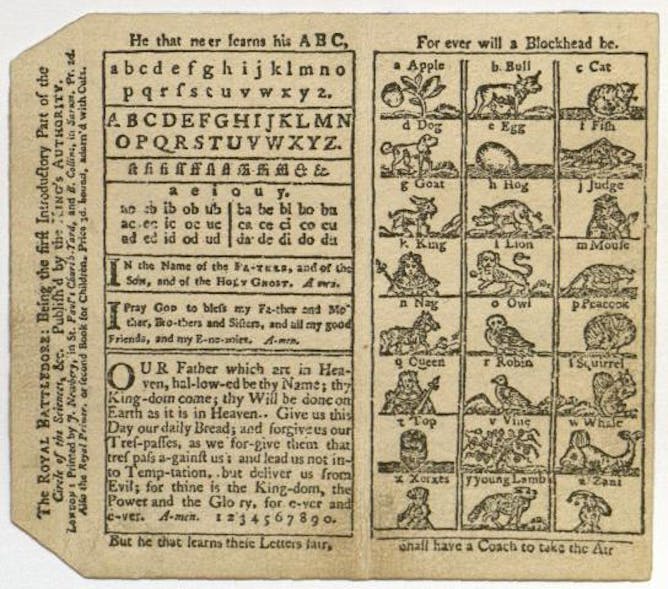
By the 18th century, children’s literature had become a commercially-viable aspect of London printing. The market was fuelled especially by London publisher John Newbery, the “father” of children’s literature. As literacy rates improved, there was continued demand for instructional works. It also became easier to print pictures that would attract young readers.
18th century Battledore printed by Newbery which adds pictures and a verse on the rewards of industry to the elements of the hornbook.
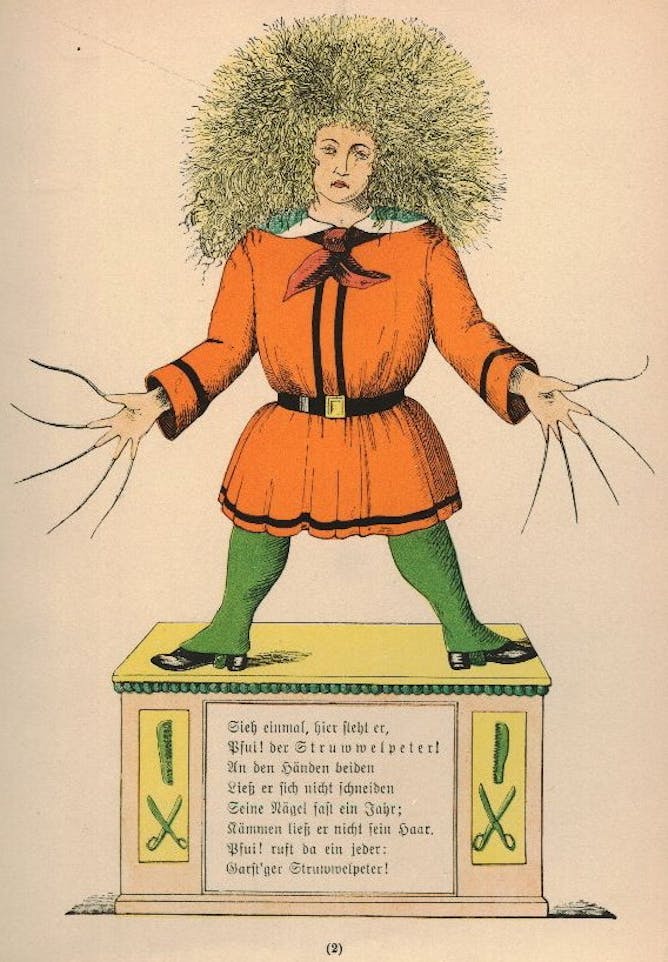
More and more texts for children were printed in the 19th century, and moralistic elements remained a strong focus. Katy’s development in patience and neatness in the “School of Pain” is key, for example, in Susan Coolidge’s enormously popular What Katy Did (1872), and feisty, outspoken Judy (spoiler alert!) is killed off in Ethel Turner’s Seven Little Australians (1894). Some authors managed to bridge the comic with important life lessons. Heinrich Hoffman’s memorable 1845 classic Struwwelpeter reads now like a kids’ version of dumb ways to die.
Struwwelpeter (‘Shock-headed Peter’) in a 1917 edition. Wikimedia commons
By the turn of the 20th century, we see the emergence of a “kids’ first” literature, where children take on serious matters with (or often without) the help of adults and often within a fantasy context. The works of Lewis Carroll, Robert Louis Stevenson, Mark Twain, Francis Hodgson Burnett, Edith Nesbit, JM Barrie, Frank L Baum, Astrid Lindgren, Enid Blyton, CS Lewis, Roald Dahl and JK Rowling operate in this vein.
Children’s books still contain moral lessons – they continue to acculturate the next generation to society’s beliefs and values. That’s not to say that we want our children to be wizards, but we do want them to be brave, to stand up for each other and to develop a particular set of values.
We tend to see children’s literature as providing imaginative spaces for children, but are often short-sighted about the long and didactic history of the genre. And as historians, we continue to seek out more about the autonomy and agency of pre-modern children in order to understand how they might also have found spaces in which to exercise their imagination beyond books that taught them how to pray.
Proposed changes to Australia’s copyright law should make it easier for people to create and distribute versions of copyrighted works that are accessible to people with disabilities.
If passed, it would enable people with disabilities to access and enjoy books and other material in formats they can use, such as braille, large print or DAISY audio.
The Australian Human Rights Commission has long been calling for action to end the “world book famine” – only 5% of books produced in Australia are available in accessible formats. This means that people with vision impairment and other reading disabilities are excluded from a massive proportion of the world’s knowledge and culture.
Under the current law, educational institutions and other organisations can produce accessible copies of books, but the system is slow and expensive. Only a small number of popular books are available, and technical books that people need for work are often out of reach.
Technology should make accessibility much easier, but publishers have been slow to enable assistive technologies.
People with disabilities have long complained that they are not able to take advantage of new technologies such as inbuilt screen reading software on computers and smartphones.
Amazon’s Kindle, for example, used to allow text-to-speech to help blind people read books, but Amazon gave in to publishers’ fears and allowed them to disable the feature. Apple’s electronic books are much better, but there are still major gaps.
Our research looked at books available through electronic academic databases, and found that most ebook libraries have some features that frustrate full accessibility.
The Copyright Act in its current form does grant statutory licences for copying by institutions that assist people with disabilities, but there are no comprehensive exceptions for individuals. Research shows that even students in resourced universities have trouble accessing the materials they need to study.
A fair right for people with disabilities
The new Bill aims to create a clear right for individuals to copy materials into accessible formats. Critically, this new “fair dealing” exception also allows other people to help out by creating and sharing accessible versions of books and other materials.
The Marrakesh Treaty, once implemented around the world, will enable organisations to share accessible books to the people who need them in other countries. This is an extremely important change as the costs of scanning and making a book accessible are so high that most blind people are denied access to most works.
Once the laws are clarified, the accessibility of books will increase dramatically. Google has been busy digitising the world’s books, and it has given those books to a charity called Hathi Trust. Soon, Hathi Trust will be able to share those books with blind people around the world.
Google’s partnership with Hathi Trust means that blind people will soon be able to access more than 14 million volumes almost overnight. This figure may grow quickly as Google has already digitised more than 30 million books. Very soon, the proportion of accessible books might jump from 5-10% to closer to 30%.
A missed opportunity
The Bill also proposes a number of other long awaited updates to Australian copyright law. But one thing the Bill does not do is fix a drafting error that has plagued Australian copyright law for the past decade.
When Australia signed the Australia – US Free Trade Agreement, we introduced a system of “notice-and-takedown” that would protect copyright owners. The system provides a way for people to ask online service providers to remove content that infringes copyright.
But the law was poorly drafted. It applied only to a small number of Internet Service Providers (such as Telstra, Optus and iiNet) but not the larger category of search engines and content hosts.
This means it does not apply to giants such as Google and Facebook. It also means that other organisations that host content uploaded by users, such as The Conversation, are also excluded.
These safe harbours provide a shield in case people – outside of the service provider’s control – use their networks to upload content that infringes any copyright laws.
The reason they are so critical is that it is often prohibitively expensive for the companies that host internet content to check all content before a user uploads it.
But the safe harbours aren’t free. The quid pro quo is that the ISP must introduce a notice and takedown scheme. This is one of the few effective mechanisms to get content removed from the internet, and has been a crucial part of protecting the rights of publishers and authors online.
Professor Kim Weatherall explains the drafting error in Australia’s copyright safe harbours.
When the new Bill was first drafted, it was set to fix the drafting error that excludes content hosts, search engines, universities and other organisations from the scheme. But the Bill introduced this week contains no such fix.
The past two decades of the internet in the United States have shown how critical the safe harbours are to all developers, both large and small. They reduce uncertainty and allow innovation in the ways that people access content.
So while this new Bill is important, it is also a missed opportunity. The drafting error in Australia’s copyright safe harbours means that neither tech companies or authors and publishers are well protected.
Tess Van Geelen, a Research Assistant at the Faculty of Law, Queensland University of Technology, contributed to this article.





 At the BookShelf


You must be logged in to post a comment.