
Unknown's avatar

Friday essay: why grown-ups still need fairy tales


File 20171116 19845 16kf5ly.jpg?ixlib=rb 1.1
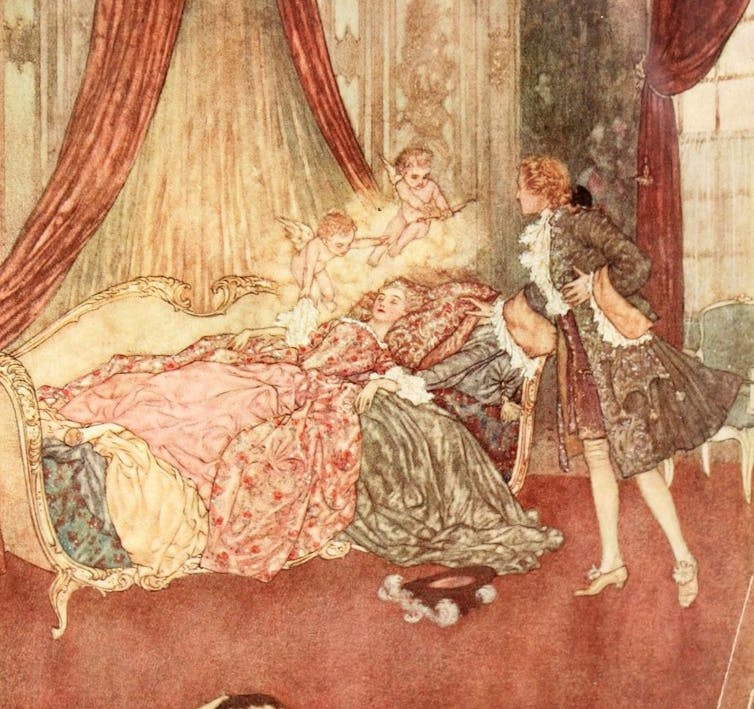
Edmund Dulac’s 1910 illustration of Sleeping Beauty.
Wikimedia images

Marguerite Johnson, University of Newcastle

For as long as we have been able to stand upright and speak, we have told stories. They explained the mysteries of the world: birth, death, the seasons, day and night. They were the origins of human creativity, expressed in words but also in pictures, as evidenced by the cave paintings of Chauvet (France) and Maros (Indonesia). On the walls of these caves, the paintings, which date back to around 30-40,000 BC, tell us myths or sacred narratives of the spirits of the land, the fauna of the regions, and humankind’s relationship to them.
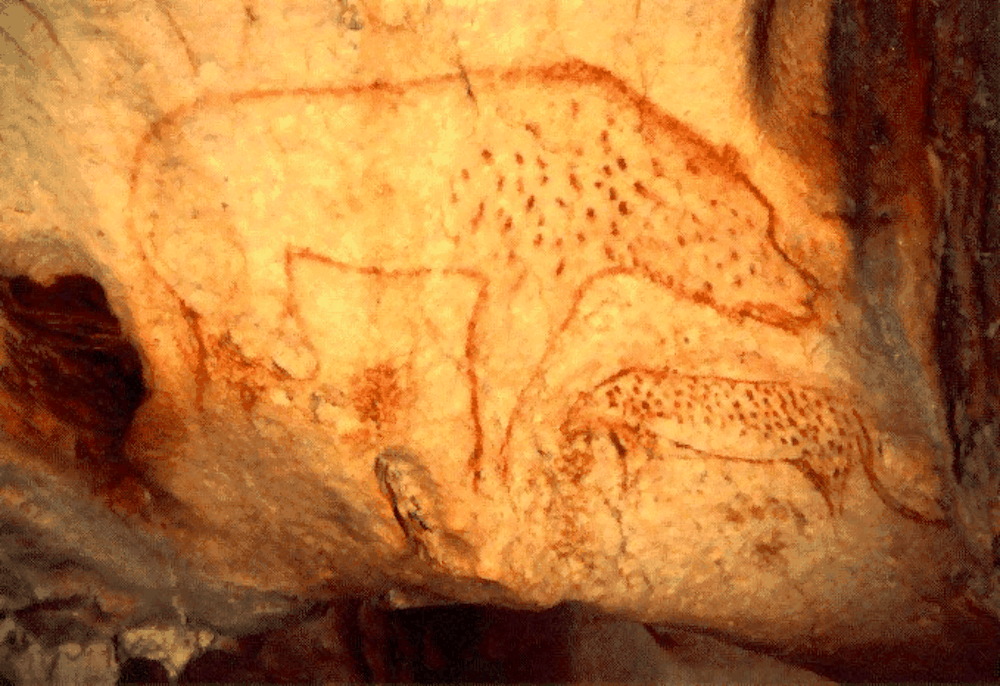
A hyena painting found in the Chauvet cave.
Wikimedia images

As humanity progressed, other types of stories developed. These were not concerned with the mysteries of the meaning of life but with everyday, domestic matters. While they were more mundane in the issues they explored, such tales were no less spectacular in their creativity and inclusion of the supernatural.

These smaller, everyday stories, combining the world of humans with fantastical creatures and seemingly impossible plots are now classified as fairy tales or folk tales. Such tales, originating in pre-literate societies and told by the folk (or the average person), capture the hopes and dreams of humanity. They convey messages of overcoming adversity, rising from rags to riches, and the benefits of courage.
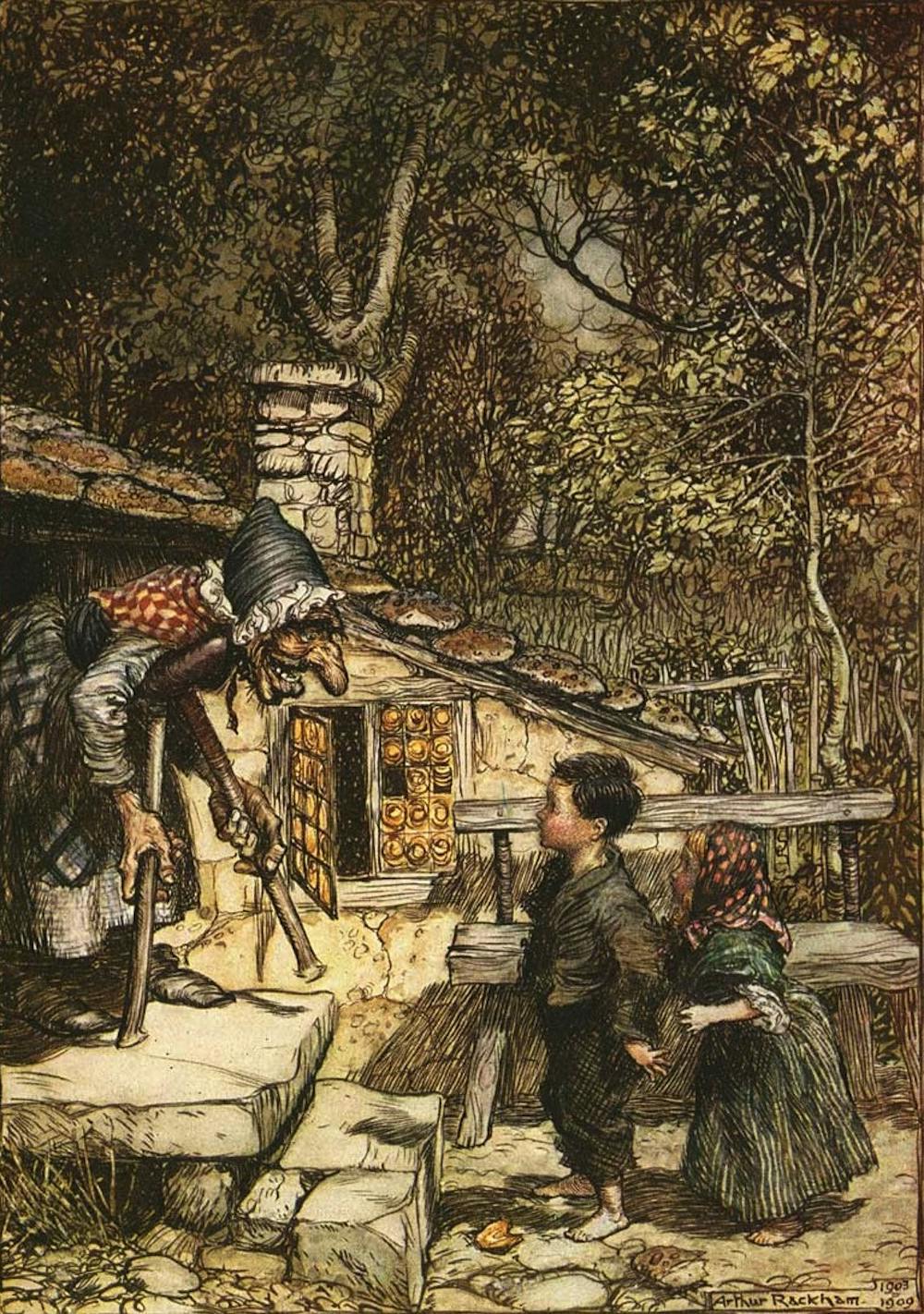
Hansel and Gretel by Arthur Rackham.
Wikimedia images

Fairy tales are also extremely moral in their demarcation between good and evil, right and wrong. Their justice references the ancient tradition of an eye for an eye, and their punishments are ruthless and complete. Originally for adults (sometimes for children), fairy tales can be brutal, violent, sexual and laden with taboo. When the earliest recorded versions were made by collectors such as the Brothers Grimm, the adult content was maintained. But as time progressed and Christian morality intervened, the tales became diluted, child-friendly and more benign.

Despite these changes, it is apparent that fairy tales are still needed today, even for grown-ups. In an uncanny, sometimes inexplicable way, we consciously and unconsciously continue to tell them, despite advances in logic, science and technology. It’s as if there is something ingrained in us – something we cannot suppress – that compels us to interpret the world around us through the lens of such tales. And if we are not the tellers, we are the greedy consumers.

‘Fairy tale’ princesses and ‘wicked witches’

The 20th anniversary of the death of Diana, Princess of Wales, for example, has been cast – like her life – as a fairy tale. Throughout the year, she has been commemorated in articles with headings such as “a troubled fairy tale”, “beyond a fairy tale”, and “just another fairy tale”. While these articles have endeavoured to deconstruct the familiar narrative, they have not been entirely successful.
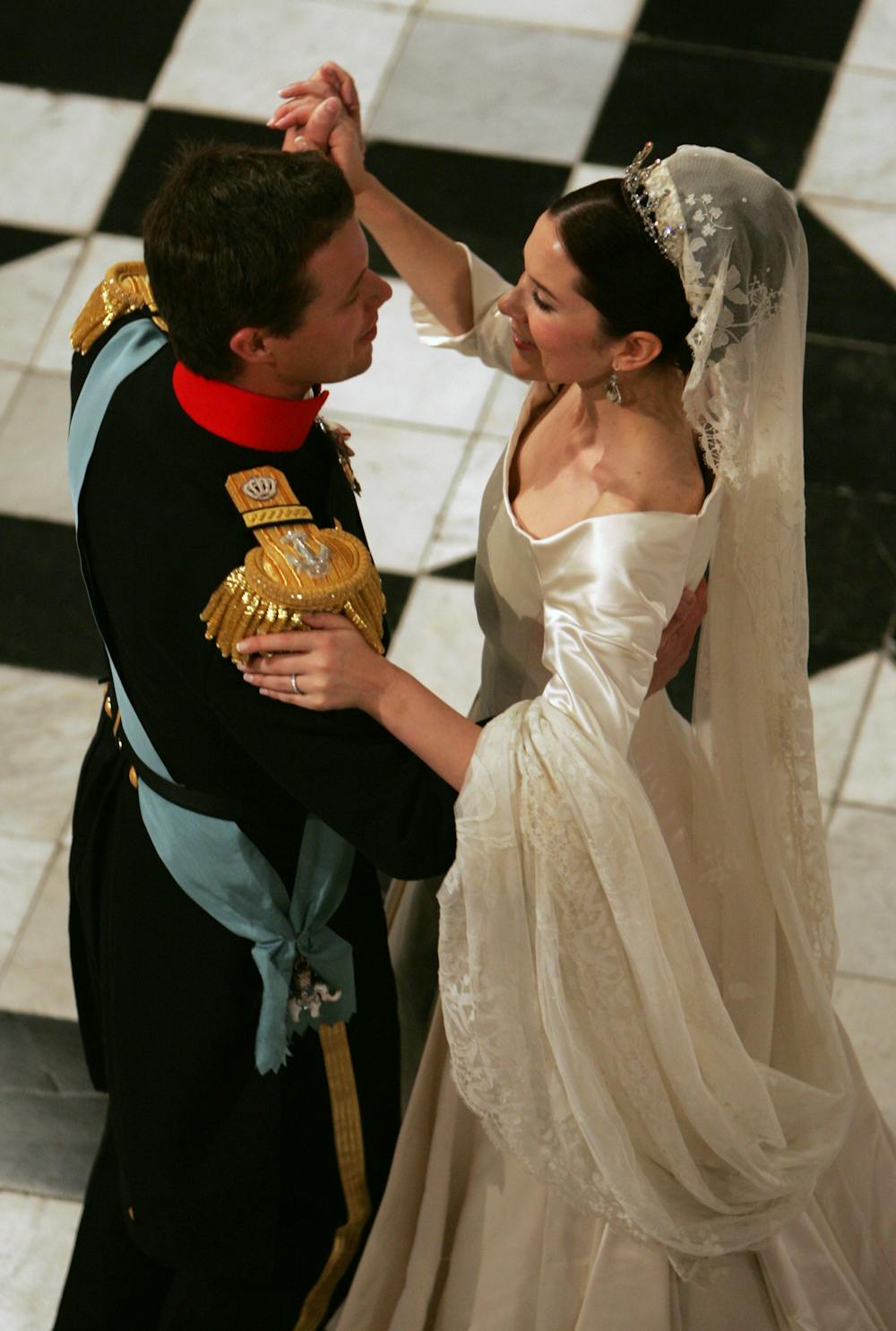
Fairy tale wedding? Prince Frederik and Princess Mary.
Jerry Lampen/Reuters

The notion of a fairy tale princess has also characterised the coverage of Princess Mary of Denmark and Duchess Catherine of Cambridge. Even after 13 years of marriage, our own “Aussie princess” is described as living a fairy tale, evident in 2017 media stories with titles such as “Princess Mary and Prince Frederik’s fairy tale royal romance”. Likewise, Kate, once a commoner, now a princess, has featured in articles titled “Prince William and Duchess Kate’s fairy-tale love story” and “Kate’s Most Royal Fairy Tale Gown (To Date)”. As the titles of some of these stories show, they also feature the mandatory prince charming (William), or the prince who is revealed to be not-so-charming after all (Charles). Others extend the fairy tale formula to include wicked stepmothers (Di’s real life stepmother) and wicked witches (Camilla).

Is such recourse to fairy tales merely a media stunt to sell stories packaged in an easily consumable, gossip-laden snack box? Or do these articles reflect that deep-seated compulsion of ours to tell and, in turn, to listen to stories? The answers are “yes” and “yes”. But let’s forget the media’s role and look at the more interesting latter point.

Many fairy tales began thousands of years ago, the age depending on the tale itself. Beauty and the Beast has its origins in the story of Cupid and Psyche from the Greek novel, The Golden Ass, from the second century AD.
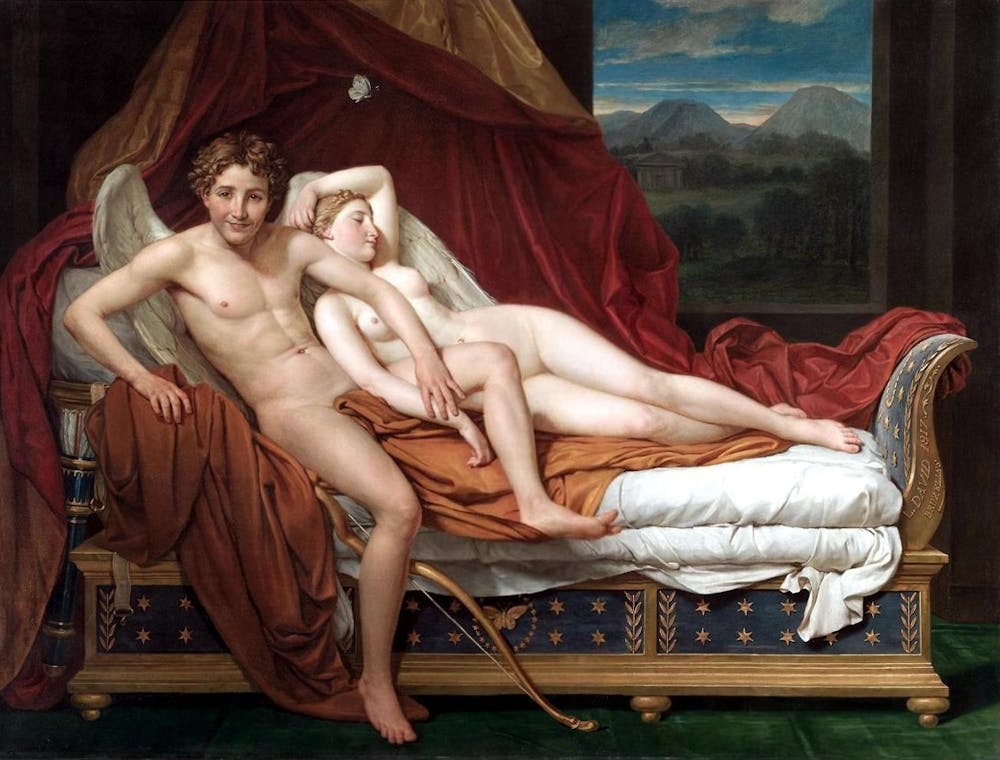
Jacques-Louis David’s 1817 painting of Cupid and Psyche, the inspiration for Beauty and the Beast.
Wikimedia images

In this tale, the beautiful Psyche is visited at night by an invisible lover – hearing only a voice – whom she is led to believe is a monster. While recorded by the novelist, Apuleius, the story is almost certainly much older; perhaps having its origins in myth and ritual, and handed down by word of mouth.

The research of Dr Jamie Tehrani has unearthed an early date for Red Riding Hood, which he has traced back to at least 2,000 years; not originating in Asia, as once believed, but most likely in Europe. Other tales studied by Tehrani have been dated to as early as 6,000 years ago.

Fairy tales are excellent narratives with which to think through a range of human experiences: joy, disbelief, disappointment, fear, envy, disaster, greed, devastation, lust, and grief (just to name a few). They provide forms of expression to shed light not only on our own lives but on the lives beyond our own. And, contrary to the impression that fairy tales always end happily ever after, this is not the case – therein lies much of their power.

They helped our ancestors make sense of the unpredictability or randomness of life. They repeated familiar experiences of unfairness, misfortune, bad luck, and ill-treatment and sometimes showed us how courage, determination and ingenuity could be employed even by the most disempowered to change the course of events.
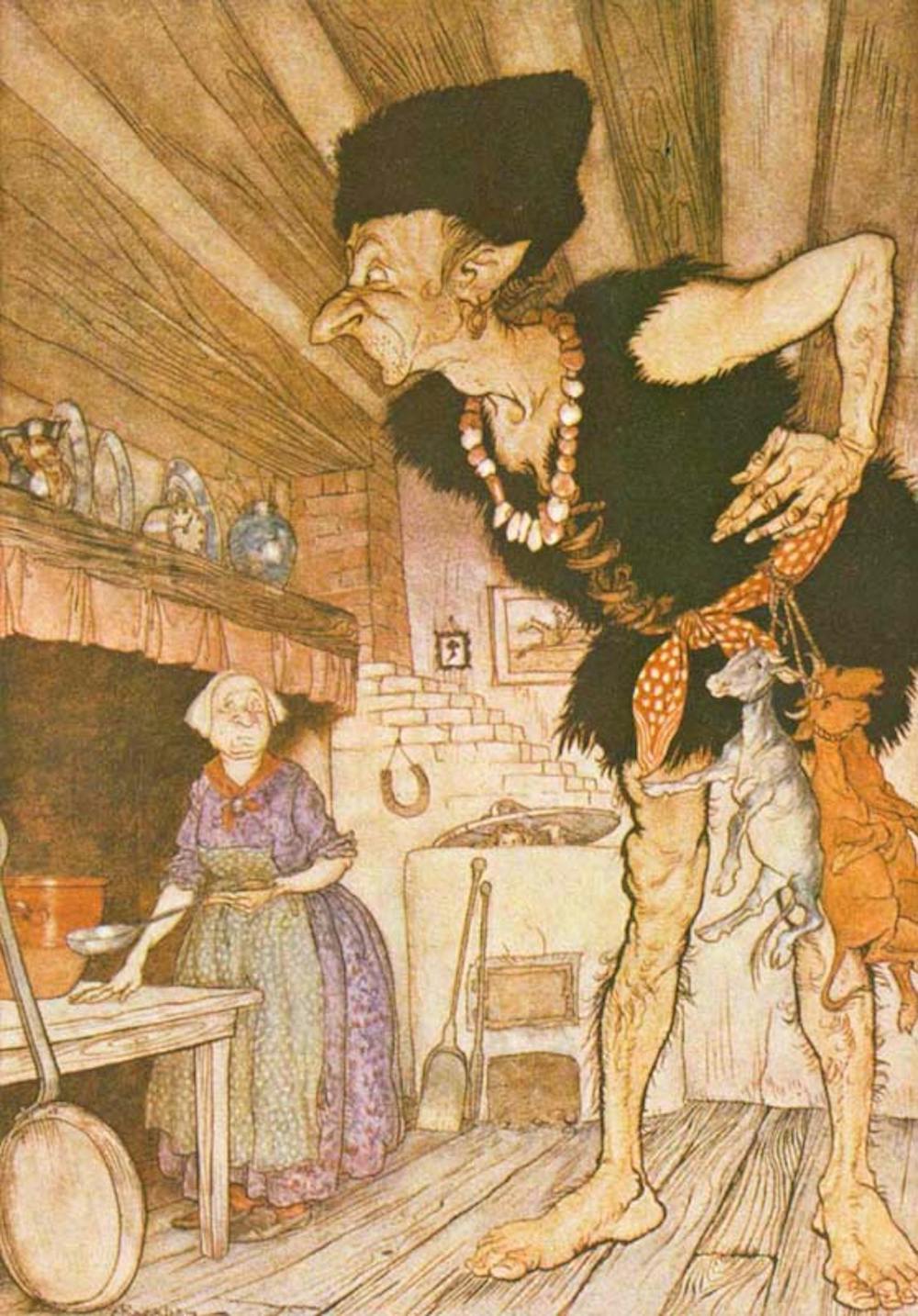
Arthur Rackham’s Jack and the Beanstalk Giant.
Wikimedia images

Jack and the Beanstalk, for example, tells how a chance encounter with a stranger (an old man who provides magic beans) can bring about terrible danger (meeting a giant) but also terrific good fortune (acquiring a hen that lays golden eggs). The tale also celebrates how a poor boy can make the most of an arbitrarily dangerous situation that could have gone either way – being eaten or becoming rich – through his bravery and his intellect.

Fairytales also celebrated unexpected good fortune and acts of kindness and heroism, thereby reinforcing – even restoring – our faith in humanity. As tales of the folk, they not only entertained, but reflected the turmoils and triumphs of the lower classes, and enabled them to fantasise about how the “other half” lived.

Cinderalla and social criticism

But tales of kings, queens, princes and princesses – of which there are many – are not only a means of mental escape for the poor. They are also a means of social criticism.
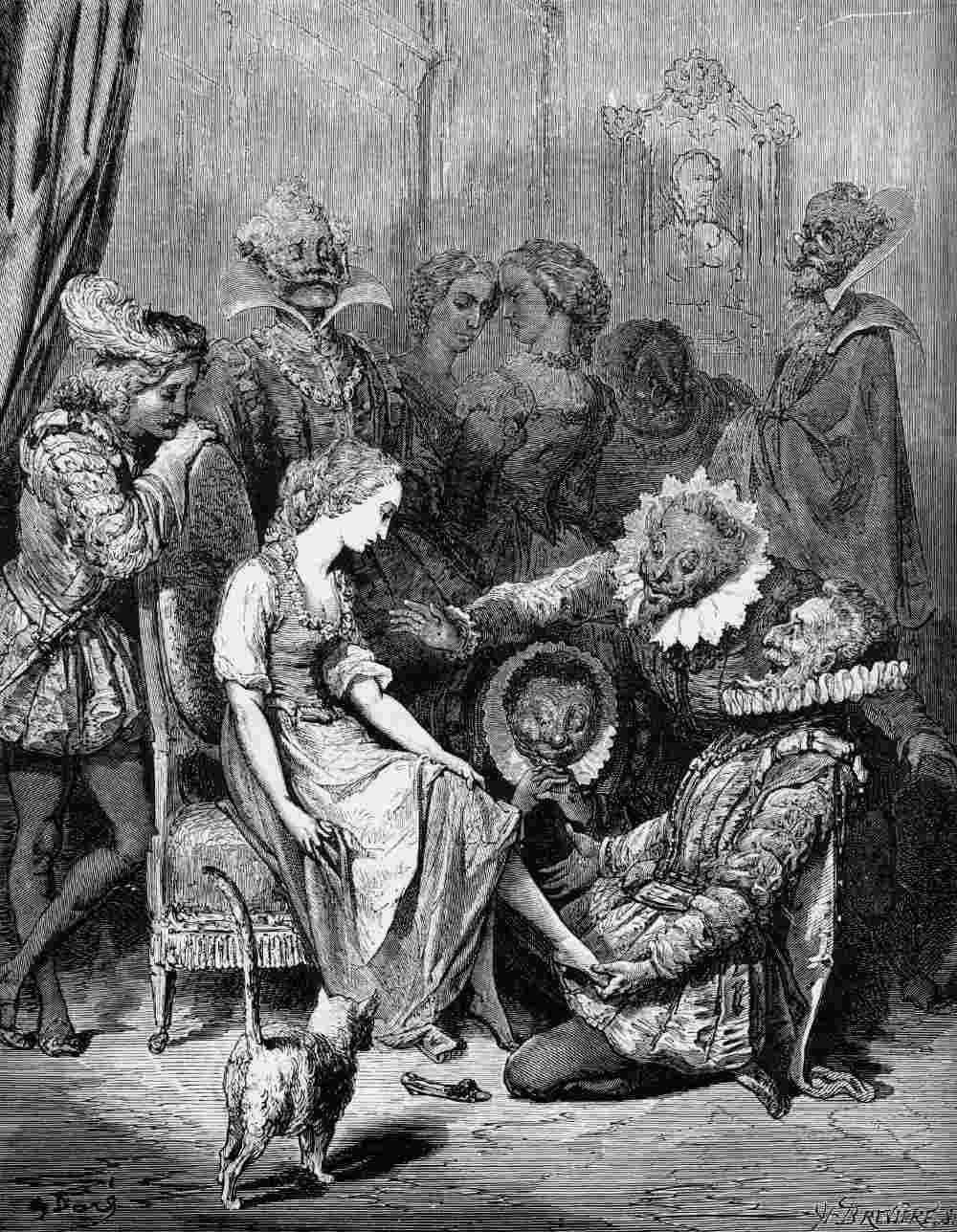
19th century engraving of Gustave Doré’s Cendrillon – Cinderella. From Dore’s 1864 edition of Stories or Fairy Tales from Past Times with Morals, originally published in 1697.
Wikimedia images

In Cinderella, as recorded by Charles Perrault, the two stepsisters may have every material possession imaginable, but their cruelty renders them grotesque. And, of course, the lowly Cinderella triumphs. In the German version, Aschenputtel, recorded by the Brothers Grimm, the fate of the stepsisters is very different. Whereas Perrault’s version has the kindly Cinderella forgive them, the Grimms – clearly working from another tradition – describe how they have their eyes plucked out by pigeons!

Such stories of fantasising about a royal life and simultaneously despising it may have functioned as an emotional release similar to the ancient Greek experience of catharsis (the shedding of anxieties through watching outrageous tragedies and obscene comedies).

Taking the fascination with Diana’s life as a fairy tale, for example, we still employ the cathartic release of the genre to interrogate her and, for those of us so inclined, to find some meaning in the Di phenomenon. From the romantic courtship, to the wedding of the century and that dress, to motherhood, glamour, betrayal, heartbreak, divorce, alienation and a new love cut short by an early death.
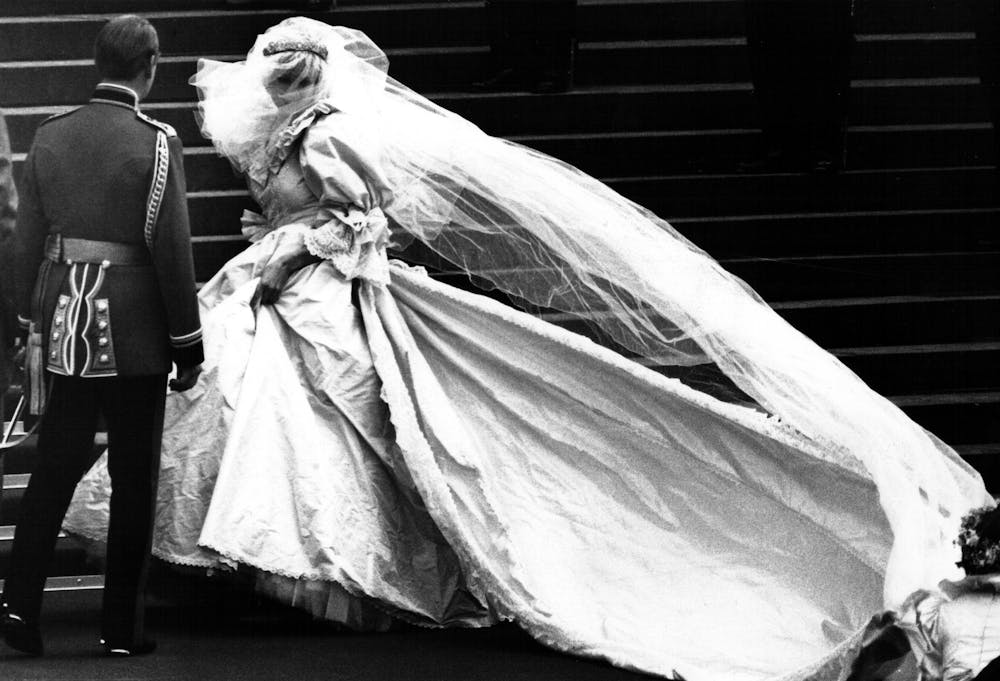
Diana on her wedding day in 1981.
Mal Langsdon/Reuters

Some, of course, have criticised the warm, fuzzy emotionalism that has sprung from the fairy tale of Di’s life. If it is not to your liking, there are more robust tales with powerful messages of resistance and resilience. In tales such as Hansel and Gretel and Donkeyskin, the young protagonists are persecuted and abused by predators.

There is much to complain about in these tales from a politically correct or feminist perspective. They are violent and subversive: Gretel pushes a witch into an oven and in Perrault’s version of Donkeyskin, a king wishes to marry his daughter following the death of his wife. But they are more than narratives of abuse. They are also about courage and ingenuity on the part of the young survivors.
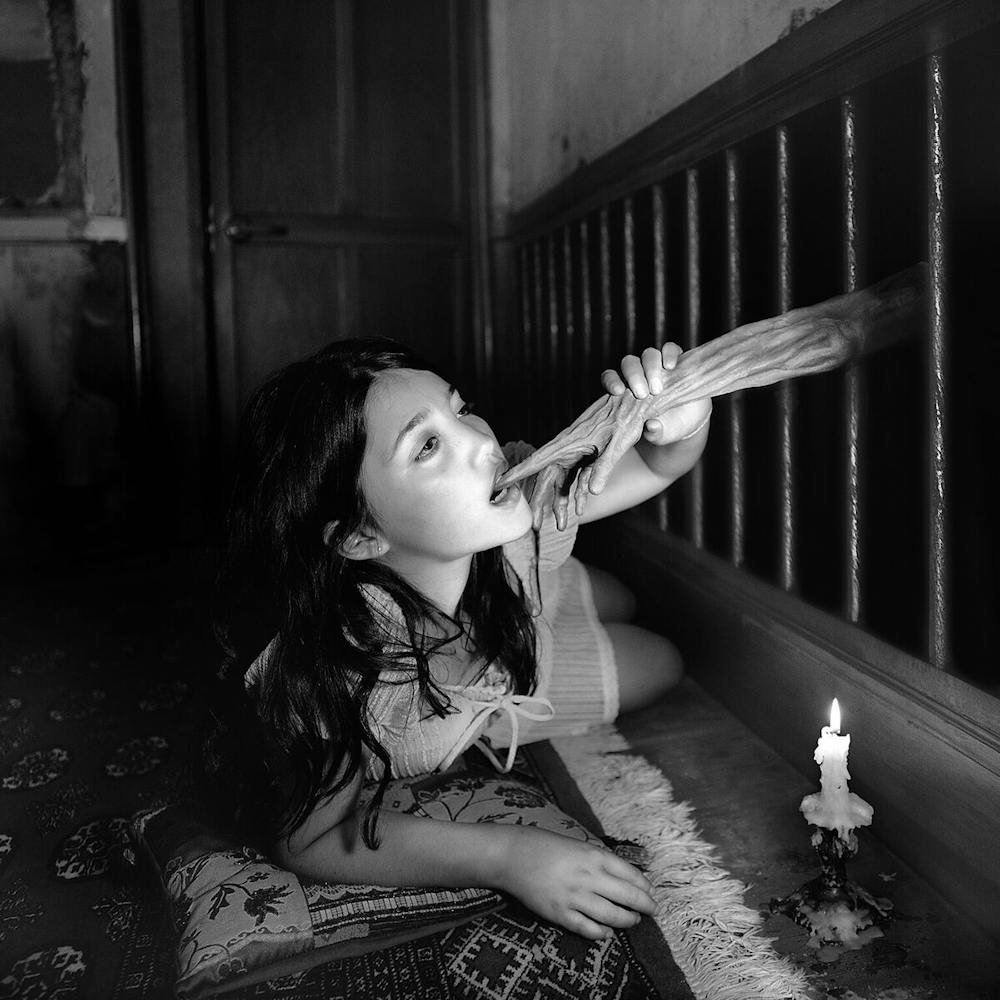
Miwa Yanagi, Gretel 2004, gelatin silver print.
Collection of the Hara Museum of Contemporary Art

Courtesy of the artist and Yoshiko Isshiki Office, Tokyo

Donkeyskin, variants of which are extant in English (Catskin) and German (All-Kinds-Of-Fur), champions the bravery and inherent goodness of the young heroine who dresses in the skin of a donkey and leaves the palace in order to escape her father’s desires. Her subsequent life as a servant, filthy, humiliated, reviled and renamed “Donkeyskin” by her fellow servants, never crushes her soul.

Within the fantasy and the convenient appearance of supernatural assistants or a romantic ending, both of which feature in Donkeyskin, these stories are powerful reminders that evil exists in the world in the form of human beings – but it is not definitive or unconquerable.

Contemporary reworkings

With the publication of the Grimms’ Children’s and Household Tales in 1812, artists and illustrators were the first interpreters of fairy tales. Visual responses have ranged from famous works by Gustave Doré, Arthur Rackham and Edmund Dulac to Maurice Sendak and Jan Pieńkowski.

More dissident responses have included the photographs of Dina Goldstein, whose Fallen Princesses series (2007-2009) is an astute response to the Disney princess phenomenon of unattainable, debilitating images of femininity and romance in bowdlerised versions of the original tales. Here, Goldstein critiques the superficiality of the princess stereotype, reminding us that it is as facile for children as the Diana fairy tale dream is for adults.

Before Goldstein, photographer Sarah Moon also challenged the dilution of fairy tales in the modern west through her provocative (sometimes banned) interpretation of Little Red Riding Hood. In this powerful rendition, Moon takes her child reader back to the original and raw meanings embedded in the tale through her exploration of the theme of the human predator in the symbolic guise of the wolf.

Moon’s decision to return to the terror and drama of the Grimms’ version is testimony to the need to challenge the dilution and contamination of the tales. Even the Grimms were guilty of adding and subtracting to the material, particularly when it came to the insertion of overt Christian morality. Equally if not more so, the Disneyfication of fairy tales has stripped them of the power and the pain to which Moon returns.

Writers and poets have also responded to the tales and, like Moon, have regularly sought to return them to their once formidable status. Women authors in particular have created powerful, sometimes heartbreaking – but always real and truthful – new versions.

Among the thousands of old tales in new clothes is the literature of second wave feminists, including the suite entitled Transformations (1971) by renegade poet Anne Sexton, who takes the domesticity of the original tales and mocks, ridicules, cherishes and – literally – transforms them. Angela Carter’s The Bloody Chamber (1979), a magnificent collection of retellings of famous fairy tales, is full of female empowerment, sensuality and violence in a tour de force that both reinstates the potency of the stories and re-imagines them.

Novelist, poet and essayist, Margaret Atwood also transforms the originals. Her response to The Girl Without Hands, which tells the story of a young woman who agrees to sacrifice her hands in order to save her father from the devil, in a poem of the same name is a profound meditation on the continuation of both abuse and survival.

The fairy tales first preserved by collectors such as the Brothers Grimm – retold, bastardised, edited, annotated, banned and reclaimed – belong ultimately to the folk who first told them. And the folk continue to tell and retell them. Closer to home than the Black Forest, a new show at the The Ian Potter Museum of Art contains work by international and Australian artists, including Tracy Moffatt and Sally Smart. The show returns – once again – to fairy tales to express social concerns and anxieties surrounding issues such as the abuse of power, injustice and exploitation.

Dina Goldstein, Snowy 2008 from the Fallen Princess series.
digital photograph

Courtesy of the artist

Fairy tales are, indeed, good to think with, and their retellings shed light on cultural, societal and artistic movements. Both children and adults should read more fairy tales – both the original and the transformed versions, for they are one of our cultural touchstones.

The ConversationAll the better to see you with: Fairy tales transformed, is on from Thursday 23 Nov 2017 to Sunday 4 Mar 2018 at The Ian Potter Museum of Art, The University of Melbourne.

Marguerite Johnson, Professor of Classics, University of Newcastle

This article was originally published on The Conversation. Read the original article.

Unknown's avatar

Why Some People Don’t Like Ebooks


The link below is to an article that takes a look at why some people don’t like ebooks.

For more visit:
https://insights.uksg.org/articles/10.1629/uksg.386/

Unknown's avatar

How huge gamble by Lady Chatterley lawyers changed obscenity law forever


Sue Rabbitt Roff, University of Dundee

Jeremy Hutchinson, who has died at 102, was one of England’s finest criminal barristers. He was counsel of choice for some of the most high-profile cases of his era. He defended the likes of Christine Keeler and Great Train robber Charles Wilson and also obscenity cases against novels like Fanny Hill and Lady Chatterley’s Lover.

Later known as Lord Hutchinson of Lullington, his role defending Penguin Books after it published the unexpurgated version of the DH Lawrence classic is particularly memorable. It remains the landmark case in British obscenity law.

But look at the details and something extraordinary emerges: Penguin’s decision to publish 200,000 copies on the advice of Hutchinson and joint lead counsel Gerald Gardiner was a massive gamble. It set up a case that were it not for the incompetence of the prosecution could easily have gone the other way.

Obscenity and England

Lady Chatterley’s Lover had only ever been legally published in abridged versions in the UK, starting in 1932. Though by 1960 the unexpurgated edition was sold in Europe and America and could be obtained under the counter in London if you knew where to go, Penguin co-founder Allen Lane wanted to publish a cheap paperback of the full thing.

The idea was to put it out at 3s 6d, the same price as ten cigarettes, to make it affordable for the “young and the hoi-polloi”. The excuse was the 30th anniversary of Lawrence’s death from tuberculosis at the age of 45.

When Penguin consulted Hutchinson and Gardiner, the lawyers retreated to reflect. A trial under the new Obscene Publications Act seemed inevitable. The act’s first paragraph stated that material will be deemed obscene if it contains elements that tend as a whole “to deprave and corrupt persons who are likely … to read, see or hear” it.

The act included a new defence in cases where the offending segments were “for the public good on the ground that [they are] in the interests of science, literature, art or learning”. In consultation with several literary experts, Hutchinson and Gardiner felt most of the racy scenes and bad language – including (30) “fucks” and (14) “cunts” – could fall under this defence. Lawrence, after all, was one of the most highly regarded writers of his era.

Hutchinson was concerned about page 258, however, where anal sex crops up – albeit obliquely. It has Oliver Mellors, the lover in the book’s title, trying to divorce his wife Bertha Coutts and being accused by her “of all unspeakable things”. Clifford Chatterley writes a letter to his own wife saying that Coutts has aired details about her marriage to Mellors which are “usually buried down in the deepest grave of matrimonial silence”.

But, he comments:

Humanity has always had a strange avidity for unusual sexual postures, and if a man likes to use his wife, as Benvenuto Cellini says, ‘in the Italian way’, well that is a matter of taste.

Lady Chatterley has pause for thought:

Connie remembered the last night she had spent with [Mellors], and shivered. He had known all that sensuality, even with a Bertha Coutts! It was really rather disgusting. It would be well to be rid of him, clear of him altogether.

Her friend Duncan Forbes then makes light of it:

If he’s made love to his wife all ends on, hasn’t he a right to? She ought to be proud of it.

While homosexual anal sex between consenting men was legalised 50 years ago in the UK, the heterosexual equivalent became legal only at the millennium in England and Wales and was highly illegal in 1960. (The 2001 film Bridget Jones’ Diary celebrated legalisation with a pretty explicit scene between Renée Zellweger and Hugh Grant.)

Illegal acts could still potentially use the public good defence, but Hutchinson feared it made the case much harder to win. Gardiner and the experts at the meeting dismissed his fears. In these more innocent times, they were betting that the prosecution wouldn’t grasp the point and omit it from their case. Hutchinson agreed to go ahead and advised Penguin accordingly.

Your witness

The defence called 35 professors of literature, authors, journalists, editors, critics, publishers and child education experts, and four Anglican churchmen. Each declared the book had sufficient literary merit to deserve publication for the public good. (Those less convinced of Lawrence’s genius begged off – Enid Blyton declared she had never read the book and “my husband said no at once”.)

Lead prosecutor Mervyn Griffith-Jones cross-examined only 14 of the 35. He lost most of those rounds, and sometimes his temper in the process. It was only in his closing speech he said to the jury:

Would you look at page 258. It is a passage which I have not – and I do not think anybody has – referred to during the course of cross-examination, or indeed at any time during this trial. It … describes what is called the ‘night of sensual passion’.

He read out the whole passage remarking: “Not very easy, sometimes, not very easy, you know, to know what in fact he is driving at in that passage.”

It’s not clear how many jurors understood the passage; some were said to be visibly shocked. Certainly Griffith-Jones had missed the significance entirely, having referenced it only to underline the book’s general depravity. Mr Justice Byrne summed up with no reference to anal sex either. The issues were, he said, promiscuity and adultery described in words that were “normally obscene”.

The jury returned in three hours and found Penguin not guilty. Neither the clergy nor any of the other experts had been examined on anal sex and it is not clear whether they realised they were implicitly defending it or not. A watershed in British obscenity law had been achieved without any discussion about the illegal sex acts central to the novel.

The ConversationIn the wake of this case, publishing in Britain became considerably more liberal. Had Hutchinson not agreed to advise Penguin to take that extraordinary gamble, things could have panned out very differently.

Sue Rabbitt Roff, Part time tutor in Medical Education, University of Dundee

This article was originally published on The Conversation. Read the original article.

Unknown's avatar

Reading in Bed


The link below is to an article that takes a look at reading in bed.

For more visit:
https://www.theguardian.com/books/2017/nov/04/read-book-in-bed-howard-jacobson

Unknown's avatar

Kindle Bestsellers from 2007 to 2017


The link below is to an article that takes a look at Kindle’s bestsellers from 2007 to 2017.

For more visit:
https://ebookfriendly.com/amazon-reveals-kindle-bestsellers-each-year-2007-2017/

Unknown's avatar

Amazon’s Best Books of 2017


The link below is to an article that takes a look at the best books of 2017 as picked by the editors of Amazon.

For more visit:
https://ebookfriendly.com/best-books-2017-amazon-editors/

Unknown's avatar

The Kindle Turns 10


The link below is to an article that looks at ten years of the Kindle.

For more visit:
https://www.theguardian.com/books/2017/nov/13/amazons-kindle-turns-10-have-ebooks-clicked-with-you-yet

Unknown's avatar

Stories of sex, stars and sharks amongst the best Australian science writing in 2017


File 20171106 1020 4bpjiz.jpg?ixlib=rb 1.1
Everyone loves a story about giant sharks.
from www.shutterstock.com

Sarah Keenihan, The Conversation

We’re proud to have five The Conversation authors featured in the The Best Australian Science Writing 2017, edited by Michael Slezak, and with a foreword by Emma Johnston.

The book was launched at The Australian Museum. The blurb says:

Good writing about science can be moving, funny, exhilarating, or poetic, but it will always be honest and rigorous about the research that underlies it.

This is what we’re all about at The Conversation – making sure that all our articles are supported by evidence, and at the same time helping readers see the relevance, the importance, the nuances but also the joy of science and technology.

Our selected authors are good examples.

In Peter Ellerton’s What exactly is the scientific method and why do so many people get it wrong?, he explains there’s a big difference between science and pseudoscience. But if people don’t understand how science works in the first place, it’s very easy for them to fall for the pseudoscience.

In Gender equity can cause sex differences to grow bigger, Rob Brooks writes that moves toward gender equity in opportunity – including the dismantling of patriarchal power structures – might, paradoxically, also widen sex differences.

Robert Fuller’s piece How ancient Aboriginal star maps have shaped Australia’s highway network likens many thousand year old Indigenous travel techniques with modern day GPS tracking. Aboriginal people have long used the stars to help remember routes between distant locations, and these routes are still alive in our highway networks today.

John Long tackles the myth that giant predators might still be cruising around our oceans in Giant monster Megalodon sharks lurking in our oceans: be serious!. Yes, giant sharks did once exist in our oceans – but these went extinct many millions of years ago.

Also included in the book is regular The Conversation author Alice Gorman, with her piece Trace Fossils: The Silence of Ediacara, the Shadow of Uranium, which we republished from Griffith Review State of Hope. The essay won the Bragg UNSW Press Prize for Science Writing 2017, which recognises the best short, non-fiction piece of science writing for a general audience.

These The Conversation pieces are presented in the book alongside 27 other selected science essays published in Australia during 2017, and written by scientists, journalists, philosophers and writers.

The ConversationScience writer and artist Margaret Wertheim received the UNSW Scientia Medal for Science Communication at the book launch, and prizes for science writing by students in years 7-10 were also awarded.

Sarah Keenihan, Section Editor: Science + Technology, The Conversation

This article was originally published on The Conversation. Read the original article.

Unknown's avatar

Book inscriptions reveal the forgotten stories of female war heroes


File 20171108 26977 bp9mv4.jpg?ixlib=rb 1.1

Librakv/Shuttestock

Lauren O’ Hagan, Cardiff University

Open up a book from the late 19th or early 20th century and chances are that you will find an inscription inside the front cover. Often, they are nothing more than handwritten names that state who owned the book, though some are a little more elaborate, with personalised designs used to denote hobbies and interests, tell jokes or even warn against theft of the book.

While seemingly insignificant markers of ownership, book inscriptions offer important material evidence of the various institutions, structures and tastes of Edwardian society, and act as tangible indicators of class and social mobility in early 20th century Britain. They can also reveal vast amounts of information on how both attitudes of ownership and readership varied according to geographical location, gender, age and occupation at this time.

My research involves collecting these inscriptions from secondhand books and working with archives to delve into the human stories behind these ownership marks. I am particularly interested in “everyday” Edwardians – the miner, the servant, the clerk – who are so often forgotten by time, yet played an essential role in ensuring Britain ran smoothly during the war years.

My latest work has focused on the stories of the female heroes of World War I. They weren’t fighting on the battlefield but their contributions at home and abroad were nothing short of incredible. Using the inscription marks they left in books, censuses, local history, and Imperial War Museum archives, I have tracked several untold tales, two of which I’ve written about here.

Elizabeth Veronica Nisbet

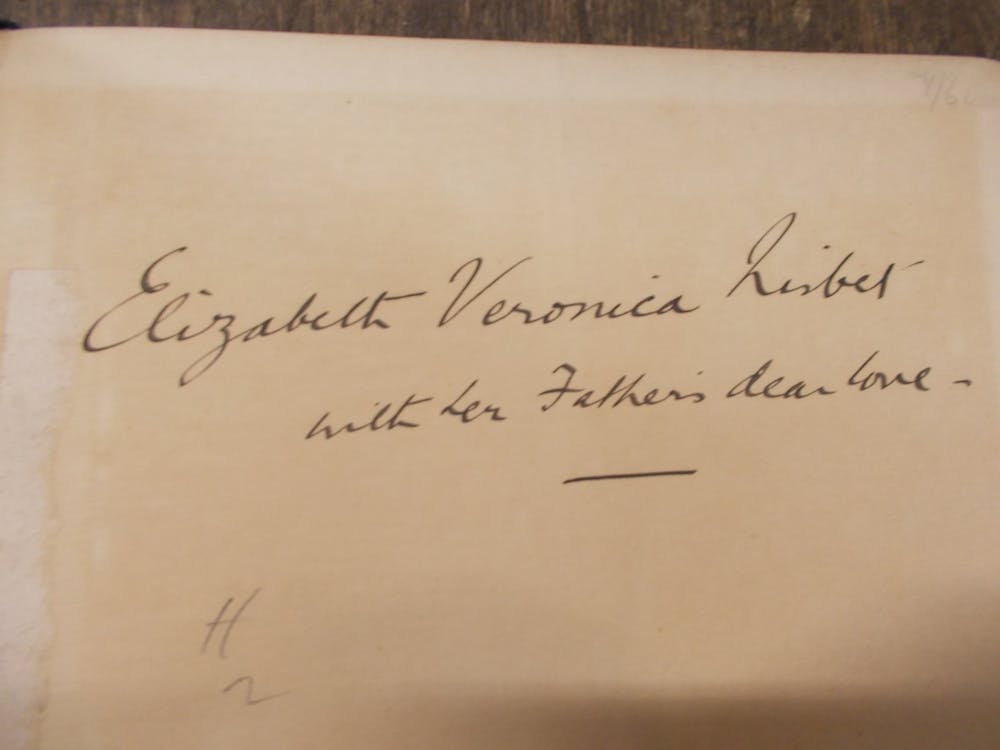
Elizabeth Veronica Nisbet’s inscription inside her copy of George Du Maurier’s book.
Author provided

Elizabeth Veronica Nisbet was born in 1886 in Newcastle. The daughter of a colliery secretary, Nisbet was part of the lower-middle class that emerged in Britain at the end of the Victorian era. She studied art at Gateshead College before serving as a nurse with St John Ambulance and the Royal Victoria Infirmary.

In 1913, Nisbet’s father gave her a copy of the biography of cartoonist George Du Maurier, and inscribed it “with dear love”. Du Maurier was well-known for his cartoons in the satirical magazine Punch, which inspired Nisbet’s own artwork. Just one year after receiving the book, World War I broke out and Nisbet headed to France to aid wounded soldiers at St John Ambulance Brigade Hospital in Étaples. This hospital was the largest to serve the British Expeditionary Force in France and treated over 35,000 casualties.

Throughout these troubled times, Nisbet’s passion for art was her salvation: she kept a scrapbook of cartoons, sketches and photos, which provide an insight into wartime Étaples and the vital work of the female nurses. Looking at her artwork, it is clear that she was strongly influenced by the cartoon style of Du Maurier, suggesting that the book remained a treasured artefact to her while she was serving in France.

//platform.twitter.com/widgets.js

Today Nisbet’s work is kept at the Museum of the Order of St John in London. After the war, she returned to Newcastle and worked again as a nurse until the 1920s when she became a full-time artist, travelling regularly to the US and Canada to showcase her work. She died in 1979 at the age of 93.

Gabrielle de Montgeon

Born in France in 1876, Gabrielle de Montgeon moved to England in 1901 and lived in Eastington Hall in Upton-on-Severn throughout her adult life. She was the daughter of a count of Normandy and part of the upper class of Edwardian society.

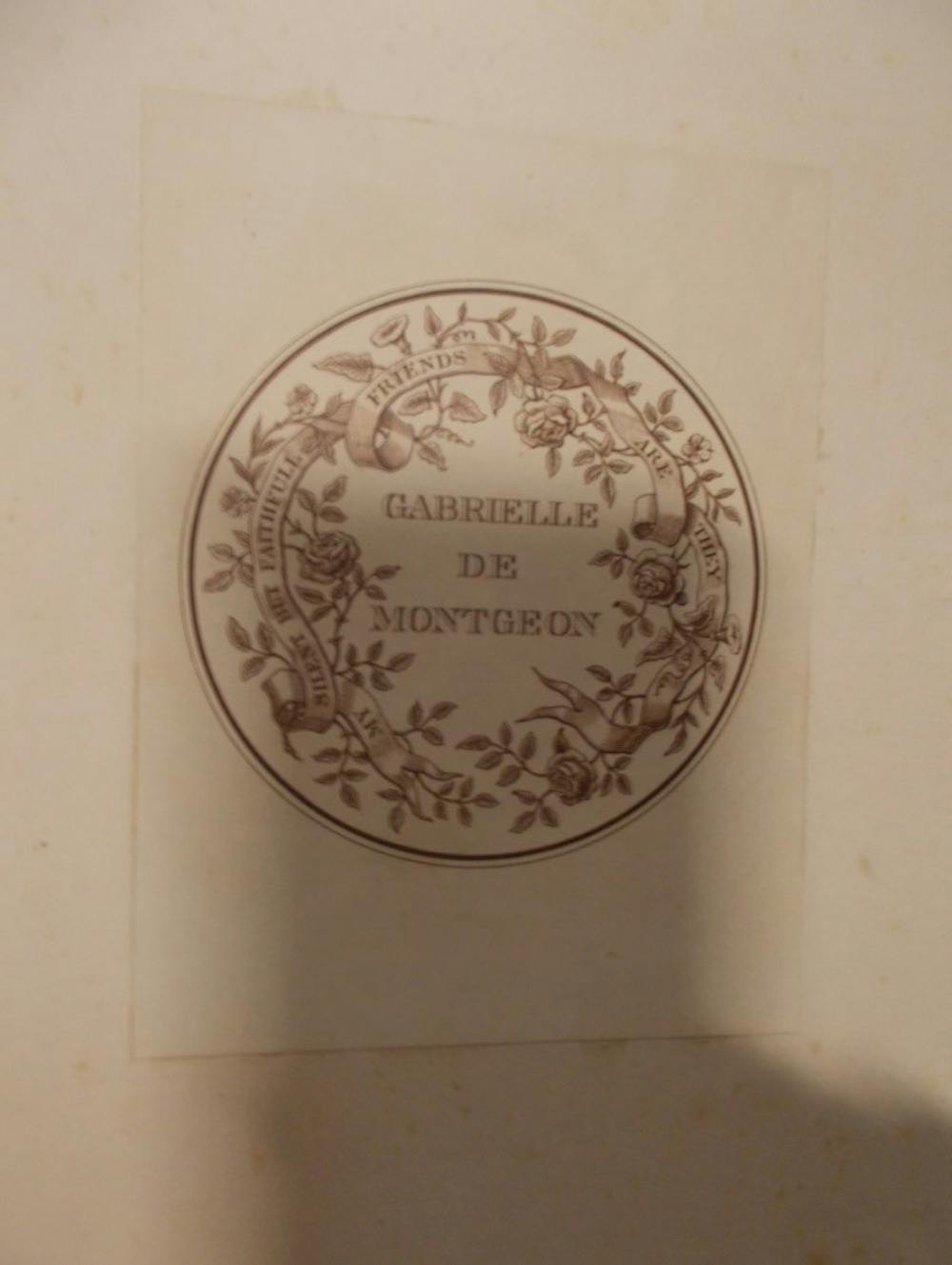
Gabrielle De Montgeon’s bookplate.
Author provided

Her affluence is showcased in the privately-commissioned bookplate found inside her copy of the 1901 Print Collector’s Handbook. The use of floral wreaths and decorative banderoles in her plate – both features of the fashionable art nouveau style of the period – mimic the style of many of the prints in her book. This demonstrates the close relationship that Edwardians had between reading and inscribing.

Stepping out of her upper class life, during World War I, de Montgeon served in the all-female Hackett-Lowther Ambulance Unit as an assistant director to Toupie Lowther – the famous British tennis player who had established the unit. The unit consisted of 20 cars and 25-30 women drivers, who operated close to the front lines of battles in Compiegne, France. De Montgeon donated ambulances and was responsible for the deployment of drivers. After the war, she returned to Eastington Hall and led a quiet life, taking up farming, before passing away in 1944, aged 68.

The ConversationConsidering the testing circumstances of war, the survival of these two books (and their inscriptions) is a remarkable feat. While buildings no longer stand, communities have passed on, and grass on the bloody battlefields grows once more, these books keep the memories of Nisbet and de Montgeon alive. They stand as a testimony of the unsettling victory of material objects over the temporality of the people that once owned them and the places in which they formerly dwelled.
Lauren O’ Hagan, PhD candidate in Language and Communication, Cardiff University

This article was originally published on The Conversation. Read the original article.

Unknown's avatar

How a young Ernest Hemingway dealt with his first taste of fame


File 20171108 14209 gtd35o.png?ixlib=rb 1.1
Ernest Hemingway with a bull near Pamplona, Spain in 1927, two years before ‘A Farewell to Arms’ would be published.
Ernest Hemingway Photograph Collection, John F. Kennedy Presidential Library and Museum, Boston.

Verna Kale, Pennsylvania State University

When he published “The Sun Also Rises” in 1926, Ernest Hemingway was well-known among the expatriate literati of Paris and to cosmopolitan literary circles in New York and Chicago. But it was “A Farewell to Arms,” published in October 1929, that made him a celebrity.

With this newfound fame, Hemingway learned, came fan mail. Lots of it. And he wasn’t really sure how to deal with the attention.

At the Hemingway Letters Project, I’ve had the privilege of working with Hemingway’s approximately 6,000 outgoing letters. The latest edition, “The Letters of Ernest Hemingway, Volume 4 (1929-1931)” – edited by Sandra Spanier and Miriam B. Mandel – brings to light 430 annotated letters, 85 percent of which will be published for the first time. They offer a glimpse at how Hemingway handled his growing celebrity, shedding new light on the author’s influences and his relationships with other writers.

Mutual admiration

The success of “A Farewell to Arms” surprised even Hemingway’s own publisher. Robert W. Trogdon, a Hemingway scholar and member of the Letters Project’s editorial team, traces the author’s relationship with Scribner’s and notes that while it ordered an initial printing of over 31,000 copies – six times as many as the first printing of “The Sun Also Rises” – the publisher still underestimated the demand for the book.

Additional print runs brought the total edition to over 101,000 copies before the year was out – and that was after the devastating 1929 stock market crash.

In response to the many fan letters he received, Hemingway was typically gracious. Sometimes he offered writerly advice, and even went so far as to send – upon request and at his own expense – several of his books to a prisoner at St. Quentin.

At the same time, writing to novelist Hugh Walpole in December 1929, Hemingway lamented the amount of effort – and postage – required to answer all those letters:

“When ‘The Sun Also Rises’ came out there were only letters from a few old ladies who wanted to make a home for me and said my disability would be no drawback and drunks who claimed we had met places. ‘Men Without Women’ brought no letters at all. What are you supposed to do when you really start to get letters?”

Among the fan mail he received was a letter from David Garnett, an English novelist from a literary family with connections to the Bloomsbury Group, a network of writers, artists and intellectuals that included Virginia Woolf.

Though we don’t have Garnett’s letter to Hemingway, Garnett appears to have predicted, rightly, that “A Farewell to Arms” would be more than a fleeting success.

“I hope to god what you say about the book will be true,” Hemingway replies, “though how we are to know whether they last I don’t know – But anyway you were fine to say it would.”

He then goes on to praise Garnett’s 1925 novel, “The Sailor’s Return”:

“…all I did was to go around wishing to god I could have written it. It is still the only book I would like to have written of all the books since our father’s and mother’s times.” (Garnett was seven years older than Hemingway; Hemingway greatly admired the translations of Dostoyevsky and Tolstoy by Constance Garnett, David’s mother.)

An overlooked influence

Hemingway’s response to Garnett – written the same day as his letter to Walpole – is notable for several reasons.

First, it complicates the popular portrait of Hemingway as an antagonist to other writers.

It’s a reputation that’s not entirely undeserved – after all, one of Hemingway’s earliest publications was a tribute to Joseph Conrad in which Hemingway expressed a desire to run T.S. Eliot through a sausage grinder. “The Torrents of Spring” (1926), his first published novel, was a parody of his own mentors, Sherwood Anderson and Gertrude Stein and “all the rest of the pretensious [sic] faking bastards,” as he put it in a 1925 letter to Ezra Pound.

But in the letter to Garnett we see another side of Hemingway: an avid reader overcome with boyish excitement.

“You have meant very much to me as a writer,” he declares, “and now that you have written me that letter I should feel very fine – But instead all that happens is I don’t believe it.”

The letter also suggests that Garnett has been overlooked as one of Hemingway’s influences.

It’s easy to see why Hemingway liked “The Sailor’s Return” (so well, it appears, that he checked it out from Sylvia Beach’s Shakespeare & Co. lending library and never returned it).

A reviewer for the New York Herald Tribune praised Garnett’s “simple but extremely lucid English” and his “power of making fiction appear to be fact,” qualities that are the hallmark of Hemingway’s own distinctive style. The book also has a certain understated wit – as do “The Sun Also Rises” and “A Farewell to Arms.”

Garnett’s book would have appealed to Hemingway on a personal level as well. Though it’s set entirely in England, the portrait of Africa that exists in the background is the same sort of exotic wilderness that captured the imagination of Hemingway the boy and that Hemingway the young man still longed explore.

Imagining Africa

But Hemingway’s praise of Garnett leads to other, unsettling questions.

From its frontispiece to its devastating conclusion, Garnett’s book relies on racial stereotypes of an exoticized, infantilized Other. Its main character, an African woman, brought to England by her white husband, is meant to command the reader’s sympathy – indeed, the choice she makes in the end, to send her mixed-race child back to his African family, hearkens to an earlier era of sentimental literature and decries the parochial prejudices of English society.

However, that message is drowned out by the narrator’s assumptions about inherent differences between the races. Garnett’s biographer Sarah Knights suggests that Garnett was “neither susceptible to casual racism nor prone to imperialist arrogance,” yet Garnett’s 1933 introduction to the Cape edition of Hemingway’s “The Torrents of Spring” claims “it is the privilege of civilized town-dwellers to sentimentalize primitive peoples.” In “The Torrents of Spring,” Hemingway mocked the primitivism of Sherwood Anderson (cringe-worthy even by 1925 standards), but as Garnett’s comment indicates, Hemingway imitated Anderson’s reliance on racial stereotypes as much as he criticized it.

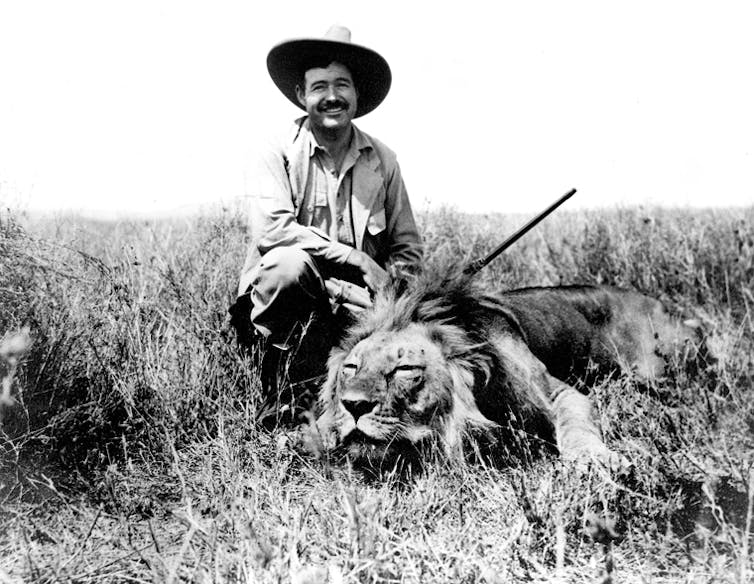
What, then, can we glean about Hemingway’s views on race from his exuberant praise of “The Sailor’s Return”? Hemingway had a lifelong fascination with Africa, and his letters show that in 1929 he was already making plans for an African safari. He would take the trip in 1933 and publish his nonfiction memoir, “Green Hills of Africa,” in 1935. The work is experimental and modernistic, but the local people are secondary to Hemingway’s descriptions of “country.”

Late in life, however, Hemingway’s views on Africa would shift, and his second safari, in 1953-4, brought what scholar of American literature and African diaspora studies Nghana tamu Lewis describes as “a crisis of consciousness” that “engendered a new commitment to understanding African peoples’ struggles against oppression as part, rather than in isolation, of changing ecological conditions.”

Hemingway went to Africa in 1934.
John F. Kennedy Presidential Library and Museum, Boston.

But back in 1929, when Hemingway was wondering what to do with an ever-growing pile of mail, that trip – along with another world war, a Nobel Prize and the debilitating effects of his strenuous life – were part of an unknowable future.

The ConversationIn “The Letters 1929-1931” we see a younger Hemingway, his social conscience yet to mature, trying to figure out his new role as professional author and celebrity.

Verna Kale, Associate Editor, The Letters of Ernest Hemingway and Assistant Research Professor of English, Pennsylvania State University

This article was originally published on The Conversation. Read the original article.