
The link below is to an article that reports on Scribd now producing original content.
For more visit:
https://goodereader.com/blog/e-book-news/scribd-is-now-producing-original-content

The link below is to an article that reports on Scribd now producing original content.
For more visit:
https://goodereader.com/blog/e-book-news/scribd-is-now-producing-original-content
The links below are to articles reporting on the 2019 Man Booker International Prize shortlist.
For more visit:
– https://publishingperspectives.com/2019/04/five-women-authors-six-women-translators-on-man-booker-2019-internationals-shortlist/
– https://www.booktopia.com.au/blog/2019/04/10/man-booker-international-shortlist/
– https://bookriot.com/2019/04/10/2019-man-booker-international-prize-shortlist/
The link below is to an article reporting on the winner of the 2019 Jackson Poetry Prize, Joy Harjo.
For more visit:
https://www.pw.org/about-us/joy_harjo_wins_jackson_poetry_prize
Cathy Baldwin, The Open University
When you think of inner-city teenagers, what springs to mind? For many, it’s hoodies, video games – and probably hating Shakespeare. But my research proves that this stereotype is far from the truth.
Shakespeare holds a contested place in the English national curriculum as the only compulsory writer to be studied between the ages of 11 and 16. This imposed curriculum attempts to situate Shakespeare’s plays as part of national culture, rather than purely as an exemplar of high art. But teens are rarely asked directly about their experiences of education, and about its relevance to them.
Instead, they are often represented as a homogenous group who are bored and resistant to studying Shakespeare, particularly when it comes to struggling with the language he used.
However, my research with over 800 students in four London secondary schools offers a very different picture. I asked these 13 to 14-year-olds what they think and/or feel when they hear the word “Shakespeare” – and some of their answers defied expectations.
Many students told me that they actually enjoy studying Shakespeare in school. From comments such as “I feel happy because I like most of his plays”, to “I feel excited because Shakespeare was the best writer ever […] a legend or genius”, they expressed levels of interest in Shakespeare that are rarely acknowledged.
These students also did not see the language as a barrier, but as a challenge to be embraced. One commented: “I also get quite happy because we do not often look at texts with old English.”
In this large cohort of students, some comments stand out, showing how varied and individual their responses are. One described Shakespeare as “one of my inspirations for writing poetry”, while another said that “although I don’t really like English, I like his plays a lot”.
Teachers seem to play a key role in developing a positive attitude in some of their students. One student said that “all the work I’ve done on Shakespeare has been interesting and fun”, while another said she “really enjoyed the last play that we did”.
This study did not look in detail at what actually happens in the classroom, but many of the students’ comments suggest that having the confidence to approach a Shakespeare text with a positive attitude partly comes from the teacher’s attitude to him and his work.
In addition to the wholly positive comments, some students demonstrated a more mixed response to the subject. One student told me that “sometimes it’s interesting and sometimes it’s just boring ‘cause in Year 7 I remember we did this one play for a very long time and it was just kind of the same thing every lesson for a double lesson”.
Here, the lessons were clearly not varied enough to hold this student’s attention all the time, although the comment suggests that the student knew that studying Shakespeare could be interesting and fun, even if it isn’t always like that in practice.
For others, the choice of play is key: “Some Shakespeare plays are more interesting than others, in my opinion.” One of the students I interviewed also articulated a clear tension in her attitudes towards studying Shakespeare. She said:
The good part is because everyone goes through different stuff, some people can relate and they can feel like they’re not alone or like this has happened before and studying Shakespeare makes you see the world differently, […] and the bad thing about it [is] learning how to write in the Shakespeare kind of structure when it won’t be useful in the future.
For a number of students, there are perhaps inevitable negative connotations attached to the word “Shakespeare”. Some did describe Shakespeare simply as “boring”, but others explained their reservations in more detail. One said: “I feel like I’ve heard the word Shakespeare too much and that I don’t want to talk about him.” Another thought “about long complicated language that no one understands”, while further complaints were about how “it is unnecessary to learn about as I don’t understand what’s beneficial for us as students”.
Overall, the students involved in this research demonstrated a breadth and depth of response to Shakespeare that counters the generalised belief that teenagers respond poorly to his work. Indeed, used as an introductory question to establish students’ attitudes to Shakespeare before attending a production at Shakespeare’s Globe theatre, in London, I have been fascinated by the variety and subtlety of thought they have demonstrated.
As one said: “I feel honoured that I’ve covered Shakespeare in school, because telling people you have read his plays makes you sound smart.” The sense of privilege inherent in this comment, despite the fact that everyone studies Shakespeare at school, is clearly something to cherish.
Cathy Baldwin, PhD Candidate in Education, The Open University
This article is republished from The Conversation under a Creative Commons license. Read the original article.
The link below is to an article that takes a look at the library of the son of Christopher Columbus, and it was huge.
For more visit:
https://www.npr.org/2019/04/24/716600905/christopher-columbus-son-had-an-enormous-library-its-catalog-was-just-found
The link below is to an article that takes a look at how to sell books on Amazon.
For more visit:
https://www.businessinsider.com/how-to-sell-books-on-amazon/
The link below is to an article that takes a look at the benefits of reading multiple books at once.
For more visit:
https://www.thefussylibrarian.com/newswire/for-readers/2019/04/23/the-benefits-of-reading-multiple-books-at-once
Laura Varnam, University of Oxford
Daphne du Maurier remains one of the 20th century’s most popular and enigmatic writers, her life captivating readers as much as her works, as the most recent biography, Manderley Forever by Tatiana de Rosnay, has shown. Her literary reputation is also finally on the rise and, although her most popular novel Rebecca has often overshadowed her wide-ranging achievements as a writer, the celebration of its 80th anniversary last year reinforced Du Maurier’s place in the canon of English Literature as a serious and influential author.
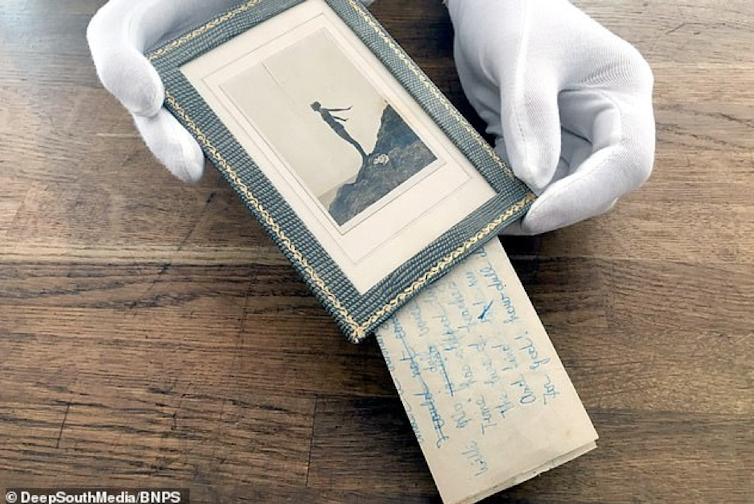
This will be aided by the recent discovery of unknown poems, written early in her writing career, hidden behind a stunning photograph of the young Du Maurier in a bathing costume on the rocks, poised to take flight into the sea that was such an inspiration to her work.
The poems were discovered by auctioneer Roddy Lloyd of Rowley’s auction house, Ely, as he prepared the archive of Du Maurier materials belonging to the late Maureen Baker-Munton for auction on April 27. Baker-Munton was PA to Daphne’s husband, Lt Gen Sir Frederick “Boy” Browning and she became a close and important friend to the Du Maurier Browning family, as expert Ann Willmore explains on the Du Maurier website.
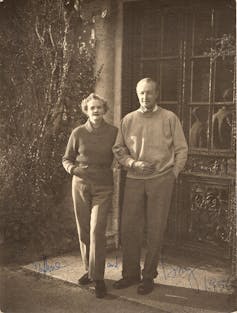
Du Maurier is still primarily known as a novelist – as well as the bestseller Rebecca she is also rightly revered for the great Cornish novels, Jamaica Inn (1936), Frenchman’s Creek (1941) and My Cousin Rachel (1951). But, as I argue in the book I am writing on Du Maurier, she was a far more versatile, wide-ranging, and experimental writer than is currently recognised. Du Maurier wrote plays, short stories and biographies throughout her career but she was also a poet, as her son Kits Browning explained to me when we spoke over the telephone recently.
Read more:
Du Maurier’s Rebecca at 80: why we will always return to Manderley
The newly discovered poems were written when Du Maurier was honing her craft as a writer in the late 1920s. At that stage she was primarily writing short stories but, as Browning told me: “My mother wrote poetry throughout her life and career.” Indeed Du Maurier often used poetry as a way of exploring an experience or emotion or testing out a character before then expanding on her ideas in a short story or novel. One of the newly discovered poems focuses on loneliness:
When I was ten, I thought the greatest bliss,
would be to rest all day upon hot sand under a burning sun…
time has slipped by, and finally I’ve known,
The lure of beaches under exotic skies,
and find my dreams to be misguided lies,
For God! How dull it is to rest alone.
Du Maurier’s work is preoccupied by the difference between fantasy and reality – and the dangers of dreaming – and her work repeatedly returns to the tension between the desire for independence and the need for companionship and human contact.
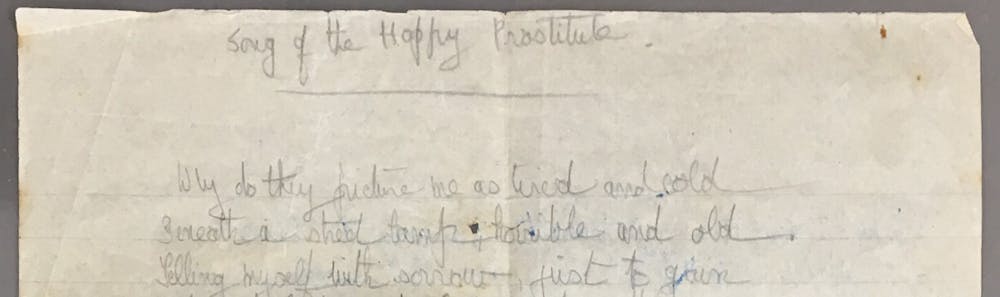
Another poem: Song of the Happy Prostitute, portrays a woman who is frustrated with the way her profession is represented.
Why do they picture me as tired and old…
selling myself with sorrow,
just to gain a few dull pence to shield me from the rain.
What on first sight might seem an unusual, even controversial, topic for the young writer in fact reflects the dominant themes of her early work, as Ann Willmore, of Bookends of Fowey, explained to me recently. Willmore discovered the unpublished Du Maurier short story The Doll in which a young woman, suggestively named Rebecca, protects her personal independence by keeping a sex doll. “The Happy Prostitute poem fits in with Daphne’s interests in gender and sexuality, especially in her early work, and she did seem to want to shock her readers”, Willmore told me.
The poem also, in my view, relates to two early short stories from the same period of Du Maurier’s life in which she created the character of a prostitute called Mazie who boldly claimed that her work enabled her to be independent. “I’m free, I don’t owe anything to no one, I belong to myself”, Mazie declares in the short story Piccadilly. Growing up in the 1920s, when the freedom and autonomy of women was increasingly a topic for public debate, Du Maurier’s choice of subject matter reflects the concerns of her day.
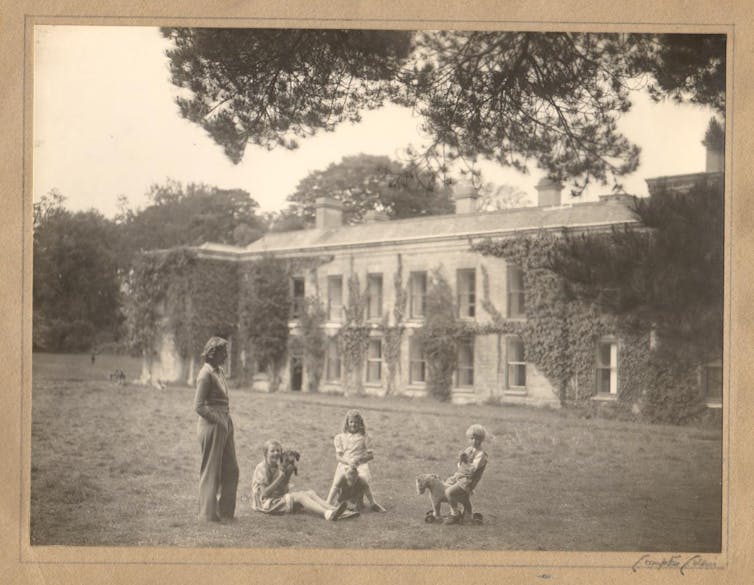
Du Maurier was a very privileged young woman, growing up in the grandeur of Cannon Hall in Hampstead – but her background was theatrical and Bohemian, as the daughter of celebrated actor-manager Sir Gerald du Maurier and stage actress Muriel Beaumont. And, as her son Kits Browning stressed, she was an avid reader and gained much imaginative experience of the world from the books she devoured as a teenager.
As to why the poems were hidden behind the photograph – either by Du Maurier herself or someone else – we are unlikely ever to find out. Browning told the Daily Telegraph that perhaps she did not want her parents to read them. Perhaps the Happy Prostitute found fuller expression in the Mazie short stories.
These newly discovered poems shed important light on Du Maurier’s early work and writing practice. Still often dogged by the incorrect label of “romantic novelist”, these poems highlight the important themes of independence, gender, and sexuality that were to fascinate Du Maurier throughout her career, in both prose and poetry. They show her boldness, spirit, and strength, just like the photograph behind which they were concealed for all these years.
Laura Varnam, Lecturer in English Literature, University of Oxford
This article is republished from The Conversation under a Creative Commons license. Read the original article.
The link below is to an article that takes a look at BookTube.
For more visit:
https://www.huffingtonpost.com.au/entry/what-is-booktube_l_5cc06c21e4b01b6b3efb45ec
The links below are to articles reporting on the winner of the 2019 International Prize for Arabic Fiction, Hoda Barakat for ‘The Night Mail.’
For more visit:
– https://bookmarks.reviews/hoda-barakat-wins-the-2019-international-prize-for-arabic-fiction/
– https://publishingperspectives.com/2019/04/internationa-prize-for-arabic-fiction-2019-winner-hoda-barakat/
– https://www.theguardian.com/books/2019/apr/24/lebanese-author-hoda-barakat-wins-international-prize-for-arabic-fiction
 At the BookShelf
You must be logged in to post a comment.