
The link below is to an article that takes a look at the first banned book in American history – ‘New English Canaan’ by Thomas Morton.
For more visit:
https://www.atlasobscura.com/articles/americas-first-banned-book

The link below is to an article that takes a look at the first banned book in American history – ‘New English Canaan’ by Thomas Morton.
For more visit:
https://www.atlasobscura.com/articles/americas-first-banned-book
The link below is to an article that takes a look at the shortlist for India’s richest literary award, the JCB Prize for Literature.
For more visit:
https://www.booksandpublishing.com.au/articles/2019/10/16/141212/shortlist-for-indias-jcb-prize-for-literature-announced/
The link below is to an article that takes a look at Kindle for Kids.
For more visit:
https://www.makeuseof.com/tag/new-amazon-kindle-for-kids/
The link below is to an article that takes a look at social reading and social reading apps.
For more visit:
https://www.makeuseof.com/tag/best-social-reading-apps/
The link below is to an article reporting on the winner of the 2019 Vctorian Premier’s History Award – Phil Roberts for ‘Avenue of Memories.’
The link below is to an article that takes a look at NaNoWriMo.
For more visit:
https://www.almostanauthor.com/whats-the-big-deal-about-nanowrimo/
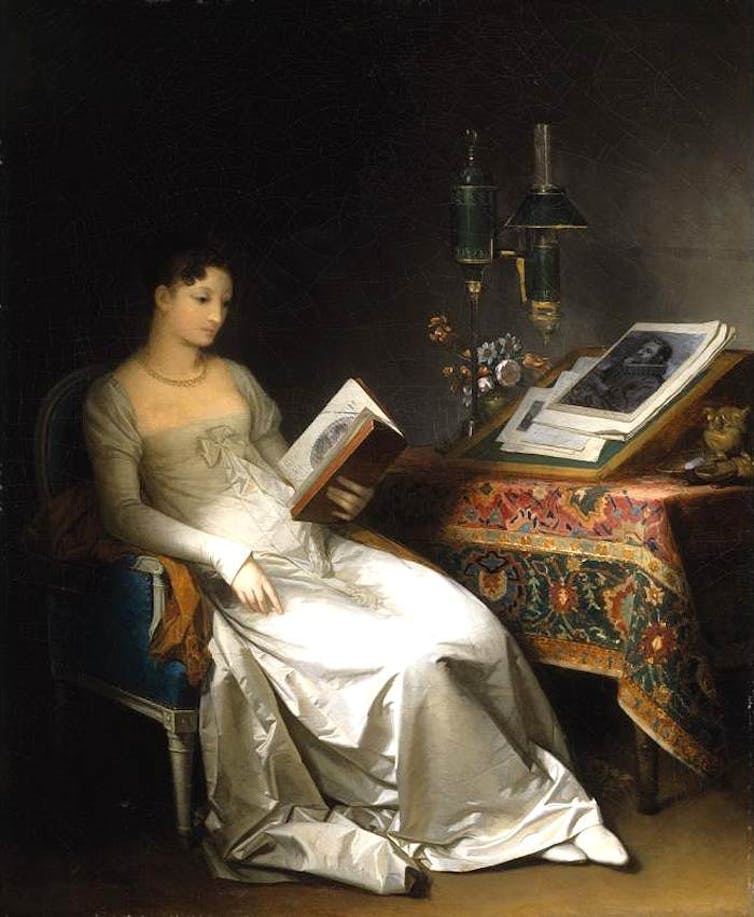
Siobhán McIlvanney, King’s College London
Straddling the private and public domains, the early French women’s press – the various published journals and pamphlets that began to appear in the 18th and early 19th centuries – can provide a unique insight into women’s everyday struggles and successes during a particularly turbulent period in France’s history.
Women’s magazines today are often thought of as ideologically somewhat conformist. They are seen to promote a limited range of feminine role models and to reinforce norms regarding women’s position within patriarchal society. The content of much of the early French women’s press presents a very different picture.
The origins of the French women’s press date back to the 18th century. The first women’s journal of any substance and longevity, Le Journal des dames, was published from 1759 until 1778. Over the next few decades a variety of different subsections and types of article emerged – many of which, whether the domestic magazine or the problem page, remain current in today’s women’s press.
It was my interest in the “political” potential of these representations of French women’s daily lives that gave rise to my book Figurations of the Feminine in the Early French Women’s Press, 1758-1848. During this period, French women had no right to political representation. Despite the Enlightenment emphasis on the rights of the individual, women were not considered of equal status to men. Their education was significantly less extensive than men’s in terms of both subjects taught and duration, resulting in high levels of illiteracy.
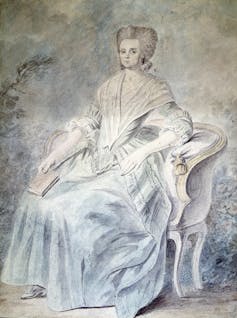
The playwright and social reformer Olympe de Gouges famously drafted her own Declaration of the Rights of Woman and the Citizen in 1791 in response to what she viewed as the gendered inequalities of the original Declaration in 1789.
The Napoleonic Code of 1804 legally obliged wives to obey their husbands and gave the latter complete control of all property. So how did these earliest women’s journals engage with the rights and roles of French women at the time?
The early French women’s press spans a range of genres, from the literary review (Le Journal des dames) to the fashion journal (Le Journal des dames et des modes [1797-1839]) to the more socially conscious feminist journal, La Femme libre (1832-34), which strove to improve employment conditions for women. These publications had a variety of target readerships, depending on the sorts of issues they covered – and these, in turn, partly depend on their historical period of publication.
Just as the Revolution of 1789 provided an impetus for women’s journals and pamphlets, such as Les Étrennes nationales des dames(1789) to intensify their demands for sexual equality, journals during the Restoration adopt a moralistic tone (Le Journal des dames et des modes, focusing on more light-hearted subjects such as fashion and characterising female readers as guardians of the hearth and paragons of virtue.
The actual readership of early French women’s journals, aside from what we can glean from articles and letters submitted by readers, is more difficult to establish and circulation claims are notoriously unreliable. Both literacy levels and the expense of the earliest women’s journals clearly limited their readership, although journals were passed among friends and within households – and, according to the correspondence of readers in Le Journal des dames et des modes (July 1803) were even read aloud.
What is clear is the pleasure expressed by many women readers at engaging in dialogue with a community of like-minded individuals and the resulting sense of collective identity and political consciousness based on gender. For the first time, French women readers – largely confined to the domestic realm – were encouraged to articulate their “private” opinions in a public forum.
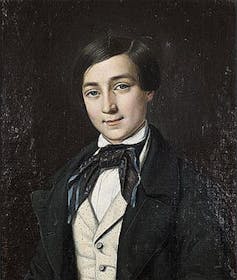
Women authors too, such as Madame de Savignac – who published educational fiction for young people – writing in Le Journal des femmes in May 1833, appreciated the role played by women’s journals in supporting women’s intellectual achievements and in giving women authors the confidence to renounce their male pseudonyms.
Many contemporary women authors adopted male pseudonyms – Savignac makes specific mention of George Sand – in order to maintain anonymity and increase the likelihood of publication in a male-dominated publishing world.
Women’s journals both act as a mirror to the society in which they are produced but can also help modify aspects of that society. Like today’s women’s press, early women’s journals in France were also selling the notion of a better life. But rather than appealing to the reader’s materialist aspirations, they did so by highlighting the need for women’s personal and public responsibility. They demonstrated a form of “civic feminism”, to employ a term adopted by the historian Carla Hesse.
If the content varies depending on the journal and the historical context in question, the radicalness of the agenda and of the narratives these journals promote is striking. Many journals – in particular the fashion press – still remained conservative in their worldview. But many others confronted legislative and social prejudices against women in an endeavour to strengthen their rights – whether to divorce or to vote – and to improve their standing in French society through the promotion of a more intellectually challenging education for women. As Suellen Diaconoff remarks in her study Through the Reading Glass: Women, Books, and Sex in the French Enlightenment:
It would be overstating the case to say that female editors focused on setting a full pro-woman agenda in their periodicals, or to assert that they saw themselves first as feminist activists and secondarily as journalists. But it is, nonetheless, true that their journals often carried a competing and alternative discourse for women, at significant variance from the model widely accepted in the mainstream.
Early French women’s journals also fought for a more inclusive French canon that treated women authors seriously. They championed women’s right to choose their own husbands in an age of arranged marriages and encouraged those women with unhappy marriages to write in anonymously about their problems, thereby providing the first example of the problem page (Le Courier de l’hymen, journal des dames, 1791).
They petitioned for improvements in women’s education and employment conditions (La Femme libre and La Voix des femmes, 1848). In short, for their contemporary readers, these early journals promoted women’s intellectual, familial and professional contributions to French society.
For today’s reader, they provide a privileged and – as yet – largely un-navigated mapping of French women’s evolving personal and political trajectories.
Siobhán McIlvanney, Reader in French and Francophone Women’s Writing; Head of Department of French, King’s College London
This article is republished from The Conversation under a Creative Commons license. Read the original article.

Bonny Cassidy, RMIT University
Why do we tell stories, and how are they crafted? In this series, we unpick the work of the writer on both page and screen.
From Patrick White’s Voss to Tim Winton’s Breath, white, male Australian novelists have reproduced the hero character through sexualised conquests of other bodies and spaces.
To limited levels of success, debut novelist Shaun Prescott explores alternatives to this tradition in The Town.

Voss, an anti-hero, virtually penetrates his immaculate lover, Laura, through telepathy; just as his journey into the “dead heart” of the country is both invasive and seemingly invisible.
Winton’s Pike looks back on a life defined by his own climactic physical drives towards the ocean and women. Despite rarely making sexual references, even Gerald Murnane’s narratives often employ traditional fantasies of women who, similar to his grassy horizons, are distant and mirage-like.
Though not without self-awareness, these stories repeat gendered male quests in which women and nature are analogous. They also reflect colonial visions of unpeopled landscapes for the taking.
Written in the era of the Stella Count – a survey of newspapers, journals and magazines to gauge gender bias in Australian book reviews – Prescott’s The Town joins recent debuts by his peers, Jack Cox’s Dodge Rose (2016) and Tom Lee’s Coach Fitz (2018), in attempting to respond to a moment of intensified feminist and anti-colonial activism.
These novels follow the great renaissance of First Nations fiction led by Alexis Wright, Kim Scott and Melissa Lucashenko. They appear alongside culturally and sexually diverse settler stories by male authors like Omar Musa and Peter Polites. As a corollary to social change, the future of the white, heterosexual male character in Australian writing will undergo revision.
Murnane’s influence on The Town manifests in Prescott’s minute attention to Australian regionalism. It’s also there in Prescott’s reduction of that locality to abstractions, his narrator speculating:
If there’s a town in the countryside where I belong, it might already be hidden by some impenetrable shimmer.
It’s David Ireland, though, who emerges as the most productive influence on Prescott. The latter may be continuing Ireland’s quite radical subversion of Australian gender images.
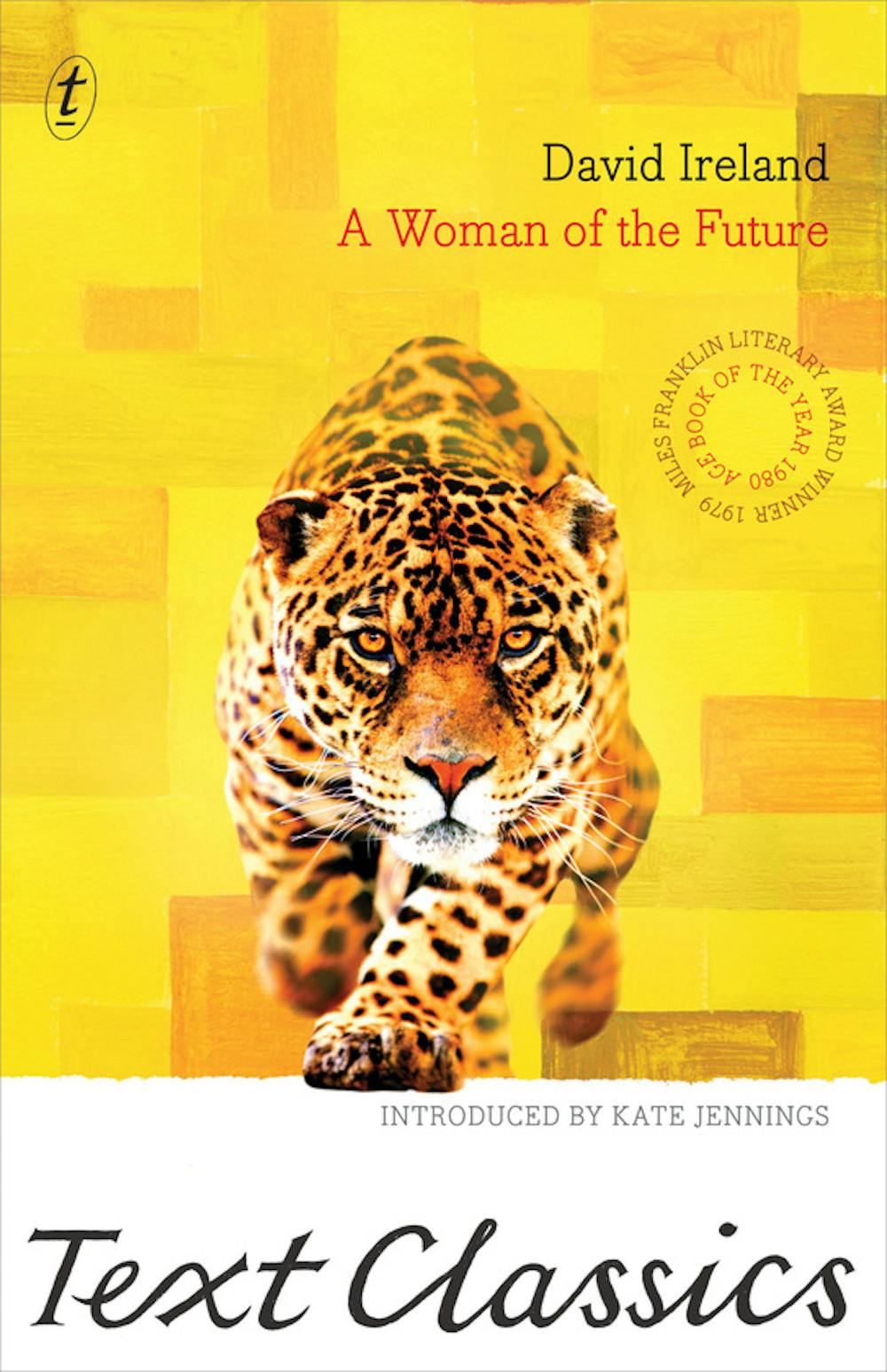
Ireland’s novels, including A Woman of the Future (1979) and City of Women (1981), probe the edges of realism and project into dystopian or surreal futures, just as Prescott does in The Town. Like Ireland, Prescott creates a magical realist world of parochial plausibility.
Prescott’s unnamed narrator is attempting to write a book on disappearing Australian towns, when the one he has chosen to research begins to dissolve into blank gaps and holes. This happens both metaphorically, as plazas and supermarkets take over town precincts, and literally as a source of mild terror. It’s all relayed with a bemused, laconic tone of narration:
The shops in the main streets were all closing. Dust set in thickly, brochures and mail littered stoops, and signs lost their colour beneath the gloom of rusted awnings. These losses did not register with the townspeople: they wandered the air-conditioned plazas, entering and exiting via escalators from dark undercover car parks.
Prescott ups the ante when it comes to plot. His narrator is searching for purpose. He has no outwardly directed sexual drive and where attraction looks like it could become a motivation, it proves a red herring.

The narrator strikes up a rapport with his housemate’s girlfriend, Ciara, who becomes an ally. While she leaves her boyfriend and joins him on the road, the journey is neither romantic nor sexually tense. They are useful to one another. Her help makes the narrator feel “unqualified to speak”.
By reconstructing character conventions, Prescott flouts a heterosexual questing plot. Instead of sex, his narrator seeks food and drink, an austerely documented yet solo pastime.
Touching on the right to speak at the heart of anti-patriarchal and anti-colonial representations, the narrator’s cultural voice – his manuscript – peters out. A remnant sense of conservative responsibility compels him salvage what he can of the town’s disappearing culture. Ultimately, he comes to reject the goal as foolish and vain.
The narrator ends up in Sydney, living in a car. Anonymity, incoherence and lost community define his experience of the city. Alone in the crowd, he observes an Anzac parade, a fleeting celebration of “unanimous sadness”. He concludes that collective cultural identity is a temporary truth. The man in the landscape, once silently independent, is now confused, homeless and deferential.

This is where the frame of the novel buckles. Prescott’s narrator must speak – a lot, and to us – so he remains our interpreter of the world. While he relinquishes anthropological detachment, he also encourages himself to let go of the town as a subject to be recorded.
The novel’s protagonist exceeds its fictive device. This leaves Prescott in a tricky spot; The Town is, after all, the promised manuscript about disappearing towns. Prescott doesn’t scramble his protagonist’s world or morality as Ireland does, but ends the narration of his own cultural theory.
Structurally, The Town outstays its plot, becoming circular and monotonous. The narrative veil over Prescott’s own voice can feel like an unnecessary smokescreen when his ideas might, after all, have reached greater depths in the form of an essay.
To speak or not to speak; Prescott seems undecided. We watch as a white Australian male writes himself a marginal relationship to the continent.
Bonny Cassidy, Lecturer in Creative Writing, RMIT University
This article is republished from The Conversation under a Creative Commons license. Read the original article.

Denise Rosemary Nicholson, University of the Witwatersrand
To fulfil their mission in the 21st century, libraries, archives, museums and galleries must engage in a wide variety of new activities.
Libraries, for example, house collections of printed works but must now also provide access to online journals, e-books, multimedia, Africana and archival treasures, images, government publications and legal material, posters and artworks. Collection, development, cataloguing, lending, preservation and replacement must take place online as well as in hard copy.
Academic libraries – and even some school ones – are now embedded in core teaching programmes. They support education and innovation and provide services for people with disabilities. Library services include teaching, literacy programmes, research support, data management, and copyright and plagiarism awareness training.
As knowledge hubs, libraries must meet the various information needs of a country’s citizens. In addition, they promote authors and publishers by purchasing, collecting and preserving their works for perpetuity.
Without access to library and archival collections, creativity and innovation would be almost impossible.
But South Africa’s current copyright law dates back to 1978, and is completely inadequate, outdated and irrelevant in a digital world. It has been a barrier to access to information for far too long.
South Africa’s Copyright Amendment Bill is waiting for President Cyril Ramaphosa’s signature. The bill has been strongly contested. Academic Sanya Samtani, for example, supports the bill with an argument based on her PhD research. For its part, the Coalition for Effective Copyright strongly opposes it.
There is merit in all these arguments. But my view is that there is positive news in the Bill’s provisions for libraries, archives, museums and galleries. For example, it will ensure that valuable documentary records and cultural heritage can be preserved for future generations.
The current Copyright Act has no provisions for libraries, archives, galleries and museums. As an afterthought, limited provisions were included in Section 13 regulations for libraries and archives.
Digitisation is the main form of preserving material in the 21st century. Yet the country’s copyright law doesn’t permit it. This causes serious problems for libraries, archives, museums and galleries. They are currently unable to digitise any of their works without first having to get copyright permission, and to pay high copyright fees.
Such entities have large collections of fragile material which can no longer be handled. The only way to preserve this material – and to make it accessible – is to digitise the content. For example, there are media libraries full of Beta and VHS video tapes, film reels and other material that can no longer be accessed as the technologies are obsolete.
To convert these works to current technologies, libraries and related entities must first get copyright permission. In many instances, rights-holders ignore the requests, or are impossible to trace (making them orphan works). In some cases permission is denied. Collections end up with gaps in them.
These issues affect access to archives, which are used for research, teaching and learning, creating and innovating and sharing information. They get in the way of the civic right to access information provided in the South African Constitution.
Lack of adequate and appropriate copyright limitations and exceptions for libraries, archives, museums and galleries have inhibited or prevented them from carrying out their statutory mandates. They have large collections of valuable documents, posters, artworks, artefacts, newspapers, recordings, and images that cannot be reproduced or even accessed. Often this is because the rights-holders cannot be traced, and there are no provisions for orphan works in the current law.
On top of this, restrictive licences and contracts often prevent libraries and similar entities from carrying out their duties. Cross-border exchanges aren’t permitted. Interlibrary loans are permitted in the current law, but this does not extend to digital sharing.
The new Copyright Amendment Bill takes cognisance of existing international conventions and treaties, treaty proposals and foreign laws. It also draws on the country’s Constitution and the excellent EIFL Model Copyright law, drafted by information specialists in various countries, including South Africa. This document is a practical guide to assist librarians, as well as their legal advisors and policy-makers, when national laws are being updated. It is designed to support access to knowledge and the public interest mission of libraries.
The Bill also implements the principles of the 2015 Cape Town Declaration, signed by South Africa and 12 other African countries. This includes the commitment
to encourage the implementation of fair and balanced copyright laws to facilitate access to information for all.
The Bill doesn’t use the word “digitisation” specifically. But it will allow libraries, archives, museums and galleries to engage in preservation, digital curation and format-shifting. This will ensure their collections are preserved and made accessible for future generations.
They will be able to share information and replace lost or stolen works. They will also be able to provide information, images, recordings or other media for historical events, exhibitions and educational purposes.
Legal deposit libraries will also finally be able to carry out their statutory mandates. These include that they collect, preserve and make accessible the country’s cultural heritage and historical documentary records in the digital space.
The Bill has been given the thumbs up by the International Federation of Library and Institutions – the leading international body representing the interests of library and information services and their users. It represents over 2.3 million libraries worldwide, serving over a billion users. It has labelled the Bill both progressive and practical. The International Council of Archives, the umbrella organisation that promotes international cooperation for archives and archivists, has also formally supported the Bill.
This suggests that South Africa is about to have a copyright law that could serve as a precedent for other countries.
Denise Rosemary Nicholson, Scholarly Communications Librarian, University of the Witwatersrand
This article is republished from The Conversation under a Creative Commons license. Read the original article.

Shareena Z Hamzah, Swansea University
In 1605, England’s parliament was sitting on a powder keg, literally. Like now, the country was bitterly divided between two factions, with religion at the heart of the schism after the Reformation pitted Protestants and Catholics against each other in a life or death struggle. History tells us that instead of seeking a political solution such as an election, a group of 13 Catholic conspirators plotted to blow up parliament.
The conspiracy aimed to assassinate King James I and the Protestant establishment with a massive explosion under the House of Lords. Every “fifth of November” since then, what is now known as the Gunpowder Plot is remembered in Britain through bonfires, fireworks and the burning of effigies of one of the conspirators, Guido (Guy) Fawkes. Following the torture and execution of Fawkes and his co-conspirators, accusations of treason, heresy, and witchcraft were used to persecute many of the perceived enemies of the crown.
The process of arrest, torture, trial and execution was widespread, as the king sought to rid the country of his twin hatreds: Catholicism and witchcraft. This purge caused many Catholics, especially priests, to flee northwards to escape the king’s revenge. Lancashire came to be perceived by the royal court as a lawless area where Catholicism and witchcraft thrived – and it was there that the infamous Pendle witch trials of 1612 took place.
Though evidence remains from the actual trials, one of the most intriguing accounts didn’t come until 400 years after the events, when author Jeanette Winterson published her work of fiction, The Daylight Gate. In this story, the fates of a group of vagrant women and a Catholic nobleman, Christopher Southworth, converge when the attention of the law turns towards them. Winterson uses the genuine names of the women who were tried for witchcraft – though freely fictionalising their lives. Southworth was also a real person, a Jesuit priest from one of the oldest families in Lancashire.

As in real life, the women in the novel are charged with murder by witchcraft. Whether they committed acts of witchcraft or not, that is not their true crime here. These women have too much power and liberty for the patriarchal Protestant society in which they live. Southworth, meanwhile, is hunted in the novel for his involvement in the Gunpowder Plot. Captured previously, he had escaped from prison and fled to France, before returning to England to save his sister from her own witch trial.
There is no evidence to show the real Southworth was a part of the Gunpowder Plot. But historical record shows us Southworth was accused of coaching a young girl to make false accusations of witchcraft against her family – possible because the family had renounced Catholicism and converted to Protestantism. Given this, it’s likely he would have supported at least the aims of the Gunpowder Plot.
The fictional women’s bodies are sites onto which the men of the law project both their fears and desires. “Look her over for the witch marks – go on, Robert, run your hands across her. Do you like her breasts?”, remarks a constable’s assistant. But these are bodies made monstrous by the effects of poverty. The feet of the appropriately named Mouldheels are described as stinking “of dead meat … wrapped in rags and already beginning to ooze”. Yet despite this monstrosity, these women are still raped by their captors as desire, disgust and domination merge.
Southworth’s status in the novel is initially different from the women. He was born and raised with the twin privileges of being male and wealthy. With no marks on his body to denote his Catholic faith, he could not be identified as an “other” without specific knowledge of his religious divergence from the ruling class. But, following the failed Gunpowder Plot, his torture at the hands of the king’s jailers results in his body being made monstrous. Attempts to blind Southworth leave scars on his eyelids and cheeks, and pictures are carved into his chest with knives.
Like the women, he is raped by his jailers. He is then literally emasculated when his penis and testicles are cut off. Perhaps luckily for the real-life Southworth, there is no evidence of an arrest, although his historical records are very scant. By comparison, the archives indicate the torture of Fawkes at the hands of the king’s inquisitors.
In this febrile, paranoid society of post-Gunpowder Plot England, the connection between Catholics and witches is stated explicitly. As Potts, the prosecutor sent by the royal court to seek out heretics, says: “Witchery popery, popery witchery. What is the difference?”. The outcomes are certainly very similar. And the burning of the womens’ bodies after their execution mirrors the ritual bonfires and immolation of Guy Fawkes effigies that have celebrated the failure of the Catholic plotters ever since.
Winterson’s novel forces the reader to consider what a monster is and what they might look like. Elizabeth Device, one of the supposed witches, is described as follows: “The strangeness of her eye deformity made people fear her. One eye looked up and the other looked down, and both eyes were set crooked in her face.” But her disfigured appearance had not saved her from being raped nine years before the novel’s setting. Throughout the book, fear and disgust mix dangerously with desire and power to produce awful crimes.
The real monsters are the men who savagely abuse and oppress the unfortunate – whether women or Catholics. Yet, they are not represented as physically repulsive. One of the torturers even has a “pleasant voice” as he questions his victims. In the end, The Daylight Gate reveals that monstrous desires produce and prey on monstrous bodies, and all those subjected to the burning heat of the king’s revenge eventually turn to ash. While the political situation in Britain today has moved away from the Catholic/Protestant schism of 1605, it is worth remembering the human tragedies behind the celebration of Bonfire Night.
Shareena Z Hamzah, Honorary Research Associate, Swansea University
This article is republished from The Conversation under a Creative Commons license. Read the original article.
 At the BookShelf


You must be logged in to post a comment.