Unknown's avatar

Friday essay: how many climate crisis books will it take to save the planet?


Ben White/Unsplash, CC BY

Ian Lowe, Griffith University

It’s that time of the year again. Brochures and emails spruik a bumper crop of new books about the climate crisis.
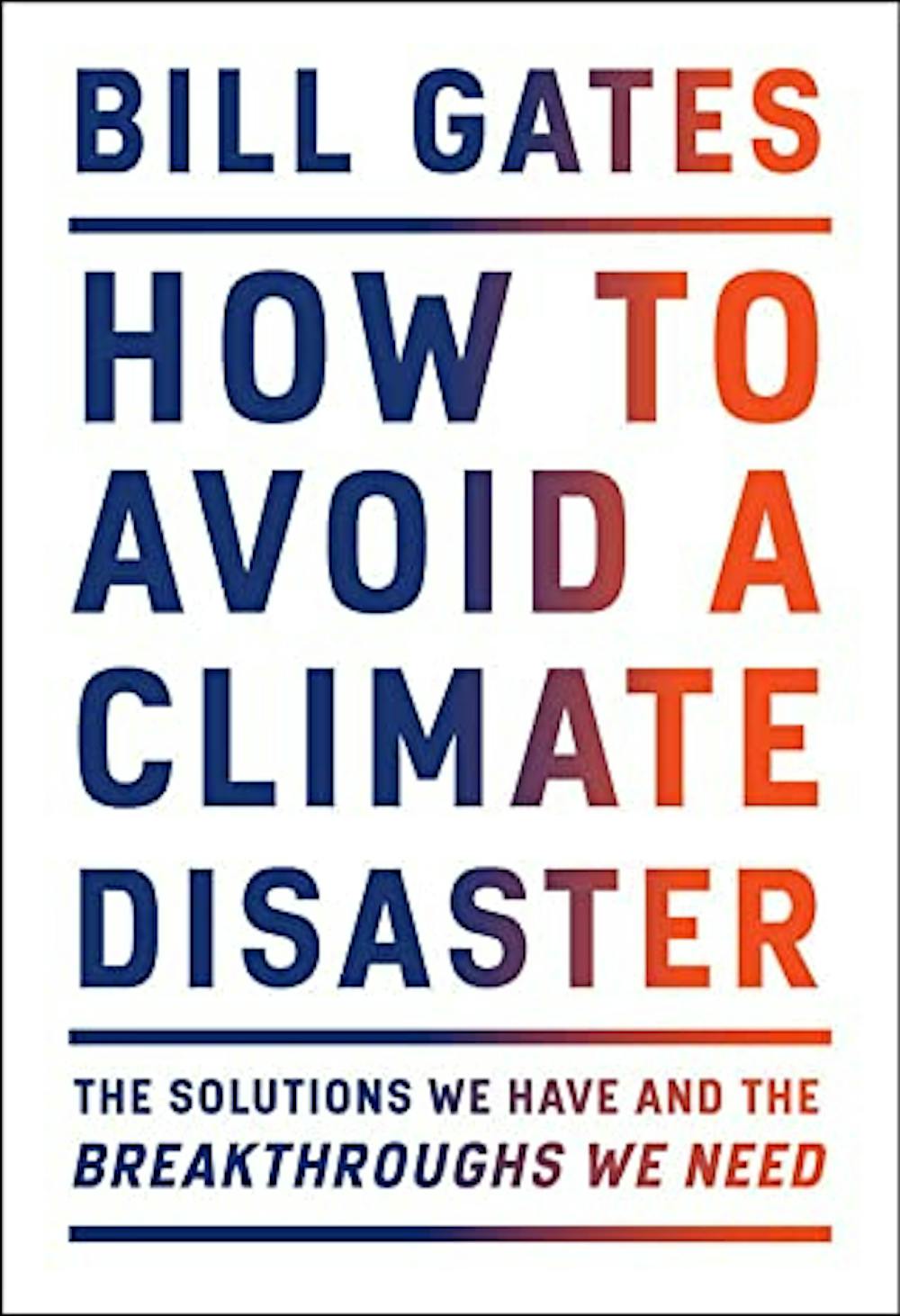
Book cover: Bill Gates How to Avoid a Climate Disaster

Goodreads

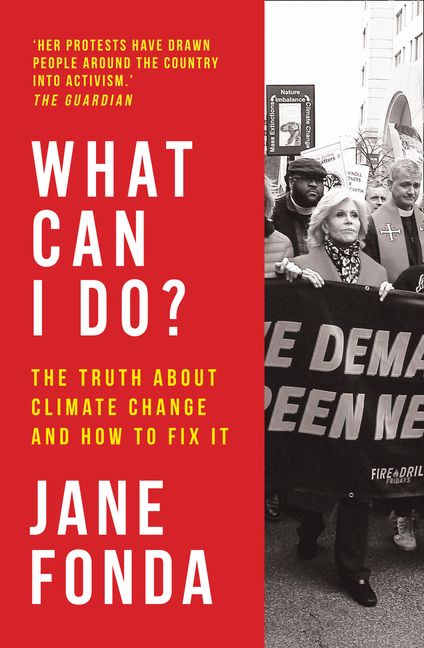
This time there are some really big names: How to Avoid a Climate Disaster by Bill Gates, Climate Crisis and the Global New Deal by Noam Chomsky and Robert Pollin, All We Can Save by Ayana Elizabeth Johnson and Katharine K. Wilkinson, What Can I Do? The Truth About Climate Change and How to Fix It by Jane Fonda, as well as new efforts from David Attenborough and Tim Flannery.

The incoming tide of new books makes me reflect and wonder whether writing still more books about climate change is a waste of precious time. When the UN is calling for governments to act to achieve carbon neutrality by 2050, are books just preaching to the converted? My answer is no, but that doesn’t mean publishing, buying or reading more books is the answer to our climate emergency right now.


Read more:
Friday essay: thinking like a planet – environmental crisis and the humanities


Decades of books

In April, on the 50th anniversary of Earth Day, the New York Times told readers this might be the year they finally read about climate change. But many already have.

The earliest titles date back to 1989: The Greenhouse Effect, Living in a Warmer Australia by Ann Henderson-Sellers and Russell Blong; my own contribution, Living in the Greenhouse, and the first book aimed at the US public, Bill McKibben’s The End of Nature.
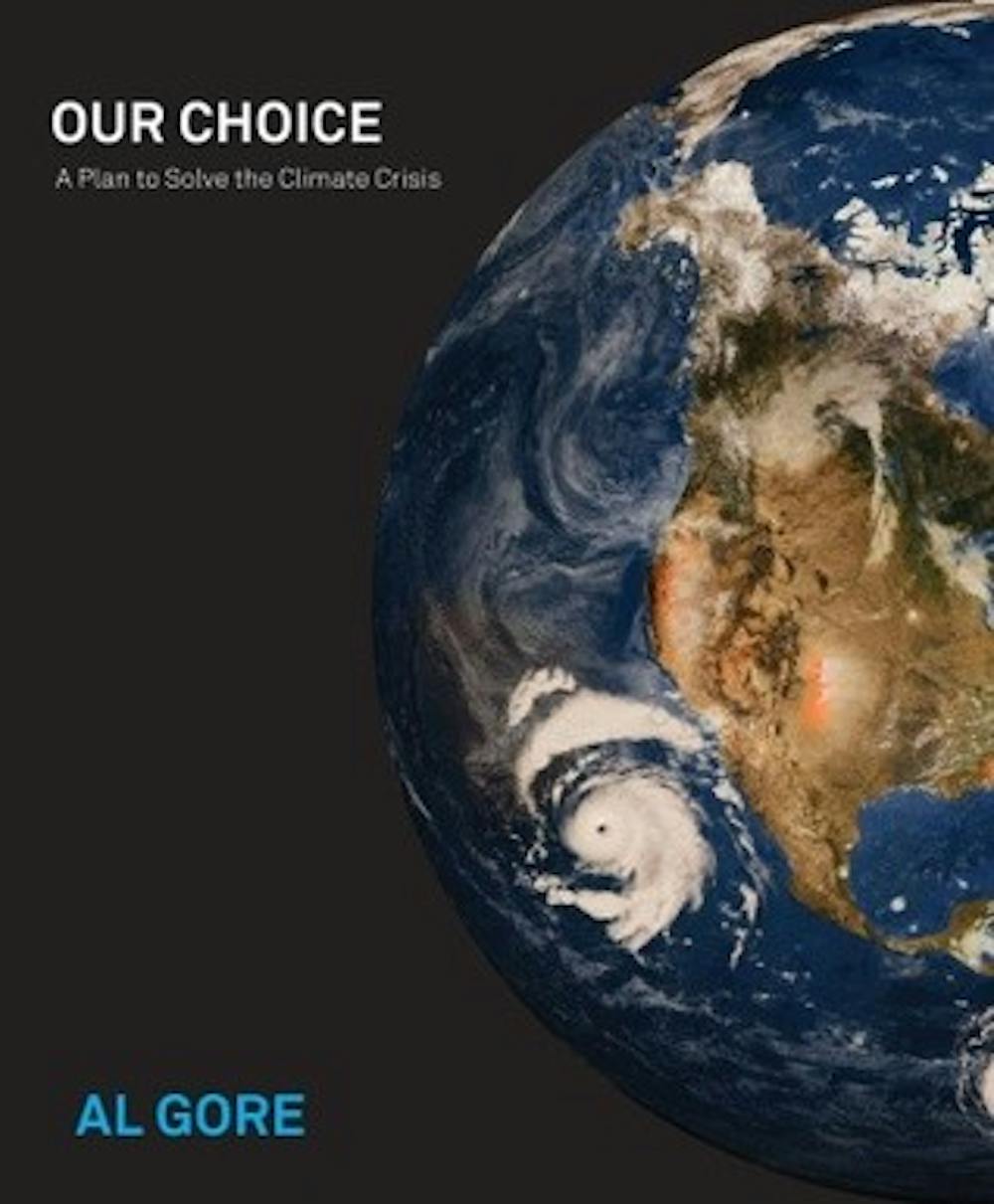
Book cover: planet earth image. By Al Gore.

Goodreads

The science was still developing then. We knew human activity was increasing the atmospheric concentration of greenhouse gases like carbon dioxide and methane. Measurable changes to the climate were also clear: more very hot days, fewer very cold nights, changes to rainfall patterns.

The 1985 Villach conference had culminated in an agreed statement warning there could be a link, but cautious scientists were saying more research was needed before we could be confident the changes had a human cause. There were credible alternative theories: the energy from the Sun could be changing, there could be changes in the Earth’s orbit, there might be natural factors we had not recognised.

By the mid-1990s, the debate was essentially over in the scientific community. Today there is barely a handful of credible climate scientists who don’t accept the evidence that human activity has caused the changes we are seeing. The agreed statements by the Intergovernmental Panel on Climate Change, the IPCC, led to the Kyoto Protocol being adopted in 1997.

And so — as the urgency being felt by the scientists increased — more books were published.

Former US vice president and 2007 Nobel Prize winner Al Gore’s book Our Choice: A Plan to Solve the Climate Crisis was first published in 2008 and has since been issued in 20 editions. There have been more than enough books to furnish a list of the top 100 bestselling titles on the topic, recommended by the likes of Elon Musk and esteemed climate scientists and commentators. The ones I have acquired fill an entire bookcase shelf — dozens of titles describing the problem, making dire predictions, calling for action.

Girl walks through bookshop.
Preaching to the converted might not be such a bad thing.
Becca Tapert/Unsplash, CC BY


Read more:
‘The Earth was dying. Killed by the pursuit of money’ — rereading Ben Elton’s Stark as prophecy


Deeds not words

Does the new batch of books risk spreading more despair? If the previous books didn’t change our climate trajectory then what is the point in making readers feel the cause is hopeless and a bleak future is inevitable?

Book cover: What can I do? by Jane Fonda

Goodreads

No. Writing more books isn’t a waste of time, but they also shouldn’t be a high priority at the moment. The point of writing a book is to summarise what we know about the problem and identify credible ways forward.

Those were my goals when I wrote Living in the Greenhouse in 1989 and Living in the Hothouse in 2005. The main purpose of the first book was to draw attention to a problem that was largely unrecognised, trying to inform and persuade readers that we needed to take action. By the release of the second book, the aim was to counter the tsunami of misinformation unleashed by the fossil fuel industry, conservative institutions and the Murdoch press. Rupert Murdoch spoke at News Corp’s AGM this week, maintaining: “We do not deny climate change, we are not deniers”.

But there are two reasons why I’m not working on a third book right now.

The first is time. If I started writing today, it would be late next year before the book would be in the shops. We can’t afford another year of inaction. More importantly, the inaction of our national government is not a result of a lack of knowledge.

On November 9, United Nations chief António Guterres said the world was still falling well short of the leadership required to achieve net-zero carbon emissions by 2050:

Our goal is to limit temperature rise to 1.5 degrees Celsius above pre-industrial levels. Today, we are still headed towards three degrees at least.

Some believe the inaction is explained by the corruption of our politics by fossil fuel industry donations. Others see is a fundamental conflict between the concerted action needed and the dominant ideologies of governing parties. Making decision-makers better informed about the science won’t solve either of these problems.

They might be solved, however, by the evidence that a growing majority of voters want to see action to slow climate change.

And the COVID-19 pandemic has focused, rather than distracted, the community on the risks of climate change. A recent survey by the Boston Consulting Group of 3,000 people across eight countries found about 70% of respondents are now more aware of the risks of climate change than they were before the pandemic. Three-quarters say slowing climate change is as important as protecting the community from COVID-19.

The growing awareness and sense of urgency are backed by another recent study looking at internet search behaviour across 20 European countries. Researchers found signs of growing support for a post-COVID recovery program that emphasises sustainability.

Kids climate books on shelf.
Books have also educated young readers on the climate emergency.
Shutterstock


Read more:
Why it doesn’t make economic sense to ignore climate change in our recovery from the pandemic


Change is happening, more is needed

Still, preaching to the converted is not necessarily a bad thing. They might need to be reminded why they were persuaded that action is needed, or need help countering the half-truths and barefaced lies being peddled in the public debate. Books can fulfil that mission. So can speaking to community groups, which I do regularly.

I tell audiences the urgent priority now is to turn into action the knowledge we have about the accelerating impacts of climate change and economically viable responses. Our states and territories now have the goal of zero-carbon by 2050, so I am giving presentations spelling out how this can be achieved. We urgently need the Commonwealth government to catch up to the community.

Climate action protest sign above crowd.
Mass protests have called for environmental leadership.
Unsplash/Markus Spiske, CC BY

Change is happening rapidly. More than 2 million Australian households now have solar panels. Solar and wind provided more than half of the electricity used by South Australia last year and that state achieved a world-first on the morning of October 11: for a brief period, its entire electricity demand was met by solar panels.

The urgent task is not to publish more books on the crisis, but to change the political discourse and force our national government to play a positive role.The Conversation

Ian Lowe, Emeritus Professor, School of Science, Griffith University

This article is republished from The Conversation under a Creative Commons license. Read the original article.

Unknown's avatar

African science fiction: rereading the classic Nigerian novel The Palm-wine Drinkard


Shutterstock

Nedine Moonsamy, University of Pretoria

In 1952 The Palm-wine Drinkard became the first West African novel written in English to be published internationally. That it was written by Amos Tutuola, an unknown Nigerian clerk who took to writing to alleviate boredom, meant the book caused a stir. To this day, it’s celebrated as a key example of African fantasy.

But more recent analysis suggests that the Western view of Tutuola as a fantasy writer is slightly patronising, because it overlooks how seriously his work engages with African reality on its own terms.

Similarly, my reading of the novel explores how it is more suitably classified as a pioneering work of African science fiction than of fantasy. And a lot of that has to do with the way Tutuola uses language. Fantasy deals in the mythic and supernatural. Science fiction is an invention more grounded in reality. I suggest that the lazy appeal to African fantasy and folklore is in line with a longstanding dismissal of Africans as technological beings and, by extension, writers of science fiction.

What the book’s about

The Palm-wine Drinkard introduces us to the Drinkard, who passes his time drinking palm wine with his friends. The alcoholic drink is made from the sap of palm trees, collected by a tapster.

Then his beloved tapster dies after falling from a tree. No longer able to access palm wine, the Drinkard soon loses favour with his friends.

He resolves to bring the tapster back from the place where all dead souls go – Deads’ Town. He passes through many strange towns, meeting bizarre creatures on his journey before finally reuniting with his tapster. Only to learn that a dead person cannot leave Deads’ Town.

In black and white, a balding dark-skinned man looks frankly and openly at the camera.
Amos Tutuola.
Marcoslampert/Wikimedia Commons, CC BY-SA

Bereft, the Drinkard returns home. Having matured on his journey, he is no longer a nonchalant drunkard and demonstrates his newfound sense of civic duty by bringing an end to a famine in his village.

Western critics hailed The Palm-wine Drinkard as inventive and avant-garde. But Nigerian critics were puzzled and even embarrassed by Tutuola’s use of English. They argued no such English existed, even in a purely spoken form.

Putting the debate of literary quality aside, Tutuola’s striking use of language is undoubtedly sublime, able to transport the reader in ways that are necessary and expected for science fiction. He takes great pains to place his narrative within lived and believable African experience that is more in line with science fiction than fantasy.

Creating a sci-fi world

Samuel R. Delany is a luminary African-American science fiction writer and critic. For him, science fiction is able to “generate the infantile wonder” of the reader through language.

In his hallmark essay About 5,750 Words, he gives an insightful explanation of how science fiction is distinct from other types of fiction. Where realism tells what “could have happened” and fantasy explores what “could not have happened”, science fiction opens up space for events “that have not happened” yet.

An older man with a huge white beard sits looking at camera, behind him a study and shelves of books.
Samuel R. Delaney, a self-portrait.
Samuel R. Delaney/Wikimedia Commons, CC BY-SA

Fantasy can travel anywhere, but science fiction approaches the world with an inventive attitude rather than a fanciful one. Science fiction can stretch outside our current world, but never to the extent of fantasy. As Delany explains, science fiction writers very carefully use language as part of a process that helps the imagination make the leap from our world into an alternative one.

Tutuola is invested in this balancing act: he stretches the limits of realism but also reins in the unlimited possibilities of fantasy. For example, the Drinkard explains that he and his wife became immortal because they “had ‘sold our death’ to somebody at the door for the sum of £70: 18: 6d and ‘lent our fear’ to somebody at the door as well on interest of £3: 10: 0d per month, so we did not care about death and we did not fear again”.


Read more:
Science fiction offers a useful way to explore China-Africa relations


Tutuola imagines a refreshing option where states of existence like death and anxiety – much like everything else in our consumerist culture – can be traded or rented and “worn” like clothing. Giving the exact amounts in British pounds marries something as familiar as shopping with the wondrous potential that we may one day discard existential inconveniences as easily.

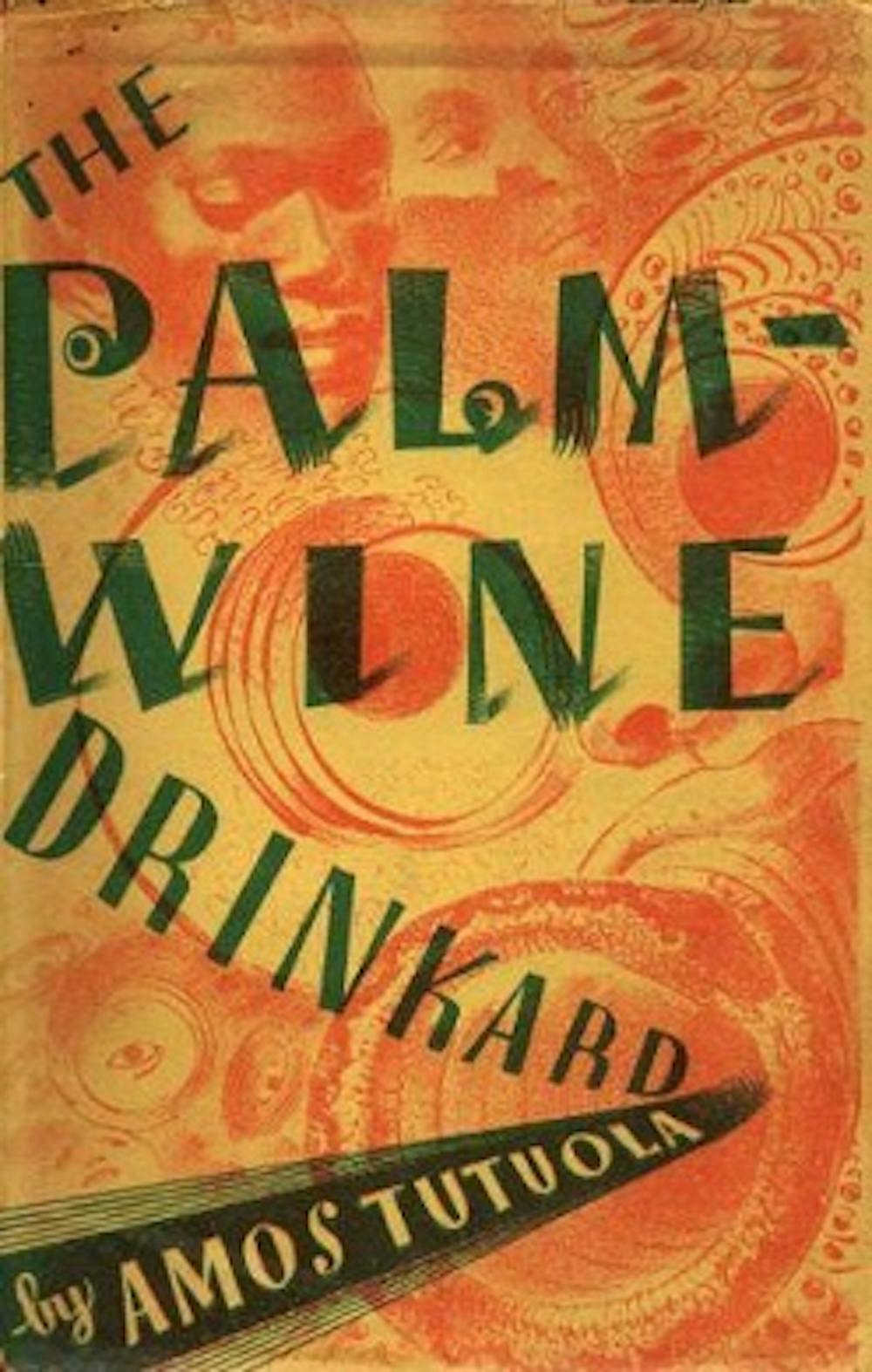
A swirling orange and gold graphic book cover. In the background, African women's faces, with green lettering reading 'The Palm-wine Drinkard by Amos Tutuola.'
The 1952 edition.
Faber and Faber UK

For every fantastic suggestion, Tutuola provides a real-world equivalent. He places the most bizarre creatures within the limits of our current experience.

In the forest the Drinkard meets a creature whose two large eyes “were as big as bowls” and feet as “long and thick as a pillar of a house”. This reliance on similes or mundane comparisons is part of an effort to weave the fanciful into the reader’s reality.

The Palm-wine Drinkard uses language in ways that critics like Delany insist are universally crucial to science fiction.

African sci-fi and fable

Some contemporary appraisals of science fiction in Africa argue that the genre is rooted in indigenous fable and folklore and should be read on unique – exceptionalist – terms.

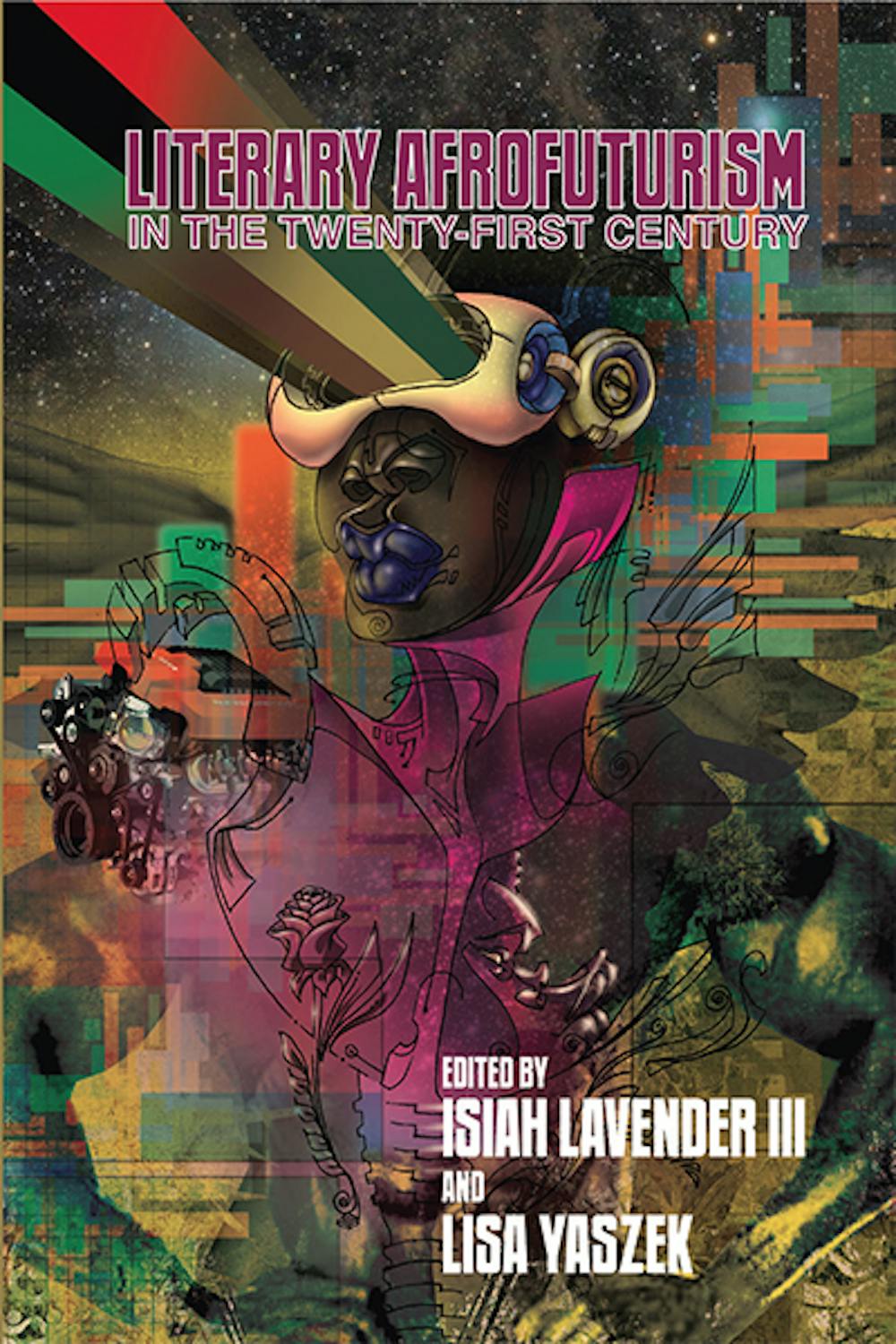
A dense graphic book cover featuring an African figure with high tech glasses on shooting out beams of coloured light, the title reading 'Literary Afrofuturism in the Twenty-First Century'

The Ohio State University Press

Yet reading African science fiction as an exclusive – and even resistant – form of science fiction, we lose sight of the globalising spirit that’s central to understandings of popular culture in Africa.

Wielding language as the ultimate form of technology, Tutuola has reassembled it and built a vocabulary for his pioneering work of African science fiction that can easily be read as a worthy participant on the global stage of popular genre fiction.

This article is based on Moonsamy’s chapter in the new book Literary Afrofuturism in the Twenty-First Century from The Ohio State University Press.The Conversation

Nedine Moonsamy, Senior Lecturer, University of Pretoria

This article is republished from The Conversation under a Creative Commons license. Read the original article.
Unknown's avatar

Not My Review: A Way With Words by Daniel Darling


The link below is to a book review of ‘A Way With Words,’ by Daniel Darling.

For more visit:
https://www.9marks.org/review/book-review-a-way-with-words-by-dan-darling/

Unknown's avatar

10 Public Domain Audiobooks


The link below is to a list of 10 public domain audiobooks.

For more visit:
https://bookriot.com/free-audiobooks-in-the-public-domain/

Unknown's avatar

Not My Review: Memoirs of an Ordinary Pastor – The Life and Reflections of Tom Carson by D. A. Carson


The link below is to a book review of ‘Memoirs of an Ordinary Pastor – The Life and Reflections of Tom Carson,’ by D. A. Carson.

For more visit:
https://www.9marks.org/review/book-review-memoirs-of-an-ordinary-pastor-by-don-carson/

Unknown's avatar

Not My Review: Expository Exultation – Christian Preaching as Worship by John Piper


The link below is to a book review of ‘Expository Exultation – Christian Preaching as Worship,’ by John Piper.

For more visit:
https://www.9marks.org/review/book-review-expository-exultation-by-john-piper/

Unknown's avatar

2020 Children’s Book Council of Australia (CBCA) Book of the Year Awards Winners


The link below is to an article reporting on the winners of the 2020 Children’s Book Council of Australia (CBCA) Book of the Year Awards.

For more visit:
https://www.booksandpublishing.com.au/articles/2020/10/16/158101/cbca-book-of-the-year-2020-winners-announced/

Unknown's avatar

ISBNs and Book Discovery


The link below is to an article that takes a look at ISBNs and book discovery.

For more visit:
https://blog.bookbaby.com/2020/10/isbn-and-book-discovery/

Unknown's avatar

The Science Behind Reading


The link below is to an article looking at the science behind reading.

For more visit:
https://bookriot.com/whats-the-science-behind-reading/

Unknown's avatar

Not My Review: God, Greed, and the (Prosperity) Gospel – How Truth Overwhelms a Life Built on Lies by Costi Hinn


The link below is to a book review of ‘God, Greed, and the (Prosperity) Gospel – How Truth Overwhelms a Life Built on Lies,’ by Costi Hinn.

For more visit:
https://www.9marks.org/review/book-review-god-greed-and-the-prosperity-gospel-by-costi-hinn/