
Unknown's avatar

Infinite Jest: how David Foster Wallace’s classic nineties novel foreshadowed the Year of Zoom


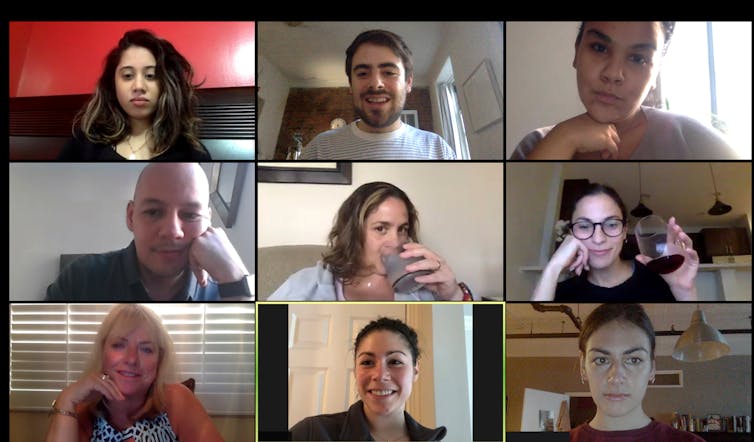
It was fun for a while, but people quickly got sick of video calls during lockdown.
Cabeca de Marmore via Shutterstock

Michael Hedges, University of Leeds

In David Foster Wallace’s Infinite Jest (1996), even the years have their price. They have been sold off and named. Year of the Whopper. Year of the Perdue Wonderchicken. Year of the Depend Adult Undergarment. Time has been reduced to another opportunity for corporate sponsorship, as if it were a Premier League football stadium.

The characters who inhabit Wallace’s world feel the pernicious grip of consumerism even more acutely than we do. They battle with the same addictions: to entertainment; to drugs and alcohol, of course; to sporting success at any cost. Sadly, we recognise each of these in our society. But at least our years haven’t been put up for sale. Yet.

Infinite Jest narrates a vision of the near future, which is now our recent past. The novel depicts a conjectural North American superstate during the first decade of the 21st century. But what if we were we living out Wallace’s speculative fiction? In a number of frightening ways, we are. One thing is for certain: there would be a clear contender for 2020 sponsorship. It would be the Year of Zoom.

Or Teams. Or Meet. Since the COVID-19 restrictions on our lives began in March, these platforms have become household names. Many of us have had to grow familiar with their distinct idiosyncrasies in order to work or socialise. Infinite Jest provides something of a user guide to handling video calls. However, it is not a ringing endorsement of them. Quite the opposite.

That Infinite Jest predicts video calls is hardly noteworthy. Communicating at a distance through a screen has long been a staple ingredient of science fiction. What is so eerily prescient about video calls in the novel is not its description of their rise. It is the reasons Wallace gives for their demise.
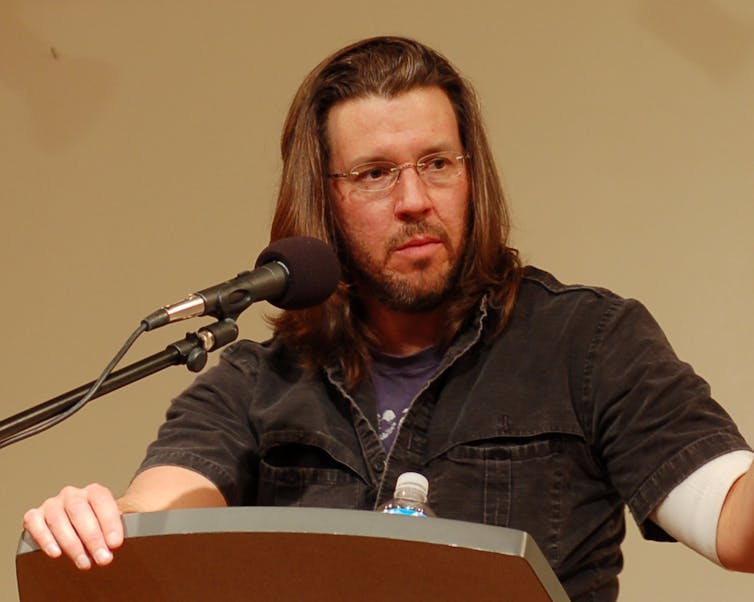
Bearded man giving lecture with microphone and lectern.
Ahead of his time: the late author David Foster Wallace.
Steve Rhodes/Flickr via Wikimedia Commons, CC BY-SA

Wallace calls it “videophony”. This nascent video-telephonic technology enjoyed “AN INTERVAL OF HUGE CONSUMER POPULARITY” before demand “COLLAPSED LIKE A KICKED TENT”. A capitalised passage of faux media analysis concludes that phone users “ACTUALLY PREFERRED THE RETROGRADE OLD LOWTECH BELL-ERA VOICE-ONLY TELEPHONIC INTERFACE AFTER ALL”. It then asks: “WHY THE ABRUPT CONSUMER RETREAT BACK TO GOOD OLD VOICE-ONLY TELEPHONING?”

Wallace’s narrator answers the call. People rejected videophony because of “(1) emotional stress, (2) physical vanity, (3) a certain queer kind of self-obliterating logic in the microeconomics of consumer high-tech”. The pandemic has proven Wallace right on all three counts.

Fancy a Zoom later?

At the beginning of lockdown, we flocked to video conferencing. It was – and remains – an invaluable means of staving off boredom and loneliness. But we have begun to feel the effects of what Wallace identified more strongly in recent months.

We held pub quizzes, then we stopped. We agreed to Zoom every week, then we didn’t. As Wallace puts it: “it turned out that there was something terribly stressful about visual telephone interfaces that hadn’t been stressful at all about voice-only interfaces.”

Plenty of people had been regularly making video calls long before the COVID-19 outbreak. Back then, however, the technology wasn’t serving as a substitute for face-to-face interaction to the same extent. In Infinite Jest, consumers have the luxury of rediscovering an earlier technology, the merits of which passed them by the first time around. We are not in the same position. We know full well the value of what we lack in lockdown – and every call has been coloured by the mourning of its loss.

We continue to use video calls in part because we know that this is as good as it’s going to get for some time. Socialising indoors is once again illegal for millions of people across the UK and elsewhere. So we have developed the videophonic coping strategies that Wallace envisioned.

Thankfully, we have been spared the “emotional stress” of realising that – as Wallace puts it – “traditional audio-only phone conversations allowed you to presume that the person on the other end was paying complete attention to you while also permitting you not to have to pay anything even close to complete attention to her.” Each of us had that earth-shattering realisation midway through our first Skype call, however many years ago. Incredibly, up till then we had never been “haunted by the suspicion that the person on the other end’s attention might be similarly divided”.

Lockdown has been more troubling for our “physical vanity”. Wallace foresaw the “shiny pallid indefiniteness” of seeing our own faces on screen. They are “not just unflattering but somehow evasive, furtive, untrustworthy, unlikeable.” To combat what Wallace terms “Video-Physiognomic Dysphoria”, the telecommunications industry devised “High-Definition Masking”. What started as composites of “flattering multi-angle photos” culminated in “a form-fitting polybutylene-resin mask”. We are not quite at that stage. Yet.

Background information

Our vanity extends far beyond our faces. Or rather, behind our faces to the backdrops that frame them. The early weeks of lockdown were littered with stories mocking politicians and journalists for their carefully curated bookshelves. But who among us cannot empathise with these contrivances? Wallace knew we would want to communicate “the sort of room that best reflected the image” of ourselves that we “wanted to transmit”. In my experience, this means having to resist the urge to tailor the spines on display to match the reading habits and political allegiances of every caller. The call ends up beginning well before the scheduled time.

The alternative isn’t much better. In Infinite Jest, people cover their videophone lens with a “Transmittable-Tableau”. These are “high-quality transmission-ready photographs, scaled down to diorama-like proportions”. Not such a ridiculous idea, given the wide range of video call backgrounds currently available.

The artfully staged bookshelf and the digital backdrop both run risks. The former can be construed as being horrendously self-involved. The latter invites the inference that there is something to hide behind whatever high-resolution facsimile the disembodied head is looming in front of. The key is to find the sweet spot between not appearing too concerned with one’s appearance, while shielding the call participants from the chaos lying slightly out of frame.

Which brings me to Wallace’s third reason for the failure of videophony. In its final throes, there emerged a “chic integrity” in rejecting videophony as “tacky vain slavery to corporate PR and high-tech novelty”. I have noticed a similar trend in recent weeks. Some callers now take a wonderful stance against vanity.

The messier the background, the better. Unsuitable lighting now trumps precisely directed anglepoise lamps. Which begs the question: why bother with the video component of video calls at all? Is the “self-obliterating logic in the microeconomics of consumer high-tech” starting to take hold, as Wallace prophesied?

Wallace’s narration announces that videophony is “less like having the good old phone ring than having the doorbell ring and having to throw on clothes and attach prostheses and do hair-checks in the foyer mirror before answering the door”. These inconveniences would be a small price to pay if it meant our doorbells would ring again. And I don’t mean for another Amazon delivery.The Conversation

Michael Hedges, PhD Candidate in Contemporary Literature and Sound Studies, University of Leeds

This article is republished from The Conversation under a Creative Commons license. Read the original article.

Unknown's avatar

Not My Review: The Daevabad Trilogy (Book 1) – The City of Brass by S. A. Chakraborty


Unknown's avatar

Finished Reading: Conqueror (Book 5) – Conqueror by Conn Iggulden


Conqueror (Conqueror, Book 5)Conqueror by Conn Iggulden
My rating: 4 of 5 stars

View all my reviews

Unknown's avatar

Not My Review: Shiver – Selected Stories by Junji


Unknown's avatar

Graphic novels are overlooked by book prizes, but that’s starting to change


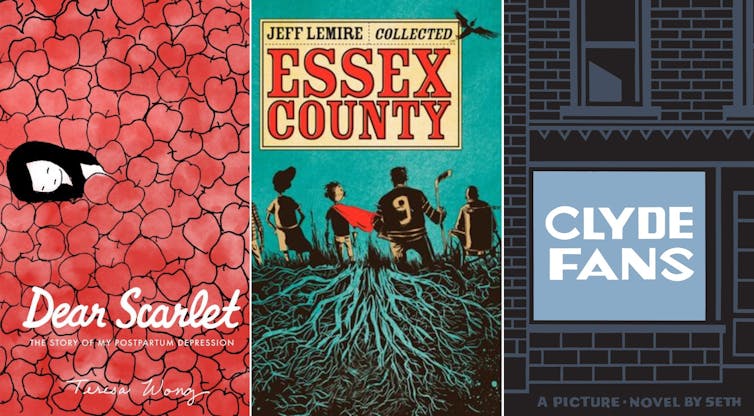
Teresa Wong’s ‘Dear Scarlet,’ Jeff Lemire’s ‘Essex County,’ and recently nominated for a 2020 Canadian literary prize, Seth’s ‘Clyde Fans.’
(Arsenal Pulp Press/Penguin Random House/Drawn&Quarterly)

Dessa Bayrock, Carleton University

In the midst of a global pandemic, almost nothing is proceeding as normal. And yet, on a dim October morning, the Scotiabank Giller Prize shortlist announcement went brightly, briefly and virtually streaming into homes and revealing the five books that had moved one step further towards winning Canada’s largest and arguably most prestigious literary award.

In some ways, however, this business as usual was a disappointment. After all, the Giller recently changed its submission guidelines to allow graphic novels to be submitted to the prize, and even more recently announced that a graphic novel was, indeed, included on the longlistClyde Fans, by highly acclaimed Canadian author and cartoonist Seth.

But after raking in praise and aplomb for featuring a graphic novel on its longlist for the first time, the Giller — like so many other book prizes — just couldn’t bring itself to put Clyde Fans on the shortlist. Business as usual, indeed.

And are we really surprised?

Prizes reflect readership

Book prizes have long overlooked and excluded graphic novels from their submissions: if not officially barred from entry (as with the Giller, which excluded graphic novels in its submission guidelines for a quarter of a century), then unofficially (as with Canada Reads, which does not specifically bar graphic novels from consideration but hasn’t shortlisted one since 2011). As a result, graphic novels are a kind of literary elephant in the room: a format of literary fiction which many, including book prizes, refuse to recognize as “literary” fiction.

This is, however, beginning to change. Increasingly, book prizes are beginning to reflect a reality many readers, professors, librarians and publishers have known for years: that graphic novels do, in fact, have serious literary value. Graphic novels span a wide variety of content, and they’re visual narratives with the same complexity and depth as purely textual novels. It’s taken decades, but public perception has changed. And now, too, so are prizes.

After all, “good literature” is not — and never has been — a static category, but rather an ever-shifting, nebulous definition built collaboratively by anyone who’s ever picked up a book. After decades of marginalization, graphic novels are now inarguably coming to be included in this mainstream definition of what is “literary.”

Furthermore, this process of acceptance is helped in no small part by book prizes’ increasing support of graphic novels; the connections between canonization and prizes are well studied. When literary institutions hold up a graphic novel as one of “the most powerful pieces of fiction published this year,” as the Giller did when it announced its longlist in September, the reading public begins to rethink their own biases against what they think is or isn’t literary — whether they know they hold those biases or not.

A troubling trend

When we start to look at the history of graphic novels and book prizes, however, a more troubling trend seems to spring up: that despite their increasing presence on book prize long- and shortlists, graphic novels don’t ever seem to win book prizes.

For instance, Sabrina, a graphic novel by Nick Drnaso about “the story of what happens when an intimate, ‘everyday’ tragedy collides with the appetites of the 24-hour news cycle,” was longlisted by The Booker Prize in 2018 — the first time a graphic novel had ever been longlisted by the Booker.

Like Clyde Fans, it too, failed to make the prize shortlist. Earlier this year, Canada Reads similarly longlisted — but didn’t shortlist — graphic memoir Dear Scarlet by Teresa Wong, which deals with post-partum depression.

Ironically, graphic novels seem to have had better chances in the book prize world the further back we look: Essex County, a graphic novel by Jeff Lemire about a rural community in Southwestern Ontario, made the Canada Reads shortlist in 2011 — making it further in the process than Clyde Fans, Sabrina and Dear Scarlet only to get knocked out on the first day of competition.

Going back even further, the highly-acclaimed Maus by American author and artist Art Speigelman won a Pulitzer in 1992. The book (full title: Maus: A Survivor’s Tale) shows Spiegelman interviewing his father, a Polish Jew, about his memories of surviving the Holocaust during the Second World War.

Even so, Maus didn’t win a Pulitzer for literature, but rather a Pulitzer Special Citation — which basically equates to a Pulitzer given by a jury when they’re not quite sure what category to put it in. Is it literature? Is it art? Is it memoir? Is it history? The answer: it’s a special citation.

Literary evolution remains slow

If these kinds of approaches to recognizing graphic novels seems like gatekeeping what we consider “serious literature,” that’s because it is.

These prizes have been slow to shift away from a European high-culture approach, demonstrating how infuriatingly slowly the western literary canon evolves, especially in any direction away from the exclusionary principles it was and is founded on.

It is, frustratingly, a sluggish and non-linear progression — both in the public perception of what is and is not “literary,” and the ways in which literary institutions such as prizes reflect those perceptions.

This is only underscored by the fact that a graphic novel won’t win the Giller this year, and a graphic novel probably won’t win it next year, either. But eventually, one day, it’ll happen — and if this new trend of graphic novels hitting prize longlists is any indication, it’s a future we’re moving closer to all the time.The Conversation

Dessa Bayrock, PhD Student, Department of English, Carleton University

This article is republished from The Conversation under a Creative Commons license. Read the original article.

Unknown's avatar

2020 Franz Kafka Prize Winner


The link below is to an article reporting on the winner of the 2020 Franz Kafka Prize, Milan Kundera.

For more visit:
https://www.theguardian.com/books/2020/sep/22/milan-kundera-joyfully-accepts-czech-republics-franz-kafka-prize

Unknown's avatar

2020 ACU Prize for Poetry Winner


The link below is to an article reporting on the winner of the 2020 ACU Prize for poetry, Geoff Page, for ‘Jericho.’

For more visit:
https://www.booksandpublishing.com.au/articles/2020/09/22/156923/page-wins-2020-acu-prize-for-poetry/

Unknown's avatar

2020 Victorian Premier’s History and Community History Awards Shortlists


The link below is to an article reporting on the shortlist for the 2020 Victorian Premier’s History Award and Community History Awards.

For more visit:
https://www.booksandpublishing.com.au/articles/2020/09/25/157244/vic-prems-history-award-2020-shortlist-announced/

Unknown's avatar

Changes at Macmillan


The link below is to an article reporting on changes at Macmillan, following a period of turmoil at the company.

For more visit:
https://www.nytimes.com/2020/09/17/books/macmillan-john-sargent.html

Unknown's avatar

2020 Blake Poetry Prize Winner


The link below is to an article reporting on the winner of the 2020 Blake Poetry Prize, Judith Nangala Crispin, for the poem ‘On Finding Charlotte in the Anthropological Record.’

For more visit:
https://www.booksandpublishing.com.au/articles/2020/09/22/156917/crispin-awarded-2020-blake-poetry-prize/