Unknown's avatar

African crime and detective fiction reshapes the genre


Alexis Huguet/AFP/Getty Images

Aretha Phiri, Rhodes University and Sam Naidu, Rhodes University

Crime and detective fiction continues to top bestseller lists across the world, spawning TV series and films. In the hands of African writers, though, the genre offers a particularly textured world view.

That Ever-blurry Line Between Us and the Criminals: Re-Visioning Justice in African Noir is a colloquium paper by Sam Naidu. It focuses on African crime and detective fiction as a complex and disruptive variety of classic, Western crime and detective fiction.

In probing the transatlantic relationship between Africa and the West, Naidu presents a useful critique of seminal Black Atlantic studies like Paul Gilroy’s
1993 The Black Atlantic: Modernity and Double Consciousness. Aretha Phiri interviewed the author.


Aretha Phiri: Your paper addresses classic noir and African noir, sub-genres of crime and detective fiction?

Sam Naidu: African crime fiction builds on and extends classic crime fiction to explore philosophical questions about identity, knowledge and power. Referencing the same dark aesthetic of classic noir – characterised by themes of alienation, pessimism, moral ambivalence and disorientation – African crime fiction amplifies political awareness. And, occasionally, it destabilises the conventions of classic crime fiction, which arose during the aftermath of the two world wars when the world was in the grip of the Cold War.

Aretha Phiri: What is the ‘political’ relationship between classic and African crime fiction?

Sam Naidu: African crime fiction builds on and extends classic crime fiction’s exploration of philosophical questions about identity, knowledge and power in the modern world.

Politically, there is a deliberate shift to consider fundamental questions about Africa and its specific requirements. The novels I have read demonstrate a preoccupation with the ambiguity of justice. They express a poignant, Afro-pessimistic lament for a continent and its injustices.

They provide this focus in terms of colonialism and the power differentials of neo-colonialism in Africa. So, you find that economic exploitation and inequalities, race, war, genocide, corruption and state capture are common subject matter.

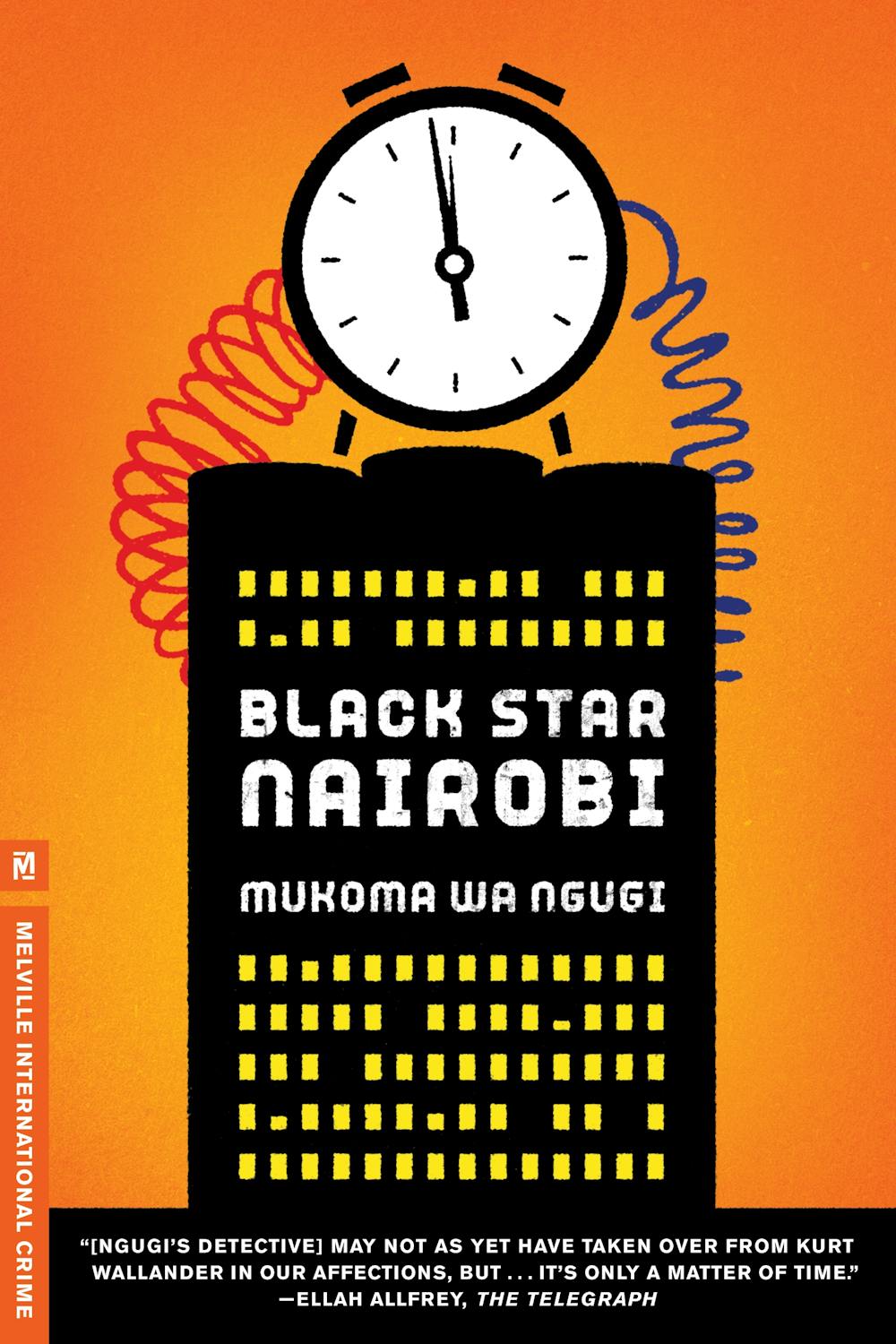
Aretha Phiri: You read Mũkoma wa Ngũgĩ’s novel Black Star Nairobi (2013) as a valuable way of demonstrating the disruption of the classical by the African? What’s it about?

Sam Naidu: It’s set mainly in Nairobi, Kenya, in 2007. It’s the eve of Barack Obama’s election as the first black US president and presidential elections in Kenya. O (short for Odihambo), a Kenyan former policeman who still works part-time for the police, has teamed up with Ishmael from the US, a former cop. Together they’ve formed a detective agency, Black Star, which is given a lucky break when O’s former boss hires them to investigate the murder of an unidentified person whose corpse is found gruesomely disfigured in the Ngong Forest outside Nairobi.

Melville House International, 2013

Aretha Phiri: You conclude in your paper that the predominant effect of African crime fiction is not so much a ‘dark’ sensibility as it is one of obscurity and poignant Afro-pessimism?

Sam Naidu: I reach this conclusion based on the literary texts. This is not my opinion of the state of the continent. The novels are very dark. They overwhelm the reader, with the mess, tragedy, garbage, cruelty, indignity and inhumanity that Africans face in reality. Due, of course, to historical and ongoing systemic oppression and corruption. For characters – and for readers – this can lead to muddledness and despair.

But the novels also offer a counterpoint – in the form of fearless detectives on the quest for justice. In the midst of the disquiet there is a faint flicker … It is this murkiness, taken to new depths, which makes African crime fiction particularly effective and significant. For example, the novel closes with a highly lyrical and metaphorical scene of African musicians in a market. Ishmael describes the competing rhythms of African music – a metaphor for the strife and power struggles of the continent. Despite the discord he detects a harmony –- “a tense harmony”.


Read more:
Nigeria’s queer literature offers a new way of looking at blackness


Aretha Phiri: How does Black Star Nairobi manage to disrupt classic crime fiction?

Sam Naidu: For example, through its innovative use of setting, characterisation, pace and conclusion to comment on ontological, existential and ethical themes to do with justice, it’s an exemplary African noir text. It explicitly extends classic noir into the realms of neo-noir.

Its blend of previous influences, use of setting, and its specific thematic concern with Afro-pessimism prompt the observation that African crime fiction extends classic noir into new literary, geo-political, and moral territories.

Murkiness, so characteristic of classic noir sensibility, mutates, at times, in African crime texts such as Black Star Nairobi and Leye Adenle’s When Trouble Sleeps, to a deliberate generic nebulousness. And thematically, to a moral blurriness so obscure as to disorient the reader and dismantle the basic binaries on which classic detective and crime fiction were predicated.

In classic noir or classic crime fiction there are clear detective heroes set up against indisputable villains (think of Sherlock Holmes) but in African crime fiction the heroes and villains often exchange roles or are complicit in some way.


Read more:
Black and queer women invite the Black Atlantic into the 21st century


Aretha Phiri: You describe this evolving genre as occupying a kind of borderland. How does this connect to your research in migration and diaspora?

Sam Naidu: In my work on literature of migration and diaspora I am mainly concerned with the experience of migrants. I am, however, also interested in how literary genres migrate. What processes of cross-pollination occur as a result of diaspora?

Aretha Phiri: What do you see African crime fiction contributing to Black Atlantic scholarship?

Sam Naidu: As a form of postcolonial, transnational writing, African crime fiction points to the relations between Africa and America. Gilroy’s Black Atlantic puts forward that race is fluid and ever-changing, rather than static. That it is transnational and intercultural, rather than national. I am arguing that African crime fiction represents race as a transnational or diasporic phenomenon while at the same time engaging with the notion that race is closely bound up with both nationality and ethnicity.

So, look at the detective hero figure Ishmael. He is an African-American who returns to Africa, gesturing, of course, to transatlantic slavery and colonialism. He’s neither African nor American – he is both. The novel explores his hybridity. At the same time, the novel presents Kenya as nation marred by ethnic clashes and wide-scale civil unrest.

African crime fiction, being the second most popular literary genre on the continent after romance, is worthy of study because of its accessibility, wide-spread, diverse readership and also its capacity for socio-political analysis. It is the ideal vehicle for such pertinent ‘detection’.

This article is part of a series called Decolonising the Black Atlantic in which black and queer women literary academics rethink and disrupt traditional Black Atlantic studies. The series is based on papers delivered at the Revising the Black Atlantic: African Diaspora Perspectives colloquium at the Stellenbosch Institute for Advanced Study.The Conversation

Aretha Phiri, Senior lecturer, Department of Literary Studies in English, Rhodes University and Sam Naidu, Professor, Department of Literary Studies in English, Rhodes University

This article is republished from The Conversation under a Creative Commons license. Read the original article.

Unknown's avatar

2020 Australian Literature Society (ALS) Gold Medal Shortlist


The link below is to an article reporting on the shortlist for the 2020 Australian Literature Society Gold Medal.

For more visit:
https://www.booksandpublishing.com.au/articles/2020/05/20/150833/als-gold-medal-2020-shortlist-announced/

Unknown's avatar

Enhanced Ebooks


The link below is to an article that discusses the problems with enhanced ebooks. Essentially, there has been no real effort in forwarding the concept – an opportunity missed?

For more visit:
https://www.thebookdesigner.com/2020/05/the-problem-with-enhanced-ebooks/

Unknown's avatar

2020 Booksellers’ Choice Book of the Year Awards Longlists


The link below is to an article reporting on the longlists for the 2020 Booksellers’ Choice Book of the Year Awards.

For more visit:
https://www.booksandpublishing.com.au/articles/2020/05/22/151025/booksellers-choice-2020-book-of-the-year-awards-longlists-announced/

Unknown's avatar

On Rereading


The link below is to an article that looks at rereading favourite books

For more visit:
https://lithub.com/doesnt-everyone-reread-their-favorite-books-all-the-time/

Unknown's avatar

2020 New York Public Library’s Young Lions Fiction Award Shortlist


The links below are to articles reporting on the shortlist for the 2020 New York library’s Young Lions Fiction Award.

For more visit:
https://publishingperspectives.com/2020/05/award-notes-new-york-public-librarys-young-lions-finalists-named/
https://lithub.com/the-nypl-has-announced-the-2020-young-lions-fiction-award-finalists/

Unknown's avatar

Reading Has Increased


In the previous post it was noted how difficult reading was to do in the current climate of anxiety and fear regarding coronavirus. However, the link below is to an article reporting on the surge in reading during the pandemic.

For more visit:
https://www.theguardian.com/books/2020/may/15/research-reading-books-surged-lockdown-thrillers-crime

Unknown's avatar

It’s Difficult to Read at the Moment


The link below is to an article that looks at why it’s so difficult to read a book at the moment.

For more visit:
https://www.vox.com/culture/2020/5/11/21250518/oliver-j-robinson-interview-pandemic-anxiety-reading

Unknown's avatar

2020 Orwell Prize for Fiction Shortlist


The link below is to an article reporting on the shortlist for the 2020 Orwell Prize for Fiction.

For more visit:
https://www.theguardian.com/books/2020/may/21/orwell-prize-for-fiction-shortlist-bernardine-evaristo-girl-woman-other-will-vie-with-lucy-ellmann-ducks-newburyport

Unknown's avatar

Beauty in code – 5 ways digital poetry combines human and computer languages


Joshua Sortino/Unsplash, CC BY

David Thomas Henry Wright, Nagoya University

Since lockdown, everyone has had to rely heavily on digital technologies: be it Zoom work meetings and lengthy email chains, gaming and streaming services for entertainment, or social media platforms to organise everything from groceries to protests. Human existence is now permeated by non-human computer language.

This includes poetry. Digital technologies can disseminate and publish contemporary poetry, and also create it.

Digital artists combine human and computer languages to create digital poetry, which can be grouped into at least five genres.

1. Generative poetry

Generative poems use a program or algorithm to generate poetic text from a database of words and phrases written or gathered by the digital poet.

The poem may run for a fixed period, a fixed number of times, or indefinitely. Dial by Lai-Tze Fan and Nick Montfort, for example, is a generative poem that represents networked, distant communication. It depicts two isolated voices engaged in a dialogue over time. Time can be adjusted by clicking the clocks at the bottom of this emoji-embedded work.

A still from generative poem Dial (2020) by Lai-Tze Fan and Nick Montfort.
nickm.com

The recent web-based work Say Their Names! by digital artist John Barber generates a list from more than 5,000 names of Black, Hispanic, and Native Americans who have been killed by police officers in the United States from 2015 to the present day. No judgement regarding the victims’ guilt or innocence is made. Each name is simply spoken – in a sometimes incongruously cheerful tone – by a computerised voice.


Read more:
Listen to me: machines learn to understand how we speak


2. Remixed poetry

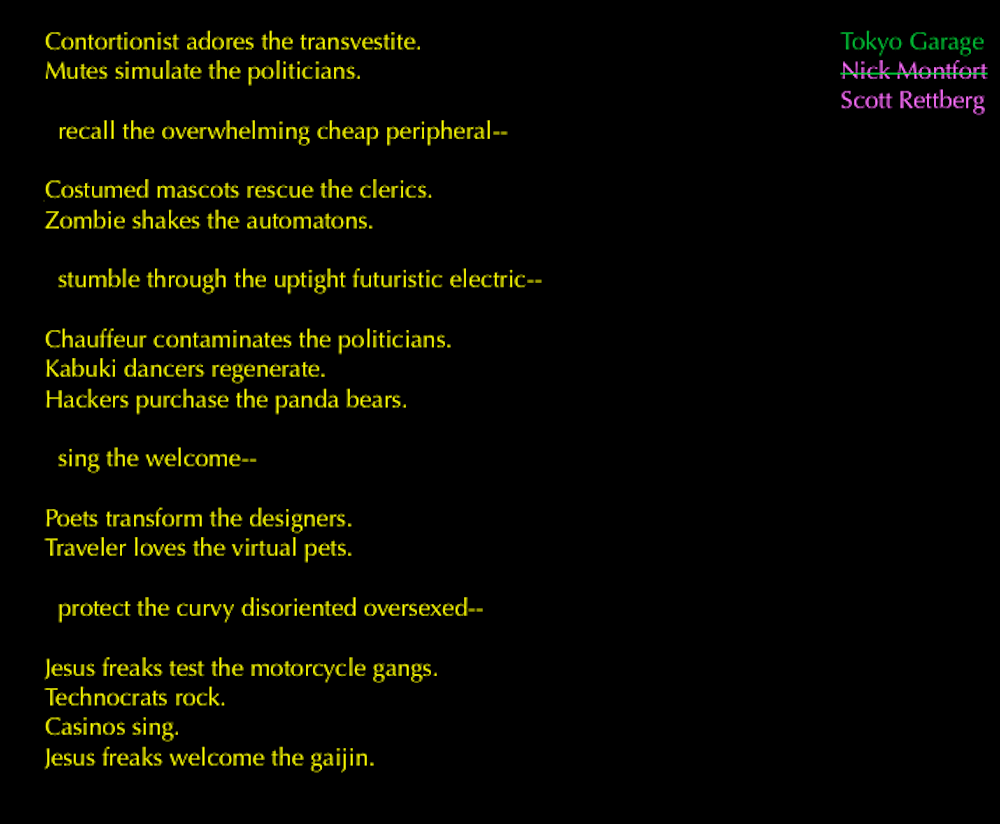
Nick Montfort’s generative poem Taroko Gorge was inspired by a visit to Taroko Gorge in Taiwan.

Montfort writes: “If others could go to a place of natural beauty and write a poem about that place, why couldn’t I write a poetry generator, instead?” Scott Rettberg then took the code from Montfort’s poem and replaced the vocabulary to produce Tokyo Garage, turning Montfort’s minimalist nature poem into a maximalist urban poem.

J.R. Carpenter undertook a similar transformation – replacing the nature vocabulary with words associated with eating.

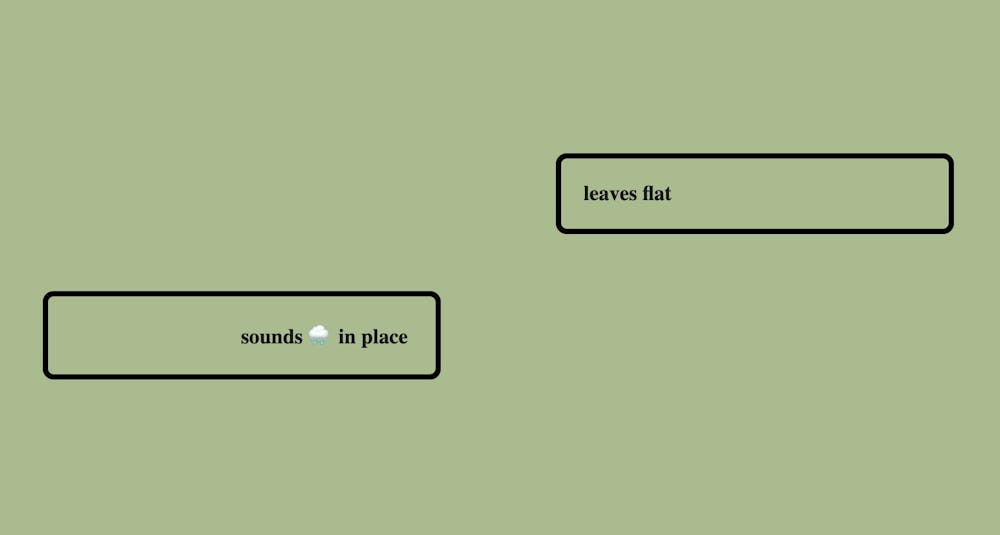
There are now dozens of Taroko Gorge remixes. By inspecting the source of Montfort’s poem, one can carve into the code to remix one’s own version.

Scott Rettberg’s Taroko Gorge remix.

3. Visual verse

For centuries, poets have combined poetry and images. In the late 1700s, William Blake combined poetry with engraved artwork in his conceptual collection Songs of Innocence. Contemporary poets use digital technologies to similarly adorn poetry with imagery.

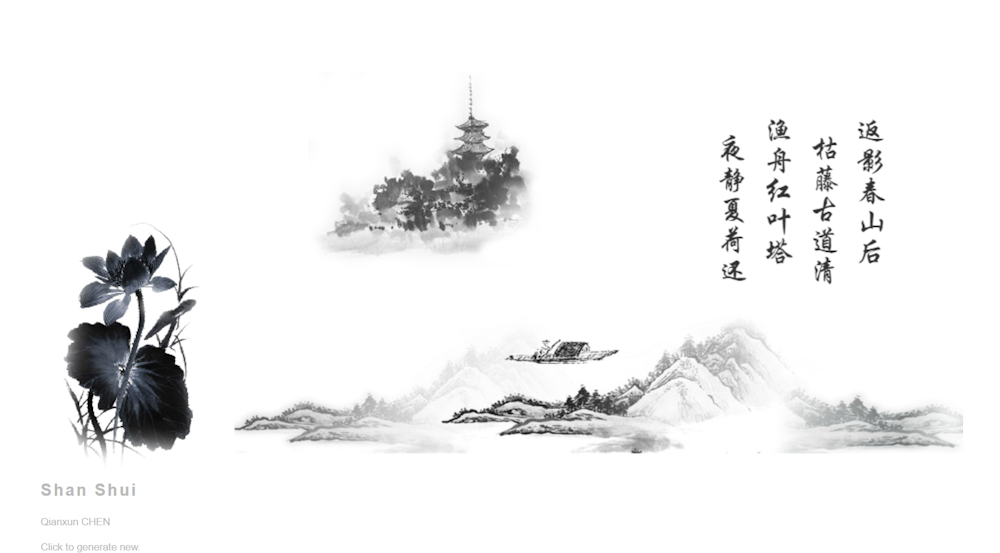
The title of Qianxun Chen’s work Shan Shui means mountain and water in Chinese, and landscape when combined as shanshui. It also refers to traditional Chinese landscape painting and a style of poetry that conveys the beauty of nature. With each click, a new Shan Shui poem is generated with a corresponding Shan Shui landscape painting.

Shan Shui (2014) by Qianxun Chen makes a new illuminated poem with each click.
elmcip.net

Visuals also find their way into poetry performance. The Buoy by Meredith Morran is a poetic work of auto-fiction that uses a series of diagrams to create a new form of language to address political issues involving marginalised identities.

Morran combines abstract images, performance and PowerPoint presentation software to indirectly address a personal history of growing up queer in Texas.

A Brief History of How Life Works (2017) by Meredith Morran.


Read more:
Friday essay: a real life experiment illuminates the future of books and reading


4. Video game poem plays

The 1960s and 70s saw the emergence of text-based computer games, such as Zork, the source code of which is archived at the MIT libraries.

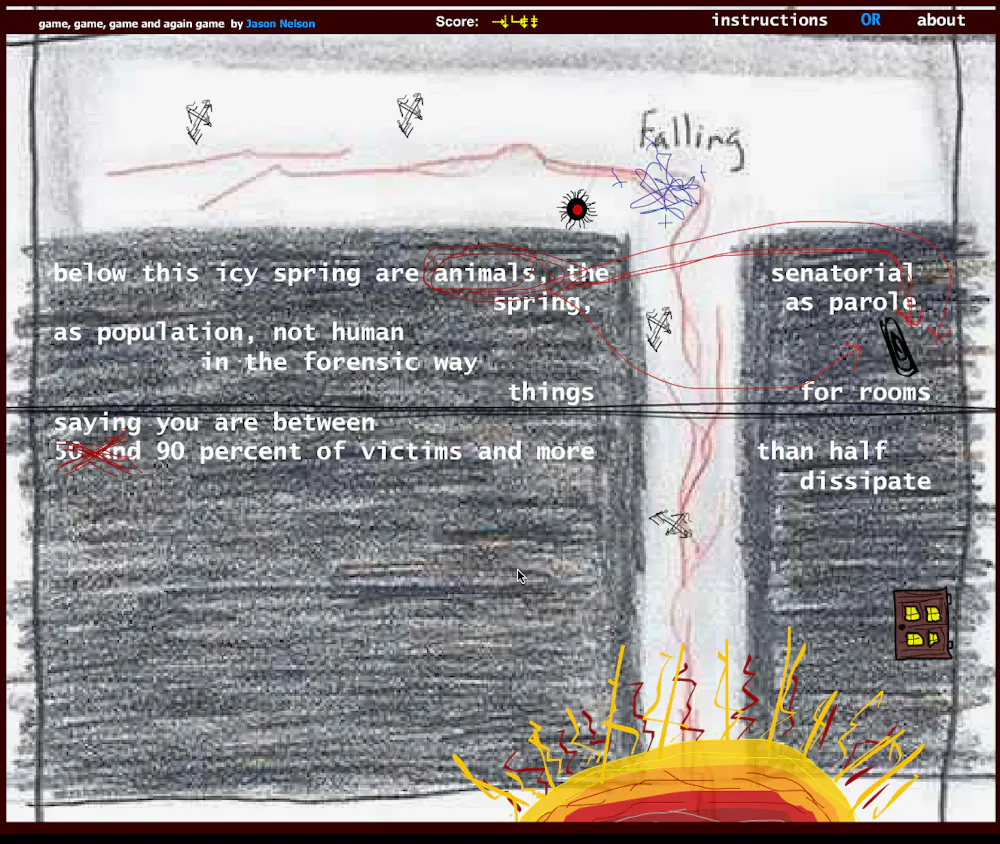
Queensland digital poet Jason Nelson has created a number of works that fuse these two modes. One is called game, game, game, and again game, which Nelson describes as “a digital poem, retro-game, an anti-design statement, and a personal exploration of the artist’s changing worldview lens”. The work disrupts commercial video game design with the player not striving for a high score – but instead moving, jumping, and falling through an excessive, disjointed, poetic atmosphere.

A still from game, game, game, and again game (2007) by Jason Nelson.
elmcip.net

The emergence of virtual reality games, such as Half-Life: Alyx, has also met with poetry.

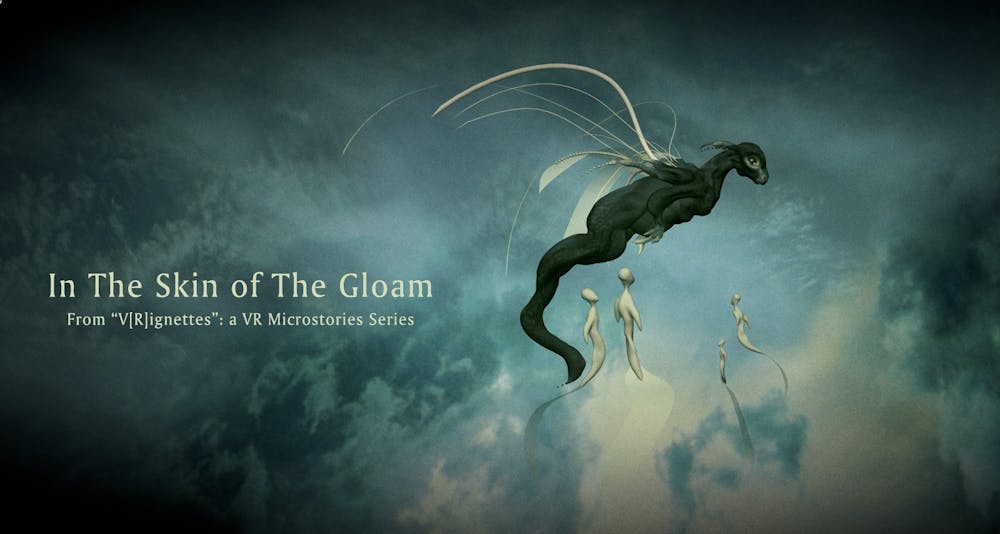
Australian digital artist Mez Breeze’s V[R]ignettes is a virtual reality microstory series. The audience can experience this work by donning a virtual reality headset or viewing it in 3D space in browser. Each V[R]ignette combines poetic text, 3D models, and atmospheric sound design. The reader (or user) can navigate by clicking on the “Select an annotation” bar at the bottom of the screen, or simply look around in 3D space and freely explore the work.

A still from V[R]ignettes (2019) by Mez Breeze.
elmcip.net

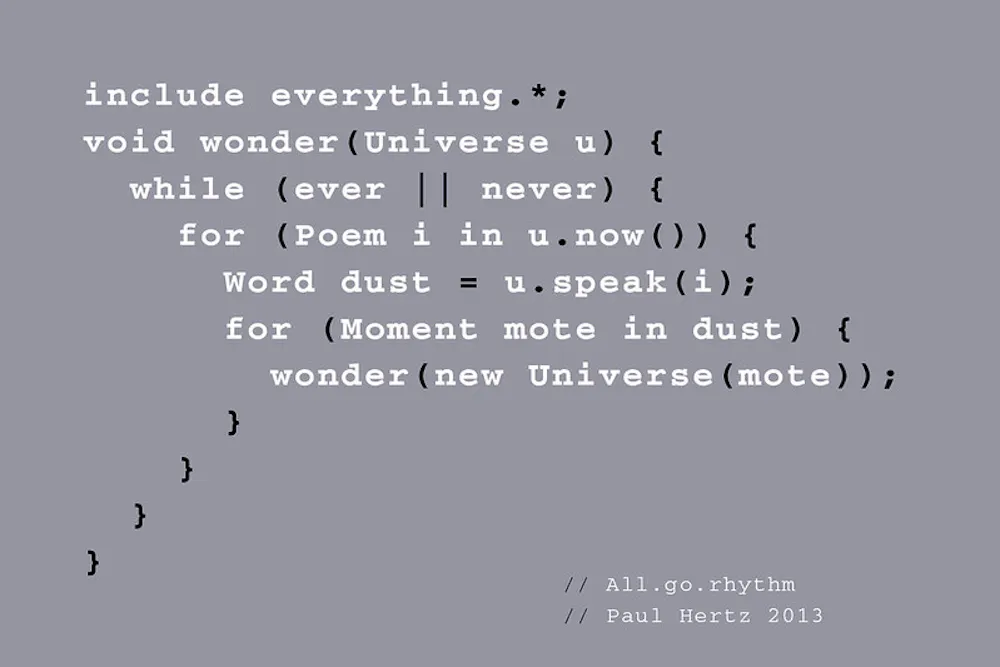
5. Coded messages

Code poetry is a genre that combines classical poetry with computer language.

Code poems, such as those compiled by Ishac Bertran in the print collection code {poems}, do not require a computer to exist. However, they do use computer languages, so to comprehend the poem one must be able to read computer code.

Like so many untranslatable Russian and Chinese poems, these works require a knowledge of the original language to be appreciated.The Conversation


Ignotus the Mage/flickr, CC BY-SA

David Thomas Henry Wright, Associate Professor, Nagoya University

This article is republished from The Conversation under a Creative Commons license. Read the original article.