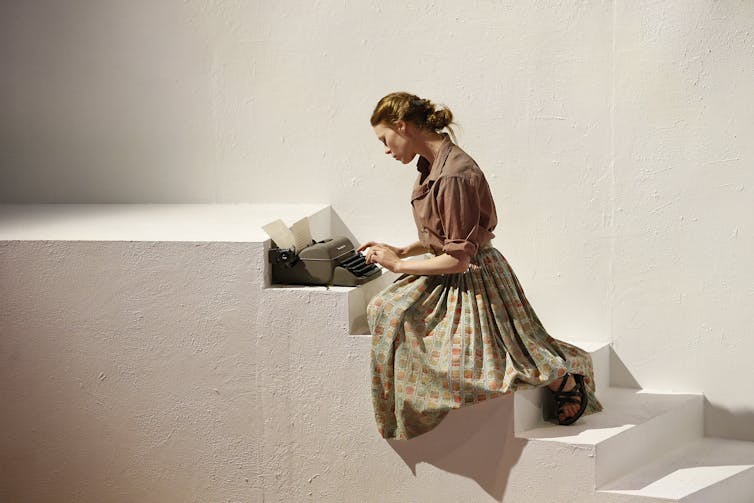
Anna McGahan as Charmian Clift in Sue Smith’s play Hydra. Long overshadowed by her husband George Johnston, recent years have seen a resurgence of interest in Clift’s life and work. Jeff Busby/Queensland Theatre
Fifty years after her death, Australian writer Charmian Clift is experiencing a renaissance. Born in 1923, Clift co-authored three novels with her husband George Johnston, wrote two under her own name, produced two travel memoirs, and had weekly column widely syndicated to major Australia papers during the the 1960s.
Clift has long been overshadowed by the legacy of Johnston, whose novel My Brother Jack is considered an Australian classic. Her novels and memoirs are sadly out of print, yet she is increasingly recognised for her important place in Australian culture.
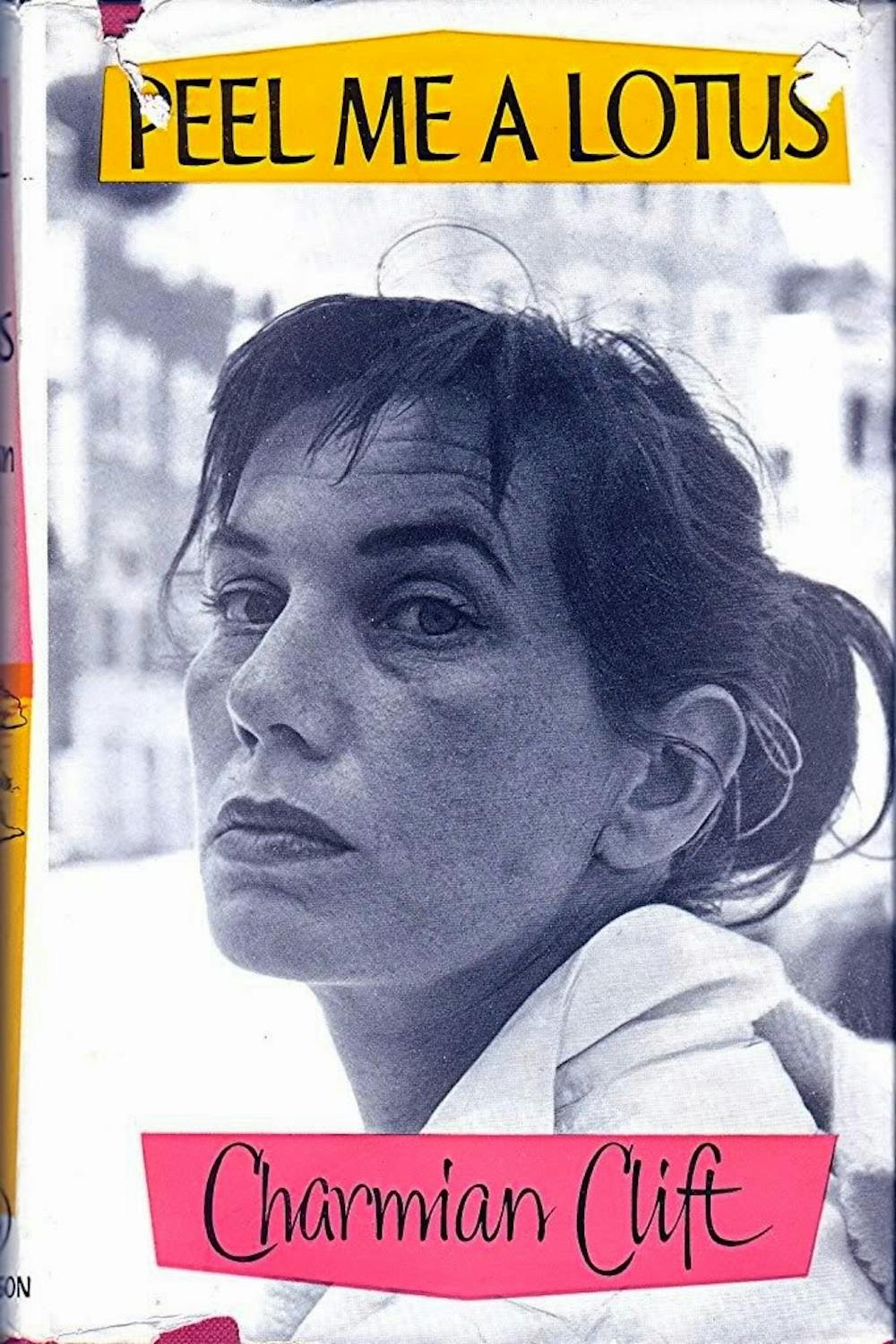
Charmian Clift, pictured on the front cover of her memoir, Peel Me a Lotus. Hutchinson, 1959
In 2018 she, along with Johnston, was inducted into the Australian Media Hall of Fame in recognition of her work as a columnist. She is also being reimagined in fiction, as the subject of A Theatre of Dreamers (2020), a forthcoming novel by English author, Polly Samson, and in Tamar Hodes’ The Water and the Wine (2018).
The revival of interest in Clift is more than a collective nostalgia or feminist correction of the historical record, although both are relevant. Many of her readers from the 60s still remember her newspaper column, and the impact that it had on their view of Australia’s place in the world, with great affection.
Younger generations, particularly women, have also been exposed to Clift’s clear and passionate voice after the columns were published in several volumes in the years following her death. That Clift and her writing continue to resonate with contemporary Australia tells us something about both her and the nation.
The Hydra years
Much of the renewed interest in Clift is focused not only on her writing, but also on the near decade that she and Johnston lived on the Greek Island of Hydra. In late 2015, artist Mark Schaller’s Melbourne exhibition, Homage to Hydra, featured paintings depicting Clift and Johnston’s island lives, with several featuring other residents from Hydra’s international population of writers and artists, including Canadian poet and songwriter, Leonard Cohen.
The same year, Melbourne musicians Chris Fatouros and Spiros Falieros debuted Hydra: Songs and Tales of Bohemia, marrying Cohen’s songs to a narrative about Clift and Johnston’s time on Hydra.
To date in 2019, Sue Smith’s play, Hydra, has been staged in Brisbane and Adelaide, casting Clift in ways that resonate sympathetically with the concerns of contemporary audiences. As Smith writes in her script’s introduction:
Charmian was a woman ahead of her time. We see this in the choices she made both in her personal life, whether it be scandalising the Greek locals by wearing trousers and drinking in bars, to insisting upon her personal and sexual freedom and, of course, through her work.
Modern readers might respond to Clift the writer, but the focus on her years on Hydra suggests there is also great interest in her charismatic personality and tempestuous life with Johnson, as their dream of a cheap and sun-soaked creative island life slowly soured.
While researching the couple’s lives on Hydra, we came across a suggestive, eye-witness diary entry by a fellow writer, New Zealander Redmond Wallis, written in 1960.
Charm is her greatest creation, Charmian Clift, the great Australian woman novelist. Charmian is very curious. She is, potentially at least, a better writer than George but she has and is deliberately creating a picture of herself … which one feels she hopes will appear in her biography some day.
The head of a literary coterie, beautiful, brilliant, compassionate but still the mother of 3 children, running a house. Sweating blood against almost impossible difficulties – a husband inclined to unfounded jealousy, the heat, creative problems, the children, the problems foisted on her by other people … and yet producing great art.
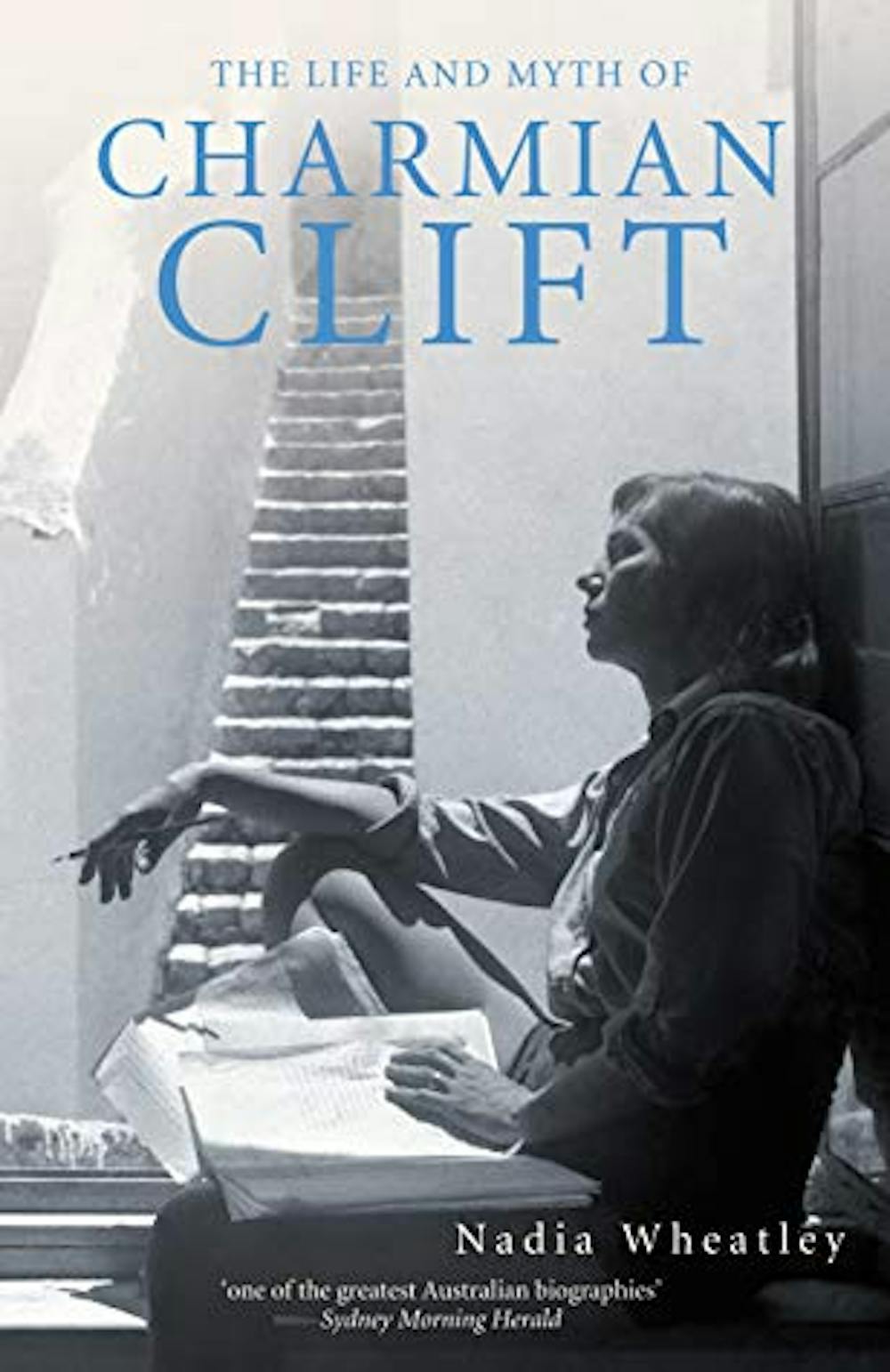
Wallis’s observations are accurate, and prophetic, in noting Clift’s capacity for self-mythologising and her belief that both she and her Hydra idyll would be remembered. Nearly four decades after Clift returned from Greece to Australia amid the acclaim for My Brother Jack, she did become the subject of an excellent biography, Nadia Wheatley’s The Life and Myth of Charmian Clift (2001).
Nadia Wheatley’s biography of Clift. Goodreads
But there were also failures amongst the success. The vision she and Johnston shared for a writing life on Hydra floundered amid poverty, alcoholism and illness. Their return to Australia in 1964 was an unlikely triumph for Johnston following the success of My Brother Jack, but Clift did not return with the same profile.
Wheatley also traced another of Clift’s great disappointments – her failure to complete her long-dreamt of autobiographical novel The End of the Morning, a struggle that was the subject of Susan Johnson’s 2004 novel, The Broken Book.
Clift did, however, leave an autobiography of sorts, in her newspaper articles. These often focused on domestic circumstances and everyday thoughts – ranging from conscription, to the rise of the Greek military junta after she left Hydra, to the changing social circumstances in Australia, and her daughter’s engagement.
These articles might not have always reflected the experiences of her readers – not everyone invited Sidney Nolan over for drinks – but Clift’s first-person narratives of a life lived with great passion and a sceptical eye to the consequences, garnered a large readership.
These readers responded to an incisive intellect with a vision of a culturally enriched Australia. She understood well the need for the country to outgrow its entrenched conservatism in order to realise its potential; and she emerged as a generous spirit who realised that the dreams and passions that drove her life were found everywhere in Australian suburbs.
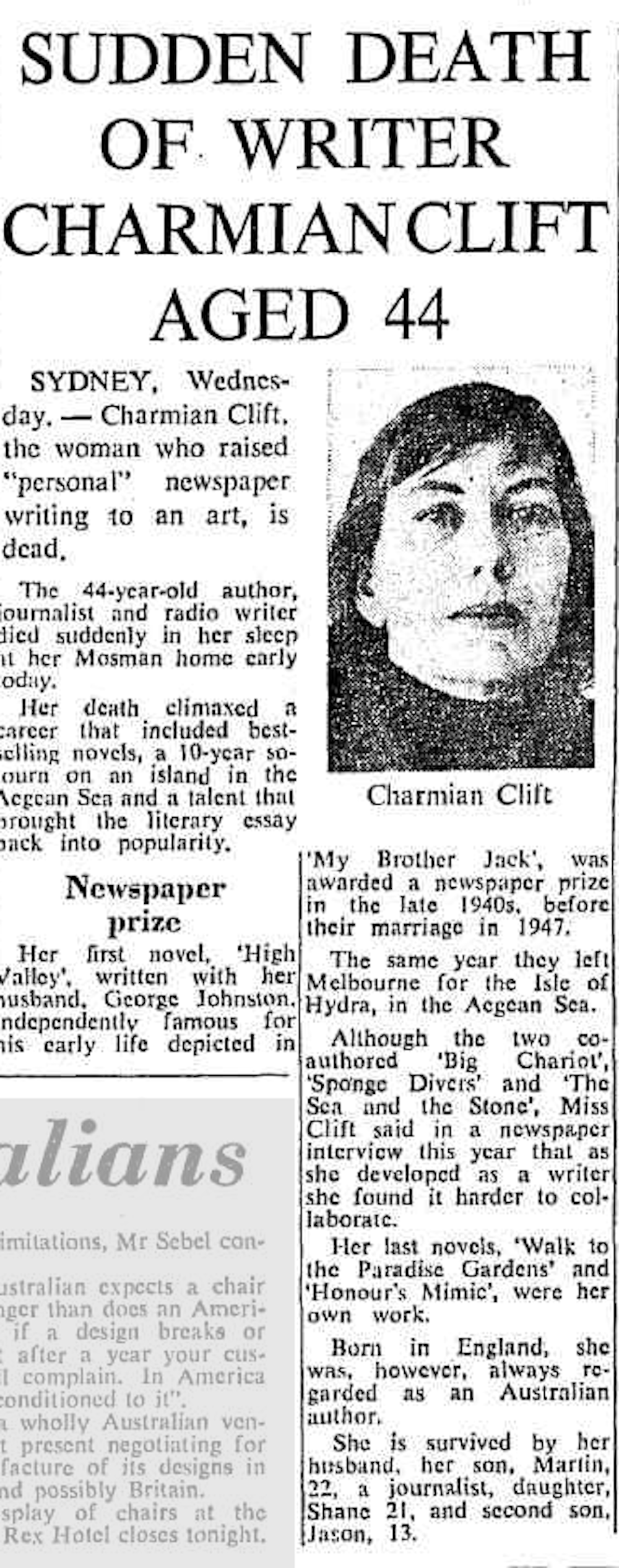
Clift’s death reported by The Canberra Times in July, 1969.
Wallis’s detection of Clift’s hubris and narcissism paints her as a potentially tragic figure. It was a fate she perhaps fulfilled, when Johnston eventually wrote of Clift’s infidelities on Hydra. Clift took her own life on July 8 1969, an event that curtailed her voice while leaving behind a legacy of loyal and grieving readers.
A natural cosmopolitan
Clift’s is one of the voices – and one of the most important female voices – that rose above the crowd during the post-war period, as the western world unknowingly girded itself for the social revolution that was to come.
Through her columns she advocated for a bolder, more outward looking future, and as someone who was naturally cosmopolitan she was avidly interested in seeing Australia become more open to the world and better integrated into the Asia-Pacific.
She didn’t always get it right (an essay decrying the rise of the Beatles and the Rolling Stones stands out!), but she helped navigate the path to a more broad-minded and inclusive vision of Australia.
Over the years Clift has emerged as someone who was not only modern, but also engaged in that most post-modern of activities, self-creation. For while Wallis scorned Clift’s self-mythologising at the time, it might now be recognised as the finest gift of the creative artist – to re-make oneself in the image of a world yet to be made. It was her gift to her readers and Australia.
Last year, I toted Anna Karenina along with me — it got soaked, and I abandoned it in an AirBnB in Dubrovnik, Croatia, after I’d finished reading it. It lasted nearly the whole trip and left a gaping, souvenir-sized hole in my suitcase; it was perfect. So as much as I’d like to dissolve the beach read label entirely, I must also admit I have a type: I want a meaty, absorbing book that takes me further into a vacation by connecting with the cultures that produced it. I want a book that can’t be disposed of, one that will take me somewhere entirely new.
In a cultural climate where the limits of empathy are increasingly under a microscope, forging cross-cultural connections feels like a pressing task. Much has been made of the relationship between fiction reading and empathy, but what happens when the limits of our worldview are bounded by the English language? While linguistic diversity is growing in Canada, the majority of Canadians still speak only English at home, and comparatively few books are translated into English. If, as José Ortega y Gasset proposes, reading in translation should transport the reader into the language — and therefore the perspective — of the author, then reading translated works may be one of the best ways to expand empathy beyond the boundaries of language.
I’m not going abroad this summer, at least not physically. I’ll be staying in Canada, with only my books to pull me to other times and places. While in recent years, I’ve focused on keeping up with new releases, this year I’m fixated on atmosphere and transportation, in a mix of old favourites and new-to-me classics from around the world.
One of my favourite themes in European literature is that of movement and fluidity, the running sense of unity of purpose amidst myriad diverse pockets of culture. The ubiquity of trains and boats support transcontinental journeys by characters who switch language mid-conversation. Last year’s Man Booker International winner, Flights by Olga Tokarczuk takes traveling and travelers as the subject of its interconnected musings, making it an ideal choice for the vacation headspace. This year’s winner, Celestial Bodies from Oman’s Jokha Alharthi, has an English edition but has not yet been published in Canada.
Croatia
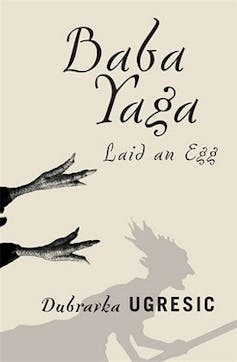
‘Baba Yaba Laid an Egg’ 2009. Canongate Books
In my opinion, no contemplation of Pan-European lore can be complete without Dubravka Ugrešic’s Baba Yaga Laid an Egg. Once labeled a witch herself and driven into exile from Croatia, Ugrešic’s take on Baba Yaga explores the shifting nature of popular folklore.
Nigeria
‘Half of a Yellow Sun,’ 2006. Knopf
Half of a Yellow Sun by Nigerian author Chimamanda Ngozi Adichie is not a translation, but it will take you to a place that only briefly existed: Biafra, a West African state founded in 1967. While the brutality of recent war may not make a particularly appetizing subject for vacation, Adichie contrasts the brutality with sumptuous descriptions of pre-war food and luxury, giving her vision of Biafra the aura of a lost dream. Adichie has referred to the war as a shadow over her childhood.
Norway
‘Kristen Lavransdatter,’ 2005. Penguin Books
There are no beaches in Kristen Lavransdatter and many more Christmases than summers, but if you start Nobel Prize-winner Sigrid Undset’s oeuvre now, it may take you until winter to finish it. Set in Medieval Norway, the book follows the titular Kristen from childhood until death, focusing on her tumultuous love affair and marriage to Erlend Nikulaussøn. Tiina Nunnally’s translation, focusing on plain, stripped-down language, presents a change in philosophy from the first English translation that cut large portions of the text and enforced stiff, archaic language absent from the original Norwegian.
Argentina
‘Fever Dream,’ 2017. Riverhead Books
Samanta Schweblin’s Fever Dream is slight in length but packs a heavy punch in both atmosphere and psychological investment. The story of a vacation gone terribly wrong, the novel’s Spanish title closely translates to “rescue distance,” a recurring concept instantly familiar to parents of young children and terrifying as it becomes repeatedly destabilized. Fever Dream is so unsettling that I sometimes hesitate to recommend it, but I’ve found myself repeatedly drawn back to its tantalizing surrealism.
Canada
‘Secwépemc People, Land and Laws,’ 2017. McGill-Queen’s University Press
I’ve spent much of my life moving around, and as a recent settler on unceded Secwepemc territory, I want to learn more about the land I live on. In a summer steeped in fiction, Secwépemc People, Land, and Laws by Marianne and Ronald Ignace is the only history on my list, but in many ways it feels similar to the others, reaching out to add a new dimension to a place in which I’m still mostly an outsider. For better or for worse, Kamloops feels the most like itself in summer, the climate wants to have its stories told. It can feel intimidating to contemplate a 10,000 year history I know nothing about, but also comforting and necessary to reach back and hear the tales of the land I now call home.
Reading aloud can help young children learn about new words and how to sound them. There’s great value too in providing opportunities for children to enjoy regular silent reading, which is sustained reading of materials they select for pleasure.
But not all schools consistently offer this opportunity for all of their students. We regularly hear from teachers and teacher librarians who are concerned about the state of silent reading in schools.
They’re worried students don’t have enough opportunity to enjoy sustained reading in school. This is important, as many children do not read at home.
For some young people, silent reading at school is the only reading for pleasure they experience.
Silent reading silenced
Research suggests silent reading opportunities at school are often cancelled and may dwindle as students move through the years of schooling.
Where silent reading opportunities still exist, we’re often told that the way it is being implemented is not reflective of best practice. This can make the experience less useful for students and even unpleasant.
Yet regular reading can improve a student’s reading achievement. Reading books, and fiction books in particular, can improve their reading and literacy skills.
Opportunity matters too, as the amount we read determines the benefits we get from reading. Regular reading can help with other subjects, such as maths.
So, what should silent reading look like?
Silent reading in school should be fun. Shutterstock/wavebreakmedia
Here are ten important things we need to do to make the most of silent reading in our schools.
If we want young people to choose to read more to experience the benefits of reading, then silent reading needs to be about pleasure and not just testing.
2. Students choose the books
Young people should not be prevented from choosing popular or high-interest books that are deemed too challenging. Books that are a bit too hard could motivate students to higher levels of achievement.
Students have reported enjoying and even being inspired by reading books that were challenging for them, such as J.R.R. Tolkein’s The Lord of the Rings.
Silent reading of text books or required course materials should not be confused with silent reading for pleasure.
3. The space is right
Like adults, children may struggle to read in a noisy or uncomfortable space.
Schools need to provide space that is comfortable for students to enjoy their silent reading.
Children need space to enjoy silent reading. Shutterstock/weedezign
4. Opportunities to chat (before or after)
Discussion about books can give students recommendations about other books and even enhance reading comprehension.
But silent reading should be silent so all students can focus on reading.
5. Inspired by keen readers
If students see their teachers and teacher librarians as keen readers this can play a powerful role in encouraging avid and sustained reading.
School principals can also be powerful reading models, with their support of silent reading shaping school culture.
6. Students have access to a library
Even when schools have libraries the research shows students may be given less access to them during class time as they move through the years of schooling.
Not all students are given class time to select reading materials from the library.
All students should be encouraged to access the school library. Shutterstock/mattomedia Werbeagentur
7. It happens often
This is particularly important for struggling readers who may find it hard to remember what they are reading if opportunities for silent reading are infrequent.
These students may also find it difficult to get absorbed in a book if time to read is too brief.
8. Paper books are available
Reading comprehension is typically stronger when reading on paper rather than a screen.
Screen-based book reading is not preferred by most young people, and can be associated with infrequent reading. Students can find reading on devices distracting.
9. There is a school library and a teacher librarian
Teacher librarians can be particularly important in engaging struggling readers beyond the early years of schooling. They may find it hard to find a book that interests them but which is also not too hard to read.
Librarians are also good at matching students with books based on movies they like, or computer games they enjoy.
10. We need to make the school culture a reading culture
Reading engagement is typically neglected in plans to foster reading achievement in Australian schools.
Practices such as silent reading should feature in the literacy planning documents of all schools.
Allowing students to read for pleasure at school is a big step toward turning our school cultures into reading cultures. Students need opportunities to read, as regular reading can both build and sustain literacy skills.
Reading should be part of the culture of a school. Shutterstock/wavebreakmedia
Unfortunately, literacy skills can begin to slide if reading is not maintained.
We need people to continue to read beyond the point of learning to read independently, though research suggests this message may not be received by all young people.
Where children do understand reading is important, they may be nearly twice as likely to read every day. So silent reading is important enough to be a regular part of our school day.
This article was co-authored by Claire Gibson, a librarian who’s studying a master in education by research at Edith Cowan University.
Charles Dickens’ great masterpiece David Copperfield begins with uncertainty:
Whether I shall turn out to be the hero of my own life, or whether that station will be held by anybody else, these pages must show.
With those few words the author gives us one of the most memorable lines to be found in 19th-century fiction and gets us thinking about who or what a hero might be.
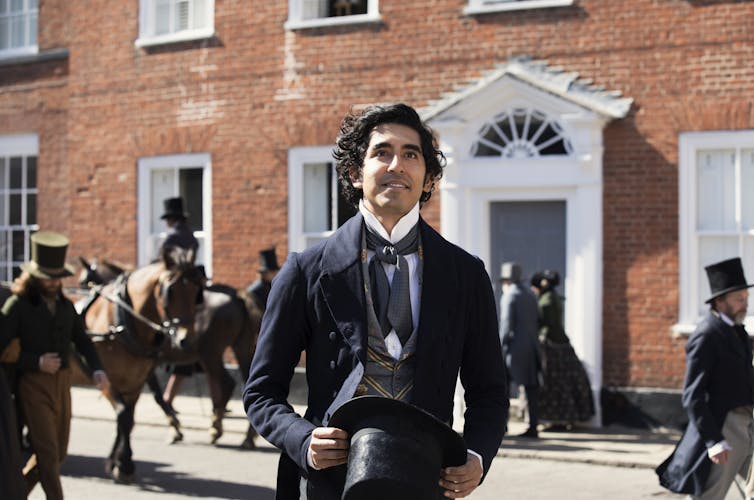
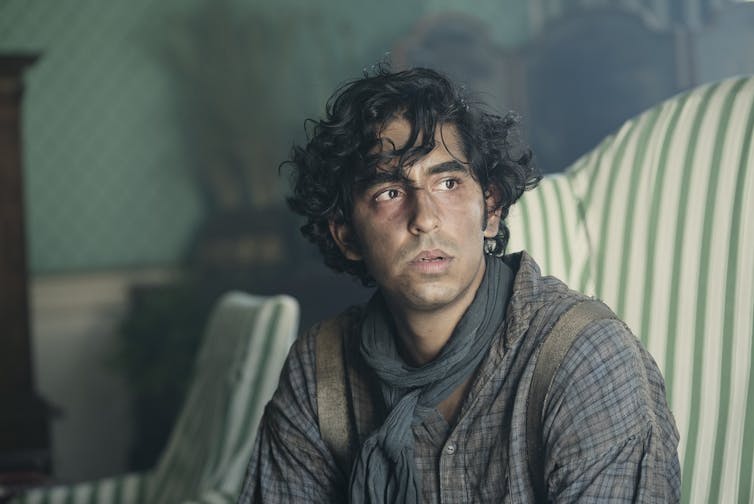
A new film version of the novel is about to open in cinemas in the UK after being premiered at the Toronto International Film Festival in September 2019 and opening the 63rd BFI London Film Festival the following month to glowing reviews. Written by Armando Ianucci and Simon Blackwell, the movie stars Dev Patel in the title role, who – as producer Kevin Loader told The Guardian, is one of those “actors who are capable of embodying the character as perfectly as possible, regardless of their ethnicity”.
The young Copperfield certainly shows some heroic promise: he’s an orphan – which is often a good start for a Victorian hero – and he manages to walk from London to Dover alone as a young boy to extricate himself from a life of dull labour. But he also lacks a certain amount of agency: Copperfield is buffeted around by chance and coincidence, relying on the hospitality and generosity of those he meets. So the strange and eccentric characters he encounters also operate as heroes to him.
We could argue, in fact, that the book meditates on the necessity of everyday heroism in a world that is often cruel and unfair. Copperfield witnesses these acts of generosity from early on in his life. When he visits Daniel Peggotty (his beloved nurse’s brother) Copperfield openly admires his heroism in offering a home to his orphaned nephew and niece and to the morbidly depressed widow, Mrs Gummidge.
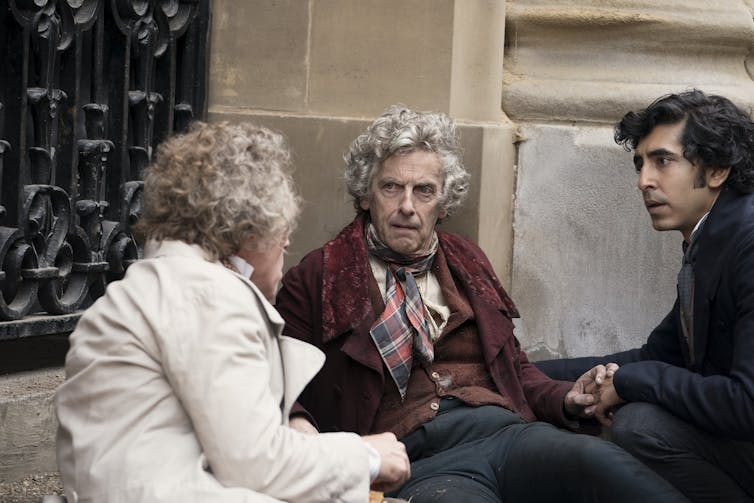
Copperfield soon has cause to rely on this sort of heroism himself – when he too is orphaned, set to work, and then runs away to throw himself on the mercy of his aunt. His aunt, the eccentric Betsey Trotwood, adopts Copperfield, having already taken on the care of the troubled but amiable Mr Dick, who had been destined for life in an asylum when emotionally traumatised by an undisclosed event in his past.
Star-studded: Peter Capaldi as Mr Micawber. Lionsgate
And of course, we must admire the ultimate heroism shown by Ham who drowns attempting to rescue the shipwrecked Steerforth – seducer of Ham’s beloved Little Em’ly. Fostering children, prison visiting, care for the elderly, the homeless, and the mentally unwell, are the acts of heroism that make Copperfield’s life liveable. They are the stitches through which a 19th-century society, without the mechanisms of a modern welfare state, holds itself together.
Everyday evil
Of course, the novel also has plenty of antiheroes, most memorably the sadistic Edward Murdstone, who squelches Copperfield’s childhood freedoms, and the insidious Uriah Heep, who defrauds Copperfield’s family. At times the novel’s small individual acts of heroism seem to be overwhelmed by forces of wrongdoing, indifference and ignorance represented by characters such as those two.
But, of course, this is Dickens – and the way in which David Copperfield’s plotlines come together reveals Dickens’ vision of the world as interconnected. The handy coincidences of converging plots are not just a sop to satisfy mawkish readers, but an embodiment of Dickens’ philosophy.
In the preface to his magazine, Household Words, Dickens tells us that he wants literature to: “bring the greater and the lesser in degree, together … and mutually dispose them to a better acquaintance and a kinder understanding”. By inculcating sympathy with others in his fiction, Dickens thought he could encourage minor acts of heroism such as those that run through the plotlines of David Copperfield.
New vision
The new film version promises to give us an energetic and modern re-working and has received 11 British Independent Film Awards nominations, including best screenplay and best actor.
Dev Patel: one of those actors who can inhabit a character regardless of its ethnicity. Lionsgate
By all accounts it will entertain us with its fast-paced frolics through a diverse Victorian London and its cast of eccentrics played by Hollywood stars including Tilda Swinton as Betsey Trotwood, Hugh Laurie as Mr Dick and Peter Capaldi as the incorrigible Mr Micawber. But it will also show us the poverty, child labour and homelessness that form the backdrop to Copperfield’s early life.
Ianucci’s film is part of a long succession of adaptations. As soon as the novel was published, adaptors began working on stage versions. It was actually the Little Em’ly fallen woman sub-plot that had most appeal for Victorian theatregoers who were already more than familiar with the poverty of industrial London.
More recent film versions of Dickens’ novels have had to make similar choices about which of Dickens’ multiple plotlines should be emphasised. David McGrath’s 2002 adaptation of Nicholas Nickleby favoured the joyful romp over the brutality of the novel’s early scenes. But McGrath’s Nickleby retains more of the Dickensian sentimentality than seems to be the case in the new David Copperfield.
The snappy trailer gives a curt but comic announcement of the death of Copperfield’s mother, whereas the novel narrates the deathbed scene in a chapter I defy anyone to read without crying. Even Dora, Copperfield’s young wife, apparently receives a reprieve from her untimely fate in the new film.
Screenwriters and directors have become wary of Dickensian sentimentality but I hope that this new version of Dickens’ own favourite novel retains those links of sympathy and acts of everyday heroism that bind the novel together. If it shows us a hero navigating his way through a difficult world aided by humour, eccentricity and kindness it will be an adaptation that sends us back to the novel to locate those elements once again in Dickens’ work.
Mystery is the bestselling genre in literature. Crime/mystery fiction, to give the genre its full title, beats inspirational, science fiction, horror and apparently even romance to take the top spot.
What there doesn’t seem to be much of in mystery fiction, however, is female detectives who begin detecting in middle age (two cases in point: Sara Paretsky’s V.I. Warshawski was 32 when we began to follow her adventures, while Patricia Cornwell’s Kay Scarpetta was 36). Women in the 40-to-60 range don’t get much of a showing as main characters in literature generally, so maybe it’s no surprise that they don’t show up as headliners in the mystery genre.
But it’s a surprise if you’re a woman in your 40s who is beginning to write mystery novels – which not so long ago I was. And while it’s a cliche that people write what they know, when I decided to write a mystery I entered into that cliche wholeheartedly. I started writing mysteries in my 40s – and I made my detectives two women in their 40s.
Two middle-aged American women and a dead man in a bowl of Vichyssoise. Amazon
But while I designed my detectives in part to mirror myself, I also chose their age for entirely different reasons. For all its advances and improvements, contemporary culture remains uncomfortable, not just with middle-aged women, but to an even greater degree with contentedly single middle-aged women – and to an even greater degree than that with childless women who are childless by choice. I wanted to confront this odd aversion head on, so I made sure that between them my detectives fill all these categories.
This decision is a small one, but for me it engaged with a question I’ve long struggled with, the question of what, intellectually, literature is supposed to do. Should it report on the world as it is, or should it model the world as it might – could, should, would – be?
Angry women
Recent fiction may not have been filled with middle-aged women, but it has been filled with angry ones. It’s jam packed with dystopian models of female repression and with women and men implacably set against one other: look at Naomi Alderman’s The Power, Leni Zumas’s Red Clocks, Margaret Atwood’s The Testaments. As I began to create my fictional world, I was troubled by the question of whether these outpourings of rage, all justified, all earned, are enough.
In one way this literature is unquestionably good: female rage is something else culture has assiduously avoided considering for centuries, and during those centuries women have been subjugated, silenced, used and abused in ways that deserve outpourings of anger.
The sleuths return. Amazon
Nor is this landscape of female repression changing quickly, and there is value in forcing it before readers’ eyes. In a recent article for The Guardian about the Staunch Prize, the new award for the best crime/mystery novel that does not feature violence against women, the novelist Kaite Welsh wrote that she wouldn’t “sanitise my writing in service of some fictional, feminist utopia … my work lies in marrying my imagination with the ugly truth”. This is an important argument.
Modeling the future
But while I don’t care about the absence of feminist utopias, I do care about the absence of writing that models the future we want. What will it be like, the world we’re striving for where the playing field is level and men and women are just people being people together? I believe that we can only imagine based on what we’ve seen, and that it’s part of literature’s job to help us see what doesn’t yet exist but could.
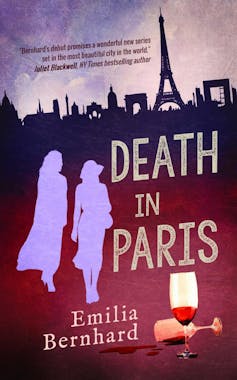
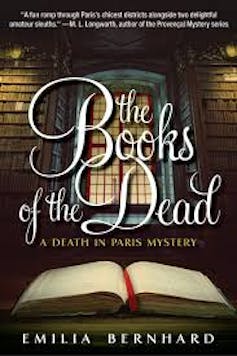
For this reason, although I grounded my novels firmly in the present (well, Death in Paris is set in 2014 and The Books of the Dead in 2016), I made some specific choices about that present. In my books, every person in a powerful position is a woman. Department heads and doctors, sources of knowledge and implacable foes: all are female.
More importantly, as far as I was concerned, no one draws attention to that. It’s so normal as to be unworthy of note. Nor does anyone comment on the fact that both my detectives are childless, and one remains happily unmarried in her mid-40s. Both of these detectives are heterosexual, but I made that decision so I could give each a husband or boyfriend who sees them as an intellectual and emotional equal, and for whom that equality is also the norm. The women in my books have and enjoy good sex, and they have and enjoy good conversations – almost none of them about men.
My books are full of oversights and omissions, and I’m far from satisfied with them. But what I aimed to do, and am still trying to do, is to augment the justifiable depictions of anger, the honest depictions of ongoing brutality and violence against women, with a small model that allows for a morsel of hope.















 At the BookShelf
You must be logged in to post a comment.