
The link below is to an article that takes a look at finding a book at the library.
For more visit:
https://bookriot.com/2019/11/29/how-to-find-a-book-in-the-library/

The link below is to an article that takes a look at finding a book at the library.
For more visit:
https://bookriot.com/2019/11/29/how-to-find-a-book-in-the-library/
The link below is to an article that takes a look at the 2019 Staunch Book Prize Winner (for the best thriller novel in which no woman is beaten, stalked, sexually exploited, raped or murdered), Samantha Harvey for ‘The Western Wind.’
For more visit:
https://www.booksandpublishing.com.au/articles/2019/11/26/142923/medieval-mystery-the-western-wind-wins-2019-staunch-book-prize/
The link below is to an article that takes a look at expansion plans for Scribd.
For more visit:
https://goodereader.com/blog/e-book-news/scribd-intends-on-expanding-into-other-markets
The link below is to an article that considers the best books of 2019 for adults, according to the New York Public Library.
For more visit:
https://www.nypl.org/bestbooksadults2019
The link below is to an article that takes a look at ebooks and libraries.
For more visit:
https://www.washingtonpost.com/technology/2019/11/26/e-books-libraries-are-huge-hit-leading-long-waits-reader-hacks-worried-publishers/
 Stonehenge by Bernard Cornwell
My rating: 2 of 5 stars
I would argue that this is not one of Bernard Cornwell’s best books. It is a tedious book to read – a real chore and requires discipline to stick at. At least that is how I found it.

Leah Henrickson, Loughborough University
Christmas is coming, and gifting is at the forefront of many minds. The latest tech changes from year to year, as do the latest fashions. But the gift that never seems to go out of style? A book.
The publishing world is at its busiest in the months leading up to Christmas. In Iceland, there is even a name for this: jólabókaflóð (pronounced yo-la-bok-a-flot) or “Christmas book flood”. The term has also come to refer to the Icelandic custom of exchanging books on Christmas Eve. As a result, a substantial portion of annual hardcover sales are during this period and nearly 850 new titles were released in 2019’s Icelandic book flood alone.
The UK’s annual Christmas book flood begins on Super Thursday: when publishers release a barrage of new titles just in time for the Christmas shopping rush. Some of the heavy hitters among the 426 hardcovers released on October 3 included Philip Pullman’s The Secret Commonwealth, Jojo Moye’s The Giver of Stars, and MP Jess Phillips’ Truth to Power.
People were giving books as gifts even before words were ever put to paper. In one of his books of epigrams, the ancient Roman poet Martial recommended the works of famous Roman writers like “Ovid’s Metamorphoses on parchment” (animal skin) and “Livy (the Roman historian) in a single volume” (appearing in a scroll, on papyrus, or on parchment) as presents for the December festival of Saturnalia. Martial’s recommendations also included book-related items like “a book-case” and “a wooden book-covering”.
As Christmas grew more commercialised, the holiday became increasingly important for the book trade. In his Battle for Christmas, American history professor, Stephen Nissenbaum, argued that books were “on the cutting edge of a commercial Christmas, making up more than half of the earliest items advertised as Christmas gifts”, citing examples from the 18th century. By the Victorian era, periodicals were regularly featuring Christmas book reviews to promote book sales during the holidays.
One such article from a 1914 issue of the New York Times begins with the declaration that “the war is not the greatest thing in the world. It cannot destroy Christmas … The publishers are ready to help”. This article touts various “gift books” suitable for Christmas exchanges: “Sumptuous books, books in the making of which illustrator and printer and binder have exercise their art at its best.”
These 20th-century gift books follow from a tradition of sumptuous books given as holiday gifts. Medieval manuscripts, for example, were gifted for a range of religious, romantic, diplomatic, and festive reasons. A 2015 exhibition about medieval gift gifting at the Getty Museum in Los Angeles, now archived online, further supports the understanding of manuscripts as gifts with personal and social value.
Writing about medieval manuscripts, Geert Claassens noted that a book – whether a medieval manuscript or a modern mass market paperback – always functions as both an object and a text. This observation is especially relevant in a world with e-books, which largely remove the “object” aspect of the book. However, a recent series of focus groups conducted by Laura Dietz at Anglia Ruskin University as part of a wider study about social perceptions of e-books has indicated that readers still prefer gifting and receiving print books over e-books. Maybe this is because it’s remarkably difficult to wrap an e-book and place it underneath the Christmas tree.
In a recent article for the international READ-IT project (Reading Europe Advanced Data Investigation Tool), media professor, Brigitte Ouvry-Vial, describes reading as “a social imaginary” that contributes to both personal and collective development. That is, reading has perceived benefits for both individuals and communities. However, she wrote:
The very motivation for non-prescribed reading has clearly shifted across time from an essentially knowledge-driven cognitive activity, to a broad information-driven cultural experience as well as a leisure activity.
This shift has also led to an association being made between being well-read or reading a lot with well-being, as books are more regularly valued according to the level of psychological uplift and self-healing they provide.
Books represent more than just knowledge; they’ve also taken on the role of highly personalised home decor. This is because books can say things about their owners. Likewise, the book you choose to give someone for Christmas can speak volumes about your relationship with that person. It’s not enough to just give someone a book and call it a day – it has to be the perfect choice.
Books have a long history of being given as Christmas gifts, and there seems little chance of the trend going away. So why not take Martial’s recommendations and bestow upon your loved one “Ovid’s Metamorphoses on parchment”? Alternatively, and more realistically, consider a nice hardcover edition found through consulting members of the Antiquarian Booksellers’ Association or the Provincial Booksellers Fairs Association.
For more modern options, YouTube is teeming with video reviews of the latest releases, as well as of “bookish” gifts to give in lieu of or alongside a book. There are also a variety of monthly book subscription boxes. By giving a book or book-related item in 2019, you’ll be contributing to a long and lovely tradition.
Leah Henrickson, Doctoral Graduate, Loughborough University
This article is republished from The Conversation under a Creative Commons license. Read the original article.
Sally O’Reilly, The Open University
Our fascination with ghostly tales around Christmas time goes back thousands of years and is rooted in ancient celebrations of the winter solstice. In the depths of winter, pagan traditions included a belief in a ghostly procession across the sky, known as the Wild Hunt. Recounting tales of heroism and monstrous and supernatural beings became a midwinter tradition. Dark tales were deployed to entertain on dark nights.
Ghosts have been associated with winter cold since those ancient times. According to art historian Susan Owens, author of The Ghost, A Cultural History, the ode of Beowulf is one of the oldest surviving ghost stories, probably composed in the eighth century. This is the tale of a Scandinavian prince who fights the monster Grendel. Evil and terrifying, Grendel has many ghostly qualities, and is described as a “grimma gaest” or spirit, and a death shadow or shifting fog, gliding across the land.
In 1611, Shakespeare wrote The Winter’s Tale, which includes the line: “A sad tale’s best for winter, I have one of sprites and goblins.” Two centuries later, the teenage Mary Shelley set her influential horror story Frankenstein in a snowy wasteland, although she wrote it during a wet summer in Switzerland.
The Victorians invented many familiar British Christmas traditions, including Christmas trees, cards, crackers and roast turkey. They also customised the winter ghost story, relating it specifically to the festive season – the idea of something dreadful lurking beyond the light and laughter inspired some chilling tales.
Both Elizabeth Gaskell and Wilkie Collins published stories in this genre, but the most notable and enduring story of the period was Charles Dickens’ A Christmas Carol (1843). In this vivid and atmospheric fable, gloomy miser Ebenezer Scrooge is confronted first by the spirit of his dead business partner, Jacob Marley, and thereafter by a succession of Christmas ghosts.
Their revelations about his own past and future and the lives of those close to him lead to a festive redemption which has spawned a host of imitations and adaptations.
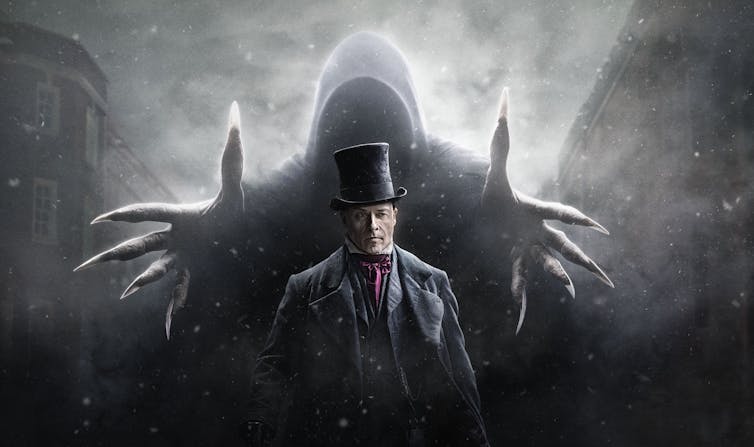
Dickens wrote the story to entertain, drawing on the tradition of the ghostly midwinter tale, but his aim was also to highlight the plight of the poor at Christmas. His genius for manipulating sentiment was never used to better effect, but perhaps the most enjoyable elements of the story are the atmospheric descriptions of the hauntings themselves – the door knocker which transforms into Marley’s face and the sinister, hooded figure of the Ghost of Christmas Yet to Come.
The tradition was further developed in the stories of M R James, a medieval scholar who published Ghost Stories of an Antiquary in 1904. His chilling Gothic yarns focused on scholars or clergymen who discovered ancient texts or objects with terrifying supernatural consequences.
Typically, James used the framing device of a group of friends telling stories around a roaring fire. In the introduction to Ghost Stories he said: “I wrote these stories at long intervals, and most of them were read to patient friends, usually at the seasons of Christmas.”
Seminal stories in his oeuvre include Number 13, Oh Whistle & I’ll Come to You and A School Story. Like Dickens, James has been widely imitated and adapted, with Stephen King citing him as an influence. King’s The Shining certainly fits into to the genre of ice-bound chiller.
Christmas ghost stories morph into new forms as time passes, like ectoplasm. Spin offs of A Christmas Carol include Frank Capra’s 1946 classic It’s a Wonderful Life, in which the story is transposed to small town America, and the 2019 film Last Christmas, the tale of a dysfunctional young woman permanently dressed as a Christmas elf, ripe for Yuletide redemption. This contemporary version conveys messages about integration and the value of diversity.
A new, high-octane version of A Christmas Carol will be shown on TV this Christmas, written by Peaky Blinders creator Stephen Knight. And M R James’ Martin’s Close, the story of a 17th century murder and its supernatural outcome, has also been adapted for the small screen.
So it seems the atavistic desire to lose oneself in tales of the supernatural is still with us. Christmas ghost stories enhance our enjoyment of the mince pies and mulled wine, and the frisson of a paranormal tale offsets the “feel-good” festive spirit that might otherwise be cloying.
Some things never change – we still have a fear of the unknown, a yearning for what is lost and a desire to be secure. In an uncertain, fast-paced world, mediated through smartphones and social media, the seasonal ghost story is here to stay. The jolt of fear and dread such stories convey make the Christmas lights glitter even more brightly.
Sally O’Reilly, Lecturer in Creative Writing, The Open University
This article is republished from The Conversation under a Creative Commons license. Read the original article.
 At the BookShelf
You must be logged in to post a comment.