On April 15, people around the world watched in horror as a voracious fire consumed the medieval wooden roof of Paris’s Notre Dame cathedral and felled its spire.
The following day brought some measure of relief: Despite the building’s wrenching losses, its masonry structure was largely intact, and many of its precious relics had been swiftly and lovingly removed by a human chain of church officials and firefighters. The building had steadfastly endured the destructive flames.
Since then, Notre Dame has been hailed as a stable and enduring symbol of French identity.
But it would be more accurate to say that the cathedral’s importance comes from the very instability of its meaning.
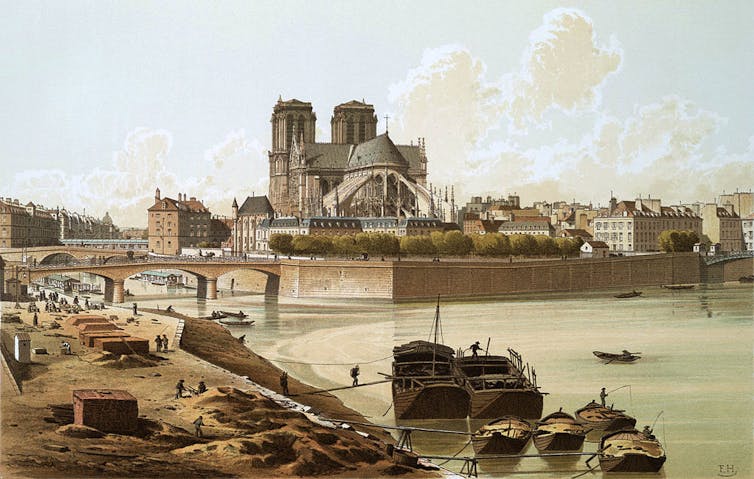
Originally completed in 1345, by the early 19th century Notre Dame stood in a state of dire disrepair. It took an idiosyncratic young architect, moved by Victor Hugo’s “The Hunchback of Notre Dame,” to fashion a new meaning for the building – one that, ironically, looked nostalgically to the past for inspiration.
‘The book will destroy the edifice’
In 1831, when Victor Hugo published his famous novel “Notre Dame de Paris” – known in English as “The Hunchback of Notre Dame” – the country was experiencing rapid social, political and industrial change.
The cathedral, meanwhile, had fallen by the wayside. Years of neglect, blinkered renovation efforts and the anti-Catholic zeal of the French Revolution had left the once-regal building in ruins.
During the French Revolution, many of the treasures of the cathedral were either destroyed or plundered. Only the great bells avoided being melted down, and the church interior was used as a warehouse for the storage of food. Brown University Library
Set in the 15th century, the novel alluringly evoked a different period in French history. In the novel, Hugo lamented that the printing press had supplanted architecture as the primary communicator of civilization’s cherished values. In one of the book’s most famous moments, the archdeacon Frollo points sadly to a printed book on his table.
“Alas! This will kill that,” he laments, directing his finger to the cathedral looming magisterially outside his window. He continues, “The book will destroy the edifice.”
Like other Romanticist writers and artists, Hugo imagined the Middle Ages as a simpler time, an era when society was governed by pure faith. He believed that back then, the cathedral was able to inspire the masses and guide them toward a life of devotion and morality. Hugo hoped that his novel might spur the building’s rebirth, allowing it to renew France’s ethical core during the Industrial Revolution.
One architect, attracted to the picturesque history on view in Hugo’s novel, would ultimately heed his call.
An architect reaches longingly for the past
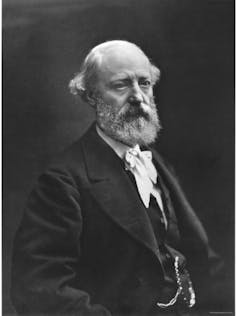
Eugène Emmanuel Viollet-le-Duc was a teenager when Hugo’s novel was published. The book affirmed Viollet-le-Duc’s suspicion that his own age’s riot of styles and tastes reflected the unwieldy chaos of modern life.
Like Hugo, he sought to capture France’s “authentic” past and, like Hugo, was drawn to the Middle Ages.
For this reason, he refused to enroll in the École des Beaux-Arts, the main training ground for France’s architects, because of the school’s dogmatic focus on classical architecture. He opted instead to learn on the job, working for architects around Paris while studying the city’s medieval architecture in his spare time.
In 1842, the government announced a competition for Notre Dame’s restoration and the 28-year-old Viollet-le-Duc threw his hat into the ring. By then, he had already established his reputation as an expert in the restoration of medieval buildings.
But for him, restoration was about more than touching up an existing form. It meant breathing life into a building by transforming it.
As he later wrote, “To restore a building is not to preserve it, to repair or rebuild it; it is to reinstate it in a condition of completeness which could never have existed at any given time.” Viollet-le-Duc knew that the very act of restoring old buildings was, itself, a modern notion.
A symbol of stability in uncertain times?
Thus, Viollet-le-Duc’s winning entry would not simply aim to preserve the cathedral as it then stood. Instead, he sought to revive the building’s mythical past.
During the restoration, Viollet-le-Duc redesigned and rebuilt the medieval spire, which had been removed in the 1780s due to its vulnerability in high winds (an absence that had appalled Hugo). He also sprinkled the building with its now-famous gargoyles in accord with Hugo’s atmospheric depiction of a building adorned with “grinning monsters.”
Viollet-le-Duc’s renovated cathedral – the version that we know today – is a product both of the French Middle Ages and of its architectural revival in the 19th century. Like Hugo, Viollet-le-Duc romantically conceived medieval architecture as a stable bulwark against his own uncertain times. He wanted to intensify what he saw as the building’s mystical power – its ability to speak to France’s past at a time when the forces of modernity were threatening to sweep its traces away.
Viollet-le-Duc also ensured his own role in the rehabilitation would forever be preserved: His likeness appears in the face of a copper statue of St. Thomas at the base of the spire.
By good fortune, this statue was removed for the renovation just last week and was spared from the conflagration.
Since the fire, many writers have correctly pointed out that the catastrophe is also only one episode in a much longer story of architectural survival.
When you think of inner-city teenagers, what springs to mind? For many, it’s hoodies, video games – and probably hating Shakespeare. But my research proves that this stereotype is far from the truth.
Shakespeare holds a contested place in the English national curriculum as the only compulsory writer to be studied between the ages of 11 and 16. This imposed curriculum attempts to situate Shakespeare’s plays as part of national culture, rather than purely as an exemplar of high art. But teens are rarely asked directly about their experiences of education, and about its relevance to them.
Instead, they are often represented as a homogenous group who are bored and resistant to studying Shakespeare, particularly when it comes to struggling with the language he used.
However, my research with over 800 students in four London secondary schools offers a very different picture. I asked these 13 to 14-year-olds what they think and/or feel when they hear the word “Shakespeare” – and some of their answers defied expectations.
What students say
Many students told me that they actually enjoy studying Shakespeare in school. From comments such as “I feel happy because I like most of his plays”, to “I feel excited because Shakespeare was the best writer ever […] a legend or genius”, they expressed levels of interest in Shakespeare that are rarely acknowledged.
These students also did not see the language as a barrier, but as a challenge to be embraced. One commented: “I also get quite happy because we do not often look at texts with old English.”
In this large cohort of students, some comments stand out, showing how varied and individual their responses are. One described Shakespeare as “one of my inspirations for writing poetry”, while another said that “although I don’t really like English, I like his plays a lot”.
Teachers seem to play a key role in developing a positive attitude in some of their students. One student said that “all the work I’ve done on Shakespeare has been interesting and fun”, while another said she “really enjoyed the last play that we did”.
This study did not look in detail at what actually happens in the classroom, but many of the students’ comments suggest that having the confidence to approach a Shakespeare text with a positive attitude partly comes from the teacher’s attitude to him and his work.
‘Be not afraid of greatness …’
In addition to the wholly positive comments, some students demonstrated a more mixed response to the subject. One student told me that “sometimes it’s interesting and sometimes it’s just boring ‘cause in Year 7 I remember we did this one play for a very long time and it was just kind of the same thing every lesson for a double lesson”.
Here, the lessons were clearly not varied enough to hold this student’s attention all the time, although the comment suggests that the student knew that studying Shakespeare could be interesting and fun, even if it isn’t always like that in practice.
For others, the choice of play is key: “Some Shakespeare plays are more interesting than others, in my opinion.” One of the students I interviewed also articulated a clear tension in her attitudes towards studying Shakespeare. She said:
The good part is because everyone goes through different stuff, some people can relate and they can feel like they’re not alone or like this has happened before and studying Shakespeare makes you see the world differently, […] and the bad thing about it [is] learning how to write in the Shakespeare kind of structure when it won’t be useful in the future.
For a number of students, there are perhaps inevitable negative connotations attached to the word “Shakespeare”. Some did describe Shakespeare simply as “boring”, but others explained their reservations in more detail. One said: “I feel like I’ve heard the word Shakespeare too much and that I don’t want to talk about him.” Another thought “about long complicated language that no one understands”, while further complaints were about how “it is unnecessary to learn about as I don’t understand what’s beneficial for us as students”.
Overall, the students involved in this research demonstrated a breadth and depth of response to Shakespeare that counters the generalised belief that teenagers respond poorly to his work. Indeed, used as an introductory question to establish students’ attitudes to Shakespeare before attending a production at Shakespeare’s Globe theatre, in London, I have been fascinated by the variety and subtlety of thought they have demonstrated.
As one said: “I feel honoured that I’ve covered Shakespeare in school, because telling people you have read his plays makes you sound smart.” The sense of privilege inherent in this comment, despite the fact that everyone studies Shakespeare at school, is clearly something to cherish.






 At the BookShelf


You must be logged in to post a comment.