When the author Richard Flanagan described Behrouz Boochani, a Kurdish-Iranian asylum seeker currently held on Manus Island, as “a great Australian writer”, he turned tired cliché into a pointed question: what makes an “Australian” writer?
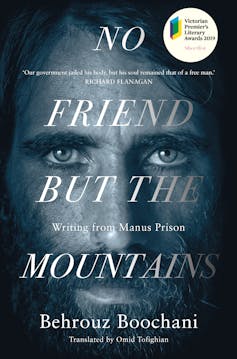
No Friend But the Mountains by Behrouz Boochani. Pan Macmillan
Flanagan was writing in the foreword to Boochani’s startling book No Friend But the Mountains (Picador), which last night won the $100,000 Victorian Prize for Literature, the richest of its kind in Australia. Boochani also claimed the award for non-fiction, worth another $25,000.
This triumph cements Boochani’s status as an Australian writer.
Boochani was arguably the most important literary phenomenon in Australian literature in 2018. In part, this is because of the distinctive qualities of No Friend But the Mountains, an epic work that moves between verse and prose, reportage and fantasy, the mundane and the historical. The fact that Boochani’s political memoir of what he calls Manus Prison was ever published in book form defies the odds.
A journalist and experimental documentary maker, Boochani wrote the book as text messages on his mobile phone, sending them, sometimes through several intermediaries, to the academic Omid Tofighian for translation into English.
Indeed, beyond the recognition of Boochani’s book as a singular achievement in its own right, its success this week highlights recent intersections of human rights activism and the vocal political position-taking of the Australian literary community.
The publication of No Friend But the Mountains was accompanied by numerous public events, such as one at the Greek Centre in Melbourne in October 2018, where the conditions detailed in the book were discussed and protested, and Boochani participated via Skype. The same month, A “National Day of Action” organised by Academics for Refugees featured public “read-ins” of the book on university campuses nationwide.
Other Australian authors have also used their voices to bring attention to the plight of asylum seekers. During her acceptance speech for her second Miles Franklin Award in August 2018, Michelle de Kretser chastised politicians for their treatment of refugees on Nauru and Manus Island. To illustrate her point, she read a list of names of asylum seekers who have died there in the past five years.
It is tempting to dismiss such actions as gesture politics by an urban elite. But each individual action has served to raise awareness of the Australian government’s policy of “offshore processing” for asylum seekers, and to fuse artistic expression with political activism in a particularly forceful manner.
At the same time, and perhaps uniquely in the history of Australian literature, No Friend has seen the translation of human rights awards into convertible cultural capital in the literary field. The author has been awarded the Anna Politkovskaya Award, the Amnesty International Award and Liberty Victoria’s Empty Chair Award. These humanitarian awards have confirmed Boochani’s rapidly acquired high profile in the literary field.
Last night’s news topped all of that to make Boochani the first “non-Australian” author to win the Victorian Premier’s Literary Awards. The Victorian government established these awards in 1985 to honour Australian writing. The specific challenge this poses to the definition of “Australian writing” can be seen as an intervention by the literary community into the field of politics. If a non-citizen who has never set foot on mainland Australia can win, who counts as an Australian author?
Ironically, perhaps, Boochani’s success simply mirrors some of the prevailing trends in Australian authorship in an age of global literary circulation, which allow writers to transcend national borders. An example of this phenomenon is Nam Le who rose to fame with the publication of his very successful The Boat. This collection of short stories, informed by the author’s diasporic identity and upbringing in Australia, soon earned him over a dozen major literary awards in Australia, the United States and Europe.
Conversely, Boochani’s status on Manus Island has been defined by deterrence, indefinite detention and the spectre of refoulement. The narrative of this experience is one that he seeks to address directly to the Australian people from beyond Australia’s borders.
With no clear solution to the indefinite detention of asylum seekers on Manus and Nauru in sight, the paradox of Boochani’s award success can only contribute further to public debate over the tangled logic of indefinite detention. It shows how cultural practices and political activism can be reconfigured to correspond with the newly created literary currency associated with refugee writing. For now, at least, Boochani is an “Australian writer” because Australia is morally implicated in what he wrote and how he wrote it.
Who makes the money in publishing? Nobody. This often repeated dark joke highlights a serious issue. The most recent figures show that Australian authors earn just $12,900 a year from writing work (the median, at $2,800, was even worse). Indeed, authors can gross less than $5,000 for Miles Franklin-nominated titles that took two or more years to write.
Fixing this isn’t as simple as reaching more deeply into publisher pockets, because most of those are empty too. While the major international houses are thriving (Simon & Schuster and Penguin Random House recently reported 16% profits), publishing Australian stories can be financially perilous.
In independent publishing, 10% of the book sale goes to the author, perhaps another 10% to the printer, and up to a whopping 70% for distribution. What’s left has to pay the publisher, editor, marketers, admin staff and keep the lights on.
But we can improve our approach to author rights. Here are five lessons we can learn from elsewhere to help Australian writers earn more money.
Traditionally, contractual “out of print” clauses have let authors reclaim their rights when a print run has sold out and the publisher doesn’t want to invest in another. But in our recent analysis of almost 150 contracts in the Australian Society of Authors archive, we found 85% of contracts with these clauses allowed authors to reclaim their rights only when the book was “not available in any edition”.
These days, books can be kept available (at least digitally or via print-on-demand) forever – but that doesn’t mean their publishers are still actively promoting them.
A better approach is to allow authors to reclaim their rights towards the end of a work’s commercial life, determined with reference to objective criteria like the number of copies sold or royalties earned in the previous year. The Australian Society of Authors recommends authors only sign contracts that have this meaningful kind of out-of-print clause – but many publishers still try to get authors to sign up to unacceptable terms.
A growing number of countries (including France, Romania, Slovenia, Spain, Macedonia and Brazil mandate author rights based on objective criteria. The French law is an interesting model. There, authors can get their rights back if a book has been published for at least four years, and they haven’t been credited royalties for at least two. This opens up new possibilities for the author to license it to another publisher, or even sell it directly to libraries or consumers.
Rebecca Giblin on the problems with publishing contracts and the case for new author rights.
#2: ‘Use it or lose it’: return author rights when they’re not being used
Publishers take very broad rights to most books: in our recent archival analysis we found 83% took worldwide rights, and 43% took rights in all languages. It’s easy to take rights – but if publishers do so, they should be obliged to either use them or give them back.
To that end we can learn from the “use it or lose it” laws that bind publishers in some parts of Europe. In Spain and Lithuania, for example, authors can get their rights back for languages that are still unexploited after five years.
#3: Introduce a ‘bestseller’ clause to contracts
Of course, it’s not always the case that there’s no money in publishing: sometimes a title that was expected to sell 5,000 copies sells 5,000,000. That changes the economics enormously: but in many cases, the contract only provides the same old 10% revenue for the author. For works that achieve unexpected success, we can learn from Germany and the Netherlands (and the proposed new EU copyright law). They have “bestseller” clauses that give authors the right to share fairly in unexpected windfalls arising from their work.
#4: Legally enshrine the right to fair payment
Even where there’s not much money to be made, the author should still receive a fair share. Again, Germany and the Netherlands lead the way on this. There, authors are entitled to “fair” or “equitable” payment for their work – and can enforce those rights if their pay is too low.
These laws don’t set a dollar amount, since what is “fair” depends on all the circumstances. However, such laws at least provide a minimum floor. If the contracted amount is unfair or inequitable, authors have a legal right to redress.
#5: Put time limits on transfers
In Australia, copyright lasts for the life of the author, and then another 70 years after that. Publishers almost always take rights for that full term – only 3% of the contracts between publishers and authors we looked at took less. But publishers don’t need that long to recoup their investments. In the US, authors can reclaim their rights from intermediaries 35 years after they licensed or transferred them.
In Canada, copyrights transfer automatically to heirs 25 years after an author dies. We used to have the same law in Australia, but it was abolished for spurious reasons about 50 years ago. If we reintroduced a similar time limit on transfers, it would open up new opportunities for authors and their heirs (for example, to license or sell to a different publisher, libraries or direct to the public).
It’s true that there’s often not much money in publishing. But by changing our approach to author rights, we can help writers earn more and make Australian books more freely available.





 At the BookShelf