Novelists are used to staring out of windows, not out at audiences. We write in solitude, and expect our readers to read in solitude. And then, for a few, the phone rings. A publicist has struck lucky with your book. It’s been shortlisted for a literary award. You can no longer be private. You have to perform live.
This year a leading independent publisher told me how he takes on a maximum of two new fiction writers a year. He knows that literary festivals and ever slimmer book review pages won’t want to hear about them. His sole hope for these books is that they win a literary prize. The big one, of course, is the Man Booker Prize.
Just one independent publisher made it to this year’s shortlist: Faber & Faber with Anna Burns’ Milkman. Faber has a kitty it can raid for the £5,000 charged to shortlisted publishers for promotional costs. And there has been plenty of promotion. As Burns admitted recently: “I can’t say anything more about my book … I’m talked out. My brain has pulled over the curtains.”
The Man Booker is something of a winner-takes-all contest. Check the current Top 20 bestsellers for original fiction and not a single shortlisted title reaches the chart. But the winner pretty much always leaps to the top. So how are the current shortlisted writers coping with this brief spell in the limelight?
First impressions
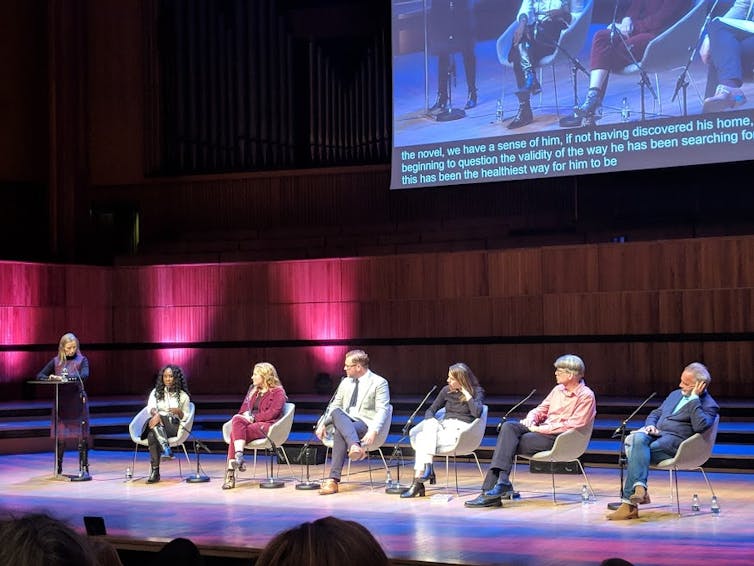
Two days before the winner was due to be announced the writers encountered each other for the first time for a Sunday night appearance at London’s Royal Festival Hall. The audience paid up to £35 a ticket to hear these writers read and talk. Take this Man Booker reading as its own performance contest, and which writer would win?
I settled in my seat with mixed expectations. In Britain, you can coax the occasional creative writing student into a soft-voiced reading, but most hate the prospect. On the other hand, writing classes in the US have spoken delivery and response at their core. In 2014, the Man Booker opened entry to US writers, so I expected the two shortlisted American writers, Rachel Kushner and Richard Powers, to leap out of the blocks.
Kushner obliged. “I recently started to wear these glasses”, she tells us, “because they’ve started to shrink all the texts in all the books.” For her excerpt from The Mars Room she pops in and out of dialogue for a tale of hotwiring a cement mixer, and laughter trills around the auditorium. Yes, she did do her own audio book, she tells the host. “I read out loud while I’m writing so I felt I’d been practising to do that.” Her big interest is in voices, their “formal syncopation – the first person is traditionally a confessional tone, a challenging voice”.
Robin Robertson’s voice is more than challenging. The Long Take is a noir novel in verse, in which a World War II veteran finds himself among the denizens of Skid Row in 1940s Los Angeles. Robertson grips hold of the perspex lectern and delivers his reading with measured threat in every line. In conversation, he tells the London audience how the book reflects the “sense of urban paranoia and panic” that gripped him on first reaching London, and the “deep sense of existential dread” felt by German filmmakers in their post-war Hollywood exile.
For Burns, her characters are nameless and appear as voices in her head. She reads in the shock of a character’s short sentences. We find ourselves shocked. We find ourselves laughing. Anna reads on. It’s tough stuff.
Esi Edugyan smiles, thanks us, tells us she’s pleased to be with us. We warm to her and recognise her nerves – but something gets stuck. The voice of the protagonist in Washington Black is of a young 19th-century boy, a slave – and his first-person past tense narrative is literary. It belongs not so much in the author’s voice, but on paper.
Richard Powers read from his novel, The Overstory, as though in awe of it, his voice close to breaking. At 502 pages, The Overstory is the longest book on the shortlist, and the five-minute reading somehow gave a sense of its length. As fellow shortlister, Daisy Johnson, noted: “There’s something treelike in the way it’s written” – and it’s true: his reading accrued detail like growth rings.
Performing arts
And so to the two “Writer in Performance” awards I took it upon myself to present for the evening. Every writer gets a special award for taking the stage yet staying true to themselves – but, for the most constant laughter and spontaneous applause, the Audience Award goes to Rachel Kushner.
I had other award categories, which Daisy Johnson nailed in reading from her Everything Under – including eye contact with audience and an urgent clarity in her reading. But ironically what clinched the Judge’s Performance Award for Daisy Johnson is the writing. She spoke as an “I” talking to a “you”. She stripped away the literary and delivered the directness of raw speech.
We all applauded, the writers walked off to sign books – and soon one Man Booker winner will be hurtled into months of celebrity. The others, surely, will step from the public gaze and return to the journey Kushner spoke of, going “deeper in myself and trying to form a rich dialogue with my own consciousness”.
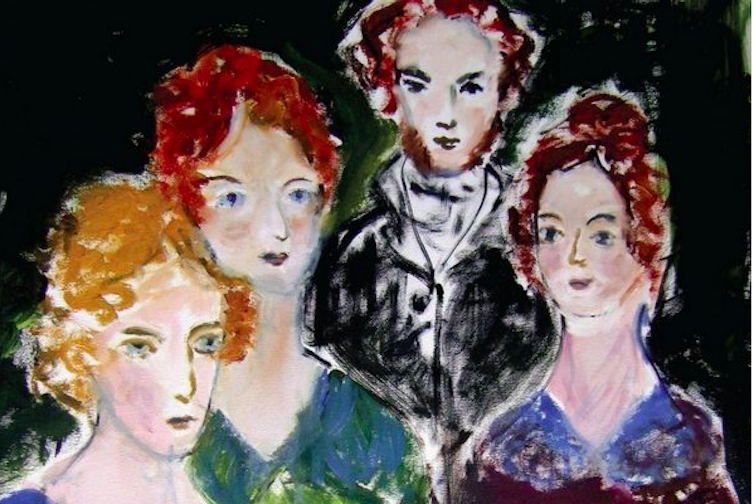
Bizarrely, the idea that Branwell Brontë had sex with his sister Emily appears to have been more palatable than the idea that he might have given her tuberculosis – or that the infection might have passed to Anne from either sibling. Those documenting the lives of the Brontës since the late 19th century have been curiously reluctant to acknowledge this fact.
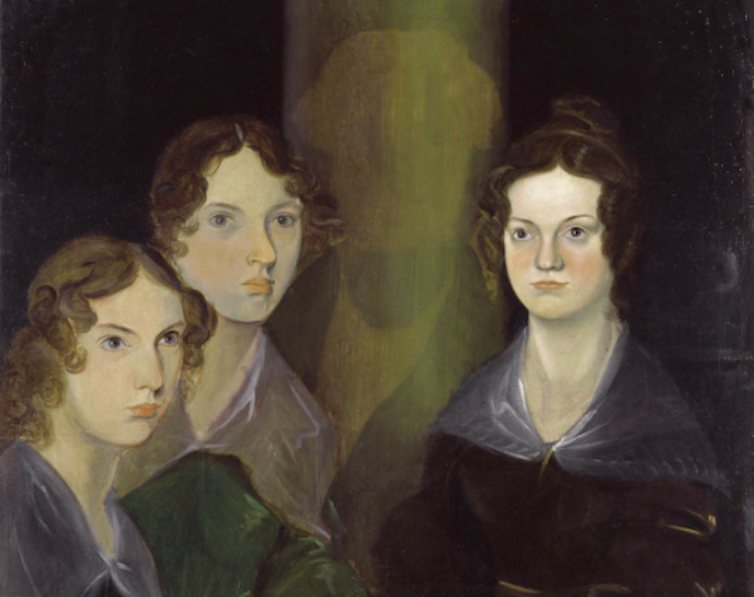
Branwell, Emily, and Anne all died from various forms of tuberculosis between September 1848 and May 1849. All three had lived together at Haworth Parsonage in Yorkshire with their sister Charlotte (who managed to last until 1855 when she too succumbed to tuberculosis). Branwell and Emily died there, and Anne died on a final trip to Scarborough, where she is buried.
We know today that tuberculosis is contagious, and particularly so between family members living in close quarters. Yet the idea that one Brontë sibling might have infected or been infected by another still seems to be taboo in Brontë biography and adaptation.
Only Claire Harman’s biography of Charlotte Brontë (2015) and Beth Torgerson’s Reading The Brontë Body (2005) have suggested the possibility of infection, even briefly. So how and why has contagion largely been written out of the story of Branwell’s, Emily’s and Anne’s deaths?
The contagion taboo
The way we think about tuberculosis has changed dramatically since Robert Koch discovered the tubercle bacillus in 1882. As Katherine Byrne has explained in Tuberculosis and the Victorian Literary Imagination, before Koch’s discovery “consumption” had often been thought of as a “mysterious, ethereal wasting disease”. It became “an identifiable bacterial infection” by the end of the 19th century, and this was also when the term “tuberculosis” started to replace “consumption”.
By the mid-20th century, the tuberculosis sufferer was no longer thought of as delicate or exceptional. Now that the infection could be clearly seen in X-rays, and treated with often brutal surgery, the tubercular body seemed much less Romantic. TB was a public health problem, and those who contracted it often faced isolation and social stigma.
Yet in this same period, biographies about the Brontës described their deaths from rather personal, individual illness, as though the discoveries made about the disease in the intervening century had never happened. The “consumption” from which the siblings died in these accounts often seems to have little in common with the disease which was by then commonly known as tuberculosis.
In 1947 alone, Ernest Raymond, Laura L Hinkley and Phyllis Bentley all told a story which stressed Branwell’s alcoholism, Emily’s grief, and Anne meekly following her two siblings to the grave. These biographers, and many more in the late 1940s and the 1950s, stressed both weather and emotion as causes of death. They created an aura of predestined tragedy around the Brontës which proved difficult to displace in the years which followed.
Films and TV dramas showed the same causes for the Brontës’ deaths. Granada TV’s The Brontës of Haworth (1973) has Branwell’s burial immediately followed by Emily clasping the table as a whistling wind comes in through the parsonage door. She coughs, sickens and dies, and Anne quietly follows.
Andre Téchiné’s Les Sœurs Brontë (1979) portrays an unusually close relationship between Branwell and Emily throughout. So when Branwell dies, Emily is emotionally, not bacterially, infected. She puts on his coat and sobs until her sobs become coughs. She is soon on her deathbed refusing the doctor, while Anne stands timidly in the hallway, meekly taking her own medicine from a spoon.
In 2016, BBC Two’s documentary Being the Brontës described the sisters’ “frail bodies” giving up on them “so young,” again suggesting a kind of fatalism about their deaths. Carl Barnes’s brilliantly funny musical Wasted, however, seems to deliberately reference the sheer absurdity of so much death in one family. Branwell is handed copies of his sisters’ published works and then immediately dies. Emily sings that she is a “Goth before my time” and then dies. Anne laments a miserable life in which she has never been touched by a desiring hand – and then dies.
Whether with surreal humour or with pathos, the Brontës’ deaths have often been presented as though they were all characters in a novel. It seems as though we want Emily, in particular, to have died because she was ready to do so, or because a tragic fate willed that it was her time.
A little more reality
Perhaps the more mundane suggestion that one sibling caught the disease from another, or from anyone else, undermines the idea that the Brontës were as unique or Romantic as we have often liked to think.
Wasted contains swearing, anachronism, and sexual references. Sally Wainwright’s To Walk Invisible (2016) also invited us to contemplate the Brontës with Yorkshire accents, and a swearing, drug-addled Branwell. There seems to be space now for a less reverential, Romanticised approach to the siblings. Perhaps it is time to accept that the Brontës didn’t die from melancholy, weather, or death wishes, but because they were infected with bacteria.
A drama or biography which allowed this possibility would open up some fascinating new ways to think about the Brontës and their work. I’ve written elsewhere about the importance of contagion theories and the rabies virus in Charlotte Brontë’s Shirley, but there is still more to be said about contagion, disease, and the Brontës.
All three sisters wrote about “consumptive” characters, from Jane Eyre’s Helen Burns to Wuthering Heights’s Frances Hindley to Agnes Grey’s labourer Mark Wood. Widening our understanding of tuberculosis in the lives of these extraordinary women would help us to read their novels afresh.
If you want to write a good sentence, you must learn to love the full stop. Love it above all other punctuation marks, and see it as the goal towards which the words in your sentence adamantly move.
A sentence, once begun, demands its own completion. As pilots say: take-off is optional, landing is compulsory. A sentence throws a thought into the air and leaves the reader vaguely dissatisfied until that thought has come in to land.
We read a sentence with the same part of our brains that processes music. Like music, a sentence arranges its elements into an order that should seem fresh and alive and yet shaped and controlled. A good sentence will often frustrate readers just a little, and put them faintly on edge, without ever suggesting that it has lost control of what is being said. As it runs its course, it will assuage some of the frustration and may create more. But by the end, things should have resolved themselves in a way that allows something to be said.
Only when the full stop arrives can the meaning of a sentence be fulfilled. The full stop offers the reader relief, allowing her to close the circle of meaning and take a mental breath.
Full stops also give writing its rhythm. They come in different places, cutting off short and long groups of words, varying the cadences – those drops in pitch at the sentence’s end which signal that the sentence, and the sentiment, are done.
A sentence wields more power with a strong stress at the end, where it sticks in the mind and sends a backwash over the words that went before. Weak sentences have weak predicates that come to the full stop with an unresounding phhtt. If you say that something is “an interesting factor to consider” or “should be borne in mind”, then the end of your sentence is just mumbly noise, because those things could be said about anything. A sentence with a strong end-stress says that its maker cared how its words fell on the reader’s ear. It feels fated to end thus, not just strung out to fill the word count.
Press enter
A good trick, when drafting a piece, is to press enter after every sentence, as if you were writing a poem and each full stop marked a line break. This renders the varied (or unvaried) lengths of your sentences instantly visible. And it foregrounds the full stop, reminding you of its power as the destination and final rest of each sentence. Winston Churchill wrote his speeches like this, in single-sentence lines, to more easily adjust his Augustan rhythms. If you keep pressing enter after every full stop, the music of your writing is easier to hear because now it can also be seen.
We live in an age when the full stop is losing its power. The talky, casual prose of texting and online chat often manages without it. A single-line text needs no punctuation to show that it has ended. Instead of a full stop, we press send. Omitting the full stop gives off an extempore air, making replies seem insouciant and jokes unrehearsed.
But writing is not conversation, nor a speech-balloon text awaiting a response. A written sentence must give words a finished form that awaits no clarification. It must be its own small island of sense, from which the writer has been airlifted and on which no one else need live. We write alone, as an act of faith in words as a way of speaking to others who are elsewhere. So a sentence must be self-supporting. It must go out into the world without the author leaning over the reader to clarify its meaning. Hence the full stop.
A sentence is also a social animal; it feeds off its neighbours to form higher units of sense. It needs a full stop not just to be a sentence, but so the next one can begin. Studies have shown that young people tend to read a full stop in a text as curt or passive-aggressive. On social media, a full stop is often used between every word to sound angrily emphatic: End. Of. Story. But in writing, a full stop is not meant to be the final word in an argument like this. It is a satisfying little click that moves the dial along so the next sentence can pick up where it left off. Its end is also a beginning.
More language-related articles, written by academic experts:
Non-Indigenous Australian writers face a dilemma. On the one hand, they can risk writing about Aboriginal people and culture and getting it wrong. On the other, they can avoid writing about Aboriginal culture and characters, but by doing so, erase Aboriginality from the story they tell.
What such writers are navigating is the risk of cultural appropriation: the often offensive taking of another’s culture. It is particularly problematic when the appropriator is in a dominant or colonising relationship with a culture’s custodians. Australian literature has a long history of appropriating and misrepresenting Aboriginal culture.
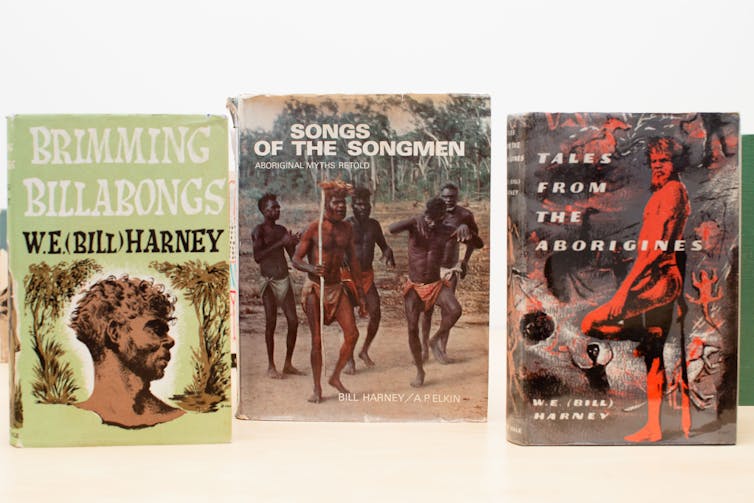
Take anthropologist A.P. Elkin and his associate W.E. Harney. These white men collaborated in the 1940s on a book translating Aboriginal songlines into anglophone ballads.
In “Our Dreaming”, a dedicatory poem to the resulting collection Songs of the Songmen, the pair open with a self-aggrandising appropriation. This opening text emphasises their ownership of works that they are merely translating.
Together now we chant the ‘old time’ lays,
Calling to mind camp-fires of bygone days.
We hear the ritual shouts, the stamping feet,
The droning didgeridoos, the waddies’ beat.
An unpublished 1943 revision by Harney, altered by Elkin, even more noticeably emphasises the two authors’ claim on these songlines. The poem is titled “To You My Friend” and the first line reads, “To you my friend I dedicate these lays,” as though Harney is bestowing this culture on Elkin directly.
The pair claim to write:
not of their huts, the bones, the dirt,
Nor the strange far look in a native’s eyes,
As he looks to his country ‘ere he dies.
Rather than this vision of the apparently doomed “native”, Songs of the Songmen would purport to extol the romantic figure of the noble savage. The poem continues:
Tis not of these we muse today:
For the ‘Dreaming’ comes, and we drift away
Into myth and legend where we’ve caught
The simple grandeur of their thought.
The pair’s poetry claims in this way to be able to salvage and recapture the “Dreaming”, represented as no longer accessible to Aboriginal people themselves.
This example shows how appropriation, far from innocent, is bound up with attitudes such as the idea of a “doomed race”. It can also be connected to such projects as assimilation and child removal; Elkin advocated both.
The Jindyworobak group
The most famous literary movement in Australia to be engaged in appropriation formed in the 1930s. They were the Jindyworobak group, their founder Rex Ingamells drawing the word from his friend James Devaney’s book The Vanished Tribes, which included a Woiwurung word list.
Jindyworobak means “to annex” or “to join” in Woiwurung. The practices of its writers were, however, more annexation of Aboriginal culture than any inclusive joining together.
Ingamells’ knowledge of Aboriginal culture came from white translators and not from Aboriginal people themselves. He visited Harney on several occasions. The Jindyworobaks both believed in the myth that Aboriginal people were doomed to extinction and advocated the appropriation of Aboriginal culture.
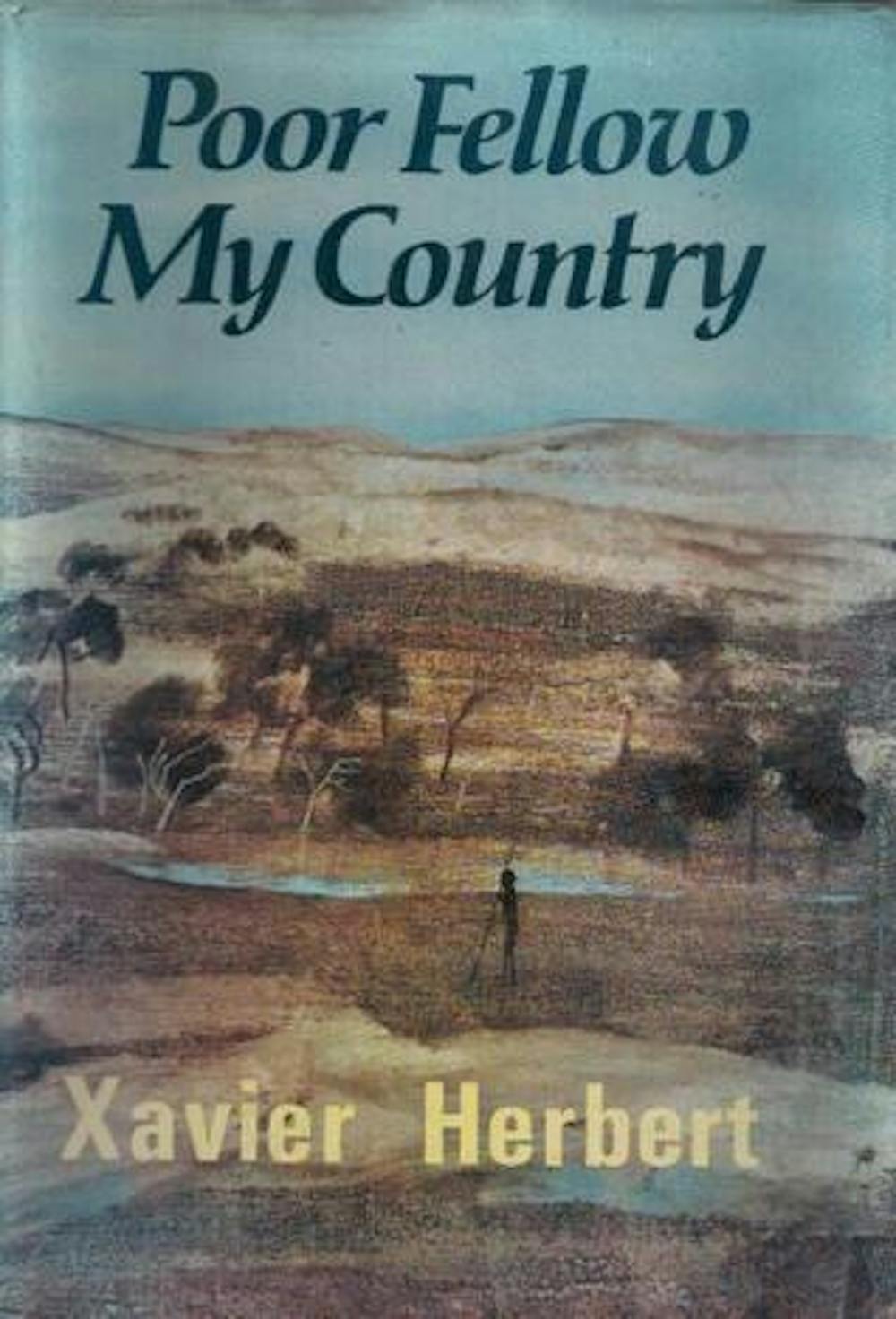
Another writer who found Harney to be a useful source was Xavier Herbert. Herbert drew on Harney’s notes on the Yanyuwa kinship system (Harney spelled the name Anula) and turned skin names into character names in his 1976 epic Poor Fellow My Country. He had Harney’s permission but not that of the Yanyuwa themselves. Herbert’s novel arguably offers a distorted view of Aboriginal kinship.
Contemporary currents
Some of Les Murray’s verse can be read as inheriting from Jindyworobak and its legacy of appropriation – notably his 1977 Buladelah-Taree Holiday Song Cycle, which presents a non-Indigenous family holiday as sacred to the equivalent of an Indigenous song cycle. Murray’s poetry is often innovative, but its progenitor is also famous for positing a near equivalence between non-Indigenous and Indigenous belonging
Murray has lent his name and ability to publications such as Quadrant, whose editors famously denied the existence of a Stolen Generation. Even where the poetry might be compelling for some, Murray’s reputation is nonetheless associated with Quadrant’s dismissal of Aboriginal perspectives on history and self-representation.
This history of appropriation is dispossession, using another’s culture for gain and without their permission. Yet some have been calling recently for Australian literature to return to and revive these legacies.
Critic and poet R.D. Wood has rhetorically asked, in the context of a discussion about the translation of song-cycles, “what might a Jindyworobak project for the 21st century look like?”. Such a project augurs poorly as a means of engagement for non-Indigenous writers.
South African-born, Western Australian poet John Mateer has used Noongar words in poems such as In the Presence of a Severed Head. The Western Australian poet John Kinsella has contextualised Mateer’s poetry thus:
In Kayang and Me, Kim Scott strongly objects to Mateer’s poetic use of Nyungar language at a reading from one of Mateer’s poems when they were both performing at an event in Canada. Scott speaks of the distress he felt at hearing a language that is only just being reconstituted and reclaimed by Nyungar people themselves, being spoken by, as he says, a white South African. There are important issues in this. First, Scott as a Nyungar is in a position to critique what he sees as an inappropriate usage of a language that has been placed under massive pressure by the machinery of colonisation.
On the other hand, his isolating Mateer’s South African origins does not take into consideration that Mateer is, both poetically and in terms of self-identity, as much a part of ‘Western Australia’ as of his birth land.
Mateer in his book Loanwords utilises borrowings and usages from a number of languages in order to reconstitute their original implications, while also building in the agency of new meaning in the language in which they are being deployed. This transnationality is the main drive of his work. Mateer meant no disrespect, I believe, but the issues are at the core of contemporary poetics. What is and is not available to the poet in creating a poetic language that carries its own intactness and its own implications for reading?
As Kinsella also argues, this is exactly where we need to be careful. While such transnational borrowings can enrich the English they emerge in, what is the effect on the speakers of the original language who are still recovering their culture in the face of colonisation?
… there are very few forums for Noongar people to come to terms with the ideas of their ancestors … so it can feel doubly wrong when recent arrivals use those representations for their own purposes.
Others, more globally, have taken umbrage with critiques of appropriation. Kwame Anthony Appiah, for instance, has recently suggested that the idea of cultural ownership is vested in the commodity and not useful for thinking about cultural borrowing. Yet, he does not consider the numerous ways in which Indigenous culture is non-transferable – because it is a form of property grounded in kinship and Country.
Some poets who engage ethically with Aboriginal ways of writing and using language include Phillip Hall and Stuart Cooke. Hall engages with the same Gulf of Carpentaria Indigenous people, the Yanyuwa, from whom Herbert stole, but he does it through a reciprocal and ethical engagement. Hall has permission to write about these relationships. Cooke’s work includes translations of song cycles from the West Kimberley, for instance one written with the permission of George Dyunjgayan.
Non-Indigenous writers, if they wish to engage ethically with Indigenous culture, must learn to respect it as a form of property grounded in kinship and Country.
Michael Griffiths is the author of The Distribution of Settlement: Appropriation and Refusal in Australian Literature and Culture (UWAP).







 At the BookShelf

