
The link below is to an article that looks at the 2018 Inky Award Shortlist.
For more visit:

The link below is to an article that looks at the 2018 Inky Award Shortlist.
For more visit:
The link below is to an article that takes a look at how to upload PDFs to the Kindle Book Store.
For more visit:
https://the-digital-reader.com/2018/08/03/how-to-upload-a-pdf-to-the-kindle-store-and-sell-it/
The link below is to another article that looks at the current question ‘is listening to audiobooks reading?’
For more visit:
https://www.goodreads.com/blog/show/1359-we-asked-you-answered-is-listening-to-audiobooks-reading
The link below is to an article that looks at the longlist for the 2018 German Book Prize.
For more visit:
https://publishingperspectives.com/2018/08/germanys-borsenverein-announces-german-book-prize-2018-longlist/
The link below is to an article that looks at how to return an accidentally purchased Kindle book.
For more visit:
https://bookriot.com/2018/08/16/how-to-return-a-kindle-book/
4Max via Shutterstock
Sheena Kalayil, University of Manchester
Apparently, I am BAME. This places me as a contender for The Guardian’s BAME awards or the Jhalak prize, both aimed at BAME writers like myself. Ah, BAME – this acronym, which means black, asian and minority ethnic, joins many other appellations offered over the decades (not all of them very nice), painstakingly attempts to address the complexities of a multicultural society. But isn’t it, despite its best intentions, rather limiting?
As a child in Zambia, I was a mwenye, if the speaker wished to be disparaging (it’s an unflattering term that I won’t translate). In most contexts my family was “Indian”, while we regarded ourselves as Keralites (being Indian was secondary). Back in Kerala, if denoted by religion, we were proud to be “Syrian Christians”, members of a Catholic congregation pre-dating the arrival of Islam in India, formed by the disciple Doubting Thomas. Of course this meant we were a cut above those “Latin Christians” who had converted centuries after to curry favour with their Portuguese colonisers.
Later, as a teenager in a new Zimbabwe, I was once again “Indian” and, in a Harare which had been segregated under the Rhodesians, my family should thus have lived in the suburb of Belvedere, which was the Indian zone, rather than as we did on the edge of the “coloured” (mixed-race) Braeside. I resisted these tortuous preoccupations with skin tones and bloodlines – and by my late teens, inspired by the rising tide which was turning against apartheid in South Africa, I was resolutely, in my eyes, “black”.
But when I arrived in the UK, I was suddenly “Asian” – defined by a great continent, of which my home state in India was a mere slender slip of a thing. I was properly foreign, with a student visa stamped in my Indian passport, but my proficiency in English led many to believe I was “British Asian”, alongside an assumption that I was second-generation British, well versed in both Withnail and I and the career of reggae DJ Apache Indian, and full of fond memories of that incredible summer of 1976. I have done my homework since, as you can see.
I returned to Africa as a young woman, and when living and working in Mozambique, I was a monye – another disparaging term, not dissimilar to mwenye, but this sobriquet was seasoned with the erroneous assumptions of being Muslim and wealthy. Then, on to the tiny island of Bioko, part of Equatorial Guinea, where I was memorably known as la chica blanca – the white girl. Oh yes, and in Spain some years later, I was declared a hindou, the religious divisions that beset my homeland refreshingly ignored. Reader, an identity crisis in the making.
But, actually not. For, observers often overlook the id and the ego: your own innate understanding of yourself. Are we swayed so much by what others call us? Probably not. Despite my nomadic childhood, my peripatetic young adulthood, my membership of a wider diaspora, angst over love affairs and migrations and appearance and employment, if I’m honest, I’ve always known myself: as impulsive, restless, often inept, but well-intentioned. Despite all the assumptions made in the geographical/religious/social “names” I have been given, these qualities best define who I am.
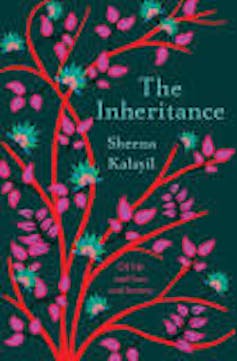
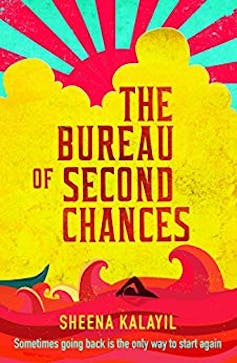
The journey I have taken to arrive at the roles I currently have – wife, mother, writer, teacher – baffles many people. My first novel (roundly rejected, then published independently) juxtaposes a young woman’s passionate love affair in Mozambique with her arranged marriage in the US. My second, published as my debut by Polygon, follows a widower’s return to India after 30 years in London. My most recent, The Inheritance, features an affair between a young student and an older lecturer, the latter born in Zimbabwe-then-Rhodesia.
As a writer, if I tap into my experiences of geographical dislocations and multilingual communities, the literary industry and reviewers often locate the story as one of identity crises, of a quest to belong, in which I give “a compelling insight into what it means to be rootless, with characters torn between the culture of their parents and that of the society in which they grew up”. All true. But not the whole story and not a unique story by any means – instead, one that is shared by millions over a shifting, transient world, including readers of fiction. To a lot of us, the mobility and code-switching and reinvention are rather normal. What informs my sense of self? Whom I love, my children, the opinions and advice of the people who are important in my life.
It feels churlish to question BAME. But, if identifying a misrepresented or under-represented minority, then why not just “minority”? The writer and historian Paul Gilroy, in his book There Ain’t no Black in the Union Jack, has already queried the “imploded, narcissistic obsession with the minutiae of ethnicity”. Why the splintering and separation? Does the “B” in BAME reference the Windrush generation or the recently arrived Somali, or neither, or both?
Are we in danger of engendering a hierarchy by stealth, so some minorities are considered more “minority” than others? As a “British Asian” (holding a British passport now, I have become one) I cannot claim to have the same experiences and reception as a Briton with Nigerian origins. But I might well share some of her experiences if she is a woman (like me), if she is a writer (like me), or if she is as scared of her teenage daughter as I am.
And if we take the “A” – what constitutes a (British) Asian? Not all of us emanate from the Punjab or Gujarat or Bangladesh, or made a prolonged stopover in East Africa. Not all of our parents arrived in the UK in the 1960s or 1970s. Not all of live in a large, dense community, or speak its language – or even wish to. Not all of us dance bhangra or admire Bollywood. Our families may not all have served in or near the Raj and we may not have a strong memory of or feelings about partition.
Disappointed? You might well be, so embedded are the discourses surrounding British Asians. A discourse which can blind an “A” in BAME to the heterogeneity and diversity within – and which is perpetuated sometimes by these individuals themselves. I once watched on television a very well-known British Asian comic whose punchline centred on the unlikelihood of finding an Indian at a Catholic school. The laughter from the audience only served to show how they little knew of the millions of Indians who are Catholic. But, more depressingly – neither it seemed, buying into the discourse, did the comic.
To note, the aforementioned Jhalak prize, is the Hindi-Urdu word for “glance”. Considering it is open to all BAME writers, the Bs and the MEs alongside the As, perhaps this is not the most inclusive title?
<!– Below is The Conversation's page counter tag. Please DO NOT REMOVE. –>

Perhaps rather than trying to solve issues about diversity by making diversity more explicit and more fractured at the expense of cohesion, we should simply acknowledge that it is, frankly, impossible to categorise a creature as self-reflective and self-concerned as a human being.
Sheena Kalayil, Senior Language Tutor, University Language Centre, University of Manchester
This article was originally published on The Conversation. Read the original article.
Anne Maxwell, University of Melbourne
In our series, Guide to the classics, experts explain key works of literature.
Harper Lee’s To Kill A Mockingbird is one of the classics of American literature. Never out of print, the novel has sold over 40 million copies since it was first published in 1960. It has been a staple of high school syllabuses, including in Australia, for several decades, and is often deemed the archetypal race and coming-of-age novel. For many of us, it is a formative read of our youth.
Read more:
‘Great books’, nationhood and teaching English literature
The story is set in the sleepy Alabama town of Maycomb in 1936 – 40 years after the Supreme Court’s notorious declaration of the races as being “separate but equal”, and 28 years before the enactment of the Civil Rights Act. Our narrator is nine-year-old tomboy, Scout Finch, who relays her observations of her family’s struggle to deal with the class and racial prejudice shown towards the local African American community.
At the centre of the family and the novel stands the highly principled lawyer Atticus Finch. A widower, he teaches Scout, her older brother Jem, and their imaginative friend Dill, how to live and behave honourably. In this he is aided by the family’s hardworking and sensible black housekeeper Calpurnia, and their kind and generous neighbour, Miss Maudie.
It is Miss Maudie, for example, who explains to Scout why it is a sin to kill a mockingbird: “Mockingbirds don’t do one thing but make music for us to enjoy. They don’t eat up people’s gardens, don’t nest in corncribs, they don’t do one thing but sing their hearts out for us.”
Throughout the novel, the children grow more aware of the community’s attitudes. When the book begins they are preoccupied with catching sight of the mysterious and much feared Boo Radley, who in his youth stabbed his father with a pair of scissors and who has never come out of the family house since. And when Atticus agrees to defend Tom Robinson, a black man who is falsely accused of raping a white woman, they too become the target of hatred.
One might expect a book that dispatches moral lessons to be dull reading. But To Kill a Mockingbird is no sermon. The lessons are presented in a seemingly effortless style, all the while tackling the complexity of race issues with startling clarity and a strong sense of reality.
Read more:
William Faulkner diagnosed modern ills in As I Lay Dying
As the Finches return from Robinson’s trial, Miss Maudie says: “as I waited I thought, Atticus Finch won’t win, he can’t win, but he’s the only man in these parts who can keep a jury out so long in a case like that.”
Despite the tragedy of Robinson’s conviction, Atticus succeeds in making the townspeople consider and struggle with their prejudice.
The effortlessness of the writing owes much to the way the story is told. The narrator is a grown Scout, looking back on her childhood. When she begins her story, she seems more interested in telling us about the people and incidents that occupied her six-year-old imagination. Only slowly does she come to the events that changed everything for her and Jem, which were set in motion long before their time. Even then, she tells these events in a way that shows she too young to always grasp their significance.
The lessons Lee sets out are encapsulated in episodes that are as funny as they are serious, much like Aesop’s Fables. A case in point is when the children return home from the school concert with Scout still dressed in her outlandish ham costume. In the dark they are chased and attacked by Bob Ewell the father of the woman whom Robinson allegedly raped. Ewell, armed with a knife, attempts to stab Scout, but the shapeless wire cage of the ham causes her to loose balance and the knife to go astray. In the struggle that ensues someone pulls Ewell off the teetering body of Scout and he falls on the knife. It was Boo Radley who saved her.
Another lesson about what it means to be truly brave is delivered in an enthralling episode where a local farmer’s dog suddenly becomes rabid and threatens to infect all the townsfolk with his deadly drool.
Scout and Jem are surprised when their bespectacled, bookish father turns out to have a “God-given talent” with a rifle; it is he who fires the single shot that will render the townsfolk safe. The children rejoice at what they consider an impressive display of courage. However, he tells them that what he did was not truly brave. The better example of courage, he tells them, is Mrs Dubose (the “mean” old lady who lived down the road), who managed to cure herself of a morphine addiction even as she was dying a horribly painful death from cancer.
He also teaches them the importance of behaving in a civilised manner, even when subjected to insults. Most of all Atticus teaches the children the importance of listening to one’s conscience even when everyone else holds a contrary view: “The one thing that doesn’t abide by majority rule”, he says, “is a person’s conscience.”
The continuing value in Atticus’ belief in the importance of principled thinking in the world of Black Lives Matter and the Australian government’s rhetoric of “African gangs”, is clear.
Atticus’ spiel on “conscience” and the other ethical principles he insists on living by, are key to the enduring influence of the novel. It conjures an ideal of moral standards and human behaviour that many people still aspire to today, even though the novel’s events and the characters belong to the past.
Lee herself was not one to shy away from principled displays: writing to a school that banned her novel, she summed up the source of the morality her book expounds. The novel, she said, “spells out in words of seldom more than two syllables a code of honor and conduct”.
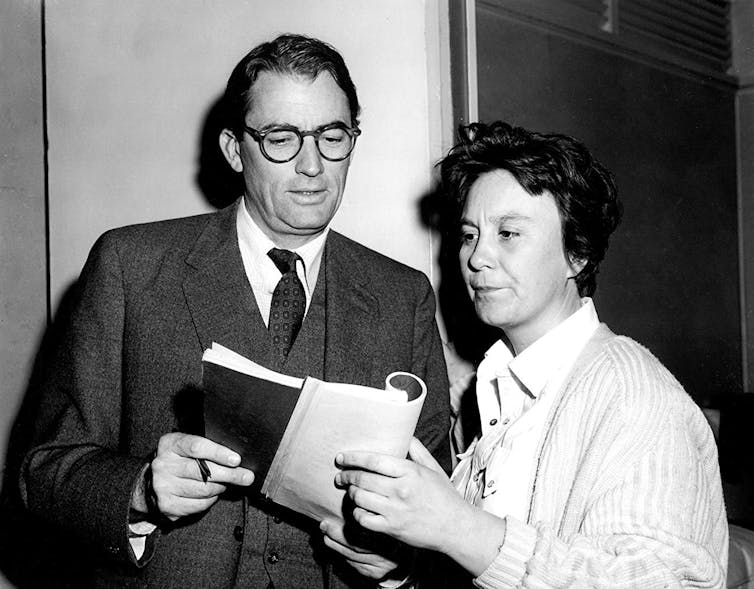
When first published the novel received rave reviews. A year later it won the Pulitzer Prize for Literature, followed by a movie version in 1962 starring Gregory Peck. Indeed, the novel was such a success that Lee, unable to cope with all the attention and publicity, retired into obscurity.
Interviewed late in life, Lee cited two reasons for her continued silence: “I wouldn’t go through the pressure and publicity I went through with To Kill a Mockingbird for any amount of money. Second, I have said what I wanted to say, and I will not say it again.”
The latter statement is doubtless a reference to the autobiographical nature of her book. Lee passed her childhood in the rural town of Monroeville in the deep south, where her attorney father defended two black men accused of killing a shopkeeper. The accused were convicted and hanged.
Undoubtedly influenced by these formative events, the biographical fiction Lee drew out of her family history became yet more complex upon the publication of her only other novel, Go Set a Watchman, in 2016. Critics panned it it for lacking the light touch and humour of the first novel. They also decried the fact that the character of Atticus Finch was this time around a racist bigot, a feature that had the potential to taint the author’s legacy.
Read more:
Review/ Has Go Set a Watchman helped topple the notion of the white saviour?
Subsequent biographical research revealed that Go Set A Watchman, was not a sequel, but the first draft of To Kill a Mockingbird. Following initial rejection by the publisher Lippincot, Lee reworked it into the superior novel many of us know and still love today.
<!– Below is The Conversation's page counter tag. Please DO NOT REMOVE. –>

Lee gave us the portrait of one small town in the south during the depression years. But it was so filled with lively detail, and unforgettable characters with unforgettable names like Atticus, Scout, Calpurnia and Boo Radley that a universal story emerged, and with it the novel’s continuing popularity.
Anne Maxwell, Assoc. Professor, School of Culture and Communication, University of Melbourne
This article was originally published on The Conversation. Read the original article.
The link below is to an article that looks at 10 ways to store books.
For more visit:
https://www.wayfair.com/furniture/sb0/cube-storage-c1775228.html
 At the BookShelf
You must be logged in to post a comment.