Why do you read? Maybe you read to relax after a long day, to learn about unfamiliar people or places, to make you laugh or to let you dream. Maybe you never really ask yourself why, but turn to books out of some vague instinct that they’re what you want or need.
The question of why humans invest such a lot of time and other resources in reading is an interesting one for researchers of both minds and texts, especially when it comes to fiction and poetry, where the answer doesn’t seem as obviously pragmatic as just learning useful facts. Whatever the answer is, it promises to tell us as much about human nature as it does about literature.
For decades now, researchers in cognitive literary studies have been suggesting reasons for why we read fiction. The dominant thinking is some variant on the idea that reading (especially reading narratives, often fictional) is pleasurable because it serves some evolutionarily adaptive purpose, in particular by giving us the chance to hone cognitive skills of one kind or another, free of real world risks. One strand of the general idea that narrative reading may increase our “fitness” is that it may quite literally help us be healthier.
Self-help books are an obvious place to start. There’s a growing body of research on “self-help bibliotherapy” (reading a self-help book, with or without some kind of formal guidance) which indicates that self-help books can sometimes be effective alternatives or supplements to other kinds of therapy.
But very little is known about whether readers respond in clinically relevant ways to poetry, fiction, or other narrative genres, such as memoir. The lack of evidence has not prevented a range of claims and theories from being proposed, and small-scale clinical uses of fiction and poetry by psychiatrists and psychotherapists seem to be fairly widespread.
So is the belief in art’s healing power just wishful thinking, or is there something to it?
Identification and insight
The focus of my work is eating disorders. To find out more about the effects of fiction-reading in this context, I set up a partnership with the leading UK eating disorder charity, Beat. We designed a detailed online questionnaire to ask respondents about the links they perceive between their reading habits and their mental health (with a focus on eating disorders). The survey attracted 885 responses (773 from people with personal experience of an eating disorder).
We found that 69% of those with personal experience reported seeking out both fiction and nonfiction to help with their eating disorder, and that 36% had found the fiction or nonfiction they tried helpful. We asked people to rate the helpfulness and harmfulness of different types of text in relation to their eating disorder, and 15% rated fiction about subjects other than eating disorders as more helpful than any other text type. At the same time, memoirs featuring an eating disorder were rated the most harmful text type, with fiction about eating disorders in second place. This suggests a complex set of effects.
But how does reading fiction actually affect health, positively or negatively? The dominant theoretical view holds that therapeutic effects arise out of a process involving identification (with the character or situation in the text) followed by insight (into the nature of one’s condition). This is perhaps accompanied by some kind of strong cathartic emotional response, followed by a problem-solving stage in which the insights are converted into intentions for personal change. This type of model usually requires that texts should portray situations as similar as possible to the reader’s own, and that they should provide happy but realistic endings.
There are many reasons to question this model. If reading about someone the same as yourself is meant to be therapeutic, what makes it different from, say, rereading your own diary entries? Does the concept of similarity become self-limiting at a certain point, and if so, at what point? And on what dimensions (nature of illness, age, sex, socioeconomic status) is similarity most relevant?
There are also reasons to wonder whether insight is necessarily the main driving force for therapeutic change. In the case of chronic eating disorders, extremely high levels of insight are often coupled with a paralysed inability to act on that insight. So at least among long term sufferers, there may be a more important role for reading experiences that increase motivation or self belief for recovery, rather than providing yet more confirmation of the awfulness of the illness.
The survey findings also direct our attention forcefully to the power of reading to do harm as well as good: one 18-year-old female respondent in recovery from multiple eating disorders described harmful reading matter as “reminding me of why I wanted to starve myself and reinforcing my irrational thoughts”. The testimony on the effects of fiction about eating disorders was overwhelmingly negative; 18 respondents also spontaneously mentioned deliberately “self-triggering”, or choosing to read books they knew would exacerbate their disorder.
Many respondents reported that their eating disorder encourages them to read in such a highly selective way that anything and everything can end up supporting the disordered mindset. Self-perpetuating feedback loops also seem to play a powerful role. If you’re feeling trapped by some aspect of an eating disorder (like low self-esteem), you might be more likely to read a certain type of text, or to read in a particular way (like zooming in on every association of thinness with something positive). This then makes you feel worse (maybe feeling instantly fatter or more determined to lose weight), which in turn encourages more unhealthy reading patterns. These vicious circles can be hard to break.
But fiction-reading seems to be one of the things that can break them. Fiction about something entirely unrelated to disordered eating can be stabilising and therapeutic in numerous ways. This can be pragmatic and embodied (allowing regular eating to happen, for example) or broadly existential: exploring alternative worlds, or reminding yourself that your life really could be different. A 27-year-old male in recovery from anorexia described how:
After reading sci-fi my mood is raised and I tend to feel more at peace with the universe, cognitively and imaginatively stimulated and inspired.
So, next time you pick up a book, reflect for a while on your reasons for doing so. And think about whether, when you’re tired or stressed out or indeed more seriously unwell, you find forms of solace, healing, or inspiration in the apparently simple black marks on a white background.
Celebrating its millennial anniversary in 2008, The Tale of Genji (Genji Monogatari) is a masterpiece of Japanese literature. Completed in the early 11th century, Murasaki Shikibu’s elegant and enchanting prose spans 54 chapters, features some 400 characters and contains almost 800 separate poems. Many consider it to be the world’s first novel, predating most European texts by several hundred years.
Murasaki Shikibu transformed her experiences of courtier life into an intricate narrative fusing fiction, history and poetry. This blending of forms defies simple categorisation under any one genre, though the striking interior life of its characters has led many to term it a psychological novel with prose that feels distinctively modern.
Captivating readers across the English-speaking world from the early 20th century onwards, she has often been compared to canonical artists such as Marcel Proust or Jane Austen for her ability to convey the splendour in the ordinary to her audience.
Consider this passage where a remorseful Genji seeks redemption from his deceased father for his misdeeds against him:
Coming to the grave, Genji almost thought he could see his father before him. Power and position were nothing once a man was gone. He wept and silently told his story, but there came no answer, no judgment upon it. (Chapter 12)
This beautifully captures both the infinite tragedy of losing a loved one, and the abyss of guilt that such unresolved conflicts inevitably impart on us. These words are just as poignant today as they would have been 1,000 years ago.
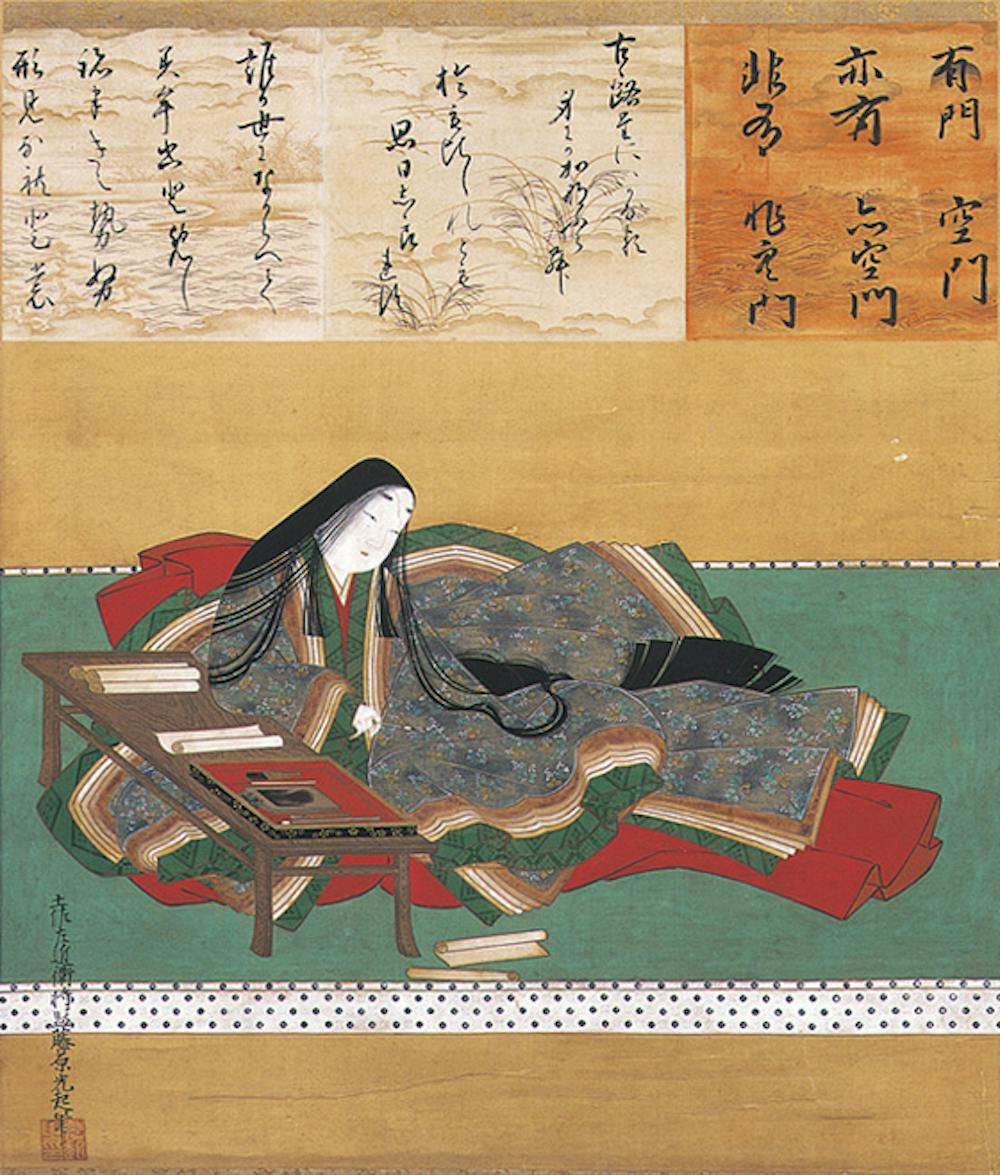
A 17th-century portrait of Murasaki Shikibu, author of The Tale of Genji. Wikimedia
The author served Empress Shōshi in the Imperial court of Heian (794-1185), situated in modern-day Kyoto. Courtiers were often referred to only by rank, and women were usually known only in relation to their husbands, sons or fathers. Due to such customs her actual name is unknown. Thus Murasaki Shikibu was likely gifted this moniker by her readers; “Murasaki” after the story’s heroine, and “Shikibu” referring to her father’s ministerial position within the court.
Her father, Fujiwara no Tametoki, was a scholar of Chinese classic literature. Despite Chinese being a masculine genre of writing, he nourished his daughter’s keen interest and special talent for it, as well as the more traditionally Japanese feminine writing styles of waka, essays, diary and letters (kana).
The Tale of Genji weaves a vivid depiction of aristocratic life in Heian Japan, which centres on the amorous exploits and political gameplay of the nobility. The titular “Shining” Genji is devastatingly handsome, with smooth-as-silk charisma, and a litany of musical, literary and academic skills that “to recount all his virtues would, I fear, give rise to a suspicion that I distort the truth” (Chapter 1).
Throughout the tale, however, he is revealed as an enigmatic but ultimately flawed hero. Rising to the rank of Honorary Retired Emperor (despite never actually reigning), the story of Genji’s success is a multigenerational saga filled with passion, deceit, jealousy, great rivalries and also great intimacies.
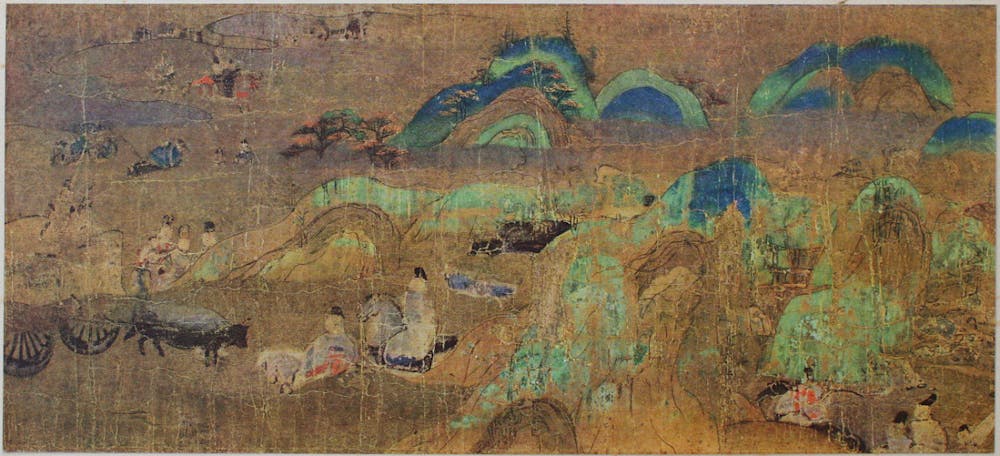
A scene from The Tale of Genji painted in the 11th century. Wikimedia
Potential readers should be forewarned, however, that many of Genji’s amorous conquests are likely to raise an eyebrow with contemporary audiences. Genji kidnaps and grooms a ten-year-old child bride, before fathering a secret love-child with his stepmother, all the while insistently pursuing a plethora of women in various extramarital affairs.
In a post-#metoo world, it is perhaps difficult to see Genji’s actions as anything but deplorable; however, by Heian standards Genji is lauded as a venerable hero. Controversial themes, including rape, have been condemned by contemporary readings. But the text allows and even encourages many different readings (for example in feminist and parodic fashions), presenting a challenge for contemporary readers and translators alike.
The challenge of translating Genji
The original Genji text in Japanese poses a number of issues for modern-day readers. Characters were rarely assigned proper names, with designations implied by way of their titles, honorific language, or even the verb form used. The writing also relies heavily on the reader’s pre-existing understanding of courtier life, poetry and history, which is often beyond the contemporary recreational reader.
The first complete English translation was published between 1925 and 1933 by esteemed orientalist scholar and translator Arthur Waley (who translated many other Chinese and Japanese texts such as Monkey and The Pillow Book). Waley’s translation prompted strong reactions from Japanese authors such as Akiko Yosano and Jun’ichirō Tanizaki. Both subsequently completed multiple translations of the work into contemporary Japanese (Yosano’s last translation was in 1939, with Tanazaki’s editions spanning 1939-1965).
There have been a number of recent translations in English, modern Japanese and several other European and Asian languages. Royall Tyler’s 2003 translation provides substantial footnotes, endnotes, illustrations and maps, which offer thorough explanations of the nuances of the text. This makes it suitable for novices as well as the academic reader.
The attention The Tale of Genji has received from translators in recent years speaks not only to the challenges in its translation but also to the beauty and importance of the work itself.
The Japanese celebration of cherry blossoms is an example of ‘mono no aware’, reflecting the tragic fleetingness of beauty. Shutterstock
The Tale of Genji is steeped in exquisite images of nature and heavily laden with tanka-style poetry. Descriptions of autumn leaves, the wailing of insects, or the subtle light of the moon work to heighten the complex and nuanced emotions of Murasaki Shikibu’s elegant characters as they traverse the difficult landscape of love, sex and the politics of court life. Such poetic language played a very important role in the communications and rituals of Heian courtier society.
The term mono no aware is often used when discussing The Tale of Genji. This somewhat untranslatable phrase portrays the beautiful yet tragic fleetingness of life. It has deep connections to Buddhist philosophies, emphasising the impermanence of things.
The Japanese celebration of the falling of the cherry blossoms is a good example of mono no aware. Murasaki’s poignant references to the natural world saturate the text and help us reflect on the illusory and sometimes unexplainable nature of life, love and loss.
As a counterbalance to such exquisite imagery, Genji also explores dark and divisive elements. Apart from familial sex, polygyny and sexualisation of children, it includes several key scenes of women experiencing spirit possession or mono no ke. These scenes depict women acting in strange and unpredictable fashions, and suggest that possession actually caused women to become ill and die.
These examples are just a taste of the vast subject matter and textual richness that The Tale of Genji offers readers. Adaptations, parodies and sequels have seen the tale reimagined into film, noh theatre, opera, manga and art. Genji is still very much alive.
An 18-year-old girl prepares to die to enable the birth of her half-vampire baby. Her spine is broken in the process, and the fanged baby begins to gnaw its way through her stomach before the girl’s husband performs a vampiric Cesarean section. This is a crucial moment in Stephenie Meyer’s Twilight novel series, published from 2005 to 2008.
Meyer’s books heralded a new, and continuing, wave of Gothic fiction for Young Adult readers, which revisits familiar literary Gothic conventions: ancient, ruined buildings and monstrous supernatural figures like the vampire, werewolf, ghost and witch.
The Gothic romances of the 18th century, such as the novels of Ann Radcliffe, and the enduringly popular Bram Stoker’s Dracula (1897), sought to recreate feelings of terror and horror for an audience of adult readers. Today, however, most Gothic fiction is being published for, and read by, young people. Surprisingly, it has proved to be the ideal genre for exploring the grotesque and frightening aspects of coming of age, and metaphorically representing pressing social issues such as racism and gender inequality.
The phenomenally popular YA genre, targeted at readers between 12 and 18 years old, evolved from realist novels of the 1960s. These books were preoccupied with the struggles of adolescence set against a backdrop of social issues. Now, though, the genre often looks to the supernatural. Beyond Twilight, some of the most popular YA Gothic series also focus on the “lives” of vampires who are protagonists rather than foes.
Richelle Mead’s six-book Vampire Academy (2007-2010), now adapted into a TV series, is about a teenage girl who is a Dhampir (half-human, half-vampire). She becomes entangled in a forbidden romance with her instructor as St Vladimir’s Academy, while learning how to defeat evil vampires named Strigoi.
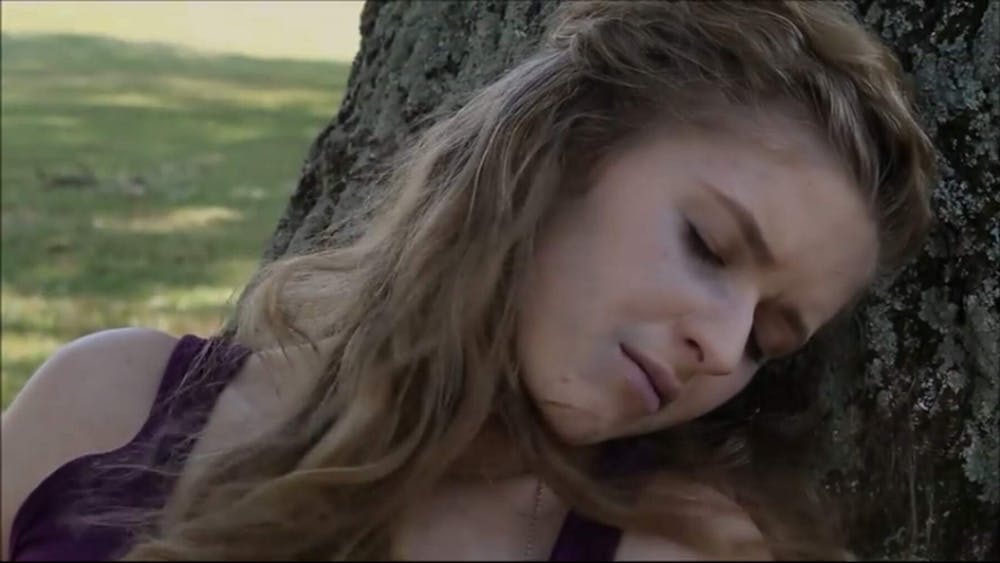
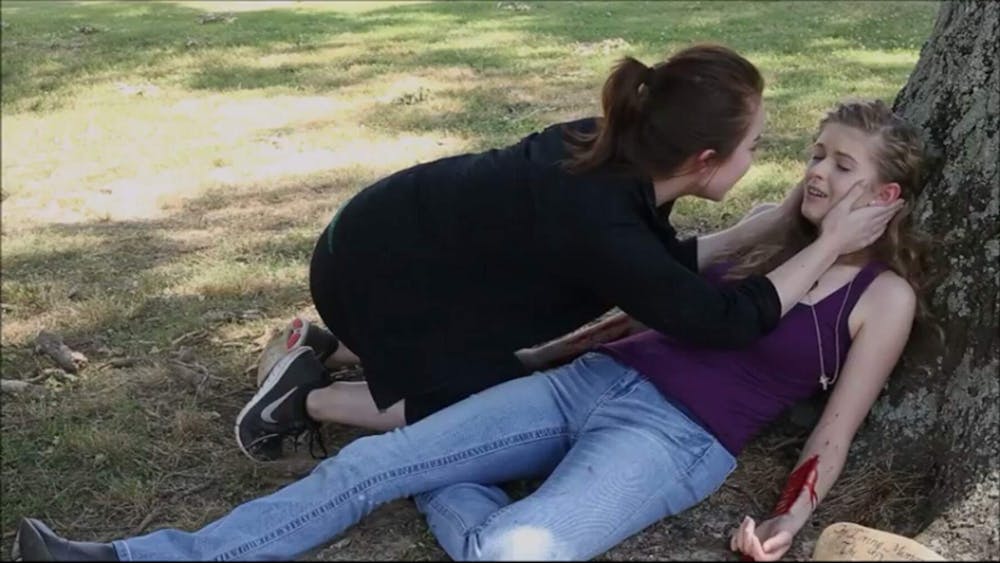
Ashley Lyn Blair in Vampire Academy: The Officially Unofficial Fan Series (2016). idmb
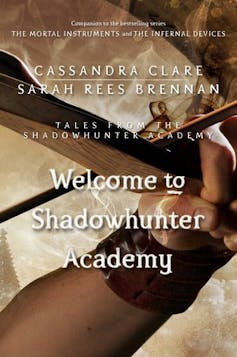
The YA Gothic revival has also embraced a wide range of supernatural entities. Cassandra Clare’s Shadowhunter Chronicles, a cross-media franchise that includes the Infernal Devices and Mortal Instruments novel series, charges angel-blooded humans with the task of protecting regular humans from a range of supernatural beings.
The Nephilim, or Shadowhunters, are busy controlling demons, warlocks, werewolves, faeries and vampires, but critically, it is their part-supernatural status that enables them to serve as protectors.
The Gothic, and its newer sub-genres like paranormal romance, have a unique resonance with teenagers. They are poised in a transitional space between childhood and adulthood, neither quite embodying the stage they are leaving behind nor fully the thing that they are in the process of becoming. It is unsurprising, then, that they have eagerly embraced the Gothic’s themes of the liminal and the monstrous, as well as its fixation on romance and sex.
Another significant element of the current YA Gothic revival is the emergence of the girl monster. In earlier manifestions of the “female Gothic”, first published in the 18th century by women writers, female protagonists were often courageous, but simultaneously passive and victimised. The plots of the female Gothic reflected the comparative powerlessness of women at the time and their fears about their vulnerability and entrapment within domestic roles and patriarchal society.
In contemporary YA Gothic, girl monsters, who can constitute a threat to others and themselves, disrupt the plotline of male monster and female victim.
Why now?
The most obvious catalyst for the embrace of Gothic conventions in literature for young people is J.K. Rowling’s Harry Potter series. Its popularity signalled a warm embrace of fantasy fiction that confronted the eternal dilemma of the battle between good and evil, charging a child – and later teenage protagonist – with the ability to save the world. While Hogwarts School of Witchcraft and Wizardry was not necessarily Gothic, the Potter phenomenon opened the way for the publication of numerous titles that embraced the possibilities of young protagonists with supernatural abilities.
Most significantly, Meyer’s Twilight series about human Bella Swan and “sparkling” vampire Edward Cullen, combined this staple figure of Gothic fiction with the teen romance novel. The Twilight novels were bestsellers internationally and the saga was voted into the number one position in Australian book chain Angus & Robertson’s Top 100 Books poll of 2010. The Twilight universe expanded from books into a highly successful film series.
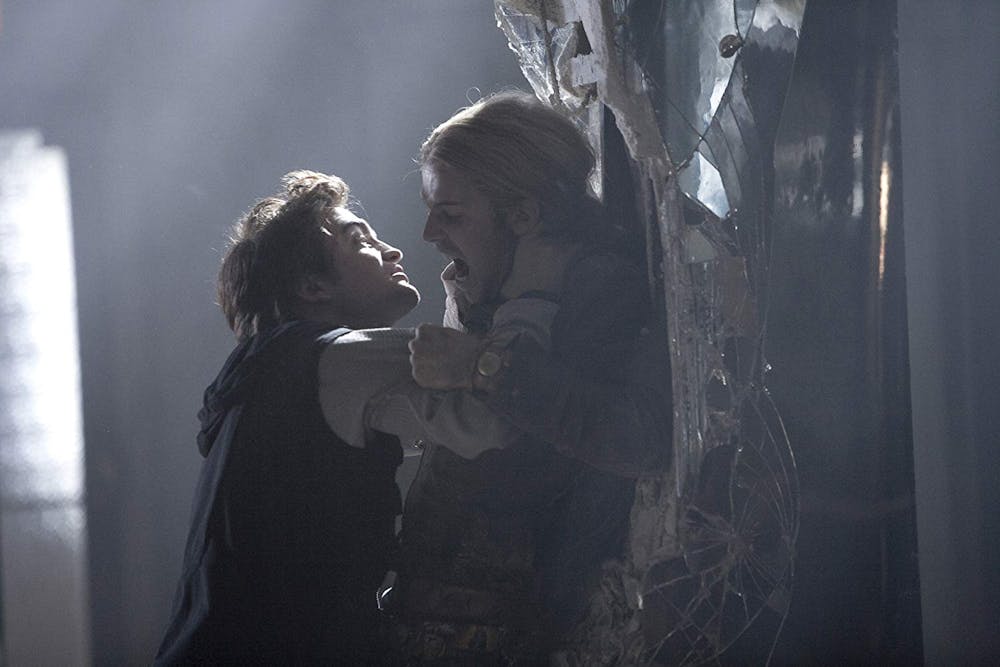
Robert Pattinson and Cam Gigandet in Twilight (2008) Summit Entertainment, Temple Hill Entertainment, Maverick Films.
The Gothic has had several major periods of popularity since its first appearance in 18th-century England, with Horace Walpole’s novel The Castle of Otranto (1764). In each subsequent revival of Gothic fiction, the genre has been reworked and reinvented to address current cultural concerns.
In particular, the monsters that haunt the pages of Gothic novels are transformed with shifting fears and anxieties. In her influential book Our Vampires, Ourselves Nina Auerbach explains that “every age embraces the vampire it needs”, and this comment can be extend to Gothic monsters more generally.
Contemporary YA fiction blurs the line between good and evil. In Gothic novels of the 19th century, monsters were usually wholly “Othered”. A Victorian-era vampire such as Stoker’s Dracula, for instance was depicted as evil, foreign, and frighteningly different to the British human.
Gary Oldman as Count Dracula in the 1992 film version of the Bram Stoker novel. Contemporary monsters are no longer set in opposition to the human. American Zoetrope, Columbia Pictures Corporation, Osiris Films
But contemporary monsters are no longer necessarily imagined as racially different or set in opposition to the human. Moreover, they are often represented sympathetically, especially in stories told from their perspective.
These include the iZombie comic series, in which the protagonist must eat brains on a monthly basis to survive, and Claudia Gray’s Evernight series, in which the reader is not even aware that the girl protagonist is a vampire for half of the first book. Indeed, as Anna Jackson explains in New Directions in Children’s Gothic, “the monsters have become the heroes” in contemporary children’s Gothic.
The passive heroine
Most Gothic novels for young people contain a romance plot. This is often because the protagonists’ age places them in the transitional zone for entering adulthood, which is demarcated by sexual experience.
In a typical YA Gothic novel, such as Twilight, a plot in which a human or monstrous girl protagonist falls for a boy who is not her “type” can dissolve the boundaries between monster and human. These monstrous love interests range from traditional Gothic ones – vampires, werewolves, zombies, ghosts and witches – to newer figures such as fallen angels and faeries. The key challenge to be overcome in these novels is the barriers posed to love by supernatural monstrosity, including the physical dangers to humans, as well as social discrimination about “cross-species” love.
In one of few major studies of teen romance fiction, published almost 30 years ago, Linda Christian-Smith described these novels as a “site of ideological struggles for young women’s hearts and minds”. In particular, she refers to teen romance fiction’s emphasis on heteronormative coupling and motherhood. Little has changed with respect to depictions of sexuality since, despite the YA Gothic’s embrace of diverse human-monster relationships.
Most romances in the genre are heterosexual. They do often emphasise the heroine’s agency through her supernatural abilities and ability to choose between men or move between relationships. However, the human heroines of the Twilight series and Lauren Kate’s Fallen series, in which the heroine becomes drawn to a boy who is a fallen angel, are comparatively indecisive and continue to need rescuing.
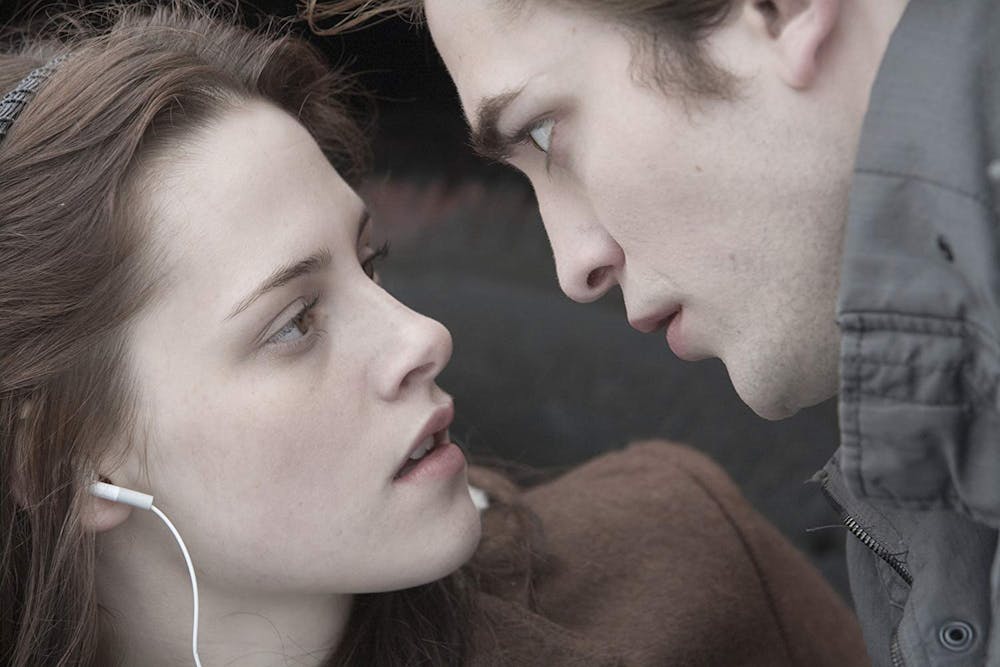
Tellingly, Joss Whedon, the creator of the TV series Buffy, The Vampire Slayer (1997-2003), has described Twilight’s Bella as lacking empowerment, overly fixated on her romantic options, and “completely passive”.
Kristen Stewart (Bella) and Robert Pattinson (Edward) in Twilight (2008). Bella has been described as a completely passive heroine. Summit Entertainment, Temple Hill Entertainment, Maverick Films.
Novels with passive human heroines allow the reader to use the fantasy of romance as a temporary escape from real-world gender inequality. Yet they also reinforce its reality for female readers.
The girl monster
Supernatural heroines, however, are often able to breach the confines of traditional femininity and become extraordinary in ways that Twilight’s Bella and other human characters cannot. In a number of YA Gothic novels, such as Mead’s Vampire Academy, the protagonists disrupt expectations of feminine behaviour because of their unique, and often poorly understood, supernatural abilities. These special powers become the focus of anxieties about the girls’ coming of age, as they pursue romances that place their broader communities under threat.
The Vampire Academy series was sufficiently popular in 2010 for three of its six titles to sell between 300,000 and half a million copies in hardcover in the US alone, according to Publishers Weekly. However, unlike the Twilight series, on which it likely attempted to capitalise, its protagonist, Rose, is half-vampire, half-human and a monster in her own right. Rose shares a close bond with vampire Lissa, and is driven to break the Academy’s rules in order to save her friend when she is kidnapped, highlighting that girls are also capable of protecting and rescuing people they love.
Ashley Lyn Blair (Lissa) and Jennifer Studnicki (Rose) in Vampire Academy: The Officially Unofficial Fan Series (2016). idmb
Vampire Academy positions Rose as a sexual object, particularly in the eyes of a privileged type of vampire (Moroi), who find Dhampir women especially attractive because of racial differences. Rose enjoys her sexuality and dresses to take advantage of it, but this sexuality operates within her definition as a strong young woman:
First they saw my body and the dress. Testosterone took over as pure male lust shone out of their faces. Then they seemed to realize it was me and promptly turned terrified. Cool.
Rose is able to reject unwelcome advances and possesses the physical strength and skills to stand up for herself, suggesting a fantasy of empowerment and equality.
Lissa, meanwhile, thwarts what amounts to an attempted gang rape of a drugged girl. A group of male Moroi students attempt to take advantage of a female feeder (person who permits their blood to be sucked) at a party, “doing a sort of group feeding, taking turns biting her and making gross suggestions. High and oblivious, she let them”.
The supernatural female protagonists in YA gothic novels are responsible for their own safety and protection, yet they also have a responsibility to keep others safe.
These heroines have some romantic and sexual agency in a way that can be considered progressive. However, their desire is also framed as disruptive and dangerous and there is an obsessive fixation on the pursuit of romance above the girl’s own development, education and safety.
In other words, the superficially radical potential of girl heroines with superhuman physical strength, mind-reading abilities, and the potential to kill can merely be a decorative smokescreen for the reinforcement of traditional feminine values.
The good and monstrous within
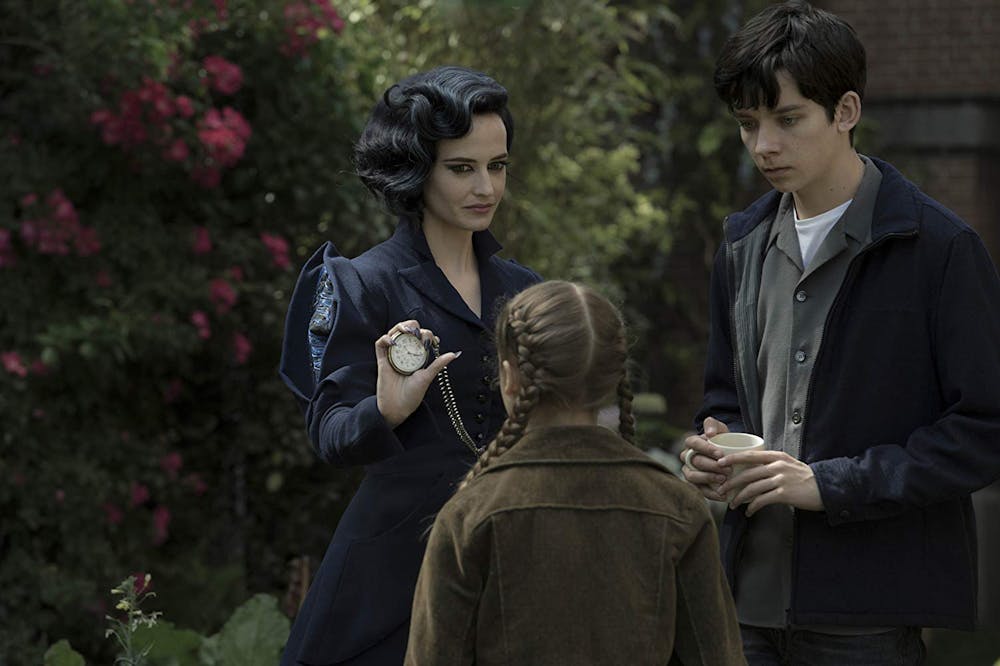
The recent proliferation of Gothic YA novels is skewed toward a female readership with a focus on girl protagonists, and significant emphasis on their quest for romance. Nevertheless, there are a number of series with boy heroes. For example, Ransom Riggs’ Miss Peregrine’s Home for Peculiar Children (the first book of which was recently filmed by director Tim Burton), focuses on a 16-year-old human boy, Jacob.
Eva Green, Asa Butterfield (Jacob) and Georgia Pemberton in Miss Peregrine’s Home for Peculiar Children (2016) Twentieth Century Fox, Chernin Entertainment, TSG Entertainment.
Jacob has inherited an ability that makes him uniquely able to help the supernatural peculiar children of the title, who are threatened by creatures named hollowgasts who are driven to murder peculiar children in order to feed upon their souls. For Jacob, his transition to adulthood is less about romance and more about self-discovery, connections with his ancestors, and finding a way to negotiate his new-found abilities and responsibilities.
In The Gothic Child, Maria Georgieva suggests that the traditional Gothic novel is preoccupied with “the growth and transformation of the child, the crisis of adolescence and the sometimes painful transition into adulthood”. She is referring to the child’s potential to grow into the hero, heroine or villain.
However, the recent surge in YA Gothic fiction takes this fascination with the darker aspects of childhood in a different direction. The girl heroine, in learning to manage the physical and emotional shifts of her development and more complex relationships in romance, can both be a threat and a saviour to others.
The fuzziness of her nature reflects both the liminal status of the teenager and new cultural understandings of the monster, who now more often resembles the typical American teen than an undead Romanian count.
Instead of contemplating a child’s potential to head towards either good or evil, recent Gothic YA acknowledges the possibility of both the good and the monstrous residing in one person.
Reading to children is beneficial in many ways. Books offer a unique opportunity for children to become familiar with new vocabularies; the type of words not often used in day-to-day conversation. Books also provide a context for developing knowledge of abstract ideas for children. When an adult reads a book to a child, they often label pictures, talk about activities in the book, solve problems together and teach them new words and concepts.
Reading to very young children can have long-lasting benefits for their later school success, not only in literacy but also in mathematics. Adding to this, early shared reading particularly helps children from disadvantaged families defy limitations associated with their socio-economic status. So, if there is only one thing you have time to do with your children, it should be reading to and with them.
Read your way to the top
Parents have long been encouraged to read more to their children. There have been many initiatives, challenges, and programs aiming to increase individual reading time and shared reading time between parents and children. These include the Australian Reading Hour Campaign, the Premier’s Reading Challenge, Let’s Read, and others.
What’s still not clear is which specific skills improve while parents read to their children, and whether the benefit of shared reading is due to other things parents do that help their children thrive at school and beyond.
That is: is it really book reading that’s beneficial or is it because parents who read more to their children also provide a lot of other resources, and engage in a range of other activities with their children?
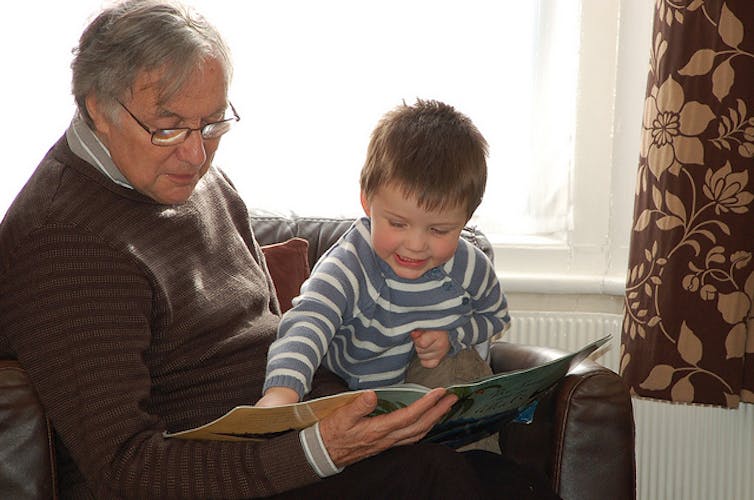
Books provide children with the opportunity for discussion and concept development. Jeremy Tarling/flickr, CC BY-SA
This was what we looked at in our study. We used data from a large scale nationwide study called the Longitudinal Study of Australian Children (LSAC). It has followed the development of 10,000 children and their families since 2004.
The sample we studied consists of 4,768 children from the cohort that was zero to one year old when the study commenced. During face-to-face interviews with trained LSAC interviewers, parents reported the frequency of them reading to their children at the age of two every week.
The LSAC then followed these children until they were four and eight years old. The good news is the majority of parents reported reading to their children at least three days a week. Specifically, 61.6% of the parents reported reading to their children every day and 21.1% of the parents read to their children between three to five days a week.
Our study showed the benefits of shared reading with children during early childhood at two to three years old is long-lasting. The more frequently parents read to their children when they were two years old, the more likely their children had better knowledge of spoken words and early academic skills such as recognising and copying geometric shapes, and writing letters, words and numbers, two years later when children were four to five years old.
What’s more, frequent early shared reading was linked to better performance in NAPLAN reading, writing, spelling and grammar. More surprisingly it was also linked to mathematics even six years later when children were eight to nine years old in year three.
Even if you only have ten minutes to read to your children, it will benefit them. Shutterstock, CC BY-SA
The most encouraging finding is that children from disadvantaged families benefited more from shared book reading. This suggests increasing the frequency of book reading is a viable way for disadvantaged families to support their children’s vocabulary knowledge and general academic achievement.
To address whether the benefits of shared reading are a product of other factors associated with parents and families, we controlled for the effect of a range of potential confounding factors. These include indicators of children’s intelligence, the number of children’s books at home, and home activities that parents engage with children other than reading. These would include drawing pictures or doing art activities with children, playing music together, playing with toys or games, and exercising together.
Even though we controlled for these other factors, the long-term importance of early shared reading still holds.
Suggestions for parents
Read more to your children and with your children. Whenever you get a chance, even if it’s only ten minutes, engage in shared reading activities.
We also suggest parents make a reading session interactive. For example, parents are encouraged to ask children questions, such as if they know the vocabulary and ask them to guess the story and what the story characters will do. Try to make the reading a learning session.
Finally, not all books are created equal. Parents are encouraged to choose the most suitable books for their child’s age to reap the most benefits of early shared reading.
I was posting a few Blogs and getting a few more ready when some bad news came through. Sadly I will be needing to take some more time away from the Blogs (immediately) – which is something completely unplanned and unexpected. This may be a lengthy break of two to three weeks. I’m afraid this is unavoidable and apologise for the time away from the Blog.
The Booker Prize has been Britain’s most influential award since its inception in 1969. Following its original mission statement of awarding a prize to “the best novel in the opinion of the judges”, the prize has created headlines and controversy over five decades, including argument over the inclusion of American authors after 2014. But it has also, and surely most importantly, rewarded writers, brought them to increasing public attention, and ensured them both critical acclaim and higher sales.
Past Booker winners are now on both school and university curricula, enriching the traditional canon of literature that all too often focuses on male, white and (upper) middle class writing that is no longer in keeping with the times. The prize has also spawned some important spin-offs, most prominently the Man Booker International Prize, first awarded in 2005 that has, over the past few years, evolved into a prize that awards both international writers and, uniquely, their translators.
In February 2017, following on from the success of previous special anniversary prizes, the Man Booker foundation launched the Golden Man Booker Prize to celebrate the prize’s 50th anniversary. Rather than having to (re)read all 51 winners, the five appointed judges – writer Robert McCrum, poet Lemn Sissay, novelist Kamila Shamsie, broadcaster and writer Simon Mayo, and poet Hollie McNish – were each allocated one decade of prize winners and tasked with identifying what they thought was the outstanding winner of those particular years. The shortlist was announced at a special event at the Hay Festival on May 26. The winner of the Golden Booker will be announced on July 8. So who’s in the running?
1970s
For Robert McCrum, the outstanding text of the 1970s winners was V S Naipaul’s In a Free State. It tells the story of two British people, Bobby and Linda, travelling across an unnamed African country in the midst of an ethnic war that suggests the Uganda of the Idi Amin years. Despite their privileged position as members of the white colonial class, Bobby and Linda come to experience firsthand the escalating violence in the country.
McCrum, in his summary of why he chose the text, explained that it was:
Outstandingly the best novel to win the Booker Prize in the 1970s, a disturbing book about displaced people at the dangerous edge of a disrupted world that could have been written yesterday, a classic for all seasons.
1980s
Lemn Sissay chose Penelope Lively’s often overlooked 1987 winner Moon Tiger, surprisingly ignoring Booker heavyweights such as Rushdie’s Midnight’s Children (1981), Thomas Keneally’s Schindler’s List (1982) or Kazuo Ishiguro’s The Remains of the Day (1989).
Moon Tiger tells the story of Claudia Hampton, who recounts her colourful life as she lies dying, covering much of the 20th century in the process. Hampton is a fascinating heroine: not quite likeable, yet immensely intriguing and fascinating, and it was this that was most remarkable for Sissay.
1990s
The 1990s novel that stood out for Shamsie was Michael Ondaatje’s The English Patient (1992). Ondaatje shared the prize with Barry Unsworth’s slave narrative Sacred Hunger – one of only two cases of a divided jury in the prize’s history. Set in Florence at the end of World War II, the novel recounts the life of a badly burnt soldier, who relives his ill-fated love affair with the married Katherine Clifton for his three companions: the spy Caravaggio, who administers morphine to the patient; his nurse Hana; and the Sikh bomb disposal expert Kip.
Ondaatje’s novel, turned into an award-winning film starring Ralph Fiennes, has always been considered one of the most high-profile winners of the award. For Shamsie, this is entirely justified: it is “that rare novel which gets under your skin and insists you return to it time and again, always yielding a new surprise or delight.”
2000s
Mayo’s outstanding winner was Hilary Mantel’s Wolf Hall of 2009, the first in a planned trilogy of Tudor novels. It charts the rise to power of Thomas Cromwell at the court of Henry VIII. Its sequel, Bring Up the Bodies, won the Man Booker Prize in 2012, making Mantel one of only three authors – alongside Peter Carey and J M Coetzee – and to date the only woman to have won the award twice.
The final instalment of the trilogy – The Mirror and the Light – is highly anticipated and scheduled for publication in 2019. What stood out for Mayo in his choice was “its questioning of what England is” – a question that is, despite the novel’s historical setting, surely pertinent in the present.
2010s
It is the most recent Man Booker Prize winner, George Saunders’ Lincoln in the Bardo of 2017, that was the most outstanding recent novel for McNish. The novel covers a single night, set in a graveyard where a grieving Abraham Lincoln mourns the death of his young son Willie. Featuring a plethora of diverse voices, Lincoln in the Bardo explores ideas of life, death and mourning in a way that, according to McNish, was simultaneously “funny, imaginative and tragic” as well as “a piece of genius in its originality of form and structure”.
Narrowing down 51 Man Booker Prize winners from five decades to a shortlist of five is a herculean task. What makes this shortlist remarkable for me is its absence of the “big” winners, the ones that are most often associated with the prize: Ishiguro, Rushdie, Keneally, Coetzee, Martell. Maybe the judges tried to steer clear of them precisely because they have had so much coverage in the past.
2018’s shortlist is very varied – historical narratives, fictional biographies, explorations of war and genocide all feature. For the judges of each decade’s “best” winner, it was a very personal decision; as it will have been for the members of the public who have voted for their favourite of the five shortlisted texts.
What do I think will happen? I’m hesitant to say … but rather than truly judging “the best” of the Booker winners, perhaps 2018’s special award will reward that novel that still manages to best capture the public mood.
Is it a coincidence that J.K. Rowling studied French and Classics? Or that Shakespeare wrote passages of dialogue in Welsh and French, suggesting that he was conversant in both? To write successfully in your first language, it can help if you know a second – it is one way of seeing the world from another perspective and making comparisons, which is after all what literature is all about. But what of writers of contemporary literary fiction?
Researchers on the Open World Research Initiative at Swansea University have investigated the nearly 300 novels that have made the Booker shortlist since 1969 to find out. And as we await the announcement of the readers’ choice of the “Golden Booker” on July 8, which will name the winning novel from the history of the Man Booker prize that has “best stood the test of time”, their initial findings throw up a disturbing recent trend that language awareness is decreasing among British-born writers.
The ability of authors to understand another language gets ignored in surveys of the Booker Prize – multiple times. If a writer’s English is inflected by Australian, South African or Canadian roots, these origins are duly noted by literary journalists. Why not language background too? Language-switchers who grew up in the former British Empire are not the only multilinguals to watch out for on the Booker shortlists. Some of their British-born counterparts also learnt a second language, which influenced their writing in similar ways: their choice of subject matter and how they expressed themselves.
The second language of writers on the shortlists is nearly always European, with French firmly in first place (more than 20 speakers among the 200 writers who have been shortlisted for the prize). German, Italian, Spanish and Russian are also well represented, as is Japanese, albeit all in single figures. There is only one identifiable Czech speaker (Tom McCarthy, nominated in 2010 and 2015) but none with Polish.
Spawn of Flaubert
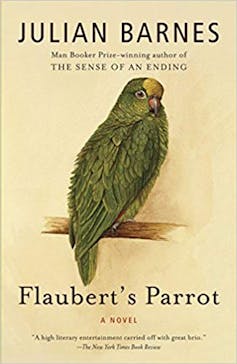
The most famous literary French speaker is probably Julian Barnes, winner in 2011 with The Sense of an Ending. His breakthrough novel Flaubert’s Parrot, which was nominated in 1984 presents a series of takes on the great French novelist assembled by a Francophile narrator. Knowing another language is after all one way to see the world from an alternative point of view. For this reason many writers cut their literary teeth, like Barnes, on foreign-language material or experiences.
The author Julian Barnes was fluent in French. Amazon
The French Lieutenant’s Woman by John Fowles should have made it to the inaugural shortlist in 1969, but it was The Magus, the original “year-abroad novel” set in Greece, which launched Fowles’ writing career. J.G. Farrell, who studied French and Spanish at university, is famous for his “empire trilogy”, Troubles (named the “lost” Booker Prize winner in 2010), The Siege of Krishnapur (winner in 1973) and The Singapore Grip (1978), but his first novel A Man from Elsewhere (1963) is set in Paris.
In his debut South (1992), the Irish writer Colm Tóibín, who has subsequently been nominated for the Booker three times, was inspired by his own encounter with Barcelona as a young man – which he transfers to a female central character who narrates some of the novel. Switching languages for an author – or anyone – can change who you are in fundamental ways. Canadian author Yann Martel won in 2002 with The Life of Pi, but his first novel Self (1996) merges gender and language identity as the multilingual narrator metamorphoses from man to woman and back again, showing that language identity is bound up with other identities and can be part of the literary imagination.
Early days
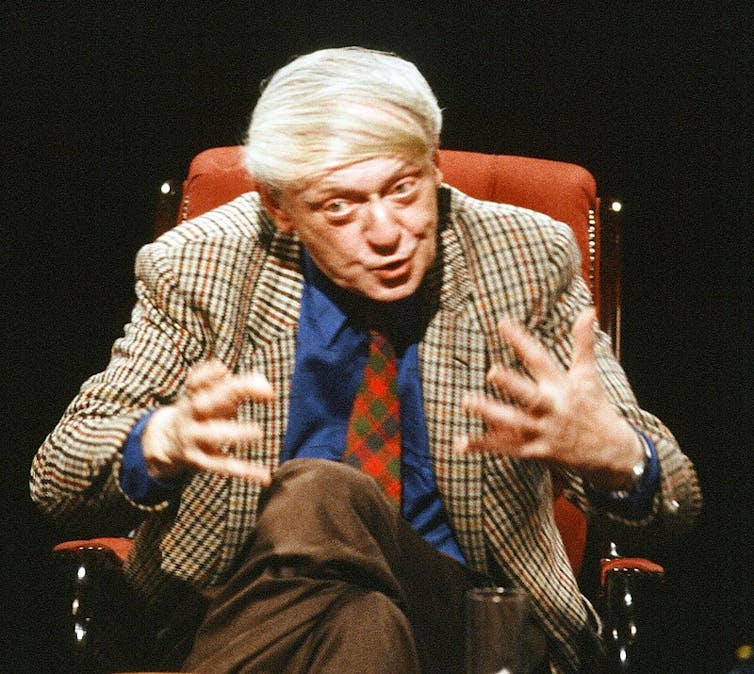
The shortlists for the Booker throw up some amazing linguists – but, at least when the British are concerned, their heyday appears to have been in the first two decades of the prize’s existence, the 1970s and 1980s. First prize for language prowess in any era would have to go to Anthony Burgess, on the shortlist in 1980 for Earthly Powers, who invented a new language for the dystopian Clockwork Orange and read and spoke up to ten real ones.
The multilingual Anthony Burgess. Open Media Ltd, CC BY-SA
Burgess was born in 1917, a year after Penelope Fitzgerald, who won the in 1979 for the evocatively entitled Offshore. Three other novels are set in Italy (Innocence, 1986), Russia (The Beginning of Spring, 1988), and Germany (The Blue Flower, 1995), each written as if by a native speaker, except of course in English.
Jewish emigrés were a further force for the internationalisation of British fiction. Sybil Bedford (1911-2006) found herself on the shortlist at the age of 78 with Jigsaw in 1989. Ruth Prawer Jhabvala (1927-2013), who moved to India after the war, where her early fiction is set, won the Booker with Heat and Dust in 1975.
The Cold War also produced some high-profile language learners. Michael Frayn – who was shortlisted in 1999 for Headlong – was taught Russian during his national service, as was DM Thomas, whose White Hotel ran Midnight’s Children a close race for the prize in 1981. Thomas translates Russian poetry and has written a biography of Solzhenitsyn. Frayn’s novels include The Russian Interpreter (1966) – and his play Democracy (2003) was about the fall of Willy Brandt.
Their close contemporary John le Carré was recruited to the secret service on the basis of speaking fluent German, which he learned after running away to Switzerland as a teenager. He has called German his “muse”. But, sadly, genre fiction is not Booker material – and, in any case, le Carré is not keen on literary awards.
The young generation
But what of younger novelists, say those shortlisted since the turn of the millennium? If we limit the field to British writers, then it is getting narrower. Graeme Macrae Burnet made the shortlist in 2016 with His Bloody Project. The Accident on the A35 from 2017 is very much a linguists’ novel about translation and transcription, as is Men in Space – the 2007 novel by the twice-nominated Tom McCarthy which is set in Prague and includes a series of jokes on interlingual miscommunication. Both authors are still under 50.
Philip Hensher, nominated in 2008 for The Northern Clemency, is reticent about his proficiency in German, which came to the fore in his 1998 novel Pleasured which is about the fall of the Berlin wall. Simon Mawer, nominated in 2009 for The Glass Room, lives in Italy. That is more or less it.
People who visit the UK are sometimes struck by how few books are translated into the world’s lingua franca which in all its global variants can seem sufficient to itself. As a culture English monolinguals risk missing out on how near neighbours are representing their experiences to themselves and each other.
Translation takes many forms, however, and mother-tongue English novelists could make up the gap by getting abroad, whether in person or through books, as previous generations were doing up to quite recently.
Guy Pearce as the Chandleresque private investigator Jack Irish: in the early years of Australian crime fiction, convicts and bushrangers featured prominently. Lachlan Moore
Most countries produce crime fiction, but the versions vary according to national self-concepts. America admires the assertive private eye, both Dashiell Hammett’s late 1920s Sam Spade and the nearly as tough modern feminists, such as Sara Paretsky. Britain prefers calm mystery-solvers, amateurs like Hercule Poirot or Lord Peter Wimsey or sensitive police like Ian Rankin’s Edinburgh-based John Rebus. The French seem to favour semi-professionals who are distinctly dissenting – in 1943 Léo Malet’s Nestor Burma stood up to Nazi occupiers nearly as overtly as to Paris criminals.
Australia’s rich and varied tradition of crime fiction and detectives, though little-known and more rarely described, reveals a range of national myths, fantasies, and even elements of truth-telling about a country whose origin lay in convictions for crime.
The first Australian crime novel appeared in 1818, but production has been uneven. Most mysteries have been published here in the period since 1980, with substantial local publicity and reviewing. Before then, locally-written and Australia-set mysteries usually arrived from England, asserting colonial authority, and then banning American publishers through an “International Market Agreement”.
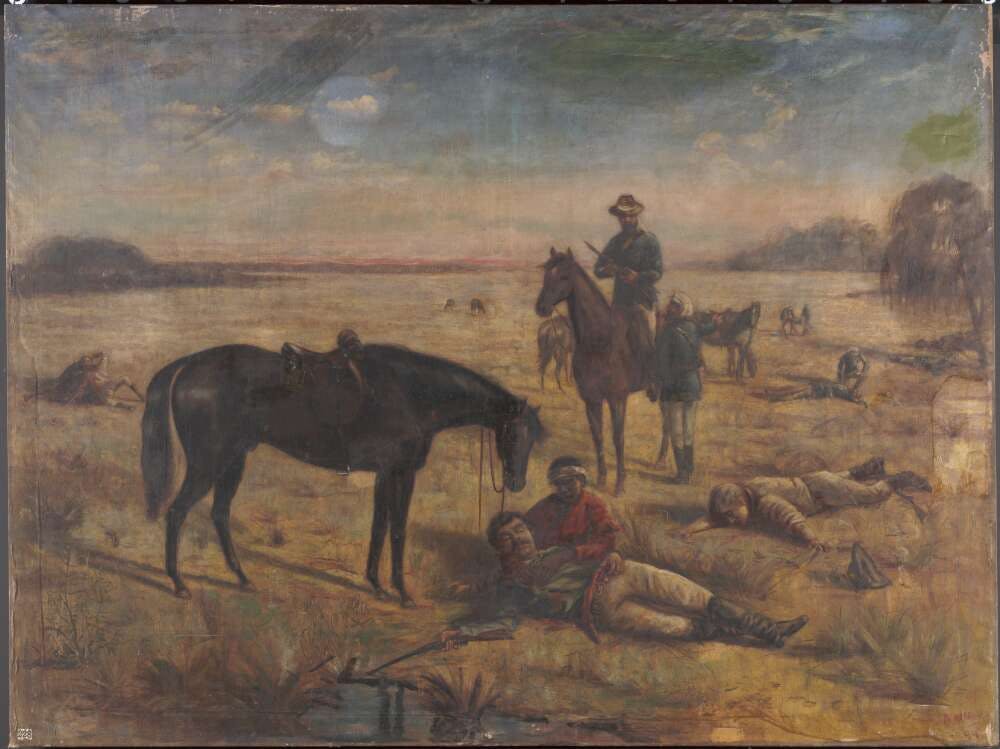
Death of Captain Starlight with his head in Warrigal’s lap, by Patrick William Marony (1858-1939). Australia’s first crime novel was about a bushranger. Wikimedia Commons
Writers sent manuscripts off to London, and a hundred or so hardbacks would arrive for local libraries, with almost no publicity and little impetus to develop the form here. But things changed with an American challenge to the “Agreement” in 1976 and the waning influence of Britain in general. In 1980 Peter Corris’s The Dying Trade began a flow of local productions – some from English firms now based here, like Allen and Unwin, who produced Jennifer Rowe with their Tolkien earnings.
Back at the start, transportation was a natural subject: in the first book of all, Thomas Wells’ Michael Howe, The Last and Worst of the Tasmanian Bushrangers (1818), Howe is a real escaped convict turned bushranger, with fictionally exaggerated adventures. Another theme was the wrongfully-convicted man like Quintus Servinton (1831) by Henry Savery.
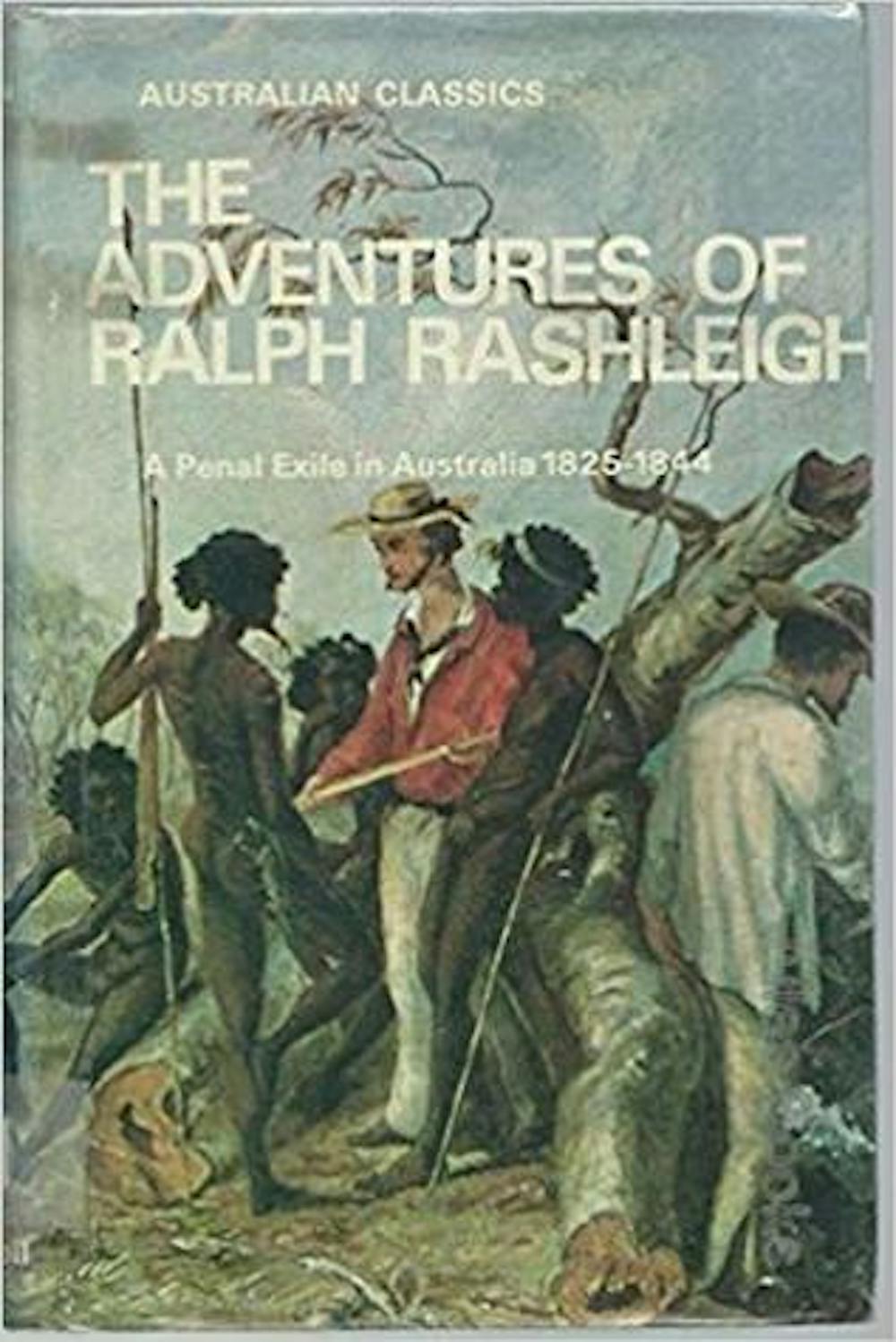
The strongest convict novel is The Adventures of Ralph Rashleigh: he experiences harsh imprisonment, then escapes to live with bushrangers, and then mostly genial Indigenes: written in 1845, probably by ex-convict James Tucker, the novel was not published for over 80 years.
Criminal threats to free settlers were central to Tales of the Colonies (1843) by Charles Rowcroft: an immigrant Tasmanian family encounters the exciting land and its fauna but also bushrangers and the historical and rather noble Indigenous leader Musquito.
In Alexander Harris’s The Emigrant Family (1849) English incomers meet a vigorous native-born family as well as a range of trouble-makers. The settler thriller moved up to squatter level in Henry Kingsley’s rambling The Recollections of Geoffry Hamlyn (1859), which offers “every known cliché of Australian life” according to Arcady in Australia: The Evocation of Australia in 19th Century English Literature, an excellent critical book by Coral Lansbury – mother of Malcolm Turnbull.
Author provided
Crime fiction illuminated the 1850s goldfields experience, mostly through short stories in the Australian Journal featuring police detectives known as “mounted troopers”, who controlled theft and crime of all kinds: they and the miners generated an early form of mateship.
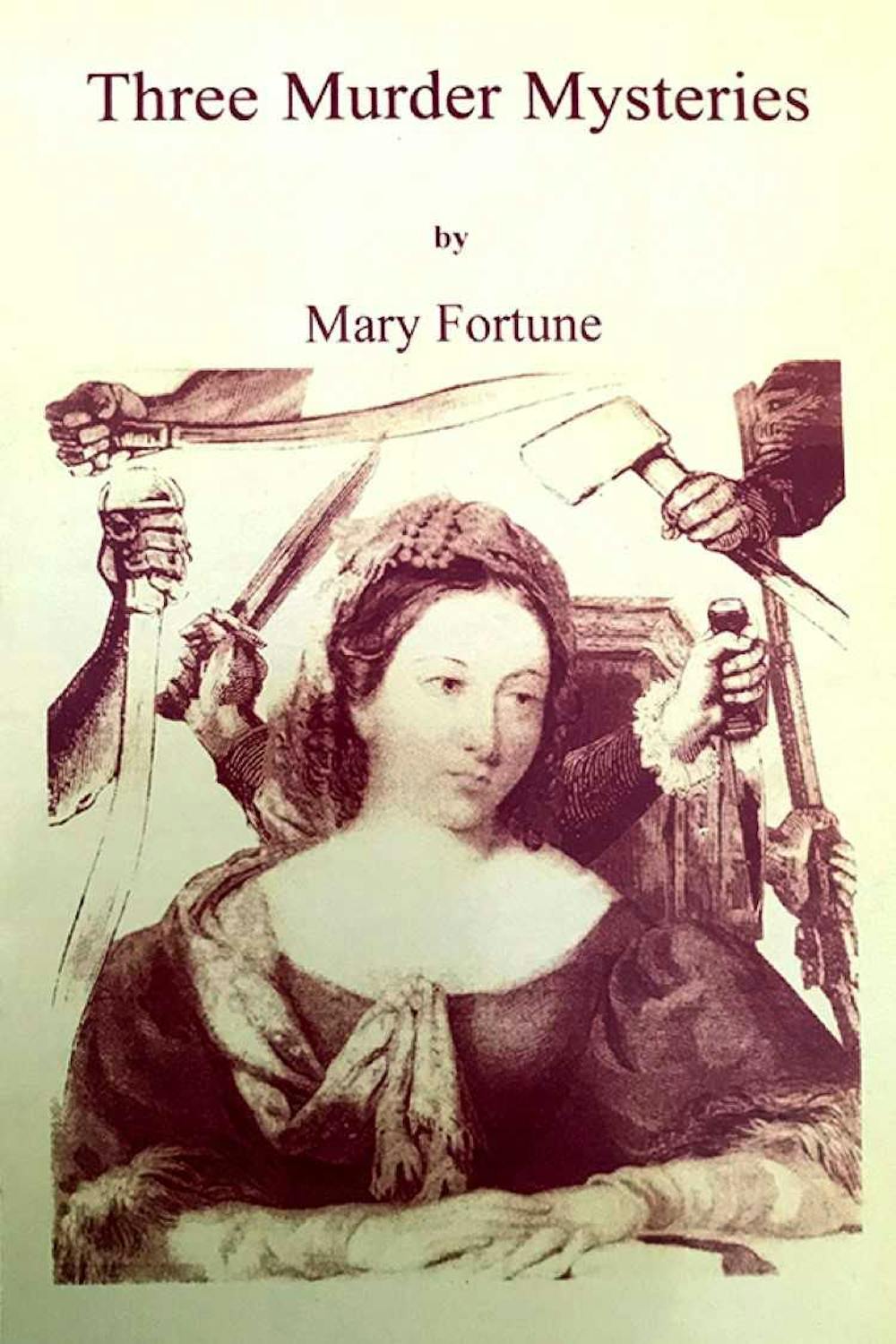
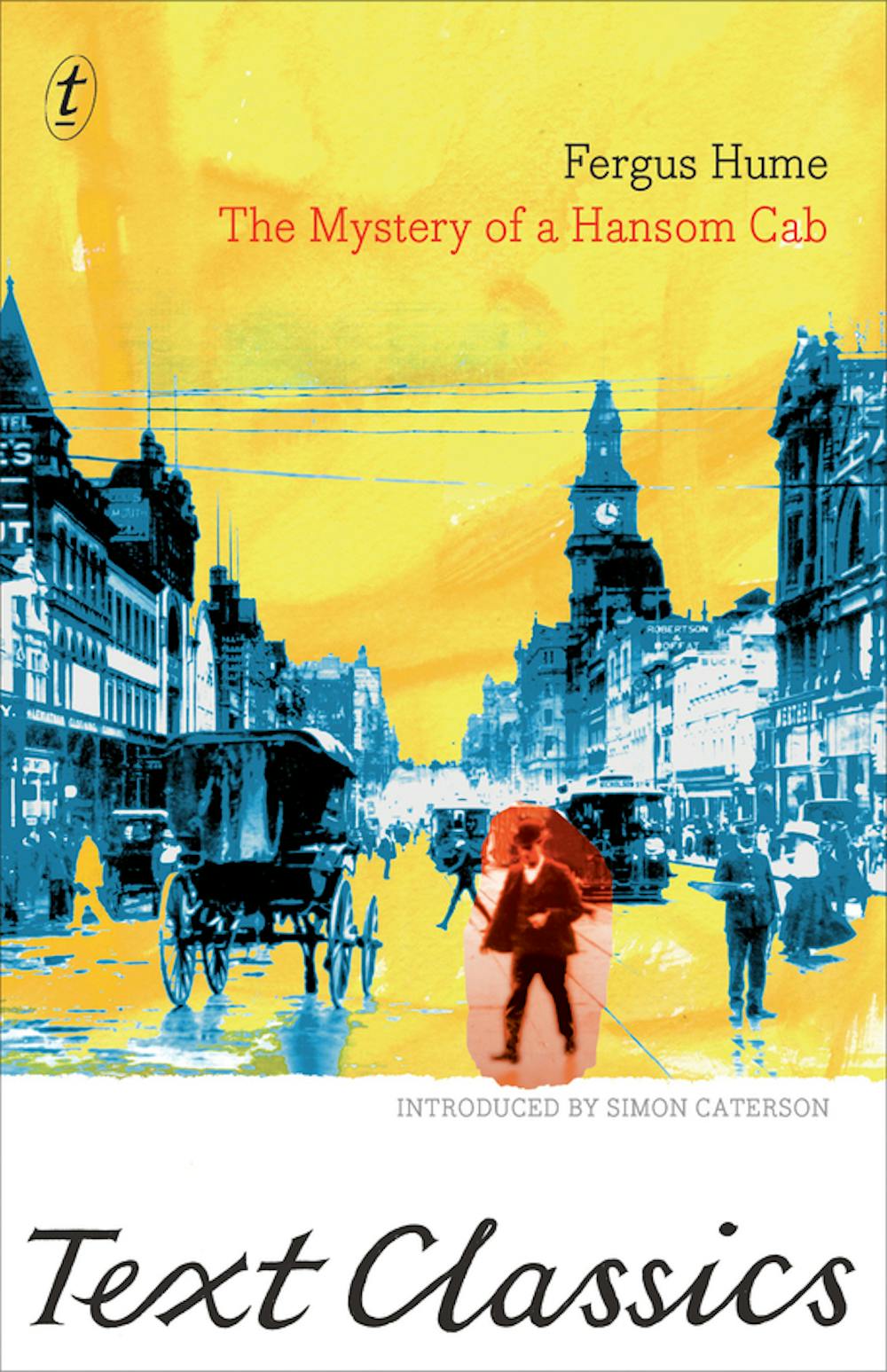
The most prolific author was Mary Fortune who, Lucy Sussex’s research has shown, wrote hundreds of crime stories to the end of the century, and has begun to be re-published. The new gold-rich urban Australia was explored, especially when Donald Cameron produced the intriguing, and almost totally forgotten, The Mysteries of Melbourne Life (1873), followed by Fergus Hume’s highly readable The Mystery of a Hansom Cab (1886): Melbourne-set and published, it then became in London the first best-seller in world crime fiction.
There had been retrospective fictions that essentially criticised the harsh convict colony and ennobled the transportees. The Broad Arrow (1859) by “Oliné Keese” (English visitor Caroline Leakey) is about a brave, true woman convict; His Natural Life by England-born Marcus Clarke offers a long, well-researched story of a maltreated, wrongly-convicted man, appearing first as a serial in the Australian Journal.
In that version he finally escapes from Norfolk Island, becomes a successful goldfields shopkeeper, and eventually returns wealthy to his much-diminished English family. But when it became a book Clarke was persuaded to drop the optimistic “Aussie-success” ending for popular novel melodrama: the escaping hero drowns tragically, and the title becomes the unironic For the Term of His Natural Life.
A more romantic and now fully Australian account of past crime and redemption was the very popular Robbery Under Arms (1881-2) by “Rolf Boldrewood”. The bushranger-turned-convict is no Anglo hero but a tough native Australian: he and his patient girlfriend end up as successful rural property-owners. So crime fiction developed a positive patriotic approach which would soon mesh with the bush myth asserted by popular writers like Lawson and Paterson – also fictional, as the cities grew.
Author provided
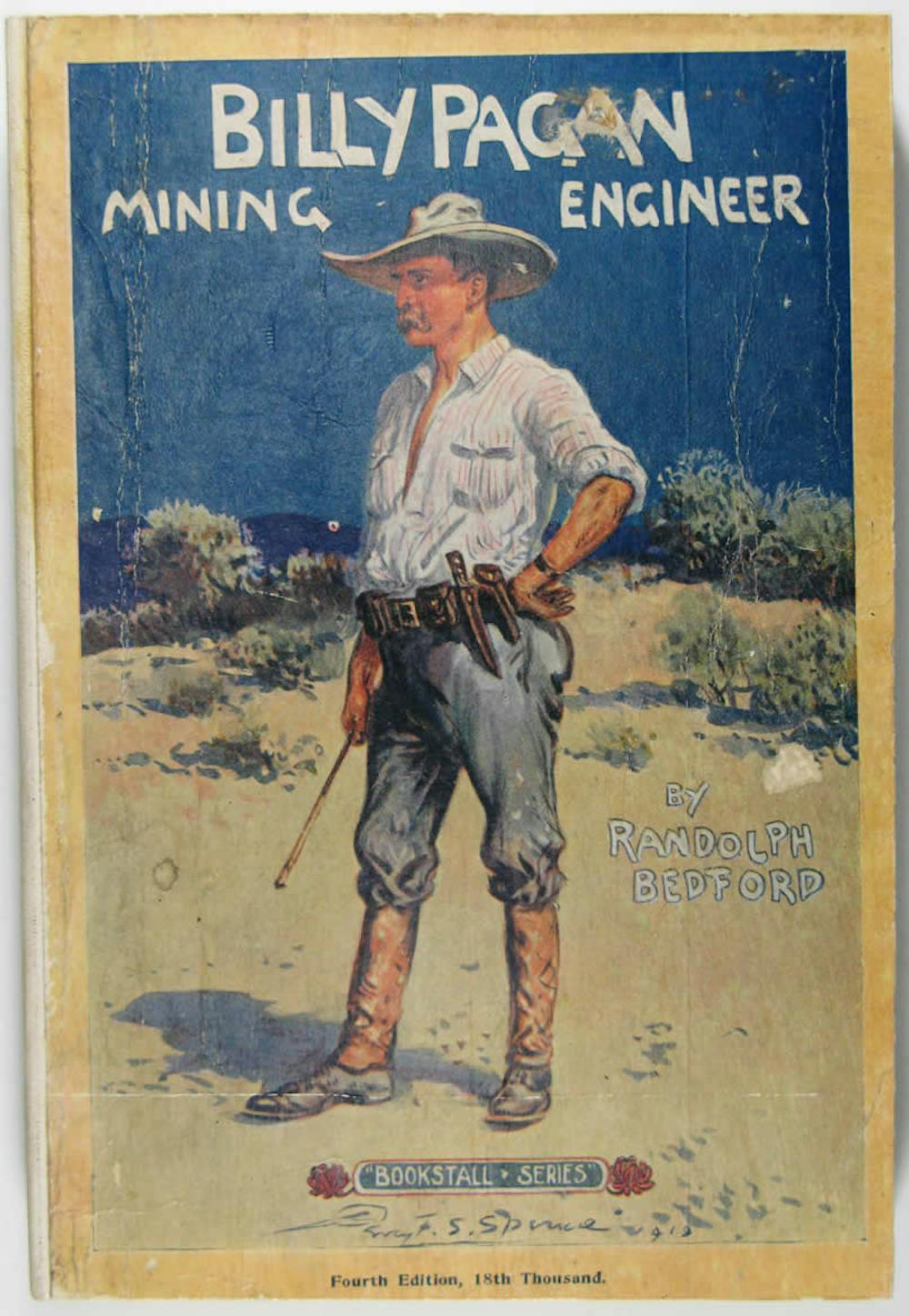
In the late 19th century there were predictable urban mysteries and better rural dramas by writers like Rosa Praed and Mary Gaunt, as well as the distinctly Australian sporting thriller, notably those set at the races by Nat Gould, and also bold roving amateur detectors such as Randolph Bedford’s Billy Pagan, Mining Engineer (1911).
But national mythic features could also be negative: notably absent have been police – while they were familiar overseas, here the memory of transportation limited them to Fortune’s people-friendly troopers, well-separated from convictism.
Equally lacking was any serious treatment of Indigenous people: they only appeared as lurking threats or helpful trackers, except in Arthur Vogan’s The Black Police (1890) in which an England-born New Zealander, who had taken a job in outback Queensland, told a bleak story about the racism he found there.
Between the wars, London publishers continued their dominance and there appeared two striking responses from local crime writers. Their novels can have “zero-setting”: though occurring in Australia they offer almost no local detail at all. Or they can be the opposite, “touristic” crime fiction, all bush and kangaroos, with the villain often consumed by the land itself in fire or flood.
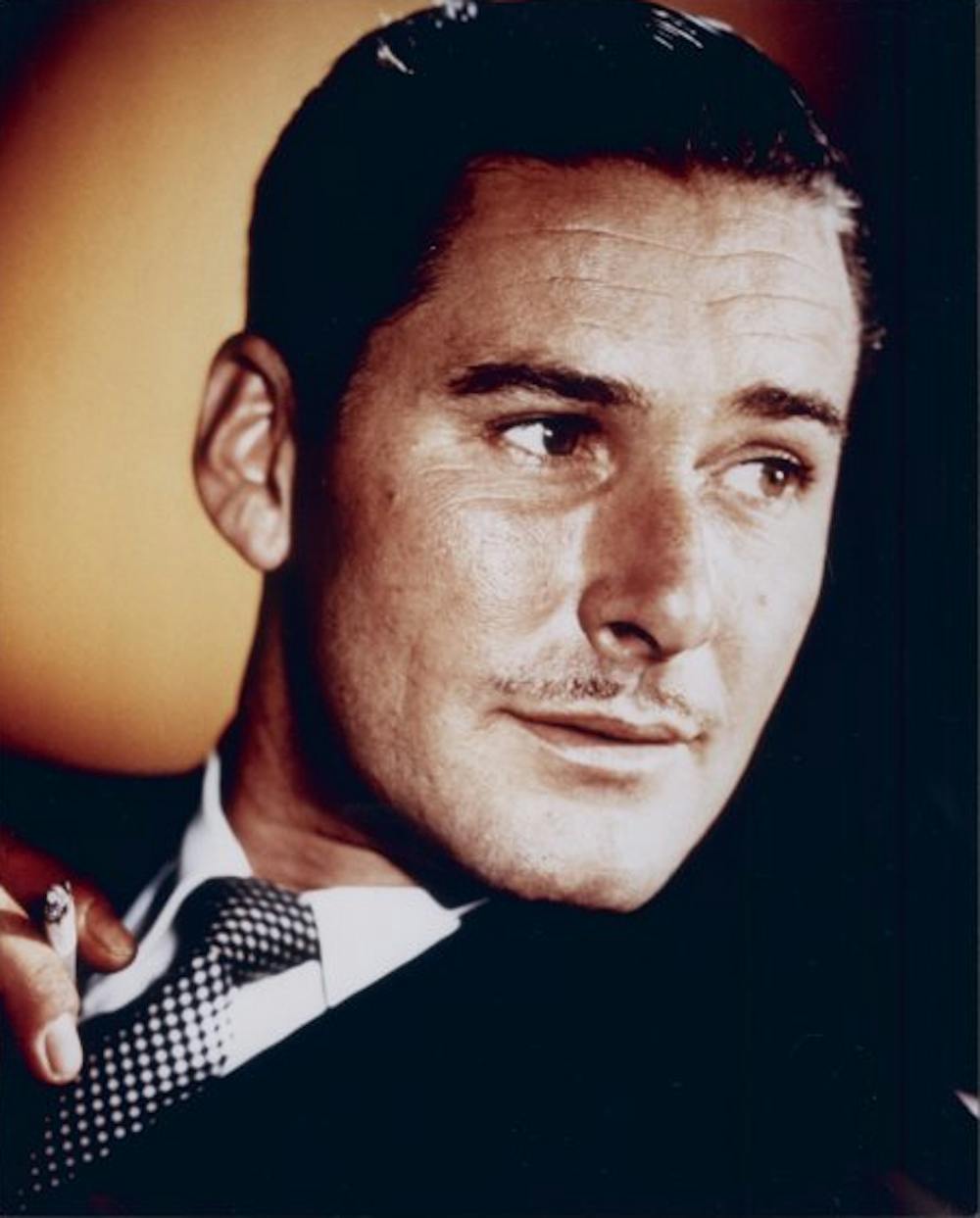
Errol Flynn, circa 1940: his thriller Showdown is very capable. Wikimedia Commons
The success of Arthur Upfield’s long series of “Bony” mysteries was not primarily based on his intelligent half-Indigenous detective but, including for overseas readers, came from the many grand outback landscapes that are so well described, to which Bony relates so strongly.
At the same time, interest developed in the formerly minor “crime novel”, the name for a story without detection and tending to sympathise with the criminal – an Adelaide-set series came from Arthur Gask. Classical mysteries were often set in the northern islands, as by Beatrice Grimshaw and Paul Maguire and, amazingly, the Hollywood actor and Tasmanian journalist, Errol Flynn, whose Showdown (1946) is a very capable thriller.
Successful women
In the 1930s Jean Spender, adopting the English style, deployed an under-heroic police detective and she was followed post-war by other successful women. June Wright’s restrained policemen usually marry the young Melbourne lady amateur detective, but she also created a fine nun-detective, Mother Paul. Sydney-based Pat Flower, from Hell for Heather (1962) on, produced a sequence of psychothrillers as potent as those by international stars such as Patricia Highsmith or Barbara Vine (the pseudonym of Ruth Rendell).
Effective post-war male crime writers existed, such as Sidney Courtier and A. E. Martin, but they too were mostly England-published and little noticed or remembered. The American private eye had a brief presence in and after World War II, with many Americans in the country and English book imports rare: both US-based and local tough-guys thrived like those by the ultra-prolific “Carter Brown” (Alan G. Yates).
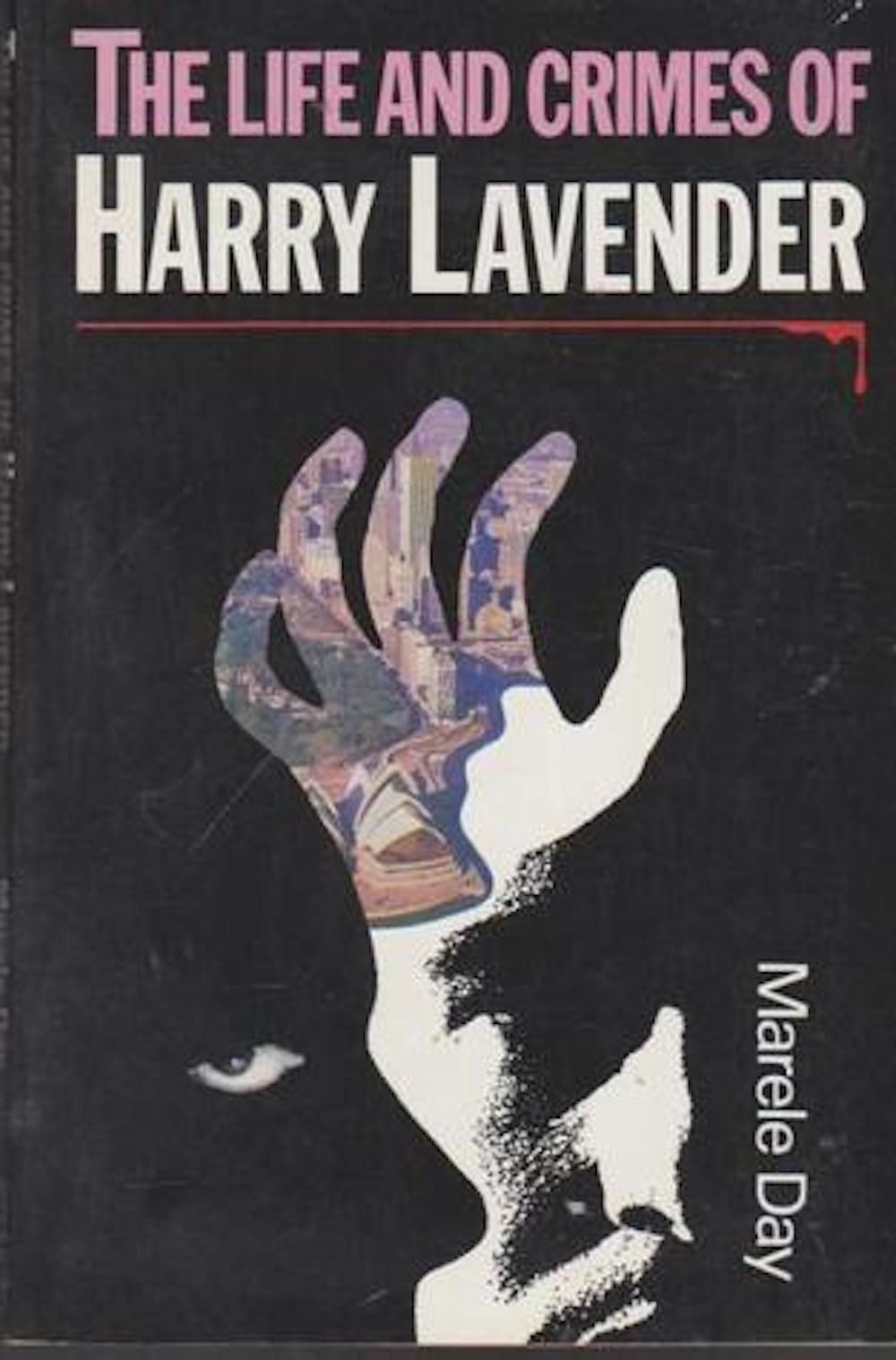
They faded, but the form would return when, feeling abandoned by Britain and looking more across the Pacific, readers were offered their own version of the American mode. The Dying Trade (1980), published in Sydney, with full local publicity, featured a truly Aussie tough guy, Cliff Hardy, and the author, Peter Corris, academic and journalist, stimulated more Sydney-based detectives, Marele Day’s elegant feminist Claudia Valentine, glamorous lesbian cop Carol Ashton by Claire McNab, and the thoughtful English-style amateur Verity “Birdie” Birdwood from publisher Jennifer Rowe. Now local readers could enjoy a wealth of their own national crime fiction, newly embodying many forms of contemporary conviction.
Melbourne soon followed with Shane Maloney’s wry amateur inquirer Murray Whelan and Peter Temple’s Chandleresque private investigator Jack Irish, so well realised on television by Guy Pearce.
The crime novel continued through Garry Disher and his genuinely tough Wyatt, while the psychothriller and other sub-genres flourished, especially from the ever-productive Gabrielle Lord. Finally, major male writers started to employ police – Disher by 1995 with Inspector Challis in The Dragon Man and Peter Temple’s very successful The Broken Shore (2005) introduced injured cop Joe Cashin.
Modern retrospection arose from Australian acceptance of the innovative mode of historical crime fiction pioneered by Umberto Eco in The Name of the Rose (1980). Melbourne led with Kerry Greenwood’s glamorous 1920s investigator Lady Phryne Fisher in Cocaine Blues (1989); later Marshall Browne offered a turn-of-the century Melbourne thriller series.
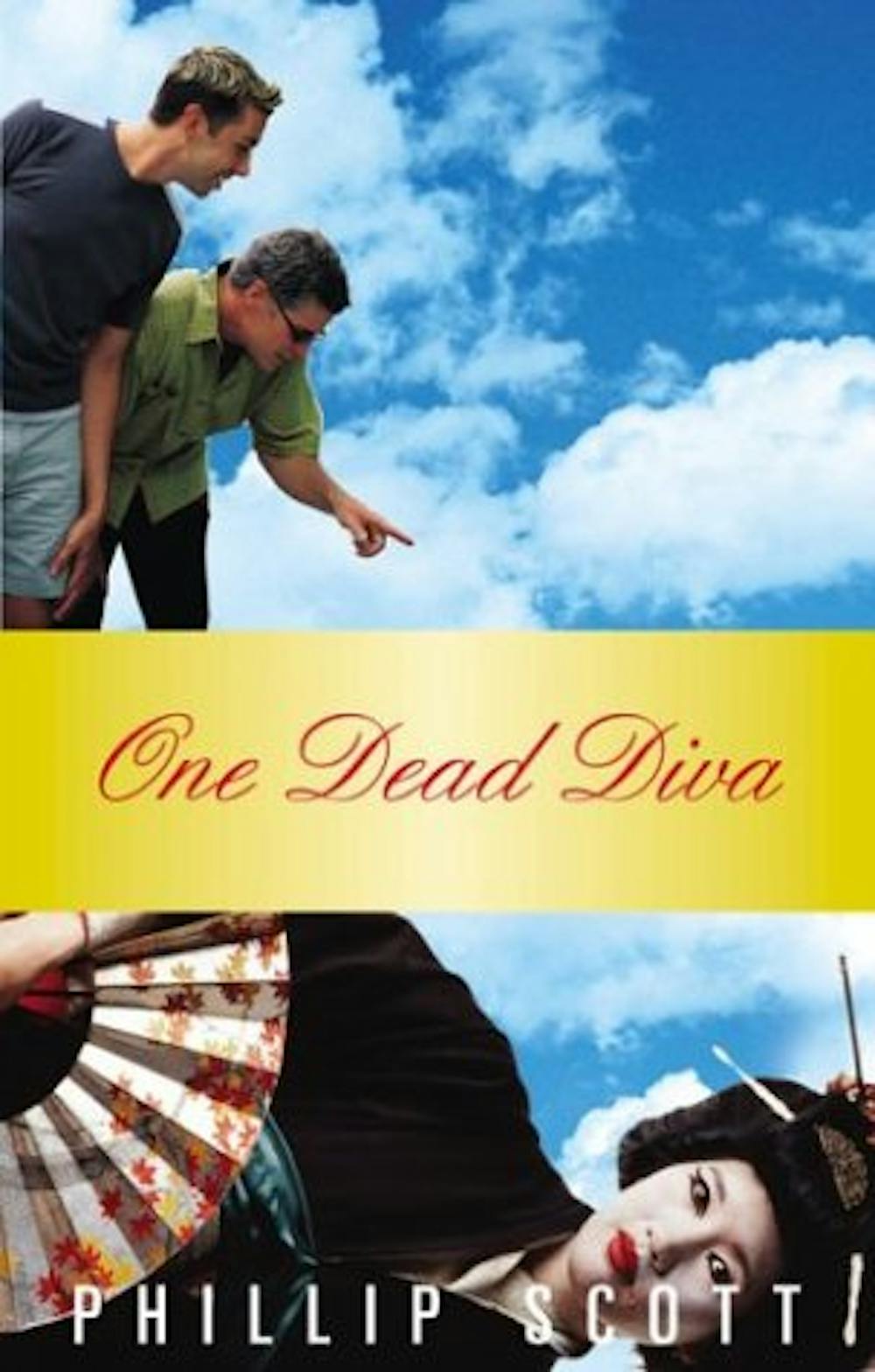
International gay crime fiction arrived: Claire McNab handled the female side forcefully, while for the men Adelaide’s notorious Duncan drowning was reworked in Roger Raftery’s The Pink Triangle (1981) and Phillip Scott’s amusing opera-related series started with One Dead Diva (1995).
Indigenous crime fiction writers also appeared. Mudrooroo Narogin produced, then as Colin Johnson, Wild Cat Falling (1965), a potent crime novel about a Perth teenager; later crime stories featured his Detective-Inspector Watson Holmes Jackamara, a figure both ironic and revealing. Archie Weller wrote a strong crime novel The Day of the Dog (1981) and tough short stories; Philip McLaren’s major novel Scream Black Murder (1995) has Indigenous police detectives, male and female, facing both public and personal challenges in Sydney’s Redfern.
Since 2000 Australian crime fiction has strengthened further, mostly with new voices. Day, Rowe and McNab all put an early end to their series and in 2017 Corris has called it a day – Cliff is smiling as the story finishes. Temple’s darkest novel, Truth, won the Miles Franklin national prize in 2010, but his recent death has saddened readers.
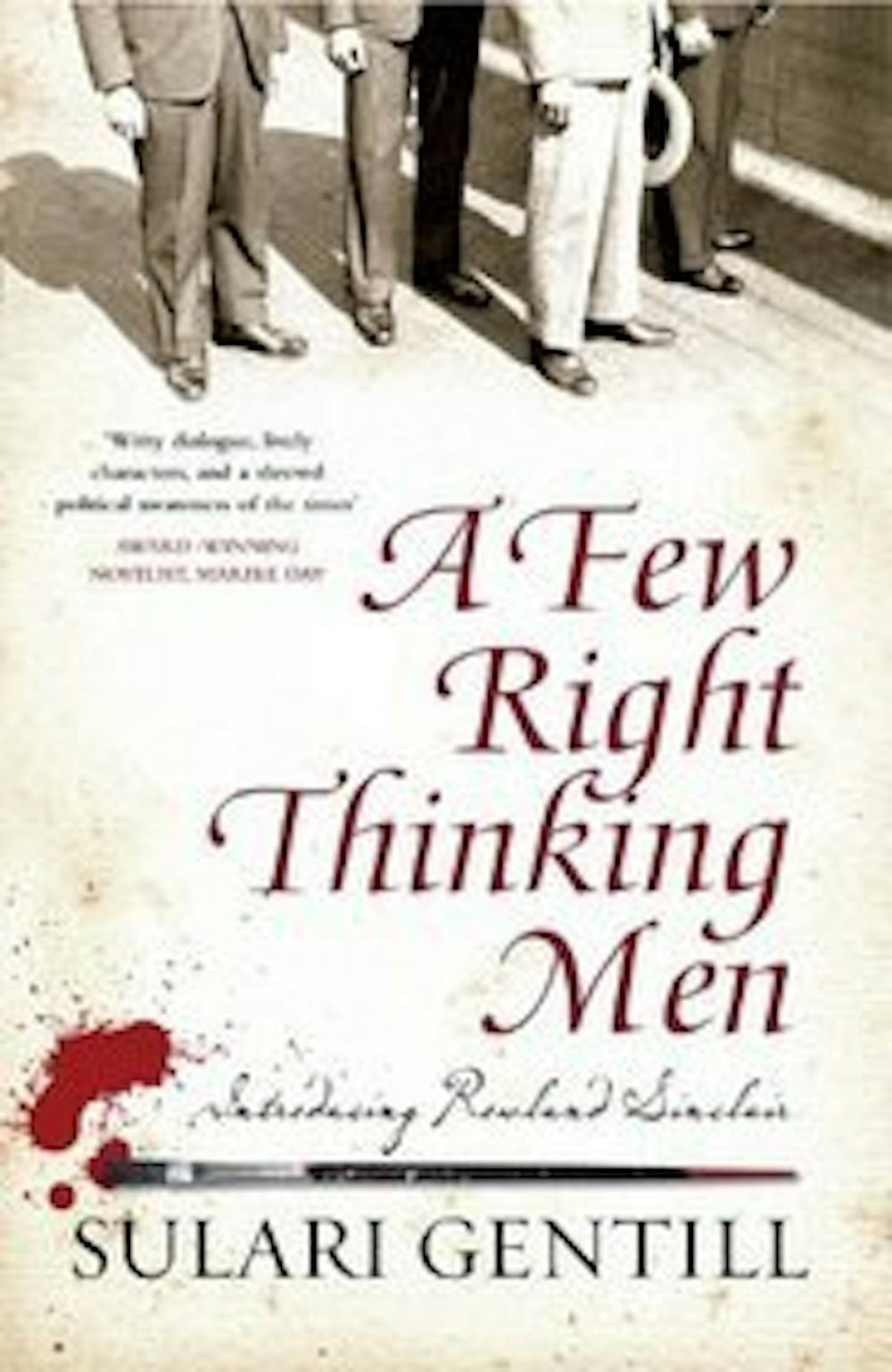
Historicism has continued. Sulari Gentill explores the politics of the 1930s in her Rowland Sinclair series, and Lady Phryne has re-appeared, but Greenwood now also turns to the “cozy” tradition with large detecting chef Corinna Chapman. Police presence has grown, with notably realistic treatments by former female officers, P.M. Newton, Karen M. Davis and Y.A. Erskine; and there are others, like Leigh Giarratano’s subtle detective Jill Jackson and Felicity Young’s Senior Sergeant Stevie Hooper, tall, brave and based in Perth, like several other modern investigators, including Alan Carter’s “Cato” Kwong, a police detective from a long-present Chinese family.
Australian women crime writers are now in a clear majority, and they also offer private eyes: Gabrielle Lord has a series about Gemma Lincoln, and Angela Savage’s well-developed Thailand-based novels feature Jayne Keeney. The psychothriller remains vigorous: journalist Caroline Overington produced the intriguing Ghost Child (2009), while Honey Brown offers deeply imaginative stories like Red Queen (2009).
The crime novel thrives among male writers — Disher’s man re-asserted his presence in Wyatt (2010) and Andrew Nette produced the both local and international Gunshine State (2016); the comic crime novel emerged in Robert G. Barrett’s series about the idiotic bogan Les Norton. Other traditions continue: Tara Moss keeps feminism alive in her Mak Vanderwall series, while Nicole Watson’s The Boundary (2011) is a powerful Brisbane-based, Indigenous-oriented narrative.
Unique features appear in Australian crime fiction, and not just the five different authors who focus their mysteries on the Melbourne Cup. More notable are Leigh Redhead’s series about Simone Kirsch, the stripper-detective, starting with Peepshow (2004), revealing in several ways, and the two fascinating poem-based mysteries by the sadly late Dorothy Porter: The Monkey’s Mask (1994) and El Dorado (2007).
Such brilliant exotics, and the richness of the tradition as a whole, show how far Australian crime fiction has come from convicts and bushrangers, without losing its continuing relationship with changing national concerns and the social and personal myths it can both test and validate.
“The battle to feed all of humanity is over,” Stanford biologist and ecologist Paul Erhlich declared on the first page of his 1968 best-seller, “The Population Bomb.” Because the “stork had passed the plow,” he predicted, “hundreds of millions of people are going to starve to death.”
Ehrlich’s book identified dramatically accelerating world population growth as the central underlying cause of myriad problems, from a food crisis in India to the Vietnam War to smog and urban riots in the United States. It sold more than 2 million copies and went through 20 reprints by 1971. Ehrlich appeared more than 20 times on NBC’s “The Tonight Show Starring Johnny Carson”, and became the first president of Zero Population Growth, a Washington D.C.–based advocacy organization, while remaining a professor at Stanford.
“The Population Bomb” created more space to hold radical views on population matters, but its impact was fleeting, and maybe even harmful to the population movement. By the early 1970s, many critics were savaging Ehrlich and the larger goal of achieving zero population growth. And the politics of “morning in America” in the 1980s successfully marginalized Erhlich as a doomsdayer.
However, as a historian who has studied debates about population growth throughout U.S. history, I believe that Ehrlich’s warnings deserve a new and less hysterical hearing. While Ehrlich has acknowledged significant errors, he was correct that lowering birth rates was – and remains – a crucial plank in addressing global environmental crises.
Ehrlich drew on nearly 200 years of thinking inspired by British pastor and political economist Robert Thomas Malthus. In his 1798 study, “An Essay on the Principle of Population,” Malthus famously predicted that “geometric” population growth would overwhelm “arithmetic” gains in agricultural production, leading to wars, famines and societal collapse.
Fears of the potentially dangerous social and ecological effects of population growth intensified after World War II. Global population surged as public health improved greatly in developing nations, increasing life expectancy. At the same time, the new science of ecology demonstrated the fragility of Earth’s interconnected systems. And the Cold War promoted worries that population-induced poverty would breed communism.
Mainstream advocates of arresting population growth emphasized better access to family planning and education, but Ehrlich had no use for such baby steps. “Well-spaced children will starve, vaporize in thermonuclear war, or die of plague just as well as unplanned children,” he wrote.
It took 200,000 years for Earth’s human population to reach 1 billion – and only 200 years to reach 7 billion. But growth has begun slowing as fertility rates decline.
Technological optimists pointed to the “Green Revolution” in agriculture, which had vastly increased crop yields up until the late 1960s. But Erhlich, echoing a growing chorus of farmers and agricultural scientists, warned that pesticides ruined the environment and would eventually backfire as weeds and pests developed resistance.
Erhlich never called population the only variable. With physicist John Holdren, he proposed the I = P x A x T formula, which describes human impact as the product of population, affluence (the effects of consumption) and technology.
Nonetheless, Ehrlich believed that population was the key multiplier and massive reductions in global population were critical for human survival. He hoped that a combination of policy carrots and sticks would reduce fertility sufficiently and preserve voluntary family planning. But he held out the possibility that coercive measures, including compulsory sterilizations, might be needed.
Backlash and a new population politics
Millions of Americans shared Ehrlich’s anxieties in 1968. Concerns about the ecological impact of global population growth had helped birth modern American environmentalism. Feminists cited overpopulation to buttress the case for reproductive and abortion rights. Politicians on both sides of the aisle urged action to lower birth rates, and Republican President Richard Nixon signed into law a Commission on Population Growth and the American Future.
But the “culture wars” of the 1970s subsumed and reconfigured population issues. On the right, the “pro-life” movement that crystallized in the wake of the Supreme Court’s 1973 Roe v. Wade decision considered any talk of population reduction anathema.
China’s one-child policy, launched around 1980, led to serious human rights abuses that allowed anti–family planning conservatives to paint all population programs in a negative light. Conservatives subsequently ignored China’s significant reforms to the policy, as well as research indicating that slowing population growth contributed to China’s economic miracle.
Moreover, newly ascendant anti-Keynesian economists rejected an older consensus that slowing population growth would yield economic benefits. These market-oriented economists asserted that denser populations created economies of scale, and that individual fertility decisions would adjust to any temporary population problems. President Ronald Reagan, who once had dabbled with Malthusianism, tellingly labeled advocates who worried about scarce resources “Doomsday prophets.”
As nations develop economically, couples have fewer children and fertility rates decline. CC BY-ND
After Congress eliminated national-origin immigration quotas in 1965, immigration rose steadily and accounted for a growing share of population growth in the U.S. In this context, white liberals increasingly risked being branded racist for supporting population reduction.
By the late 1970s, both liberals and conservatives had bought into exaggerated talk of an “aging crisis” – too few workers to pay for the bulge of baby boomers headed toward retirement. This perspective bolstered calls for higher birth rates and further reduced the sting of the overpopulation critique.
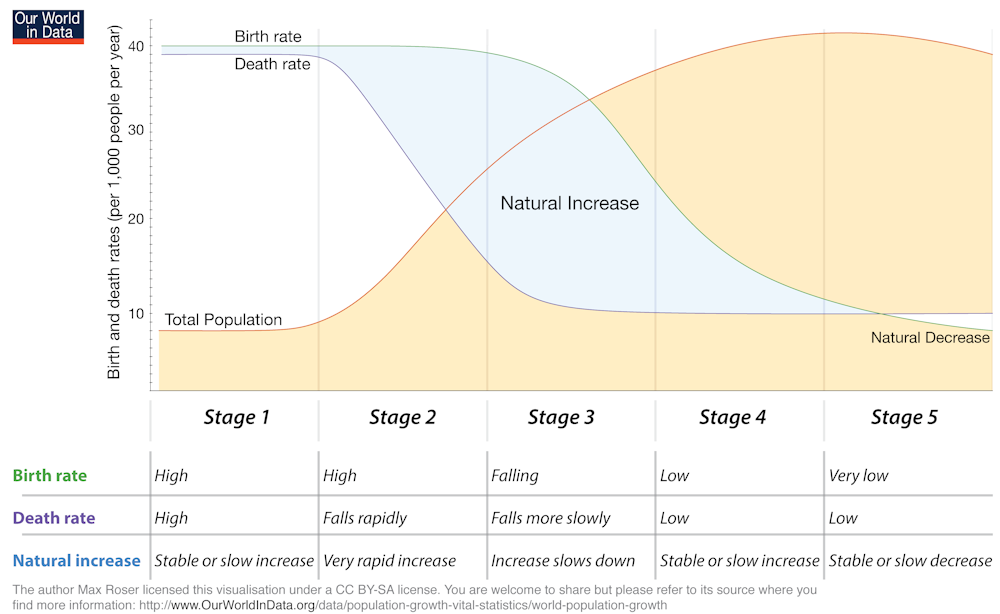
Looking back with the benefit of time, it’s clear Ehrlich was wrong to view population as all-encompassing. In addition, the global total fertility rate has declined more than he anticipated – although the development and modernization that has helped lower birth rates, a process known as the demographic transition, comes at great environmental cost.
The demographic transition is a pattern in which countries tend to transition from high birth and death rates to lower birth and death rates as they industrialize. Max Roser, CC BY-SA
Human-driven climate change is an overriding threat, and is unambiguously worsened by population growth. The Intergovernmental Panel on Climate Change estimates that limiting warming in this century to 3.6 degrees Fahrenheit (2 degrees Celsius) would require cutting global greenhouse gas emissions 40 to 70 percent by 2050 and nearly eliminating them by 2100. “Globally, economic and population growth continue to be the most important drivers of increases in CO2 emissions from fossil fuel combustion,” the panel observes.
There lies an enduring flaw in Ehrlich’s approach. If impact equals people times affluence times technology, then reducing population alone is not sufficient to solve our ecological crises. But reducing affluence is neither possible nor desirable, since it would condemn millions to lifelong poverty. Ultimately, “The Population Bomb” offered no road map for transitioning away from capitalism without causing human ruin as serious as the environmental ruin that seems to be our destiny.



 So, next time you pick up a book, reflect for a while on your reasons for doing so. And think about whether, when you’re tired or stressed out or indeed more seriously unwell, you find forms of solace, healing, or inspiration in the apparently simple black marks on a white background.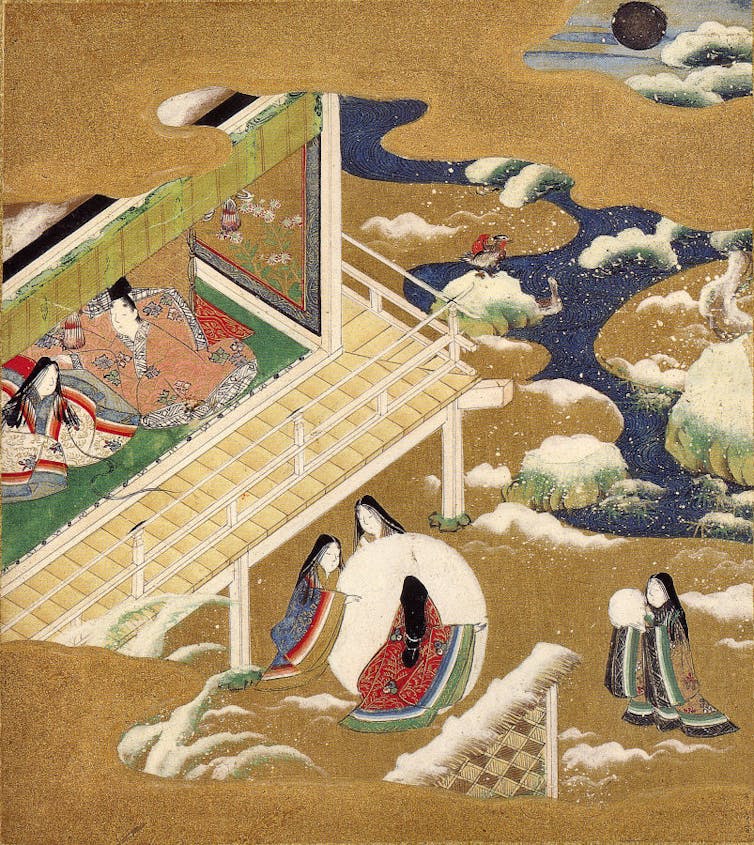

 These examples are just a taste of the vast subject matter and textual richness that The Tale of Genji offers readers. Adaptations, parodies and sequels have seen the tale reimagined into

 Instead of contemplating a child’s potential to head towards either good or evil, recent Gothic YA acknowledges the possibility of both the good and the monstrous residing in one person.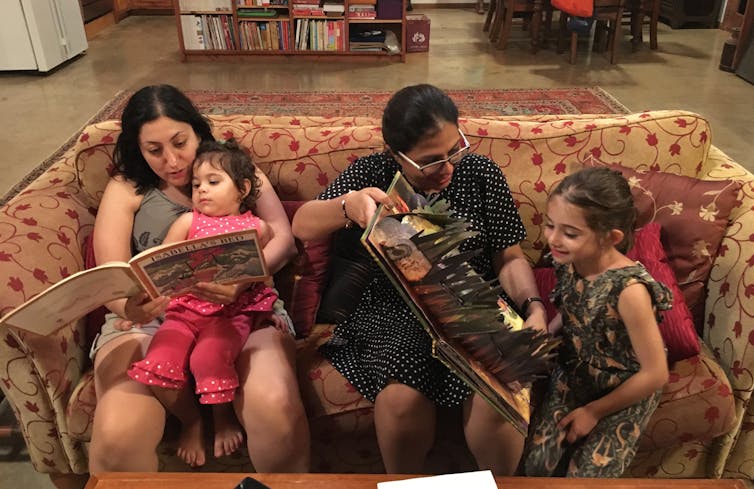

 Finally,
 What do I think will happen? I’m hesitant to say … but rather than truly judging “the best” of the Booker winners, perhaps 2018’s special award will reward that novel that still manages to best capture the public mood.
 Translation takes many forms, however, and mother-tongue English novelists could make up the gap by getting abroad, whether in person or through books, as previous generations were doing up to quite recently.
 Stephen Knight is the author of


 There lies an enduring flaw in Ehrlich’s approach. If impact equals people times affluence times technology, then reducing population alone is not sufficient to solve our ecological crises. But reducing affluence is neither possible nor desirable, since it would condemn millions to lifelong poverty. Ultimately, “The Population Bomb” offered no road map for transitioning away from capitalism without causing human ruin as serious as the environmental ruin that seems to be our destiny.
 At the BookShelf


You must be logged in to post a comment.