Unknown's avatar

Farewell to Paper presents an engaging double act on lost things


File 20180219 75974 1jk558b.jpg?ixlib=rb 1.1
Evgeny Grishkovets in Farewell to Paper: a meditation on times past, the fears raised by the dizzying turnover of technologies and the importance of patience.
Toni Wilkinson

Stephen Chinna, University of Western Australia

Soon after Evgeny Grishkovets and his translator Kyle Wilson walk on stage to perform Farewell to Paper at the Perth Festival, Grishkovets reminds the audience that the performance will be of two hours duration. This advice will be returned to later, when a mild rebuke is delivered to spectators seen glancing at their watches.

While advertised in the festival program as a “one-man show”, the rapport between the actor, Grishkovets, and the translator, Wilson, lends the performance the sense of a double act. Wilson – a translator and specialist in Slavonic languages – has read the script beforehand but in performance he incorporates Grishkovets’s ad libs. Grishkovets almost dances his part as he speaks, pausing for Wilson’s translations, sometimes interjecting.

Under fluorescent lights in front of a backdrop of candy stripe wallpaper and five doors, the set is cluttered with the detritus of obsolete objects, such as a writing desk with a set of plans, various papers, and two typewriters. The floor is scattered with books, map cases and a globe of the world. Grishkovets periodically opens one or more of the doors behind him to reveal objects that supply visual reinforcements to his scenarios of loss.

As well as paper, there are farewells to many other things, such as the traditions and the technologies of a previous age. Through the course of the performance, Grishkovets proceeds to offer up a succession of narratives, frequently utilising physical props of material items and practices that have become obsolete. These include things such as quill pens, pen knives, blotting paper, inkwells, the handwritten letter, letter openers, telegrams, and more.

What becomes obvious is that these previous technologies enforced a need to compose, and a time to reflect. He describes the act of writing a letter, the licking and sealing of an envelope, the purchase and placing of a stamp, and the journey to the post office or the mail box. The list of obsolete items and practices continues with typewriters (it would appear that the last one was made in Delhi in 2011), and a nostalgic narration on the joys of owning his first Pentium computer.

As well as paper, there are farewells to many other things, such as the traditions and the technologies of a previous age.
Toni Wilkinson, Perth Festival

Many of these items are presented physically through the five doors in the backdrop of the set. For example, a narrative concerning the discovery of two 1000-year old messages written on birch bark leads to Grishkovets opening the doors at either end of the set to reveal birch trees. At suitable moments, other doors are opened to display such objects as a mound of handwritten letters and a bookcase.

In a marvellous display of three sequential door revelations, we see a mailbox in which the young Evgeny posted his first letter while staying with his grandparents. In the second is the mass of pipes and conduits that he imagined transported his letter underground to his parents elsewhere. In the third, the row of dilapidated mailboxes in the stairwell of an apartment building where letters were delivered.

Grishkovets is a subtle performer. His excellent sense of timing, his economy of action, his communication with the audience, all reveal an actor skilled in his craft. Wilson is also an effective performer, recognising the requirements of pace, timing, rhythm and in tune with the subtle nuances of Grishkovets’s delivery of his lines. Wilson’s frequent wry exchanges with Grishkovets over small points of translation add to the flavour of the double act between them.

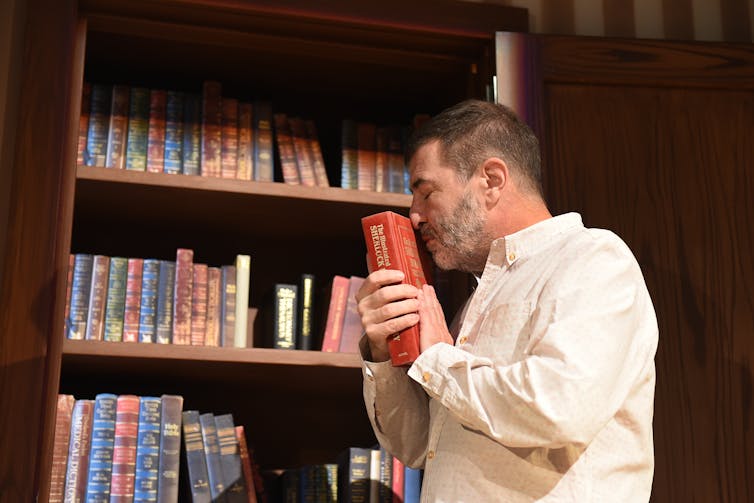
Grishkovets often focuses on the visual, the tactile, the aural and the olfactory aspects of paper technology. Do you appreciate the weight of a book, and the texture of its cover, of its pages? Can you savour the smell of a book – and its dust? Can you enjoy the smell of newsprint, the rustle of a newspaper? Can you savour the smell of an smart phone? Does an iPad rustle?
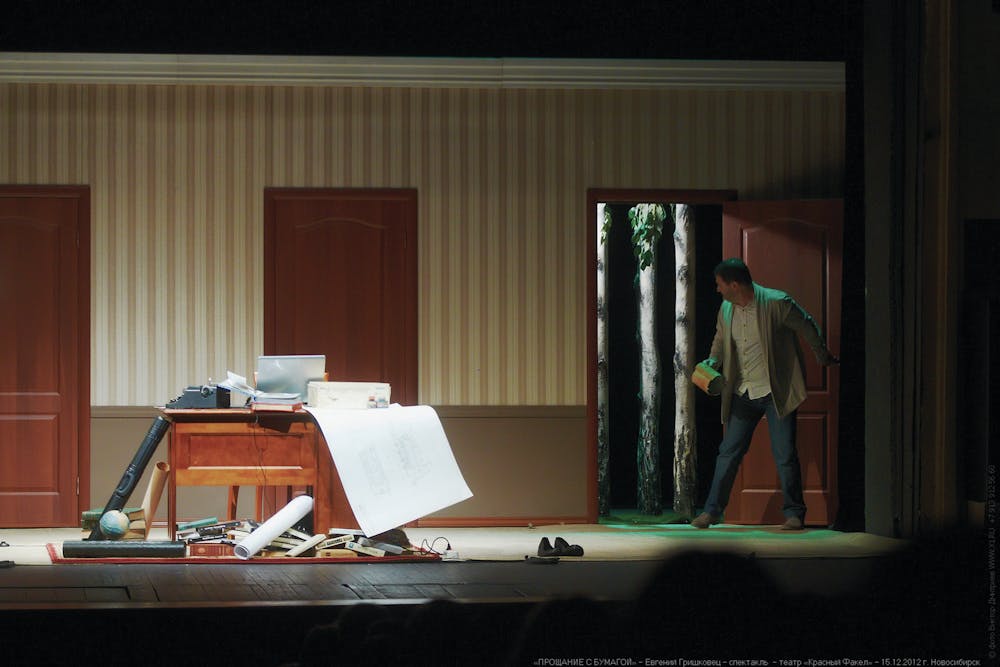
A door opens on birch trees.
Toni Wilkinson, Perth Festival

While these juxtapositions have a light tone, the author is invoking a sense of a deeper nostalgia and regret for the “signs of time past, or of times that are passing” as he puts in the program notes.

As well as being a meditation on times past and the fears raised by the dizzying turnover of technologies, there is also a key message here about the importance of patience.

This message is foreshadowed in that early warning concerning the two-hour duration. However, while Grishkovets is lamenting the loss of a slower paced existence and demonising the speed of 21st century life, he does it with humour, a light touch, and a willingness to point out the drawbacks associated with previous technologies and practices in a world of paper.

The ConversationA thoroughly engaging performance by Grishkovets, aided by the sensitively presented translations by Wilson, was rewarded with strong applause by a full house audience.

Stephen Chinna, Senior Honorary Research Fellow, University of Western Australia

This article was originally published on The Conversation. Read the original article.
Unknown's avatar

Ebooks are Stupid


The link below is to an article that reports on comments from the Hachette CEO, in which he basically says ebooks are stupid.

For more visit:
https://goodereader.com/blog/e-book-news/hachette-ceo-proclaims-ebooks-are-a-stupid-product

Unknown's avatar

Not My Review: Truly Devious (Book 1) – Truly Devious, by Maureen Johnson


Unknown's avatar

Not My Review: The Storm King, by Brendan Duffy


Unknown's avatar

Not My Review: The War of the End of the World, by Mario Vargas Llosa


Unknown's avatar

Writing’s power to deceive


File 20180213 44663 16qrmwg.jpg?ixlib=rb 1.1
Even common knowledge isn’t immune.
ledokolua/Shutterstock.com

Andrew Elfenbein, University of Minnesota

When I was researching and writing my new book, “The Gist of Reading,” I wanted to explore long-held assumptions about reading and how we process what we read.

Some of these assumptions have changed through time. For example, as novels became popular in the 18th century, many warned that they were dangerous and had the potential to cultivate ignorance and immorality in readers, especially female ones.

Today, many would consider that view antiquated. People probably think that reading a narrative – fiction or otherwise – might be able to influence a reader’s opinions or personal beliefs. But their prior knowledge of real-world facts should be safe.

For example, readers might read a story in which a character mentions in passing that Hillary Clinton, rather than Donald Trump, won the 2016 election. This shouldn’t influence readers’ ability to quickly respond that Trump was the real winner, right?

And yet I came across a substantial amount of psychology work that has demonstrated how reading stories – both nonfiction and fiction – has a powerful ability to distort readers’ prior knowledge.

Did George Washington really become president?

In psychologist Richard Gerrig’s 1989 study “Suspense in the Absence of Uncertainty,” Gerrig developed short, nonfictional narratives about well-known events, such as the election of George Washington as president of the United States, that he gave to participants.

Some participants read a version of the narrative that foregrounded facts that made it doubtful Washington would become the president; others read a narrative that made his presidency seem likely.

Readers who read the doubtful version took longer to verify that he had indeed become president (or to recognize that a sentence denying that he had become president was not true).

Even though they knew Washington eventually became president, simply reading a very short narrative had enough power to make readers significantly less sure of what they already knew.

While Gerrig’s experiment presented readers with nonfictional stories about real events, another study demonstrated that reading a short fictional story containing falsehoods presented as facts can make readers more likely to treat them as facts, even if readers have previously shown that they know the truth.

In the study, participants took an online survey that quizzed them on their world knowledge – for example, identifying the world’s largest ocean (the Pacific) – and then had them rate how confident they were in their answer.

Two weeks later, the same participants read two fictional stories and were warned that these stories might contain some false information. The stories actually contained inaccurate versions of the very facts that the readers had been tested on two weeks earlier. For example, in one story, a character (incorrectly) mentioned, in passing, that the Indian Ocean was the world’s largest.

After reading the stories, the participants took the same world knowledge test they had taken two weeks earlier. The inaccurate information turned out to have a serious effect: Readers did worse on the world knowledge test after reading the stories than they had done two weeks before. In particular, questions they had gotten right two weeks earlier they now got wrong – even for the questions that they had answered most confidently on the earlier test.

And remember: All of this happened despite the fact that readers had been explicitly told that the stories would contain inaccurate information.

Pushing back against misinformation

Given our struggle to discern misinformation from fiction, psychologists have been interested in exploring how it to combat it. It seems especially vital to develop strategies that make people smarter about what they are gleaning from what they read, and to encourage ways to become more skeptical.

In a 2016 article,
psychologist David N. Rapp outlines how to defeat, or at least reduce, the misinformation effect.

Rapp describes four key strategies that have proven especially effective.

First, when readers actively tag information as accurate or inaccurate while they read, inaccuracies lose much of their effect. It’s not enough to know that something you read is incorrect: Unless you actively tag it as wrong while reading it, you may suffer the misinformation effect.

Second, the further removed fiction is from everyday reality, the less vulnerable readers are to believe false facts that may be embedded in it. Rapp and his colleagues found that misinformation in fantasy stories had much less effect on readers’ knowledge than misinformation in more realistic stories. Rapp argues that this could mean readers are able to compartmentalize their response to fiction. Fantasy stories like “The Hobbit” probably have less of an ability to alter real-world knowledge than, say, a piece of historical fiction, like Philippa Gregory’s “The Other Boleyn Girl,” which is grounded in historical events but nonetheless riddled with historical inaccuracies.

Third, Rapp found that some inaccuracies are so flagrant that readers do notice them. They may be persuaded that St. Petersburg, rather than Moscow, is the capital of Russia. But it’s much harder to persuade them that Russia’s capital is Brasilia. Brasilia is just too different from anything that readers associate with Russia to make it a convincing capital.

Finally – and perhaps most importantly in today’s climate of “fake news” – readers may be sensitive to the authority of a source. False facts from a generally credible source seem to have more effect than false facts from a disreputable one. The challenge, of course, is that what counts as a credible source to one reader may count as the opposite to another reader.

I find all these psychological experiments telling precisely because they generally avoid having participants read about hot-button issues that may make them feel defensive or partisan.

The traditional suspicion of fiction arose from its ability to excite and engage. Yet the materials in these experiments are comparatively dry – and the fictional information was nonetheless able to cast a spell on the reader.

In other words, even without emotional appeals, by warping the most neutral of facts, readers can easily be persuaded to question or even reverse what they already know.

The ConversationSuch work underscores more than ever that suspicion of reading is not entirely ungrounded. Today, not only is the internet filled with dubious information but there are also deliberate attempts to spread misinformation via social media channels. In this era of “fake news,” scrutinizing the sources of our knowledge has become more critical than ever.

Andrew Elfenbein, Professor of English, University of Minnesota

This article was originally published on The Conversation. Read the original article.

Unknown's avatar

Sideload Epub Ebooks on Microsoft Edge


Unknown's avatar

Literary Feuds


The link below is to an article that takes a look at 25 of the ‘best’ feuds between writers.

For more visit:
https://lithub.com/25-legendary-literary-feuds-ranked/

Unknown's avatar

Not My Review: Falling Kingdoms (Book 6) – Immortal Reign, by Morgan Rhodes


Immortal Reign (Falling Kingdoms #6)
by Morgan Rhodes

Unknown's avatar

Why there need to be more autistic characters in children’s books


File 20180123 33538 1la00lk.jpg?ixlib=rb 1.1
Autistic characters in children’s books are few and far between.
Shutterstock

Shalini Vohra, Sheffield Hallam University

The children’s writer Michael Morpurgo has written a new novel inspired by his autistic grandson, which is set to be published later this year. Flamingo Boy is set in the Camargue in the south of France during World War II and features a boy who “sees the world differently”.

Morpurgo explained how it didn’t occur to him to write a book about autism until his grandson was born, which isn’t totally surprising – as autistic characters in books are few and far between.

Fiction plays a significant role in shaping how people understand and respond to autism. And in this way, books are often used by both schools and parents to help children and young people understand more about autism.

But the limited and skewed portrayal of autism means it is often
misrepresented rather than represented in fiction. For an autistic child or young person this can be extremely isolating and they are often unable to find a version of “themselves” in a book.

There aren’t many autistic characters in children’s books.
Pexels.

The sad reality is many authors and publishers – perhaps from fear of causing offence – appear to steer clear of autistic characters in their narrative. As a consequence, books with autistic characters are either tucked away in the special section of bookshops and libraries, or absent altogether.

Writing together

My research looks at the role fiction plays in creating awareness and acceptance of autism among children, as well as how the portrayal of autism in children’s books shapes how autism is understood and responded to. As part of the research, I recently put on an interactive discussion at the Festival of Social Science around the topic of how autism is portrayed in children’s fiction.

The panel included Vicky Martin, writer of M is for autism and M in the middle, and Amanda Lillywhite, writer and illustrator of picture books including Friends, written for the Neuro Foundation which works to improve the lives of those affected by neurofibromatosis – a genetic condition caused by a mutation in one of their genes. On the panel was also Elaine Bousfield, founder of new publishing house Zuntold. And the audience consisted of autistic children, young people and adults. As well as parents of autistic children, secondary school teachers, academics and the general public.

One of the key topics discussed at the event was around the idea of “co-production”. This is where books are written in collaboration with autistic children and young people – much like the M in the Middle series, which was authored by Martin, but written jointly with girls of Limpsfield Grange, a school for autistic girls.

Making magic happen

The story of M has captured the hearts of readers and already resulted in a sequel to the first book. The girls of Limpsefield Grange have also featured in an ITV documentary Girls with autism. Why? Because M is the story of an autistic teenage girl who is interesting, endearing and real.

She’s written and created with a group of teenage autistic girls. Big chunks of the book is written verbatim, with their very words, and the rest is heavily edited by them. It doesn’t get more real than that. M is the one girl they all created together.

With younger children, drawing or comic workshops might be a more accessible way of getting them to think about characters.
Pexels.

Similarly, as a part of her book for the Neuro Foundation, Lillywhite spent time with children with neurofibromatosis. They spoke about themselves and their experiences of things that matter not just to them but also to many other children, such as bullying. And while all the characters in the book have the genetic disorder neurofibromatosis, the stories aren’t about that and are just as relevant for every child.

Getting heard

Autism is extremely diverse and perhaps the only way to have a good representation of it in fiction is by having lots of autistic characters – in comics, in picture books and in novels.

Publishers too have an important role to play in garnering collaborations and bringing work co-produced with autistic children and young people to market – much as in the M books. Publishing house Zuntold, for example, has an interactive novel writing project which encourages people to write the next piece.

Ultimately, every story – whether in life or fiction – has characters, and all characters are different. So given that autism affects more than one in 100 people, there needs to be more done to represent the outside world inside story books.

The ConversationMillions of people have a relative on the autism spectrum. And it is only by making autistic characters a part of mainstream books that we can hope for widespread understanding and acceptance of autism.

Shalini Vohra, Senior Lecturer in Marketing, Sheffield Hallam University

This article was originally published on The Conversation. Read the original article.