Maybe she does not think of these two jobs as different, but rather as extensions of each other.
This, at least, is the impression Roy gives her readers in her latest novel, The Ministry of Utmost Happiness (Hamish Hamilton), which came out in early June. Two decades in the making, the book records the story of India as it transpired over those 20 years.
This contemporary history is told and retold by myriad voices: those of hijras, people who identify themselves as belonging to the third gender or as transgender; of a dalit man (of the lowest castes) who pretends to be Muslim; of Kashmiris, of Indian civil servants, cold-blooded killers and puppet journalists; of adivasis (tribal populations) and of artists, of owls and kittens and of a dung beetle named Guih Kyom.
Roy’s second fiction work was 20 years in the making. Penguin/Amazon, FAL
Locales are similarly wide-ranging. Roy takes readers from a graveyard in Old Delhi to civil war-torn Kashmir and to central Indian forests, where Maoist insurgents fight India’s army. Some of the book transpires too in the 18th-century astronomical site, Jantar Mantar, the only place in Delhi where people are allowed to protest.
Roy uses the internal contradictions of the movements and the locales to mirror her meandering plotlines, which knit all these skeins together into a kaleidoscopic larger narrative.
It’s an uneasy fit, and the book often feels like it is about to burst at the seams. Still, Roy somehow holds it all together, clumsily yet passionately, leaving no one and nothing out.
Both the margins and the marginalised speak in the Ministry of Utmost Happiness, a feat Roy has also sought to achieve with both her activism and her non-fiction work.
The story follows two characters: Anjum, nee Aftab, a hijra who rejects the politically correct term “transgender”, and Tilo, a Delhi-based architect turned graphic designer who kidnaps a baby from Jantar Mantar.
Anjum’s life is a lens onto an alternate duniya, or world, one where hijras live and learn together, cloistered, following their own rules, regulations and hierarchies.
That changes forever when Anjum travels to Gujarat, a western Indian state that is known for its recent history of religious violence between Hindus and Muslims, and witnesses a massacre. Shortly thereafter, Anjum moves to a graveyard in Old Delhi.
As always, Roy’s brilliance shines most in her choice of locales and the imagery they invoke.
Conflict-beset Kashmir, which Roy has covered extensively in her non-fiction work, features in her latest novel. KashmirGlobal/Flickr, CC BY-SA
In The God of Small Things (1997), the banks of the Meenachil River in southern Kerala served as the space of deviance for the protagonists, where Ammu and Velutha have their escapades and Estha and Rahel get up to mischief.
In The Ministry of Utmost Happiness, the author gives us two contrasting, contradictory settings: a graveyard that becomes a place of life and the verdant Kashmir valley, a space of death and misery.
Anjum starts a guesthouse in the old graveyard, with each room enclosing a grave. Holding feasts for festivals, she invites her friends over to dine regularly at the graveyard-guest house. Later, Tilo moves in permanently with the baby.
The reader understands this resplendent graveyard, which features not just living humans but an impressive stock of animals too, as an ode to tolerating (or, more correctly termed, to accommodating) plurality, a blunt contrast to the truth of modern-day India, with its increasing intolerance towards religious and social differences.
For this, for trying to etch out a semblance of hope, for showing broken things and shattered people coming together to carve out a niche of their own, Roy deserves applause.
At times all these voices, places and problems escalate into a dissonant cacophony that leaves the reader perplexed, exhausted and grasping at the multiple threads of the plot. But the novel’s brilliance lies in how it captures subtle moments, with attention to detail and sharp compassion.
For instance, the Ustad (master) Kulsoom Bi takes Anjum and the other newly initiated hijra residents to a light and sound show at the Red Fort in Delhi just so they can hear the fleeting but distinct coquettish giggle of a court eunuch. She explains to them that they, the hijras, were not “commoners, but members of the staff of the Royal Palace in the medieval period.”
These nuggets of everyday history and poetry keep readers hooked, gradually lowering us through each of the story’s many layers and offering moments of clarity in an otherwise tangled mesh.
Some have called Roy’s novel a “fascinating mess”, but frankly when one decides to write a shattered story about all things, the narrative(s) is bound to get fuzzy.
The book may be difficult for those who have not been following Roy and her causes in the long years since God of Small Things. But those who get her intellectual moorings and understand her role as a voice of dissent in today’s climate of “saffronisation” – the spread of extreme-right Hindu values across India, a nation veering hazardously towards authoritarianism, know that the author and her work are one.
Roy’s novel, much like her role as a public intellectual, is a reminder that the world we inhabit is a composite one – a duniya of duniyas – where invisible people, their unrepresented struggles and their unacknowledged yearnings have the right to exist.
The Ministry of Utmost Happiness tells their story, extolling everyone’s right to be heard, even if only fleetingly, in the coquettish giggle of a court eunuch.
Cover art from “Annie Muktuk and Other Stories,” Norma Dunning’s first book filled with sixteen Inuit stories which portray the unvarnished realities of northern life via strong and gritty characters. (University of Alberta Press)
I am Norma Dunning. I am a beneficiary of Nunavut; my ancestral ties lie in the village of Whale Cove. I have never been there. My folks left the North shortly before my birth. I am southern Inuk, born and raised.
I am a writer. I have always been a writer. I would dream of publishing my writing, but it was easier and safer not to. I kept all of it in a drawer. I would think about publishing, and then I would think about the process of publishing. As an Indigenous, female writer I didn’t want to take it. I didn’t want to take the criticism.
I didn’t want to take the reworking of my words into a form that is standard Western format, or into the practices that are expected and accepted within literary work. I know that I do not write in the ways that most non-Indigenous writers do. I didn’t want my work re-colonized.
I have a small reputation of being a poet, and my poetry manuscript is usually rejected twice a year. Over the last seven years, I am often invited to read my poetry at various local events. I am very honoured to have been asked, but I am the poet who shows up without her book of published poems. I am the poet with her work attached to a clipboard. I am surprised that my first published work, Annie Muktuk and Other Stories, is a book of short stories. There’s irony in that.
Inuit peoples live in two worlds
Writing for me is not a hobby. Writing is a part of my being, a part of daily living. It is for me what breathing is for others. It is physical in that if I am not creating a story or a poem, I do not feel well. I know that of myself. It is spiritual and emotional. Producing the written word is the only place where I can be who I am, without expectations, without criticism and without someone looking over my shoulder telling me that I am wrong.
Inuit peoples do not read and write and ingest culture the way non-Inuit Canadians do. I believe Inuit Canadians do not place a high value on the written word. Instead, we come from a culture with roots that lie within the passing on of stories orally; this is what lies within our blood and genetic memories. When I operate outside of my own circle of family and friends, I operate in a different fashion. It is not compromise. It is survival.
When I was studying for my BA degree, my minor was in creative writing. I have since taken many university creative writing courses and I received two prestigious awards for my efforts through the University of Alberta. Creative thinking is a requirement for my doctoral work, and taking writing courses has helped me. However, the other students in the writing classes were not always supportive. I heard their criticisms every week.
While not every class was good or productive, I was exposed to the writing of non-Inuit poets and writers from long ago. I enjoyed their old works, which were new to me. I thought about how they could spend time running up hill and down dale and always remain writing in their predictable and trained writing format. I cannot write about butterflies or bumblebees. In time, I published the odd poem here and there, but never a story. The stories were mine. It took many years to decide to share them.
Deciding to publish
Until one winter afternoon, close to Christmas. I was standing in a lineup at a post office. It was a long line, filled with people wanting their packages to exotic places to be stamped “Express!” I held my thick, brown envelope addressed to the University of Alberta Press close to my chest. I thought I could do this another day, but I knew that if I stepped out of the lineup, I would never send that envelope out anywhere. When I was asked if I wanted a rush delivery, I gasped, “No!”
The longer it took for anyone to read my work, the longer I was safe. The longer the characters that I had created could stay only mine. If no one ever read it, I didn’t have to explain who these people were. The longer the envelope took to deliver, the longer my creative world belonged to only me. I didn’t hear back from the press for over a year. I kept telling myself that was OK. Things take time. Inuit are patient.
When I was told that the press accepted my work, I was stunned. Perhaps part of being an Indigenous writer is the expectation of rejection. I did not get what I was used to. I was assigned to my editor, who is a Namibian man, born and raised. He knows colonialism very well. He lives it, like me. The path to publishing became less complicated. I knew one thing; my words were safe with him. He got it.
However, there was one long discussion over the use of a comma or a period. I had written the sounds of two Inuit women throat singing. I had written it without any grammar. I knew how the song sounded in my head, but what I had to think about was a non-Inuit readers’ understanding.
I sang it to myself for 45 minutes. Was it “Oooma” insert period or “Oooma” insert comma? There were emails and phone calls around two simple sentences. I learned to think about how grammar shapes understanding. What if I was a foreigner reading this passage; how would it sound in my head? We worked it through because my editor took the time to build a good working relationship with me. He didn’t dive in and try to make me or my words “right.” He didn’t push for the quick fix that I know all too well. When non-Inuit do that, it is a signal for me to run.
As Aboriginal artists, we inherently analyze the people around us, because we walk inside two worlds. Aboriginal artists do the hard work, the heavy lifting. We put out into the world the truth of Canada’s grand narrative. Aboriginal artists take the whispered secrets and put them onto paper. It is not easy work.
If my book does any one thing, I hope it brings other Inuit writers to a publisher. I hope other Inuit writers realize that they can do this too. They can put their work out there. They can publish. Be fearless. Stand by your words, and believe that no matter where you stand, you are Inuk.
Former Globe and Mail newspaper reporter turned novelist Omar El Akkad contemplates his debut book American War in his publisher’s Toronto office in this 2017 file photo. (THE CANADIAN PRESS/Chris Young)
Editor’s note: The Conversation Canada asked our academic authors to share some recommended reading. In this instalment, Bryan Gaensler, an astronomer who wrote about life in 2167, highlights a few of his recent picks.
My passion is science fiction. Here are my favourite sci-fi books that I’ve read this year:
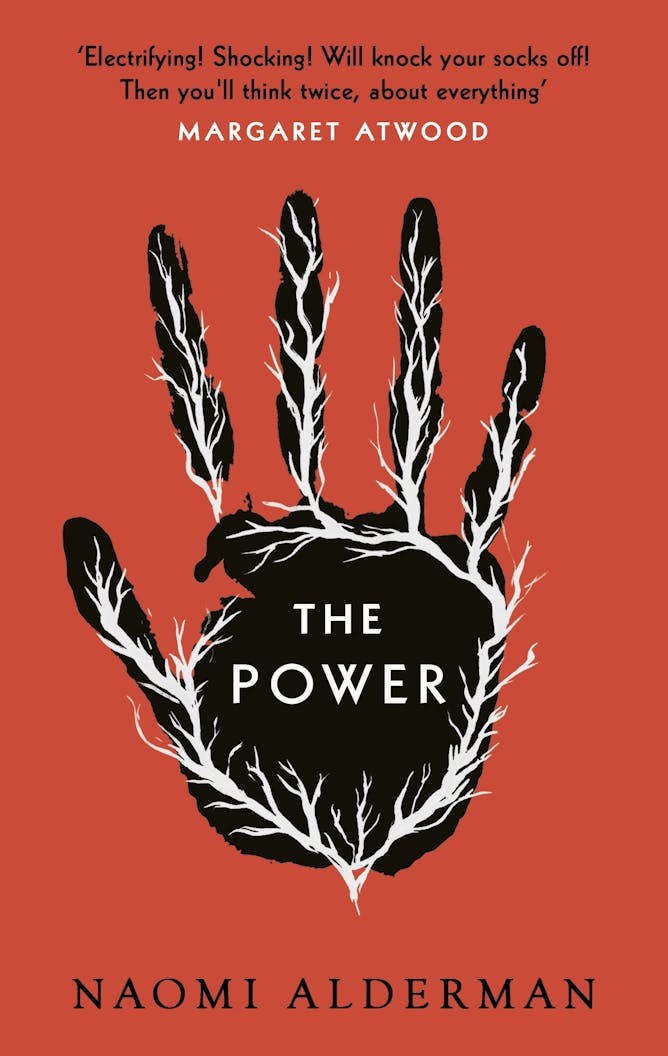
Women around the globe spontaneously develop the ability to deliver electric shocks through their fingertips. As they begin to use this power to intimidate, control and kill, the world order is turned upside down.
A spectacular novel, and surely the favourite to sweep all the sci-fi book awards for 2017. People can be both cruel and good-intentioned, often at the same time. Introduce a new power imbalance, and society is abruptly transformed. Wonderful writing, and a whopper of a story twist. Turns The Handmaid’s Tale on its head.
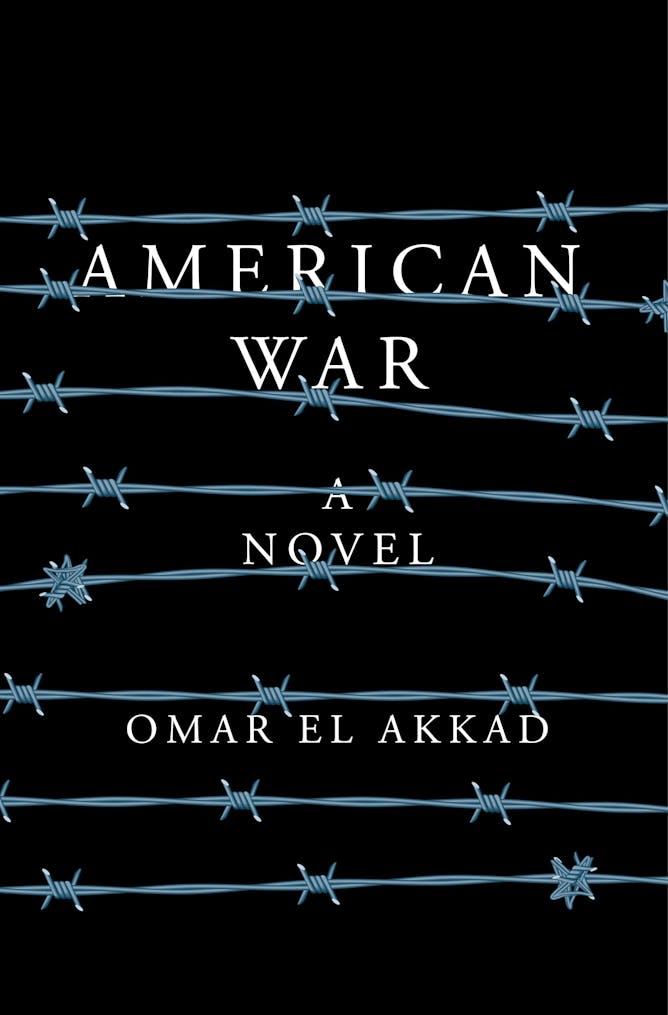
A hundred years from now, Florida has vanished under the seas, the Bouazizi Empire is the new world superpower, and the United States has begun its second civil war. In the South, a young woman ends up in a refugee camp and is slowly radicalized into terrorism.
An intense, moving portrait of a future America that maybe isn’t the future after all. The characters are complex and the story is all too real. A spectacular debut.
Tom Barren travels back in time, accidentally alters the course of history, and returns to a horrifically changed, dystopian present day. The catch? Tom grew up in a utopia of flying cars and moon bases, and the dystopia that he finds himself trapped in is our timeline, warts and all.
A gem of a story that provides several new twists on time travel. If you’ve screwed up the timeline, should you fix it? What if there were two different ways to travel through time, with different rules and different consequences? And under all of this is the classic sci-fi question writ on the scale of billions of lives: Do the needs of the many outweigh the needs of a few? Hard to put down, with a lovable lead character.
The life story of Archibald Isaac Ferguson, born in 1947 in Newark, N.J. Except that this is the story of four identical Fergusons, each of whom take divergent paths as their lives play out.
A tour de force story of adolescence and the path not taken. It’s hard to believe a single author could possibly cram so many real-life details, emotions and characters into a single book. Extraordinarily memorable and engaging.
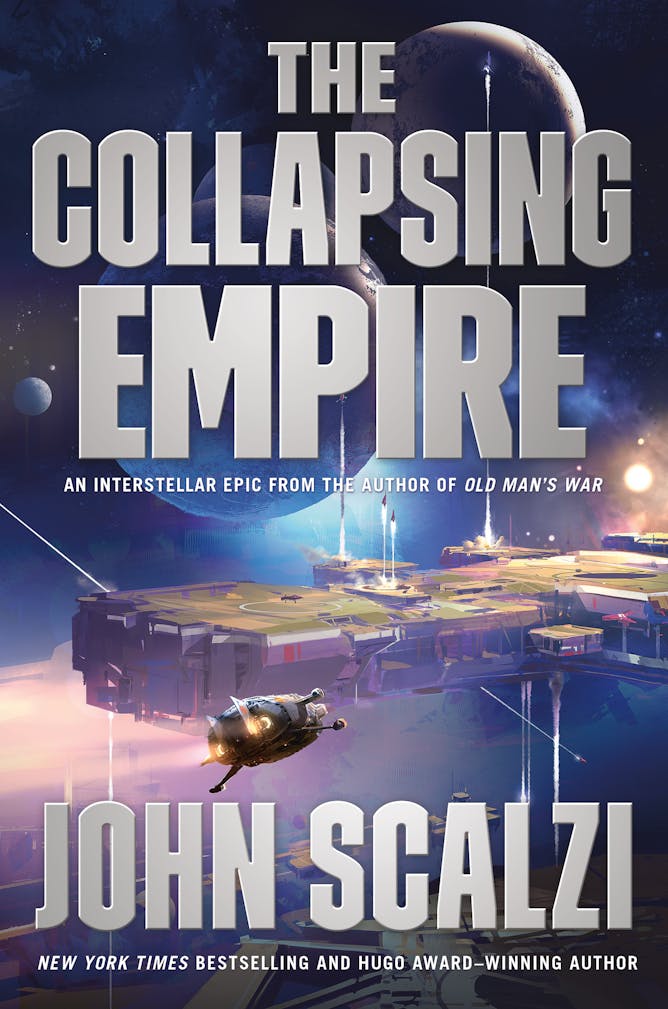
Humans have spread throughout a galactic empire, our worlds interconnected by faster-than-light wormholes. But what happens to trade, the economy and civilisation itself when the wormholes start to break down?
A fun and fast-spaced space opera, centred on some forthright women and some fresh ideas. In the spirit of Asimov’s Foundation, Scalzi explores the theme of the downfall of empire on a galaxy-spanning scale.
Two prominent writers died in July 1817. The first was arguably the most famous woman in Europe. The other was a country clergyman’s daughter whose life had revolved around her family and her home county.
Germaine de Staël travelled widely and her work had been translated into several languages. She was the only daughter of wealthy Swiss banker Jacques Necker, who became finance minister to Louis XVI, and was brought up in the stimulating environment of Parisian society. She published major treatises on the influence of passions on individuals and nations, on literature and its relationship to society, not to mention on Germany (1813). She wrote on Marie Antoinette’s trial, on peace, on translation, on suicide.
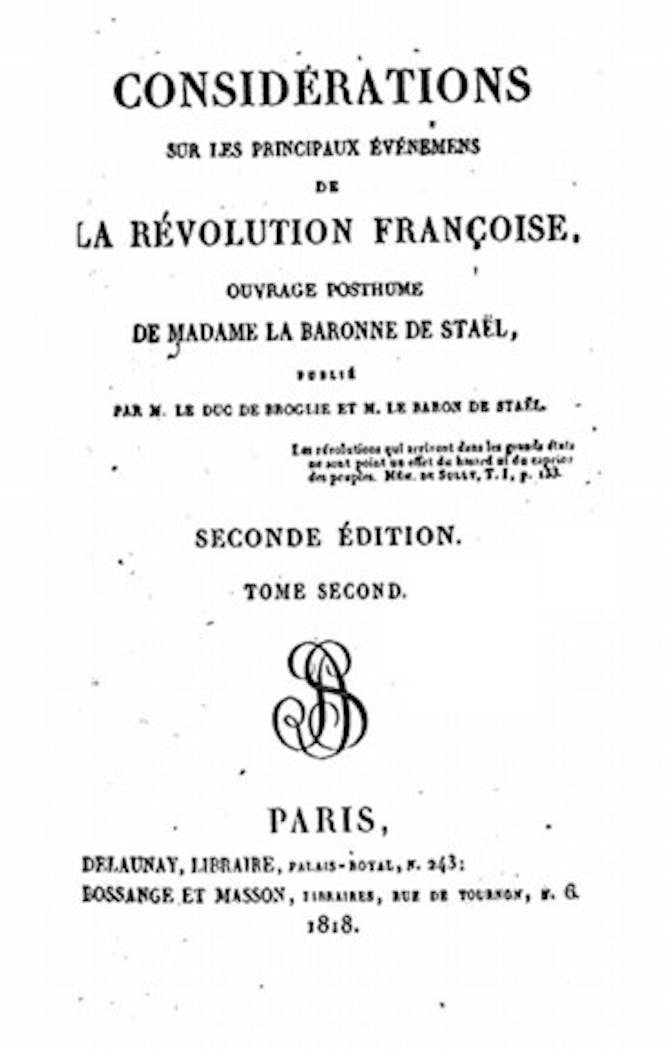
Her novels Delphine (1802) and Corinne or Italy (1807) were bestsellers throughout Europe. She was also a commentator on, and historian of, the French Revolution in texts which only appeared after her death. Most periodicals felt that anything she penned, fact or fiction, political or philosophical, was worthy of a mention – whether to praise or to condemn it.
Unlike Staël’s father, George Austen encouraged his daughter Jane’s literary pursuits: he bought her notebooks for her early stories, gave her a mahogany writing desk and attempted (unsuccessfully) to get her work into print in 1797. Jane Austen’s first published book, Sense and Sensibility, “a new novel by a lady”, which came out in 1811, bore no author’s name on its title page. The same would go for the other novels published in her lifetime – all sold well and brought a welcome income but, to the outsider, nothing could connect them with the discreet woman who, through her richer brother’s generosity, lived with her mother and sister in a cottage on his estate.
Death notices
Staël’s death in Paris was widely reported. The Monthly Magazine, before commenting at length on the funeral arrangements, opened a “Further Notice of Madame de Staël” with the following assertion:
To speak of the literary celebrity of Madame de Staël, of the elevated talent which distinguished her, of all the talent which placed her among the first writers of the age, would be to speak of all things known to all France and to all Europe … To speak of her generous opinions, her love for liberty, her confidence in the powers of intelligences and of morality, confidence which honours the soul which experiences it, would be, perhaps, in the midst of still agitated parties, to provoke ill-disposed impressions.
Germaine de Staël: her thoughts on the French Revolution. Online Library of Liberty
Staël had been reviled for her political ideas, caricatured by the gutter press for her unconventional looks and lifestyle, exiled by several regimes, and treated by Napoleon as a personal enemy, to the extent that it was said that the emperor recognised three powers in Europe: England, Russia and Madame de Staël.
When the unmarried “Miss Jane Austen” died in Winchester four days after Staël, the announcement her family (probably) wrote recalled she was the daughter of a clergyman and acknowledged that she was the author of Emma, Mansfield Park, Pride and Prejudice and Sense and Sensibility. It added:
Her manners were most gentle, her affections ardent, her candour was not to be surpassed, and she lived and died as became a humble Christian.
Future biographical notes, including the one penned by her nephew – A Memoir of Jane Austen – developed this image. He wrote of his aunt:
Of events her life was singularly barren: few changes and no great crisis ever broke the smooth current of its course. Even her fame may be said to have been posthumous: it did not attain to any vigorous life till she had ceased to exist. Her talents did not introduce her to the notice of other writers, or connect her with the literary world, or in any degree pierce through the obscurity of her domestic retirement.
Bestseller: but who is it by? Lilly Library, Indiana University via Wikimedia Commons
To this day, in the only authenticated portrait of her – a sketch by her sister Cassandra – she looks the part in her simple cap and dress, so unlike Staël’s flamboyant turban and scarlet gown. More than “Miss Austen”, she is “Jane Austen”, someone to whom we feel we can relate. Her admirers, readers but also cinephiles who have enjoyed the adaptations, come from all the corners of the earth, are known as “Janeites”.
Many of Staël’s works have long been out of print or available only in pricey scholarly editions. She is recognised as one of the forerunners of 19th-century liberalism but does not have the common appeal and widespread recognition that time has brought to Austen.
Contrasting legacies
The seeds for the “fickle fortunes” – to borrow the title of the current exhibition at Chawton House (the “Great House” lived in by her brother Edward Austen-Knight which is now home to a library of early women’s writing) – of the international literary superstardom of Austen and the waning of Staël’s fame are partly present in these obituaries.
Austen’s family cleverly crafted a reputation for demureness and devotion to both God and family as a way of deflecting from the sometimes ambiguous contemporary attitude towards women authors. Her life was presented as quintessentially English and uneventful and her character as modest and self-effacing – in many ways the opposite of Staël’s.
In a late addition to his biographical sketch about his sister, 15 years after the death of both women, Henry Austen claimed that when invited to a party Staël was due to attend, Austen “immediately declined”.
This probably imaginary anecdote illustrates an essential reason for Austen’s success: yes, she is a great writer, but so too is Staël. Austen’s existence threatened nobody. Staël’s championing of republican ideals, consideration of the role of emotion in politics and use of fiction to promote geopolitical and societal reflections meant her life could be discussed and her works forgotten. Considering them jointly can help us question what shapes our canon of great writers.
Homer’s Iliad is usually thought of as the first work of European literature, and many would say, the greatest. It tells part of the saga of the city of Troy and the war that took place there. In fact the Iliad takes its name from “Ilios”, an ancient Greek word for “Troy”, situated in what is Turkey today. This story had a central place in Greek mythology.
The poem deals with a very short period in the tenth year of the Trojan war. This sometimes surprises modern readers who expect the whole story of Troy (as, for instance, in Wolfgang Petersen’s 2004 film Troy). But Homer and other early epic poets confined their narratives to particular periods in the war, such as its origins, key martial encounters, the fall of the city, or the returns of the soldiers to Greece. There is no doubt that Homer and other early poets could rely on a very extensive knowledge of the Trojan war among their audiences.
Brad Pitt as Achilles in the film Troy. Warner Brothers
The central figure in the Iliad is Achilles, the son of Peleus (a mortal aristocrat) and Thetis (a sea-goddess). He comes from the north of Greece, and is therefore something of an outsider, because most of the main Greek princes in the poem come from the south. Achilles is young and brash, a brilliant fighter, but not a great diplomat. When he gets into a dispute with Agamemnon, the leading Greek prince in the war, and loses his captive princess Briseis to him, he refuses to fight and remains in his camp.
He stays there for most of the poem, until his friend Patroclus is killed. He then explodes back on to the battlefield, kills the Trojan hero Hector, who had killed Patroclus, and mutilates his body.
The Iliad ends with the ransom of Hector’s body by his old father Priam, who embarks on a mission to Achilles’ camp in the gloom of night to get his son’s body back. It is worth noting that the actual fall of Troy, via the renowned stratagem of Greeks hidden within a Wooden Horse, is not described in the Iliad, although it was certainly dealt with in other poems.
All of this takes place under the watchful gaze of the Olympian gods, who are both actors and audience in the Iliad. The Olympians are divided over the fate of Troy, just as the mortals are – in the Iliad the Trojan war is a cosmic conflict, not just one played out at the human level between Greeks and non-Greeks. Ominously for Troy, the gods on the Greek side, notably Hera (queen of the gods), Athena (goddess of wisdom and war), and Poseidon (god of the land and sea), represent a much more powerful force than the divine supporters of Troy, of whom Apollo (the archer god and god of afar) is the main figure.
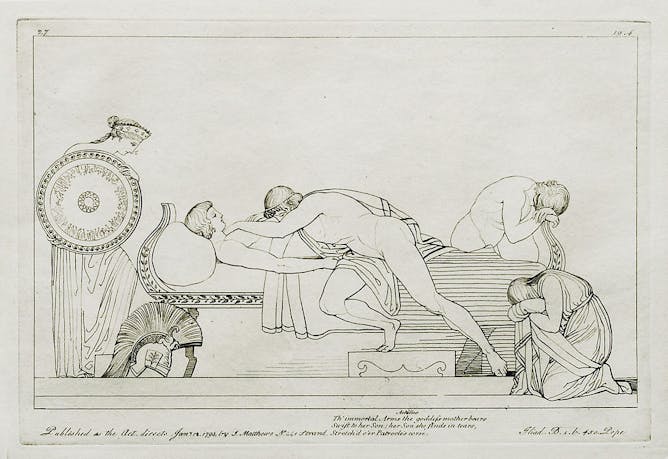
Achilles mourns the death of Patroclus. John Flaxman, The Iliad, 1793
The many faces of Homer
The Iliad is only one poetic work focused on the war for Troy; many others have not survived. But such is its quality and depth that it had a special place in antiquity, and probably survived for that reason.
Achilles dragging the body of Hector behind his chariot. Vase circa 490 BC.
We know virtually nothing about Homer and whether he also created the other poem in his name, the Odyssey, which recounts the return journey of Odysseus from the Trojan war, to the island of Ithaca. The Iliad was probably put together around 700 BC, or a bit later, presumably by a brilliant poet immersed in traditional skills of oral composition (ie “Homer”). This tradition of oral composition probably reaches back hundreds of years before the Iliad.
Early epic poetry can be a way of maintaining the cultural memory of major conflicts. History and archaeology also teach us that there may have been a historical “Trojan war” at the end of the second millennium BC (at Hissarlik in western Turkey), although it was very unlike the one that Homer describes.
The Iliad was composed as one continuous poem. In its current arrangement (most likely after the establishment of the Alexandrian library in the early 3rd century BC), it is divided into 24 books corresponding to the 24 letters of the Greek alphabet.
It has a metrical form known as “dactylic hexameter” – a metre also associated with many other epic poems in antiquity (such as the Odyssey, and the Aeneid, the Roman epic by Virgil). In the Odyssey, a bard called Demodocus sings on request in an aristocratic context about the Wooden Horse at Troy, giving a sense of the kind of existence “Homer” might have led.
The language of the Iliad is a conflation of different regional dialects, which means that it doesn’t belong to a particular ancient city as most other ancient Greek texts do. It therefore had a strong resonance throughout the Greek world, and is often thought of as a “pan-Hellenic” poem, a possession of all the Greeks. Likewise the Greek attack on Troy was a collective quest drawing on forces from across the Greek world. Pan-Hellenism, therefore, is central to the Iliad.
Death and War
A central idea in the Iliad is the inevitability of death (as also with the earlier Epic of Gilgamesh). The poignancy of life and death is enhanced by the fact that the victims of war are usually young. Achilles is youthful and headstrong, and has a goddess for a mother, but even he has to die. We learn that he had been given a choice – a long life without heroic glory, or a short and glorious life in war. His choice of the latter marks him out as heroic, and gives him a kind of immortality. But the other warriors too, including the Trojan hero Hector, are prepared to die young.
The gods, by contrast, don’t have to worry about dying. But they can be affected by death. Zeus’s son Sarpedon dies within the Iliad, and Thetis has to deal with the imminent death of her son Achilles. After his death, she will lead an existence of perpetual mourning for him. Immortality in Greek mythology can be a mixed blessing.
The Iliad also has much to say about war. The atrocities in the war at Troy are committed by Greeks on Trojans. Achilles commits human sacrifice within the Iliad itself and mutilates the body of Hector, and there are other atrocities told in other poems.
The Trojan saga in the early Greek sources tells of the genocide of the Trojans, and the Greek poets explored some of the darkest impulses of human conduct in war. In the final book of the Iliad, Achilles and Priam, in the most poignant of settings, reflect upon the fate of human beings and the things they do to one another.
The archaeological site of Troy in western Turkey. Jorge Láscar, CC BY
Postscripts and plagiarists
It was often said that the Iliad was a kind of “bible of the Greeks” in so far as its reception within the Greek world, and beyond, was nothing short of extraordinary. A knowledge of Homer became a standard part of Greek education, be it formal or informal.
Ancient writers after Homer, even the rather austere Greek historian Thucydides in the 5th century BC, assume the historicity of much of the subject-matter of the Iliad. Likewise, Alexander the Great (356-323BC) seems to have been driven by a quest to be the “new Achilles”. Plutarch tells a delightful story that Alexander slept with a dagger under his pillow at night, together with a copy of Homer’s Iliad. This particular copy had been annotated by Alexander’s former tutor, the philosopher Aristotle. One can only imagine its value today had it survived.
In the Roman world, the poet Virgil (70-19BC) set out to write an epic poem about the origins of Rome from the ashes of Troy. His poem, called the Aeneid (after Aeneas, a traditional Trojan founder of Rome), is written in Latin, but is heavily reliant on Homer’s Iliad and Odyssey.
My own view is that Virgil knew Homer off by heart, and he was probably criticised in his own life for the extent of his reliance on Homer. But tradition records his response that “it is easier to steal Heracles’ club than steal one line from Homer”. This response, be it factual or not, records the spell that Homer’s Iliad cast over antiquity, and most of the period since.



 The Ministry of Utmost Happiness tells their story, extolling everyone’s right to be heard, even if only fleetingly, in the coquettish giggle of a court eunuch.
 If my book does any one thing, I hope it brings other Inuit writers to a publisher. I hope other Inuit writers realize that they can do this too. They can put their work out there. They can publish. Be fearless. Stand by your words, and believe that no matter where you stand, you are Inuk.



 A fun and fast-spaced space opera, centred on some forthright women and some fresh ideas. In the spirit of Asimov’s Foundation, Scalzi explores the theme of the downfall of empire on a galaxy-spanning scale.

 This probably imaginary anecdote illustrates an essential reason for Austen’s success: yes, she is a great writer, but so too is Staël. Austen’s existence threatened nobody. Staël’s championing of republican ideals, consideration of the role of emotion in politics and use of fiction to promote geopolitical and societal reflections meant her life could be discussed and her works forgotten. Considering them jointly can help us question what shapes our canon of great writers.



 My own view is that Virgil knew Homer off by heart, and he was probably criticised in his own life for the extent of his reliance on Homer. But tradition records his response that “it is easier to steal Heracles’ club than steal one line from Homer”. This response, be it factual or not, records the spell that Homer’s Iliad cast over antiquity, and most of the period since.
 At the BookShelf


_(14779852741).jpg)
You must be logged in to post a comment.