Unknown's avatar

Emily Brontë’s fierce, flawed women: not your usual Gothic female characters


File 20180729 106521 1d0041s.png?ixlib=rb 1.1
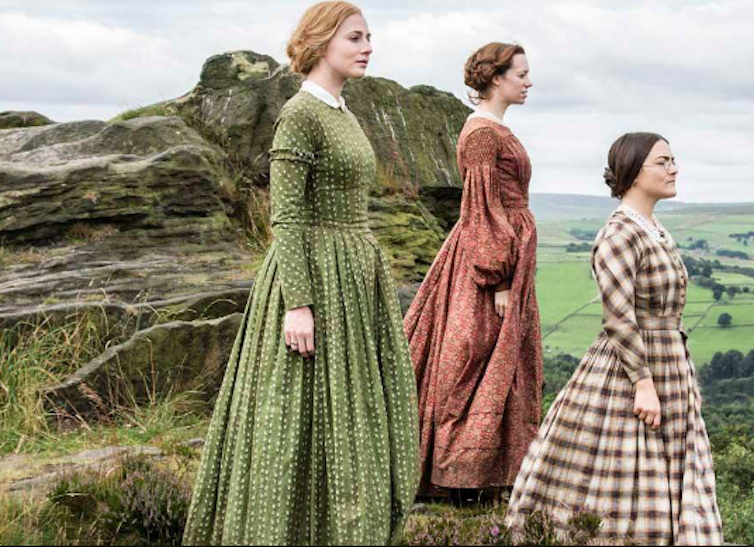
BBC Cymru’s To Walk Invisible, the story of the Brontë sisters.
BBC

Clare Pettitt, King’s College London

Domestic violence, alcoholism, child abuse, neglect, sexual obsession and torture: Emily Brontë’s 1847 novel Wuthering Heights is nothing if not graphic in its depiction of the messy, frightening and chaotic lives of unhappy families. No wonder critics at the time were repelled by its “shocking pictures of the worst forms of humanity” and its “details of cruelty, inhumanity, and the most diabolical hate and vengeance”. But the women in the novel, trapped in these toxic, inter-generational cycles of abuse, are not passive but remain resolute and resistant.

“Whether it is right or advisable to create things like Heathcliff, I do not know,” wrote Charlotte Brontë in her apologetic preface to the 1850 posthumous edition of her sister’s novel. But despite her misgivings, Heathcliff remains one of the most memorable and enduring characters in Victorian literature.
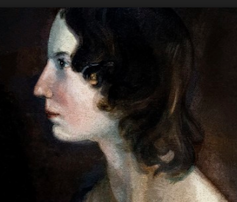
Emily Brontë died of tuberculosis the age of 30. Wuthering Heights was her only novel.

The boy adopted by the Earnshaws as a gypsy child grows up to hang his fiancée’s dog. He refuses a nurse or doctor to his dying son – crying: “Lock him up and leave him.” And he frequently assaults and threatens others – “I’ll crush his ribs in like a rotten hazel-nut” he says of Edgar Linton. Later he also threatens to rip out his wife Isabella fingernails and digs up his great love Catherine Earnshaw’s coffin with necrophiliac fervour.

In Brontë’s description of a fight between Heathcliff and Hindley, Catherine Earnshaw’s elder brother, who has just tried to shoot him, the choreography is cool and exact:

The knife, in springing back, closed into its owner’s wrist. Heathcliff pulled it away by main force, slitting up the flesh as it passed on… His adversary had fallen senseless with excessive pain and the flow of blood that gushed from an artery or a large vein. The ruffian kicked and trampled on him, and dashed his head repeatedly against the flags.“

Violence and abuse

Charlotte Brontë’s preface famously excuses the book as the “rugged” outpouring of her sister’s untutored imagination as a “nursling of the moors” and suggests that Heathcliff is the focus of all the villainy in the book. But Heathcliff is not the only perpetrator of violence and abuse in a novel which bristles with attacks and injuries, both mental and physical.

At one point Hindley orders the servant (and principal narrator) Nelly Dean to: “‘Open your mouth.’ He held the knife in his hand, and pushed its point between my teeth”. In an alcoholic rage Hindley grabs his own baby son and shouts, “‘I’ll break the brat’s neck.’ Poor Hareton was squalling and kicking in his father’s arms with all his might, and redoubled his yells when he carried him up-stairs and lifted him over the banister.” The father then drunkenly drops him, and baby Hareton’s life is only saved because Heathcliff manages to catch him.

Wuthering Heights is, in the words of the novel, “a string of abuse or complainings” – and worse. Brontë trains a singularly cool and unflinching gaze on the violent behaviour that can explode in the intimate spaces of the “home”.

Early critics saw this clearly, but more recent critics have noticed it less. Perhaps the attention given to Brontë as a woman writer by feminist critics in the 1970s and 1980s, hugely important as it was, pushed readings of the novel away from the representation of violence and towards ideas of female repression.

Loathsome women

In her famous 1987 analysis, Desire and Domestic Fiction: A Political History of the Novel, literary scholar Nancy Armstrong reads the double-generation plot as resolved by the middle-class female (Catherine’s daughter Cathy) who disrupts and transforms the old order with her domestic rule. Armstrong says: “Where there had always been brambles at Wuthering Heights, Catherine has Hareton put in her ‘choice of a flower bed in the midst of them’.”
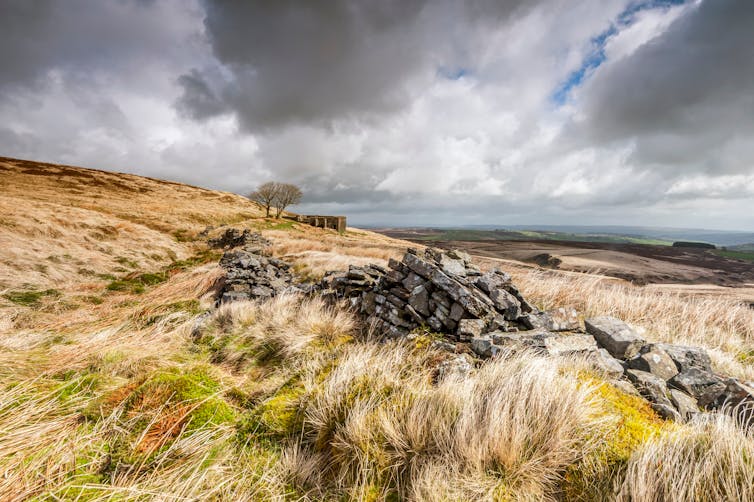
The ruins of Top Withens on Haworth Moor, scene of the fictional Wuthering Heights.
Shutterstock

But such readings perhaps underestimate the manipulative, violent and obsessive behaviour of the female characters and both their complicity and their agency in abuse. Balanced against the “painful appearance of mental tension” in Heathcliff, is what is described by Nelly Dean as the “mental illness” of Catherine.

Catherine pinches Nelly’s arm “spitefully” and slaps her face with “a stinging blow”. She forces Nelly to lie to her husband Edgar and say she is very ill in order to frighten him. Edgar’s sister Isabella scratches Catherine with her “talons” and draws blood. And Heathcliff describes Isabella – his fiancée – as “that pitiful, slavish, mean-minded… abject thing”, despising her for they way she is obsessed with him even though he treats her with appalling cruelty.

“Even the female characters excite something of loathing and much of contempt,” remarked one reviewer at the time. That Brontë dared to make her women loathsome is important. The violence against women in Gothic fiction (as in the novels of genre pioneer Ann Radcliffe) generally sees them depicted as beautiful victims. In other words the females characters suffer beautifully but passively, such as the terror endured by Emily St Aubert in Radcliffe’s Mysteries of Udolpho or the strangulation of the exquisite Elizabeth Lavenza in Mary Shelley’s Frankenstein.

But Brontë’s female characters are not victims. They remain locked in a perpetual struggle both inside the home and with the forces of nature and fate beyond the home. From their girlhoods, when “half savage and hardy” they run free on the moors, neither of the Catherines in Wuthering Heights ever lose their hardiness or give in to any of the men around them. Even Isabella manages to escape her abusive marriage to Heathcliff, and moves away with her baby son. And narrator Nelly Dean is stoic and always protective of her charges, even in the face of simmering violence.

The ConversationA different feminist argument can be made that Emily Brontë shows us how vital is the tenacious defence of self in a violent world. Catherine, Isabella, Nelly, Cathy: Brontë’s women are fierce and active in their own stories. These women are not passively resilient, but resolute, resistant and strong-willed.

Clare Pettitt, Professor of 19th Century Literature and Culture, King’s College London

This article was originally published on The Conversation. Read the original article.
Unknown's avatar

Why Emily Brontë’s Wuthering Heights is a cult classic


File 20180730 106511 uw6vf.jpg?ixlib=rb 1.1
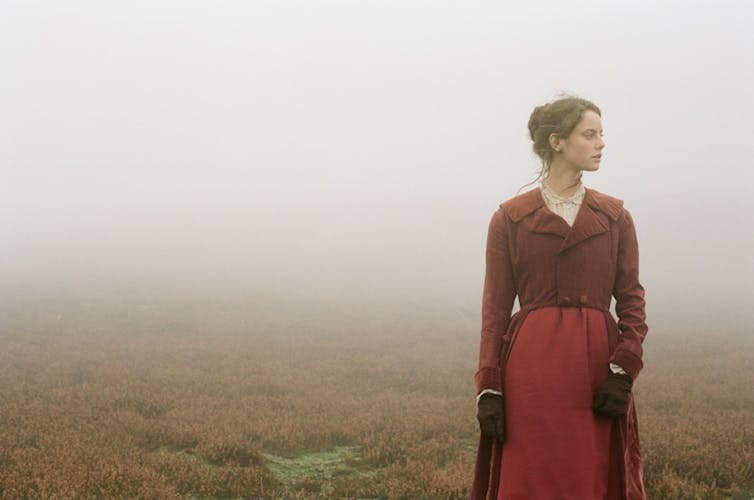
Kaya Scodelario as Catherine Earnshaw in the 2011 film adaptation of Wuthering Heights.
Film 4 and UK Film Council/IMDB

Sophie Alexandra Frazer, University of Sydney

In our series, Guide to the classics, experts explain key works of literature.

Nothing about the reception of Emily Brontë’s first and only published novel, Wuthering Heights, in 1847 suggested that it would grow to achieve its now-cult status. While contemporary critics often admitted its power, even unwillingly responding to the clarity of its psychological realism, the overwhelming response was one of disgust at its brutish and brooding Byronic hero, Heathcliff, and his beloved Catherine, whose rebellion against the norms of Victorian femininity neutered her of any claim to womanly attraction.

The characters speak in tongues heavily inflected with expletives, hurling words like weapons of affliction, and indulging throughout in a gleeful schadenfreude as they attempt to exact revenge on each other. It is all rather like a relentless chess game in hell. One of its early reviewers wrote that the novel “strongly shows the brutalising influence of unchecked passion”.

Moral philosopher Martha Nussbaum claims, however, that “we must ourselves confront the shocking in Wuthering Heights, or we will have no chance of understanding what Emily Brontë is setting out to do”. The reader must give herself over to the horror of Brontë’s inverted world.

She must jump, as it were, without looking to see if there is water below. It is a Paradise Lost of a novel: its poetry Miltonic, its style hyperbolic, and its cruelty relentless. It has left readers and scholars alike stumbling to locate its seemingly Delphic meaning, as we try to make sense of the Hobbesian world it portrays.

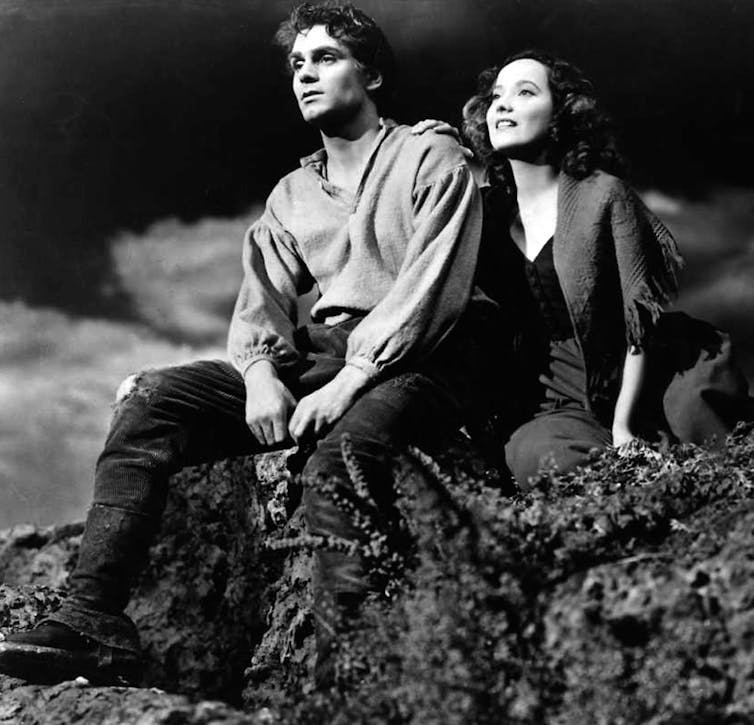
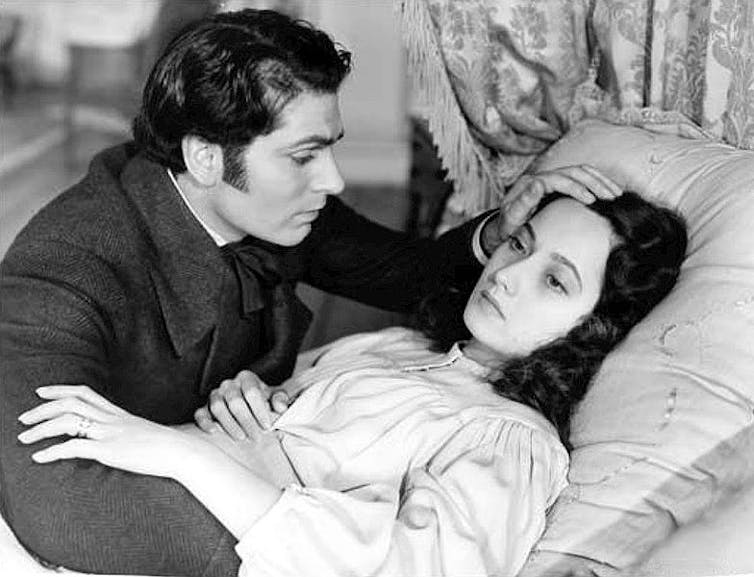
Sir Laurence Olivier (Heathcliff) and Merle Oberon (Cathy) from the 1939 film adaptation.
Photoplay/Wikimedia Commons

The author remains as elusive as her enigmatic masterpiece. As new critical appraisals emerge in this, Emily Brontë’s bicentenary year, the scant traces she left of her personal life beyond her poetry and several extant diary papers, are re-fashioned accordingly.

Described as the “sphinx of the moors”, her obstinate mystery has lured countless pilgrims to the Haworth home in which she passed almost all of her life, and the surrounding moorlands that were the landscape of her daily walks and the inspiration for her writing. Brontë relinquished her jealous hold of the manuscript only after considerable pressure from her sister Charlotte, who insisted that it be published.

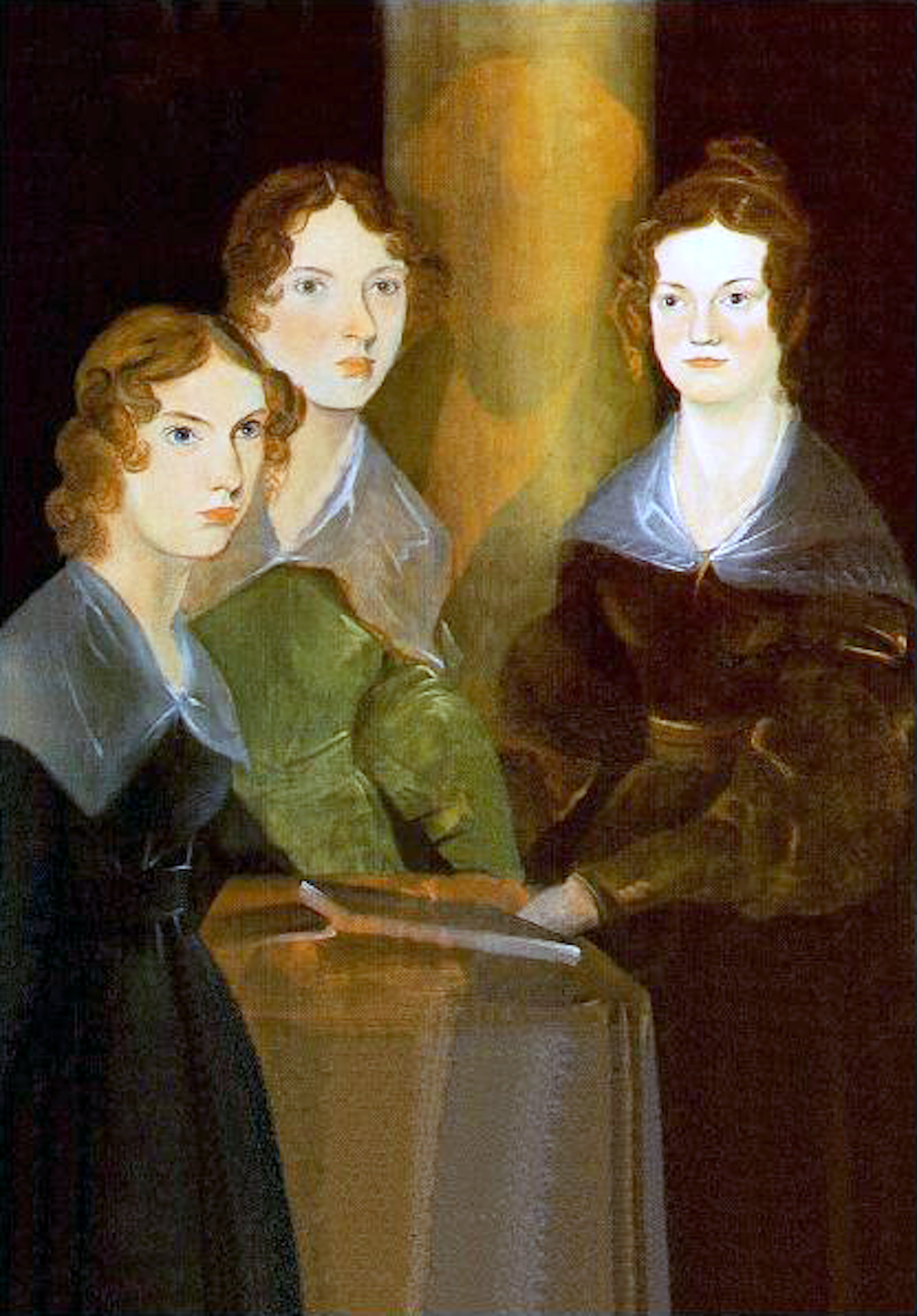
The Bronte sisters painted by their brother Branwell: from left to right, Anne, Emily, and Charlotte.
Wikimedia Commons

Wuthering Heights was released pseudonymously under the name Ellis Bell, published in an edition that included her sister Anne’s lesser known work, Agnes Grey. Emily was to die just 12 months later, in December 1848.

As Brontë biographer Juliet Barker writes, the writer stubbornly maintained the pretence of health even in the final stages of consumption, insisting on getting out of bed to take care of her much loved dog, Keeper. She resisted death with remarkable self-discipline but, “her unbending spirit finally broken”, she acquiesced to a doctor’s attendance. It was by then too late; she was just 30.

After her sister’s death, Charlotte Brontë wrote two biographical prefaces to accompany a new edition of Wuthering Heights, instantiating the mythology both of her sister – “stronger than a man, simpler than a child” – and her infamous novel: “It is rustic all through. It is moorish, and wild, and knotty as the root of heath.”


Read more:
Why Charlotte Brontë still speaks to us – 200 years after her birth


A feminist icon

It is that property of wildness that has compelled artists from Sylvia Plath to Kate Bush, whose 1978 hit single, Wuthering Heights, was representative of the magnetic pull of Brontë’s fierce heroine, Catherine. The novel has maintained its relevance in popular culture, and its author has risen to a feminist icon.

Wuthering Heights has maintained currency in pop culture, most famously in Kate Bush’s haunting 1978 hit of the same name.

The elusiveness of the woman and the book that now seems an extension of her subjectivity, gives both a malleability that has seen Wuthering Heights transformed into various mediums: several Hollywood films, theatre, a ballet and, perhaps most incongruously, a detective novel. Brontë’s name is used to sell everything from food to dry-cleaning products.

Film versions have tended to indulge in a surfeit of romanticism, offering up visions of the lovers swooning atop windswept hills, most famously in the 1939 movie, with Laurence Olivier as a dashing Heathcliff, a heavily sanitised re-telling of what the promotional material billed as “the greatest love story of our time – or any time!” Andrea Arnold’s gritty, pared-back 2011 film is the notable exception; bleak and darkly violent, the actors speak in an at times unintelligible dialect, scrambling across a blasted wilderness as though they are animals.

Contrary to Charlotte Brontë’s revisioning, however, Wuthering Heights was not purely the product of a terrible divine inspiration, emerging partially formed from the granite rock of the Yorkshire landscape, to be hewn from Emily’s simple materials.

Instead, it is the work of a writer looking back to past Romantic forms, specifically the German incarnation of that aesthetic, infused with folkloric taboos and primal longings. Her tale of domestic gothic is housed in an intricately complex narrative architecture that works by repetition and doubling, at the fulcrum of which stands Catherine, the supremely defiant object of Heathcliff’s obsession.

At the novel’s core is the corrosiveness of love, with the titanic power of Shakespearean tragedy and the dialogic form of a Greek morality play. Two families, locked in internecine war and bound together by patrilineal inheritance, stage their abject conflict across the small geographical space that separates their respective households: the luxury and insipidity of the Grange, versus the shabby gentility, decay, and violence of the Heights.

A claustrophobic novel

It is a distinctly claustrophobic novel: although we read with a vague sense of the vastness of the moors that is its setting, the action unfolds, with few exceptions, in domestic interiors. Despite countless readings, I can conjure no distinct image of the Grange. But the outline of the Heights, with each room unfolding into yet another set of rooms, labyrinthine and imprisoning, has settled into my mind. The deeper you enter into the space of the Heights – the space of the text – the more bewildering the effect.

The love between Heathcliff and Catherine exists now as a myth operative outside any substantial relationship to the novel from which the lovers spring. It is shorthand in popular culture for doomed passion. Much of this hyper-romance gathers around Catherine’s declaration of Platonic unity with her would-be lover: “I am Heathcliff – he’s always, always in my mind.” Yet their relationship is never less than brutal.

What is it about their unearthly union, with its overtones of necrophilia and incestuous desire, that so captivates us, and why does Emily Brontë privilege this form of explicitly masochistic, irrevocable and unattainable love?


Read more:
How incest became part of the Brontë family story


Brontë’s great theme was transcendence, and I would suggest that it is the metaphysical affinity that solders these two lovers that so beguiles us. The greediness of their feeling for each other resembles nothing in reality. It is hyperreal, as Catherine and Heathcliff do not aspire so much as to be together, as to be each other. Twinned in that shared commitment and to the natural world that was the hunting-ground of their childhood play, they try, with increasing desperation, to get at each other’s souls.

Penistone Crag – a rock at the top of Ponden Kirk – is believed to have been Emily Brontë’s inspiration for the place where Cathy and Heathcliff went to be alone.
Aaron Collis/Wikimedia Commons, CC BY-SA

This is not a physically erotic coupling: the body is immaterial to their love. It is a very different notion of desire to that of Jane Eyre and Rochester, for instance, in Charlotte Brontë’s Jane Eyre, which is very fleshy indeed. Both Catherine and Heathcliff want to get under each other’s skin, quite literally, to join and become that singular body of their childhood fantasies. It is a dream, then, of total union, of an impossible return to origins. It is not heavenly in its transcendence, but decidedly earthly. “I cannot express it”, Catherine tells her nurse Nelly Dean, who is our homely, yet not so benign, narrator:

But surely you and everybody have a notion that there is, or should be, an existence of yours beyond you. What were the use of my creation if I were entirely contained here? My great miseries in this world have been Heathcliff’s miseries … my great thought in living is himself. I all else perished, and he remained, I should still continue to be.

This notion of the self eclipsing its selfish form seems impossible for us to conceive in an age where one’s individuality is sacred. It is, however, the essence of Catherine’s tragedy: her search for her self’s home among the men who circle her is futile. Nevertheless, Emily Brontë’s radical statement of a shared ontology grounds the eroticism between the pair so that we cannot look away; and neither it seems, can the other characters in the novel.

The book’s structure is famously complex, with multiple narrators and a fluid style that results in one focalising voice shading into another. The story proper begins with Lockwood, a stranger to the rugged moorlands, a gentleman accustomed to urban life and its polite civilisations.

The terrifying nightmare he endures on his first night under Heathcliff’s roof, and the gruesomely violent outcome of his fear sets in motion the central love story that pulls all else irresistibly to it. Heathcliff’s thrice-repeated invocation of Catherine’s name, which Lockwood finds written in the margins of a book and mistakenly believes to be “nothing but a name”, works as an incantation, summoning the ghost of the woman who haunts this book.

The ConversationEmily Brontë speaks of dreams, dreams that pass through the mind “like wine through water, and alter the colour” of thoughts. If the experience of reading Wuthering Heights feels like a suspension in a state of waking nightmare, what a richly-hued vision of the fantastical it is.

Sophie Alexandra Frazer, Doctoral candidate in English, University of Sydney

This article was originally published on The Conversation. Read the original article.
Unknown's avatar

Wuthering Heights Infographics


The link below is to an artcile that contains a host of ifographics concerning the Emily Bronte novel, ‘Wuthering Heights.’

For more visit:
https://www.theguardian.com/books/gallery/2018/jul/30/emily-brontes-wuthering-heights-in-charts

Unknown's avatar

Emily Brontë at 200: Wuthering Heights has had readers going round in circles for 170 years


File 20180720 142432 1ib6tin.jpg?ixlib=rb 1.1
Sir Laurence Olivier and Merle Oberon in the 1939 film Wuthering Heights.
Wikimedia

Catherine Han, Cardiff University

Though she is famed as one of England’s greatest writers, Emily Brontë – whose 200th birthday would have fallen on July 30, 2018 – probably only ever wrote one novel, Wuthering Heights, first published in 1847.

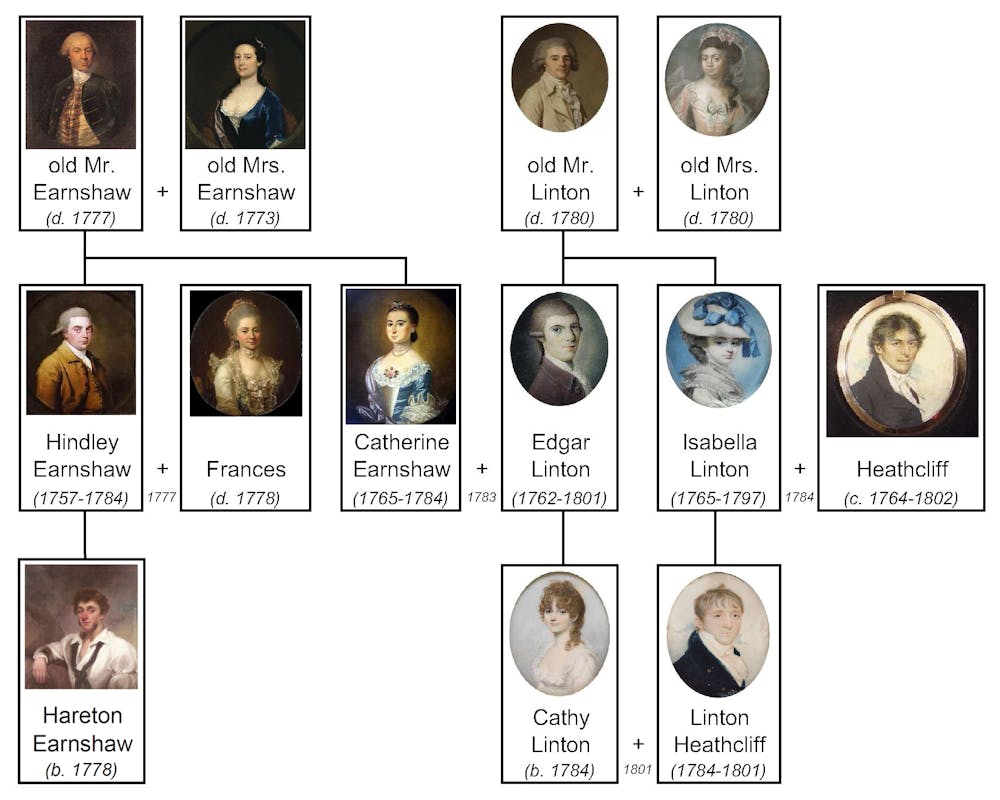
Wuthering Heights might now be synonymous with Cathy and Heathcliff, but their love affair is not the whole story. They exist within an elaborate web of semi-incestous relationships between the Earnshaw, Linton and Heathcliff families. Through its multigenerational story, the book examines whether grand but destructive passion is preferable to companionship and domesticity.

Wuthering Heights family tree.
shakko/Wikimedia, CC BY-SA

The novel’s first half relates the love between Cathy and Heathcliff, but the latter part is devoted to their descendants, especially Cathy’s daughter, Catherine Linton, and her nephew, Hareton Earnshaw. Ever since Wuthering Heights was first printed, the contrast between the two generations has prompted readers to ask the same questions. Does Brontë ultimately critique Cathy and Heathcliff’s exciting but tortured affair by comparing them with Catherine and Hareton? Or do the younger couple, after their transgressive predecessors, represent the restoration of boring convention?

Generations of patterns

From the very start, Wuthering Heights encourages readers to look at the generations in relation to one other. Brontë employs an intricate pattern of repeating names, a pattern made explicit by the bumbling narrator Lockwood. In an early chapter, Lockwood spends a night at the gothic Heights where he discovers those names graffitied onto a window ledge. He recounts:

This writing, however, was nothing but a name repeated in all kinds of characters, large and small – Catherine Earnshaw, here and there varied to Catherine Heathcliff, and then again to Catherine Linton.

In vapid listlessness I leant my head against the window, and continued spelling over Catherine Earnshaw—Heathcliff—Linton, till my eyes closed; but they had not rested five minutes when a glare of white letters started from the dark, as vivid as spectres – the air swarmed with Catherines…

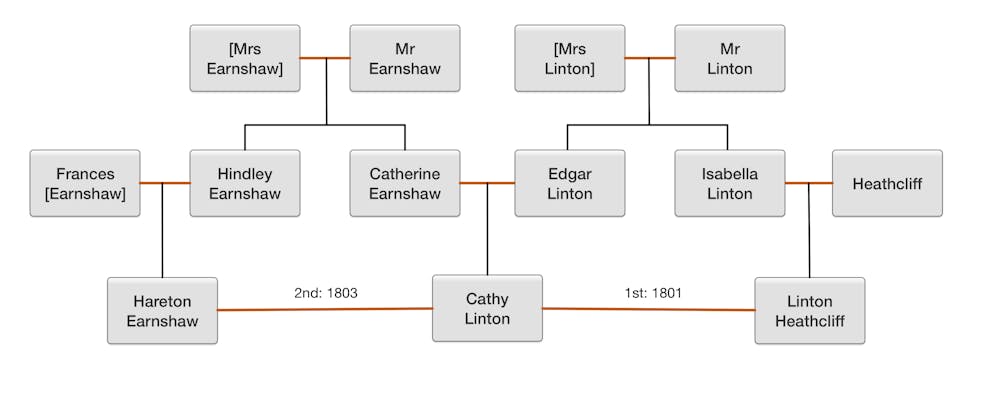
This Catherine soup foreshadows major events to come. The first Catherine, Cathy, begins the novel as “Catherine Earnshaw” before taking the surname Linton after marrying Edgar. Her daughter is born “Catherine Linton” then becomes “Catherine Heathcliff” through a forced marriage to Linton Heathcliff, Heathcliff’s son. In the final chapter, the second Catherine is engaged to Hareton and is on the verge of being renamed “Catherine Earnshaw”. As the names reveal, the novel gives one version of the story and then tells the same tale in reverse.

Relationships of Wuthering Heights.
MichaelMaggs/Wikimedia

Lockwood’s visions suggest that these names and their attached identities are floating free, ready to be claimed or disregarded at will. Indeed, names and identities within Wuthering Heights appear interchangeable. The novel keeps swapping the characters and their names around in order to imagine them in new combinations. In the process, the distinctions between the generations and their attached symbolism start to dissolve.

Circling the story

The pattern of names also suggest that Wuthering Heights is a cyclical tale rather than a linear one. The repetitions introduce all sorts of complications into how we read the two halves of the narrative in relation to each other. From one perspective, the circular structure prevents us from assuming that Wuthering Heights is a tale of doomed passion being eventually superseded and replaced by mature love. From another, the first generation can be interpreted as triumphantly returning. We start with a Catherine Earnshaw and end up looping back to a Catherine Earnshaw.

Of course, Wuthering Heights is too sophisticated to give us an either/or answer as to whether passion or companionship is preferable. On closer inspection, Catherine and Hareton possess many of the same qualities as their forebears but in less extreme and more domesticated forms. In the final chapter, the pair is described as reading together in a recently replanted garden, a detail that suggests the violence and chaos of the Heights has been tamed. They symbolise a harmonious synthesis of the many oppositions – especially nature/culture and passion/companionship – that abound in the novel. In this hybrid setting, the younger Catherine’s taking of her mother’s maiden name creates the impression of a simultaneous return and renewal.

The ConversationThe novel’s recurring names and its overall design suggests other possibilities. In particular, that Brontë was more interested in weaving a complex narrative than answering the very questions raised by her own novel. In so doing, she crafted a literary and philosophical puzzle that continues to ignite the imaginations of many authors, filmmakers and artists to this day.

Catherine Han, Teacher, Cardiff University

This article was originally published on The Conversation. Read the original article.