
Unknown's avatar

143,518 US public library workers are keeping their communities informed, connected and engaged – but their jobs may be at risk


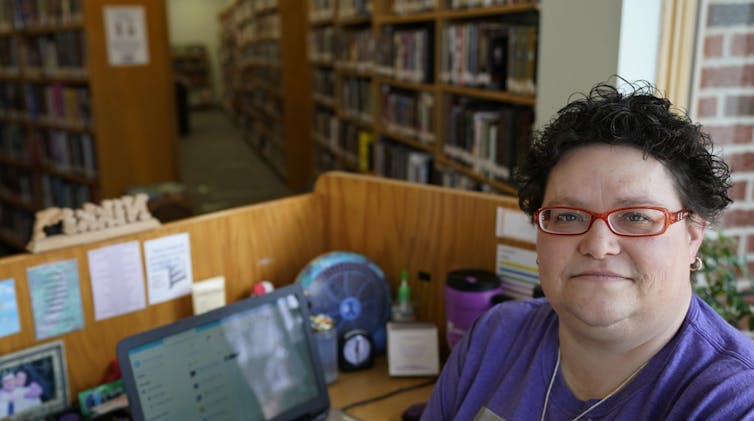
Nikki Luman works part-time for a public library in Sycamore, Ohio.
AP Photo/Tony Dejak

Rachel D. Williams, Simmons University; Christine D’Arpa, Wayne State University, and Noah Lenstra, University of North Carolina – Greensboro

CC BY-ND

America’s public library workers have adjusted and expanded their services throughout the COVID-19 pandemic.

In addition to initiating curbside pickup options, they’re doing many things to support their local communities, such as extending free Wi-Fi outside library walls, becoming vaccination sites, hosting drive-through food pantries in library parking lots and establishing virtual programs for all ages, including everything from story times to Zoom sessions on grieving and funerals.

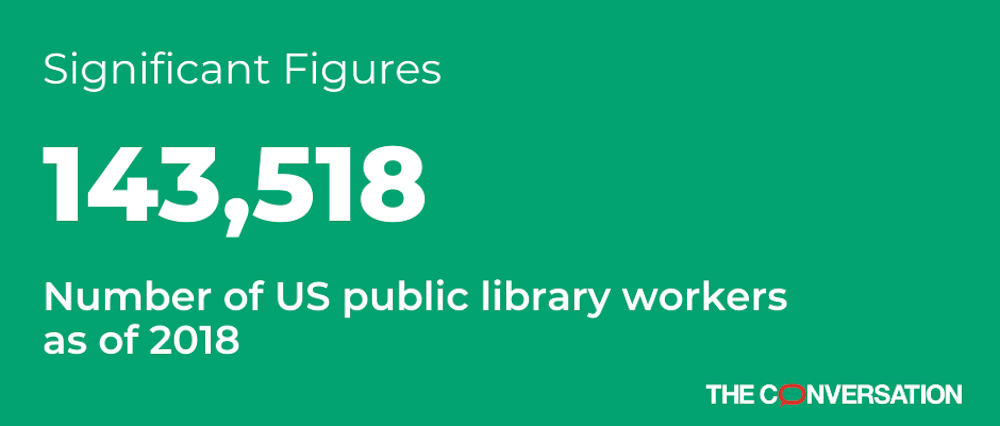
In 2018, there were 143,518 library workers in the United States, according to data collected by the Institute of Museum and Library Services. While newer data isn’t available, the number is probably lower now, and recent history suggests more library jobs may be on the chopping block in the near future.

As library and information science researchers, we are concerned about library worker job insecurity.

During the Great Recession, the economic downturn between late 2007 and mid-2009, thousands of librarians and other library staff lost their jobs. As local governments cut spending on libraries, the size of that workforce shrank to 137,369 in 2012 from 145,499 in 2008.

Many library workers actively supported the recovery from that economic crisis in many creative ways. Some loaned patrons professional attire to wear for job interviews. Others helped local unemployed people gain basic financial literacy and digital skills.

Unfortunately, many of the Great Recession’s job losses were never completely overcome. There were about 2,000 fewer library workers in 2018 than in 2008, at the height of the crisis.

Library workers are again losing their jobs despite the important roles that libraries are playing today. According to preliminary data and news coverage collected by the Tracking Library Layoffs initiative, it’s clear that not all of the library workers furloughed since March 2020, when virtually all U.S. libraries were closed amid lockdowns, have been brought back on staff.

At the same time, many library workers have had to directly engage in person with the public throughout the pandemic, exposing them to health risks.

There are steps the federal government could take to protect the nation’s libraries.

For example, after Hurricane Katrina in 2005 and Hurricane Sandy in 2012, the Federal Emergency Management Agency recognized libraries among essential services. The federal government has not taken this step so far during the coronavirus pandemic.

Among other things, lacking this designation may have made it more difficult for librarians and other library staff members to get COVID-19 vaccines.

To date, the federal coronavirus relief packages have included a total of about US$250 million to support public libraries. These funds, distributed to state library agencies, amount to approximately $14,304 – about 1.7% of their annual revenue – for each of the nation’s 17,478 library branches and bookmobiles. We suspect that this infusion of cash will fall short of what’s needed to help public libraries and their workers recover from the tumult caused by the COVID-19 pandemic.

[Over 100,000 readers rely on The Conversation’s newsletter to understand the world. Sign up today.]The Conversation

Rachel D. Williams, Assistant Professor of Library and Information Science, Simmons University; Christine D’Arpa, Assistant Professor of Library and Information Sciences, Wayne State University, and Noah Lenstra, Assistant Professor of Library and Information Science, University of North Carolina – Greensboro

This article is republished from The Conversation under a Creative Commons license. Read the original article.

Unknown's avatar

Shades of green: What gig economy workers can learn from the success of romance writers


Chris Larson, University of Colorado

When “Fifty Shades Freedopens in theaters on Feb. 9, fans will no doubt flock to see bad boy Christian Grey (played by Jamie Dornan) bested by naughty-but-nice heroine Anastasia Steele (Dakota Johnson).

A less racy but equally thrilling story, my research shows, is how romance writers are getting ahead in the digital era.

While economists and labor scholars wring their hands over the rise of the precarious gig economy, these freelancers have developed innovative business practices over the past four decades that have set them up for success in the digital era.

Romancing the gig economy

Although few have reached the flabbergasting success of “Fifty Shades” author E.L. James, a former fan fiction writer whose net worth now totals more than US$58 million, I found that the median income for romance authors has tripled in the e-book era. And more and more are earning a six-figure income.

‘Fifty Shades Freed’ is the third film based on the steamy trilogy that originated as a self-published work of fan fiction.
CC BY-SA

This uptick occurred as other types of writing became less profitable. During the same period, a survey of 1,095 Authors Guild members found that their median income from writing fell by at least 30 percent.

Clearly, romance writers know something that other authors, and many struggling freelancers, don’t. The one-third of American workers toiling in the gig economy can learn a few lessons from them.

Some 57.3 million U.S. workers freelanced in 2016, according to research firm Edelman Intelligence. Economists Lawrence Katz and Alan Krueger found that 15.8 percent of Americans work in “alternative work arrangements” (freelancing, contracting, temp work, etc.), up from 9.1 percent in 1995. In fact, they found that all net job growth in the U.S. from 2005 to 2015 came from such work.

If you’re not already freelancing, you may be soon. Edelman predicts that given current growth rates, more than half of the American workforce will freelance by 2027.

Experts don’t agree whether this trend is good or bad for workers and the economy. The freedom is nice but freelancing often pays poorly.

While few writers are getting rich off books alone – I found that half of romance writers earned less than $10,000 in 2014 – more and more are able to support themselves. While only 6 percent earned at least $100,000 in 2008, more than 15 percent did in 2014. Most gig workers, including authors, patch together a living through multiple occupations.

You might speculate that romance writers’ succeed because smut sells. But that doesn’t explain why romance writers are faring better than their peers with digital sales.

Instead, three surprising practices set romance writers up for success: They welcome newcomers, they share competitive information, and they ask advice from newbies.

https://datawrapper.dwcdn.net/r0E4m/7/

Welcoming newcomers

Faced with rejection and ridicule from other writing groups in the 1970s, romance writers formed their own professional association, Romance Writers of America. It now has some 10,000 members.

From its start in 1980, the group embraced newcomers. Unlike other major author groups – and most professional associations – this one welcomes anyone seriously pursuing a career in the field. Newcomers may join once they’ve completed an unpublished romance manuscript.

//platform.twitter.com/widgets.js

Similar groups, including the Authors Guild, Mystery Writers of America and Science Fiction and Fantasy Writers of America, limit full membership to published authors. In some cases, these groups only accept members whose work has been published by specific companies or who have earned a specified amount of money in royalties.

Unlike Romance Writers of America, most traditional guilds, unions and trade associations only admit established professionals.

These barriers to entry can stultify and stagnate industries, especially with today’s transitions. Network theorists Walter Powell and Jason Owen-Smith, for instance, found that the most successful biotech companies in the 1990s formed strategic alliances with newcomers.

This phenomenon isn’t new.

Political science professor John Padgett of the University of Chicago found that upper-crust families in Renaissance Florence who allied themselves with new, upstart families prospered, while members of the elite who shunned newcomers lost influence over time.

Like the protagonist of this series, romance novel writers are pretty smart.
Kate Haskell, CC BY-NC-SA

Sharing competitive information

A strong tradition of mentoring pervades the culture. Romance Writers of America runs contests for unpublished writers and schedules conference tracks for newbies, and informal Yahoo loops, Google groups and meetups help newcomers get oriented.

These networks proved valuable when new digital self-publishing avenues opened up 10 years ago.

Numerous self-published romance writers, including blockbuster author Bella Andre, known for her Sullivan family books, shared their mistakes and successes with other writers as they tried new digital methods of publishing and promotion. Marie Force, best-selling author of the Gansett Island series, started an online self-publishing advice group. Some authors, like Brenna Aubrey, whose romantic stories are about geek culture, even declare their earnings.

This radical transparency that propelled many romance writers to digital success can work in other fields.

For instance, openly sharing local rates and best practices could prove valuable to workers who find jobs through sites like Upwork and TaskRabbit, many of whom set their own prices.

Getting advice from newbies

The openness of romance writers has yielded an unexpected side benefit: access to innovators. The most successful romance writers I studied were experienced authors who asked newcomers for advice.

Using social network analysis tools, my colleague Elspeth Ready and I looked at advice patterns among 4,200 romance writers I surveyed.

While you might presume that novice writers would seek advice more often than anyone else, this wasn’t the case. While 72 percent of unpublished authors in my survey sought advice in the past year, a subset of established writers asked advice just as often. These were established authors interested in shifting to self-publishing.

Many of them did, successfully. I found that, by 2014, traditionally published authors who had added self-publishing to their portfolio out-earned all other romance writers: These so-called “hybrid” authors had a median income of $87,000.

Of course, most writers weren’t earning nearly that much: Half earned less than $10,000 a year. And my survey relied on self-reported income, which can be imprecise. Still, as a whole, these writers saw their prospects improve as the digital gig economy grew and other authors were earning less than before.

The ConversationAt a time when work is becoming increasingly solitary, it only seems fitting that a model involving mutual care and support comes from the freelancers who earn a living from imagining successful connections.

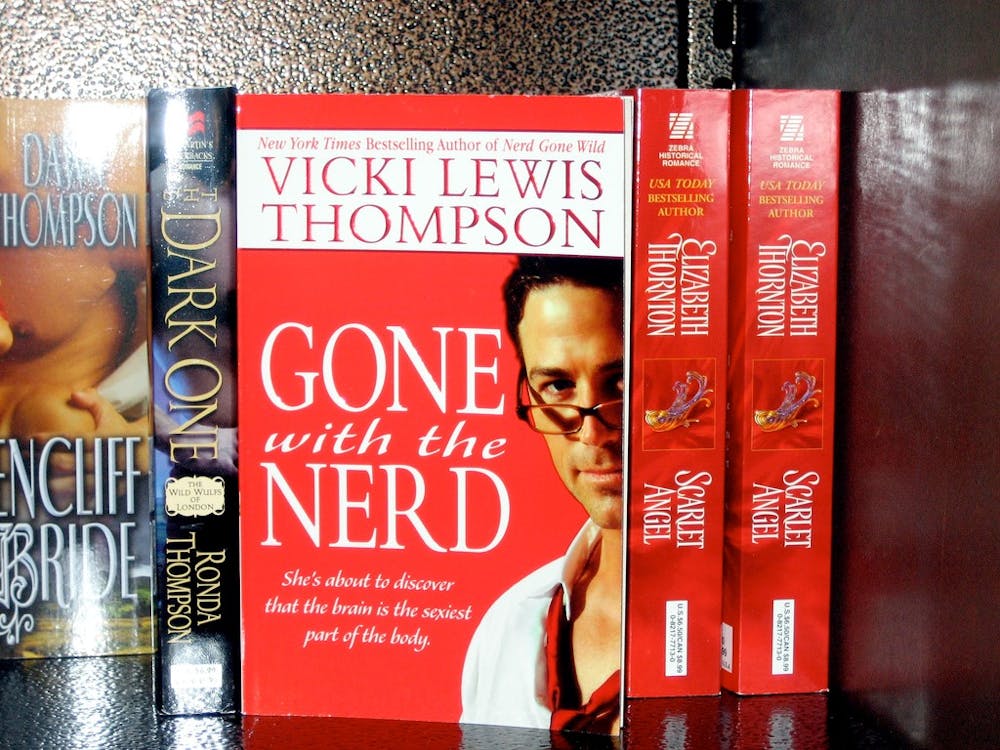
Two samples of this genre.
Daniel Oines, CC BY-NC-SA

Chris Larson, Assistant Professor of Journalism, University of Colorado

This article was originally published on The Conversation. Read the original article.