Language is like archaeology. It lays down evidence for following generations to excavate and write PhD theses about. Layers of the stuff. And such has been the language of the year of COVID.
Not surprisingly, COVID has spawned an efflorescence of words and expressions. And these will certainly be dug up for analysis by our descendants.
In Australia we have a characteristic way of repurposing words, and we have applied it to COVID. Isolation became “iso”, which was crowned (joke: corona is Latin for crown) Word of the Year, or WOTY, by the Australian National Dictionary.
And coronavirus became “rona”, the Macquarie Dictionary’s COVID WOTY for 2020, announced today.
The Macquarie has departed from its usual practice (as has the Oxford English Dictionary) and anointed not one but two WOTYs (should that be WOTIES?): one to honour the way COVID has dominated our world, thinking and language this year; and another across-the-board WOTY as well. Their latter choice was “doomscrolling”, the practice of continuing to read news online or on social media when you know there’s nothing new in the news, and it’s all miserable.
Iso and rona are diminutives or hypocoristics. I have a database of over 6,000 of these in Australian English. These are derived forms of words that express an emotional overtone, usually amiable and solidaristic (“barbie” for barbecue; “servo” for service station), sometimes pejorative (“commo” for communist, “drongo” for well, an idiot).
But my personal nomination for the 2020 WOTY is “quazza” for quarantine. I predicted its birth and was fulfilled when it duly appeared.
Quazza follows a pattern in Australian English where R becomes Z: Terry gives “Tezza”, Barry gives “Bazza”, and quarantine yields “quazza”. Which is a long way from the Italian word quarantina, a reference to the 40-day period ships had to anchor off Italy in days gone by to prove there was no plague on board.
These diminutives serve an important purpose. They de-demonise threatening words. Without reducing the level of the words’ threat, the diminutives imply: this is something we can get our minds around and manage.
And gradually, with some temporary reversals, that is what we have done, and much more effectively than most other countries. Though whether the diminutives have medical force is not yet proven.
‘Doomscrolling’ captures the intersection of this year’s unfolding catastrophes and social media. Unsplash, CC BY
Getting the message
Of course, there’s more to the influence of language under COVID than diminutives. In terms of public health and communication, three key agencies have driven our handling of the pandemic: scientists, policymakers and the public.
In Australia, the passage of information and action between these three entities has worked rather well. Science has transmitted reliable and helpful analyses of coronavirus and COVID-19 to policymakers. They informed our understanding of specific pandemic terms like “incubation” and “reinfection”.
State and federal governments have issued action guidelines with terms like “COVID safe”. And the public has created their own shorthand like the diminutives described above to make it all a bit friendlier.
Australians have accessed the science through the media and the internet, and have generally acted responsibly.
Using words consistently and specifically is vital when it comes to health messages. Unsplash/United Nations, CC BY
The key mechanism for communicating along the three axes between science, policymakers and the public involves messaging. Words matter in this context. What is needed is simple, direct, transparent and plausible language. Translations for multilingual communities are also vital.
Australian authorities have used words effectively and fairly consistently (though not always). The words and terms have fallen within four broad lexical categories:
1. isolation — lockdown, isolation, quarantine
2. distance — social distancing, venue capacity
3. hygiene — handwashing, sanitiser (or “hand sanny” in Australian slang), masks
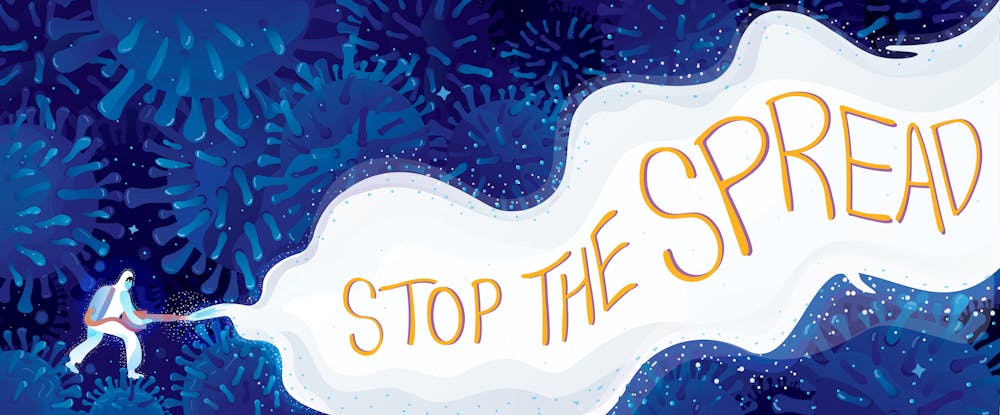
3. social — COVID safe, flatten the curve, stop the spread, WFH (work from home).
The British messaging was much less effective, moving from “Protect the NHS” (National Health Service) to “Stay alert” without specifying what people should be alert to.
Unfortunately, many countries took up the phrase “social distancing”, when what was needed was “physical distancing”, continuing social interaction as an important part of maintaining well being. The World Health Organisation agrees.
Next time — and there certainly will be a next time — we need to be better prepared.
There will be new vocabulary to describe, and perhaps to help tame, potential new threats. The messaging may be very similar, and we will know, from our experience with COVID-19 in 2020, how best to stop “covidiots” from acting “coronacrazy”.
‘Cancel culture’ has been nominated Word of the Year by The Macquarie Dictionary, for reflecting the zeitgeist. Wes Mountain/The Conversation, CC BY-ND
How many of these words, shortlisted by The Macquarie Dictionary in its search for the 2019 Word of the Year, have you used? Anecdata, big minutes, cancel culture, cheese slaw, cleanskin, drought lot, eco-anxiety, flight shaming, healthwashing, hedonometer, mukbang, ngangkari, robodebt, silkpunk, thicc, and whataboutism?
I confess the only one on this list (whittled down from 75 words), that has passed my lips has been “cleanskin”, but I wasn’t referring to someone with no tattoos – the new definition.
I may not have used these shortlisted words, but I have certainly experienced the effect of some of them and can appreciate the value of others. (“Whataboutism”, for instance, a technique used “in responding to an accusation, criticism or difficult question in which an opposing accusation or criticism is raised”, will come in very handy when describing many politicians. )
I doubt, though, whether I’ll be able to remember and use many of these words, colourful and tinged with negativity as many are.
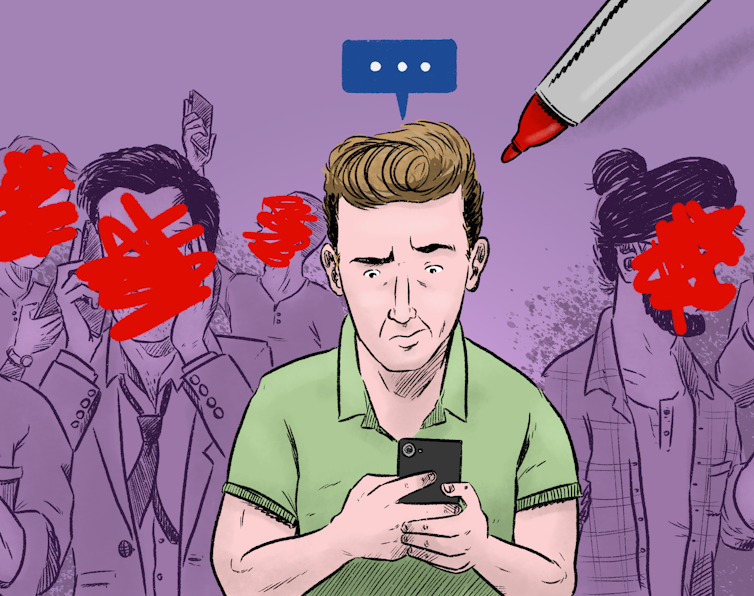
The Macquarie Dictionary committee has chosen “cancel culture” as its Word of the Year. The term is used to describe community attitudes that
…call for or bring about the withdrawal of support from [for] a public figure, such as cancellation of an acting role, a ban on playing an artist’s music, removal from social media, etc., usually in response to an accusation of a socially unacceptable action or comment by the figure.
Unfortunately, there have been any number of recent examples in Australia of ostracism through “cancel culture”, whose cases have progressed to the courts. I hesitate to mention Geoffrey Rush here.
The committee chose “cancel culture” because it believes the term “captures an important aspect of the past year’s zeitgeist”.
In looking over the list, I’m not sure that I like any of these words. I think a couple of them are ridiculous, in particular “hedonometer”, an algorithm using language data from Twitter to analyse levels of happiness.
To qualify as Macquarie’s word of the year, a word must be newly added to the dictionary in that year or, as is the case with “cleanskin”, an old word with an additional new meaning.
Macquarie points out that it differs from other dictionaries, as some simply choose the most common word being searched, or most topical word, regardless of its status as “new”. The people at Cambridge Dictionary, which chose “upcycling” for 2019, relied on their Instagram account to make the call.
If the Macquarie committee had done this, its 2019 Word of the Year would have been “cheese slaw” (a salad of grated carrot, grated cheese, and mayonnaise), which it admits would have been a “niche and controversial” choice.
Macquarie has posted a photo on its website of a cheese slaw (stuffed into a sandwich), as well as an equally unappetising photo of a companion food word “mukbang”. A mukbang, by the way, describes a live online broadcast in which someone eats, often a large amount, while simultaneously speaking to their audience.
Criteria apart from “new” for Macquarie appear to be that a word is ubiquitous, timely, influential, and makes a valuable contribution to Australian English. So, does “cancel culture” qualify? Kind of.
Macquarie sorts the year’s new words into 15 categories, and one could spend an enjoyable time and several hours cruising through them: agriculture, arts, business, communications, eating and drinking, environment, fashion, health, politics, sport, and technology.
ngangkari and thicc
Two of the most interesting new additions – both runners-up as word of the year (along with eco-anxiety) – are “ngangkari”, adopted unaltered from Pitjantjatjara, for an Indigenous practitioner of bush medicine, and “thicc” from African American English, which “celebrates body positivity that does not conform to conventional white standards of beauty”.
The environment figures strongly in this year’s shortlist, in “eco-anxiety”, “flight shaming”, and “drought lot”. Still, the folk at Collins Dictionary named their Word of the Year for 2019 as “climate strike”. The Oxford Dictionary chose “climate emergency” as its Word of the Year.
Flight shaming is an anti-flying movement that originated in Sweden last year, which encourages people to stop taking flights to lower carbon emissions. shutterstock
The Macquarie Committee has now opened the voting for People’s Choice Word of the Year 2019. Only once in the past five years has the committee’s and the people’s choice aligned. In 2015, “captain’s call” won both categories.
You may wonder why the competition is even called “word of the year” when it comprises two words, or even three. In 2016 the people’s choice was “halal snack pack”. As the website points out, it’s the lexical unit of meaning that the committee considers, what’s called the “headword” in a dictionary.
In the meantime, if you are interested in chasing up the Macquarie shortlist and maybe voting, you have until midnight on Sunday December 8 to do so.






 At the BookShelf