

Unknown's avatar

Shakespeare on Zoom: how a theatre group in isolation conjured up a Tempest


Madeleine MacMahon as ‘Sebastianne’ in a live production of The Tempest by Creation Theatre from 2019.
Creation Theatre/ Big Telly Theatre Company

Laura Jayne Wright, University of Oxford

While theatres remain closed, the way we watch Shakespeare is changing. When I picture the audiences Shakespeare would have written for, I think of the groundlings in Shakespeare in Love(1998). They stand, arms on the edges of the stage, staring upwards, eyes filled with tears – laughing, clapping, gasping. They are part of the show – and they show that they’re there. In the bright afternoon sun, the actors can see and hear every reaction.

Right now, of course, it’s not possible to take a trip to the playhouse. Still, with the National Theatre, the Globe, and the Really Useful Group moving quickly to put past performances online, the theatre can come to us via YouTube. We can see and hear the actors (and, having watched Hamlet, Jane Eyre and The Phantom of the Opera, I’ve been very grateful for it). But even though we can tweet our reactions, the actors can’t see or hear us.

The possibility of live performances during lockdown might change that. Over the Easter weekend, I watched an Oxford-based theatre company, Creation Theatre, and their co-producers at Big Telly Theatre Company from Portstewart in Northern Ireland, put on a production of The Tempest via video conferencing platform Zoom.

It seemed a tricky challenge under lockdown, with each cast member performing (and rehearsing) from home. Indeed, as chief executive and creative producer Lucy Askew warned before the play began, the night’s events were at the mercy of the technological gods.

But, when the play began and Ariel conjured a storm, suddenly it became clear that – despite our isolation – we too were part of the action. The audience’s microphones (muted while the actors spoke) were suddenly raised and we were asked to click our fingers to make it rain. The screen was full of audience members – and their pets, and their glasses of wine, and their pyjamas – and the storm was, even if I say so myself, convincing.

Within the space of an hour, the audience asked Antonio for answers via the chat function as he boasted of his usurpation of Prospero, we blew wind into the path of his ship and – in lieu of a banquet – all held up an offering of snacks (chocolate biscuits, from me). Each time other audience members appeared on screen, there was a rush of excitement as we got to see one another.

Listening to the island.

Shakespeare knew the importance of his audience’s reaction. At the end of The Tempest, Prospero relinquishes his magic and asks for something in return:

But release me from my bands
With the help of your good hands.
Gentle breath of yours my sails
Must fill, or else my project fails.

It’s a moment when we are asked to make some noise – to clap with our “good hands”, to cheer (or whistle, or shout) with our “gentle breath”. Prospero’s redemption, if we allow him that possibility, comes from finally turning outwards, it comes from him seeing the necessity of his connection to others – to his daughter, to his once-forgotten subjects in Milan, and, perhaps, to us.

Yet, for all of the noise we made, this new medium exposed the myriad kinds of loneliness in The Tempest. Prospero sat in front of a backdrop of television screens, reminding us that we were all at one remove from one another. When Caliban described the noises of the island, the “Sounds, and sweet airs that give delight and hurt not”, it was painfully apparent that he was alone and that there was nothing real to hear. When Ferdinand proposed to Miranda and reached from his screen to hers in an impressive feat of Zoom technology, that brief moment of “contact” was bittersweet.

After all, the despair of being alone is a fear which Prospero seeks to create. As ordered, Ariel deliberately scatters the shipwrecked courtiers across the island. Yet, as John Donne, a contemporary of Shakespeare, wrote:

No man is an island entire of itself;
every man is a piece of the continent, a part of the main.

The dispersed groups come back together – Prospero leaves his island exile, and returns home. It’s not a perfect resolution, and it’s not a happy ending, but it is, nonetheless, a reunion.

Somewhere new?

As site-specific, conference call plays go, The Tempest lends itself to such a production. It’s a play about isolation and exile, about characters moving around a small island without ever meeting one another. Creation’s performance did nothing to disguise its new medium. In fact, the most powerful part of the performance came as Prospero spoke the famous epilogue which begins: “Now my charms are all o’erthrown”.

The cast slowly and methodically packed up their bedsheet green screens and wiped off their makeup. They changed their onscreen identities from their character’s names back to their own. By the time we were invited to stay on Zoom for a moment or two, to catch up with friends, thank the actors, and wave goodbye, the spell was broken.

But the magic may not be entirely over, not least as the popularity of their performances have led to Creation extending its run. Moreover, The Tempest is not the only play offered in this new genre of “Zoom Shakespeare”. Another group of actors recently collaborated to create A Midsummer Night’s Stream, which they advertise not simply as a reading but a live performance, “adapted for our stage”. And there is no reason to think that “Zoom Theatre” will stick to Shakespeare.

While we will (to entirely misuse one of Prospero’s lines) return to a time when we “have no screen between this part he play’d/And him he play’d it for”, Zoom Theatre may not be a temporary measure. Perhaps new plays will be written with the possibilities of Zoom and YouTube in mind. For many, watching theatre from home will allow for greater access and comfort. And, for now, speaking back, making noise, and waving at strangers, could inject a bit of silliness into our own isolated worlds.The Conversation

Laura Jayne Wright, Stipendiary Lecturer in English, University of Oxford

This article is republished from The Conversation under a Creative Commons license. Read the original article.

Unknown's avatar

Shakespeare’s ‘The Tempest’ explores colonialism, resistance and liberation


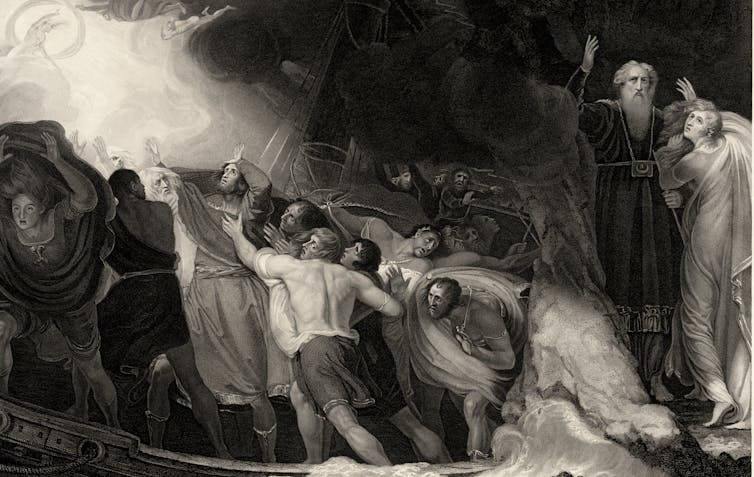
Shakespeare’s ‘The Tempest’ contains timeless themes around resistance and colonialism. Here in an engraving by Benjamin Smith based on a painting by George Romney of Act I, Scene 1 of ‘The Tempest’ by William Shakespeare.
(Benjamin Smith/George Romney/ Library of Congress’s Prints and Photographs division /pga.03317)

Paul Yachnin, McGill University and Hannah Korell, McGill University

Last winter, at the Studio Theatre at Ryerson University in downtown Toronto, Canadian actor Antoine Yared played Caliban in The Tempest. He stood, centre stage, looking out over the audience as he reassured his companions that the magic music of the island should not frighten them. He said:

“The isle is full of noises … that give delight and hurt not.”

But his face told the audience a different story — the story of a man heartbroken for what had been taken from him.

We chose Shakespeare’s The Tempest as the centrepiece for our “Playing for Free” workshop because the play has been entangled with the history of slavery and freedom in the west for over 400 years.

In this NYC 2016 production of Shakespeare’s ‘The Tempest,’ Reanna Roane, as ‘Ariel,’ perches on a rock in Central Park during the Outdoor Co-Ed Topless Pulp Fiction Appreciation Society theatre company’s performance.
(AP Photo/Kathy Willens)

The Tempest tells the story of the Duke of Milan, Prospero, who many years before had come to the island with his infant daughter. Upon arriving, Prospero enslaved two of its inhabitants, Caliban and the spirit Ariel. The play follows three interconnecting plotlines: Prospero’s revenge plan against his enemies; how his daughter, Miranda, falls in love with the son of his chief enemy; and how Caliban plans to destroy Prospero and take back the island.

Many consider the play an allegory of European colonization, and throughout the centuries, Caliban’s character has featured prominently in arguments that defend or resist against colonialist tyranny.

The Tempest has also been interpreted as an allegory of liberation. The 20th-century writer Roberto Fernández Retamar declared that the insurgent Caliban spoke for the colonized peoples of the Americas. In 1993, a production by Robert Lepage in Montréal portrayed Caliban as a working-class punk-rocker in open rebellion against the elite Prospero.

The Tempest and religious conversion

In our workshop, we wanted to blend theatre and scholarship to understand how The Tempest could have been used by both European colonialists and also by advocates of resistance. We also wanted to understand how the play might still be relevant.

The workshop brought together four Stratford Festival actors, three student actors from the Ryerson Performance Program and Renaissance scholars from an international initiative dedicated to understanding how Shakespeare’s work helped create the world we live in now.

The artists and scholars worked for a day and a half toward the performance. We talked about the history of slavery and freedom, primarily by thinking about how Christian conversion had served colonization. Indeed conversion has been an instrument of domination in the Americas from 1492 and onwards into recent times.

Forced conversion haunts the play. But there is another kind of conversion in the play where characters achieve the freedom to be true to themselves.

Caliban: Searching for the Other

Prospero attempts to strip away Caliban’s dignity. Prospero forces him to remain “stied” in a hard rock. In the Ryerson performance, Antoine Yared playing Caliban chose his first moments on stage carefully. Rather than obeying Prospero’s commands to “come,” he walked past Prospero, his back turned in a sign of his rebellion. For Caliban, even the act of walking around the Island, his home, was now charged with submission or defiance.

When Caliban encountered the shipwrecked servants he would recruit as co-conspirators against Prospero and when one of them fed him liquor, Caliban thought he had at last come face to face with God. He said to the drunken servant:

“Hath thou not dropped from heaven? … I prithee be my god.”

The drunk Caliban began singing and shouting:

“Freedom, high-day! High-day, freedom! Freedom!, high-day, freedom!”

But when the invisible Ariel began to make her magical music, the two servants quaked in terror. They knelt at Caliban’s feet. Caliban rose up — straight and fine like a young tree. He stood triumphantly over the two trembling servants. The music was something he knew well. It was nothing to be afraid of.

“Be not afeard; the isle is full of noises,

Sounds, and sweet airs, that give delight and hurt not.

Sometimes a thousand twangling instruments

Will hum about mine ears; and sometime voices,

That if I then had waked after long sleep,

Will make me sleep again: and then in dreaming,

The clouds methought would open and show riches

Ready to drop upon me, that when I waked

I cried to dream again.”

At the Ryerson performance in Toronto, Antoine Yared as Caliban chose his first moments on stage carefully. He walked past Ben Carlson as Prospero, his back turned in a sign of his rebellion.
Author provided

That was in rehearsal. But when Yared played Caliban in front of the audience, he changed the way he did the speech. His lines about the music of the island were no longer triumphant. They were something that could break your heart.

Yared’s Caliban was a man who had once been at one with the natural world, but who had been cast out and could only recapture some sense of the beauty of nature by dreaming. When he said, “I cried to dream again,” it was as if he were a man turning and turning, trying to find the beloved he had lost.

The workshop taught the actors, the scholars and the members of the audience how the play The Tempest, with its depiction of slavery, resistance and love might have challenged people of the past to see Caliban’s humanity and might also speak to audiences in the 21st century.

Yared’s Caliban left us with this urgent question. It was as if he were echoing Ariel and asking the audience:

“If you have eyes to see this suffering one, if you are human, your affections would become tender.”

[ Expertise in your inbox. Sign up for The Conversation’s newsletter and get a digest of academic takes on today’s news, every day. ]The Conversation

Paul Yachnin, Tomlinson Professor of Shakespeare Studies, McGill University and Hannah Korell, PhD Candidate, McGill University

This article is republished from The Conversation under a Creative Commons license. Read the original article.