
Unknown's avatar

Summer reads: When you can’t travel, let a book transport you


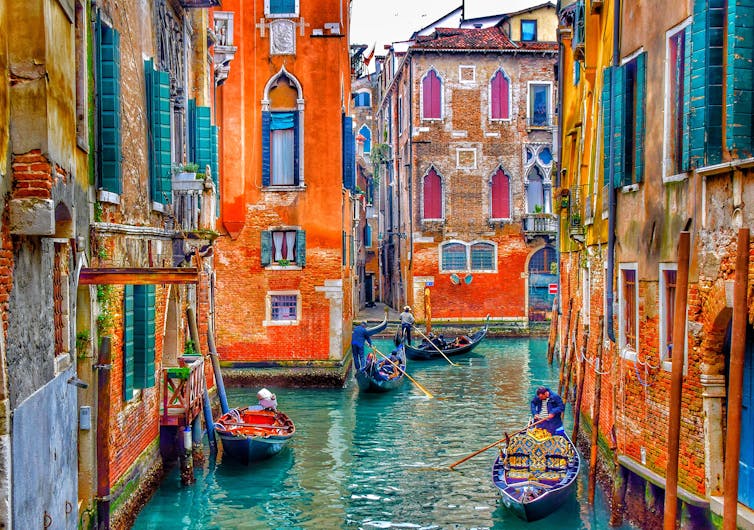
If you can’t get to Venice, Italy, allow a book translated from Italian to transport you there.
Tom Podmore/Unsplash

Amy McLay Paterson, Thompson Rivers University

I don’t understand beach reads. And I’m not the only one. There’s no universal consensus about the category, though the marketing tends to revolve around those books popularly considered disposable, unserious, or at the very least, books “you don’t mind getting wet.”

Last year, I toted Anna Karenina along with me — it got soaked, and I abandoned it in an AirBnB in Dubrovnik, Croatia, after I’d finished reading it. It lasted nearly the whole trip and left a gaping, souvenir-sized hole in my suitcase; it was perfect. So as much as I’d like to dissolve the beach read label entirely, I must also admit I have a type: I want a meaty, absorbing book that takes me further into a vacation by connecting with the cultures that produced it. I want a book that can’t be disposed of, one that will take me somewhere entirely new.

What I really want is to decouple the notion of summer reading as a lifestyle marker of class or gender. If the “pursuit of intellectual betterment” feels inaccessible or off-putting, I would like to propose at least the pursuit of expanding our emotional connections.

In a cultural climate where the limits of empathy are increasingly under a microscope, forging cross-cultural connections feels like a pressing task. Much has been made of the relationship between fiction reading and empathy, but what happens when the limits of our worldview are bounded by the English language? While linguistic diversity is growing in Canada, the majority of Canadians still speak only English at home, and comparatively few books are translated into English. If, as José Ortega y Gasset proposes, reading in translation should transport the reader into the language — and therefore the perspective — of the author, then reading translated works may be one of the best ways to expand empathy beyond the boundaries of language.

I’m not going abroad this summer, at least not physically. I’ll be staying in Canada, with only my books to pull me to other times and places. While in recent years, I’ve focused on keeping up with new releases, this year I’m fixated on atmosphere and transportation, in a mix of old favourites and new-to-me classics from around the world.

Italy

‘Arturo’s Island,’ 1957.
Arnoldo Mondadori Editore

I won’t tell you to read Elena Ferrante, because you’ve probably heard that before. Instead, I will be delving into the work of Elsa Morante, a possible inspiration for Ferrante’s pseudonym. Arturo’s Island, originally published in English in 1959, has been published in a new translation by Ann Goldstein (translator of Ferrante’s Neapolitan novels). The novel promises a mix of the remote island setting steeped in Morante’s preoccupation with social issues and the spectre of war.


Poland

‘Flights,’ 2018.
Riverhead Books

One of my favourite themes in European literature is that of movement and fluidity, the running sense of unity of purpose amidst myriad diverse pockets of culture. The ubiquity of trains and boats support transcontinental journeys by characters who switch language mid-conversation. Last year’s Man Booker International winner, Flights by Olga Tokarczuk takes traveling and travelers as the subject of its interconnected musings, making it an ideal choice for the vacation headspace. This year’s winner, Celestial Bodies from Oman’s Jokha Alharthi, has an English edition but has not yet been published in Canada.


Croatia
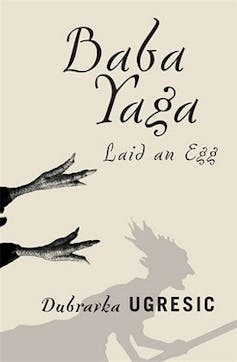
‘Baba Yaba Laid an Egg’ 2009.
Canongate Books

In my opinion, no contemplation of Pan-European lore can be complete without Dubravka Ugrešic’s Baba Yaga Laid an Egg. Once labeled a witch herself and driven into exile from Croatia, Ugrešic’s take on Baba Yaga explores the shifting nature of popular folklore.


Nigeria

‘Half of a Yellow Sun,’ 2006.
Knopf

Half of a Yellow Sun by Nigerian author Chimamanda Ngozi Adichie is not a translation, but it will take you to a place that only briefly existed: Biafra, a West African state founded in 1967. While the brutality of recent war may not make a particularly appetizing subject for vacation, Adichie contrasts the brutality with sumptuous descriptions of pre-war food and luxury, giving her vision of Biafra the aura of a lost dream. Adichie has referred to the war as a shadow over her childhood.


Norway

‘Kristen Lavransdatter,’ 2005.
Penguin Books

There are no beaches in Kristen Lavransdatter and many more Christmases than summers, but if you start Nobel Prize-winner Sigrid Undset’s oeuvre now, it may take you until winter to finish it. Set in Medieval Norway, the book follows the titular Kristen from childhood until death, focusing on her tumultuous love affair and marriage to Erlend Nikulaussøn. Tiina Nunnally’s translation, focusing on plain, stripped-down language, presents a change in philosophy from the first English translation that cut large portions of the text and enforced stiff, archaic language absent from the original Norwegian.


Argentina
‘Fever Dream,’ 2017.
Riverhead Books

Samanta Schweblin’s Fever Dream is slight in length but packs a heavy punch in both atmosphere and psychological investment. The story of a vacation gone terribly wrong, the novel’s Spanish title closely translates to “rescue distance,” a recurring concept instantly familiar to parents of young children and terrifying as it becomes repeatedly destabilized. Fever Dream is so unsettling that I sometimes hesitate to recommend it, but I’ve found myself repeatedly drawn back to its tantalizing surrealism.


Canada

‘Secwépemc People, Land and Laws,’ 2017.
McGill-Queen’s University Press

I’ve spent much of my life moving around, and as a recent settler on unceded Secwepemc territory, I want to learn more about the land I live on. In a summer steeped in fiction, Secwépemc People, Land, and Laws by Marianne and Ronald Ignace is the only history on my list, but in many ways it feels similar to the others, reaching out to add a new dimension to a place in which I’m still mostly an outsider. For better or for worse, Kamloops feels the most like itself in summer, the climate wants to have its stories told. It can feel intimidating to contemplate a 10,000 year history I know nothing about, but also comforting and necessary to reach back and hear the tales of the land I now call home.The Conversation

Amy McLay Paterson, Assessment and User Experience Librarian, Thompson Rivers University

This article is republished from The Conversation under a Creative Commons license. Read the original article.

Unknown's avatar

Summer reading guide from The Conversation’s economists


Charis Palmer, The Conversation and Helen Westerman, The Conversation

Challenging, inspiring and funny: a handful of our economics writers share the favourite books they read this year.

Rodney Maddock, Adjunct Professor of Economics, Monash University


W.W. Norton & Company

The Courage to Act by Ben Bernanke

Ben Bernanke’s The Courage to Act gives a wonderful insight into the problems he faced in trying to deal with the crisis, around legislative restrictions, and blame shifting amongst the various regulators.


Penguin Random House

Doing Good Better by William MacAskill

William MacAskill’s Doing Good Better is a great read about the problems with international charities and on ways in which we can do better in providing assistance.


Penguin Random House

The Heart Goes Last by Margaret Atwood

Margaret Atwood’s The Heart Goes Last was my best novel of the year: she is simply a wonderful writer and this one extrapolates ideas about how a prison might be run for profit, posing a possible end state of privatisation.


Echo Publishing

Resurrection Bay by Emma Viskic

Emma Viskic’s Resurrection Bay is the perfect holiday detective story set; perfect for aeroplanes or the beach.


Janine Dixon, Senior Research Fellow, Victoria University


Niche Press

Creating Cities by Marcus Westbury

Marcus Westbury, founder of Renew Newcastle, identified a problem and set about trying to fix it. An economist would hardly credit the idea that the main street in the CBD of a major Australian town could lie mostly empty, while at the same time property owners were declining genuine offers of business. Without being an economics textbook, Creating Cities gives us insight into the market incentives that lead to this sub-optimal allocation of resources. The book takes the reader on a fascinating journey through the process of renewal of an urban centre. Westbury describes the failure of large, centrally-led projects (think monorail) to revive Newcastle, and the surprising success of individuals and small enterprises in breathing life into the once empty shopfronts.


Melbourne University Publishing

City Limits by Jane-Frances Kelly and Paul Donegan

“A higher proportion of Australians live in cities than almost any other country, and most of our national wealth is generated in them.” There is no question that well-functioning cities are a great enabler of economic activity and provide residents with a high standard of living. However, in cities a diverse range of individuals and agencies operate and respond to incentives which are not always in the interests of the greater good. This book gives detailed and informative descriptions of the state of many Australian cities, and explores the many challenges faced by city planners, residents and businesses alike.


Allen & Unwin

The Economics of Just About Everything by Andrew Leigh

I’ve been lucky enough to hear Andrew Leigh speak on a couple of occasions and he tells a great yarn. His message is clear – economics is about incentives – and he illustrates his point over and over with interesting data and stories to go with it. He dispels the myth that economists are only interested in money. I’ve got this one for my 14-year-old nephew for Christmas this year.


Stephen King, Professor, Department of Economics, Monash University


Federation Press

From Protection to Competition by Kerrie Round and Martin Shanahan

I reviewed this book for an international competition law journal earlier this year. It is a great little book that provides a history of Australia’s attitudes to competition and our competition laws from 1788 to 1974 (the end date is when our current competition laws were introduced). It is a comprehensive work of economic history and also a great “story”. It is easy to forget that for most of Australia’s history businesses happily and legally formed cartels to prevent “undesirable” competition and to harm consumers. It is also interesting to see government responses (e.g. having government owned businesses to try and increase competition – they usually failed). It is a gem that I referenced in my most recent article on The Conversation.


Deborah Ralston, Professor of Finance, Monash University


Melbourne University Publishing

Advanced Australia by Mark Butler

Much of my research over recent years has been on post-retirement and I think this book is a really accessible discussion of the issues involved. Although a sitting member, Butler seems to take a pretty balanced view of how the ageing population is impacting on the economy. His track record as Minister for Mental Health and Aged Care through a period of considerable reform to aged care gives him a fairly authoritative point of view. I really enjoyed his speech on this topic to the National Press Club recently.


Ross Guest, Professor of Economics, Griffith University


Cengage Learning

Real-world Economic Policy by Jan Libich

This is the best book for me this year. Succinct contributions on a range of topical themes from economists from various fields and persuasions.


Richard Holden, Professor of Economics, UNSW Australia


Crown Business

Zero to One by Peter Thiel

Paypal founder and noted venture capitalist Peter Thiel discusses how monopoly is essential for innovation, not the terrible thing economists have always told you.


Penguin Random House

Destiny and Power by Jon Meacham

Biography of George Herbert Walker Bush (aka Bush 41).


Simon & Schuster

Crippled America by Donald Trump

Just because…


Penguin Random House

America’s Bank by Roger Lowenstein

How challenging it was to create the US Federal Reserve system.


Catherine de Fontenay, Associate Professor, Melbourne Business School


PublicAffairs

Poor Economics by Abhijit V. Banerjee and Esther Duflo

In the last decade, development economics has undergone a revolution, led primarily by Esther Duflo, an intense young Frenchwoman who is a professor at MIT. The new approach emphasises using randomised control trials (similarly to medicine) to test the efficacy of different policies, and to build a more accurate picture of the economic challenges of the bottom billion (the poorest billion people on earth). The insights garnered are simply amazing, and will lead to changes in policy that will have a profound effect on the condition of the poor for many decades.


Tim Harcourt, J.W. Nevile Fellow in Economics, UNSW Australia


Princeton University Press

Why Australia Prospered by Ian McLean

Ian McLean turns economic history conventional wisdom on its head in this thought provoking book.


Crown Publishing Group

Why Nations Fail by Daron Acemoglu and James Robinson

Why did the USA succeed while Mexico struggled? Same with Argentina or Australia or Botswana and Sierra Leone? The role of institutions matters. A country needs well defined property rights and democratic rights to succeed.


Simon & Schuster

Korea: The Impossible Country by Daniel Tudor

How South Korea went from one of the world’s poorer nations to an OECD nation in five decades.


Penguin Books Australia

Australia’s Second Chance by George Megalogenis

Even better than his first book. Megalogenis looks at the role of immigration in Australian economic development.


Penguin Books Australia

The Story of Australia’s People by Geoffrey Blainey

Australia is 50,000 years old, not 230, and Geoffrey Blainey tells us why. Amazing stories of indigenous history and innovation.

The Conversation

Charis Palmer, Deputy Business Editor, The Conversation and Helen Westerman, Business + Economy Editor, The Conversation

This article was originally published on The Conversation. Read the original article.

Unknown's avatar

Infographic: Summer Reading


The link below is to an infographic flowchart that aims to assist you in your reading over the Summer (northern hemisphere). Here is Australia it is of course winter.

For more visit:
http://www.flavorwire.com/297601/the-ultimate-summer-reading-flowchart