
As we have moved on from the printed vs digital books debate (unlikely), we have now entered the debate over audiobooks vs reading. The link below considers this question.
For more visit:
https://bookriot.com/2018/07/10/audiobooks-vs-reading/

As we have moved on from the printed vs digital books debate (unlikely), we have now entered the debate over audiobooks vs reading. The link below considers this question.
For more visit:
https://bookriot.com/2018/07/10/audiobooks-vs-reading/
The link below is to an article that takes a look at how the brain learns to read.
For more visit:
http://blogs.plos.org/blog/2018/04/25/how-the-brain-learns-to-read-development-of-the-word-form-area/
The link below is to an article that takes a look at the ways we read.
For more visit:
https://lithub.com/on-the-ways-we-read-and-are-written-to/
The link below is to an article that looks at annotations in books.
For more visit:
https://lithub.com/sometimes-the-best-way-to-read-is-to-mark-up-the-book/
The link below is to an infographic that looks at reading and better health.
For more visit:
http://blog.bookbaby.com/2018/04/can-reading-books-lead-to-better-health/

Margaret Kristin Merga, Curtin University; Paul Gardner, Curtin University; Saiyidi Mat Roni, Edith Cowan University, and Susan F Ledger, Murdoch University
Reading to your child is one of the most successful ways of instilling a love of reading in them. But in our recent study, more than one-quarter of primary-school-aged respondents claimed they were never read to at home.
Children typically enjoy being read to, and see educational, social and emotional benefits to the practice. But families are busy, and finding time to read aloud can be eaten up by the demands of everyday life.
Not all parents have been read to themselves as children, so may not have experienced a model they can then follow with their own children. And many adult Australians may be struggling readers themselves.
With this in mind, here are five suggestions that can help make the experience of reading to your children fun, relaxing and educational.
For many people, the best time to read with their children is at night, once the children are in bed. But if you find your child too cranky and disengaged at this time (or if you are feeling tired yourself), you might want to try reading to them earlier in the day.
Read more:
Three easy ways to get your kids to read better and enjoy it
Whatever the time, it’s important to give the book and your children all of your attention. Phones and other devices with enabled notifications should be switched off. Everyone should be comfortable, and children should associate time spent being read to with enjoyment.

Where possible, we strongly suggest reading to your child becomes part of the daily routine. The more often children are read to, the more substantial the benefits. Reading to children is both an opportunity to model how the written word sounds and a chance for family bonding.
Children don’t typically enjoy having the story stopped every few seconds for comprehension checking, so we suggest you keep interruptions to a minimum.
But recapping is useful when picking up a book again after a break. If parents let their children provide this recap (“So, where are we up to?”) this also enables informal comprehension checking. Opportunities for prediction are also beneficial (“Wow… what do you think might happen next!”).
Sharing your response to a book and encouraging children’s responses stimulates critical thinking. These techniques and others can enhance learning and comprehension, but they shouldn’t upset the fluidity of the reading experience or turn it into a test.

You can share the task of the reading itself with your children if they want to. This is beneficial for a range of reading skills, such as reading comprehension, word recognition and vocabulary building.
You can start reading to your child from early infancy to support their developing language abilities, so it’s never too early to start. The skills infants and young children develop through shared reading experiences can set them up for literacy achievement in their subsequent schooling years.
Read more:
Research shows the importance of parents reading with children – even after children can read
Reading to your children remains important beyond the early years, too, with continuing benefits for literacy development and cognitive skills.
We should read to young people for as long as possible. There is no age where the benefits of being read to completely expire.
Very recent research in the UK found struggling adolescent readers can make remarkable gains on their reading comprehension when books are read to them at school. This is perhaps due to the opportunity for students to enjoy books that are too hard for them to read themselves.
We suggest you select a book that interests both you and your child. Reading together is a great opportunity to share your passions while broadening your children’s horizons through making diverse book choices.

Don’t be afraid to start reading chapter books to your children while they are still very young. The age to begin this will vary depending on your child’s attention span, but it’s often possible to begin this with pre-schoolers.
As long as the story isn’t too complex, children love to be taken on an enjoyable journey into books that are too hard for them to read independently. This can also help to extend child’s vocabulary, among other benefits.
Read more:
How building your child’s spoken word bank can boost their capacity to read
It’s a good idea to take your children to the library and model how you choose interesting books for shared reading. Research shows many primary and high school children are easily overwhelmed by choice when they attempt to pick what books to read independently, so helping them with this is a valuable skill.
Not all of us are destined to be award-winning voice actors, and that’s OK. It’s great to use expression and adopt different voices for the characters in a book, but not everyone will feel able to do this.
At multiple points in our research, we’ve come across people who have praised the reading efforts of parents who weren’t confident readers, but who prevailed nonetheless. For example, in our recent paper a respondent described being read to by her mother who struggled with dyslexia. This mother, and many other parents, have inspired a love of reading in their children through their persistence.

 Being taken into the virtual reality of story is a memorable, pleasurable experience that stays with us forever. Reading aloud provides parents with a valuable opportunity to slow down, relax and share the wonderful world of books with their children.
Margaret Kristin Merga, Senior Lecturer in Education, Curtin University; Paul Gardner, Senior Lecturer: Literacy Education, Curtin University; Saiyidi Mat Roni, Lecturer, Edith Cowan University, and Susan F Ledger, Associate Dean Engagement, Murdoch University School of Education, Murdoch University
This article was originally published on The Conversation. Read the original article.
The link below is to an article that takes a look at whether tablets aid or don’t aid early reading.
For more visit:
https://www.edsurge.com/news/2015-09-01-do-tablets-help-or-hinder-childhood-literacy
The link below is to an article that looks at who doesn’t read books in the USA.
For more visit:
https://the-digital-reader.com/2018/03/24/by-the-numbers-who-doesnt-read-books-in-america/
The link below is to an article in which the writer states ‘I Have Forgotten How to Read.’
For more visit:
https://www.theglobeandmail.com/opinion/i-have-forgotten-how-toread/article37921379/

Laura Scholes, Queensland University of Technology
Year 3 reading outcomes of 2017 NAPLAN testing once again demonstrate a gender gap, with boys underachieving compared to girls. A focus on teaching for the test has not closed the gender gap and only reduced student motivation and well-being.
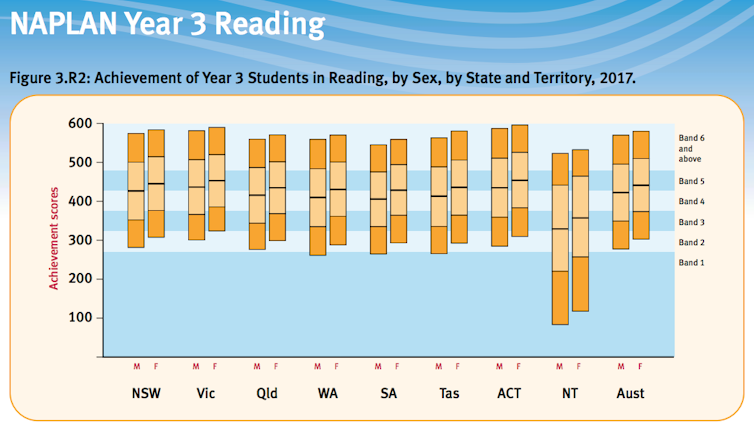
Calls for a review of NAPLAN ten years on are timely. But as well as looking at how high-stakes testing is narrowing the curriculum and causing student stress, we need to consider the testing regime’s influence on boys’ attitudes towards reading.
Read more:
NAPLAN 2017: results have largely flat-lined, and patterns of inequality continue
Reports increasingly highlight how negative attitudes towards reading constrain experiences for some boys. In the United Kingdom, a National Literacy Trust survey of 21,000 children aged eight to 16 found boys were more likely than girls to believe someone who reads is boring and a geek.
This attitude is believed to be related to deep-seated cultural issues that lead many boys to believe reading is feminine and “uncool”. Reluctance to read then translates into less time reading and lower achievement.
There is now a call in the UK for schools to have a policy of promoting enjoyment of reading rather than just a focus on effective teaching of phonics skills.
We have known for a long time that positive attitudes towards reading influence boys’ engagement with reading. Engagement influences practice, resulting in the Matthew Effect as cumulative exposure to print accelerates development of reading processes and knowledge.
Attitudes towards reading are not innate; they are learned predispositions in response to favourable or unfavourable experiences. In this way, a boys’ attitude towards reading develops over time as the result of beliefs about reading and, importantly, specific reading experiences.
In Australia, the focus on NAPLAN has changed the landscape of teaching and literacy experiences for students.
As part of this change, didactic teaching of reading for NAPLAN can compound negative attitudes about the nature of reading at school. Reading is seen as a passive (feminine) endeavour associated with boring schoolwork (preparing for the test).
While teaching phonics is already embedded in good teaching practice, the introduction of the Year 1 phonics check will potentially further narrow the curriculum as teachers are pressured to teach for yet another test. This initiative could also impact on teaching practices for reading in the early years.
Read more:
Explainer: what is phonics and why is it important?
If we are interested in enhancing reading outcomes for underachieving boys, we need to foster positive attitudes towards reading that translate into practice. The change needs to be from a focus on teaching reading to helping boys become successful and satisfied readers.
My recent survey of 320 Year 3 children from 14 schools in Queensland identified their self-reported enjoyment of story books, non-fiction books, magazines and comics, and self-reported reading frequency.
Students coloured in a box to reflect an emotive face on a Likert scale to indicate their level of enjoyment and their frequency of reading. Students’ Year 3 NAPLAN reading outcomes were also collected.
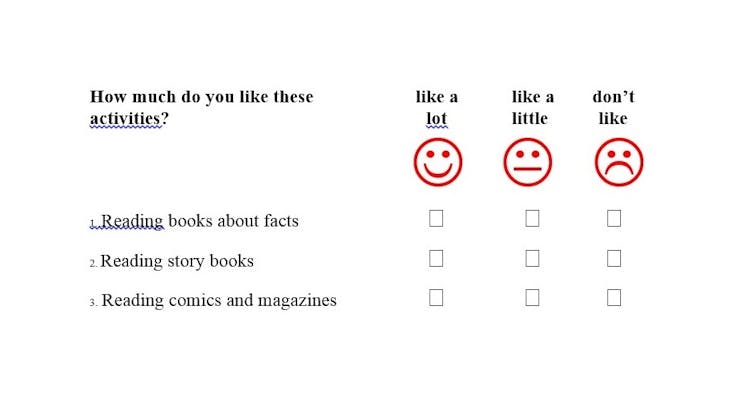
Findings from the Pearson test of correlation between survey variables indicated correlation between higher student NAPLAN reading scores and higher levels of enjoyment for reading story books/non-fiction books and higher reading frequency. There was a statistically significant positive correlation between reading scores and reading frequency, and reading scores and reading enjoyment.
Even when teachers are supporting specific learning difficulties (such as dyslexia), it’s important to expand boys’ repertoire of positive reading experiences. This requires a shift from the exclusive teaching of the mechanics of reading to teaching practices that contextualise experiences and encourage enjoyment of reading.

Expand school reading cultures. Directly challenge beliefs about reading being a feminine pursuit. Teachers can select and use texts that challenge what it means to be male and the power structures that exist in school and society.
Focus on the arts. Include artists-in-residence schemes, poetry weeks, dance sessions run by professional dancers, and drama productions that allocate lead roles to disengaged boys. Boys often enjoy working with “readers’ theatre” scripts, which allow them to feel like active participants in a story.
Leave reading choices up to students 50% of the time. Provide a wide range of texts to stimulate interest and build confidence through paired reading schemes and teacher decisions to give students space to talk about and reflect on what was enjoyable.
Promote male mentoring. Include parent-mentors and vertical mentoring with older boys mentoring younger boys in the school.
Let them talk! Boys who are reluctant readers need to have successful reading experiences. Use literature circles with mixed-ability grouping, providing boys with the support they need to focus on the “big ideas” in the story, as well as on the words and structure of the texts.
Include variety. Use interactive classroom activities fit for purpose so that both short, specific focused activities and more sustained, ongoing activities are used, as and when appropriate.
Risk-taking in teacher practice. Bring more creativity and variety. Expose students to new and novel reading experiences.
Implement teaching practices that encourage discussion. Based on Philosophy for Children, enhance reading comprehension as students explore different answers, examine the strengths and weaknesses for each, and critically reflect on assumptions along the way.
Read more:
Research shows the importance of parents reading with children – even after children can read
 When the focus is on teaching for the test, direct instruction and an exclusive focus on phonics, there is a narrowing of curriculum and teaching practice. Strategies can be easily implemented in the classroom. We need to move from teaching reading for NAPLAN testing, to teaching boys to enjoy reading to ensure their success.
Laura Scholes, Research Fellow, Australian Research Council (DECRA), School of Early Childhood and Inclusive Education, Queensland University of Technology
This article was originally published on The Conversation. Read the original article.
 At the BookShelf
You must be logged in to post a comment.