A new book of poetry is offered to a world of readers where very few of us have or take the time to read poetry. Most of us are skeptical about it, suspicious of it for asking of us so much of our time and attention, and possibly giving us little back but puzzles.
Nevertheless I open the book. The first word of the book is “Parting”, printed twice: once as the title of the book’s first poem and again as that poem’s opening word. Parting, of course, doesn’t necessarily mean an ending, for it is essentially what every new life requires.
“All things new/move us”, David Malouf observes part way through this opening poem (playing again on a word that carries several layers of conflicted meaning), uniting reader and poet in a common understanding of partings as beginnings. This is a clever, wise and benign manner of reminding the reader that they have left something in order to arrive here where this very act of holding an open book becomes an aspect of the rhythms of a wider cosmos.
UQP
The stance of the poem is characteristic of Malouf, with its poised consciousness of a speaking self on display through reference to the poem’s presence on the page and the poem’s witness to the act of writing. In a Malouf book it is rare to find the direct personal pronoun, “I”, but there is always somewhere the presence of a writer, a voice, a reflection of someone present at the occasion of the poem.
This reticence about saying “I” might be coyness, it might be a natural shyness, it might be to do with a conviction, along with T.S. Eliot and many before him, that the poetry in a poem is rarely best served by making the poem personal. Or it might be the realization that so much more is possible by way of allusion, insinuation, investigation and imagination if one comes at the truth in a poem slant — as Emily Dickinson demonstrated so well.
Lessons for a destructive world
The neat couplets of this first poem move confidently through free verse lines constructed sometimes on the swing of the phrasing, sometimes on the drama of the imagery, or on a turning thought. Gentle rhyming and near-rhyming run through the poem (e.g. distinction-perfection, moon-room, lost in-begin), along with repetitions of certain words when the rhetoric lifts a little towards what might be an utterance meant to be heard across the room.
This quiet neatness of execution too is characteristic of Malouf’s poetry, and perhaps increasingly so recently. Even a more ragged poem in this collection, such as Aubade.com, reminiscent of From the Book of Whispers in Malouf’s Typewriter Music, comes to the page with a coherent grace, wit and rhythm. The impression of control — of never putting a foot wrong — might have to do with Malouf’s superb feel for bringing a poem to its point, often through a sensual gesture.
I read on. The fourteen poems following, titled Kinderszenen — scenes from childhood — are named after Robert Schumann’s 1838 melodies, which he called “small droll things” composed in response to his wife observing that he could be like a child. These poems are brief and mostly playful reflections on childhood, on imagery in language, and on the possible stances of poetry towards a wider world where poetry can, perhaps, hear what is not yet here —
From a clear sky
the whine, beyond human ears,
of a long-distance missile. History. (from Eavesdropping)
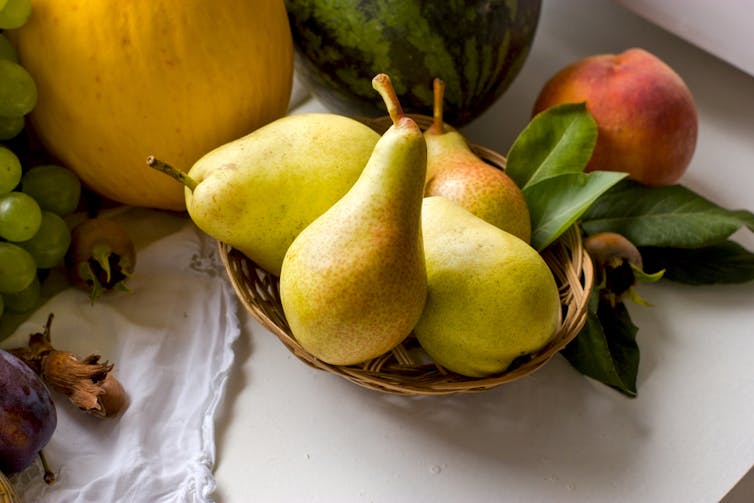
History is a ‘long-distance’ missile in Malouf’s poem Eavesdropping. Shutterstock
From this series, Dancing with a Giant is as much about reading with a child’s engaged imagination as it is about being a child in a grown-up world — a world where, in a game of “gleeful terror”, each child will soon enough find themselves “Already/in up to the neck.”
It might be that in a Maloufian world every object and phenomenon of nature takes on a human face just as in ancient Greece the Gods were as human in their impulses, rages and jealousies as any of us are; or it might be that in the Maloufian world we manage to share with nature its relentless, rhythmical inhuman moods. Whichever way one turns these poems to the light, there is in them a sense of connection between all things (a poetry that can “span a Beurre Bosch pear/in a fruit bowl to the planet”), and that is perhaps the great lesson poetry offers to our fragmented and catastrophically destructive contemporary world.
Yearning for permanency
Still with this series, Fifth Column shares a sensibility with Sylvia Plath’s famous Mushrooms, though in this case it is time not the cloned mushroom that arrives as a sly invader sending its agents out. The poem begins with a childhood wartime memory (Malouf was five or six when the second world war began) and quickly dances through decades of change, then back like Plath’s poem to the ironic solidity of domestic details.
Less political than Plath’s poem, Malouf’s (like hers) is buoyant and hopeful:
… Time, that sly
invader who sent his agents
out, who looked
like us and talked like us,
through all the rooms of
the house to change the coins
in our pockets, the oaths we sealed
with spit or blood, the weights,
the measures. On kitchen shelves,
and tables, set for lunch
and dinner, the plain thick serviceable
crockery for china.
Where Plath’s poem breathes foreboding and prophecy, Malouf’s is one that opens awareness to an ongoing unheeded upheaval within everything. He notes that what we have recourse to when we yearn for permanency is whatever seems “serviceable”. Here too, there is a place for the poem, particularly those that are at least on first appearances serviceable — or as Wallace Stevens put it, are at least “what will suffice”. I think that this is the kind of poem Malouf is trying to find himself writing as he goes.
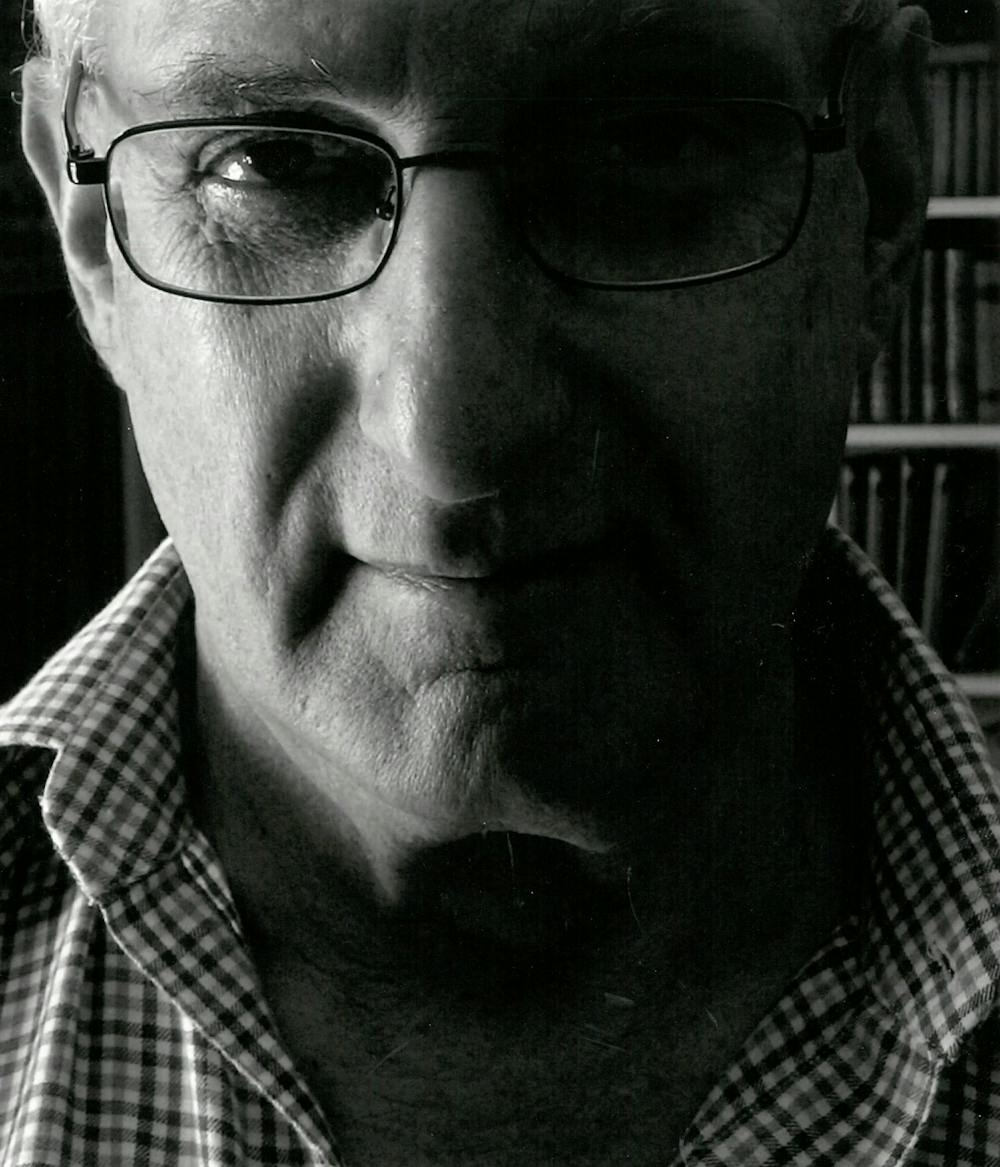
David Malouf has authored three recent poetry collections. Conrad Del Villar
Malouf’s poetry is not quite an open book, for “books/like houses have their secrets”, as he notes in a poem that responds to his mother’s claim that she could read him “like a book”. This poem is one his rare first-person poems, though it slips into the third person before the ending. Fittingly enough it is focused upon his attempt not to be simply the “open book in his mother’s lap” but rather to be one who is far enough apart to see and dream and wait for the plot to thicken.
Another first-person poem much later in the book seems to me to bring into itself most of the themes and images and preoccupations of the entire collection. And on top of that it is a charming, spellbinding poem, one that deserves to be anthologized well into the future. Incident on Myrtle Street brings scents, scariness, night, death’s angel, domestic attention to detail, and self-consciousness over the act of writing all together in a narrative that is not only charming but hauntingly told. I will leave you to purchase the book, or browse it in a shop, and go straight to it (it’s on page 56).
The power of presence
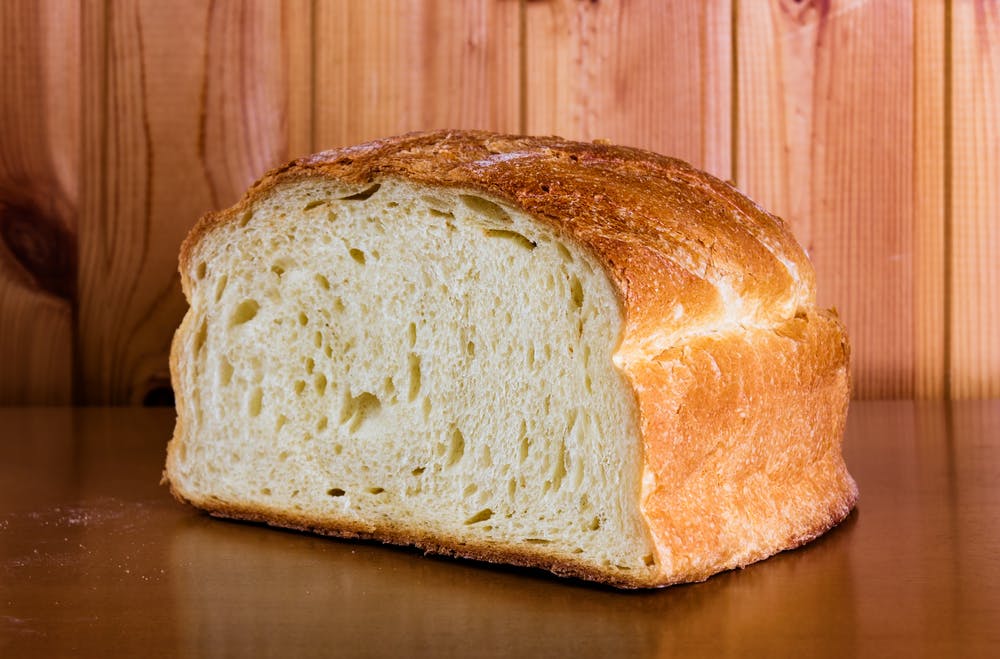
I can’t leave the book without noting that the words “presence” and “present” recur across the poems. One is even titled In the Presence. Among these poems of presence, The New Loaf is one that fills its moment with a presence that includes somehow all of human history and all the knowledge we might need to be kin, while offering us a loaf of bread in such light that Vermeer might be considering painting it. It’s another poem worth the price of the book, and that’s a bargain really — two poems in one book that make the purchase worthwhile, and promise an abundant return in pleasure for your time spent reading in that strange art of poetry.
Malouf’s poem The New Loaf offers a loaf of bread good enough to paint. Shutterstock
If poetry served Malouf as an apprenticeship on his way to becoming a novelist, then this late return to poetry in three recent collections seems to bring him back in a new way to steadying poems that do justice to the open gaze, the sly wit, the swift imagination and the poise he has in spades.
This might be a quiet kind of poetry with little bitter irony, little engagement with the world of technology and social media, few linguistic pyrotechnics, and no confessional stripping of the self, but it is something special to have read it and found in it much that is genuine, graceful, true, surprising and delightful.
I read the poems through for the second time (I confess to reading the book three times now) at a table in a café with a group of deaf children and women beside me. They were surprisingly noisy, tapping the table, slapping parts of their bodies in exclamation, letting out brief bursts of involuntary laughter, and moving around, leaning into each other, touching each other, lifting an eyebrow at each other or sticking out a chin.
I was distracted by them and convinced by them all over again that we are creatures of deep abilities when we want to communicate with each other. I love poetry that moves towards the kinds of inchoate communications words and text can’t usually manage. Malouf’s poetry has this quality, if a reader can sit with it for a little while.
Review: Unfettered and Alive by Anne Summers (Allen and Unwin)
Years ago, when I was young, I lived in an apartment in Sydney’s Potts Point that looked straight down into Anne Summers’ house. Summers had recently published her “Letter to the Next Generation” – and it’s likely that any discomfort not arising from the strange proximity of our urban views was directly attributable to this.
In the “Letter”, Summers famously wrote that she was “horrified” and “mortified” by the antics of women like my younger self – the wayward daughters of the revolution who had failed to measure up on the long tough march to gender equality.
The “Letter” drew its inspiration from years Summers spent as editor of Ms. magazine. Oddly enough, Summers’ new autobiography, Unfettered and Alive, is also shot through with the upheaval of these years and the aftermath of her falling out with US feminists Gloria Steinem and Susan Faludi.
Anne Summers. Kevin McDermott
Many harsh things are said in this book. It’s difficult to decide whether to praise its “breathtaking honesty” – as critics undoubtedly will – or draw back like a witness to some gruesome accident.
These are bitter struggles over the memory narratives of feminism.
Unfettered and Alive picks up where Summers’ earlier autobiography, Ducks on the Pond, leaves off. It’s the 1970s, a time when women’s choices are startlingly limited. Women earn just 65.2% of men’s salaries. The employment ads are divided into men’s and women’s jobs. Women are not allowed to drink in the front bar at pubs – they are banished to the ladies lounge.
Summers, age 30, is already a leading figure in the Women’s Liberation Movement that puts an end to all this. She is the author of one of the most significant early works of Australian feminist history, Damned Whores and God’s Police, and a co-founder of the inner-city women’s refuge, Elsie.
Later, she will be remembered as the head of the Office of the Status of Women, and a significant figure in the passage of the Anti-Discrimination Act and the battles over affirmative action, though only a chapter of the book is devoted to this.
Summers starts her story in 1975, when she answers an advertisement for an “energetic self-starter” at The National Times, then under the “wily” editorship of Max Suich. Here, she quickly sets to work on the multi-feature series that gave fresh impetus to the royal commission into the state of NSW prisons, and wins her a Walkley.
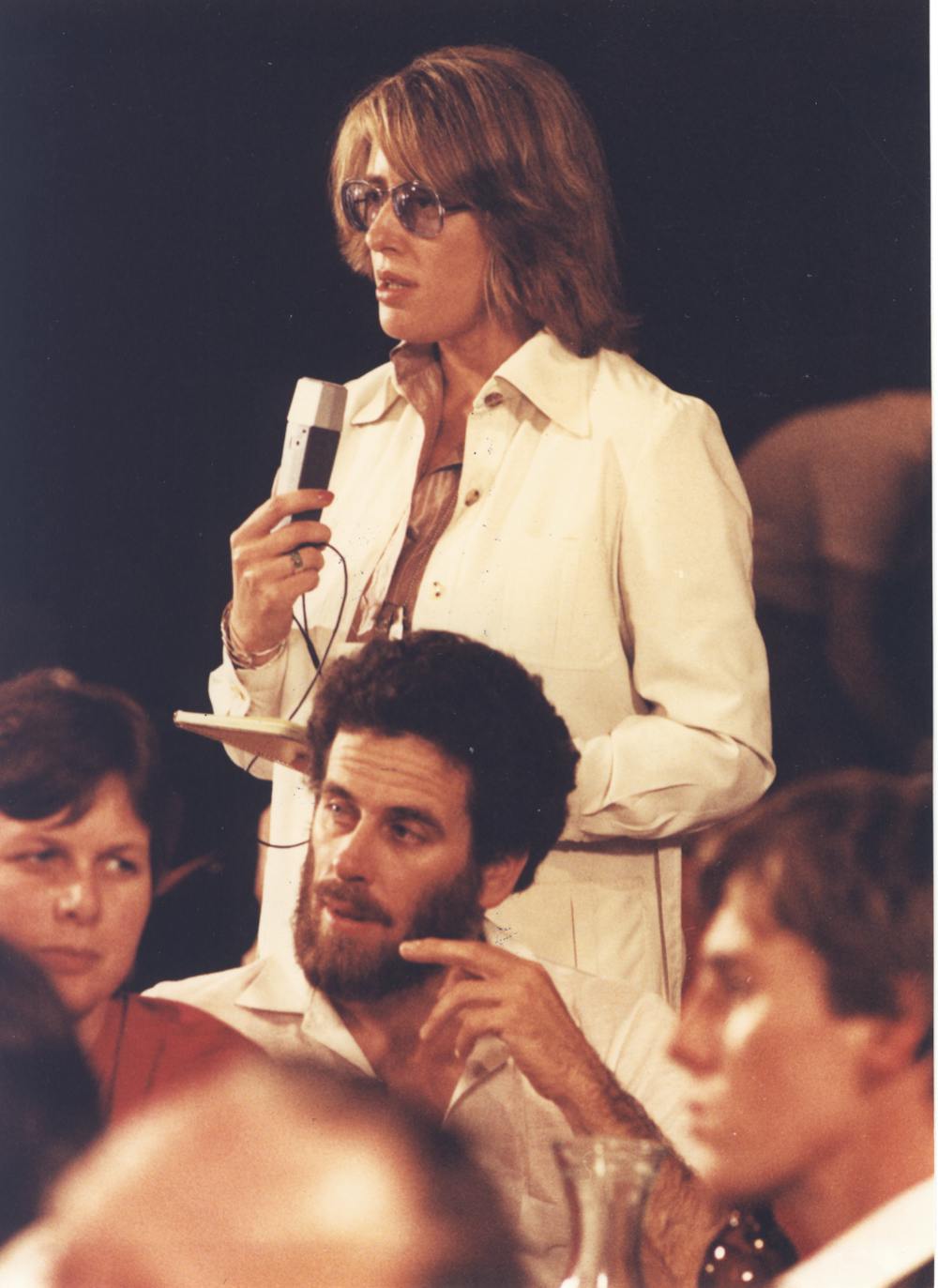
Summers at the National Press Club during the 1980 CHOGM meeting in Australia directing a question at British Prime Minister Margaret Thatcher. Allen and Unwin
Other more woman-focused stories follow. There’s the “gang bang” of a teenage girl at St Paul’s College, Sydney University. Another story, “How women are trained: if it’s not rape what is it?” reports on events in the Far North Queensland town of Ingham, where police openly acknowledge that 30 or 40 local women and children have been raped. “I reported it to police,” one girl told Summers, recollecting the first time she was gang-raped by five men at the age of 13. “But I didn’t have enough evidence. I wasn’t bruised enough.”
Working in Canberra as a political correspondent in the Fraser years, Summers is painfully honest about her fear of not doing the job well. “I can see the absolute terror in your eyes,” a reporter from a rival newspaper told her.
She reports walking out of a media conference held by Bill Hayden, in which the “alternative prime minister” decided to kick things off with a rape joke. “My colleagues didn’t seem bothered by such things,” Summers writes. Sexist behaviour went unchallenged and unnoticed because “it was the way things were back then”.
But Summers is also judgmental about other women in her memoir. In an atmosphere in which cabinet ministers chase female reporters around their desks, Summers recollects telling off a female reporter for wearing a “sexy outfit”. “I was very tough on a woman in my bureau who came to work one day with a dress that was slit practically to the waist.”
Confessions tumble across the pages: her breast-reduction surgery, the weight-loss regime that saw her drop 10kg and her pride in her “brand new body”. She talks about being brought up on a DUI charge when she took up her appointment at the Office of the Status of Women. She reveals her fondness for Robert Burton suits – it’s the era of the “femocrats” and big hair, shoulder pads and flats are in.
The 1980s are a time of epic change for women. New legislation and policy frameworks are put into place. Not everybody appreciated it. “One morning I found flung across the windscreen of my car a life-size plastic sex doll … ” Summers is alarmed, “not because this tawdry piece of plastic could hurt me but because whoever put it there could”.
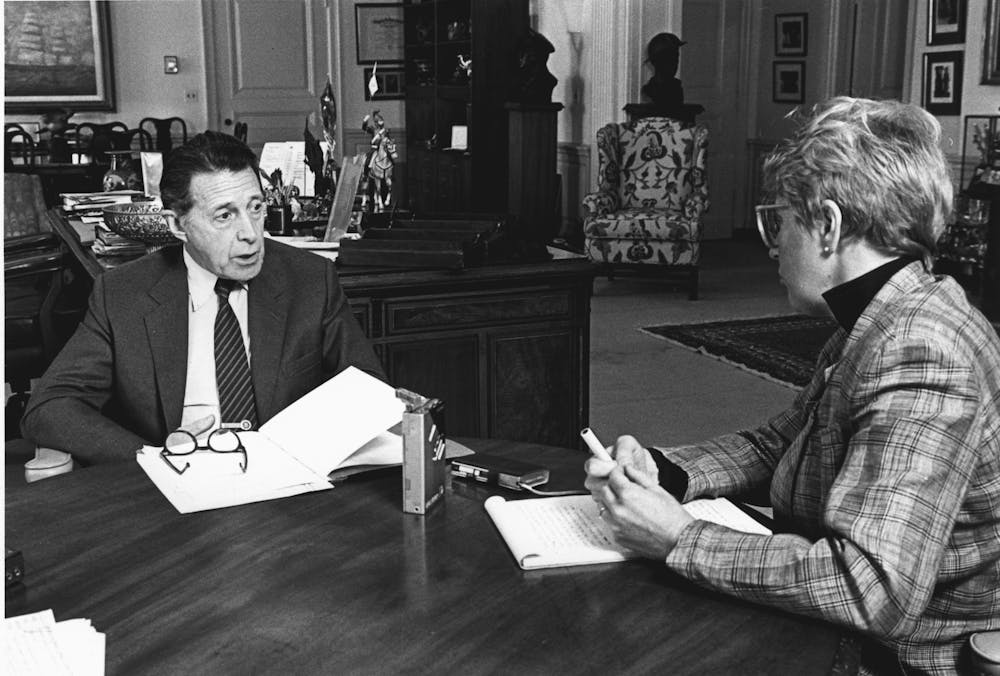
‘I was the first Australian journalist to interview a US Secretary of Defence when I sat down with Caspar Weinberger in his office at the Pentagon in June 1986.’ Allen and Unwin
The Ms. Years
Summers arrived at the “shambolic offices” of Ms. magazine, on West 40th Street, New York, following the unexpected purchase of the iconic feminist publication by Fairfax in 1987. Summers calls the magazine “chaotic”. It operated like a feminist collective, she writes, in which “everyone appeared to be equal” and everybody had to do their own “shitwork”.
According to Summers, this “might have been okay for the women’s movement” but it was “no way to run a magazine”. But Ms. did not understand itself as just another media outlet. It was the printed vanguard of US feminism. It was – and still is – synonymous with the name of US feminist Gloria Steinem.
Summers put the entire staff on 60 days’ probation and fired three. But later in the chapter she adds: “I … should have cleared out the whole place.”
Summers set about giving the magazine an “80s lift”. This included increasing the focus on fashion, makeup advertisements, and the inclusion of a gardening page.
She also embarked on a total redesign, including a new logo, masthead and an advertising campaign with the tagline, “We’re not the Ms. we used to be”. The ad featured a string of photographs showing an old hippie morphing into a young woman with a “glamorous 1980s look”.
It can’t have been an easy time. Steinem lost editorial control over the magazine as part of the financial arrangement. But, according to Summers, the magazine remained “almost neurotically dependent on Steinem”.
The relationship between the two women quickly became strained. Summers says she constantly questioned “the gap between Steinem’s rhetoric and the way she conducted herself”. The contents of Steinem’s apartment are said to be “disturbing”, including the covers on Steinem’s loft bed, which was draped in “flimsy white fabric” and a “set of physician’s weighing scales” in her kitchen, all of which are said to be “strange stuff for a feminist”.
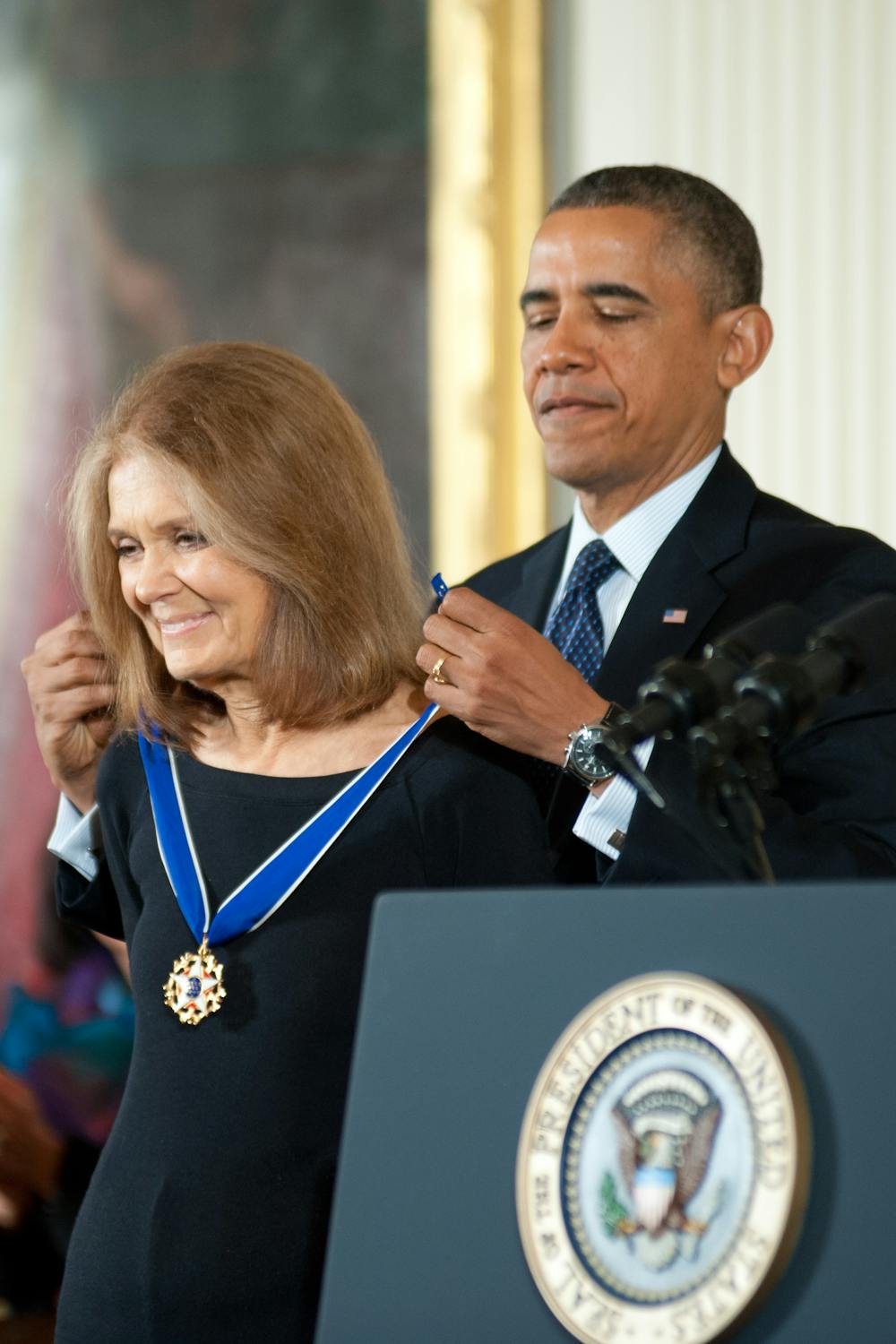
Gloria Steinem receives the Presidential Medal of Freedom from then US President Obama in 2013. Shutterstock
It was the Hedda Nussbaum case that brought matters at Ms. to breaking point. When Joel Nussbaum murdered his six-year-old daughter and bashed his wife Hedda, debates raged in feminist circles as to whether Hedda should have been treated as an accomplice to her daughter’s death. Summers and Steinem took up opposed positions. Summers argued it was time to “stop excusing the behaviour of all battered women”. Steinem argued that Hedda was a “total victim” and believed the coverage was a “betrayal of everything Ms. had ever stood for”.
The decision to pull a close-up image of the heavily beaten Hedda off Ms’s cover remains a matter of controversy today. Summers writes that the photo was removed on the advice of her head of advertising sales who said: “We’ve just cracked the beauty category. You can’t do this to me.”
There was a lot of pressure around revenue. Summers and Australian colleague Sandra Yates had recently engaged in an audacious management buyout, after Warwick Fairfax announced his untimely decision to sell. According to Summers, Ms. advertisers wanted their customers to be “happy” not “challenged or confronted”. “… our only chance of survival was to meet or, if possible, exceed our advertising budget.”
Fraught decisions followed. “I was stricken when Barbara Ehrenreich proposed her next column be a satire on fast cars,” writes Summers. “I explained to her how sensitive and demanding these advertisers were, how we could not afford to lose them. Would she be willing to change topics?”
Ehrenreich, the acerbic social critic, refused.
The first edition of Susan Faludi’s global bestseller Backlash: the Undeclared War Against Women carried several pages attacking the editorial direction of Ms. under Summer’s leadership. Back in Australia, following the forced sale of the publication, Summers was “stunned”. There was “a tone to the writing that made it sound almost malicious”. She initiated a “tough” exchange of lawyer’s letters, demanding a rewrite of all subsequent editions of the book.
The entry now stands at around one page, which Summers quotes. Faludi writes:
The magazine that had once investigated sexual harassment, domestic violence, the prescription drug industry and the treatment of women in third world countries now dashed off tributes to Hollywood stars, launched a fashion column, and delivered the real big news – pearls are back.
An air of anxiety
Women who do not conform to certain gender ideologies fare badly in Summers’ book. Stay-at-home mums are berated for pushing baby buggies, young women are berated for “baking and doing craftwork”.
An air of anxiety runs through the remaining chapters. The months on Paul Keating’s staff end with Summers “sobbing with humiliation and rage” at the notorious “True Believer’s Dinner” that wound up costing $35,000. She had wanted Bob McMullan to be minister for women, and he had refused. She also didn’t think the unions at Parliament House ought to be paid for working through the $100 per ticket event.
Her period as editor of The Sydney Morning Herald’s Good Weekend magazine was also clouded when the MEAA took action to “protest my management style”, after Summers fired her deputy for “disloyalty” over a sexual harassment allegation. “I was not a mother, so I must be a whore,” writes Summers, explaining the ferocity of the attacks.
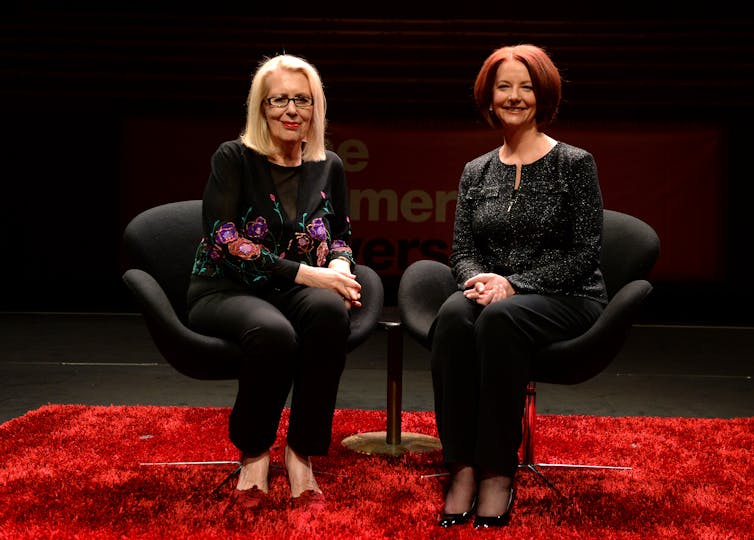
In 2013, Summers returned to address this same “widespread hostility towards women”, which had prominently manifested itself in the “woman-shaming” of the prime minister, Julia Gillard. In a new book, and a series of articles and interviews, she situated Gillard’s treatment as part of a continuing cultural pattern of “malicious and mendacious slurs” against high-achieving women.
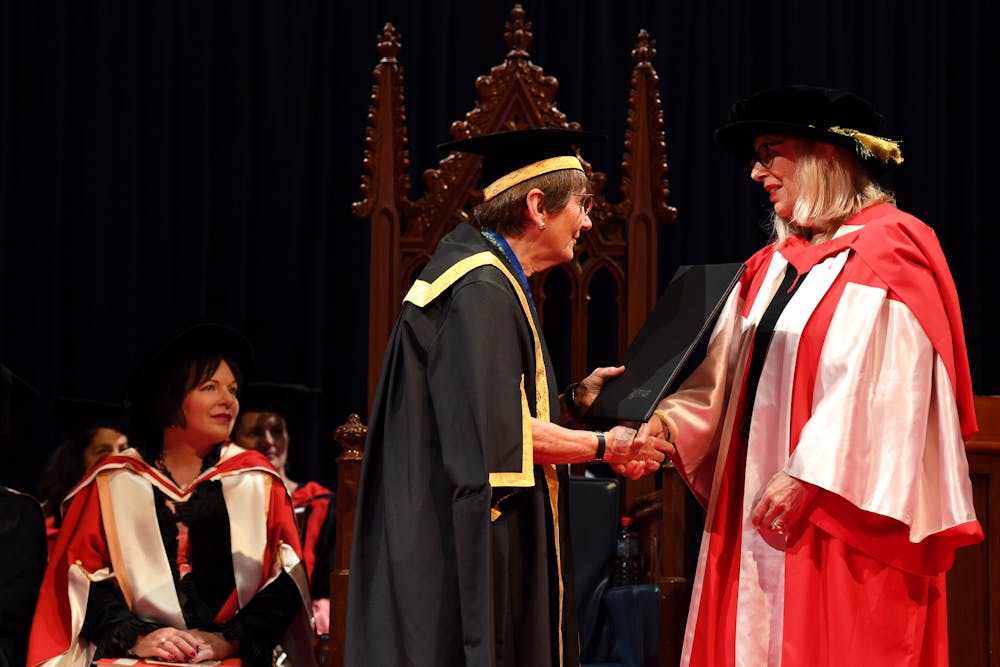
Anne Summers (right) receives an honorary Doctorate of Letters from Pro-Chancellor Dorothy Hoddinott at the University of Sydney in 2017. Paul Millar/AAP
Women are immeasurably better off for the achievements set out in Summers’ book, despite some frightening backwards steps since, not to mention a failure to gain ground on childcare policy and the gender wage gap. Feminism has also become more flexible, opening itself up to longstanding critiques around class and race.
But it remains difficult for women to have their voices heard. Women in Australia who have spoken up on #MeToo are almost immediately threatened with defamation action – and some of them are being sued. Women of all ages still name family and domestic violence, workplace sexual harassment and street violence and harassment close to the top of their list of concerns.
Next to this, “doing craftwork”, wearing a split skirt, or covering your bed in “flimsy white fabric” – as Gloria Steinem undoubtedly did – doesn’t seem like much to worry about.
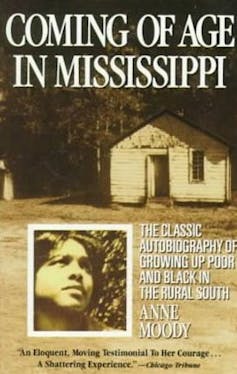
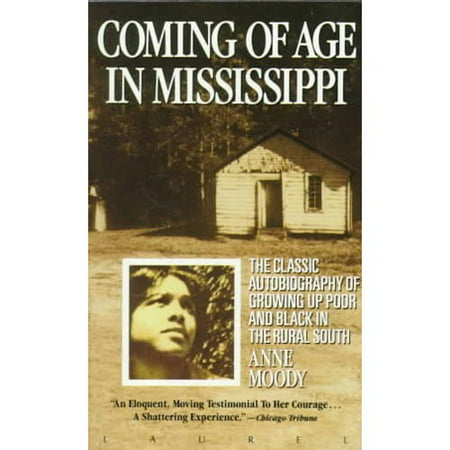
A rare exception is Anne Moody’s “Coming of Age in Mississippi,” which was published in 1968. It spoke to the day’s pressing issues – poverty, race and civil rights – with an urgent timeliness.
Fifty years later, the book still commands a wide readership. Read each year by thousands of high school and college students, it remains a Random House backlist best-seller – a title that continues to sell with little to no marketing.
As I research Anne Moody’s life for my upcoming biography, I often wonder what her memoir’s continued popularity means. Does it signal dramatic progress on race relations in the U.S. – or does it instead show us that, as former Sen. Ted Kennedy wrote in 1969, “If things are somewhat different, then they are not different enough.”
Till’s death opens Moody’s eyes
Written when Moody was 28 years old, “Coming of Age” is a gripping story. In spare, direct prose, she takes readers into the world of African-American sharecroppers in the Jim Crow South. As a child, she chopped and picked cotton, cleaned houses for white people, and wondered why whites had better everything – better bathrooms, better schools and better seats in the movie theater.
That mystery remained unsolved when, in 1955, Moody learned that white men had killed a black boy her age just a few hours’ drive north. The killing felt personal.
“Before Emmett Till’s murder, I had known the fear of hunger, hell, and the Devil,” she wrote. “But now there was … the fear of being killed just because I was black.”
Closer to home, whites ran her cousin out of town, brutally beat a classmate, and burned an entire family alive in their home. Amid such horrors, Moody feared a nervous breakdown.
But she resolved to resist.
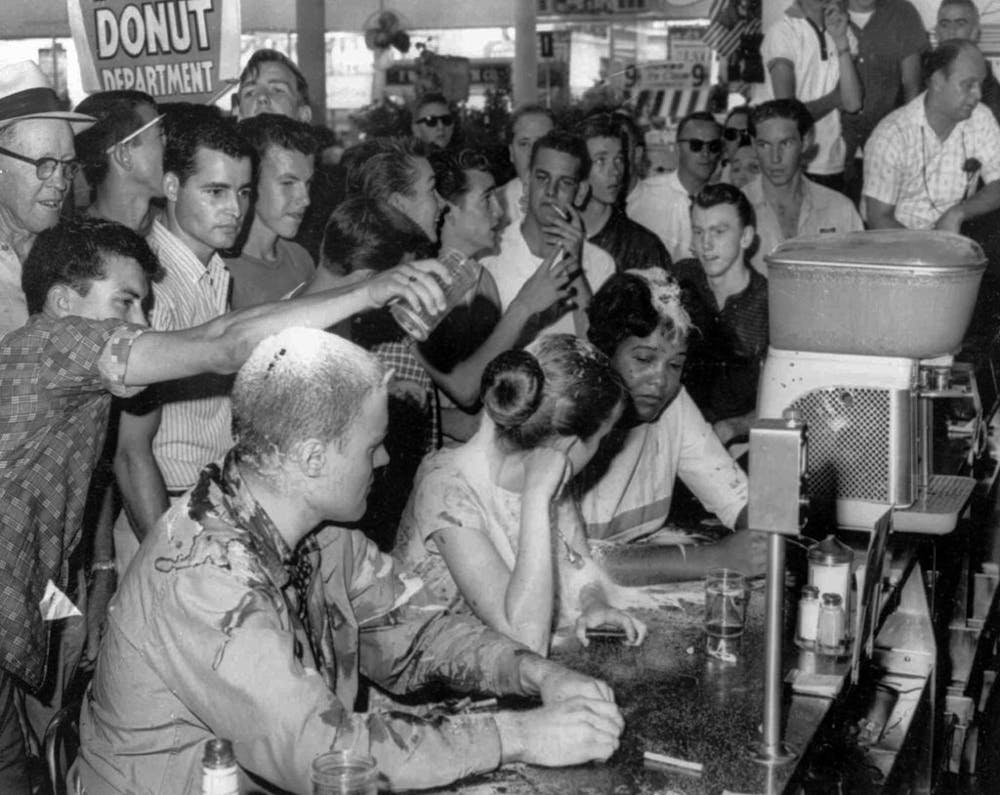
In 1963, Moody became infamous in Mississippi after she challenged racial segregation in what would be the era’s most violent lunch-counter sit-in. At the Woolworth’s in Jackson, Mississippi, white men shoved Moody off her stool, dragged her across the floor by her hair and, when she crawled back, smeared her with ketchup, sugar and mustard.
Photographer Fred Blackwell captured a now-iconic image of this day, with Moody seated in the middle.
In the early 1960s, Moody worked tirelessly as an organizer for the Congress of Racial Equality in Canton, Mississippi. But after facing daily death threats, she fled to the North, where she moved from city to city, raising money for the movement.
At each stop, she described what it was like to come of age, as a black woman, in Mississippi. At one, she shared a stage with baseball great Jackie Robinson, who urged her to write down her story.
So she did.
Readers react
After “Coming of Age in Mississippi” was published, the response was split.
Some readers viewed the book as – in the words of one reviewer for The New Republic – a “measure of how far we have come.” To them, the worst of racism was over, and Moody’s account served as a stark reminder of how bad things once were.
Many readers praised Moody’s story. Many in her home state, however, spurned it. Dell
Others, however, read Moody’s experiences of racism as simply one chapter in a current and ongoing struggle – “the sickening story of the way it still is for thousands who are black in the American South,” as Robert Colby Nelson wrote for The Christian Science Monitor.
Massachusetts Sen. Ted Kennedy read it both ways.
He called the memoir “a history of our time, seen from the bottom up, through the eyes of someone who decided for herself that things had to be changed.” Still, he regretted that the book did not mention recent advances, like the Voting Rights Act of 1965, which enabled the election of several black public officials in Moody’s own hometown.
Meanwhile, for decades, Southern media outlets and public institutions shunned “Coming of Age in Mississippi” and Anne Moody herself. Hostile whites in Moody’s hometown of Centreville, Mississippi even threatened to kill her if she ever returned.
How much has really changed?
By contrast, today, “Coming of Age” shows up on high school and college reading lists throughout the South, and Anne Moody appears among 21 authors pictured on the Mississippi Literary Map. Her crumbling childhood home sits on the recently renamed Anne Moody Street, and Anne Moody Memorial Highway now connects Centreville and Woodville, the town where she graduated from high school.
In Moody’s day, local public officials were all white. Now they more closely reflect the county’s 75 percent black population.
In 1963, Moody mourned the assassination of her beloved colleague, Medgar Evers, president of the state National Association for the Advancement of Colored People, and watched in horror as local whites refused to convict his murderer. Thirty years later, Byron De La Beckwith was finally convicted of homocide and imprisoned for life. Today, visitors who fly into the Mississippi state capital, land at Jackson-Evers International Airport.
These shifts make “Coming of Age” seem, to many readers, an inspiring account of survival, resistance and victory.
But to others, the book is anything but a triumphalist story. Instead, its lessons are grim: In retrospect, civil rights victories seem superficial, while the brutal poverty and racism Moody described endures.
Anne Moody was one of the lucky ones. She graduated from college, moved north and published a best-selling memoir.
But despite the accolades, television appearances, radio interviews and speaking engagements, she could never really escape Jim Crow Mississippi. It had deprived her of her family and a place to truly call home.
“Coming of Age” ends with Moody listening to civil rights workers sing the anthem, “We Shall Overcome.”
“I wonder,” she wrote. “I really wonder.”
Fifty years later, many of us are still wondering.
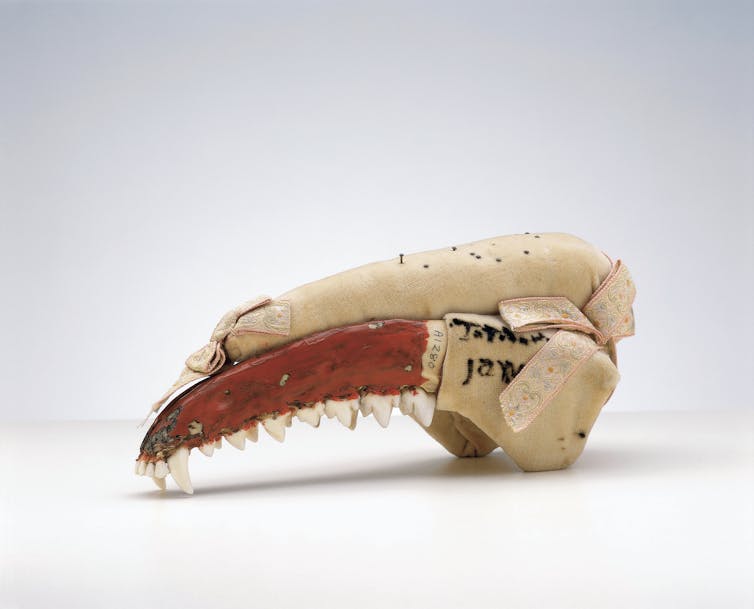
This pin cushion made from the jawbone of a thylacine won second prize in the handicraft section of the Glamorgan Show in 1900. Courtesy Tasmanian Museum and Art Gallery
Book Review: Island Story: Tasmania in Object and Text.
The island of Tasmania lies suspended beneath Australia like a heart-shaped pendant of sapphire, emerald and tourmaline. Here is where the world runs out, crumbling into the vast expanse of the Southern Ocean.
Island Story: Tasmania in Object and Text offers us a fresh perspective on this terrible and beautiful place. Editors Ralph Crane and Danielle Wood invite the reader to discover Tasmania anew with their inspired juxtaposition of objects from the Tasmanian Museum and Art Gallery with texts as diverse as the objects. The pictures are arresting, the textual extracts are perfectly chosen and the design by Imogen Stubbs is gorgeous. Don’t be misled, this is no bland coffee table book.
As benefits such an ancient place, Island Story opens with the specimen of a hairy-legged cicada, an endemic species so ancient it was resident in the supercontinent of Pangea.
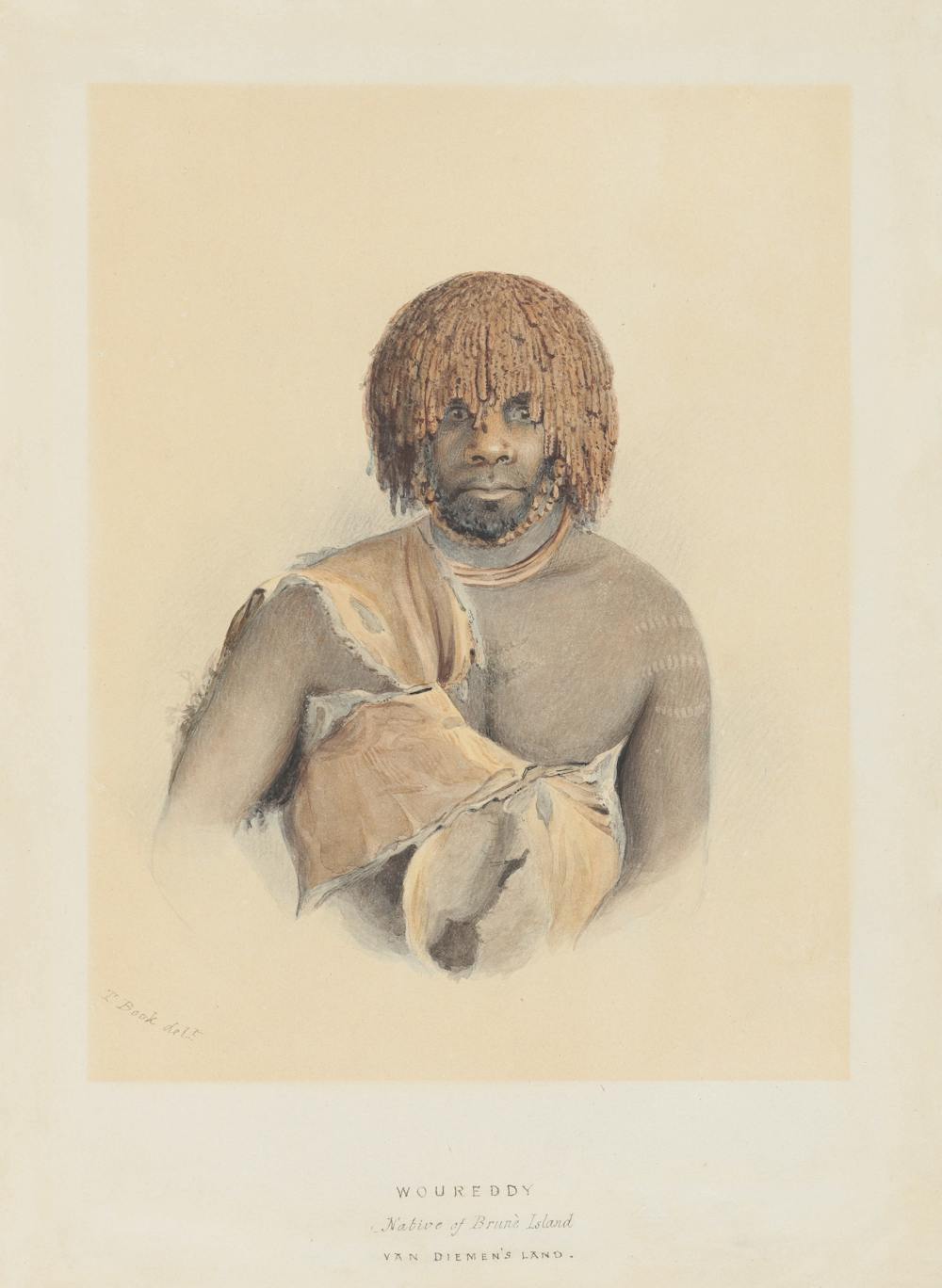
What follows is Thomas Bock’s 1837 portrait of Woureddy, cleverman and warrior of the original people of Tasmania, whose unbroken occupation of the island lasted 40,000 years until colonial invasion brought it to a dreadful end within the short span of Woureddy’s life.
Thomas Bock, Woureddy, Native of Bruny Island, Van Diemen’s Land.
Watercolour, 1837 Courtesy Tasmanian Museum and Art Gallery
Paired with the portrait is the befuddled interpretation of Woureddy’s narrative of the beginning of the world by George Augustus Robinson, the self-proclaimed evangelical missionary primarily responsible for the removal of all the original owners of the land to distant Flinders Island in the Bass Strait.
Robinson’s grand achievement in “conciliating” the original people of Tasmania was celebrated in an 1840 painting by Benjamin Duterrau, reproduced with a paired text by Greg Lehmann that puts in words an implicit theme of Island Story that “the spectre of genocide must be confronted and its consequences owned”.
Connections
The organising principle for the book is “the human desire to see, make and enjoy connections between seemingly disparate things”. A travelling case from the 1920s belonging to the silent move actress Louise Lovely, paired with an extract from Marie Bjelke Petersen’s novel Jewelled Nights that became a movie in 1925 starring Ms Lovely, seems unexceptional, but turn the page and there is a news photograph of arrests at the gay law reform protests in 1988.
The apparent disparity is resolved with the paired biographic extract by the gay rights activist Rodney Croome recalling his bizarre quest to shake the hand of the abhorrent Sir Joh Bjelke Peterson, favourite nephew of Marie, because his was the last hand to touch this writer Croome so admired.
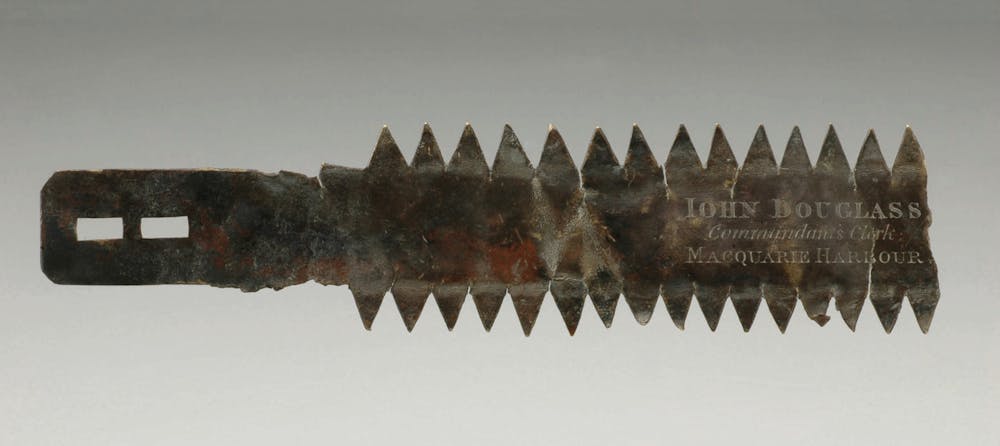
In my desire to see and make connections I found the dominant trope of this book to be captivity: entirely apposite for a place that began its modern history as prison. Among the more mundane objects is a saw from the infamous prison at Macquarie Harbour paired with historian Hamish Maxwell Stewart’s account of the extreme misery that drove so many fatal escape attempts.
John Douglas’s saw, c. 1830s. Courtesy Tasmanian Museum and Art Gallery
Most chilling is the simple cambric and cotton hood with narrow eye slit for prisoners in the dreadful separate prison at Port Arthur. They had to pull it over their heads whenever they left their cell.
Convict Cowl, c. 1850. Courtesy Tasmanian Museum and Art Gallery
In the paired extract from a travelogue by Anthony Trollope, a man who endured 40 years of frightful punishment at Port Arthur after being transported for mutiny, a boy tells Trollope: “I have tried to escape – always to escape – as a bird does out of a cage”.
A delicate watercolour of three young Hobart ladies by the gentleman painter and convicted forger Thomas Wainwright is paired with his 1844 petition begging he be released from “vice in her most revolting and sordid phase” that constituted his seven years in captivity.
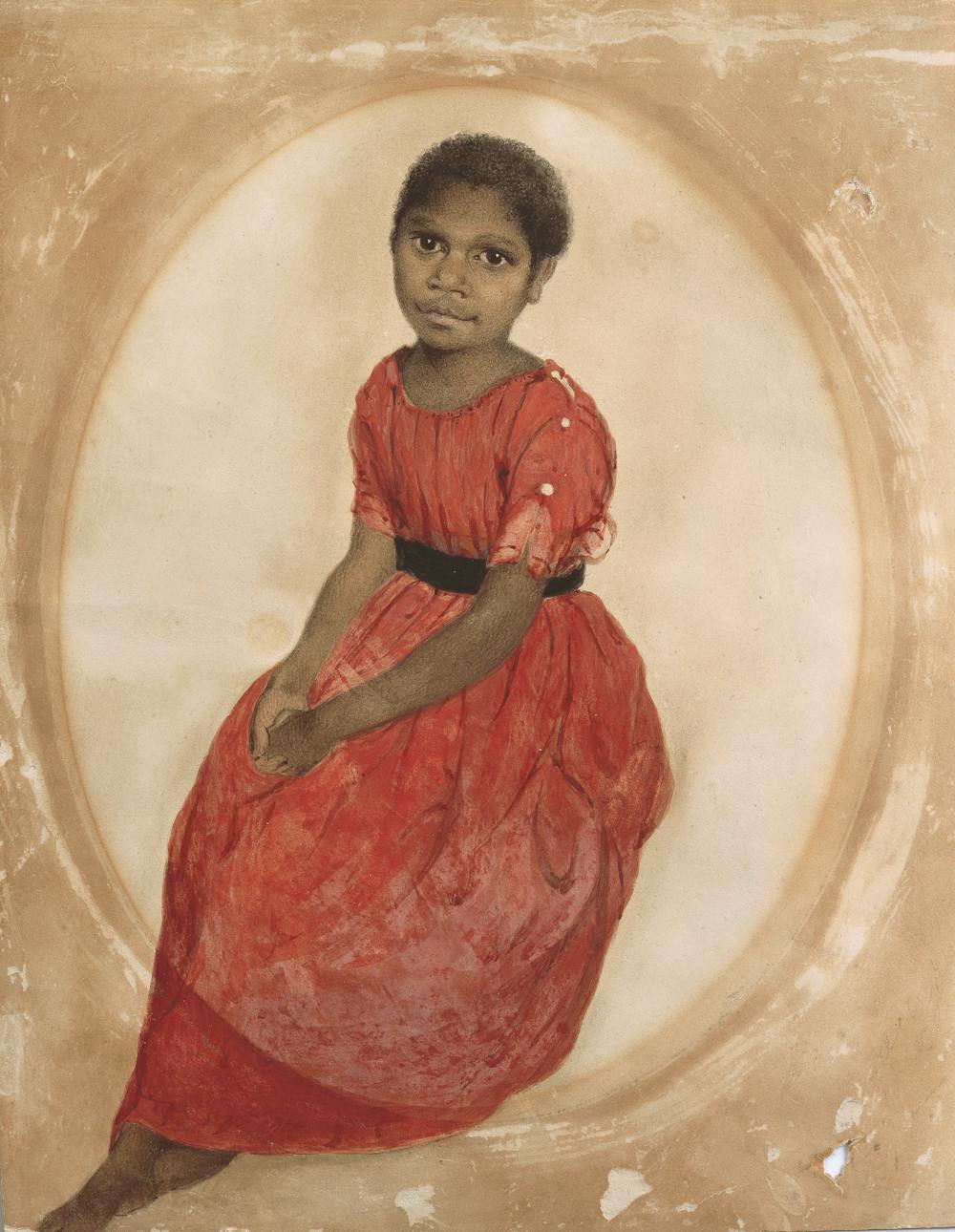
Thomas Bock, Mathinna, Watercolour, 1842. Courtesy Tasmanian Museum and Art Gallery
The painter Thomas Bock also spent years as a convict. In addition to his portrait of Woureddy, the book reproduces his exquisite 1842 portrait of Mathinna, the young girl taken from captivity at Wybalenna on Flinders Island and sent to live at government house as a sort of household pet.
A recent photograph of the chapel at Wybalenna is paired with the 1846 petition to Queen Victoria from several young men protesting their unjust treatment at Wybalenna.
One year after the petition, four dozen survivors were transferred to another place of captivity at a disused convict station at Oyster Cove south of Hobart. All of those taken to Oyster Cove died, except for Fanny who had married an ex-convict named William Smith and went to live on land she was granted in the Huon Valley. She is represented here in the wax cylinders that captured her singing in her own language in 1899.
As one might expect, the extinct Tasmanian Tiger has several outings in this book: as a skeleton, a skin carriage rug and an exquisite jawbone pincushion that won second prize in the handicraft section of the Glamorgan Show in 1900. There is no still from the famous film of the last thylacine in his iron cage, but there is a poignant poem by Cliff Forshaw about the creature’s desolate pacing.
Thylacine Skin Buggy Rug, c. 1903, photographed by Robert David Stephenson. Courtesy Tasmanian Museum and Art Gallery
There are numerous other images from the Zoology section: a specimen drawer of impaled butterflies, stuffed wattlebirds imprisoned in a glass cabinet and a wombat taken from the wild around 1796 and kept in a cage at Government house in Sydney then preserved in spirits and sent to England where the taxidermist mistakenly set the animal standing upright.
Then there is John Burns, the fighting lion born in captivity in the Sydney Zoo and for many years displayed in a huge cage in a circus to be tamed by Captain Humphries and his whip.
Known for his morose moods and fits of rage, John Burns would thrill the audience with his fierce fight for supremacy over Humphries. His body was sent to the taxidermist and displayed in the museum diorama as a tableau with a lioness and two cubs in 1901.
The fighting lion was long gone by my childhood. What I remember of the diorama, which remained until quite recently, was a tableau of an Aboriginal warrior with his wife and two children sitting around a fire. This tableau was made of resin, you understand.











 At the BookShelf

You must be logged in to post a comment.