View from a highway rest stop east of Ravensthorpe, Western Australia. In Kim Scott’s Taboo, the landscape becomes a narrator. Chris Fithall/flickr, CC BY
Why do we tell stories, and how are they crafted? In this series, we unpick the work of the writer on both page and screen.
The omniscient narrator – an all-knowing, third-person voice – is making a return to contemporary fiction. Indigenous Australian author Kim Scott, in choosing this technique for his latest award-winning novel, Taboo, is not alone: we can also find it in recent fiction by Zadie Smith (White Teeth; On Beauty) and Richard Powers (The Overstory).
Readers might be surprised by this trend. Isn’t the penchant to narrate in this way – like a kind of god – long dead? Curiously, the answer is no.
Along with several of his peers, Kim Scott is playing with a mode of omniscience deeply informed by the legacy of postmodernism in literature, a movement characterised by, among other things, a critique of the unreliable narrator. As with all of Kim Scott’s fiction, it matters deeply who it is that is speaking.
Literary scholar Paul Dawson has argued that the reappearance of the omniscient narrator in recent fiction can be read as “a performance of narrative authority”. He suggests one reason omniscience has returned is the anxiety many writers now feel about the role and place of storytelling in contemporary culture, where freely available digital media stories, peppered with fake news, produce and reproduce endlessly. As a result, there is very little about in the way of the consistently reliable narrative authority.
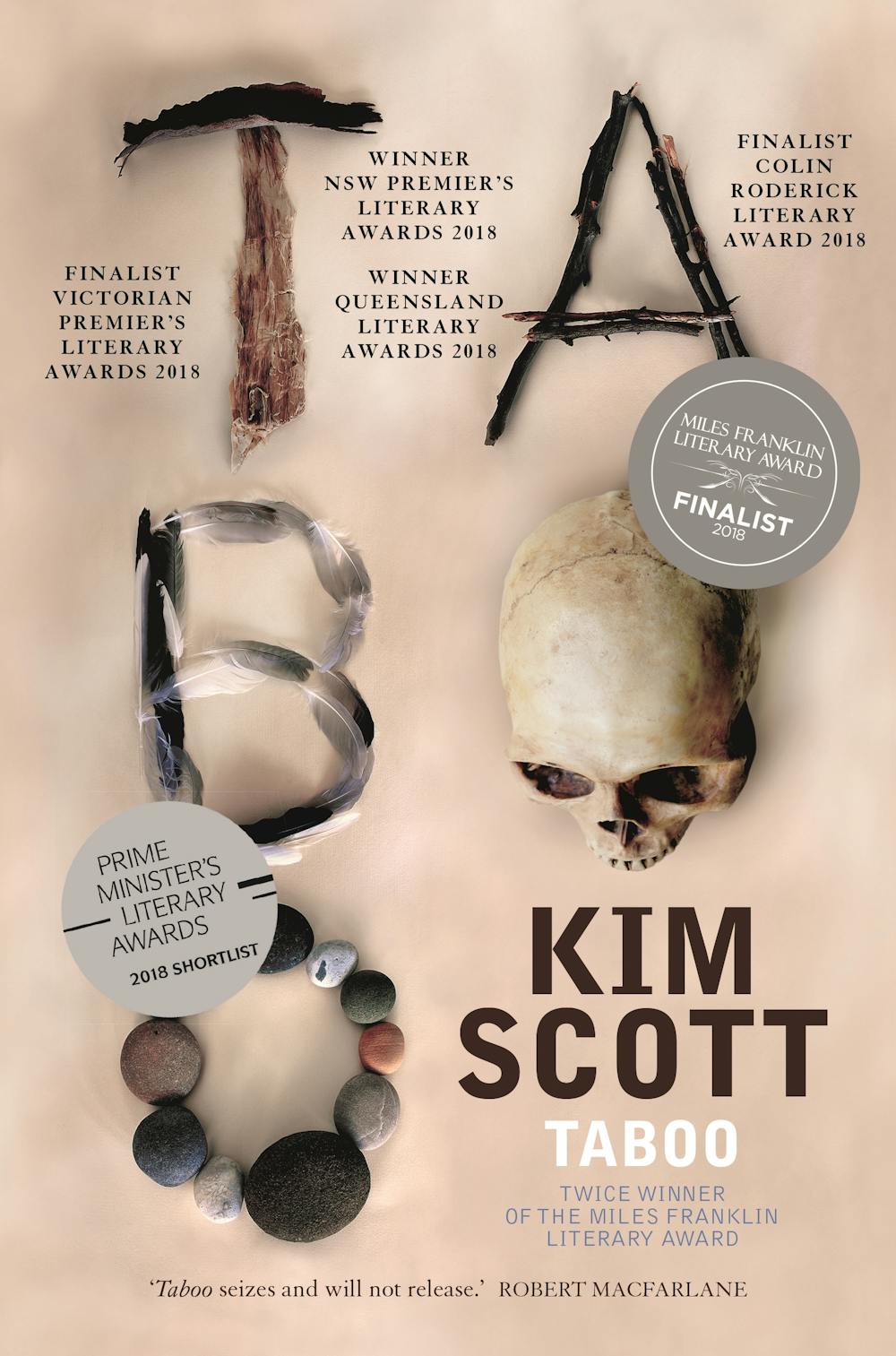
Pan Macmillan
Enter Kim Scott’s omniscient narration in Taboo. Here is a narration that is playfully performative, in part to acknowledge and perhaps counter the many problems with narrative authority in contemporary life, but also to approach a very difficult topic.
This is a novel about a massacre site, and the question of how to adequately acknowledge what such a site means for both Indigenous and non-Indigenous Australians in the present.
Questions around power and narration are entirely pertinent in this context. Whose history is this? And who can tell it adequately? Who has the authority? Who, even, has an adequate handle on the story?
The sense of the flesh-and-blood Indigenous Australian author, Kim Scott, is ever present behind the text. Curiously, he even inserts an Afterword, a non-fiction commentary on his intentions with the novel, directly following the final page. It is an exegesis, or explanation, of sorts. But in and through the novel itself, the omniscient voice is not the implied voice of the author. It is something else entirely.
Reviewing Taboo for the Sydney Morning Herald, literary critic Peter Pierce describes the novel as having an “oracular” voice. Pierce may simply mean that the voice of the novel is enigmatic, but Scott’s narration is also oracular in the sense of employing a voice that claims the authority of an oracle – a source of wisdom from some higher, more ancient order of meaning.
Sometimes this makes the book feel like a work of magic realism, where the magical creeps into the real world, as in the opening pages:
We thought to tell a story with such momentum; a truck careering down a hillside, thunder in a rocky riverbed, a skeleton tumbling to the ground. There must be at least one brave and resilient character at its centre (one of us), and the story will speak of magic in an empirical age; of how our dead will return, transformed, to support us again and from within.
Reviewer Jane Gleeson-White has described the voice of the book as belonging to “‘undead’ Noongar ancestors who rise from the riverbed to narrate”. This is functionally correct, but Scott’s text is not a conventional ghost story, nor is the first-person plural, with its sense of a haunting presence, heavily laboured.
Author Kim Scott employs an omniscient voice in his latest novel. Pan Macmillan
For much of the novel, we are focused upon the key protagonist, Tilly, in a way that could easily be mistaken for conventional realism. Except that it isn’t. Scott regularly disrupts that notion through shifts of perspective, a regular pulling back to the bigger picture. Here is one example, where the reader’s “sitting” on Tilly’s shoulder as she looks out the window of her group’s tour bus is interrupted by another viewpoint, one she cannot be simultaneously aware of:
Seen through the insect-smeared windscreen: scarcely undulating, dry and bleached ground; fence lines beside the road and dividing, at wide intervals, a mostly bare landscape. A fence is just the posts holding hands, thought Tilly, and such long arms in between them … “This place, Tilly, where we’re going” Gerry began, but Tilly was not listening and he let the words die. No one took up the conversation.
Taboo’s omniscient narration is gently provocative. It prods us to think about being or existence, for the novel’s unseen collective voice is more-than-human. As an ancestral voice, it is possible to understand our narrator(s) as a life expanded beyond the human form to encompass land, water, fire and curlew. We are encouraged to shift our thinking beyond the human-centric and towards the relation between human and other forms, especially ecological ones.
Consider, for example, this passage from the end of the novel, when an elderly Tilly is pictured at some point in the future, contemplating a pile of tree branches in a forest:
[She] would see not timber limbs but the bones of something new and ancient, something recreated and invigorated, and would think of when she first heard a voice rumbling from a riverbed, and how something reached out to her.
Did Scott just suggest that a riverbed might have a voice? That an energy without form might have reach?
To some extent, the meaning we take from Taboo depends upon how we think about the whole notion of omniscience. In my view, Scott’s choice of narrative technique works to ask of us as humans an increasingly important question: where are our limits? His use of omniscient narration might therefore be understood as a not just a literary choice, but a philosophical and ethical one.
Shot at Dawn Memorial at Alrewas, Staffordshire, which commemorates British soldiers shot as cowards during World War I. Martin Christopher Parker via Shutterstock
During World War I there was one military execution on average for every week of the war. Soldiers were executed for offences including cowardice, desertion, mutiny, disobedience, assisting the enemy or striking a senior officer. In 2006, the Labour government pardoned 306 soldiers who had been executed for desertion and cowardice in recognition that they were likely to have been victims of war trauma.
The pardons were a long time coming and lagged considerably behind the public understanding of shell shock. This discussion started almost as soon as the guns stopped firing on November 11 1918. One book which was widely influential at the time was A P Herbert’s The Secret Battle which was published in June 1919. As we mark the centenary both of Herbert’s book and of the Treaty of Versailles on June 28 we should move beyond the World War I commemoration to consider the conflict’s aftermath.
In 1928, Herbert’s book was republished in a new edition with an admiring preface by Winston Churchill. He wrote the book was:
One of those cries of pain wrung from the fighting troops […] like the poems of Siegfried Sassoon should be read in each generation, so that men and women are under no illusion about what war means.
The Secret Battle was particularly influenced by the work of the famous shell shock doctor W H R Rivers – Herbert’s novel was a kind of case history, a fictional report on his protagonist’s legal case and mental health. In his famous 1917 essay,Freud’s Psychology of the Unconscious, Rivers highlights the wide implications of Sigmund Freud’s theories of repression and the unconscious for a study of “human conduct” including criminal responsibility.
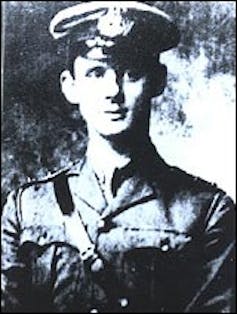
Shot at dawn: Lieutenant Edwin Leopold Arthur Dyett.
Rivers argued especially that war neurosis was caused by the repression of the natural impulse to flee the battlefield. Already written into the doctor’s understanding of psychoanalysis in wartime is the dangerous link between treatment and punishment. He understood that behaviours that were symptoms of shell shock might easily become capital crimes.
Herbert’s unnamed narrator uses the language of “battle psychology” in examining the chain of events that led his friend Harry Penrose to be executed for desertion. Herbert’s novel is in fact a fictional version of real court martial case, that of temporary Sub-Lieutenant Edwin Dyett, who was executed in 1917 despite a diagnosed history of shell shock. Herbert had also studied law and conducted court martial prosecutions and defences throughout his war service.
Make them be quick
In this highly emotional historical context, Herbert’s novel shows poignant restraint in its representation of Penrose’s death by firing squad:
The thing was done seven mornings later, in a little orchard behind the Casquettes’ farm. The Padre told me he stood up to them very bravely and quietly. Only he whispered to him ‘For God’s sake make them be quick’. That is the worst torment of the soldier from beginning to end – the waiting. He was shot by his own men, by men of D Company.
Despite his opposition to the military death penalty, Herbert also included a long fictional debate about court martial in general inspired by the intense feelings inspired by Penrose’s case held between the soldiers of his platoon, which set the tone for future parliamentary debates of the 1920s. This restrained, unbiased aspect of Herbert’s text reflects the narrator’s final summary, which deliberately refuses to become a polemic:
This book is not an attack on any person, on the death penalty, or on anything else, though if it makes people think about these things so much the better. I think I believe in the death penalty – I do not know. But I did not believe in Harry being shot. That is the gist of it; that my friend Harry was shot for cowardice – and he was one of the bravest men I ever knew.
Understanding shell shock
Despite the modesty of this final claim, the first readers of Herbert’s novel took his approach very seriously. For example, in the Times Literary Supplement, the reviewer, R O Morris, linked the book with “medical research” and the “psychoanalytical treatment of shell shock” suggesting that Herbert’s novel is the first war chronicle to deal with “the many subtle ways that fear has of getting at a man” from a “scientific understanding”.
Herbert’s book brought the injustices of the death penalty for cowardice to public debate.
At the same time, the reviewer struggles with the wider implications of the novel, arguing that in designing the tragedy of Penrose, the novelist “has left no stone unturned to ensure the full measure of calamity”.
In short, the novel challenged cultural beliefs about the natural justice of the military death penalty. Penrose was felt by the reviewer to be too sympathetic a character to be executed, precisely because of the complex, humanising psychological portrait Herbert offers.
But as early as 1922, a government report on shell shock admitted that similar injustices had undoubtedly occurred, as “psychoneurotic soldiers might have been court martialed and executed for cowardice before the phenomenon was understood”. It is suggested in this report that shell shock defences were rejected in around a third of cases.
American World War I scholar Ted Bogacz has argued that this 1922 report offered a direct line to the eventual abolition of the death penalty for cowardice in 1930. (Incidentally, despite Churchill’s admiration of the novel, he voted against this legislation). But fictional texts such as Herbert’s novel were just as important as the 1922 government report in raising awareness of the effects of shell shock and in reforming military procedures.
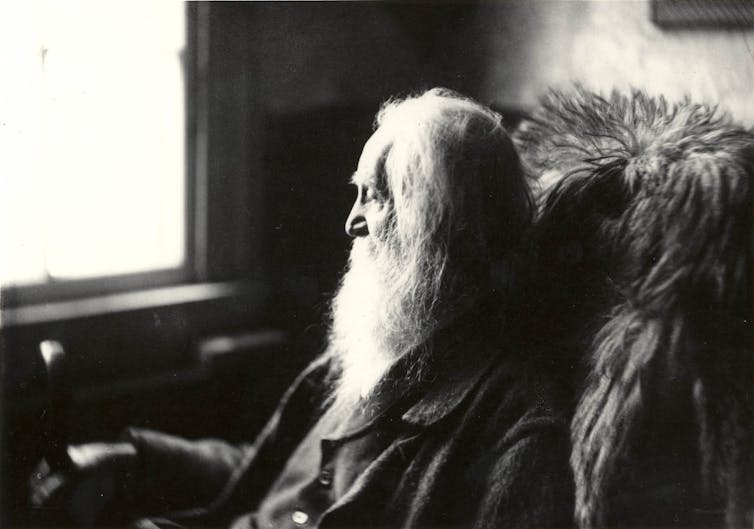
Poet Walt Whitman in his home in New Jersey in 1891. Born 200 years ago this week, Whitman is celebrated in America for his daring poetry collection Leaves of Grass. Samuel Murray/Wikimedia Commons
This year marks the 200th anniversary of the birth of Walt Whitman, America’s most admired poet. Celebrations will be especially joyful around his birthday on May 31 and in New York City, whose citizens were often depicted in his poems. But the poetry many people now love won him notoriety before it won him fame.
Whitman’s life was interesting and varied. He was born in 1819 and grew up in and around Brooklyn, moving often as his family tried to make money from farming and real estate. His formal education ended when he was 11. He worked by turns in Manhattan and Brooklyn as a printer’s apprentice, a schoolteacher and a newspaper publisher, before resolving to become a writer.
Having had some success – a novel and newspaper pieces – he became chief editor of the Brooklyn Eagle, but lost this position when his opposition to the spread of slavery clashed with the views of the newspaper’s owner. Luckily, an opportunity arose to work on a newspaper in New Orleans. Whitman enjoyed this different culture, but never lost his horror of slave auctions.
On learning his brother George might have been injured during the Civil War, Whitman travelled to Washington DC and Fredericksburg, Virginia, to look for him. Fortunately, George’s wound was only superficial, but Whitman stayed on in Washington as a nurse, where he attended to sick, maimed and dying soldiers.
Working in field hospitals, Whitman’s health deteriorated, and at the age of 53 he suffered a stroke. Although he made a partial recovery, he was cared for by friends until he died almost 20 years later in March 1892. By then, he was admired for his writing in England, but the thousands who lined the streets in New Jersey for his funeral procession were probably more curious about his enormous tomb, which he had designed himself, than his writing.
We don’t know how or why Whitman began to invent his extraordinary poetry. In 1842 he listened to “The Poet”, a lecture in which philosopher Ralph Waldo Emerson called for a national bard who could write about the US in all its diversity. But Whitman’s daring originality seems more than a mere response to Emerson’s demands.
It is clear he thought of his book of poems, Leaves of Grass, as an experimental project. He took the opportunity of having the best compositors, the Rome brothers, typeset his poems, and he supervised the work closely, revising his poetry to fit the page. He even set about ten pages of the type himself.
The book’s long non-rhyming lines are reminiscent of bible verses. Each seems to correspond with a single breath or a single gesture. Words or phrases are often repeated at the beginning of a series of lines, building up a rhythmical pattern. However, Whitman is careful to break the pattern before it can become mere rhetoric. The reader is constantly being called to attention:
Smile O voluptuous cool-breath’d earth!
Earth of the slumbering and liquid trees!
Earth of departed sunset – earth of the mountains misty-topt!
Earth of the vitreous pour of the full moon just tinged with blue!
Earth of shine and dark mottling the tide of the river!
Earth of the limpid grey of clouds brighter and clearer for my sake!
Smile, for your lover comes. (“Song of Myself”, canto 21)
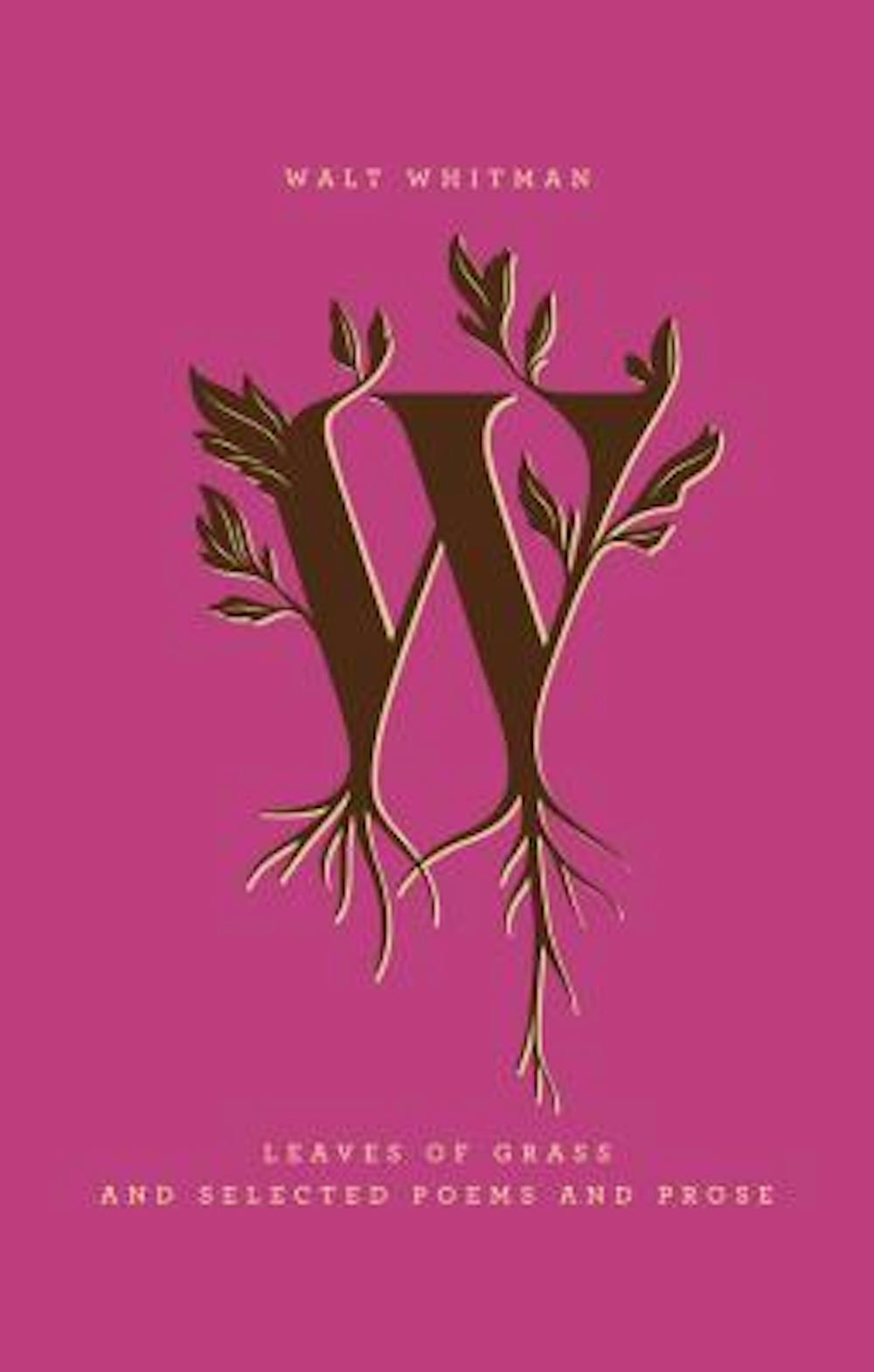
Leaves of Grass was Whitman’s sole book of poetry. Rather than publish several collections containing new poems, he revised and expanded this single volume, so that the first edition of 12 poems eventually became a thick book of close to 400 poems.
There are six editions of the book (nine, if you count different type-settings). As soon as one was published Whitman would revise, regroup and add to the poems, treating the published book as a manuscript to be edited and republished.
The overall result of this practice is that Whitman’s poetry is seen always to flow from a single being; it is as unified and as singular as the man who made it.
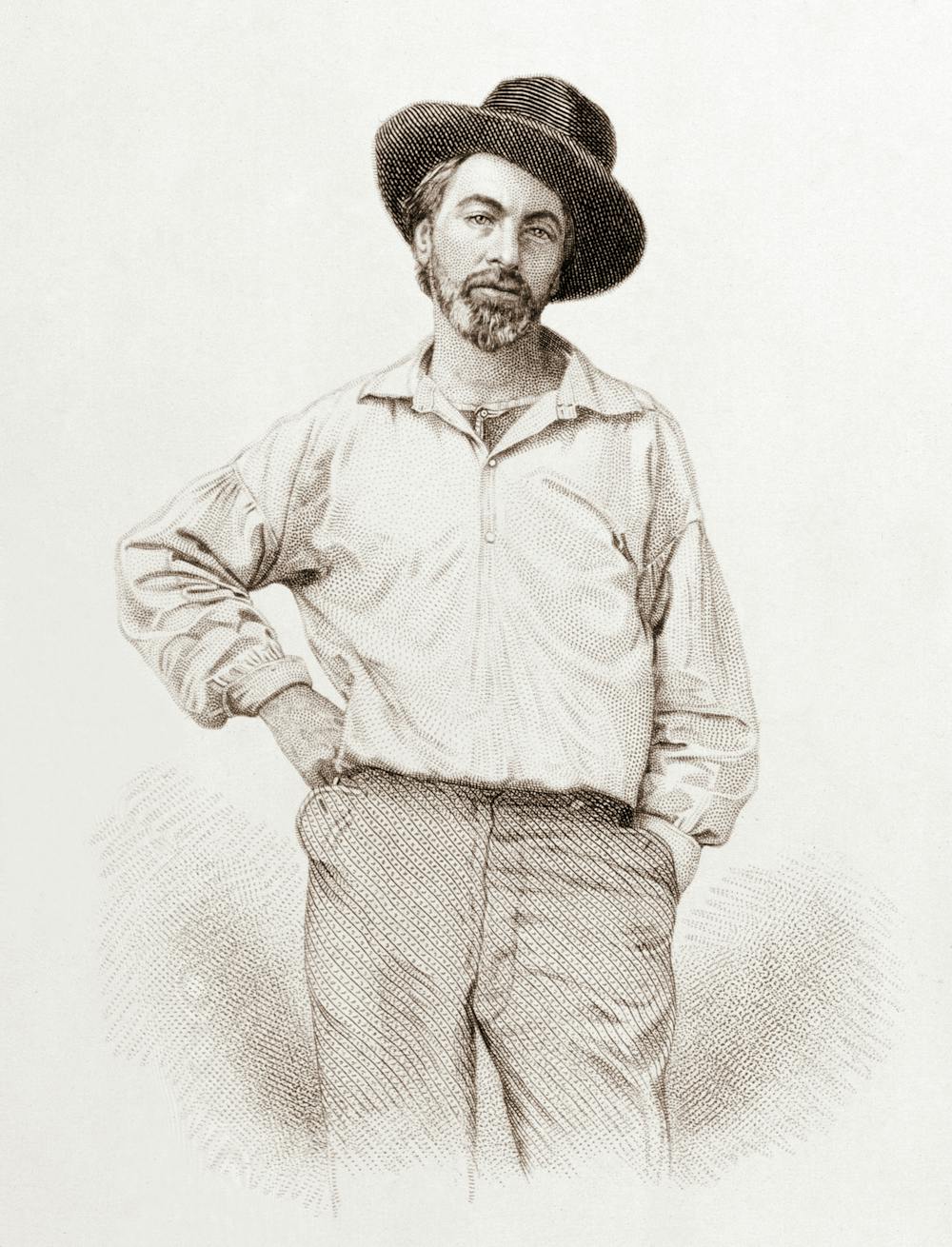
The first edition of Leaves of Grass did not even contain the author’s name on the title page, but he was instantly recognisable from his picture on the frontispiece – a working man in his prime, open-shirted, hat on the back of his head, hand on hip, looking straight out at the reader.
Walt Whitman, 1854, frontispiece to Leaves of grass, Fulton St., Brooklyn, N.Y., 1855, steel engraving by Samuel Hollyer from a lost daguerreotype by Gabriel Harrison. Wikimedia Commons
The poet of democracy
Emerson’s influence – or Whitman’s agreement with Emerson – can be seen in Whitman’s insistence on democracy as a central value of American society. People are equal, according to Whitman, because we are all mortal; moreover, we all have immortal souls.
In “Song of Myself”, we can see the connection between democracy, equality and immortality in the symbolic use of grass, which grows everywhere:
[…] I guess it is a uniform hieroglyphic,
And it means, Sprouting alike in broad zones and narrow zones,
Growing among black folks as among white,
Kanuck, Tuckahoe, Congressman, Cuff, I give them the same, I receive them the same. […]
Tenderly will I use you curling grass,
It may be you transpire from the breasts of young men,
It may be if I had known them I would have loved them,
It may be you are from old people, or from offspring taken soon out of their mothers’ laps,
And here you are the mothers’ laps. […]
What do you think has become of the young and old men?
And what do you think has become of the women and children?
They are alive and well somewhere,
The smallest sprout shows there is really no death […]
All goes onward and outward, nothing collapses,
And to die is different from what any one supposed, and luckier.
In this passage the grass signifies equality, by making no distinction where it grows. A “hieroglyphic” symbol might need an expert – such as Whitman – to translate it, but it grows “uniform[ly]”, giving everyone the same rights and the same chances to mean something in the great poem that is America, as Whitman saw it.
Poet of the soul
As a result of Whitman’s habit of revision, we can witness the growth of many poems. The Sleepers, generally agreed to be among his finest, was worked on over the course of his career.
It is one of his most ambitious poems, with a triumphant ending that seems genuinely earned. It poses questions about the limitations of a single human life. How can one life, or one death, or one gender, be enough for a man, a poet, consumed by curiosity?
Whitman wants to dream every sleeper’s dream, be every sleeper’s lover, know every person’s meaning in the larger scheme, live everyone’s life and die everyone’s death.
In the third section of the poem, he envisages a beautiful swimmer, who comes to grief on rocks and dies. His body is then retrieved and laid out in a barn, with others, to be mourned just as the slain soldiers in the Revolutionary War (1775-83) were mourned by General Washington.
A Native American woman comes to visit the man’s mother, and then goes on her mysterious way, before everyone else returns to their rightful place: immigrants return home, colonial masters return to their countries of origin, the dead (including the beautiful swimmer), those waiting to be born, the sick, the disabled, the criminal are all likened to one another and restored in sleep.
At the end of the poem, all of the restored sleepers begin to awaken, an event described in terms of reconciliation and resurrection:
The sleepers are very beautiful as they lie unclothed,
They flow hand in hand over the whole earth from east to west as they lie unclothed,
The Asiatic and African are hand in hand, the European and American are hand in hand […]
The felon steps forth from the prison, the insane becomes sane, the suffering of sick persons is reliev’d,
The sweatings and fevers stop, the throat that was unsound is sound the lungs of the consumptive are resumed, the poor distress’d head is free […]
Stiflings and passages open, the paralyzed become supple,
The swell’d and convuls’d and congested awake to themselves in condition,
They pass the invigoration of the night and the chemistry of the night, and awake. (Canto 8)
Only at the end of the poem does Whitman state that he has been previously afraid to trust himself to the night, but that now he is at peace with the rhythm of night and day, sleeping and waking, which governs the world.
Poet of the body
Whitman’s poetry was initially unpopular. Not only was his new verse form considered outlandish, but his insistence on the worthiness of the body put him beyond respectability. Emerson originally endorsed him, “greet[ing him] at the beginning of a great career”, but when Whitman published Emerson’s approving letter without permission in the next edition of the book, he put Emerson in an awkward position.
Emerson tried to dissuade Whitman from publishing explicit poems about sex and sexuality, but Whitman did so anyway. The 1860 edition of Leaves of Grass introduced a Children of Adam section, depicting robust heterosexual love, and a Calamus section, which celebrated love between men:
Not heat flames up and consumes,
Not sea-waves hurry in and out,
Not the air delicious and dry, the air of ripe summer, bears lightly along white down-balls of myriads of seeds,
Wafted, sailing gracefully, to drop where they may,
Not these, O none of these more than the flames of me, consuming, burning for his love whom I love […]
There were a few enthusiastic anonymous reviews for Leaves of Grass, but they were written by Whitman. His friends William Douglas O’Connor and John Burroughs allowed Whitman to make bold claims for his poetic achievements under their names. One pamphlet, ostensibly by O’Connor, was called The Good Grey Poet, an image of wholesomeness that went some way toward transforming and boosting Whitman’s image. Eventually, in 1881, Whitman had the opportunity to publish an edition of his book with a major publisher, Osgood.
However, no sooner had 1,500 copies of this definitive edition been printed than the publisher had to withdraw it, under threat of litigation for promoting obscenity. Then, in 1882, Leaves of Grass was banned in Boston. Fortunately, he was taken up by another publisher, and made more than $1000 in royalties on this edition.
Whitman’s overtly homoerotic poems won him friends as well as enemies. The English socialist writer and reformer Edward Carpenter visited him twice, and Oscar Wilde was also pleased to meet him. John Addington Symonds, an English poet and critic, wrote to Whitman over many years, urging him to state explicitly what he meant by the love of comrades.
At last Whitman emphatically disavowed any claim made by Symonds about the possibly sexual nature of the Calamus poems and stated that he had fathered six children. No evidence has been found to substantiate this claim.
Only after his death were Whitman’s romantic letters to streetcar conductor Peter Doyle published. Today Whitman is claimed as a champion of same-sex love, although whether or not it was consummated is still a matter of debate and probably unknowable.
In one of the appraisals that Whitman ghost-wrote, he claimed to be better appreciated across the Atlantic than he was in America. There is truth in this: a censored English edition had found its way to a band of fervent supporters in industrial Bolton, near Manchester. They sent him a birthday message and ten pounds, and eventually two of them, J. W. Wallace and Dr John Johnson, went to visit the poet, by then gravely ill.
A lively transatlantic correspondence ensued that lasted long beyond the death of the poet and the two leaders of the Bolton Whitman reading group. Whitman’s birthday is still celebrated with a walk led by Bolton Socialist Club members.
The transformation of Whitman from shunned outsider to national poet-hero happened in fits and starts. Whitman’s own critical efforts and those of his transatlantic disciples began it. Then Whitman’s “spiritual son”, Horace Traubel, wrote a nine-volume work called With Walt Whitman in Camden, published between 1906 and 1996, designed to make Whitman’s thought more generally known.
Wealthy collectors of Americana began to exhibit the various editions of Whitman’s books. Readers began to appreciate Whitman’s insistence on the body and the value he placed on manly love. Whitman’s poetry began to be studied wherever American literature was taught, and he was taken up by popular culture.
Whitman’s birthplace in Huntington, New York, is now a museum, close to the Walt Whitman Shops on Walt Whitman Road. You can take a tour through his last residence – the only house he ever owned – in Camden, New Jersey.
He is now considered the father of free verse (although he was not the first poet to use it), the father of modern poetry, and, according to one critic, the “imaginative father and mother” of every American, whether a poet or not.
Whitman is also recognised with parks in Washington DC and New York. Among the most moving tributes is the Dupont Circle train station in Washington DC, which contains an inscription from his poem “The Wound Dresser”.
Originally written about the Civil War, these lines in their new context become a tribute to those who cared for sufferers during the AIDS crisis. One senses that the poet would be gratified at last to be given the recognition craved by this generous, embracing imaginative personality.











 At the BookShelf

_-_1887_-_ritr._da_Eakins,_Thomas_-_da_Internet.jpg)

You must be logged in to post a comment.