
Unknown's avatar

Inside the story: 99 versions of the same tale in The Drover’s Wives


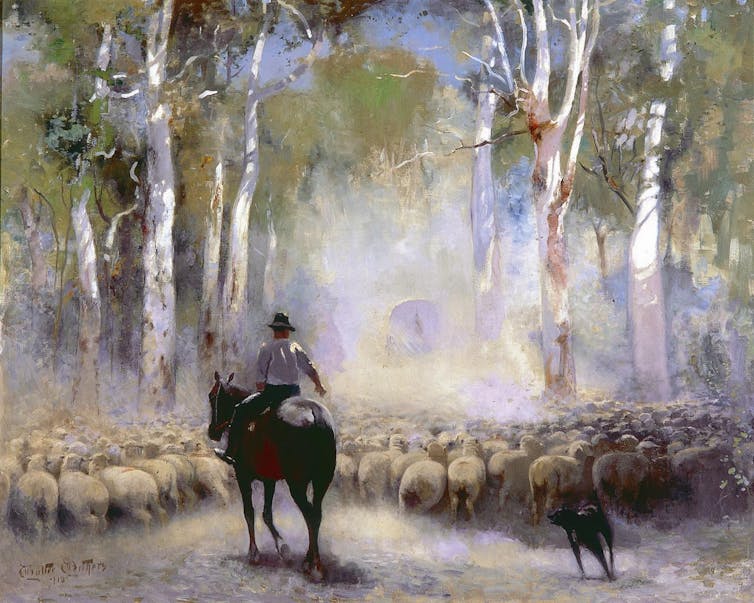
Walter Withers, ‘The Drover’, 1912, oil on canvas. A recent book reinterprets Henry Lawson’s The Drover’s Wife in 99 ways, offering new perspectives on the classic short story.
Wikimedia Commons

Dave Drayton, University of Technology Sydney

Why do we tell stories, and how are they crafted? In this series, we unpick the work of the writer on both page and screen.


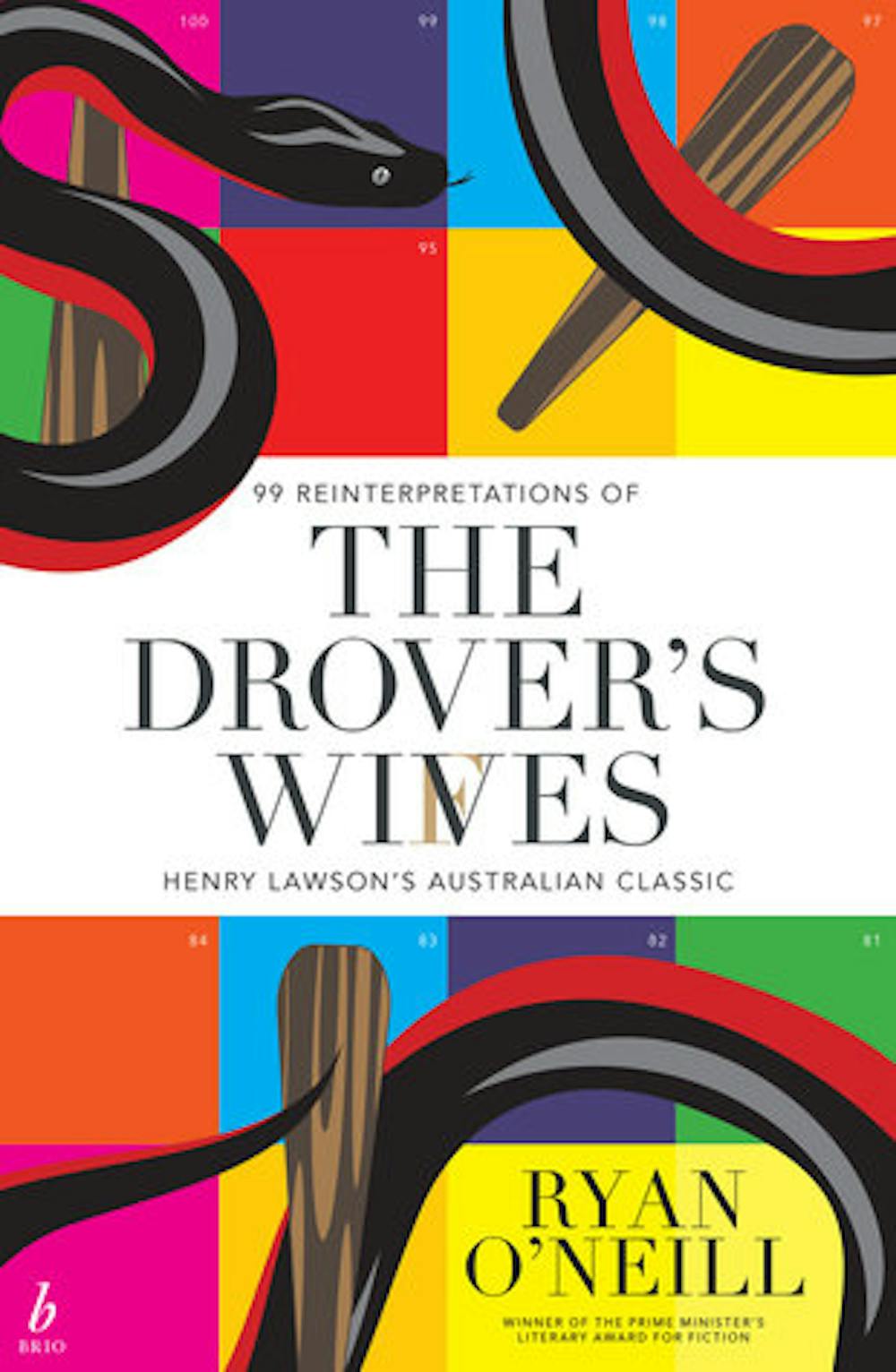
Ryan O’Neill’s recent book The Drover’s Wives joins a rich corpus of Australian literary works inspired by Henry Lawson’s short story, The Drover’s Wife (first published in The Bulletin in 1892).

But O’Neill’s approach differs from that of other authors, by offering not one reinterpretation – as in Frank Moorhouse’s satirical take and Barbara Jefferis’ feminist retelling, for example – but 99 different versions of the story.

His book envisages the Lawson story in various forms, including: as a tweet, a school English essay, an Amazon book review, a limerick, a computer game, a gossip column, and even a sporting commentary.

O’Neill’s book is dedicated to both Henry Lawson and French novelist Raymond Queneau. The latter was a founding member of the Oulipo (Ouvroir de Littérature Potentielle), a mostly French assortment of experimental writers, mathematicians and scientists, founded in 1960.

O’Neill attempts Queneau’s method of literary variations on a theme in Exercises In Style (first published in French in 1947), but with an Australian context.

Goodreads

Lawson’s The Drover’s Wife provides the central narrative of O’Neill’s test. In the story, the titular wife of the absent drover spends a sleepless night keeping watch for a snake that had earlier alarmed her children. She passes the time reminiscing on hardships she has faced in the bush before. As daylight nears, the snake appears, and she clubs it to death.

As with Exercises In Style, the original narrative in O’Neill’s book is of secondary importance to the telling and the myriad ways these tellings transform the tale.

O’Neill’s experiment highlights the fact all writing is constrained by certain rules. It’s easier to play the game when you know these rules (and bend them, too).

By taking a text so familiar as its starting point, O’Neill’s tweaks show the conventions of 99 different forms of writing, while shining new light on Lawson’s classic in the process.

Narrative techniques

The fourth reinterpretation in The Drover’s Wives – a “Year 8 English Essay” – begins with the prompt: “What narrative techniques does Lawson use to shape the reader’s perception of the drover’s wife?” With some substitution, we might re-render the question: “What narrative techniques does O’Neill use to shape the reader’s perception of The Drover’s Wife?” Let me count the ways …

Among the most interesting rewrites is a version of the poem where the story is reduced to only onomatopoeia (words that look like the sound they make): the snake is represented by “slithers, sizzles and snaps”.

In another version, he experiments with “spoonerisms” – a display of shining wit where the initial syllables of two or more words are transposed. Instead of a “small herd of grass eaters”, O’Neill renders the drover’s flock as a “small herd of ass greeters”.

He even includes a tanka, a Japanese poetic form similar to haiku:

A snake approaches.
The woman and children run
And hide in the house.
Through the long night she watches –
Shedding memories like scales
And the snake burns with the dawn.

O’Neill departs from the methods originally proposed by Queneau’s book by progressing into more contemporary territory (using PowerPoint lecture slides; a 1980s computer game; emojis; tweets; an Amazon book review; a reality TV show; a meme; a spam e-mail; and internet comments).

He also uses forms specific to an Australian cultural context (an RSCPA report; a letter to the Daily Telegraph; Ocker; and Bush Ballad).
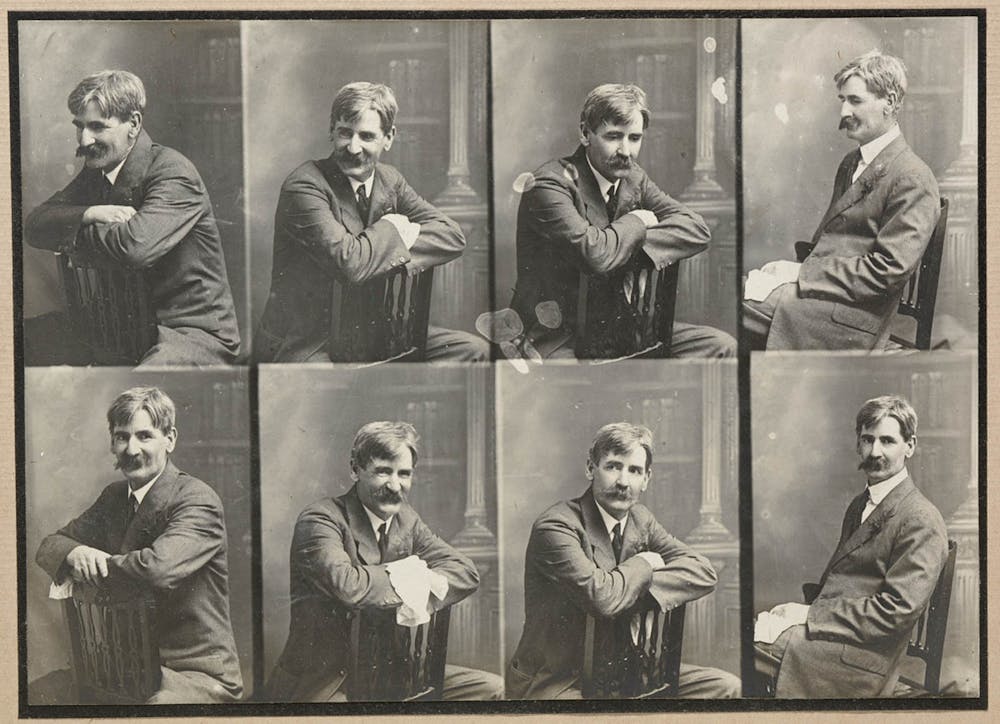
Portraits of Australian author Henry Lawson. Ryan O’Neill joins a long line of writers who have put their own spin on Lawson’s classic short story.
Mitchell Library, State Library of New South Wales

Techniques of transformation

A useful way to illustrate the impact of each technique employed by O’Neill is to examine its effect on the opening paragraph in Lawson’s original, used to establish the scene:

The two-roomed house is built of round timber, slabs, and stringy-bark, and floored with slit slabs. A big bark kitchen standing at one end is larger than the house itself, veranda included.

In O’Neill’s text:

  • the Monosyllabic chapter re-renders the opening with single syllable words: “They lived in the bush in a shack with two rooms, miles and miles from the main road […] ”

  • the Yoked Sentence chapter, requiring each sentence to begin with the last word of the previous sentence, opens: “The drover’s wife and her four children lived in an isolated house deep in the bush. Bush was all around, and the nearest neighbour was miles away. Away to the north somewhere, the drover […]”

  • in the Lipogram chapter, which requires the conscious omission of one or more letters, the omission of the letter E renders the exposition differently: “A bush cabin in an outlying part of Australia marks a distant location for our story”.

The opening paragraph is likewise transformed by the use of rhyme in various other chapters.

One that takes the form of a 1950s Children’s Book begins: “There was once a bush farm that the sun rose over, and on that little farm lived the wife of a drover.”

In the Elizabethan Drama chapter, the chorus does the expositional work, beginning their prologue: “A household, poor but rich in dignity / In fair Australia where we lay our scene / Bush all around in stretches to infinity / No indoor plumbing, just an old latrine.”

As is common, the opening lines of the limerick chapter introduce not the house, but the central character of the poem: “There once was the wife of a drover, Who met with a snake, and moreover …”.

In the 1980s Computer Game chapter, the new level of interactivity is made apparent with a shift to second person narration: “You are in a large kitchen by a two-room house”.

A similar technique is used to achieve the tone in the Cosmo Quiz chapter, which parodies the conventions of a glossy magazine quiz: ten multiple choice questions to show you whether you’re a time traveller’s wife, a Stepford wife or a drover’s wife.

How do these various narrative techniques shape perception of Lawson’s original story? On their own, each may heighten or enhance a latent quality that lies in waiting. For instance, the Cosmo Quiz reveals the gender dynamics, satirising the protagonist’s apparent absent agency.

Taken as a whole, the book functions equally as a playful and experimental collection of brief narratives, and an illustrative compendium of writing techniques.The Conversation

Dave Drayton, Lecturer in Creative Writing, University of Technology Sydney

This article is republished from The Conversation under a Creative Commons license. Read the original article.

Unknown's avatar

Not My Review: Siege – Trump Under Fire by Michael Wolff


The link below is to a book review of ‘Siege – Trump Under Fire,’ by Michael Wolff.

For more visit:
https://www.theguardian.com/us-news/2019/jun/02/siege-review-michael-wolff-trump-fire-and-fury

Unknown's avatar

Not My Review: The Rest of the Story by Sarah Dessen


Unknown's avatar

Not My Review: The Ten Thousand Doors of January by Alix E. Harrow


Unknown's avatar

Not My Review: Flowers for Algernon by Daniel Keyes


Unknown's avatar

Not My Review: Animal Farm by George Orwell


The link below is to a book review of ‘Animal Farm’ by George Orwell.

For more visit”
https://blog.bookstellyouwhy.com/book-spotlight-animal-farm

Unknown's avatar

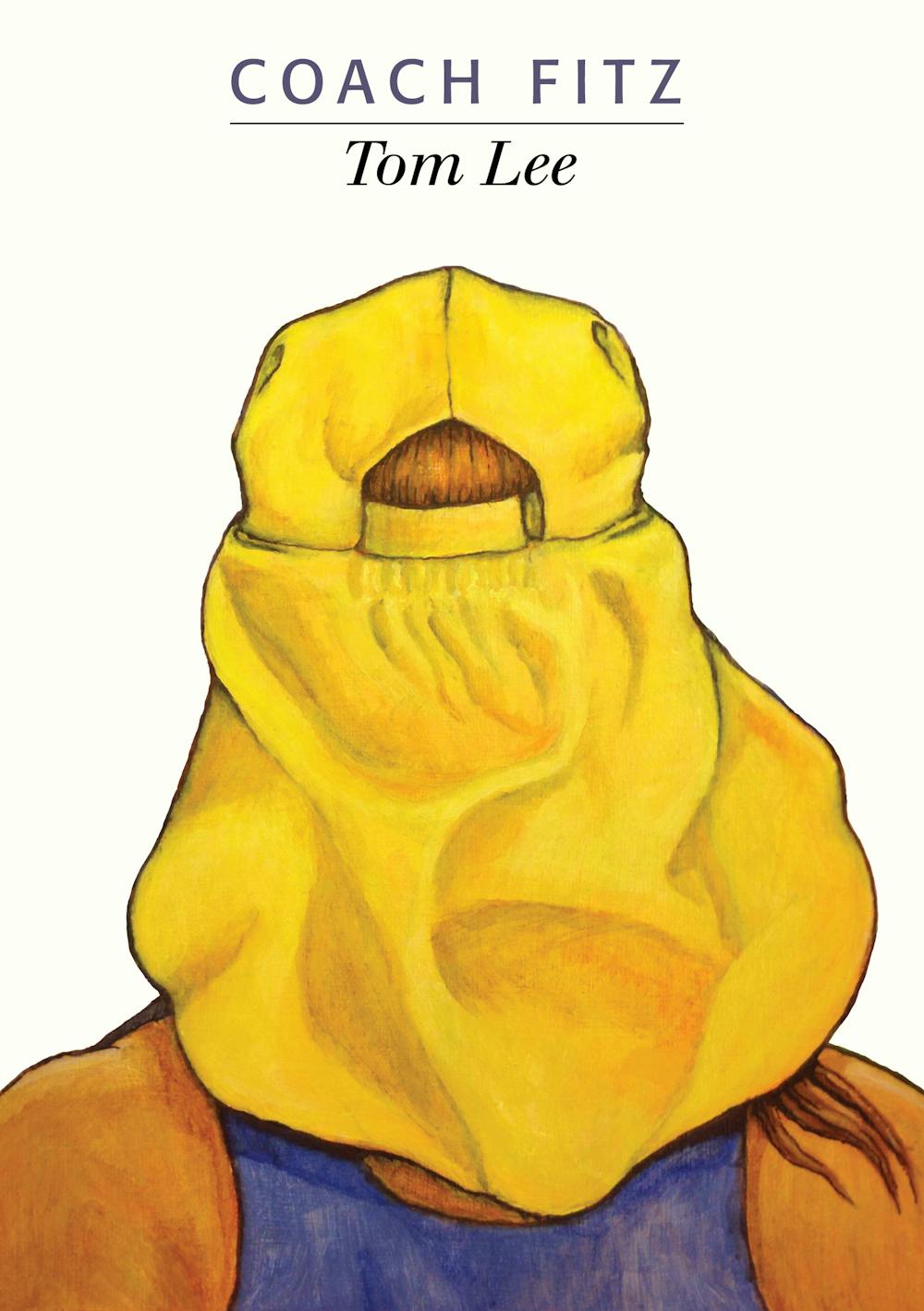
Inside the story: Coach Fitz and the accidentally comic voice


In the novel Coach Fitz, the narrator is seemingly unaware of his humorous voice. This device is one way that the novel subverts expectations.
Shutterstock

Debra Adelaide, University of Technology Sydney

Why do we tell stories, and how are they crafted? In this series, we unpick the work of the writer on both page and screen.

Early in Tom Lee’s debut novel, Coach Fitz, the narrator declares his intention to pay for an intensive program of training as a runner by saving money. He proposes to take on several menial jobs – window washing, school playground supervision, cocktail bartending – but also to adopt personal austerity, which includes “fulfilling the long-held dream of living in my car, an early model maroon Honda Odyssey”.

This is just one example of the book’s humour, a technique that is a vital aspect of its intriguing, multilayered appeal. This humour is much more than a device: it is an intrinsic part of a narrative that seeks to disrupt conventions of the novel by inverting reader expectations of the form.

At the same time, however, its anti-hero narrator, Tom, is cast in the mould of time-honoured tradition: Tom is an awkward everyman, a naïve Don Quixote, a digressive Tristam Shandy.


Giramondo

The story is a simple one: Tom has returned to Sydney after some time away – which has involved a failed relationship – and decides to focus solely on improving his physical fitness.

This is matched with a desire to strip down his life, as well as open it up: at the same time that Tom is living in his car and using outdoor beach showers, he is traversing and exploring the Sydney terrain, and absorbing lessons from his new coach on architecture, philosophy, the environment, and psychology, particularly tht of young males.

There is perhaps no immediate comic effect of the line about Tom living in his Honda, but the fact is the more I re-read it the funnier it seems. It is typical of the humour that ripples through every page: measured, grave, almost sober.

This humour relies entirely on the personality and thus voice of the narrator, and yet this narrator at first glance is far from comical: indeed, his voice is fussy, pedantic, and endlessly self-regarding.

It is not surprising to learn that two authors for whom voice is paramount have influenced this novel: W. G. Sebald, in particular his 1995 novel The Rings of Saturn, and closer to home the fictions or “reports” of Gerald Murnane, such as Barley Patch.

Comedy is possibly not the first quality that springs to a reader’s mind when considering these two authors either, however in both Sebald and Murnane we also hear voices of pedantic precision and obsessive reflection that at times strike comic notes.

Like Tom, the narrators of these texts seem entirely unaware of the humour of their utterances. For instance, in Murnane’s 1982 novel, The Plains, the narrator at one point confides in great detail to the reader his plans for seducing his patron and host’s wife, but without any apparent understanding of how preposterous these plans are.


Read more:
The case for Gerald Murnane’s The Plains


Coach Fitz author Tom Lee has been influenced by authors Gerald Murnane and WG Sebald, for whom voice is paramount.
Aaron Seymour

To claim that comedy is not content-driven, but relies entirely on voice, is of course hardly new: voice is also essential for any stand-up comedian, however this is expected – it’s the object of a comic routine. The narrative of Coach Fitz is not a routine, and the comedy is part of the journey, not the destination.

Although there is this innocence, or lack of self-consciousness, paradoxically, the narrator is also consciously considering every aspect of his existence. Nothing is left unexamined in his pared-back running and training life: sourdough bread, outdoor exercise gyms, internet cafes, muscle tone, horse racing, domestic architecture, urban native vegetation, the Six Foot Track in NSW, and the eccentric eponymous coach herself, an endless source of scrutiny who eludes ultimate comprehension.

Context is also vital in this comic effect. It is possible to open the novel almost at random and extract a sentence that chimes harmoniously and delivers this measured, sober comedy, but I suspect if I were to select another line as I have above, it would not sound funny out of context.

The narrator is profoundly contradictory. He is pompous but his earnestness makes that forgivable. He is well-informed, indeed over-informed, passing on to the reader his knowledge of everything from topography and birdwatching, to the best breakfast to be found in the eastern suburbs’ cafes, and yet knowledge does not necessarily deliver understanding. For example, Tom is unable to anticipate or deal with the main crisis thrust upon him when Coach Fitz makes a drunken lecherous move on him.

Indeed, for all this knowledge, Tom remains an innocent. Having cast off Coach Fitz he decides to become a trainer himself, and selects as his first pupil the brother of the woman he hopes to get back together with: the reader can see how that will go down a mile off, but he cannot.

Lee’s narrator strikes the reader as someone with whom you would happily spend a day with, exploring an urban track before sharing a picnic of bread, cheese, figs and olives, but whose singular charm would wear thin soon enough. Despite that I yearn to hear this voice again.The Conversation

Debra Adelaide, Associate Professor, Creative Practices Group, University of Technology Sydney

This article is republished from The Conversation under a Creative Commons license. Read the original article.
Unknown's avatar

Not My Review: Primaterre (Book 1) – Iron Truth by S. A. Tholin


Unknown's avatar

Not My Review: Empirium (Book 2) – Kingsbane by Claire Legrand


Unknown's avatar

Not My Review: Lock Every Door by Riley Sager