Unknown's avatar

Shakespeare and Cervantes: what similarities between the famous writers reveal about mysteries of authorship


Andy Rain/EPA

Alfonso Martín Jiménez, Universidad de Valladolid

William Shakespeare and Miguel de Cervantes, two of the most important writers of literature, are surrounded by a halo of mystery related to authorship.

In the case of Shakespeare, the question of whether he is the true author of his plays has circulated for some time. In the case of Cervantes, mysteries about authorship tend to concern who wrote the sequel to the first part of Don Quixote, one of the earliest modern novels.

Cervantes published the first part of Don Quixote in 1605. In 1614, an unofficial sequel by the pseudonymous Alonso Fernández de Avellaneda was published. In response, a year later, Cervantes published his sequel to Don Quixote, denouncing Avellaneda’s version in the prologue. Since then, Avellaneda’s identity has become the greatest mystery in Spanish literature.

Cervantes, Shakespeare and education

Both Cervantes and Shakespeare lived and died at around the same time. Shakespeare was born into a wealthy, rural family and Cervantes had humbler origins, yet both had a passion for the theatre and wrote plays.

In both cases, we hardly know anything about their childhoods and education (although it is known that neither went to university).
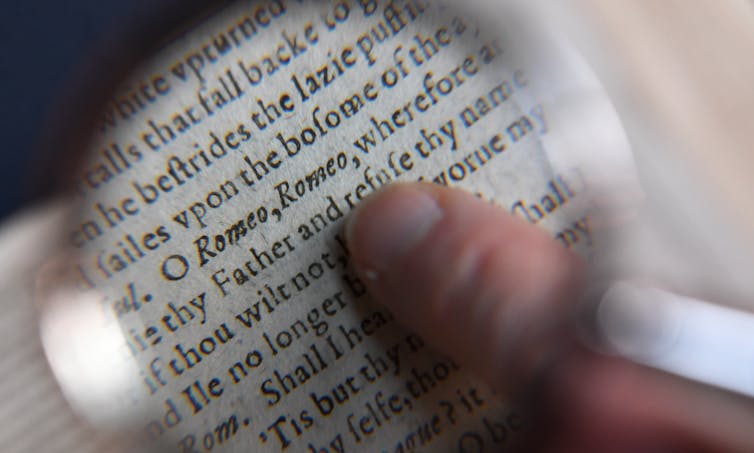
Person’s finger on magnified page of Shakespeare’s Romeo and Juliet, reading:
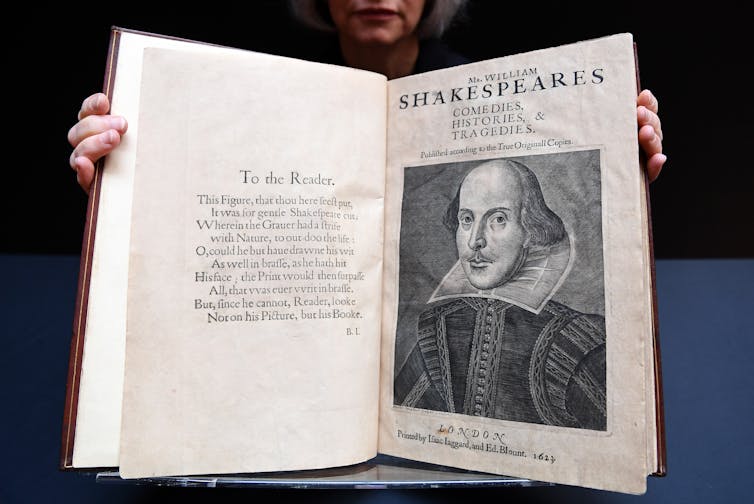
Shakespeare’s works have been attributed to 80 different authors.
Andy Rain /EPA

Great authors lend themselves to speculation. Shakespeare’s lack of education is one of the main arguments against the idea that he wrote his works, which have been attributed to 80 different authors. While Cervantes’ authorship tends not to be under the same scrutiny, questions about who exactly Alonso Fernández de Avellaneda was, remain.

Cervantes’ own educational background, however, suggests that it is possible to write to a high standard without academic training. If this could be true for the Spanish writer, why not for Shakespeare too?

A very large number of authors have also been proposed as candidates for the authorship of Avellaneda’s sequel to Don Quixote.

Social and cultural prejudices have been important in both cases. Shakespeare’s works show a detailed knowledge of the highest social classes, which is why it is thought that they should have been composed by some illustrious person of the time, such as Sir Francis Bacon.

However, Cervantes also had knowledge of the higher social classes and did not belong to them. Some researchers have even proposed that Avellaneda could have been Lope de Vega, the most prominent Spanish playwright at the time, since it is more attractive to imagine Cervantes confronted with a great author than with a mediocre person.

In both cases, figures who died well before both Shakespeare and Cervantes have been proposed as authors: Edward de Vere, 17th Earl of Oxford as the author of Shakespeare’s plays, and the Spanish writer Pedro Liñán de Riaza as Avellaneda, the unconvincing argument being that their works were left incomplete and were finished by other writers.

That said, it’s important to look at other plausible explanations. At the time of the publication of the first part of Don Quixote, there were no copyright laws protecting writers from continuations or plagiarism of works, which explains how Avellaneda’s version came to be.

Similar confusion has been caused in Shakespeare’s case. The Taming of the Shrew had an earlier anonymous version titled: The Taming of a Shrew, seemingly supporting theories that Shakespeare’s version was co-authored, or written by someone else entirely.

These days, however, following a theory put forward by Shakespearean scholar Peter Alexander in 1926, it is generally accepted that The Taming of A Shrew was simply an attempt to record the live production version of the play from memory.

In the case of Cervantes, I think I have cleared the mystery: we already know what Cervantes thought about Avellaneda’s identity, which should put an end to absurd speculation.

Cervantes and issues of authorship

As one popular theory goes, Avellaneda’s sequel to Don Quixote should be read as an embittered response to Cervantes’ parody of two real people: Lope de Vega and Jerónimo de Pasamonte. Pasamonte was a soldier from the region of Aragon who took part – as did Cervantes – in the battle of Lepanto (1571). Cervantes is said to have behaved heroically in the battle since, despite being ill, he insisted on fighting and was wounded several times.
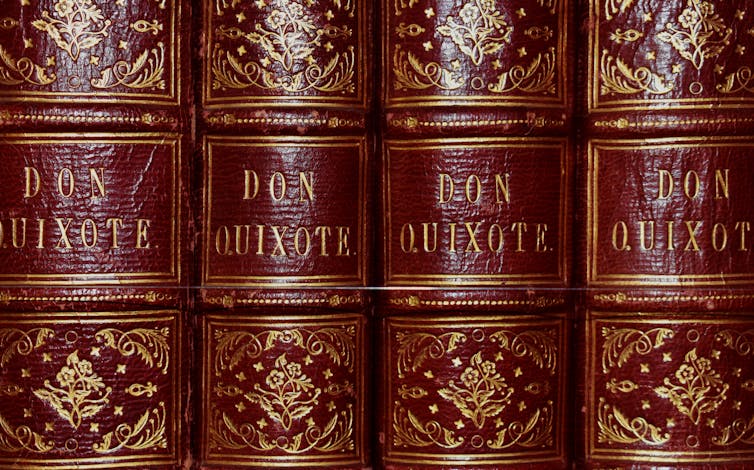
Red hard-bound editions of Miguel de Cervante’s Don Quixote books in a row on a shelf
Cervantes’ parody of the apocryphal Don Quixote hints at Avellaneda’s true identity.
Amani A/Shutterstock

Shortly afterwards, in 1574, Pasamonte was taken prisoner and spent 18 years in captivity. Upon his release, he returned to Spain and finished his autobiography, Life and Works.

When writing about the capture in 1573 of La Goleta (where there was in fact no actual battle), Pasamonte claimed to have acted as heroically as Cervantes at the battle of Lepanto.

After seeing how Pasamonte had usurped his heroic deeds in his autobiography, Cervantes satirised it in the first part of Don Quixote. Cervantes turned Jerónimo de Pasamonte into Ginés de Pasamonte, a galley slave, who is presented as a liar, a cheat, a coward and a thief, and is gravely insulted by characters Don Quixote and Sancho Panza.

The revenge of Pasamonte

The hypothesis that Pasamonte was Avellaneda, proposed by Martín de Riquer, an academic at the Royal Spanish Academy of the Language, is increasingly accepted.

As I have probed in my book, “The two second parts of Don Quixote”, Pasamonte sought to take revenge on Cervantes, writing a sequel to Don Quixote with the intention of robbing Cervantes of his earnings from the second part. In order not to be linked to Cervantes’ galley slave, he then signed it under a pseudonym.

To get revenge on Avellaneda, Cervantes imitated his imitator and created a masterly scene, making the literary representation of Avellaneda (personified in a character known as Jerónimo) recognise his Don Quixote as the true one.

As attractive as speculation about Shakespeare and Cervantes’ authorship may be, looking closer at their lives shows just how irrelevant class, education and conspiracy theories are in terms of explaining their genius.The Conversation

Alfonso Martín Jiménez, Catedrático de Teoría de la Literatura y Literatura Comparada, Universidad de Valladolid

This article is republished from The Conversation under a Creative Commons license. Read the original article.
Unknown's avatar

Guide to the classics: Don Quixote, the world’s first novel – and one of the best


File 20180419 163998 yzofvu.jpg?ixlib=rb 1.1
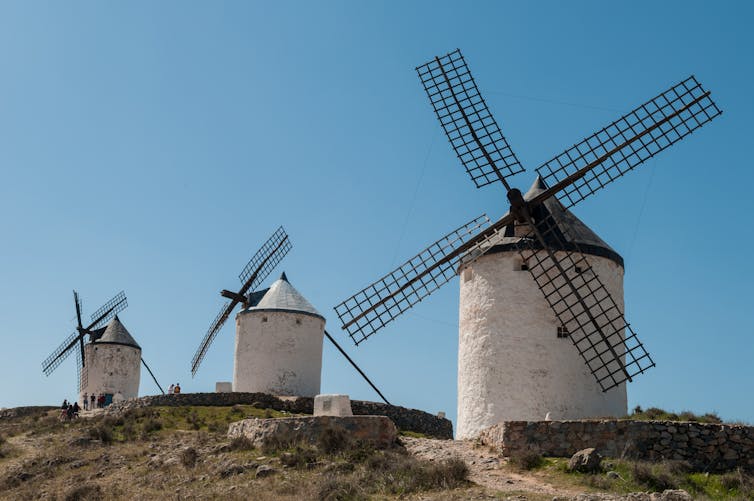
The “Don Quixote” windmills in Consuegra, Spain. They were made famous by the novel in the 16th century.
Wikimedia Commons, CC BY-NC-SA

Ana Puchau de Lecea, University of Melbourne and Vicente Pérez de León, University of Melbourne

Somewhere in La Mancha, in a place whose name I do not care to remember…

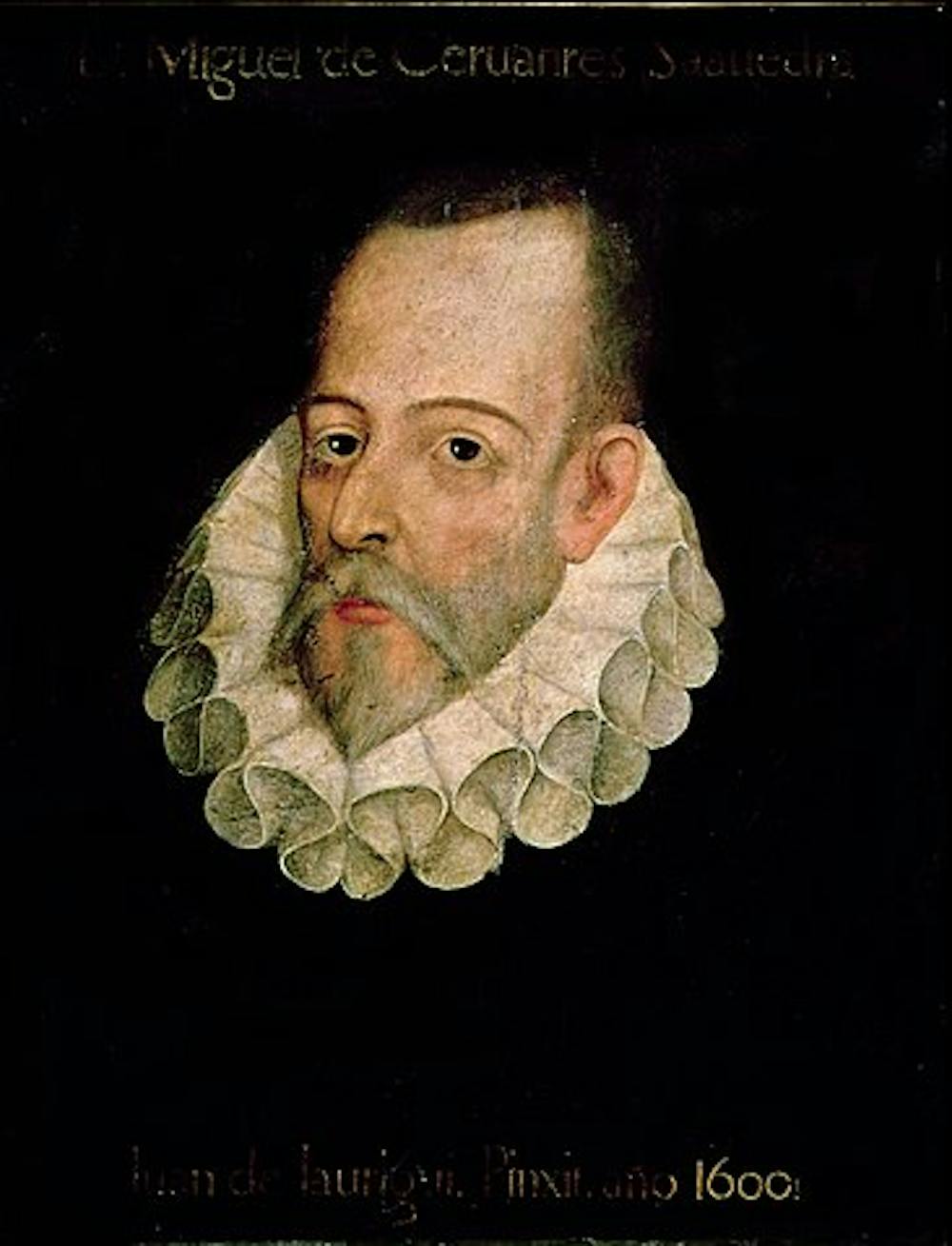
Portrait of Miguel de Cervantes y Saavedra (1547-1615) is commonly attributed to Juan de Jáuregui, yet no portrait of Cervantes has ever been authenticated.
Wikimedia Commons

This line, arguably the most famous in the history of Spanish literature, is the opening of The Ingenious Nobleman Don Quixote of La Mancha by Miguel de Cervantes, the first modern novel.

Published in two parts in 1605 and 1615, this is the story of Alonso Quijano, a 16th-century Spanish hidalgo, a noble, who is so passionate about reading that he leaves home in search of his own chivalrous adventures. He becomes a knight-errant himself: Don Quixote de la Mancha. By imitating his admired literary heroes, he finds new meaning in his life: aiding damsels in distress, battling giants and righting wrongs… mostly in his own head.

But Don Quixote is much more. It is a book about books, reading, writing, idealism vs. materialism, life … and death. Don Quixote is mad. “His brain’s dried up” due to his reading, and he is unable to separate reality from fiction, a trait that was appreciated at the time as funny. However, Cervantes was also using Don Quixote’s insanity to probe the eternal debate between free will and fate. The misguided hero is actually a man fighting against his own limitations to become who he dreams to be.

Open-minded, well-travelled, and very well-educated, Cervantes was, like Don Quixote himself, an avid reader. He also served the Spanish crown in adventures that he would later include in the novel. After defeating the Ottoman Empire in the battle of Lepanto (and losing the use of his left hand, becoming “the one-handed of Lepanto”), Cervantes was captured and held for ransom in Algiers.

This autobiographical episode and his escape attempts are depicted in “The Captive’s Tale” (in Don Quixote Part I), where the character recalls “a Spanish soldier named something de Saavedra”, referring to Cervantes’s second last name. Years later, back in Spain, he completed Don Quixote in prison, due to irregularities in his accounts while he worked for the government.

Tilting at windmills

In Part I, Quijano with his new name, Don Quixote, gathers other indispensable accessories to any knight-errant: his armour; a horse, Rocinante; and a lady, an unwitting peasant girl he calls Dulcinea of Toboso, in whose name he will perform great deeds of chivalry.

While Don Quixote recovers from a disastrous first campaign as a knight, his close friends, the priest and the barber, decide to examine the books in his library. Their comments about his chivalric books combine literary criticism with a parody of the Inquisition’s practices of burning texts associated with the devil. Although a few volumes are saved (Cervantes’s own La Galatea among them), most books are burned for their responsibility in Don Quixote’s madness.

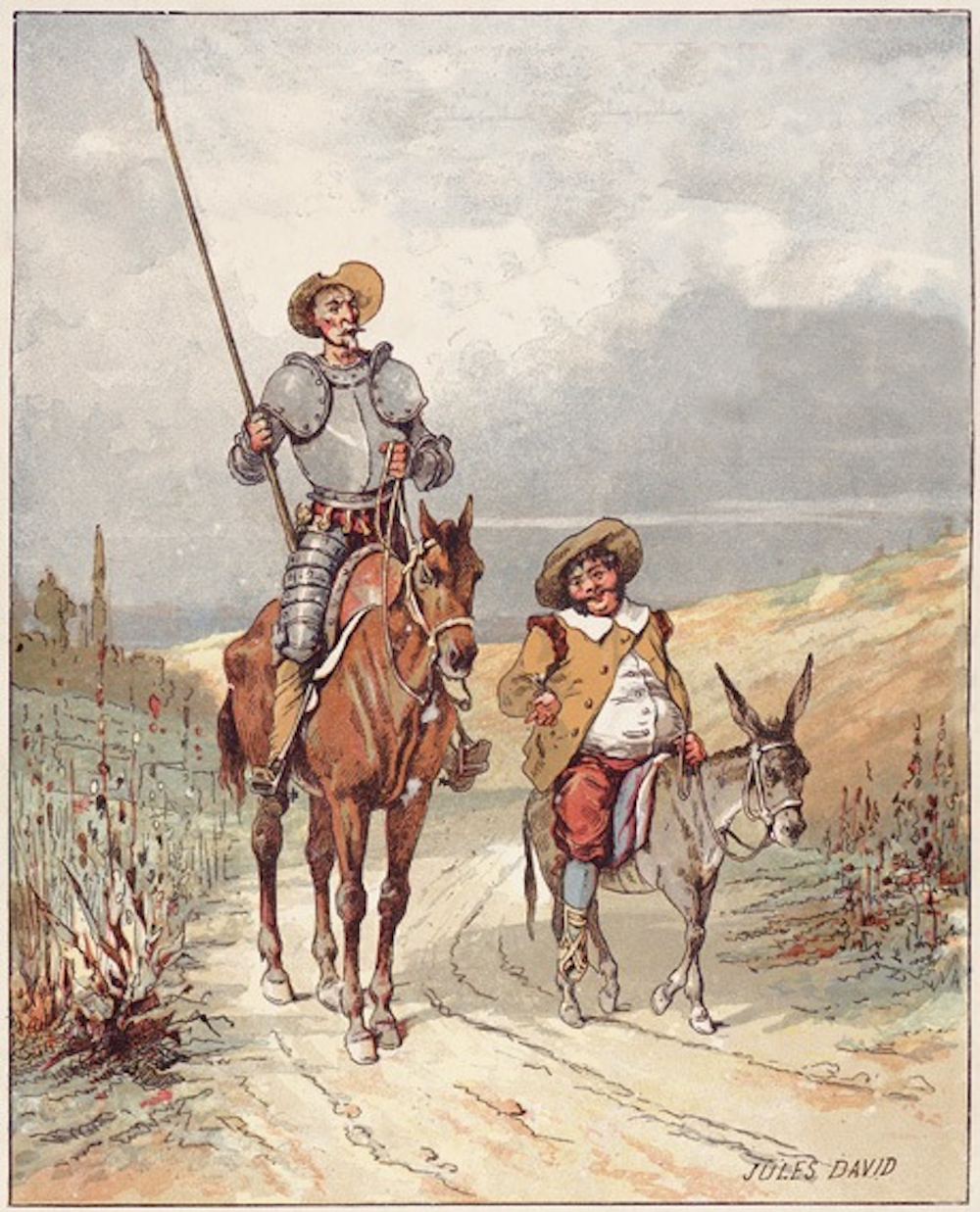
Jules David, ‘Don Quixote and Sancho Panza’, 1887.
Wikimedia Commons

In Don Quixote’s second expedition, the peasant Sancho Panza joins him as his faithful squire, with the hopes of becoming the governor of his own island one day. The duo diverges in every aspect. Don Quixote is tall and thin, Sancho is short and fat (panza means “pot belly”). Sancho is an illiterate commoner and responds to Don Quixote’s elaborate speeches with popular proverbs. The mismatched couple has remained as a key literary archetype since then.

In perhaps the most famous scene from the novel, Don Quixote sees three windmills as fearful giants that he must combat, which is where the phrase “tilting at windmills” comes from. At the end of Part I, Don Quixote and Sancho are tricked into returning to their village. Sancho has become “quixotized”, now increasingly obsessed with becoming rich by ruling his own island.

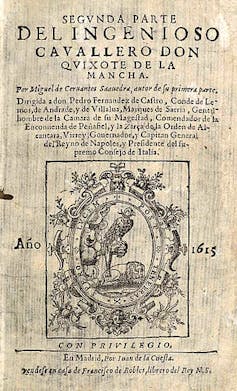
The cover of Don Quixote Part II (1615).
Wikimedia Commons

Don Quixote was an enormous success, being translated from Spanish into the main European languages and even reaching North America. In 1614 an unknown author, Alonso Fernández de Avellaneda, published an apocryphal second part. Cervantes incorporated this spurious Don Quixote and its characters into his own Part II, adding yet another chapter to the history of modern narrative.

Whereas Part I was a reaction to chivalric romances, Part II is a reaction to Part I. The book is set only one month after Don Quixote and Sancho’s return from their first literary quest, after they are notified that a book retelling their story has been published (Part I).

The rest of Part II operates as a game of mirrors, recalling and rewriting episodes. New characters, such as aristocrats who have also read Part I, use their knowledge to play tricks on Don Quixote and Sancho for their own amusement. Deceived by the rest of the characters, Sancho and a badly wounded Don Quixote finally return again to their village.

After being in bed for several days, Don Quixote’s final hour arrives. He decides to abandon his existence as Don Quixote for good, giving up his literary identity and physically dying. He leaves Sancho – his best and most faithful reader – in tears, and avoids further additions by any future imitators by dying.

The original unreliable narrator

The narrator of Part I’s prologue claims to write a sincere and uncomplicated story. Nothing is further from reality. Distancing himself from textual authority, the narrator declares that he merely compiled a manuscript translated by some Arab historian – an untrustworthy source at the time. The reader has to decide what’s real and what’s not.

Don Quixote is also a book made of preexisting books. Don Quixote is obsessed with chivalric romances, and includes episodes parodying other narrative subgenres such as pastoral romances, picaresque novels and Italian novellas (of which Cervantes himself wrote a few).

Don Quixote’s transformation from nobleman to knight-errant is particularly profound given the events in Europe at the time the novel was published. Spain had been reconquered by Christian royals after centuries of Islamic presence. Social status, ethnicity and religion were seen as determining a person’s future, but Don Quixote defied this. “I know who I am,” he answered roundly to whoever tried to convince him of his
“true” and original identity.

Don Quixote through the ages

Many writers have been inspired by Don Quixote: from Goethe, Stendhal, Melville, Flaubert and Dickens, to Borges, Faulkner and Nabokov.

In fact, for many critics, the whole history of the novel could justifiably be considered “a variation of the theme of Don Quixote”. Since its early success, there have also been many valuable English translations of the novel. John Rutherford and more recently Edith Grossman have been praised for their versions.

RTVE’s adaptation of Don Quixote for TV (1992).

Apart from literature, Don Quixote has inspired many creative works. Based on the episode of the wedding of Camacho in Part II, Marius Petipa choreographed a ballet in 1896. Also created for the stage, Man of La Mancha, the 1960s’ Broadway musical, is one of the most popular reimaginings. In 1992, the State Spanish TV launched a highly successful adaptation of Part I. Terry Gilliam’s much-awaited The Man Who Killed Don Quixote is only the most recent addition to a long list of films inspired by Don Quixote.

M. Petipa’s Don Quixote by the American Ballet Theatre.

The ConversationMore than 400 years after its publication and great success, Don Quixote is widely considered the world’s best book by other celebrated authors. In our own times, full of windmills and giants, Don Quixote’s still-valuable message is that the way we filter reality through any ideology affects our perception of the world.

Ana Puchau de Lecea, PhD Candidate and Teaching Associate, University of Melbourne and Vicente Pérez de León, Honorary Fellow, University of Melbourne

This article was originally published on The Conversation. Read the original article.