
Unknown's avatar

143,518 US public library workers are keeping their communities informed, connected and engaged – but their jobs may be at risk


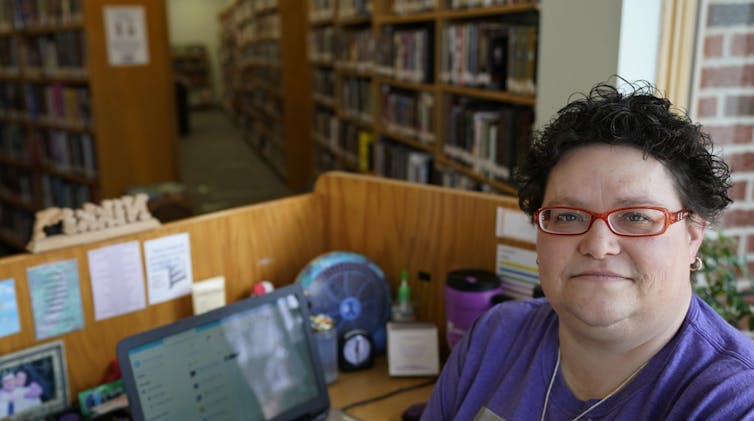
Nikki Luman works part-time for a public library in Sycamore, Ohio.
AP Photo/Tony Dejak

Rachel D. Williams, Simmons University; Christine D’Arpa, Wayne State University, and Noah Lenstra, University of North Carolina – Greensboro

CC BY-ND

America’s public library workers have adjusted and expanded their services throughout the COVID-19 pandemic.

In addition to initiating curbside pickup options, they’re doing many things to support their local communities, such as extending free Wi-Fi outside library walls, becoming vaccination sites, hosting drive-through food pantries in library parking lots and establishing virtual programs for all ages, including everything from story times to Zoom sessions on grieving and funerals.

In 2018, there were 143,518 library workers in the United States, according to data collected by the Institute of Museum and Library Services. While newer data isn’t available, the number is probably lower now, and recent history suggests more library jobs may be on the chopping block in the near future.

As library and information science researchers, we are concerned about library worker job insecurity.

During the Great Recession, the economic downturn between late 2007 and mid-2009, thousands of librarians and other library staff lost their jobs. As local governments cut spending on libraries, the size of that workforce shrank to 137,369 in 2012 from 145,499 in 2008.

Many library workers actively supported the recovery from that economic crisis in many creative ways. Some loaned patrons professional attire to wear for job interviews. Others helped local unemployed people gain basic financial literacy and digital skills.

Unfortunately, many of the Great Recession’s job losses were never completely overcome. There were about 2,000 fewer library workers in 2018 than in 2008, at the height of the crisis.

Library workers are again losing their jobs despite the important roles that libraries are playing today. According to preliminary data and news coverage collected by the Tracking Library Layoffs initiative, it’s clear that not all of the library workers furloughed since March 2020, when virtually all U.S. libraries were closed amid lockdowns, have been brought back on staff.

At the same time, many library workers have had to directly engage in person with the public throughout the pandemic, exposing them to health risks.

There are steps the federal government could take to protect the nation’s libraries.

For example, after Hurricane Katrina in 2005 and Hurricane Sandy in 2012, the Federal Emergency Management Agency recognized libraries among essential services. The federal government has not taken this step so far during the coronavirus pandemic.

Among other things, lacking this designation may have made it more difficult for librarians and other library staff members to get COVID-19 vaccines.

To date, the federal coronavirus relief packages have included a total of about US$250 million to support public libraries. These funds, distributed to state library agencies, amount to approximately $14,304 – about 1.7% of their annual revenue – for each of the nation’s 17,478 library branches and bookmobiles. We suspect that this infusion of cash will fall short of what’s needed to help public libraries and their workers recover from the tumult caused by the COVID-19 pandemic.

[Over 100,000 readers rely on The Conversation’s newsletter to understand the world. Sign up today.]The Conversation

Rachel D. Williams, Assistant Professor of Library and Information Science, Simmons University; Christine D’Arpa, Assistant Professor of Library and Information Sciences, Wayne State University, and Noah Lenstra, Assistant Professor of Library and Information Science, University of North Carolina – Greensboro

This article is republished from The Conversation under a Creative Commons license. Read the original article.
Unknown's avatar

Reasons for the Importance of Librarians


The link below is to an article that takes a look at the importance of librarians.

For more visit:
https://ebookfriendly.com/reasons-librarians-more-important-than-ever-illustration/

Unknown's avatar

Strange Questions at the Library


The link below is to an article that looks at strange questions asked of librarians of the New York Public Library over the years.

For more visit:
https://lithub.com/the-strangest-questions-ever-asked-of-new-york-city-librarians/

Unknown's avatar

What Librarians Wish You Knew About Libraries


Unknown's avatar

Ten ways teacher librarians improve literacy in schools


Margaret Kristin Merga, Edith Cowan University

Australian schools constantly strive to improve the literacy outcomes of their students. Supporting literacy achievement for struggling readers is particularly important because these readers have their disadvantage compounded: capable students develop “richer” skills through continued exposure to reading, and the gap between them and struggling readers widens.

The number of Australian students deemed “low performers” in reading literacy proficiency has been rising over time. Our percentage of high performers is shrinking – nearly one in five adolescents are in the low performer category.


Read more:
Six things you should do when reading with your kids


With school about to start for the year, we should consider how we can optimise support for struggling readers. Young people’s literacy attainment significantly shapes their academic, vocational and social potential. More than seven million adult Australians have their opportunities limited by their literacy level.

Research suggests the presence of qualified library staff in school libraries is associated with better student performance in literacy. But until now, little was known about what specifically they do to achieve this. My new research gives us insight into these key practices.

What do they do?

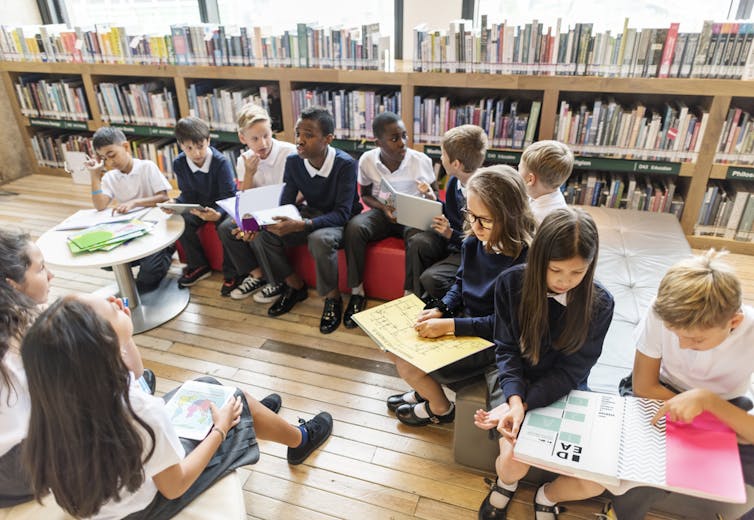
In 2018, I visited 30 schools in urban and rural sites as part of the Teacher Librarians as Australian Literature Advocates in Schools project. I interviewed teacher librarians to explore a range of questions, including the role they play as literacy educators.

For some children, silent reading time is the only time they have to read.
from http://www.shutterstock.com

There are 40 recurring literacy support strategies used by teacher librarians. But my recent paper focuses on ten strategies that have a particularly strong link to supporting struggling readers:

1. Identification of struggling readers. Teacher librarians support the timely identification of struggling readers through the data they collect on student performance. The sooner struggling readers are identified, the sooner the school can help them.

2. Providing age and skill-appropriate materials for struggling readers. Teacher librarians match students with age-appropriate materials they can manage and topics and genres they prefer. The more a student enjoys and is interested in reading, the more likely they are to keep it up.

3. Teaching students how to choose books they like. Both children in primary and secondary schools have suggested they would read more if it were easier to choose books that appeal to them. Teacher librarians teach students how to do this.

4. Support for students with special needs and readers at risk. For example, Hannah, a teacher librarian, described working with “a young boy who is dyslexic, and I was reading to him and made a dyslexic error, and went back and explained what I’d done and he said, ‘Yeah, I do that, too.’” She then connected him with age and skill-appropriate materials, and he went on to read “an enormous amount”.

5. Matching struggling readers to appropriate books for their skill level. Research suggests when struggling readers have texts matched appropriately with their ability and personal interest, they are more persistent, invested, and use more cognitive skills. Teacher librarians show expertise in making good matches.

6. Promoting access to books. Access to books is positively related to reading motivation, reading skills, reading frequency and positive attitudes toward reading. Teacher librarians make their books accessible. Francesca described regular use of a pop-up library:

We take [it] out into the wilds. And you know, kids will come up and go, ‘oh, what have you got, what have you got.’”

7. Making books and reading socially acceptable. Where young people believe books are socially acceptable, they’re more likely to read and have a positive attitude toward reading. Reading frequency is associated with literacy benefits, so this is ideal. Teacher librarians use a variety of strategies to enhance how books are viewed socially in their schools, including facilitating peer recommendations.

8. Reading to students beyond the early years. Reading aloud offers a range of benefits in the early years and beyond, including an increased enjoyment of reading and increased motivation. Libba described reading aloud to the teenage boys in her classes as a wonderful experience that was very well received. One boy even stated: “that was beautiful”.


Read more:
Research shows the importance of parents reading with children – even after children can read


9. Facilitating silent reading time. Though opportunities for silent reading at school may be limited, for some struggling readers, it’s the only book reading they do. Teacher librarians act as keen advocates for silent reading in their library and more broadly in the school. And something is better than nothing, especially for readers who struggle.

10. Preparing students for high stakes literacy testing. Achievement on high-stakes literacy tests is essential for graduation in Western Australia, a controversial move which has seen graduation rates slide. A similar initiative has been explored but rejected in NSW.

Teacher librarians supported struggling readers to achieve this essential academic goal through a range of initiatives. For example, teacher librarian Stephanie supported students to use practice online testing programs in her library, which gave students the practice they needed to sit both NAPLAN and online literacy and numeracy assessment (OLNA) tests.

Why does this matter?

Teacher librarians in Australian schools are a valuable resource often taken for granted. They have faced significant budgetary cuts in recent times, despite a 2011 government inquiry into school libraries. Teacher librarians noted they play an important educative role in our schools.


Read more:
Six things you can do to get boys reading more


Recent findings suggest teacher librarians’ morale and related sense of job security may be low. If schools and policy-makers wish to improve students’ literacy outcomes, they should invest in school libraries and our dual-qualified teacher librarians.The Conversation

Margaret Kristin Merga, Senior Lecturer in Education, Edith Cowan University

This article is republished from The Conversation under a Creative Commons license. Read the original article.

Unknown's avatar

Instagram Tips for Librarians


The link below is to an article that looks at Instagram tips for Librarians.

For more visit:
https://bookriot.com/2018/08/28/instagram-tips-for-librarians/

Unknown's avatar

What Does a Librarian Do?


The link below is to an article that takes a look at the question, ‘what does a librarian do.’ Hint – the answer is not, ‘not very much.’

For more visit:
https://lithub.com/what-exactly-does-a-librarian-do-everything/

Unknown's avatar

A library without librarians is a just a shed full of books


Joanna Mendelssohn, UNSW Australia; Catherine De Lorenzo, UNSW Australia, and Catherine Speck, University of Adelaide

For some years we have been researching the how, why and wherefore of exhibitions of Australian art. We have tracked down retired curators and art museum directors, recording their memories before they fade.

We have crossed the country to see exhibitions. But most of the time we have been buried in archives and libraries. While large public libraries are excellent for general research, those small specialist libraries attached to state and national art museums are our essential tools of trade.

With the exception of the Edmund and Joanna Capon Research Library at the Art Gallery of New South Wales, these libraries are by appointment only. All the meticulously researched exhibitions of Australian and international art depend on their museum libraries – they track down works of art and tease out ideas from distant publications.

These libraries are our treasure trove. The Art Gallery of New South Wales press cuttings book goes back to the 1890s. There are international art journals dating from the 1890s, invitations to every imaginable exhibition, annual reports from the most unlikely places – as well as transcripts of scandalous court cases.

Most art museum libraries hold material associated with their own collections and exhibitions. Two institutions, however, have made their libraries international research hubs. At the Art Gallery of New South Wales, a succession of librarians have collected archives from Australian artists, curators and institutional records. The renamed National Art Archive is central to the proposed Sydney Modern Project.

For many years its secret weapon has been the head librarian, Steven Miller, the author of scholarly books and erudite blog posts while the visual resources librarian, Eric Riddler, has an uncanny ability to track down obscure archival photographs and identify the protagonists.

At the National Gallery of Australia in Canberra, James Mollison, its first Director, knew that an outstanding research library was an essential tool in positioning the gallery as an international leader. He acted accordingly in funding the library. When he was a young education officer at the National Gallery of Victoria, he had access to the specialist records that have been expanded into the Shaw Research Library, presided over by the ever helpful Luke Doyle.

The National Gallery of Australia: its library is now open only four days a week.
Robert Montgomery/Flickr, CC BY

Thanks to Mollison’s foresight, for almost 40 years the catalogues, books and archives at the National Gallery of Australia have been the envy of those who don’t live in the city. The monetary value is A$37 million, but the worth is much more.

The Chief librarian, Joye Volker, and the senior librarian, Helen Hyland, are both well-known to interstate and international visitors who have have benefited from their detailed knowledge of the collections. Their assistance to researchers has extended to sending digital versions of archives meticulously recorded over many years.

The retired Betty Churcher wrote most of her book, Australian Notebooks (2014), in the library, while Sasha Grishin’s Australian Art: a History (2014) says of Joye Volker and her staff: “It would not have been possible to complete this book without their assistance.”

When the Federal Government announced in September it was eliminating 63 positions from national cultural organisations, both Volker and Hyland were “let go”. With the “natural attrition” from other staff, this means the National Gallery library is now only open four days a week. Tough times mean hard decisions.

But libraries without librarians are just storerooms. Specialist librarians can make apparently tangential leaps and suddenly produce a raft of documents that give answers to questions the researcher is yet to ask.

As well as hard copy resources, when we visited Queensland’s Gallery of Modern Art Research Library Jacklyn Young and Cathy Pemble-Smith gave ready access to digital files and data bases. Specialist research librarians save months of time for hard pressed academic researchers and curators.

At the Art Gallery of South Australia Jin Whittington is surely one of the state’s living treasures with her specialist knowledge and generous spirit, answering constant queries on the finer details of the archive and library. Specialist librarians and archivists are crucial for primary research.

At the recent Art Association of Australia and New Zealand annual conference, the subterranean topic of conversation was the very future of the National Gallery’s library. Budget cuts may lead to its holdings being transferred to the equally under-resourced National Library.

Anthony White, president of the association, which represents art historians, curators and artists, said:

The art-specific knowledge that art librarians provide, as well as their unique expertise in advanced research skills, are indispensable for those historians, critics and curators who are opening new avenues in thinking about global visual cultures that speak to contemporary concerns.

This sorry tale is not unique to art, or even to Canberra. It is a part of the inevitable consequences of a succession of “efficiency dividends” by the Commonwealth Government which is placing public institutions on a diet akin to anorexia.

The Conversation

Joanna Mendelssohn, Associate Professor, Art & Design: UNSW Australia. Editor in Chief, Design and Art of Australia Online, UNSW Australia; Catherine De Lorenzo, Honorary associate professor, UNSW Australia, and Catherine Speck, Professor, Art History;, University of Adelaide

This article was originally published on The Conversation. Read the original article.

Unknown's avatar

Quotes About Libraries and Librarians


The link below is to an article with 50 quotes about libraries and librarians.

For more visit:
http://ebookfriendly.com/best-quotes-about-libraries-librarians/

Unknown's avatar

Our Favorite Pop Culture Librarians