
Unknown's avatar

Indigenous children’s book ‘Little Louis’ aims to curb COVID-19 vaccine hesitancy with a culturally relevant story


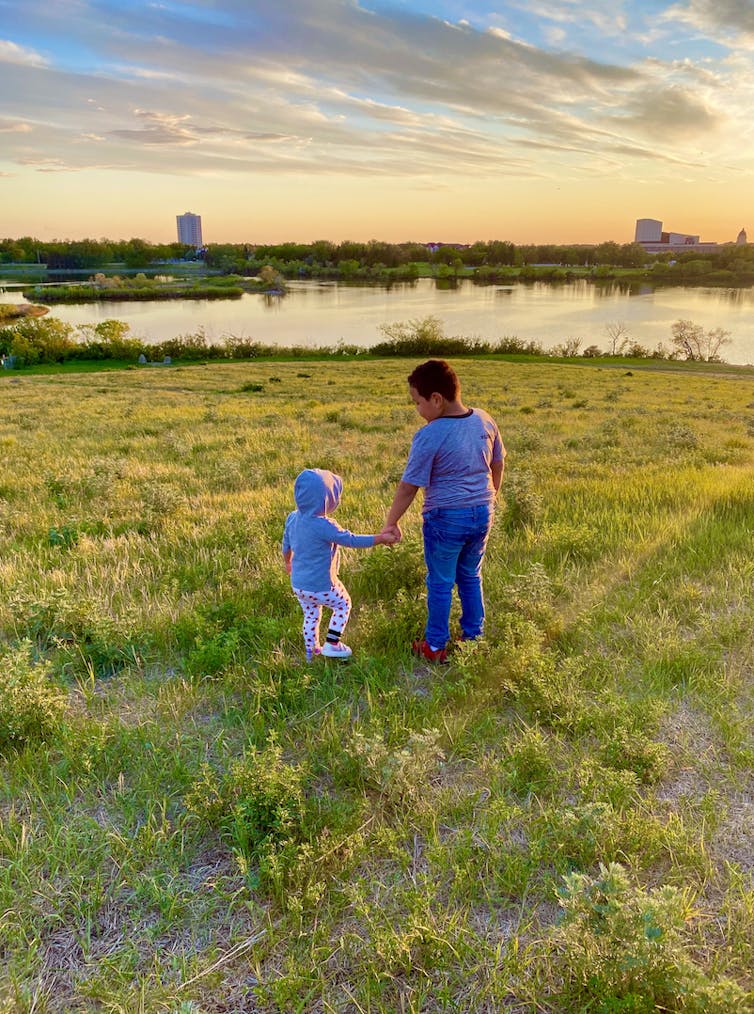
The children’s book, Little Louis, tells the story of a young boy preparing for his COVID-19 vaccination.
(Morning Star Lodge), Author provided

Patrick Sullivan, University of Saskatchewan and Heather O’Watch, University of Saskatchewan

The COVID-19 pandemic has been difficult for everyone. But communities are different, and so are their pandemic experiences. After more than a year of uncertainty and frustration, vaccines have brought many a sense that a return to normal is on the horizon. However, health and research communities now face a new challenge: vaccine hesitancy.


Click here for more articles in our series about vaccine confidence.

While there are countless reasons to be vaccine hesitant, we must acknowledge the numerous legitimate reasons for hesitancy.

For example, if a community has experienced an exhausting history of medical experimentation, forced or coerced sterilization and breaches of trust by the very institutions presenting the vaccine, their hesitancy is based on cultural or historical factors and entirely distinct from the “anti-vaxx” movement.


Read more:
Nutrition researchers saw malnourished children at Indian Residential Schools as perfect test subjects


This is the daunting reality for many Indigenous communities across the country. As a result, there is an urgent need to repair trust and promote vaccine confidence through evidence-based knowledge.

At Morning Star Lodge, we are part of a partnership between the community research advisory committee at Star Blanket Cree Nation and Solutions for Kids in Pain (SKIP). Together we have collaborated to promote vaccine confidence while demonstrating the importance of community-led research.

Reflecting culture

We entered into this partnership to promote vaccine uptake under the direction of Indigenous communities. Through our discussions, we came to solutions about ways we could promote COVID-19 vaccination information — like booklets for Indigenous children and adults. After coming up with several solutions, Star Blanket Cree Nation’s research advisory committee members pointed towards an additional need: A children’s book, and in came Little Louis.

Many Indigenous Peoples grew up without medical information that respected or reflected their culture, the CRAC recognized the need to reverse this trend. A children’s book that reflects the identities of Indigenous children is important for making information accessible to all.

SKIP, Morning Star Lodge and Indigenous community members began to prepare a children’s book that is engaging, educational and relevant for Indigenous children experiencing needle fear or vaccine hesitancy — seeing their culture reflected in a children’s book can make all the difference when it comes to getting the jab. Needle fear or hesitation is a common feeling and there is minimal children’s literature on the topic, especially literature that is culturally relevant.

The Star Blanket Cree Nation’s cultural, community and storytelling expertise far exceeds that of SKIP or Morning Star Lodge. The community research advisory committee members live in, and are from, the communities we serve, their Indigenous Knowledge adds depth and relevance to all of our projects. Their guidance and leadership ensures that developments, like Little Louis, directly reflect community needs.

Indigenous Peoples expertise, guidance and leadership

Little Louis talks about how to prepare for getting a vaccine, what vaccines feel like and what parents and children can do in order to be supported. The intention is that Little Louis will evolve into several different stories that will target different audiences and address different issues as time goes on and different issues arise. This sort of flexibility is a requisite to working with dynamic communities.

Inflexible research was and is often the norm. “Helicopter” research (where researchers enter communities, collect data and leave, never to be heard from again) was and is still practised. This entirely one-sided interaction always benefits researchers but rarely, if ever, benefits communities. It frequently misrepresents realities for Indigenous communities and actively creates negative stereotypes that have been used to justify systemic racism.

Historically, research with Indigenous Peoples was not conducted “in a good way.” Today, researchers can be guided to correct the errors of the past through principles like OCAP (ownership, control, access and possession) and the CARE and FAIR principles for Indigenous data governance. Further, researchers can learn about ethical engagement and cultural safety to ensure their research is truly ethical and upholds community perspectives.

In practice, this means Indigenous Peoples should be at the helm of any research that may impact them or is about them. Doing so can prevent harmful misrepresentations, promote self-determination and contribute to solutions Indigenous communities actually need — like a children’s book that addresses vaccine hesitancy.

The following is a synopsis of “Little Louis.” Check the Morning Star Lodge blog for updates on publication.

Meet Little Louis

Little Louis tells the story of Louis, a young boy preparing for his COVID-19 vaccination. Louis starts by sharing his fears and frustrations with safety restrictions and the vaccine. His family listens and tells him how brave he is for making the decision to keep himself and the community safe.

Still nervous and hesitant about the vaccine, Louis’ family has an idea to create a “little” Louis, out of paper, which he can bring to the vaccination clinic during his appointment. Louis’ family also shares the story of a brave Métis leader named Gabriel Dumont and his rifle, le petit (little one).

The night before the vaccination appointment, Louis dreams of going on a fishing adventure with Little Louis where they reel in what they think is a fish but it turns out to be a big needle! Louis and Little Louis both bravely face the needle, reeling it in until it turns into the big catch they hoped for. The next morning Louis shares his dream with his family. They tell him that he was brave for facing his fears.

Finally, Louis goes to his vaccine appointment with Little Louis by his side. The doctor asks to see Little Louis to give him the vaccine first. Observing that Little Louis was brave and didn’t get scared, Louis is ready and the doctor gives Louis his vaccine. Both Louis and Little Louis are now protected from COVID-19!

Do you have a question about COVID-19 vaccines? Email us at ca‑vaccination@theconversation.com and vaccine experts will answer questions in upcoming articles.The Conversation

Patrick Sullivan, Sr. Research Assistant, Morning Star Lodge, University of Saskatchewan and Heather O’Watch, Research Assistant, Morning Star Lodge, University of Saskatchewan

This article is republished from The Conversation under a Creative Commons license. Read the original article.

Unknown's avatar

The Murri Book Club and the politics of reading for Indigenous Australians


File 20180706 122271 16toi9s.jpg?ixlib=rb 1.1
Australian book clubs are overwhelmingly white, middle-aged, middle-class and female.
Shutterstock.com

Maggie Nolan, Australian Catholic University

Although the 2018 Closing the Gap report on Indigenous disadvantage highlighted the importance of literacy for Indigenous Australians, progress remains slow. But, while reading is widely considered an unmitigated good and a marker of prestige, it is not a simple issue for some Indigenous Australians.

I have been investigating the politics of reading for Indigenous Australians by visiting the Murri Book Club, an Indigenous book club, in Townsville and discussing the role of books and reading in its members’ lives. As one woman told me:

No one ever read to me as a child. The only reading we ever had was church … reading at Bible studies. We had to get hit with a stick to sit still and stop moving and making noises … And so, to me, reading was restrictive, I suppose, and boring because of that part. It was never fun.

One of the concerns for members of the Murri Book Club is that books and reading are linked to the ongoing history of assimilation that, even now, presumes a divide between Indigenous oral story-telling and non-Indigenous literacy. This is why the members of the club show more ambivalence towards reading than might be expected of a typical book club.

Book clubs have been described by scholar Marilyn Poole as “one of the largest bodies of community participation in the arts in Australia”. Current research suggests that these clubs are overwhelmingly white, middle-class, middle-aged and female. Members of most mainstream book clubs are part of what Wendy Griswold has termed “the reading class”, which is small in size but immense in cultural influence.


Read more:
Three reasons why the gaps between Indigenous and non-Indigenous Australians aren’t closing


Reading and power

Janeese Henaway, the Indigenous Library Resources Officer at the library, started the book club in 2011 and introduced me to the group. Janeese was raised just south of Townsville in a town called Ayr. When Janeese was asked to facilitate a book club, it was suggested to her that they follow the model practised by the Brisbane-based Reconciliation Reading Group that has met monthly in the Queensland State Library for over 15 years.

But Janeese was unsure about how to proceed.

I didn’t know at that point how to run the club in a way that was culturally appropriate … I explained that we did not then want to go to a book club and have heavy discussions on Indigenous issues. The group predominantly wanted a light, entertaining and enjoyable experience. Although we’re Murris, we are also readers.

One woman told me she joined the group because she wanted to set an example for her son. While many book clubs operate within an unspoken discourse of self-improvement, it is rare for book club members to be so explicit.

For this member, reading is a cultural resource that carries significant weight. As she tells it, her son is much more interested in (Indigenous) culture and, for him, reading and culture are “two separate things”. She recalls him asking, “Why I gotta read for? I’m gonna be an Island boy, man, when I grow up. You don’t need to read”. For her son, culture is about story, not about reading.

There is a long history, particularly throughout the assimilation era, of Aboriginal and Torres Strait Islander people being actively prevented from speaking their languages. Members of the Murri book club are aware that policies of assimilation mean less access to oral stories. The imposition and authority of the written word can be seen to clash with Indigenous practices of oral story-telling. A commitment to reading can make some Indigenous people feel that they must sacrifice other cultural values that have sustained them as individuals, families and communities for millennia.


Read more:
Read, listen, understand: why non-Indigenous Australians should read First Nations writing


Members of the Murri book club experience this sacrifice as a cultural compromise. One member, an Aboriginal and Torres Strait Islander Indigenous Liaison Officer at a tertiary institution, suggested the solution is more Indigenous-authored texts that record Indigenous knowledge. But he is also aware that the focus on reading has come at a cost:

But these guys … [the others in the Murri book club] I envy them … Like the oral stories are there [for me], but they’re not in that layer that these guys have. And then because of that book, the authority of the book, when you get them old people to talk, they say, ‘Ah, that’s not true. It’s not in a book.’ Only, every now and then, they say, ‘It doesn’t all have to be in a book.’

In response to this recollection of the authority of books as a source of truth, another member responded: “But keep in mind that you were trained in that way … Print had authority over the spoken word.”

Although she loves reading, this member rarely reads the book club books. She comes along primarily for social reasons — for connecting with community. In spite of her love of books and reading, she is very conscious of the fact that books, and the authority of written language, were key tools in undermining oral traditions in her home of the Torres Strait. Indeed, the Murri book club, as a whole, are more aware than most that reading is connected to power.

The ConversationIn their discussions, the Murri Book Club has taken a communal institution so often associated with white, middle-class culture and remade it as a force for decolonising contemporary cultures of reading. It challenges assumptions not only about book clubs, but also about Aboriginal and Torres Strait Islander Australians. While reading can come with significant cultural baggage for some Indigenous people, it can also be a powerful tool.

Maggie Nolan, Senior lecturer in Humanities, Australian Catholic University

This article was originally published on The Conversation. Read the original article.

Unknown's avatar

Indigenous picture books offering windows into worlds


File 20170602 8008 xu0xn4
Front cover of Tjarrany Roughtail – the book features a collection of Dreaming stories.
Magabala Books

Ambelin Kwaymullina, University of Western Australia

In this series, we’ll discuss whether progress is being made on Indigenous education, looking at various areas including policy, scholarships, school leadership, literacy and much more.


In a town by the sea that lies in the homeland of the Yawuru people, there sits a small publisher. But in the scope of its ambition, the depth and complexity of its range, and its commitment to bringing the voices of Aboriginal and Torres Strait Islander peoples to all Australians, Magabala Books looms large on the Australian literary landscape.

The Broome-based publisher was established in the 1980s, partly in response to concerns that Indigenous stories were being taken and published without permission by non-Indigenous academics and storytellers.

Today, Magabala has the most extensive list of Indigenous children’s literature of any Australian publisher. So for parents and teachers looking to introduce children to the many worlds of Aboriginal and Torres Strait Islander peoples, Magabala Books is a good place to begin.

And anyone who buys a Magabala publication also has the comfort of knowing that they are purchasing an ethically published book. Indigenous peoples hold copyright in their stories and there is a return of benefits to the Indigenous storytellers and/or their communities.

While it is not possible to cover the depth of Magabala’s range in a single article, I offer here, as a starting point, five picture books that have wisdom to share with all ages. While most of these books are listed as suitable for lower primary, I’d suggest this is the point at which children can begin reading the books but not where enjoyment of these texts ends.


Magabala Books

Tjarany Roughtail

By Gracie Greene, Joe Tramacchi and Lucille Gill

Ability: lower primary

First published in 1992, this book is rightly considered a classic. A collection of Tjukurrpa (Dreaming) stories of the Kukatja people of the Kimberley region of Western Australia, Tjarany Roughtail is a bilingual illustrated narrative in which the pictures speak as powerfully as the words. It is also a book that can grow with children through the layers of knowledge it offers.

Young children will enjoy the stories of the Dreaming ancestors. Older children can explore the diagrams that explain the meaning of the symbols used in the artwork, as well as the maps of the Kukatja kinship system which shows the web of relationships between Aboriginal peoples and their homelands. And all ages can treasure a book that is at once a culture, language, art and philosophy text.


Magabala Books

Stolen Girl

By Trina Saffioti and Norma MacDonald

Ability: lower primary

This is a Stolen Generations tale written by Trina Saffioti (Gugu Yulangi people) and illustrated by leading artist Norma MacDonald (Yamatji and Nyungar peoples). It is told in nuanced, sparse text accompanied by illustrations that convey the warmth of family, the terror of removal, and the loneliness of life in an institution. The book ends with the hope of returning home, captured through the image of a girl stepping through a half open door into a sunlit landscape.

Stolen Girl is a moving tale that gently introduces children to a traumatic aspect of Australian history that echoes through the lives of Indigenous peoples today.


Magabala Books

Fair Skin Black Fella

By Renee Fogorty

Ability: lower primary

This masterful work by Wiradjuri writer and illustrator Renee Fogorty addresses Aboriginal identity, and in particular that being Indigenous is about culture, community and family rather than skin colour. The story is brought to life by illustrations that sensitively and appropriately capture the message of a tale that speaks to the importance of inclusiveness and belonging.


Magabala Books

Our World

By the One Arm Point Remote Community School

Ability: Upper primary

What is life like in worlds different from your own? This book tells of the Bardi Jaawi people of the Ardiyooloon community, weaving together history and traditional stories with the seasons and rhythms of everyday existence.

Our World features the children’s artwork as well as photographs of them undertaking activities such as fishing, constructing windmills from pandanus leaves, and learning animal tracks. As a whole, the book conveys a wonderful sense of Bardi Jaawi children speaking of their lives to the child-readers of the text in a meeting of lives and worlds.


Magabala Book

Once

By Dub Leffler

Ability: lower primary

This reconciliation tale by artist and writer Dub Leffler (Bigambul and Mandandanji people) is an evocative tale of friendship across difference, with the poetic text given full expression in illustrations that capture the beauty of the story and speak straight to the heart.

These books, along with the many other narratives by Indigenous storytellers, offer opportunities for children and adults to journey through diverse Indigenous realities – and in so doing, to begin to build bridges across worlds.


The ConversationRead more articles in this series.

Ambelin Kwaymullina, Assistant Professor (Law School), University of Western Australia

This article was originally published on The Conversation. Read the original article.

Unknown's avatar

Do you know a Bunji from a Boorie? Meet our dictionary’s new Indigenous words


Bruce Moore, Australian National University

A new edition of the Australian National Dictionary has just been published. It contains 16,000 words and while the first edition (published in 1988) included about 250 words from 60 Aboriginal and Torres Strait Islander languages, the latest has more than 500 words from 100 languages.

Conventional wisdom has it that borrowings of this kind usually occur in the initial “contact” period. In 1770, for instance, James Cook and Joseph Banks collected the word kangaroo from the Guugu Yimithirr language in the area now known as Cooktown in Queensland, and it immediately came into use in English.

Soon after the initial batches of convicts arrived in Sydney from 1788 onwards, words from local languages were taken up, especially for new flora and flora and for things associated with the Indigenous people: koala, wallaby, kurrajong, waratah, woomera, corroboree. Later, the language of the Perth area provided jarrah, kylie (a word for “boomerang”), numbat, and quokka. The language of the Geelong area provided the mythical monster the bunyip.

The Indigenous word waratah was quickly adopted.
Internet archive book image/flickr

Some Aboriginal words, although noted in the early period, were not used widely in Australian English until much later. Perhaps the most startling example of this is the word quoll, which comes from the Guugu Yimithirr language, and was also collected by Cook and Banks in 1770.

When the Europeans arrived in 1788, they did not use quoll or other Indigenous names for these marsupials. Instead, they used the term native cat, preferring to construct terms based on superficial resemblances to things of their “known” world. It wasn’t until the 1960s that quoll was reintroduced, and eventually replaced native cat, largely due to the efforts of the naturalist David Fleay, who highlighted the absurdity of some of the vernacular names for Australian animals.

It took nearly 200 years for the word quoll to be widely used.
WA Department of Parks and Wildlife/AAP

Many of the new Aboriginal words in this edition refer to flora and fauna, and many of these result from an interest in using Indigenous names rather than imposed English descriptive ones.

Thus, the southern and northern forms of the marsupial mole are now referred to by their Western Desert language names itjaritjari and kakarratul. The rodent once called the heath mouse is now known by its indigenous name dayang, from the Woiwurrung language of the Melbourne area. The amphibious rodent formerly known as water rat, is now more commonly referred to in southern Australia as the rakali, from the Ngarrindjeri language.

Other additions to the dictionary include (from the Noongar language of the Perth area) balga for the grass tree, coojong for the golden wreath wattle, moitch for the flooded gum and moort for Eucalyptus platypus.

Coojong, formerly known as golden wreath wattle.
liesvanrompaey/flickr, CC BY

The increasing interest in bush tucker has meant the inclusion of akudjura for the bush tomato, from the Alyawarr language of the southern region of the Northern Territory, and gubinge, from Nyul Nyul and Yawuru of northern Western Australia, for an edible plum-like fruit.

Other new terms reflect a renewed interest in aspects of Aboriginal and Torres Strait Islander culture and various kinds of activism on the part of Indigenous peoples.

They include bunji, “a mate, a close friend a kinsman” (from Warlpiri and other languages of the Northern Territory and northern Queensland), boorie, “a boy, a child” (from Wiradjuri), jarjum, “a child” (from Bundjalung), kumanjayi, “a substitute name for a dead person” (from Western Desert language), pukamani “a funeral rite” (from Tiwi), rarrk “a cross-hatching design in art” (from Yolngu languages), tjukurpa, “the Dreaming; traditional law” (from Western Desert language) and yidaki, “a didgeridoo” (from Yolngu languages).

Performance of a Yidaki Didg and Dance at Sydney Opera House in 2000.
Adam Pretty/AAP

The word migaloo – “a white person” – comes from Biri and other northern Queensland languages, where it originally meant “a ghost, a spirit”; many Australians are familiar with this word as a name for the albino humpback whale that migrates along the east coast of Australia.


Author provided

Many of these terms begin their transition to mainstream Australian English in forms of Aboriginal English, and some of them are primarily used in Aboriginal English.

In addition to the words from Indigenous languages, there are numerous terms new to the dictionary that render Indigenous concepts and aspects of traditional culture, formed from the resources of English.

These include such terms as: carved tree, dreamtime being, freshwater people, keeping place, law woman, paint up, saltwater people, secret women’s business, smoking ceremony, songline, sorry business, welcome to country.

A smoking ceremony at the Aboriginal Tent Embassy in Canberra earlier this year.
Mick Tsikas/AAP

Others derive from more specific political contexts and political activism: Day of Mourning, great Australian silence, Invasion Day, Mabo, tent embassy, traditional ownership and white blindfold (“a view of Australian history that emphasises the achievements of white society and ignores Aboriginal society”).

This is a dictionary based on historical principles. This means that each entry maps the full history of a word, establishing its origin, and documenting its use over time with illustrative quotations from books, newspapers, and the like. Words and meanings are included if they are exclusively Australian, or used in Australia in special or significant ways.

The dictionary, edited at the Australian National Dictionary Centre at the Australian National University, and published by Oxford University Press, will be launched today at Parliament House in Canberra.

The Conversation

Bruce Moore, Visiting Fellow in the School of Literature, Languages, and Linguistics, Australian National University

This article was originally published on The Conversation. Read the original article.