Unknown's avatar

Holocaust poetry and the reclamation of many identities


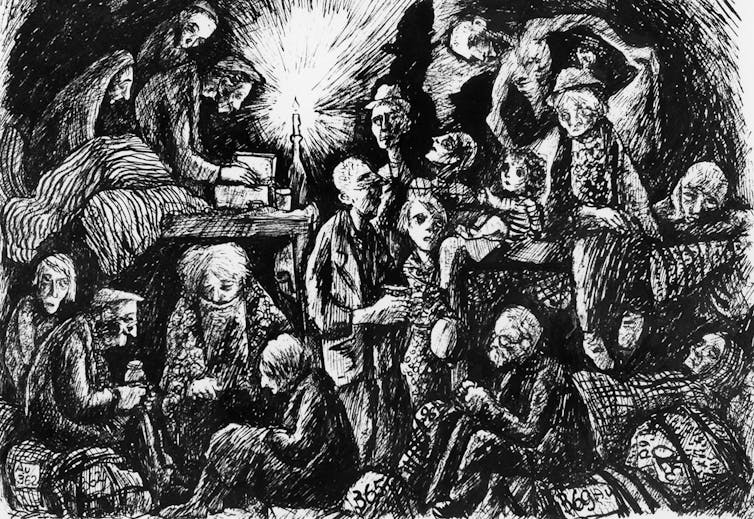
In the Living Quarters by Bedrich Fritta portrays Terezín (Theresienstadt) ghetto where early Holocaust poetry was written.
Wikimedia

Marian de Vooght, University of Essex

The first Holocaust poems were written 90 years ago, when the full extent of the horror was yet to be known. Starting in the 1930s, those first works foreshadowed the catastrophe that was soon to come. As the second world war erupted and the Nazi killings began, people continued to write poetry that recorded direct experiences of persecution and lamented the murder of loved ones.

While many writers of Holocaust poetry are Jewish, there are those who belong to other groups targeted by the Nazi regime. Including those who were perceived to have disabilities, Roma and Sinti people, political and religious opponents and homosexual men.

Writing poetry of the Holocaust has often been a way to reclaim identity, as writer and translator Lou Sarabadzic puts it:

Victims of the Holocaust are not the Other in these lines, but rather the authors, the ones we listen to, the ones expressing emotions.

As such, they continue to be written today as people continue to reckon with the memories and impact of the Holocaust.

Diverse backgrounds

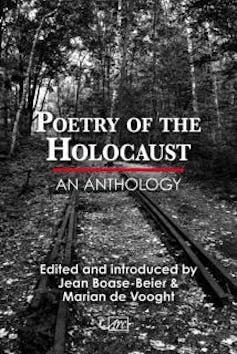
Published in 2019, Poetry of the Holocaust: An Anthology brings together poems from 19 languages that were previously unavailable in English. The translations in this book are followed by the original texts. These include poems in languages not normally associated with the Holocaust, such as Norwegian and Japanese, and from places like Argentina, Denmark and South Africa.

Author provided

Holocaust poetry in the 1930s and through the war wrestled with the incomprehensible reality its writers were facing. The earliest poems in Europe responded to the foreboding of the fascist regime and its politics of elimination.

In 1932, the German poet Eduard Saenger wrote in reaction to the sinister change of atmosphere that he was witnessing in his country:

A silent wind sends fear through the land / with an edge like the howling of wolves.

Like Saenger, many wrote poems warning of the approaching dark times and also in reaction to specific events, like the book burnings of May 1933 and Kristallnacht in November 1938.

During the war, the poems documented life in ghettos, prisons and concentration camps. They spoke of mass shootings and of seeing neighbours deported.

Writing in the Terezín (Theresienstadt) ghetto in the early 1940s, the Czech teenager Dagmar Hilarová expressed the desire to die rather than undergo further humiliation and torture:

Like a bird with wounded wings / To lie down, / And not to wait for morning.

Poems written in concentration camps were memorised or hidden, often later found by others. Sallie Pinkhof wrote a poem in Bergen-Belsen in 1944, in which he mocked the state of his body:

What a hoot / these loose-fitting tendons / and bones in my foot!

Pinkhof did not survive but his poems were preserved by fellow camp inmates. An anonymous poem found in the Zigeunerlager (Gypsy Camp) of Auschwitz-Birkenau opens with the wish:

Do not wake me from my dream, / so the world need never know / how they treat a Roma.


Read more:
Nazis murdered a quarter of Europe’s Roma, but history still overlooks this genocide


After the war

For many the horror of the Holocaust is both lifelong and unspeakable. As the memory and impact of the catastrophe continue to be felt by survivors, their children and people touched by its reverberations, poems continue to be written about the Holocaust to express what is almost beyond words. Dutch poet Chawwa Wijnberg (2001), whose father was executed by the Nazis:

Always present is the unsaid / the unsaid / that rips the wound open

Silence is a recurrent theme. Rita Gabbai-Simantov, a Sephardic-Turkish poet who lives in Greece and writes in Ladino, Judaeo-Spanish, about Thessaloniki – “old Saloniki” – and its wiped-out Jewish community (1992): “As you walk, your companion / will be silence”.

After her visit to Auschwitz, the Lithuanian poet Janina Degutytė recorded in 1966 the enduring silence of the people who were deported from her country and murdered:

Lips gasp for air … / The only sound is the rustling of golden leaves, / The rustling flow of time: which was – is – will be …“.

Later poetry also gave voices to persecuted groups who were previously unrepresented. In 1995, French writer André Sarcq was the first to express the fate of gay men who for decades after the war, in France and elsewhere, could not speak about their experience in concentration camps. This was because homosexuality continued to be outlawed and they felt, in Sarcq’s words, like “the rag of a pool of souls”.
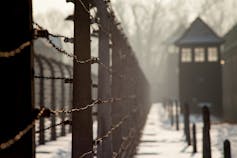
The poet Janina Degutytė wrote a poem about Lithuanian victims after visiting Auschwitz in Poland.
Szymon Kaczmarczyk/Shutterstock

Poetry of the Holocaust continues to be written in our time. A striking example is the poem by Angela Fritzen, a journalist who has Down’s syndrome. Written after visiting an exhibition in Bonn, Germany in 2016, the poem is about the fate of people with disabilities during the Nazi era. “To have strength” is how Fritzen ends her deeply felt poem.

Holocaust poetry is a rich and diverse genre that continues to be added to. Both the older and the contemporary poems need readers, because Holocaust poetry is about communication. The poets felt the need to share their pain and it is vital that readers take the chance to empathise with what they have been through. By way of reflecting on the experience of others we recognise what it means to be human.

The translators of the quoted lines of poetry in this article are: Jean Boase-Beier (Saenger, Fritzen, Sarcq), Anna Crowe (Gabbai-Simantov), Maria Grazina Slavėnas (Degutytė), Marian de Vooght (Pinkhof, Sarcq) and Philip Wilson (Hilarová).The Conversation

Marian de Vooght, Visiting Fellow, Department of Government, University of Essex

This article is republished from The Conversation under a Creative Commons license. Read the original article.
Unknown's avatar

Nigerian writers compare genocide of Igbos to the Holocaust


File 20190208 174864 ldpkgf.jpg?ixlib=rb 1.1
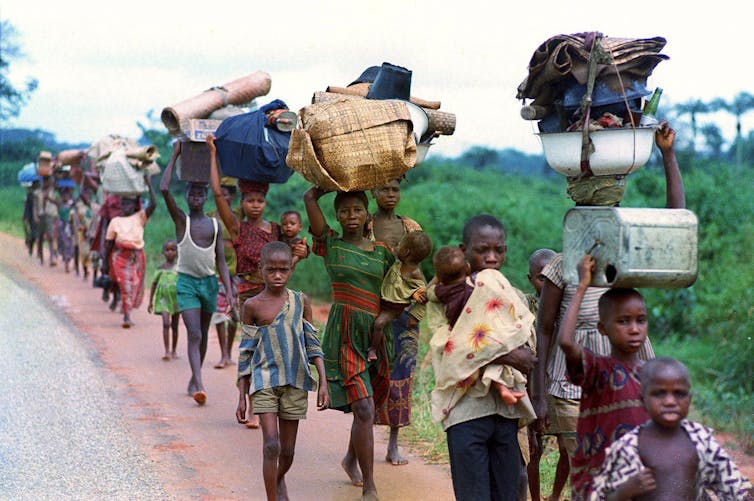
Biafran refugees flee federal Nigerian troops on a road near Ogbaku, Nigeria in this 1968 photo. Between one and three million people are estimated to have died.
(AP Photo/Kurt Strumpf)

Chigbo Arthur Anyaduba, University of Winnipeg

During the massacre of Igbos in Nigeria between 1966 and 1970, one to three million people died. In the decades since, writers have worked to make sense of the immense human tragedy.

These literary representations of the massacres use the Holocaust as an important point of reference.

The war in Nigeria, with its associated mass atrocities, is arguably one of the first major moments in postcolonial Africa when accusations of genocide were made. Following military coups in Nigeria in 1966, the military and ethnic extremists systematically targeted and killed Igbos across the then Northern and Western regions of Nigeria.

Massacres of Igbos and other Easterners across the country led to thousands of deaths and the displacement of millions.

The massacres led the Eastern Region of Nigeria to declare its secession from Nigeria. The region was renamed the republic of Biafra. Nigeria invaded Biafra in July 1967, leading to a protracted war. The federal government used starvation tactics which led to upwards of three million civilian deaths in Biafra. Biafra officially surrendered to Nigeria in January 1970.

After its genocidal war, the Nigerian government proceeded to engineer a culture of denial.

To counter that propaganda, writers reflecting on that past have often framed the war as genocide. A common feature in the writings is the comparison of Igbo experiences of atrocities to Jewish ones during the Holocaust.

The Holocaust as cultural icon of genocide

During the Biafran War, U.S.-based Igbo poet, Onwuchekwa Jemie, compared the murder of Igbos in Nigeria to the Nazi German murder of Jews during the Second World War. His poem, “Requiem” (from his 1970 poetry collection, Biafra: Requiem for the Dead in War) reflects this:

Once in 53 
Three times in 66 
Nigerians shoot civilians
through the ears
rehearsing all known tortures
murdering all males
and raping old women
forcing teenage girls in leper clinics
hundreds butchered…
the 30,000 innocents
mowed down Nazi fashion
a final solution
that failed again. 

In “Requiem,” Jemie catalogues the systematic persecutions and murders of Igbo civilians, which he considers similar to the Nazis’ “final solution.”

The lines “a final solution / that failed again” encapsulate the poet’s defiant view that Biafra will survive the genocidal onslaught from Nigeria.

Global history scholar Lasse Heerten has explained in his work on Biafra, that such comparisons of Igbo suffering to the Nazi genocide of Jews reveal the growing awareness of the Holocaust in African conflict zones at the time.

The comparison of Igbo suffering to the Holocaust offers a way for the writers to internationalize Igbo experience in Nigeria. In so doing, they are sharing a moral message about the universal condition of human cruelty.

The cruel human condition

Similarly, the 1971 poem “Vultures” by Chinua Achebe reflects on the troubling realization that humans possess simultaneously a capacity for human care and a vulture’s inhumane savagery. The poet imagines a Nigerian military commander as a vulture and compares him to the Commandant of the Nazis’ death camp at Belsen:

Thus the Commandant at Belsen 
Camp going home for 
the day with fumes of 
human roast clinging 
rebelliously to his hairy 
nostrils will stop 
at the wayside sweetshop 
and pick up a chocolate 
for his tender offspring 
waiting at home for Daddy’s 
return… 
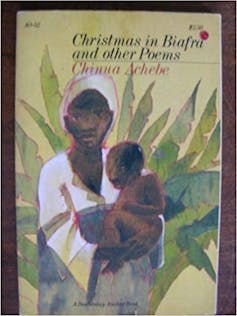
‘Christmas in Biafra and other Poems’ by Chinua Achebe was published in 1973 and includes ‘Vultures.’
Anchor Books

Achebe’s reference to the Holocaust evokes the Nazi death camps as a site of savagery: “fumes of / human roast.” He seems to be alluding to Paul Celan’s 1948 poem, “Death Fugue,” which describes the cremation of Jewish victims in the Nazi camps as a “grave in the sky.”

Reference to the Holocaust in Achebe’s poem provides a way to meditate on the ironic condition of human cruelty.

Another writer who used the Holocaust as a metaphor for moralizing about the human condition is Nobel laureate Wole Soyinka, who was jailed for his attempts to mediate between Biafra and Nigeria. His 1972 prison memoir The Man Died expresses his frustration over the unending cycles of brutality and the pattern of genocidal murders taking place in Nigeria. Soyinka’s other books, plays and poems on the 1966-1970 crisis equally draw on the Holocaust as a way to comment on cruelty.

‘And the World Has Remained Silent’

Half of a Yellow Sun.

Such comparison between Igbo suffering and the Holocaust intending to convey a moral message on human condition can be found in several other writings, including Flora Nwapa’s Never Again, Chris Abani’s Graceland (2004), Nnedi Okorafor’s fantasy novels, Who Fears Death (2010) and The Book of Phoenix (2015), and notably too in Chimamanda Ngozi Adichie’s novel, Half of a Yellow Sun (2006).

In Half of a Yellow Sun, there are several instances comparing the experiences of Igbos to those of Jews under the Nazis.

For example, the title of the character Ugwu’s story, ‘The World Was Silent When We Died,’ echoes the original Yiddish title of Elie Wiesel’s Holocaust memoir, Un di Velt Hot Geshvign, (“And the World Has Remained Silent”).

Universalize can also mean generalize

I believe these literary analogies between Jewish and Igbo experiences have helped to make the atrocities public and known. However, these analogies can also overwhelm the particulars of the Nigerian context of the crisis.

Because the political contexts of such historical mass atrocities being compared vary significantly, these comparisons may come at the cost of our understanding of genocide in African states. Both African and European historical contexts within which these atrocities occurred may become de-territorialized and depoliticized.

In the meantime, local suppression of political questions of Igbo self-determination and justice in the war’s aftermath remain unaddressed.The Conversation

Chigbo Arthur Anyaduba, Assistant Professor, University of Winnipeg

This article is republished from The Conversation under a Creative Commons license. Read the original article.