
Unknown's avatar

Why Christmas ghost stories have such enduring appeal


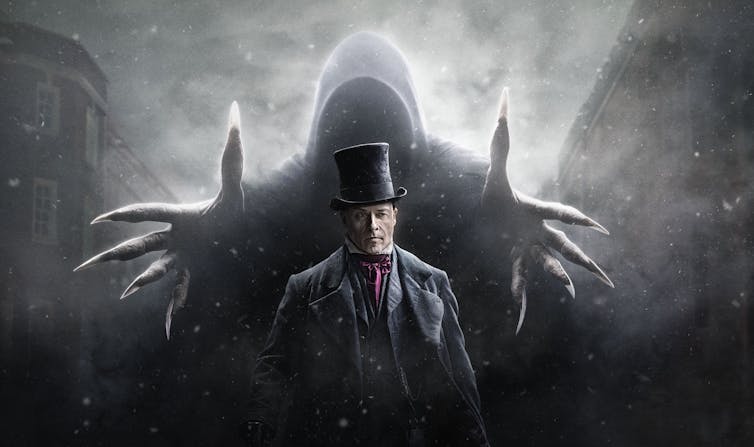
A modern Christmas Carol.
BBC/Scott Free/FX Networks

Sally O’Reilly, The Open University

Our fascination with ghostly tales around Christmas time goes back thousands of years and is rooted in ancient celebrations of the winter solstice. In the depths of winter, pagan traditions included a belief in a ghostly procession across the sky, known as the Wild Hunt. Recounting tales of heroism and monstrous and supernatural beings became a midwinter tradition. Dark tales were deployed to entertain on dark nights.

Ghosts have been associated with winter cold since those ancient times. According to art historian Susan Owens, author of The Ghost, A Cultural History, the ode of Beowulf is one of the oldest surviving ghost stories, probably composed in the eighth century. This is the tale of a Scandinavian prince who fights the monster Grendel. Evil and terrifying, Grendel has many ghostly qualities, and is described as a “grimma gaest” or spirit, and a death shadow or shifting fog, gliding across the land.

In 1611, Shakespeare wrote The Winter’s Tale, which includes the line: “A sad tale’s best for winter, I have one of sprites and goblins.” Two centuries later, the teenage Mary Shelley set her influential horror story Frankenstein in a snowy wasteland, although she wrote it during a wet summer in Switzerland.

The Victorians invented many familiar British Christmas traditions, including Christmas trees, cards, crackers and roast turkey. They also customised the winter ghost story, relating it specifically to the festive season – the idea of something dreadful lurking beyond the light and laughter inspired some chilling tales.

Both Elizabeth Gaskell and Wilkie Collins published stories in this genre, but the most notable and enduring story of the period was Charles Dickens’ A Christmas Carol (1843). In this vivid and atmospheric fable, gloomy miser Ebenezer Scrooge is confronted first by the spirit of his dead business partner, Jacob Marley, and thereafter by a succession of Christmas ghosts.

Their revelations about his own past and future and the lives of those close to him lead to a festive redemption which has spawned a host of imitations and adaptations.

Dickens wrote the story to entertain, drawing on the tradition of the ghostly midwinter tale, but his aim was also to highlight the plight of the poor at Christmas. His genius for manipulating sentiment was never used to better effect, but perhaps the most enjoyable elements of the story are the atmospheric descriptions of the hauntings themselves – the door knocker which transforms into Marley’s face and the sinister, hooded figure of the Ghost of Christmas Yet to Come.

The tradition was further developed in the stories of M R James, a medieval scholar who published Ghost Stories of an Antiquary in 1904. His chilling Gothic yarns focused on scholars or clergymen who discovered ancient texts or objects with terrifying supernatural consequences.

Chilling tales

Typically, James used the framing device of a group of friends telling stories around a roaring fire. In the introduction to Ghost Stories he said: “I wrote these stories at long intervals, and most of them were read to patient friends, usually at the seasons of Christmas.”

Seminal stories in his oeuvre include Number 13, Oh Whistle & I’ll Come to You and A School Story. Like Dickens, James has been widely imitated and adapted, with Stephen King citing him as an influence. King’s The Shining certainly fits into to the genre of ice-bound chiller.

Christmas ghost stories morph into new forms as time passes, like ectoplasm. Spin offs of A Christmas Carol include Frank Capra’s 1946 classic It’s a Wonderful Life, in which the story is transposed to small town America, and the 2019 film Last Christmas, the tale of a dysfunctional young woman permanently dressed as a Christmas elf, ripe for Yuletide redemption. This contemporary version conveys messages about integration and the value of diversity.

A new, high-octane version of A Christmas Carol will be shown on TV this Christmas, written by Peaky Blinders creator Stephen Knight. And M R James’ Martin’s Close, the story of a 17th century murder and its supernatural outcome, has also been adapted for the small screen.

So it seems the atavistic desire to lose oneself in tales of the supernatural is still with us. Christmas ghost stories enhance our enjoyment of the mince pies and mulled wine, and the frisson of a paranormal tale offsets the “feel-good” festive spirit that might otherwise be cloying.

Some things never change – we still have a fear of the unknown, a yearning for what is lost and a desire to be secure. In an uncertain, fast-paced world, mediated through smartphones and social media, the seasonal ghost story is here to stay. The jolt of fear and dread such stories convey make the Christmas lights glitter even more brightly.The Conversation

Sally O’Reilly, Lecturer in Creative Writing, The Open University

This article is republished from The Conversation under a Creative Commons license. Read the original article.
Unknown's avatar

The enduring power of print for learning in a digital world


File 20171002 12115 5nz9dp

PHOTO FUN

Patricia A. Alexander, University of Maryland and Lauren M. Singer, University of Maryland

Today’s students see themselves as digital natives, the first generation to grow up surrounded by technology like smartphones, tablets and e-readers.

Teachers, parents and policymakers certainly acknowledge the growing influence of technology and have responded in kind. We’ve seen more investment in classroom technologies, with students now equipped with school-issued iPads and access to e-textbooks. In 2009, California passed a law requiring that all college textbooks be available in electronic form by 2020; in 2011, Florida lawmakers passed legislation requiring public schools to convert their textbooks to digital versions.

Given this trend, teachers, students, parents and policymakers might assume that students’ familiarity and preference for technology translates into better learning outcomes. But we’ve found that’s not necessarily true.

As researchers in learning and text comprehension, our recent work has focused on the differences between reading print and digital media. While new forms of classroom technology like digital textbooks are more accessible and portable, it would be wrong to assume that students will automatically be better served by digital reading simply because they prefer it.

Speed – at a cost

Our work has revealed a significant discrepancy. Students said they preferred and performed better when reading on screens. But their actual performance tended to suffer.

For example, from our review of research done since 1992, we found that students were able to better comprehend information in print for texts that were more than a page in length. This appears to be related to the disruptive effect that scrolling has on comprehension. We were also surprised to learn that few researchers tested different levels of comprehension or documented reading time in their studies of printed and digital texts.

To explore these patterns further, we conducted three studies that explored college students’ ability to comprehend information on paper and from screens.

Students first rated their medium preferences. After reading two passages, one online and one in print, these students then completed three tasks: Describe the main idea of the texts, list key points covered in the readings and provide any other relevant content they could recall. When they were done, we asked them to judge their comprehension performance.

Across the studies, the texts differed in length, and we collected varying data (e.g., reading time). Nonetheless, some key findings emerged that shed new light on the differences between reading printed and digital content:

  • Students overwhelming preferred to read digitally.

  • Reading was significantly faster online than in print.

  • Students judged their comprehension as better online than in print.

  • Paradoxically, overall comprehension was better for print versus
    digital reading.

  • The medium didn’t matter for general questions (like understanding the main idea of the text).

  • But when it came to specific questions, comprehension was significantly better when participants read printed texts.

Placing print in perspective

From these findings, there are some lessons that can be conveyed to policymakers, teachers, parents and students about print’s place in an increasingly digital world.

1. Consider the purpose

We all read for many reasons. Sometimes we’re looking for an answer to a very specific question. Other times, we want to browse a newspaper for today’s headlines.

As we’re about to pick up an article or text in a printed or digital format, we should keep in mind why we’re reading. There’s likely to be a difference in which medium works best for which purpose.

In other words, there’s no “one medium fits all” approach.

2. Analyze the task

One of the most consistent findings from our research is that, for some tasks, medium doesn’t seem to matter. If all students are being asked to do is to understand and remember the big idea or gist of what they’re reading, there’s no benefit in selecting one medium over another.

But when the reading assignment demands more engagement or deeper comprehension, students may be better off reading print. Teachers could make students aware that their ability to comprehend the assignment may be influenced by the medium they choose. This awareness could lessen the discrepancy we witnessed in students’ judgments of their performance vis-à-vis how they actually performed.

3. Slow it down

In our third experiment, we were able to create meaningful profiles of college students based on the way they read and comprehended from printed and digital texts.

Among those profiles, we found a select group of undergraduates who actually comprehended better when they moved from print to digital. What distinguished this atypical group was that they actually read slower when the text was on the computer than when it was in a book. In other words, they didn’t take the ease of engaging with the digital text for granted. Using this select group as a model, students could possibly be taught or directed to fight the tendency to glide through online texts.

4. Something that can’t be measured

There may be economic and environmental reasons to go paperless. But there’s clearly something important that would be lost with print’s demise.

In our academic lives, we have books and articles that we regularly return to. The dog-eared pages of these treasured readings contain lines of text etched with questions or reflections. It’s difficult to imagine a similar level of engagement with a digital text. There should probably always be a place for print in students’ academic lives – no matter how technologically savvy they become.

Of course, we realize that the march toward online reading will continue unabated. And we don’t want to downplay the many conveniences of online texts, which include breadth and speed of access.

The ConversationRather, our goal is simply to remind today’s digital natives – and those who shape their educational experiences – that there are significant costs and consequences to discounting the printed word’s value for learning and academic development.

Patricia A. Alexander, Professor of Psychology, University of Maryland and Lauren M. Singer, Ph.D. Candidate in Educational Psychology, University of Maryland

This article was originally published on The Conversation. Read the original article.

Unknown's avatar

Six years on: the enduring influence of J. D. Salinger


Emma Michelle, University of Melbourne and Anne Maxwell, University of Melbourne

Today marks six years since celebrated writer J. D. Salinger passed away at his home in Cornish, New Hampshire, at the age of 91. Famously shunning all aspects of public life for decades prior to his death, he published no new work after 1965 and gave no interviews after 1980. Yet he apparently continued to write every day with a religious diligence.

In 1972 a girlfriend observed “he has completed at least two books, the manuscripts of which now sit in the safe”.

Unsealed portions of depositions taken in 1986 showed Salinger confirmed under oath that he was writing “Just a work of fiction. That’s all”.

And then after his death, a 2013 book and documentary detailed five new works he approved for publication between 2015 and 2020, however so far none have eventuated.

Today on the anniversary of his death, we reflect on how J. D. Salinger’s writing first influenced the world and how it continues to do so now.

The Catcher in the Rye and young-adult fiction

For many teenage readers The Catcher in the Rye was a revelation. The earliest critics called protagonist Holden Caulfield a “lout,” his angst and suffering “cute,” and his rebellious nature “the differential revolt of the lonesome rich child,” though none could overlook the 1951 novel’s commercial success and popularity with adolescents.

1950 portrait of J. D. Salinger. Portrait by Lotte Jacobi.
Wikipedia Commons. Lotte Jacobi Collection, University of New Hampshire

The Catcher in the Rye has sold 65 million copies worldwide and continues to sell 250,000 more each year, frequently as a prescribed text in high school curricula.

Salinger’s pre-eminence as a youth writer is mainly attributed to the way he successfully captures the language of young people and depicts themes that appeal to teenage sensibilities. John Green – perhaps the most popular contemporary author of young-adult fiction – said last year that “anybody who writes about teenagers does so in the shadow of Salinger”.

Rarely (if ever) does a list of the best young-adult fiction omit the novel and, as David Levithan wrote in 2010:

The Catcher in the Rye was one of the first books on the shelf of our young adult [sic] literature, and for almost sixty years we’ve written plenty more in an attempt to keep it company.

Controversy: the death of John Lennon

First edition of Catcher in the Rye, 1951.
Little, Brown and Company

Once a text gains a diehard following it is vulnerable to extremes of interpretation. When Mark David Chapman shot John Lennon in December of 1980 he was found reading The Catcher in the Rye at the scene. Inside the book he’d written “This is my statement” and signed off as Holden Caulfield.

Months later, John Hinckley Jr. tried to assassinate President Ronald Reagan and police found a copy of the novel in his hotel room.

Salinger never gave public comment on the shootings during his lifetime. Yet by all accounts he despised critics misreading his texts, and one could assume that murder is a most extreme misreading of Holden stood for. Critics have rightly asserted that Holden’s rebellion “never quite transcends the adolescent pique at wrong guys and boring teachers,” and that Holden:

… wanders through New York with a genuine desire, to quote an old Beatles tune, to “take a sad song and make it better”, but he doesn’t know how to begin […]. Simply put, it appears Chapman misread The Catcher in the Rye.

Film and the work of Wes Anderson

The Catcher in the Rye has inspired leagues of on-screen stories – notably Rebel Without a Cause (1955) and Six Degrees of Separation (1990 play and 1993 film). A drama about Salinger’s life has been announced and will address “the birth of The Catcher in the Rye,” despite his insistence that a film adaptation of the novel must never arise.

This film is supposedly based on a 2011 biography, perhaps an interesting way of circumventing the writer’s wishes.

Yet nowhere is his influence in film felt more than the work of Wes Anderson. Salinger’s Glass family (who feature heavily in his later work) are reconstructed in Anderson’s The Royal Tenenbaums (2001) as three child prodigies struggle to adjust to adult life.

Margot’s bathtub conversation, The Royal Tenenbaums.

Margot’s bathtub conversation with her mother is clear homage to a scene in Salinger’s 1957 novella Zooey, and even her favourite coat finds its twin in a Salinger story.

The precocious young lovers in Anderson’s Moonrise Kingdom (2012) replicate numerous child figures in Salinger’s fiction. Children in Salinger’s work are equal parts characters and symbols of virtue, where the integrity and innocence of childhood is idealised and broken adults can find salvation in their “wonderful directness“.

Anderson’s film is no different, with Suzy and Sam repeatedly shown as “resourceful, optimistic, capable of loyalty and love – all the qualities with which their elders struggle”.

Despite the prospect of forthcoming titles, 2015 came and went and the world was left wanting. The J. D. Salinger Literary Trust was busy fighting a small publisher over foreign licensing rights for some old short stories, and any schedule for forthcoming Salinger books is still to be confirmed.

However, despite this absence, there remains abundant evidence of his influence in the contemporary world.

The Conversation

Emma Michelle, , University of Melbourne and Anne Maxwell, Assoc. Professor, School of Culture and Communication, University of Melbourne

This article was originally published on The Conversation. Read the original article.