Unknown's avatar

Coronavirus: Defoe’s account of the Great Plague of 1665 has startling parallels with today


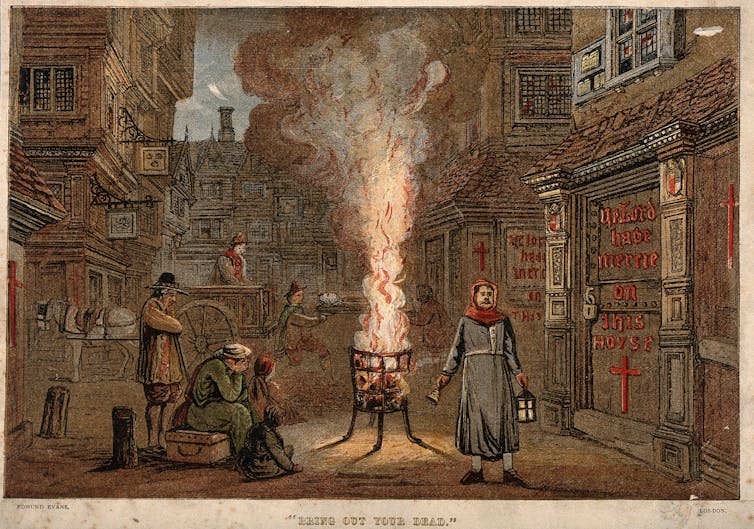
A street during the Great Plague in London, 1665, with a death cart and mourners.
Wellcome Images, CC BY-NC-SA

David Roberts, Birmingham City University

In 1722, Daniel Defoe pulled off one of the great literary hoaxes of all time. A Journal of the Plague Year, he called his latest book. The title page promises “Observations of the most remarkable occurrences” during the Great Plague of 1665, and claims it was “written by a citizen who continued all the while” in London – Defoe’s own name is nowhere to be found.

It was 60 years before anyone twigged. From oral testimonies, mortality bills, lord mayor’s proclamations, medical books and literature inspired by the 1603 plague, Defoe had cooked the whole thing up.
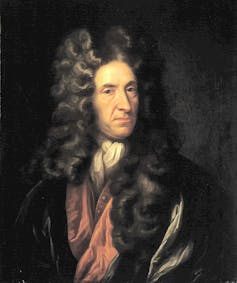
Unreliable memoir: Daniel Defoe (1660-1731)
National Maritime Museum, London.

And yet this extraordinary book lies like the truth. It’s the most harrowing account of an epidemic ever published – and it really leaps off the page now in the era of COVID-19. We feel what it was like to walk up a main thoroughfare with no one else about. We read of the containment orders published by the government, and how people got round them. We share the distress of families denied proper funerals for their loved ones.

We learn of the mass panic as people tried to understand where the disease came from, how it was transmitted, how it could be avoided, what chance you had if you caught it, and – most modern of all – how fake news and fake practitioners multiplied answers to all those questions.

Then and now

Bubonic plague was, of course, far nastier than coronavirus. In its ordinary form – transmitted by fleabites – it was around 75% fatal, while in its lung-to-lung form, that figure went up to 95%. But in the way it was managed – and the effect it had on people’s emotions and behaviour – there are eerie similarities amid the differences. Defoe captured them all.

His narrator, identified only as HF, is fascinated by what happened after the lord mayor ordered victims to be locked in their homes. Watchmen were posted outside front doors. They could be sent on errands to fetch food or medicine and took the keys with them, so people contrived to get more keys cut. Some watchmen were bribed, assaulted or murdered. Defoe describes one who was “blown up” with gunpowder.
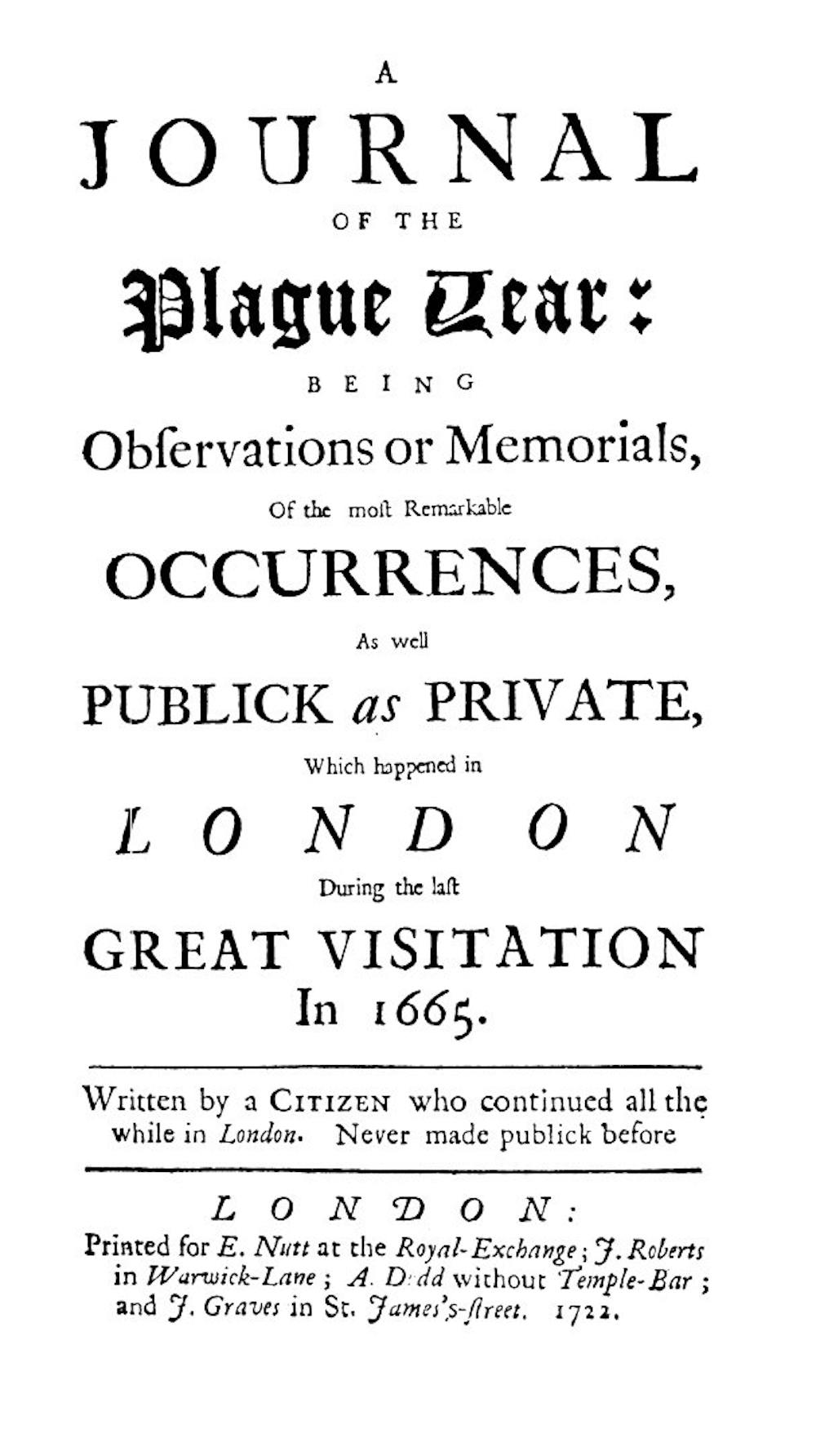
Defoe’s Journal of the Plague Year.

HF becomes obsessed with the weekly mortality figures. They charted deaths by parish, giving a picture of how the plague was moving around the city. Still, it was impossible to be sure who had died directly of the disease, just as in the BBC news today we hear people have died “with” rather than “of” COVID-19. Reporting was difficult, partly because people were reluctant to admit there was an infection in the family. After all, they might be locked in their homes to catch the disease and die.

HF is appalled by those who opened up taverns and spent their days and nights drinking, mocking anyone who objected. At one point he confronts a group of rowdies and gets a torrent of abuse in return. Later, exhibiting one of his less appealing traits, he is gratified to hear that they all caught the plague and died.

He is a devout Christian, but the stories that worry him most are the ones that still shock everyone today, regardless of their beliefs. Is it possible, he asks, that there are some people so wicked that they deliberately infect others? He just can’t square the idea with his more kindly view of human nature. Yet he hears plenty of stories about victims breathing into the faces of passers by, or infected men randomly hugging and kissing women in the street.

Discriminating disease

When Prince Charles and Boris Johnson fell ill recently, we were told the virus “does not discriminate”. HF has something to say about that. For all his uncertainties, he is adamant about one thing. Plague affected the poor disproportionately. They lived, as they do now, in more cramped conditions, and were more susceptible to taking bad advice.

They were more likely to suffer ill health in the first place, as now, and they had no means of escape. Near the start of the outbreak in 1665, the court and those with money or homes in the country fled London in droves. By the time the idea had occurred to the rest of the population, you couldn’t find a horse for love or money.
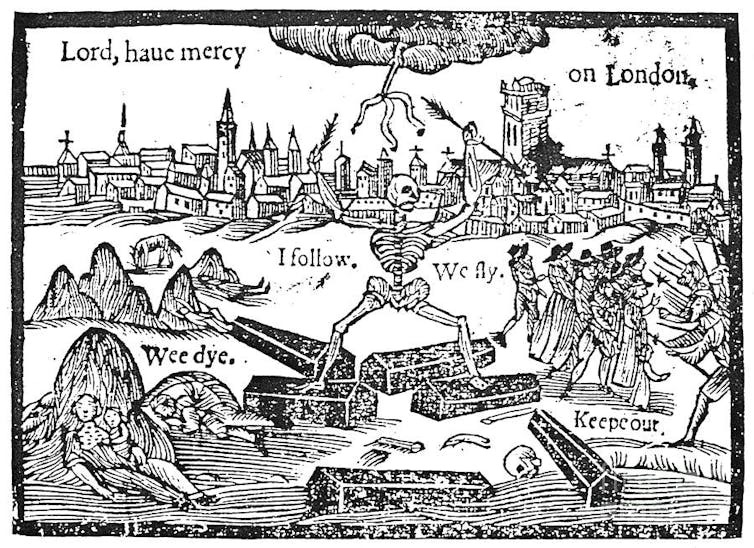
‘Lord, have mercy on London.’
Contemporary English woodcut on the Great Plague of 1665.

Throughout the journal, HF tells us he hopes his experiences and advice might be useful to us. There’s one thing in particular governments might learn from the book – and it’s tough. The most dangerous time, he reports, was when people thought it was safe to go out. That was when the plague flared up all over again.

Plague literature is a genre in its own right. So what draws writers and readers to such a grisly subject? Something not entirely wholesome, perhaps. For writers, it’s the chance to explore a world in which fantasy and reality have swapped places. We depend on the writer as heroic narrator, charting the horror like the best news reporter.

For readers, it’s the feeling that you might sneak with him to the very edge of the plague pit and live to tell the tale. For his closing words, HF hands us a doggerel poem that sums up his feelings and ours:

A dreadful plague in London was
In the year sixty five,
Which swept an hundred thousand souls
Away: yet I alive!The Conversation

David Roberts, Professor of English and National Teaching Fellow, Birmingham City University

This article is republished from The Conversation under a Creative Commons license. Read the original article.
Unknown's avatar

What ‘Walden’ can tell us about social distancing and focusing on life’s essentials


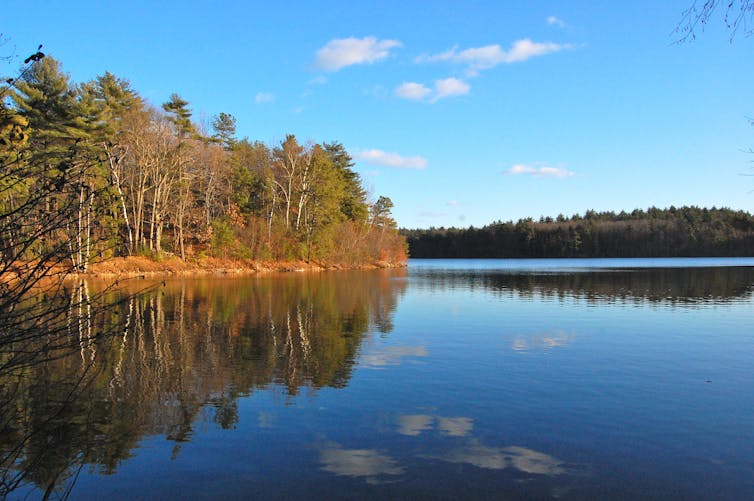
Walden Pond in Concord, Massachusetts.
ptwo/Wikipedia, CC BY

Robert M. Thorson, University of Connecticut

Seeking to bend the coronavirus curve, governors and mayors have told millions of Americans to stay home. If you’re pondering what to read, it’s easy to find lists featuring books about disease outbreaks, solitude and living a simpler life. But it’s much harder to find a book that combines these themes.

As the author of three books about essayist, poet and philosopher Henry David Thoreau, I highly recommend “Walden,” Thoreau’s 1854 account of his time living “alone” in the woods outside Concord, Massachusetts. I qualify “alone” because Thoreau had more company at Walden than in town, and hoed a bean field daily as social theater in full view of passersby on the road.

Published in over 1,000 editions and translated into scores of languages, “Walden” is the scriptural fountainhead of the modern environmental movement, a philosophical treatise on self-reliance and a salient volume of the American literary canon. In his introduction to the Princeton edition, John Updike claims that Thoreau’s masterpiece “contributed most to America’s present sense of itself” during the cultural renaissance of the mid-19th century, yet “risks being as revered and unread as the Bible.”

Another reason to read or reread “Walden” during trying times is that it gushes with sorely needed optimism and is laced with wit. And Thoreau befriends you by writing in the first person.

Reality lies within us

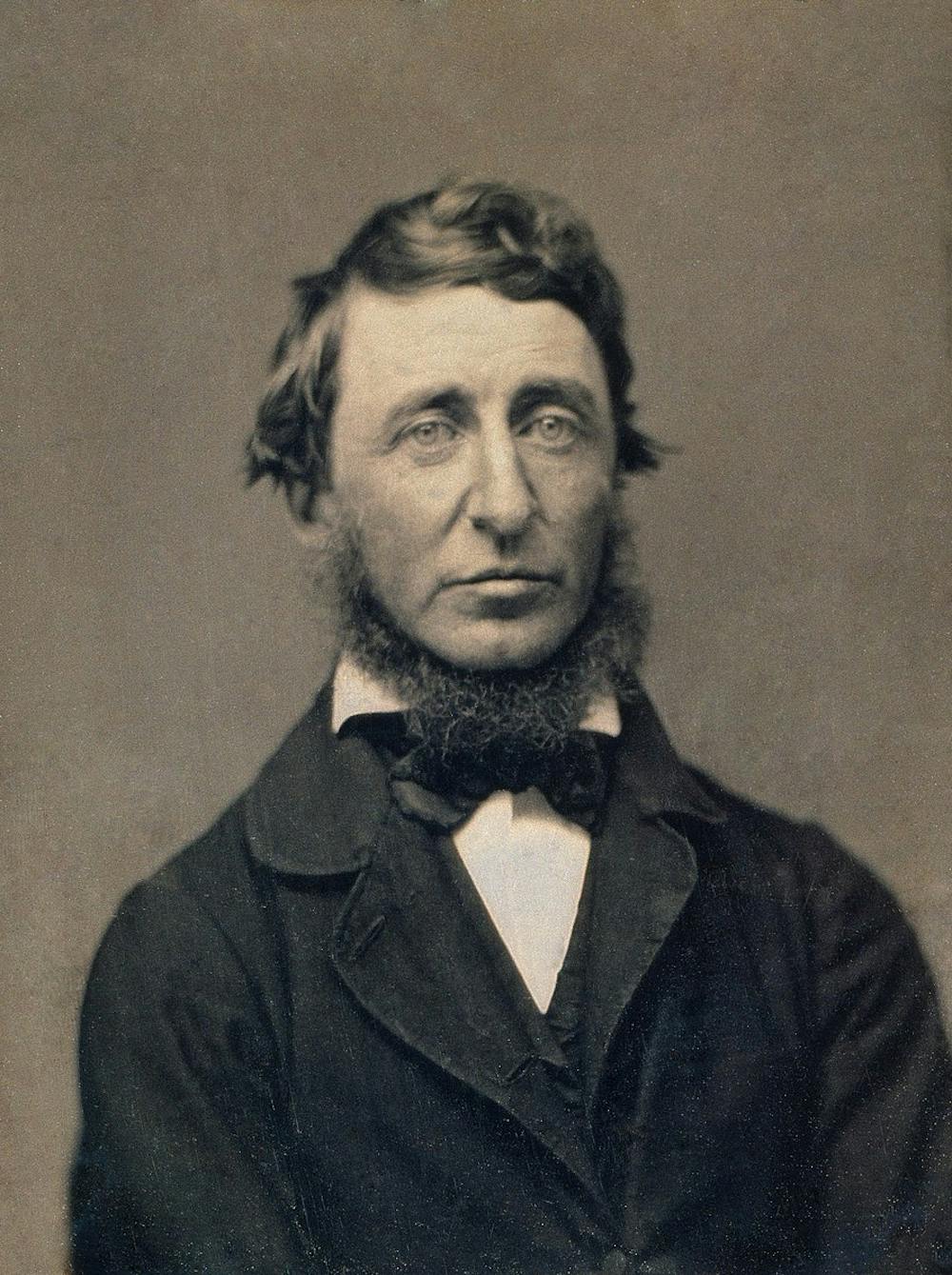
Henry David Thoreau, 1856.
National Portrait Gallery/Wikipedia

As governments mandate social distancing to protect public health, many readers may be coming to grips with solitude. Thoreau devotes a chapter to it, extolling the virtue of getting to know yourself really well.

“Why should I feel lonely?” he asks, “is not our planet in the Milky Way?” Elsewhere he clarifies the difference between what we need and what we think we need, writing, “My greatest skill has been to want but little.”

“Walden” doesn’t have to be read straight through like a novel. For readers who have previously given up on it, I suggest rebooting in the middle with “The Ponds,” which opens thus: “Sometimes, having had a surfeit of human society and gossip, and worn out all my village friends, I rambled still farther westward than I habitually dwell…” Thoreau then retreats away from the mindless distractions of community life toward an immersion into Nature, with water at its spiritual center.

Next, flip back to the earlier chapter “Where I Lived and What I Lived For.” Here Thoreau invites readers on a downward journey, from the fleeting shallows of their social lives to the solid depths of their individual lives:

“Let us settle ourselves, and work and wedge our feet downward through the mud and slush of opinion, and prejudice, and tradition, and delusion, and appearance, that alluvion which covers the globe, through Paris and London, through New York and Boston and Concord, through Church and State, through poetry and philosophy and religion, till we come to a hard bottom and rocks in place, which we can call reality…”

Our brains build that reality – yours, mine, everyone’s – by integrating external sensory signals with internal memories. Thoreau’s point – which is supported by 21st-century cognitive and neuroscience research – is that the real you precedes the social you. Your world is built from the inside of your skull outward, not vice versa.

‘Walden’ is a book about breaking away and focusing on the essential facts of life.

The elusive simple life

Thoreau’s retreat to Walden Pond is often mistaken for a hermit’s flight deep into the woods. Actually, Thoreau put some distance between himself and his home and village so that he could understand himself and society better. When not in town, he swapped human companionship for the “beneficent society” of Nature for long enough to make “the fancied advantages of human neighborhood insignificant.”

Today mandatory social distancing is wrecking the global economy, based on traditional metrics like gross domestic product and stock prices. Viewed through “Walden,” this wreckage may look like a long-overdue correction for an unsustainable system.

Thoreau feared that the economy he saw was headed in the wrong direction. His opening chapter, “Economy,” is an extended rant against what he viewed as a capitalistic, urbanizing, consumption-driven, fashion-conscious 19th-century New England.

Of his neighbors, Thoreau wrote, “By a seeming fate, commonly called necessity, they are employed, as it says in an old book” – meaning the Christian Bible – “laying up treasures which moth and rust will corrupt and thieves break through and steal. It is a fool’s life, as they will find when they get to the end of it, if not before.”

In contrast, his recipe for a good economy is one of “Walden”‘s most famous quotes: “Simplicity, simplicity, simplicity! I say, let your affairs be as two or three, and not a hundred or a thousand.”

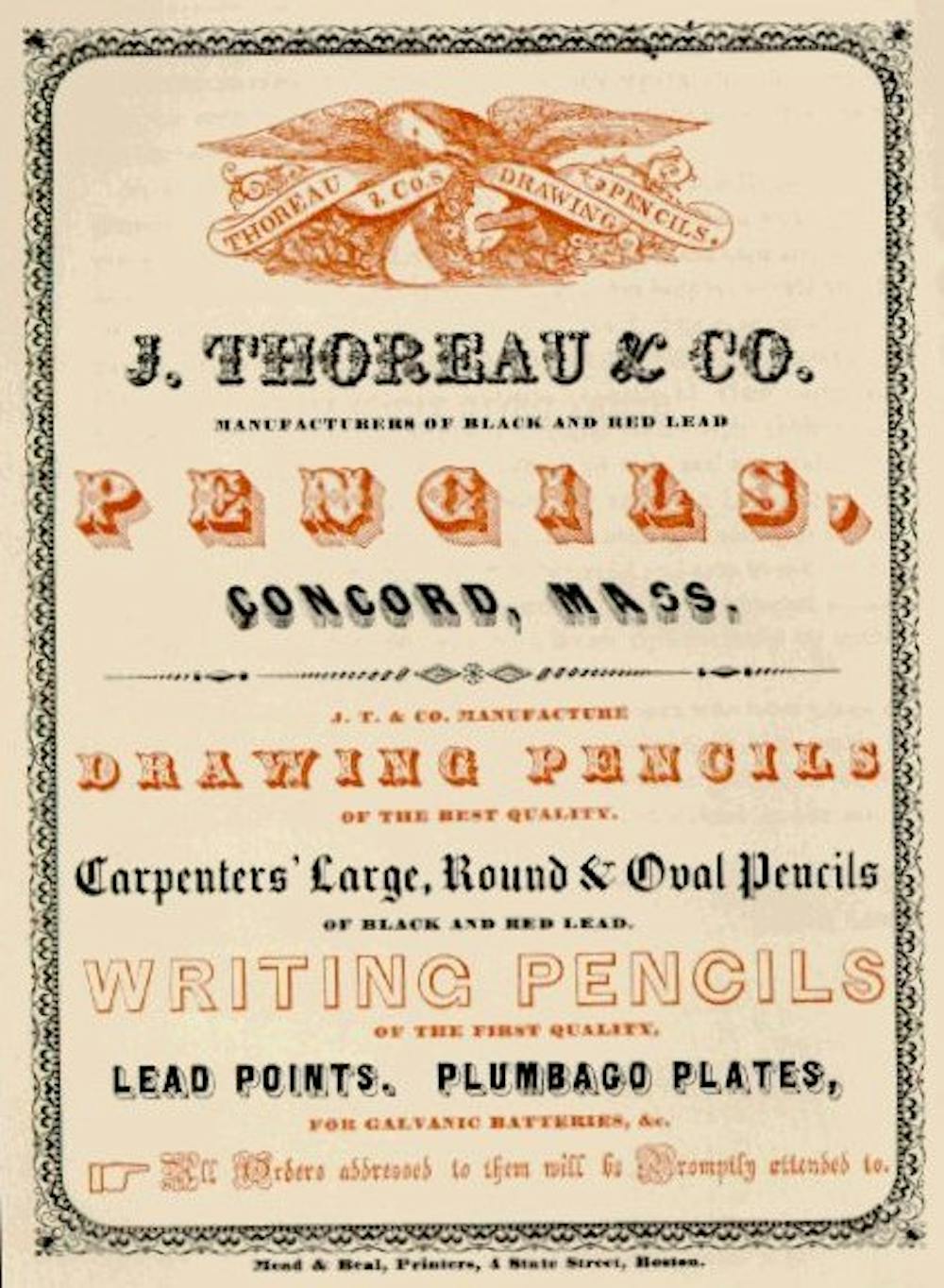
Thoreau’s family operated a flourishing pencil manufacturing business in the 1840s.
University of Florida, CC BY

That was easier said than done, even for Thoreau. When he conceived “Walden,” he was an unemployed, landless idealist. By the time it was published, he lived in a big house that was heated with Appalachian coal, earning income by manufacturing pulverized graphite and surveying for land developers.

Since then, the world’s population has more than quintupled and developed nations have built a global economy approaching US$100 trillion per year. Human impacts on the planet have become so powerful that scientists have coined the term Anthropocene to describe our current epoch.

Finding perspective in solitude

Some Americans have tried at least halfheartedly to follow “Walden”’s idealistic advice by living deliberately, being more self-reliant and shrinking their planetary footprints. Personally, although I’ve downsized my house, walk to work, fly only for funerals and cook virtually every meal from scratch, in my heart I know I’ve also contributed to the world’s swelling population, burn fracked natural gas and am hopelessly embedded in a consumer economy.

Nevertheless, after several weeks of social distancing, I’m rediscovering the value of two of Thoreau’s key points: Solitude is helping me recalibrate what matters most, and the current economic slowdown offers short-term gains and a long-term message for the planet.

These benefits don’t compensate for the incalculable personal losses and grief that COVID-19 is inflicting worldwide. But they are consolation prizes until things stabilize in the new normal. On my daily solitary walk in the woods, I am mindful of Thoreau’s words: “Next to us is not the workman whom we have hired, with whom we love so well to talk, but the workman whose work we are.”

[You need to understand the coronavirus pandemic, and we can help. Read our newsletter.]The Conversation

Robert M. Thorson, Professor of Geology, University of Connecticut

This article is republished from The Conversation under a Creative Commons license. Read the original article.
Unknown's avatar

Thucydides and the plague of Athens – what it can teach us now


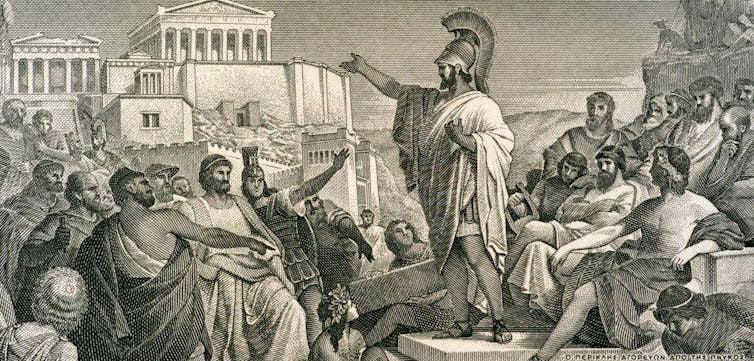
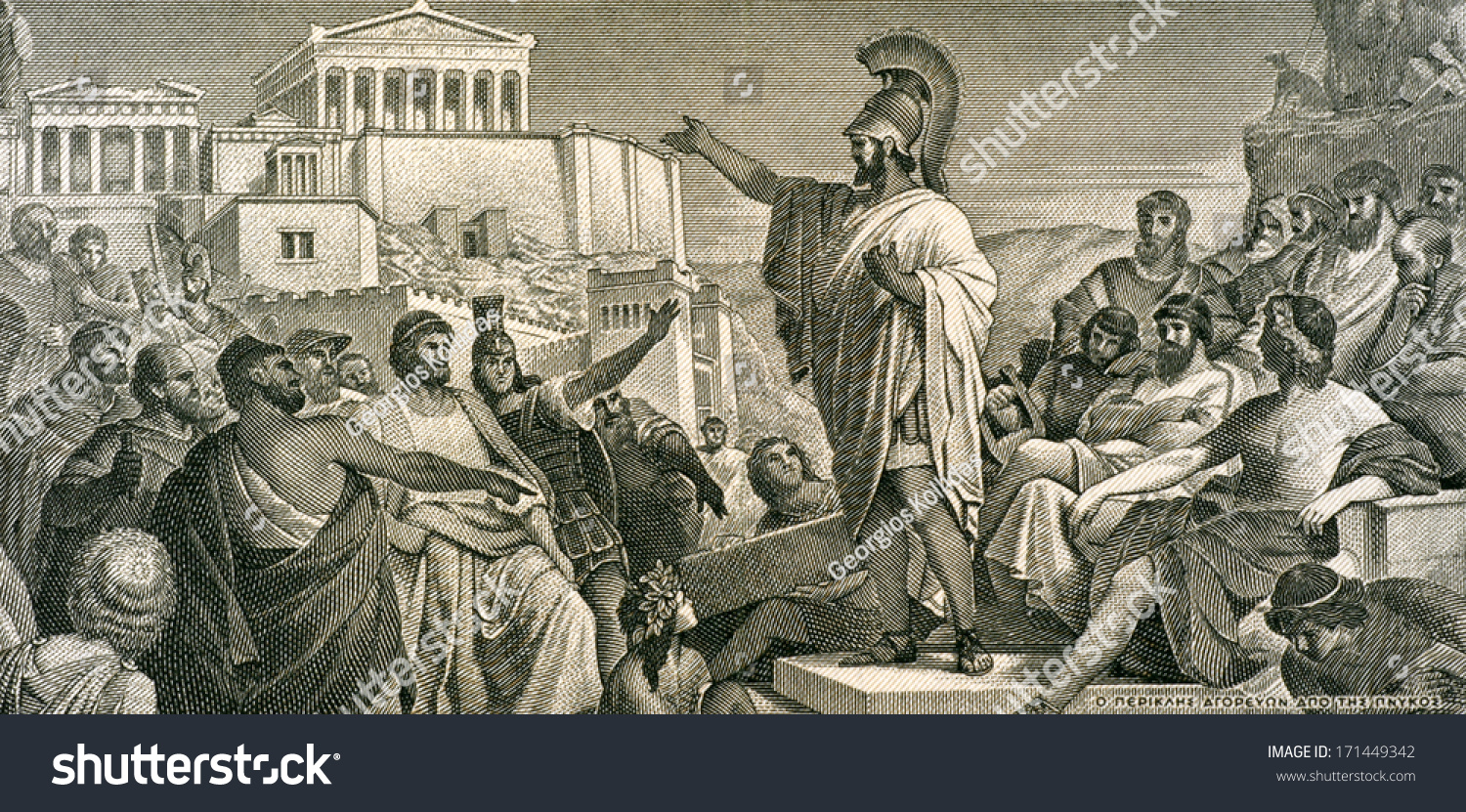
Pericles Funeral Oration on the Greek 50 Drachmai 1955 Banknote.
Shutterstock

Chris Mackie, La Trobe University

The coronavirus is concentrating our minds on the fragility of human existence in the face of a deadly disease. Words like “epidemic” and “pandemic” (and “panic”!) have become part of our daily discourse.

These words are Greek in origin, and they point to the fact that the Greeks of antiquity thought a lot about disease, both in its purely medical sense, and as a metaphor for the broader conduct of human affairs. What the Greeks called the “plague” (loimos) features in some memorable passages in Greek literature.

One such description sits at the very beginning of western literature. Homer’s Iliad, (around 700BC), commences with a description of a plague that strikes the Greek army at Troy. Agamemnon, the leading prince of the Greek army, insults a local priest of Apollo called Chryses.

Apollo is the plague god – a destroyer and healer – and he punishes all the Greeks by sending a pestilence among them. Apollo is also the archer god, and he is depicted firing arrows into the Greek army with a terrible effect:

Apollo strode down along the pinnacles of Olympus angered

in his heart, carrying on his shoulders the bow and the hooded

quiver; and the shafts clashed on the shoulders of the god walking angrily.

Terrible was the clash that rose from the bow of silver.

First he went after the mules and the circling hounds, then let go

a tearing arrow against the men themselves and struck them.

The corpse fires burned everywhere and did not stop burning.

Plague narratives

About 270 years after the Iliad, or thereabouts, plague is the centrepiece of two great classical Athenian works – Sophocles’ Oedipus the King, and Book 2 of Thucydides’ History of the Peloponnesian War.

Thucydides (c.460-400BC) and Sophocles (490-406BC) would have known one another in Athens, although it is hard to say much more than that for a lack of evidence. The two works mentioned above were produced at about the same time. The play Oedipus was probably produced about 429 BC, and the plague of Athens occurred in 430-426 BC.

Thucydides writes prose, not verse (as Homer and Sophocles do), and he worked in the comparatively new field of “history” (meaning “enquiry” or “research” in Greek). His focus was the Peloponnesian war fought between Athens and Sparta, and their respective allies, between 431 and 404 BC.

Thucydides’ description of the plague that struck Athens in 430 BC is one of the great passages of Greek literature. One of the remarkable things about it is how focused it is on the general social response to the pestilence, both those who died from it and those who survived.

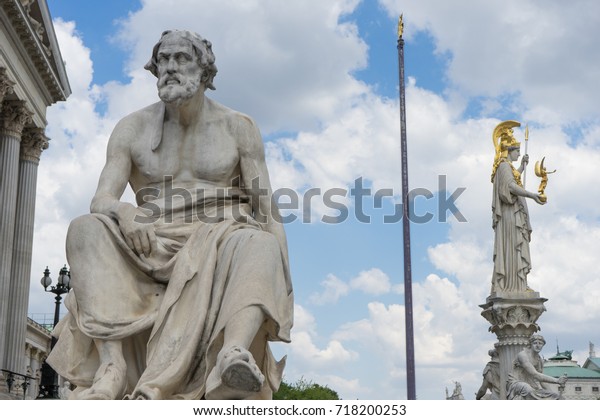
Statue portrait of historian Thucydides outside the Austrian parliament in Vienna.
Shutterstock

A health crisis

The description of the plague immediately follows on from Thucydides’ renowned account of Pericles’ Funeral Oration (it is important that Pericles died of the plague in 429 BC, whereas Thucydides caught it but survived).

Thucydides gives a general account of the early stages of the plague – its likely origins in north Africa, its spread in the wider regions of Athens, the struggles of the doctors to deal with it, and the high mortality rate of the doctors themselves.

Nothing seemed to ameliorate the crisis – not medical knowledge or other forms of learning, nor prayers or oracles. Indeed “in the end people were so overcome by their sufferings that they paid no further attention to such things”.

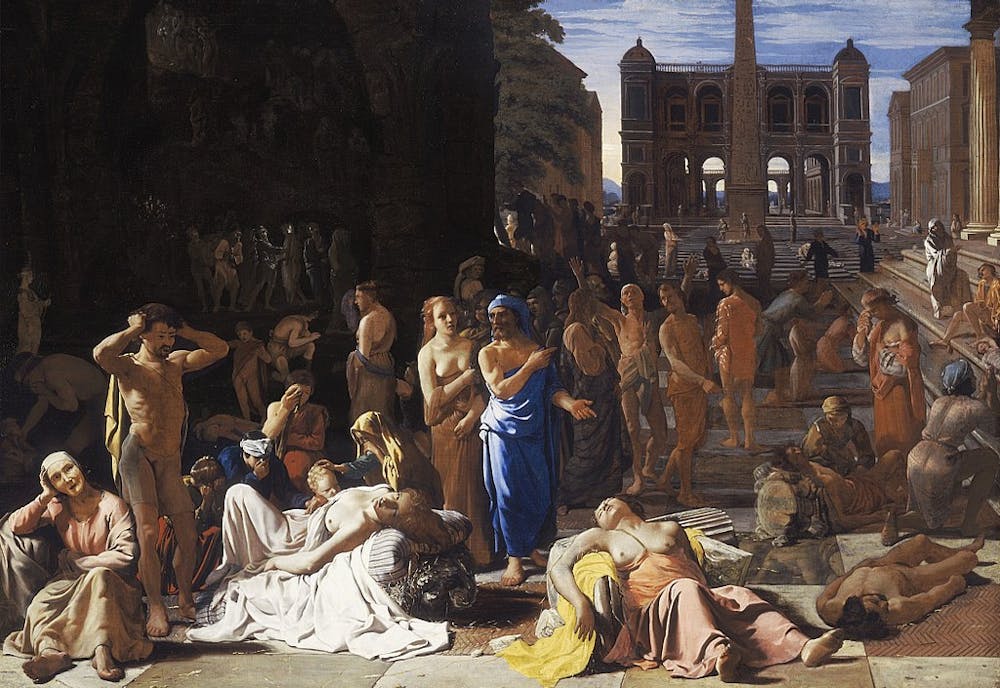
He describes the symptoms in some detail – the burning feeling of sufferers, stomachaches and vomiting, the desire to be totally naked without any linen resting on the body itself, the insomnia and the restlessness.

Michiel Sweerts’ Plague in an Ancient City (circa 1652).
Wikimedia

The next stage, after seven or eight days if people survived that long, saw the pestilence descend to the bowels and other parts of the body – genitals, fingers and toes. Some people even went blind.

Words indeed fail one when one tries to give a general picture of this disease; and as for the sufferings of individuals, they seemed almost beyond the capacity of human nature to endure.

Those with strong constitutions survived no better than the weak.

The most terrible thing was the despair into which people fell when they realized that they had caught the plague; for they would immediately adopt an attitude of utter hopelessness, and by giving in in this way, would lose their powers of resistance.

Lastly, Thucydides focuses on the breakdown in traditional values where self-indulgence replaced honour, where there existed no fear of god or man.

As for offences against human law, no one expected to live long enough to be brought to trial and punished: instead everyone felt that a far heavier sentence had been passed on him.

The whole description of the plague in Book 2 lasts only for about five pages, although it seems longer.

The first outbreak of plague lasted two years, whereupon it struck a second time, although with less virulence. When Thucydides picks up very briefly the thread of the plague a little bit later (3.87) he provides numbers of the deceased: 4,400 hoplites (citizen-soldiers), 300 cavalrymen and an unknown number of ordinary people.

Nothing did the Athenians so much harm as this, or so reduced their strength for war.

A modern lens

Modern scholars argue over the science of it all, not the least because Thucydides offers a generous amount of detail of the symptoms.

Epidemic typhus and smallpox are most favoured, but about 30 different diseases have been posited.

Thucydides offers us a narrative of a pestilence that is different in all kinds of ways from what we face.

The lessons that we learn from the coronavirus crisis will come from our own experiences of it, not from reading Thucydides. But these are not mutually exclusive. Thucydides offers us a description of a city-state in crisis that is as poignant and powerful now, as it was in 430BC.The Conversation

Chris Mackie, Professor of Classics, La Trobe University

This article is republished from The Conversation under a Creative Commons license. Read the original article.