
The link below is to an article about the Seattle Public Library and how it has hidden 1000 books throughout the city.
For more, visit:
http://boingboing.net/2012/05/11/seattle-library-hides-1000-bo.html

The link below is to an article about the Seattle Public Library and how it has hidden 1000 books throughout the city.
For more, visit:
http://boingboing.net/2012/05/11/seattle-library-hides-1000-bo.html
from the Reformation to the Beginning of the Reign of King George I, by Thomas Crosby
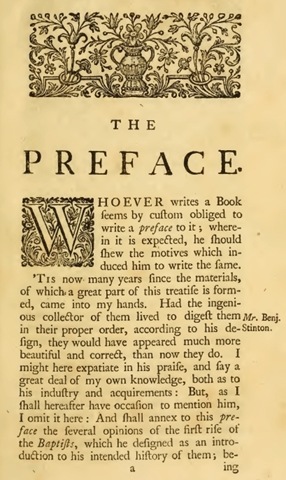 As noted in a previous post, I have been reading ‘The History of the English Baptists from the Reformation to the Beginning of the Reign of King George I,’ by Thomas Crosby. I have also been adding this work to my website (a link to this book appears at the end of this post).
I have now completed reading and adding the preface, table of contents and part of the first chapter.
The preface covers the period from the early church through to the first Baptists in England, tracing the origins of the Baptists and disproving their rise to that of the Anabaptists at Munster and the disaster that occurred in that city as a result of the Anabaptist rebellion.
Though a lengthy preface, it briefly touches on such as the Albigenses, the Waldenses, Wickcliff, Donatists, etc. Crosby goes back through history, from the reformation to the first century finding evidence of Baptistic beliefs and practices. It is a very interesting study, even though it is brief. Another interesting aspect of this study is the evidence for early Baptistic existence, even in the writings of Paedobaptist authors and the evidence against the early practice of infant-baptism in the early church.
To read the preface and further, please follow the link below:
http://particularbaptist.com/library/Crossby-Thomas_Vol1_HistoryEnglishBaptists_contents.html
By Melchior Kirchhoffer
 This book by Melchior Kirchhoffer seems to be an honest dealing with the life of the sometimes volatile Reformer. William Farel was a man greatly used of God in his own right, but his greatest contribution to the Reformation within the Providence of God, was to convince John Calvin to go to Geneva and head the work of reformation in that city. Through this meeting with Calvin, Farel brought the greatest of the Reformers out of relative isolation and into far greater public usefulness.
Kirchhoffer follows Farel from his early days in the Roman communion, to his days as a faithful servant of God used tremendously in the work of reformation in and about Switzerland.
This is a very easy book to read and gives a very good account of Farel’s life and work. It does not gloss over the weaknesses of the Reformer, clearly detailing what they were and the impact they had upon his ministry. Neither does it gloss over the contribution that Farel made to the progress of the Reformation.
To follow my progress in getting this work online and to read the book itself, visit:
 At the BookShelf