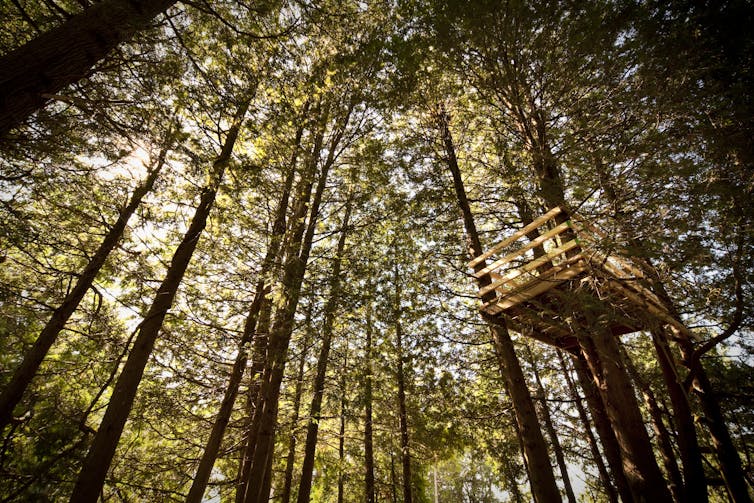
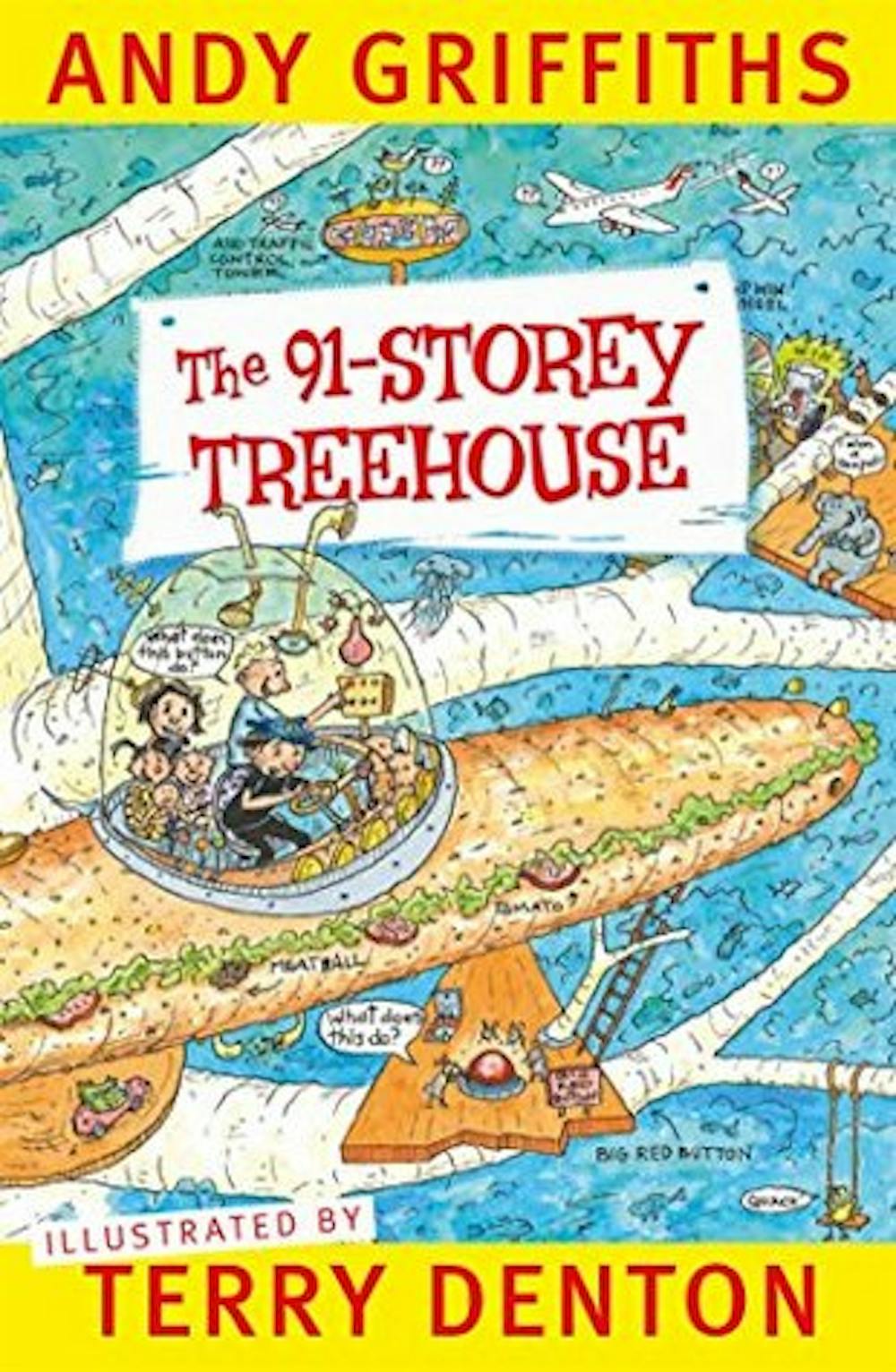
Two of Australia’s most popular children’s storytellers live in a treehouse. It’s a Thirteen-Storey one, at least it started out that way. The storytellers are Terry Denton and Andy Griffiths, responsible for an array of children’s comedies, who live in a fantasy treehouse paradise. There they write and illustrate their stories, distracted by the lemonade fountains, see-through shark-infested swimming pool and a marshmallow gun that shoots directly into your mouth.
Since its arrival on the literary scene in 2011, this Treehouse has grown by 13 storeys at a time. The next edition will be 104 storeys. The books have sold over 3 million copies in Australia alone. The treehouse now contains a detective agency, a mashed potato and gravy train and a machine that makes money… or honey… depending on what you’d prefer. These delights interrupt Andy and Terry as they write for their publisher, Mr Bignose. Indeed the treehouse functions as a metaphor for the writing process … its storeys provide food for the stories produced inside.
Treehouses feature often in children’s stories. In Dav Pilkey’s popular Captain Underpants series, the heroes George and Harold write comics in their treehouse and retreat to it when things get out of hand, to regroup and create their way out of trouble. There are, of course, Tolkien’s Ents, the walking trees who fight on the side of good against Sauron and his army. Or Dr Seuss’s Lorax, who guards the Truffula trees from devastation. Ents and the Lorax are guardians of the ecosystem. When they act we know that something is badly out of kilter – in these cases in the fight between good and evil.
Mention Enid Blyton’s Faraway Tree stories, meanwhile, and many a grown-up gets misty-eyed. Mary Pope Osborne’s Magic Tree House series has been going strong for 25 years, and has nearly 100 titles. Carter Higgins’s Everything You Need for a Treehouse helps you get kitted out for your own woodland home. And mythology is full of trees.
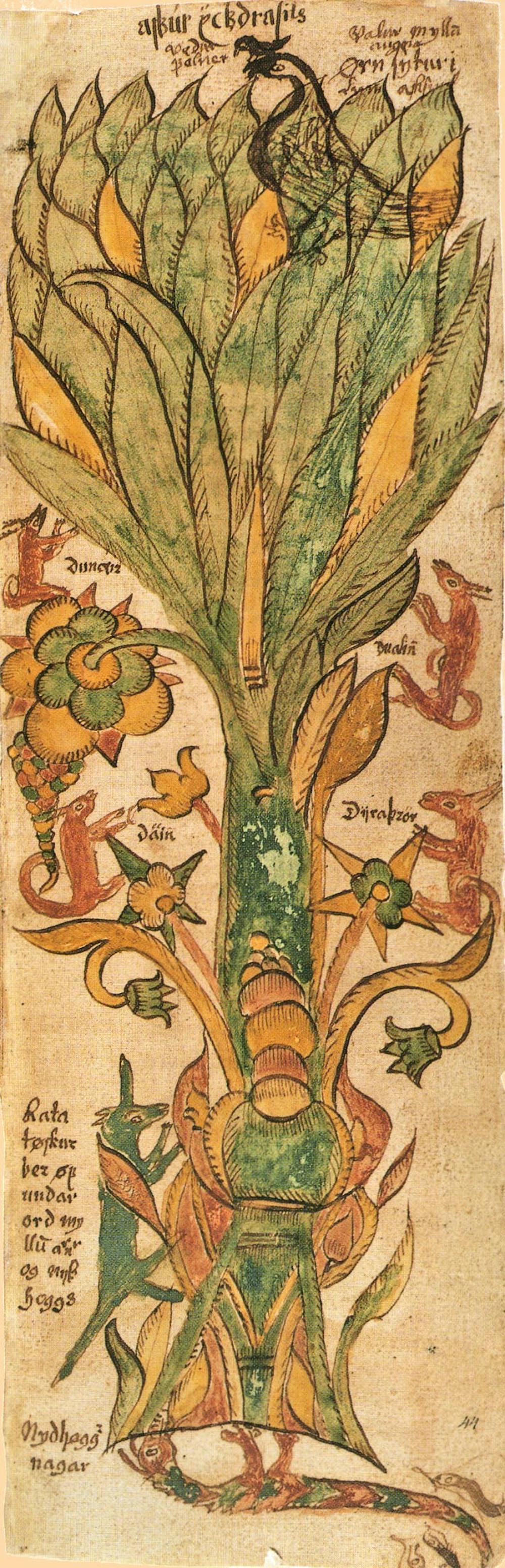
The World Tree in a 17th century Icelandic manuscript. Wikimedia Commons
The World Tree of ancient Norse mythology, Yggdrasil, is similar to the thirteen-storey treehouse, linking the nine realms of the world (of fire, of ice, of elves, of gods, of fertility, of giants, of dwarves, of humans, and of the dishonorable dead). In Ovid’s Metamorphoses, when King Eresichthyon of Thessaly cut down the Greek Goddess Demeter’s favourite oak tree she teamed up with her sister Fames to torment him with a hunger so eternal that he eventually ate himself.
So it’s not surprising that living in the trees gives Andy and Terry and George and Harold access to fantasy spaces, and to magic and mystery. A technical term for this is liminality: in a liminal space, you are on the borders of things, or thresholds (the word come from the Latin for threshold, limen). If you live in a tree, you are up in the air, but connected to the earth.
At heart, most myths respond to fundamental practical needs. Tree house stories recognise that children need time in nature. For generations of urban children, these books offer a fantasy of unsupervised creative spaces where they can control their own adventures, face dangers that test them and engage with others in a less restricted way.
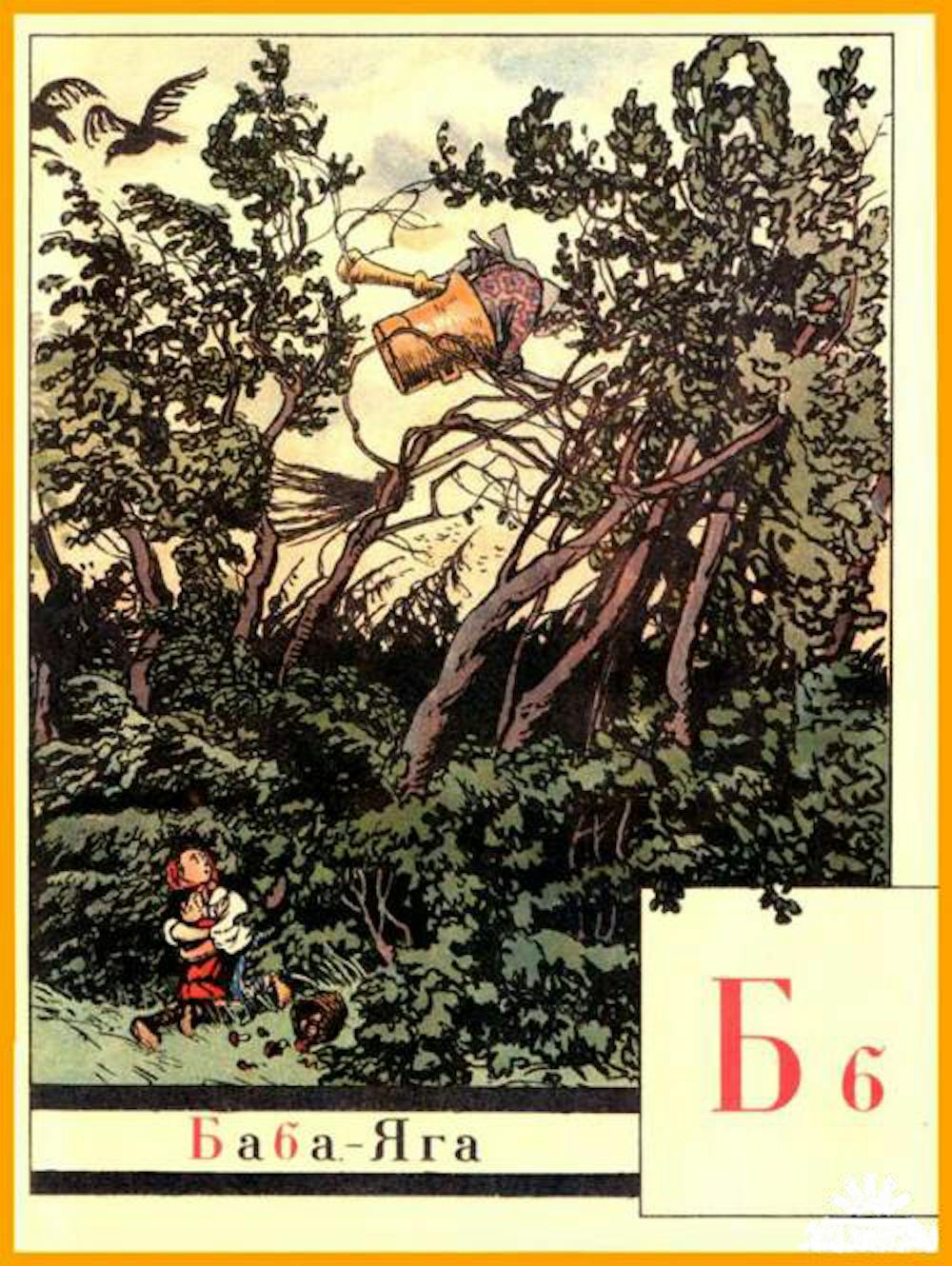
Baba Yaga by Alexandre Benois. Wikimedia Commons
In Vitamin N: The Essential Guide to a Nature Rich Life (2016), author Richard Louv coined the phrase “Nature deficit disorder” to describe the human costs of alienation from the natural world. Opportunities for play in nature have dramatically declined in urbanised societies and with them, benefits such as creativity, problem-solving and emotional and intellectual development.
Writers like Denton and Griffiths recognise the child’s need for nature. So does Tina Matthews, in whose Waiting for Later a tree provides company for a child whose family is too busy to spend time with her. And so does mythology which regularly takes characters into nature, to confront, to challenge or to come to terms with life.
While the Thirteen-Storey Treehouse may not be directly inspired by Yggdrasil or Demeter’s Oak, or hop about like Baba Yaga’s hut, it understands the relation between creativity and time in the woods, taking part in a grand literary tradition that goes as far back as myth itself.
The children’s writer Michael Morpurgo has written a new novel inspired by his autistic grandson, which is set to be published later this year. Flamingo Boy is set in the Camargue in the south of France during World War II and features a boy who “sees the world differently”.
Morpurgo explained how it didn’t occur to him to write a book about autism until his grandson was born, which isn’t totally surprising – as autistic characters in books are few and far between.
Fiction plays a significant role in shaping how people understand and respond to autism. And in this way, books are often used by both schools and parents to help children and young people understand more about autism.
But the limited and skewed portrayal of autism means it is often
misrepresented rather than represented in fiction. For an autistic child or young person this can be extremely isolating and they are often unable to find a version of “themselves” in a book.
There aren’t many autistic characters in children’s books. Pexels.
The sad reality is many authors and publishers – perhaps from fear of causing offence – appear to steer clear of autistic characters in their narrative. As a consequence, books with autistic characters are either tucked away in the special section of bookshops and libraries, or absent altogether.
Writing together
My research looks at the role fiction plays in creating awareness and acceptance of autism among children, as well as how the portrayal of autism in children’s books shapes how autism is understood and responded to. As part of the research, I recently put on an interactive discussion at the Festival of Social Science around the topic of how autism is portrayed in children’s fiction.
The panel included Vicky Martin, writer of M is for autism and M in the middle, and Amanda Lillywhite, writer and illustrator of picture books including Friends, written for the Neuro Foundation which works to improve the lives of those affected by neurofibromatosis – a genetic condition caused by a mutation in one of their genes. On the panel was also Elaine Bousfield, founder of new publishing house Zuntold. And the audience consisted of autistic children, young people and adults. As well as parents of autistic children, secondary school teachers, academics and the general public.
One of the key topics discussed at the event was around the idea of “co-production”. This is where books are written in collaboration with autistic children and young people – much like the M in the Middle series, which was authored by Martin, but written jointly with girls of Limpsfield Grange, a school for autistic girls.
Making magic happen
The story of M has captured the hearts of readers and already resulted in a sequel to the first book. The girls of Limpsefield Grange have also featured in an ITV documentary Girls with autism. Why? Because M is the story of an autistic teenage girl who is interesting, endearing and real.
She’s written and created with a group of teenage autistic girls. Big chunks of the book is written verbatim, with their very words, and the rest is heavily edited by them. It doesn’t get more real than that. M is the one girl they all created together.
With younger children, drawing or comic workshops might be a more accessible way of getting them to think about characters. Pexels.
Similarly, as a part of her book for the Neuro Foundation, Lillywhite spent time with children with neurofibromatosis. They spoke about themselves and their experiences of things that matter not just to them but also to many other children, such as bullying. And while all the characters in the book have the genetic disorder neurofibromatosis, the stories aren’t about that and are just as relevant for every child.
Getting heard
Autism is extremely diverse and perhaps the only way to have a good representation of it in fiction is by having lots of autistic characters – in comics, in picture books and in novels.
Publishers too have an important role to play in garnering collaborations and bringing work co-produced with autistic children and young people to market – much as in the M books. Publishing house Zuntold, for example, has an interactive novel writing project which encourages people to write the next piece.
Ultimately, every story – whether in life or fiction – has characters, and all characters are different. So given that autism affects more than one in 100 people, there needs to be more done to represent the outside world inside story books.
Millions of people have a relative on the autism spectrum. And it is only by making autistic characters a part of mainstream books that we can hope for widespread understanding and acceptance of autism.
If you think back to your childhood, what sticks with you? For many people, it’s those cosy times when they were cuddled up with a parent or grandparent, being read a story.
But bedtime stories aren’t just lovely endings to the day or a way to induce sleep, they are also a safe way to experience and discuss all sorts of feelings and situations. So even when children think they’re just being told about an adorable bunny’s adventures, they are actually learning about the world around them.
We know that children’s books can act like both mirrors and windows on the world. Mirrors in that they can reflect on children’s own lives, and windows in that they can give children a chance to learn about someone else’s life. We also know that this type of self-reflection and opportunity to read or hear about different lives is essential for young people.
Research on prejudice shows that coming in contact with people who are different – so-called “others” – helps to reduce stereotypes. This is because when we see people who initially seem different, we learn about them and get closer to them through their story. The “other” seems less far away and, well, less “otherly”.
But while it may be ideal for children to actually meet people from different backgrounds in person, if that isn’t possible, books can serve as a first introduction to an outside world.
Representing the world
Despite knowing how important it is for diversity to be represented in our day-to-day lives, many children’s books are still littered with white, male, able-bodied, heterosexual, cisgender, nominally Christian characters. And research suggests that over 80% of characters in children’s books are white – which clearly doesn’t reflect the reality of our world.
All of these reasons are why the We Need Diverse Books movement was set in motion in 2014, stemming from a discussion between children’s books authors Ellen Oh and Malinda Lo. The movement aims for more diverse children’s books to actually be created and for these works to be available to young people. And while we need people to actually write them, we also need publishers to produce them, and bookstores, libraries, and schools to stock them.
Getting diverse books into the hands of young readers. Pexels.
As someone who researches children’s literature, I think we’d have fewer conflicts in the world if we all read more diverse literature and lived more diverse lives.
I like to think that if we had more diverse children’s books, featuring a broad range of characters in many different jobs and situations, as well as more diverse role models in the media, young people would feel empowered, and they’d believe that when they grow up, they could be anyone and do anything they wanted. And they’d look at their friends and think the same for them, and they’d grow up respecting and appreciating everyone’s talents.
With this mindset present, issues such as race or religion wouldn’t even play a subconscious role. And it would mean that within a generation or two, we wouldn’t read articles about appalling and depressing statistics, and we wouldn’t need campaigns to increase diversity in literature, academia, or anywhere else.
Role models
But books aren’t just about “others”. When we see people like ourselves in the media, including in fiction, we get a glimpse of who we might become, and we feel validated. We can gain role models and inspiration through literature.
Perhaps partly in response to people’s growing awareness of the need for role models – whether in person or in literature – one young black girl, Marley Dias, started a campaign to find 1,000 “black girl books”. Dias recommends works such as Brown Girl Dreaming by Jacqueline Woodson, One Crazy Summer by Rita Williams-Garcia, Chains by Laurie Halse Anderson and I Love My Hair by Natasha Anastasia Tarpley.
But I wonder how many of those “black girl books” feature black girls in prominent roles, such as working as professors, doctors, teachers, or even as presidents of nations. I have a suspicion that the percentage would be disappointingly low.
Wanted: diverse role models. Shutterstock
Just featuring a minority character isn’t enough to create quality diverse literature, but it is a first step. And while there are some useful websites that recommend diverse children’s books and even literary awards dedicated to promoting such works, much still needs to be done.
Along with the increased worries today about immigrants, refugees, and general “otherness”, some societies seem to be headed towards a sense of false nostalgia about a time when the world was controlled by whites.
Given this is not how the world is or should be, we owe it to young readers to show them reality in the books they’re reading. Perhaps then the next generation will be less frightened of the “other” if they get to meet them and learn about them from an early age.
Gorgon: a vicious female monster with sharp fangs. Her power was so strong that anyone attempting to look upon her would be turned to stone. The Gorgon wore a belt of serpents that intertwined as a clasp, confronting each other. There were three Gorgons, and each one had hair made of living snakes.
In The Gorgon in the Gully (2010), Melina Marchetta’s delightful book for 10-12 year olds, no one has ever seen a Gorgon. But one apparently lives in a small valley near the sports fields at the school attended by a boy called Danny. When Danny looks up Gorgon on the internet, he finds the above definition. And his local Gorgon’s reputation for fierceness is only equalled by its record as a hoarder of balls.
So when Danny’s ball goes into the gully, and Simmo, the School Bully, dares him to go in after it, Danny is caught between his fear of the Gorgon, and his fear of being a “gutless wonder”.
His mother advises him to:
look at whatever you’re scared of from a different angle. Look at it up really close. Find a friend at school who’s not afraid to look at things up close with you.
Ŧhe ₵oincidental Ðandy
Which is what Danny does. Gradually, he becomes friends with Simmo, and they work together to confront the Gorgon. When they finally do, they discover it is nothing like their imaginings. Indeed it’s not a Gorgon at all. It is a gentle old man who has been wondering when the children are going to retrieve their balls. In conquering his fear, Danny conquers the Gorgon, gets his ball back and becomes known as “Gorgon-buster”.
The Gorgon in the Gully goes neatly to the core of the Medusa allegory: if fear is petrifying, one needs to know how to look at it “up close”.
And like the hero Perseus assisted by the goddess Athena, who used a reflective shield to deflect Medusa’s stare and avoid being petrified, Danny finds a way to look closely at his fears from different angles, and to overcome them.
Lurking in literature
Monsters from classical myth have been lurking in the gullies of Western literature for a long time – in retellings and adaptations, and acting as symbols and metaphors for aspects of the human experience.
They’ve been surfacing recently in fantasy for children and young adults. Imaginary Medusas, realistically drawn Minotaurs, as well as a multitude of many-headed Scyllas, Hydras and Cerberuses: they all appear in Australian children’s and YA fiction.
Why are so many contemporary writers reconnecting with the monsters of classical myth? I think it’s partly because they provide profound connections to issues of identity, coming of age, and finding one’s place in the world. These are fundamental matters in children’s literature, which aims to educate and socialise children to fit in, and also to express their concerns about the world and their place in it.
And writers are working now in a globalised context, with a rich cornucopia of referents. The mash-up culture of film, television, gaming and comic book franchises is a case in point, in which protagonists connect with figure after figure from myth and legend.
It’s fun to play with mythical beasts. And it’s interesting to connect to them as well.
Connecting with Medusa can mean confronting her monstrous powers, facing the fear she represents. It can also mean sympathising with her.
As Ovid tells it, in one version of the myth (which like all classical myth has many variants), Medusa was seduced (or raped) by Poseidon in Athena’s temple, and Athena transformed her beautiful hair into snakes as a punishment for this defilement. Like many monstrous tales in Greek mythology, it doesn’t seem fair.
Today, some Australian writers are more sympathetic to Medusa, as can be seen in The Gaze of the Gorgon (2002), by Karen R. Brooks. This is the second novel in a four-part portal fantasy in which a magic necklace takes 13 year old Cassandra Klein to Morphea, a mystical realm in which myths and fairytales are living and real. There, she does battle with the witch Hecate, who is trying to get control over this fantasy world, and who forces Medusa to use her powers to turn the Morpheans to stone.
But when Caz meets Medusa, she discovers that she is, in fact, an unwilling tool of Hecate. Together, they agree to “reverse the evil” that has been done, and give the petrified ones back their lives. This means that Caz has to kill Medusa.
Gazing at the bowed head of the Gorgon, Caz took a deep breath. ‘I am so sorry,’ she whispered. And before she could change her mind, raised the sword above her head and dropped her arms.
The Gaze of the Gorgon, by Karen Brooks. Lothian Books (2002)
Caz and her friends gather the blood spurting from Medusa’s neck, and use it to heal wounds and revive the petrified. By willingly submitting to Caz’s blade, Medea’s death-dealing monstrosity is transformed into healing powers. It’s a revisionist take on the subject that comments on and compensates for the essential unfairness of Medusa’s treatment, both at the hands of Brooks’s Hecate, and Poseidon and Athena.
Mining hidden fears
This revisionist approach, which challenges the original myths, can also be seen in treatments of the Minotaur. To summarise the famously tangled myth: it is half-bull, half-man, the product of a union between Pasiphae, the queen of Crete, and a snow-white bull sent to the King (Minos) by Poseidon for sacrifice.
Because Minos kept the bull alive, Poseidon punished the family by making Pasiphae fall in love with it. And when she gave birth to the Minotaur, King Minos had it shut away in the Labyrinth, created by the master-inventor, Daedalus. Minos demanded regular sacrifice of Athenian youths and maidens – to be sent into the Labyrinth and devoured by the Minotaur.
The Athenian hero Theseus volunteered to go. Ariadne (daughter of Minos and Pasiphae) helped him find his way in and out of the labyrinth, using a ball of thread to guide him. He repaid her by abandoning her on an island, where she was discovered and taken up by Bacchus.
Theseus killing the Minotaur in Hyde Park’s Archibald Fountain. Gord Webster, CC BY-SA
Jennifer Cook’s Ariadne: The Maiden and the Minotaur (2005) is set in ancient Greece, and tells this story from the point of view of a key player, the princess Ariadne, or Ari.
Ariadne: The Maiden and the Minotaur, by Jennifer Cook. Lothian Books (2005)
Cook’s Ari is an impatient, irreverent, lively modern teenager, highly critical of her family.
Here, Cook draws attention to the point that the Minotaur is Ariadne’s blood relation, recasting it as Ari’s little brother “Tori”, a disabled child, Pasiphae’s illegitimate son (born from an affair, but not an affair with a bull). To his family, Tori is a symbol of shame and disgrace, both illegitimate and disabled.
In Cook’s story, it’s the Labyrinth, designed to contain many vicious traps, and King Minos’ insistence on the sacrifices, that kill the Athenians not the Minotaur.
In conspiring with Theseus, Ari saves Tori, and escapes with him. Far from being abandoned by Theseus and taken up by Bacchus she finds true love elsewhere, fading out of recorded story, with satisfaction.
When I asked Cook what drove this depiction of a feisty Ariadne, she replied:
I remember hearing the Minotaur myth and wondering about Ariadne and thinking how typical it was of the Greek hero Theseus to get all of the help from her and then take all of the credit. To add insult to injury he dumps her and takes off with her sister. And her reward? To get ‘married’ (Greek myth parlance for raped) by Dionysos [Bacchus]. And yes, I did my honours degree in feminist history.
Cook’s feminism, coupled with her sympathy for the Minotaur as unwitting victim of a dysfunctional family (and also of the gods), influences her approach to the myth. In essence it is a coming-of-age story, in which Ariadne identifies the true monsters in her family. Tori stands for all that the family is ashamed of; the myth of the Minotaur stands for the lies people tell when the truth is too frightening. In caring for Tori and rescuing him, Ari demonstrates modern Australian ideas of love, justice, and empathy far different from the stark ironies of the Ancient Greek myths.
Liberating and facing the Minotaur
These modern Australian attitudes can be seen too, in Myke Bartlett’s fantasy novel for teenagers, Fire in the Sea (2012), in which a terrifying Minotaur comes to Australia on a mystical mission to restore the lost city of Atlantis to life:
All eyes were on the matted fur of his head, the exposed and bloodied teeth, and the horns. The head of a bull, the body of a man, the teeth of a lion.
Fire in the Sea, by Myke Bartlett. Text Publishing, 2012
In this story, fantasy elements intrude on the real world and have to be dealt with by the protagonist, a teenage orphan called Sadie. She faces a brutally bestial fighting machine in the Minotaur. Yet as the story unfolds, Sadie discovers the Minotaur is a slave to Atlantis’s head priestess, Lysandra, acting against its will to keep her in power.
In the novel’s end game, when Lysandra’s realm is disintegrating below the waves, Sadie confronts the Minotaur, believing she is ready to kill it. But she looks into its eyes, and sees flickers of humanity. Unable to slay the beast, she severs the chain around its neck, liberating it from servitude.
Here, Bartlett points to the tragedy of the Minotaur’s origins: as an unwitting byproduct of the gods’ and humans’ treachery, it is forced to act as a symbol of monstrosity.
The book also makes a point that life is worth the risk of death. As an orphan who has witnessed her parents’ death, Sadie is deeply afraid of dying. Letting the Minotaur go means risking that it will kill her: what she is most afraid of.
Worse things than death?
But perhaps there are worse things than death. And in Requiem for a Beast (2007), writer-illustrator-musician Matt Ottley uses the figure of the Minotaur to explore the pain of monstrous pasts, personal and national.
Requiem For A Beast, by Matt Ottley. Hachette Australia (2007)
Requiem for a Beast is the story of a young stockman who confronts his own, his father’s and his country’s past. During a routine muster, he tracks down a magnificent bull that has evaded capture. He traps it in a ravine, where it falls and is badly wounded. Knowing that if he does not act, it will die a lingering death, the boy takes his knife and kills the bull.
Coming of age can mean confronting one’s demons, coming to terms with one’s past. And as the boy reflects on his encounter with the bull, his story is told through flashbacks: to his childhood, to learning of his father’s shameful story – he had been part of a group of men who had killed a young Aboriginal boy – and reflections about the Stolen Generation.
This book is shot through with iconic Australian imagery – the big sky, the harsh but beautiful landscape, the image of the drover and the muster. And linking them to the boy’s inner drama is the image of the Minotaur.
Otley anchors this specifically to a key memory from the boy’s childhood: visiting a museum with his father, they enter the mythology room, where the father explains the myth of the Minotaur.
What was it that happened that day? Why did that strange beast follow me – out of the museum and into the rest of my life? It hunted me, tracked me through the years, and slowly drew my spirit – who I was – from me until there was nothing left.
What indeed? What is Ottley’s Minotaur? A symbol of the repressed and repression? Of the violence of Australia’s past? A symbol of the demons teenagers face as they transition from childhood to adulthood, and come of age?
The book connects classical myth to the teenage experience, and also to the iconic myths and stories of Australian culture, while considering important national issues like the Stolen Generation. It runs the risk of imposing the standards of the Western canon onto the local context (as Erica Hately points out) yet it also shows the power of classical material to open up important discussions about our own culture.
A minotaur relaxes at Bondi beach. Nicole Grech, photograph by Bentley Smith, CC BY-NC-SA
Myth in our DNA
I’ve focused here on Medusas and Minotaurs. But Australian authors explore many other mythical beasts, engaging with their entertaining, fun and scary aspects.
Chasing Odysseus (The Hero Trilogy #1), by Sulari Gentill. Pantera Press (2011)
Geoffrey McSkimming’s energetic diesel-punk adventure series, Cairo Jim, exploits the resonant power of myths from Gorgons to Satyrs. Ian Trevaskis takes children back in time to help the ancient heroes fight ancient foes in Hopscotch: Medusa Stone.
Terry Denton finds the more cuddly aspects of the Minotaur in The Minotaur’s Maze (2004), while Phillip Gwynne turns Cerberus, the three-headed guard-dog to the underworld, into a computer program in Bring Back Cerberus (2013). And in The Zoo of Magical and Mythological Creatures (2009), Sam Bowring’s hero, Zackary, becomes the keeper of a whole zoo of magical creatures.
Sulari Gentill’s Hero Trilogy retells Homer’s Odyssey from the point of view of a girl called Hero. When I asked Gentill what it was about classical myth she thought connected to young readers, she said there was an engaging familiarity to them:
I suspect that there is a kind of DNA that classical/ancient myth has contributed to all the stories that have come after them in Western literature. Consequently there’s a strange familiarity to them even if one has never heard the particular legend before. They add to our appreciation of new stories and we feel a connection even if we don’t know why.
We might think that Medusa and the Minotaur are buried in the past. But they surface in the present surprisingly often: testing our bravery; challenging our ideas about monstrosity and danger; and revealing the continued influence of classical antiquity, and its power in literature for our young readers.


 While the Thirteen-Storey Treehouse may not be directly inspired by Yggdrasil or Demeter’s Oak, or hop about like Baba Yaga’s hut, it understands the relation between creativity and time in the woods, taking part in a grand literary tradition that goes as far back as myth itself.
 Millions of people have a relative on the autism spectrum. And it is only by making autistic characters a part of mainstream books that we can hope for widespread understanding and acceptance of autism.


 At the BookShelf