
The link below is to an article that looks at 3 reasons to hold onto a book.
For more visit:
https://bookriot.com/2019/01/26/reasons-to-hold-onto-a-book/

The link below is to an article that looks at 3 reasons to hold onto a book.
For more visit:
https://bookriot.com/2019/01/26/reasons-to-hold-onto-a-book/
The link below is to an article that takes a look at how to introduce children to books and getting them into reading.
For more visit:
https://momlovesbest.com/reading-for-kids
Claire Squires, University of Stirling
People across the global book trade have been engrossed by a ripe scandal engulfing one of their own – publisher-turned-author Dan Mallory, whose novel The Woman in the Window was one of the runaway bestsellers of 2018. One tweet summed up the buzz:
The comment from the literary agent Laura Williams refers to a lengthy article in the New Yorker about Mallory, who writes under the pseudonym A J Finn. As the headline explosively proclaimed, Mallory’s life “contains even stranger twists” than his fiction.
These twists, according to the New Yorker, include repeated lies: about his mother’s death from cancer, his own cancer diagnoses, an Oxford PhD, a job offer from a rival publishing company which leveraged promotion. He also, the article suggests, may have impersonated his brother, sent abusive emails, and – most curious of all – left plastic cups of urine in the New York office of his boss (“messages of disdain, or … territorial marking”, speculated the New Yorker – although it went on to quote a spokesperson for Mallory saying he hadn’t been responsible for that).
The article is careful to present evidence for these revelations via both named and anonymous sources, or to state that certain allegations are unproven. The revelations are either denied by Mallory, or blamed in a statement on “dissembling” produced by severe mental illness.
Even more curiously, Mallory’s uncompleted PhD focused on Patricia Highsmith, author of The Talented Mr Ripley – that twisty tale of a man who murders and then impersonates another. His own The Woman in the Window presents its readers with an unreliable first-person narrator who witnesses – or does she? – a crime.
An unreliable narrator – and an unreliable author? Literary liars and impersonators weave their tales through publishing history. Remember the “memoirs” of James Frey, A Million Little Pieces, which presented as fact made-up scenes of drug addiction and alcoholism?
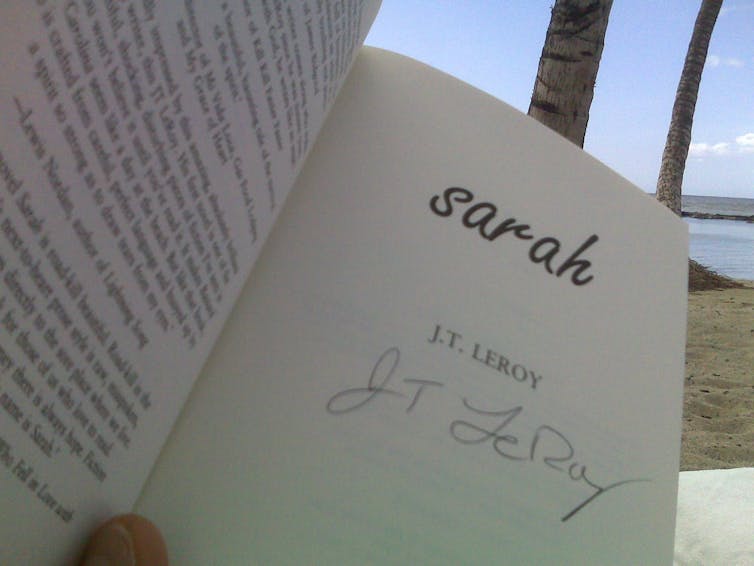
Fiction-writing fraudsters also abound: prize-winning Australian Helen Darville falsely presented herself as the Ukrainian “Helen Demidenko” and wore peasant blouses ti publicise her book: The Hand That Signed the Paper. Meanwhile JT LeRoy’s novelised tales of an abusive boyhood turned out to be entirely invented, their author represented in public by a (possibly) transgender impersonator.
Mallory joins an infamous line of literary hoaxers, then. But what might this torrid tale tell us about the mental and physical health of the publishing industry?
Social media commentators quickly identified an issue beyond the tricksy questions of truth and lies: that of Mallory’s rapid career trajectory. A “Waspy” family background was polished by an elite US college education, employment at a New York publisher, postgraduate studies at Oxford, a London publishing job and promotion. Then back across the Atlantic to a $200,000 salary and a book deal brokered through his professional networks.
As one much-retweeted comment put it, alongside all the tawdry revelations of the story, it also spoke volumes about the problematic pattern of publishing career paths.
The New Yorker has multiple accounts of how Mallory seemingly charmed writers and fellow publishers, and there’s no implication – other than light borrowing of plots and characterisation – that his writing is not his own. Good looks operated alongside that charm, until the beguilement revealed its multiple deceptions. But the question of how to get ahead in publishing, and those who get to make such rapid ascents, remains.
Publishing and the literary world have serious issues of access and inclusion. The roughly equal number of men and women in board positions in UK publishing does not represent the preponderance of female staff lower down company hierarchies – about 66-80% of people in the industry are women, surveys variously report.
Unsurprisingly this glass ceiling creates a gender pay gap: 16% in 2017 and some even worse figures in 2018’s mandatory reporting from larger companies. Publishing also has its sleaze and #MeToo claims.
In terms of ethnic diversity, a 2018 UK Publishers Association survey showed the BAME workforce of publishing to be under 12%. This is marginally below the 2011 census figure of 13% in England and Wales, but it’s far below the 40% of London, where UK publishing is highly centralised (itself presenting issues of regional diversity).
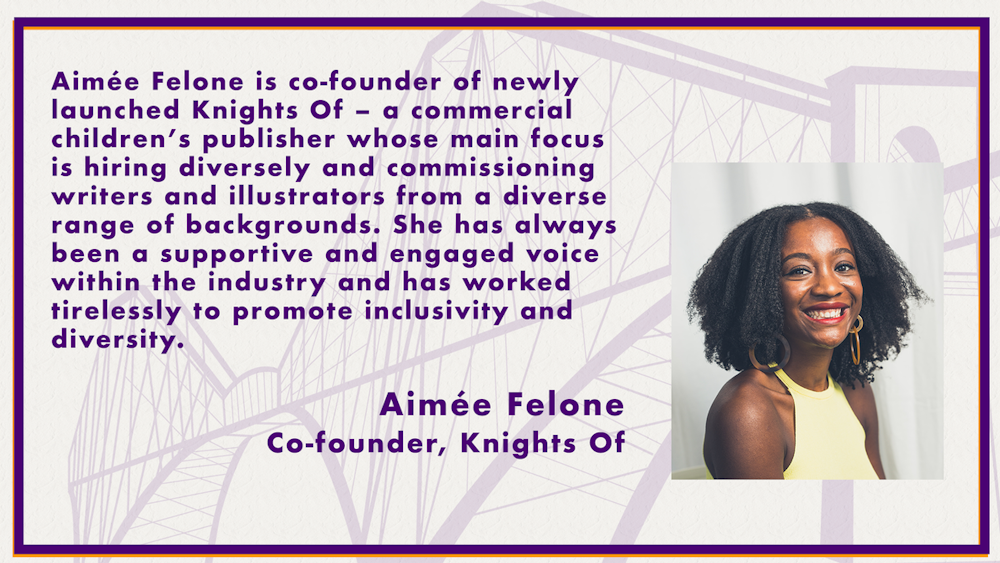
Repeated surveys have demonstrated publishing’s diversity deficit. Scholarship from Anamik Saha and Melanie Ramdarshan Bold focuses on the challenges of cultural production for writers of colour. Over a period from 2006-2016, Ramdarshan Bold identified, only 8% of young adult books published in the UK were by writers of colour.
Like other creative industries, publishing is a middle-class activity, with working-class publishers and writers frequently recounting stories of prejudice and cultural condescension – eg. in publisher Laura Waddell’s Nasty Women chapter, and in Dead Ink’s anthology of working-class essays Know Your Place.
The 2018 report Panic! Social Class, Taste and Inequalities in the Creative Industries shows publishing’s class demographic to be “especially grave”. Less than 13% of publishers are from working-class backgrounds, while more than 33% have upper middle-class origins.
Such individual and statistical accounts of exclusion demonstrate why the wild story of one already-privileged individual bluffing his way higher and higher up the publishing echelons has caused so much consternation. If the story is true, Mallory repeatedly fooled university admissions offices and publishers’ employment processes. But what employment practices enabled him to rise, even when his story had started to unravel? And how did his apparent charm and good taste enable him to fail upwards? The answers to these questions remain in a dysfunctional swirl of rumour, anonymous sources, non-disclosure agreements and myth-making that probably won’t hurt Mallory’s book sales.
But there are wider systemic and institutionalised issues at play here: the urine scent-marking in the editor’s office (whether proven to be Mallory or not) is a metaphor for the regimes of value in operation within publishing. There is a mystique about taste – a whiff of privilege – that prevails unhelpfully and often prejudicially in the publishing industry. Such inequitable practices govern which hot new literary property we pick up next.
Claire Squires, Professor in Publishing Studies, University of Stirling
This article is republished from The Conversation under a Creative Commons license. Read the original article.
The link below is to an article that takes a look at a Medieval book that opens 6 ways in order to read 6 different texts.
For more visit:
https://boingboing.net/2019/01/09/dos-a-dos-x6.html
The link below is to an article that takes a look at decluttering books – yes, it is yet another.
For more visit:
https://www.theguardian.com/books/shortcuts/2019/jan/08/are-books-clutter-marie-kondo-advice-give-them-away
The link below is to an article that takes a look at where to donate those unwanted/no longer needed book. The article is more for the USA, however, there are some ideas that are relevant elsewhere as well.
For more visit:
https://www.epicreads.com/blog/where-to-donate-books/
The link below is to an article that looks at decluttering books – yes, another one.
For more visit:
https://www.latimes.com/books/jacketcopy/la-ca-jc-goodbye-stuff-books-20170511-htmlstory.html
The link below is to an article that takes a look at letting go of books. This all seems a little unsettling to me 🙂
For more visit:
https://www.readitforward.com/essay/article/let-go-of-your-books/
The link below is to an article that provides 8 ideas for what to do with unwanted books.
For more visit:
https://bookriot.com/2019/01/10/repurpose-unwanted-books/
Dominique Boullier, Sciences Po – USPC; Mariannig Le Béchec, Université Claude Bernard Lyon 1, and Maxime Crépel, Sciences Po – USPC
We stand amazed by the vitality of printed books, a more than 500-year-old technique, both on and offline. We have observed over the years all of the dialogue which books have created around themselves, through 150 interviews with readers, bookshops, publishers, bloggers, library assistants, 25 participant observations, 750 responses to an online questionnaire and 5,000 mapped sites in France and the francophone world. An impressive collective activity. So, yes, your book carries on living just by staying on your shelf because you talk about it, remember it, and refer to it in conversation. Even better still, you might have lent it to a friend so that she can read it, perhaps you have spent time with people who have spoken about it before buying it, or after having read it. You will have encountered official reviews, of course, and also blogs about it. The conversation goes on even when the book is no longer in circulation.
What first struck us was the very active circulation of books in print, compared with digital versions which do not spread so well. Once a book has been sold either in a bookshop or through an online platform, it has multiple lives. It can be loaned, given as a present, but also sold on second-hand, online or in specialist shops. And it can go full circle and be resold, such journeys made in a book’s life are rarely taken into account by the overall evaluation of the publication.
The application Bookcrossing allows you to follow books that we “abandon” or “set free” by chance in public places so that strangers take possession of and, then, you hope, get in touch to keep track of the book’s journey. Elsewhere, the book will be left in an open-access “book box” which have popped up across France and other countries. Some websites have become experts in selling second-hand books like Recyclivre, which uses Amazon to gain visibility.
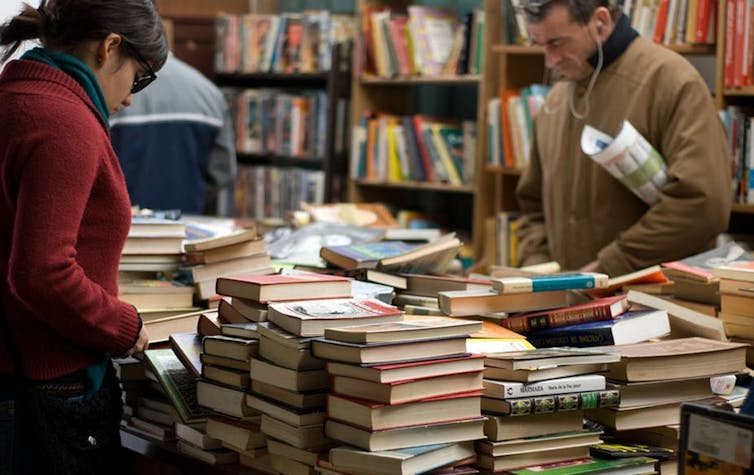
Yard sales, antiques fairs, book markets give a new lease of life to countless books which remained forgotten because they were a quick one-time read. The book as a material object, regardless of its age, retains an unequalled sensorial pleasure, and brings with it special memories, bygone times, a sacred piece of craftsmanship with its fragile bindings, or, the nostalgia offered by children’s books or fairy tales.
Whole professions are dedicated to the web, and increasingly so, since it first came into existence. This has turned the second life of books and the recycling of them into a money-making machine for online retailers, and as a result books are kept alive. Some people have become eBay sellers, experts only thanks to the books they sell on this platform. Sometimes even, these books’ lives are extended by charity shops, such as Oxfam. At some stage however, there is only the paper left to give a book its value, once it has been battered and recycled.
One would have thought that faced with the weight, volume, and physical space occupied by books in print, that the digital book ought to have wiped the floor with its print counterpart. This has been the case with online music, for example, which practically handed a death sentence to the CD, or for films on demand which have greatly shrunk the DVD market. However, for books, this simply has not happened. In the United States like in France, the market for online books never surpasses the 20% mark of the sales revenues of books in print. And that is without including the sales revenue of the second-hand book market as we previously mentioned. The digital book seldom goes anywhere once purchased, due to controls imposed on the files by digital-rights management (DRM) and the incompatibility of their formats on other digital devices (Kindle and others).
Our interviews revealed the pleasure of giving books as presents, but also of lending them. The exchange of the physical item with its cover, size and unique smell bring much more satisfaction than if a well-meaning friend offers you digital book files on a USB stick containing… a thousand files already downloaded! Indeed, the latter will seldom ever be considered a present but rather a simple file transfer, equivalent to what we do several times a day at work. This also gives rights holders reasons to thus decry “not paying is theft”, in this case the gift of files would also become theft.
Bloggers who exchange books as presents (bookswapping) show that goodwill prevails and puts stress on the backburner. This is done on the condition that the book is personalised in some way: a poignant quote, a meaningful object associated in some way with the book (cakes for example!), and the surprise of receiving a completely random gesture of kindness.
What travels even better than books are conversations, opinions, critiques, recommendations. Some discussions are created within or around reading groups or in dedicated forums online such as the Orange Network Library, for example. There are recommended reading lists, readers’ ratings, and book signings with authors are organised. These networks are digital, but they existed well before the Internet, and they remain dynamic today.
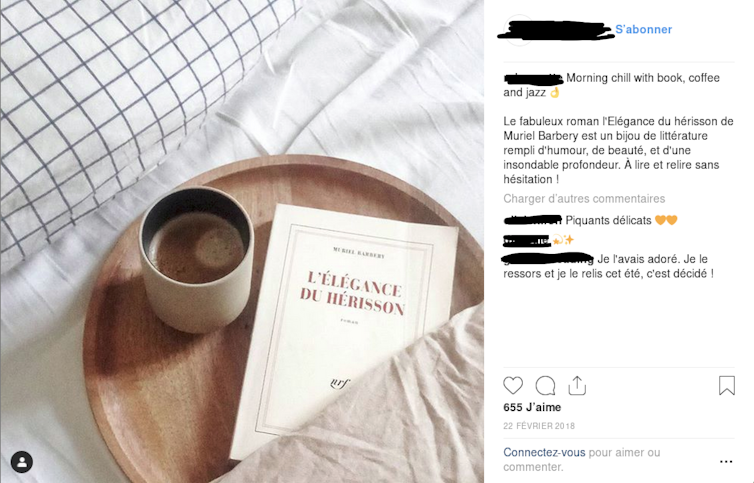
However, the rise of blogs at the start of the 2000s led to an increase in the number of reviews by ordinary people. This provided visibility, even a reputation for some bloggers. Of course, institutional and newsworthy reviews continue to play their role in guiding the masses, and they are influential prescribers protected by publishers. But websites like Babelio, combine a popular expertise, shared and distributed among many bloggers who are sometimes very specialised themselves. The website was created in 2007 and has over 690,000 reader members.
The proliferation of content and publications can easily disorientate us; the role of these passionate bloggers, who are often experts in given literary fields, becomes important because they are “natural” influencers one might say, as they are the closest to the public. However, some publishers have understood the benefits of working with these bloggers, especially in so far as concerns specialist genres like manga, comics, crime novels or youth fiction. Sometimes a blogger, YouTuber and web writer is published like Nine Gorman.
Some bookshops contribute even more directly in coordinating these bookworms, they “mould” their audience, or at least they support the books both online and in their shops with face-to-face meetings. Conversation is a unifying force for fans who are undoubtedly the best broadcasters across a broad sphere.
Platforms encourage readers to expand their domain, in the guise of fanfictions, which are published online by the author or his readers. The relationship with authors is closer than ever and is much more direct, the same can be said of the music industry. On particular platforms like Wattpad, texts which are made available are linked with collective commentary.
But above all, the dialogue about reading has often been transformed into writing itself. It might be published on a blog and may be likened to authorial work but at the other end of the spectrum, it might be something modest like the annotations one leaves in their own book. These annotations, more common in non-fiction texts, can form a sort of trade. For example if you lend or sell on a book, which is also stocked and shared with the online systems of Hypothes.is, it allows any article found on the web to be annotated, and the comments saved independent to the display format of the article. This makes it easier to organise readers into groups.
Printed books have in fact become digital through the use of digital platforms which allow them to be circulated as an object or as conversations about the book. The collective attention paid creates a permanent and collaborative piece of work, very different to frenetic posts on social media. Readers take their time to read, a different type of engagement altogether to social media’s high frequency, rapid exchanges. The combination of these differently paced interactions can, though, encourage one just to read through alerts from social media posts then followed by a longer form of reading.

Networks formed by books constitute as well a major resource for attracting attention. This is still not a substitute for the effects of “prize season” which guides the mass readership, but which deserves to be considered more critically, given the fact that publishers increasingly take advantage of these active communities.
It would thus be possible to think of the digital book as part of the related book ecosystem, rather than treating it as just a clone. To call it homothetic, is to say that it is an exact recreation of the format and properties of the book in print in a digital format. Let’s imagine multimedia books connected to, and permanently engaged with, the dialogue surrounding the book – this would be something else entirely, affording added value which would justify the current retail price for simple files. This would therefore be an “access book” and which would perhaps attract a brand new audience and above all it would widen this collective creativity already present around books in print.
Dominique Boullier, Mariannig Le Béchec and Maxime Crépel are the authors of “The book exchange: Books’ lives and readers’ practices.”
Dominique Boullier, Professeur des universités en sociologie, Sciences Po – USPC; Mariannig Le Béchec, Maître de Conférences en Sciences de l’Information et de la Communication, Université Claude Bernard Lyon 1, and Maxime Crépel, Sociologue, ingénieur de recherche au médialab de Sciences Po, Sciences Po – USPC
This article is republished from The Conversation under a Creative Commons license. Read the original article.
 At the BookShelf
You must be logged in to post a comment.