If there is any difficulty in reading what I write it is because of the material I use. In my case the thought is always simple.
“Difficulty” is an understatement for the reader’s experience of the bewildering Ulysses, with its notoriously experimental styles and form, extravagantly wrought language, and approach, in which nothing is “stupidly explained” – a stance that the young Joyce had praised in his idol, Norwegian playwright Henrik Ibsen.
A 1922 portrait of James Joyce. shutterstock
Declan Kiberd’s book Ulysses and us: The art of everyday living explores the somewhat generous proposition that Ulysses is a “book of wisdom” about the everyday world. The key to understanding the genius and richness of Ulysses, I suggest, is Joyce’s inspired “simple” thought of interjecting into this “one day in the life” of a city — its smells and sounds, its sandwichboard men, jingling brass bed quoits, gorgonzola cheese and burgundy, its trams and pubs — an epic apparatus of correspondence that draws us to explore the vast canvas of the work.
By “correspondence”, I mean where one element – say an object, sensation, or cognition – resonates with another, forging a meaningful connection. The most overt form of this is the referencing of Homer’s Odyssey throughout the novel’s 18 episodes. Homer tells the story of Odysseus (the Roman form of this name being “Ulysses”), a guileful Greek warrior, and his epic adventures throughout the Mediterranean region on his way home to Ithaca, to be reunited with his kingdom, his constant wife Penelope (whose virtue is besieged by suitors), and his son Telemachus.
goodreads
The correspondences between this story and a rather uneventful day in Dublin are by no means self-evident. Odysseus’ counterpart in Ulysses, Leopold (Poldy) Bloom is an advertising salesman who leaves home to go to a funeral, and to work, in the knowledge that his wife Molly (Penelope) intends to have an affair that day with Blazes Boylan. Meanwhile, the young poet and intellectual Stephen Dedalus is living a somewhat bohemian life in the Martello Tower with the blasphemous, garrulous, amusing Buck Mulligan. The paths of Dedalus and Bloom cross during the day and night until they meet and have a wide-ranging conversation. Bloom takes care of a now drunken Stephen, and invites him home to stay the night.
The correspondences then, do not necessarily entail finding similarities between everyday life and the epic, but they can evoke connections and comparisons that lead us to reflect. The effect is often comic (Odysseus, participant in the great siege of Troy is reduced to Bloom besieging potential advertisers), in a book of which Joyce said “there is not one single serious line in it”, but some correspondences resonate deeply.
For instance, Poldy misses his natural son Rudy, whose death has badly affected his marriage. Stephen (corresponding to the son Telemachus) resembles his literal father rather too much: the verbally inventive, intemperately drinking Simon Dedalus. He could perhaps use the tempering touch of caring, practical-minded Bloom. And even a marriage marred by infidelity is, in Ulysses, something to celebrate. Learning how to read Ulysses also leads us to read human experience in ways that defy conventional expectations.
Dirt for art’s sake: Ulysses’ reception
Ulysses’ electrifying novelty polarised opinion from the outset. After it was published by Sylvia Beach in Paris in 1922, T.S. Eliot called it the
most important expression which the present age has found; it is a book to which we are all indebted, and from which none of us can escape.
Many readers were unprepared for the strong language, detailed attention to bodily functions, including female orgasm, and Molly Bloom’s uninhibited discourse. Not only does this modern-day Penelope defy the Homeric virtue of constancy, but she revels in her transgression: (“yes and damn well fucked too up to my neck nearly”). For many, including those who had read the book only partly or not at all, it was chaotic, formless, or as Joseph Brooker notes, a latrine, a “phone book”, a desert “as dry as it is stinking”.
First published by The Little Review, in serial form, it was the subject of an obscenity trial and was banned in the USA, then the UK. In 1933, however, Justice Woolsey’s decision in the US District Court observed that Ulysses was not “dirt for dirt’s sake”.
In Australia, the news that it was obscene, and the news that it was not, took longer to break. The Brisbane Courier Mail of 19 September 1941 claimed that “after being freely available to the public of Australia for the last 20 years”, Ulysses had been “banned by the Minister for Customs”. The ban was not overturned until Gough Whitlam’s 1972 accession to power. (Gough once gave a copy of the banned book to his wife.)
A damaged love story
Bloomsday in Dublin, 2011. William Murphy/flickr
One of Joyce’s enduring creations is that of a community of people worldwide who meet to read, discuss or dramatise Ulysses each June 16. Ulysses is not only Joyce’s time capsule of Dublin on that day in 1904, but a monument to his beloved partner Nora Barnacle. It was on June 16 1904 that Nora first “walked out” with Joyce, and administered what he described to her in a letter as a sexual “sacrament”. Later that year they eloped in self-proclaimed exile to the Continent.
However, on a rare return trip to Dublin five years later, Joyce’s friend Vincent Cosgrave hinted that he had enjoyed Nora’s favours before Joyce did. Joyce, agonised with doubt, was shattered. Ultimately a good friend, J.F. Byrne, reassured him that the story was untrue. Years later, Joyce assigned Byrne’s address to Bloom: 7 Eccles Street. Joyce’s crisis of faith over Nora’s fidelity had, somewhat masochistically, inspired the central event of Ulysses. And indeed, Peter Costello’s thoughtful biography of Joyce suggests that Cosgrave’s boast was not necessarily empty.
A Dublin Martello tower. David Jones/shutterstock
The “plot” of Joyce’s epic is otherwise just two cartographer’s lines, the intersecting paths of Bloom and Joyce’s alter ego Stephen Dedalus. Dedalus believes himself cast out of the Martello tower by flatmate Buck Mulligan, and surrenders the key to him. Bloom forgets his key. Both are symbolically usurped; Dedalus does not know where he will spend the night.
The first six episodes of Ulysses follow firstly Dedalus’ and then Bloom’s mornings, using internal monologue to reveal the protagonists’ thoughts. In later episodes, the structure, language and logic of the writing itself undergo a dizzying series of experiments. These developments constitute Joyce’s own “Odyssey of Style”, which takes the reader on a wild ride.
The seventh, breakout chapter for instance, “Aeolus”, is centred on the offices of the Freeman’s Journal and Evening Telegraph. Aeolus is associated with the Greek god of the winds, whom Joyce mischievously associates with the art of rhetoric. This was set out in a table of correspondences for each episode that he used to explain his design to a mystified public. Aside from the preponderant gossip and banter, in this episode both great oratory and nauseatingly flowery writing receive extended attention — the latter to hilarious effect, as Simon Dedalus and other layabouts damn the purple prose splenitively before, parched by their exertions, inevitably adjourning to the pub.
A panoply of rhetorical devices is employed in the episode, which is punctuated by a series of newspaper-style captions or sub-heads, and incorporates multiple references to air flow, as various blowhards in the offices shoot the breeze or, in the case of declining lawyer J.J. O’Molloy, seek to “raise the wind”: ie, borrow some cash.
But what is most impressive in this episode is how Joyce extracts meaning through adroitly signalled chains of correspondence that, in the political climate of 1904, make pointed connections between Ireland’s history of subjection (symbolised in Nelson’s Pillar and the GPO, from which “His Majesty’s vermilion mailcars” circulate), and her nationalistic aspirations. Chillingly, the episode is set at the time (12 noon) and place of the 1916 Easter Uprising. A gloomy proclamation by editor Myles Crawford, “We’re the fat in the fire” proves prophetic. Indeed, these offices did burn in 1916. Joyce had begun planning this episode in 1917.
Following episodes include a parodic history of English literature (“Oxen of the Sun”) and a phantasmagorical absurdist drama set in seedy Night-Town (“Circe”) where even objects such as gongs, soap and gas jets get speaking parts. Impressively, Joyce even wrings poetry and beauty out of an apparently technical and scientific mock catechism (“Ithaca”), which includes an inventory of seemingly every Bloom possession.
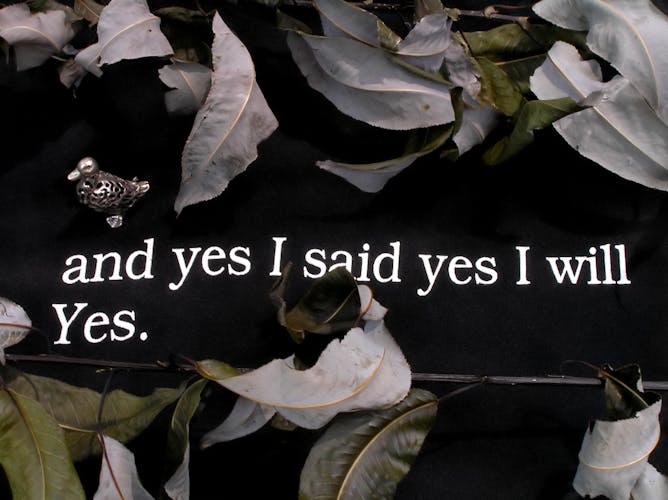
The last line of Molly’s famous monologue. greg/flickr, CC BY
Lastly, there is the justly famous tour de force of Molly’s unpunctuated stream of conscious monologue (“Penelope”), the subject of countless memorable rehearsed readings in Bloomsday activities. “Penelope” is an epic in its own right, in which Molly reviews her day, past lovers, Poldy himself. Molly is accorded the last word.
Ulysses by correspondence
Joyce likely derived his principle of correspondence from multiple sources, although he adapted it to his own purposes. His early interest in mystical and hermetic philosophy followed the loss of his fervent Catholic faith. Two early influences on Joyce were the poet William Blake and the Swedish philosopher and theologian Swedenborg. Both were interested in the idea of correspondence between the material and divine realms, and the spiritual principle that earthly conditions reflect higher realms.
Bloom expresses a parallel idea in a passage from the “Calypso” episode, where he visits the pork butcher to buy a kidney for breakfast.
Leaving the shop, Bloom responds to an everyday object:
Watering cart. To provoke the rain. On earth as it is in heaven.
Mysteriously, the very next line records that
A cloud began to cover the sun slowly, wholly. Grey. Far.
Even mundane experience need not be meaningless. Take for example, the references to meat in “Calypso”. In Homer, Calypso is the goddess who detained Odysseus on her island for years for her carnal pleasure. For Bloom, the sight of sausages in the butcher’s window is answered by his desire to perv on the “hams” of the next door girl, whom he in turn associates with a tattered religious garment, a scapular, “defending her both ways”. For Joyce, church and policing are closely linked; both are in the confession business. Bloom now indulges in a memory, or fantasy, of the girl enjoying a cuddle with a policeman in Eccles Lane: “They like them sizeable. Prime sausage.” Later, his disparate musings on meat link us to universal themes of sex, death and advertising.
Sausages invoke a reverie on sex, religion and death. Shutterstock
As a young man, Joyce had read Lamb’s The Adventures of Ulysses and was attracted to its supernatural elements. Ulysses is punctuated by curious parallels between Bloom and Dedalus, and various synchronicities: Poldy thinks about Blazes Boylan, who immediately appears; Stephen, who has complained about Ireland’s three masters, in a later scene turns his head back suddenly to see a three-master ship. These are not the contrived coincidences of Dickens but realistic experience, attended to in the spirit of wonder.
Bloom in wonderland
Ulysses is a feast of a book. The walls and the streets echo with laughter, song and banter. The life lived in the shops and pubs and workplaces, the décor, the clothes, the advertising signs and appliances, is brought back to life in these pages, filtered through the minds of artistic Stephen and scientific but “wonderstruck” Bloom. “Wonder” is one of Bloom’s favourite words; there is much to wonder at.
Ulysses captures the life of a city. Jaclin/flickr, CC BY-NC
In the first episode, Stephen stands at the stairhead on the tower, haunted by visions of his dead mother:
Buck Mulligan’s voice sang from within the tower. It came nearer up the staircase, calling again. Stephen, still trembling at his soul’s cry, heard warm running sunlight and in the air behind him friendly words.
Is this mere hallucination, the product of a stressful night, or the continuance of unresolved grief at his mother’s death? And what can we make of Bloom’s parallel experience that same morning?
Quick warm sunlight came running from Berkeley road, swiftly, in slim sandals, along the brightening footpath. Runs, she runs to meet me, a girl with gold hair on the wind.
Since a cloud has just begun to cover the sun, it seems likely that Stephen’s vision occurs at a similar time to Bloom’s. Kiberd’s beautiful suggestion that this is Bloom’s “Homeric vision”, is appealing. Equally, he could be hallucinating his absent daughter Milly, but then how do we explain Stephen’s similar vision? A definitive answer is not necessarily achievable.
Whatever we make of it, Joyce’s epic resembles the “open work” spoken of by Umberto Eco: one that invites us to explore it for ourselves. The supreme virtue of Ulysses is that it so richly rewards the considerable exertions required of us.
Some relevant resources:
Which edition of Ulysses?
Choosing the preferred edition of Ulysses is not a transparent choice, given the vexed publishing history of this book, and the so-called Joyce Wars. Many critics prefer Hans Walter Gabler’s corrected text (1986). Danis Rose’s attempt to find a more definitive text has met with mixed reviews. Jeri Johnson’s introductory essay to the book in the Oxford World’s Classics series is excellent, and this edition also has some very useful notes on each chapter at the back. Take note however that this is a reprint of the original typesetting of 1922 and so is prone to some possible textual errors.
Audio resource
An excellent audio recording from an ensemble cast that really brings the book alive. In my view, the best way to approach Ulysses: Free downloadable files at: https://archive.org/details/Ulysses-Audiobook
Guides and commentary
It has been said that one does not read Joyce, one studies Joyce. Certainly there is no shame in taking a guide book with one, when embarking on a reading odyssey. Bear in mind however that guides can be a mixed blessing: they can over-explain and over-interpret, or present us with an overwhelm of information.
A popular, updated guide to Ulysses:
Blamires, Harry. The New Bloomsday Book: A Guide through Ulysses 3rd ed. London: Routledge, 1996.
A reasonably demanding guide to and interpretation of Ulysses, from an influential Joyce critic:
Ellmann, Richard. Ulysses on the Liffey. London: Faber and Faber, 1972.
Thucydides’s History of the Peloponnesian War breaks off before the story is over. After detailing the armed conflict between the Athenians and the Spartans (and their respective allies) between 431 and 404 BCE, the eight-book text ends abruptly in the middle of a chapter as if, one day, the writer simply dropped his pen and left his desk, never to return.
What required such urgent and final attention? And why did Thucydides never return to complete the manuscript? Whatever the answers, the book’s incompleteness adds a human touch to a work that is otherwise an accomplished and polished piece of writing.
The Peloponnesian War Thucydides recounts culminated in Sparta’s surprisingly late victory over the Athenians and ended a power dynamic that had shaped the ancient Aegean world for decades.
Everything changed in its aftermath. Both major powers came out of the war considerably weakened, opening the door for the later annexation of Greece by Philip of Macedon, his son Alexander the Great, and, finally, the Romans.
A fragment of the fourth book of the History of the Peloponnesian War. Wikimedia Commons
In Thucydides, the war found an author of meticulous standard and dedication who created a work that still resonates in the disciplines of history, international relations, and political science. His thoroughness, sharpness, and matter-of-fact analysis have led some people to believe that he, and not fellow historian Herodotus, deserves the title “father of history”.
Thucydides would have agreed. His history includes several direct and indirect attacks on his immediate predecessors, most notably on Homer and Herodotus. While never once referring to him by name, Thucydides accused Herodotus of fabulation, storytelling, and a writing style that pandered to his immediate audience.
Needless to say, Thucydides was convinced that he himself offered a far superior product. He set the bar and set it high:
And the results, by avoiding patriotic storytelling, will perhaps seem the less enjoyable for listening. Yet if they are judged useful by any who wish to look at the plain truth about both past events and those that at some future time, in accordance to human nature, will recur in similar or comparable ways, that will suffice.
As a high-ranking Athenian military commander (or “strategos”), Thucydides brought to the project firsthand experience of the war, as well as an acute understanding of the complex power politics behind events on the battlefield. His analysis of the immediate and underlying causes of the war and his insight into the considerations and motivations of those fighting it remain one of the most brilliant pieces of political history to date.
His sharp analysis of the kind of forces that stir popular sentiments and drive collective decision making still resonates in the modern world. It fulfils its author’s own – somewhat preposterous – proclamation about the nature of his work:
It is a possession for all time (“ktema eis aei”), not a competition piece to be heard for the moment, that has been composed.
No self-esteem issues here.
Nonetheless, his programmatic prediction proved right. More than 2500 years later, Thucydides’ History still stands among the foundational texts in the classical canon due to its enduring analytical sharpness and the acuteness of his observations.
My war is bigger than yours
When Thucydides set out to compose his work, the writing of warfare was already a notable tradition launched with a bang by the legendary Homer about three centuries earlier. In his epic poem Iliad, Homer related the story of the Trojan War as an epic battle involving gods and humans alike. He was followed 300 years later by Herodotus who gave an account of the Persian Wars, similarly rich in iconic battles and larger-than-life personalities on both sides of the conflict.
A double bust of Herodotus and Thucydides. Wikimedia Commons
With Thucydides, the writing of war took a new direction. In contrast to the wars of Homer and Herodotus, the armed conflict that concerned Thucydides was fought primarily among Greeks. It also involved events that occurred within the author’s lifetime, which introduced a contemporary dimension to the genre.
Thucydides focused on offering a strong and authoritative account of the war, its causes, and behind the scenes negotiations. To this end, he largely left out the gods and religious explanations more generally – although there is still more religion in Thucydides than one may think.
Instead, he offered a deep analysis of human factors and motivations. Although Thucydides was aware that all authors exaggerate the importance of their topic, he still felt inclined to make a case for his:
And this war – even though men always consider the war on hand the most important while they are fighting but once they have ended it are more impressed by ancient ones – will nevertheless stand out clearly as greater than the others for anyone who examines it from the facts themselves.
The reasons he gave were three-fold: the Peloponnesian War was fought between two cities at the height of their power; these powers went into conflict prepared; and most of the Greek world (and beyond) was subsequently drawn into the fighting.
The so-called “archaeology” of his work – a succession of observations laid out in the beginning – sets out his method: eyewitness accounts; the critical evaluation of sources and informants; and, finally, his own experience and insight.
What stands out throughout is the sharpness with which Thucydides reports. In contrast to Herodotus, he no longer includes alternative viewpoints and traditions but offers a strong, singular explanation of events. Yet the authorial voice Thucydides created in the History should not belie the fact that he engaged in his very own forms of make–believe.
Through the speeches, in particular, Thucydides offers evaluations of events and situations in a voice other than his own. Interspersed throughout the History, they provide a commentary on the events from the perspective of the historical actors.
A battle of words
Some modern critics decry the speeches in Thucydides’ History as the failure of an otherwise truthful and authoritative narrator. Yet Thucydides himself apparently saw no problem; there was no conflict between his aim to tell what really happened and his use of speeches, although he did find the subject important enough to warrant an explanation:
Insofar as these facts involve what the various participants said both before and during the actual conflict, recalling the exact words was difficult for me regarding speeches I heard myself and for my informants about speeches made elsewhere; in the way I thought each would have said what was especially required in the given situation, I have stated accordingly, with the closest possible fidelity on my part to the overall sense of what was actually said.
Among the speeches, the so-called “Funeral Oration” stands out. Allegedly delivered by the famous Athenian statesman and orator Pericles’ after the first year of the Peloponnesian war, the speech was intended to celebrate those who had fallen, and offers an appraisal of Athenian culture, identity, and ideology.
Pericles’ Funeral Oration by Philipp Foltz (1852). Wikimedia Commons
Thucydides’ Pericles makes an emphatic appeal to the very foundations of Athens’ power and supremacy. His appraisal of Athenian greatness includes references to bravery, military strength, democracy, freedom, and the rule of law, as well as to “soft” values such as the love of beauty, education and the arts.
However, a different picture of life in Athens follows this oration: Thucydides’ detailed account of the plague that broke out shortly afterwards. Thucydides, who was also afflicted, reports in detail on the plague’s impact on the human body, the city, and its people. Lawlessness, disregard for custom, egotism and a general lack of order in the face of death took hold of Athens.
The strong contrast between the high-minded “Funeral Oration” and the ravages of the plague provides a powerful insight into the principles that guide Thucydidean enquiry. This author is not afraid to point out that ideological premise and historical practice don’t always mesh. Time and again he shows that in extreme situations, it is human nature to diverge from ideals that are otherwise firmly held.
In these moments, the anthropologist and humanist in Thucydides comes to the fore. Recent scholarship has highlighted this dimension of his work. Even though the main focus in his History remains on warfare and the geo-political deliberations that inform it, there is more on human nature and culture in this work than one may think. And, more frequently than not, Thucydides extends his sharp analysis from politics and warfare to the human and cultural factors driving human history.
The tragedy of power politics
The same sharp analysis runs throughout the work. It cuts to the core of the hidden forces, motivations, and considerations at stake in various historical situations, and informs such diverse accounts as the so-called “Mytilenean Debate” and the “Melian Dialogue”.
The Mytilenean Debate revolves around whether the Athenians should revoke their decision to annihilate the entire western Ionian city of Mytilene in retaliation for a revolt.
Thucydides has two main speakers set out the case. Both speakers make a series of complex arguments revolving around questions of justice, fairness, good governance, and the nature of hegemonic rule. Cleon (a General during the Peloponnesian War) argues for harsh treatment: doing otherwise would set a dangerous precedent for other allies. Diodotus (his opponent), on the other hand, takes up this point and insists that a more lenient response is the superior strategy: it would not corner those rebelling but provides them with a viable alternative that secures a future source of revenue for Athens.
Diodotus’s argument, in particular, invokes the principles and practices of these aforementioned “soft powers” successfully. As such, the Athenians choose to overturn the decision. A trireme is dispatched just in time to prevent major bloodshed.
However, a very different side of Athens emerges in the Melian Dialogue. This is the only section in the History that’s set out like a dramatic fast-paced sequence of direct speech – a dialogue like an Athenian tragedy. Importantly, this conceit allowed both the Athenians and the Melians to present their views directly and as a collective voice.
Should the Melians (a Spartan colony) be allowed to remain neutral? Or should the Athenians insist they submit and pay tribute? The Melians make a passionate plea for justice and the right to remain neutral. The Athenians counter by pointing out:
the standard of justice depends on the equality of power to compel and that … the strong do what they have the power to do and the weak accept what they have to accept.
Allowing the Melians to remain neutral would set a dangerous precedent and threaten Athenian hegemony.
Over two millennia later, this line of reasoning still resonates. Particularly now, as populism reemerges, insights into the power of words to influence public sentiments and decision-making remain acutely (and painfully) up-to-date.
In a modern context, the American political theorist Robert Mearsheimer calls the dynamics of such considerations which revolve around national self-interest “the tragedy of great power politics”. In his book of the same name, he describes the constant struggle of nation states to maintain and optimise power and hegemony in order to prevent other states from dominating them.
And a tragedy it is. Both the Athenians and the Melians remain steadfast. Melos (an Aegean island inhabited by Dorians) refuses to submit. Athens ends up murdering all men of military age and selling their wives and children into slavery.
It is such resonances which make the History stand out and endure. The voice of the characters within the story reverberate with the voice of Thucydides as its author.
Despite his penchant for long-winded sentences – truthfully and painstakingly rendered into English in most translations – Thucydides’ History of the Peloponnesian War has become a classic by virtue of the sharp political realism at its core.
It remains a must-read for all who want to understand how power politics manifest, and learn about its effect on the psychology of humankind, both individual and collective.
All translations are from M. I. Finley and R. Warner’s translation of Thucydides: History of the Peloponnesian War (New York, 1972)
(for my colleague Vras who never grows tired of arguing over Herodotus and Thucydides with me)





 Ellmann, Richard. Ulysses on the Liffey. London: Faber and Faber, 1972.


 At the BookShelf


You must be logged in to post a comment.