So warns the inscription on the gates of the inferno, the first realm of Dante Alighieri’s celebrated work, now known as the Divine Comedy. “La Commedia”, as Dante originally named it, is an imaginary journey through the three realms of the afterlife: inferno (hell), purgatorio (purgatory) and paradiso (heaven).
Dante and Beatrice see the Empyrean at the end of their journey to heaven. Gustave Doré & Kalki
It might not sound all that funny, but Dante called his epic poem a comedy because, unlike tragedies that begin on a high note and end tragically, comedies begin badly but end well. The poem indeed ends well, with the protagonist, also named Dante, reaching his desired destination – heaven – a place of beauty and calm, light and ultimate good. Conversely, the inferno is dark, morose and inhabited by irredeemable sinners.
Dante wrote the comedy during his exile from Florence between 1302 and his death in 1321. It is the first significant text written in the Italian vernacular and is written in terza rima, an interlocking three-line rhyme scheme invented by the author.
Dante set the beginning of the story on Holy Thursday, 1300, when he was 35-years-old. He alludes to being “middle aged” in the opening lines of the poem:
Halfway through our life’s journey
I woke to find myself within a dark wood
because I had strayed from the correct path.
Oh how hard it is to describe
how harsh and tough that savage wood was
The very thought of it renews the fear!
To hell, and back again
At the beginning of Inferno, Dante alludes to the apocalyptic vision of the biblical Book of Revelation. In a dark wood, three menacing beasts, a leopard, a lion, and a she-wolf – respectively symbolising lust, pride and greed – prevent Dante from climbing a mountain.
William Blake, Dante running from the three beasts, 1824-1827. Wikimedia
As Dante despairs, the Roman poet Virgil, author of the Aeneid, appears, announcing that he has been sent to guide him. They must first descend into hell, a cone-shaped crater that was caused by the fall of Lucifer.
Before beginning the journey, and in keeping with the classical epic tradition, Dante invokes the goddesses known as muses to inspire him, something he will do at the beginning of the next two books, Purgatorio and Paradiso.
Dante and Virgil must pass through nine circles of hell, in which the punishments increase in severity to match the gravity of the vices being punished. In the first circle are mythological and historical characters who died before Christianity was founded and were therefore not initiated through baptism. Lingering here are noble and virtuous characters – like Plato, Aristotle, Galen, Avicenna, Cicero, and Ovid.
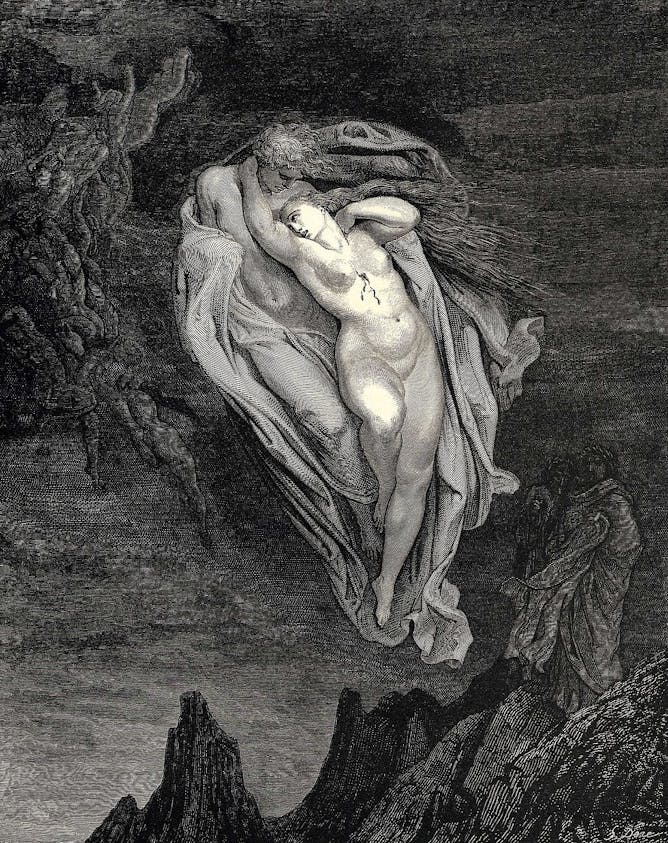
Francesca and Paolo, adulterers, Gustave Dore, circa 1860. Wikimedia
In the second circle, Dante is distraught by the cruelty of the punishment he observes. There, he encounters the souls of the lustful, including the legendary Tristan and Isolde and the historical Francesca da Rimini and her lover Paolo. Murdered by Francesca’s husband and Paolo’s brother, Giovanni Malatesta, these two souls drift aimlessly, their bodies fused together as punishment for adultery. They are joined for eternity, inverting the biblical prescription in Matthew that “what God has joined together, let man not separate.”
In the remaining seven circles of hell, Dante and Virgil observe punishments that are so grisly that sinners are reduced to grotesque conditions. These inspired the frescoes depicting the final judgement day that the painter Giotto painted around the walls and ceiling of the Scrovegni Chapel in Padua.
The writer Dante’s friend and compatriot, Giotto was commissioned to paint the inside of the chapel by the son of an infamous usurer that Dante identifies in the seventh circle of hell. There, men with moneybags hanging round their necks flick off flames, just as dogs shoo away insects in summer.
In the next, the circle of the fraudulent, Dante and Virgil encounter popes guilty of simony (or the selling of church services). Having inverted the moral order, they face an eternity buried upside down with their heads in the trenches. Only their legs can be seen from above, waving around frantically.
Ugolino and his sons. Jean-Baptiste Carpeaux, 1865-67. Wikimedia
In the ninth circle, the pilgrims see the Count Ugolino chomping on the skull of Archbishop Ruggieri, the punishment for treachery. In reality Ugolino conspired against his party, the Ghibellines, to bring the opposing Guelfs to power. The Archbishop later betrayed and imprisoned Ugolino with his offspring, gradually starving them to death.
Finally the pilgrims arrive at the centre of the earth, where they must scale the hairy sides of Lucifer to be able to ascend to the surface of the earth to get to purgatory, where they must be cleaned of the stain of hell. At the entrance of purgatory, an angel inscribes the letter “P” on Dante’s forehead seven times with the tip of his sword, saying “Make sure you cleanse these wounds when you are inside”. Each “P” stands for piaghe (wounds) that form from peccati (sins). Dante must work off and cleanse away each of them in the seven terraces of purgatory. As he leaves each terrace repented, the angel brushes his forehead, removing one of the letters.
Renewed and purified, Dante is now disposed to rise to “the stars”. Drawing on the writings of Saint Augustine, a woman called Beatrice, who has taken over from Virgil and guides Dante through heaven, explains that God’s creations, exiled to earth, long to return to their place of origin. Dante and Beatrice ascend through several heavens, the moon, and the planets, to the Empyrean, the heaven of divine peace. Like Inferno and Purgatorio, Paradiso ends with a reference to the stars:
Here high fantasy lost its impulse but my will and desire were already propelled, as a wheel is equally moved by the love that moves the sun and other stars.
Dante through the ages
Early commentators focused on interpreting the work as an allegory for the life of Jesus. In his Life of Dante, Giovanni Boccaccio, author of the Decameron, classified Dante as a prophet and his poem a prophecy. Humanist Cristoforo Landino (1424-98) viewed the poem as a metaphor for the soul’s journey back to God, and Neapolitan political philosopher Giambatista Vico (1668-1744) saw the Divine Comedy as a product of its barbarous time and Dante as the historian of his age, labelling him the Tuscan Homer.
More recently the Divine Comedy has inspired many creative works including art, architecture, literature, music, radio, film, television, comics, animations, digital arts, computer games and even a papal encyclical, Deus caritas est (2006), which, according to Pope Benedict XVI was inspired by the final verse of Paradiso.
It is most often Dante’s Inferno, its graphic imagery and twisted characters, that has inspired litterateurs like Chaucer, Milton, Honoré de Balzac, Marx, Elliot, Forster, Beckett, Primo Levy and Borges.
Few films have incorporated the entire epic tale. The earliest silent films, in 1911 (L’Inferno) and 1924 (Dante’s Inferno), and the first motion picture in 1935 (also Dante’s Inferno) all focused on the creatures and events of the inferno.
Peter Greenaway and Tom Phillips’s multi-award winning 1990 A TV Dante juxtaposes narration by John Gielgud, electronic images and sounds, with asides by experts, such as explanations of the three “beasts” by David Attenborough. A 2010 animation and 2012 documentary focus on the horror of the inferno, while another terrifying 2010 animation is based on a video game and departs considerably from the original.
Nor must the inferno be the focus to instil fear or terror. The film American Psycho is among 33 films with no connection to the Divine Comedy that contain, collectively, 64 occurrences of the iconic phrase at the gates of the inferno: “Abandon all hope ye who enter here,” a phrase that still inspires dread and terror in the audience almost 700 years later.
Punctuation aficionados will already have noticed the clever ambiguity the apostrophe creates in the title of Damien Freeman’s new book Abbott’s Right: The Conservative tradition from Menzies to Abbott. Is it a possessive apostrophe? And if so, what exactly is Abbott possessing? Is it Australia’s conservative tradition, or at least his version of it? Or is he claiming some unspecified right – to promulgate his beliefs, to say what he thinks, regardless?
Perhaps the apostrophe indicates a contraction – as in “Abbott is right”, meaning correct. The subject, our once and now deposed Tony Abbott, would certainly make the case for all three: that he represents the authentic traditions of Australian conservatism; that it is his right as a backbencher to prosecute his take on these traditions whatever the costs to the government; and that he sincerely believes he is correct. So does the book, which places Abbott in the conservative political tradition fashioned by Menzies, Fraser and Howard. It argues that the Liberal Party needs to return to its conservative roots as a centre right party, and sees Abbott as the champion of that return.
The book dates Australia’s conservative tradition as beginning with the “big-bang” of Menzies’ founding of the Liberal Party in 1944. This is wrong. In so far as there was a “big bang”, it was the Fusion of 1909, when Alfred Deakin’s Protectionist Liberals joined with Joseph Cook’s free traders turned anti-socialists. They presented a united political front to the newly-powerful Labor Party, threatening them both in the parliament and the electorate. It was an uneasy alliance, and the party reformed and disintegrated twice before the mid-1940s. By then, “conservative” had come to mean reactionary or at least reactive, hence Menzies’ determination that the new party be progressive.
MUP
The book includes a quick run-through of the thinking of the Liberal Party’s prime ministers since Menzies, together with discussions of the take on Australian political thought of Keith Hancock, Donald Horne and Paul Kelly. Freeman writes well, so the book skips along, but in so doing it elides so many distinctions and ignores so many facts that it is very unsatisfactory. One glaring omission is the failure to distinguish between economic and social policies. When Howard claimed that the Liberal Party was the custodian of both the liberal and the conservative traditions of Australian politics, he was embracing the economic liberalism of the 19th century free traders, while championing socially conservative attitudes to women’s role, marriage and family life, and to traditional British Australian nationalism.
In the second part of the book, titled “More than a three word slogan”, Freeman argues that Abbott’s thinking and policies can be located in a conservative tradition deriving from Edmund Burke. I found this unconvincing. Exactly how Abbott’s claim that the Liberal Party is the party of low tax, small government and economic freedom derives from Burke’s arguments for the advantages of incremental change and respect for the traditions of a nation defeats me, especially given Australia’s strong history of trade unionism.
Again and again, Freeman argues that an Abbott policy has its roots in Burkean conservatism, but it is only ever a claim, made so by saying it. The book ignores completely the influence of Catholic thinking on Abbott, and there is only one index reference to Santamaria. Surely this explains his social conservatism on marriage and the family at least as well as any debt to Burke.
Freeman argues that Abbott’s opposition to an emissions trading scheme and a carbon tax was “Burkean” because the Burkean is cautious about massive change. But presumably “Burkeans” are also cautious about massive risks, not just to the present but to the future generations, which they take as their special responsibility. Why isn’t Abbott’s rejection of a modest carbon price simply a reactionary and irresponsible defence of the power and wealth of the fossil fuel industry which is wreaking havoc in our atmosphere?
Abbott has an afterword, in which he claims that the heart of conservatism is “a trust between the living, the dead and the yet unborn. It is wrong for this generation to live on its children’s credit card”. How can the man who wrote this be so determined to wreck every serious attempt Australian politicians make to reduce our carbon emissions, including in his own party? The book is an attempt to cloak Abbott in a political philosophy. The shrinking band of Abbott’s admirers will no doubt admire the cloak. The rest of us will still see a naked political animal.




 Nor must the inferno be the focus to instil fear or terror. The film


 Abbott has an afterword, in which he claims that the heart of conservatism is “a trust between the living, the dead and the yet unborn. It is wrong for this generation to live on its children’s credit card”. How can the man who wrote this be so determined to wreck every serious attempt Australian politicians make to reduce our carbon emissions, including in his own party? The book is an attempt to cloak Abbott in a political philosophy. The shrinking band of Abbott’s admirers will no doubt admire the cloak. The rest of us will still see a naked political animal.
 At the BookShelf
You must be logged in to post a comment.