Unknown's avatar

‘Persuasion:’ Jane Austen’s greatest novel turns 200


Robert Morrison, Queen’s University, Ontario

When I was asked a few years ago if I would like to edit one of Jane Austen’s novels, I quickly answered that I would be happy to, and especially if I could edit her greatest novel.

“I’m sorry, Rob,” was the reply. “Someone is already editing Pride and Prejudice.”

“That’s ok,” I said, much relieved. “Pride and Prejudice is not Austen’s greatest novel. Jane Austen’s greatest novel is Persuasion.”

It is – among many other things – the most moving love story she ever told. Anne Elliot is the second daughter of the absurdly vain baronet Sir Walter Elliot of Kellynch Hall. Frederick Wentworth is an officer in the British navy during the Napoleonic Wars.

Eight years before the novel begins, Wentworth proposes to Anne and she accepts him after a brief and intense courtship, only to be persuaded by her father and her older friend Lady Russell to break off the engagement. Wentworth, angry and badly hurt, goes back to sea, where he conducts a successful series of raiding expeditions on enemy ships, and amasses a fortune in prize money.

When Napoleon abdicates for the first time in April 1814, Wentworth returns to England and soon pays a visit to his sister, who now lives near Anne. Throughout his absence, meanwhile, Anne has found no one who compares to him, and has pined away to the point where now, at 27 years old, her bloom is gone and she has begun the descent into spinsterhood.

Many critics have argued that, as a result of suffering and regret, Anne is already “mature” when the novel opens, while the rich and carefree Wentworth has a good deal of growing up to do before he recognizes – or, rather, re-recognizes – her worth.

On the contrary, for all that divides them when he returns, Anne has as much to learn about love as Wentworth does, and her journey toward their reconciliation contains as much confusion as his. Indeed, part of the enormous appeal of Persuasion is Austen’s ability to convey the ways in which Wentworth and Anne are moving steadily toward one another even as their various missteps, flirtations and assumptions seem to be driving them still further apart.

Their reunion is the finest scene in all of Austen, and in it they do not even speak face to face, for Austen understood that mediated and misdirected messages frequently carry a far greater charge than explicit declarations.

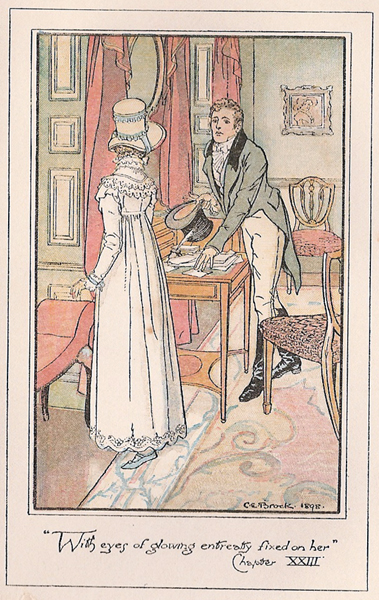
Anne and Wentworth are both in a room at the White Hart Inn in Bath. He is sitting at a desk writing a letter. She is nearby speaking to a mutual friend, Captain Harville, about men, women and constancy.

Harville believes that men feel more deeply than women. Anne takes the opposite view, and while she does not mention Wentworth or her own circumstances, everything she says is clearly with him in mind.

She has spoken to no one about her grief over Wentworth, and it is not long before eight years of pent-up anguish flood out of her. “We certainly do not forget you, so soon as you forget us,” she tells Harville. “It is, perhaps, our fate rather than our merit. We cannot help ourselves. We live at home, quiet, confined, and our feelings prey upon us.”

Wentworth, still writing his letter, overhears Anne’s comments and knows immediately that she is speaking about their relationship, and about all that has been lost.

Seizing another sheet of paper, he begins a second letter in which he records his feelings toward her as she utters hers toward him, and which he leaves behind on the desk for her to read.
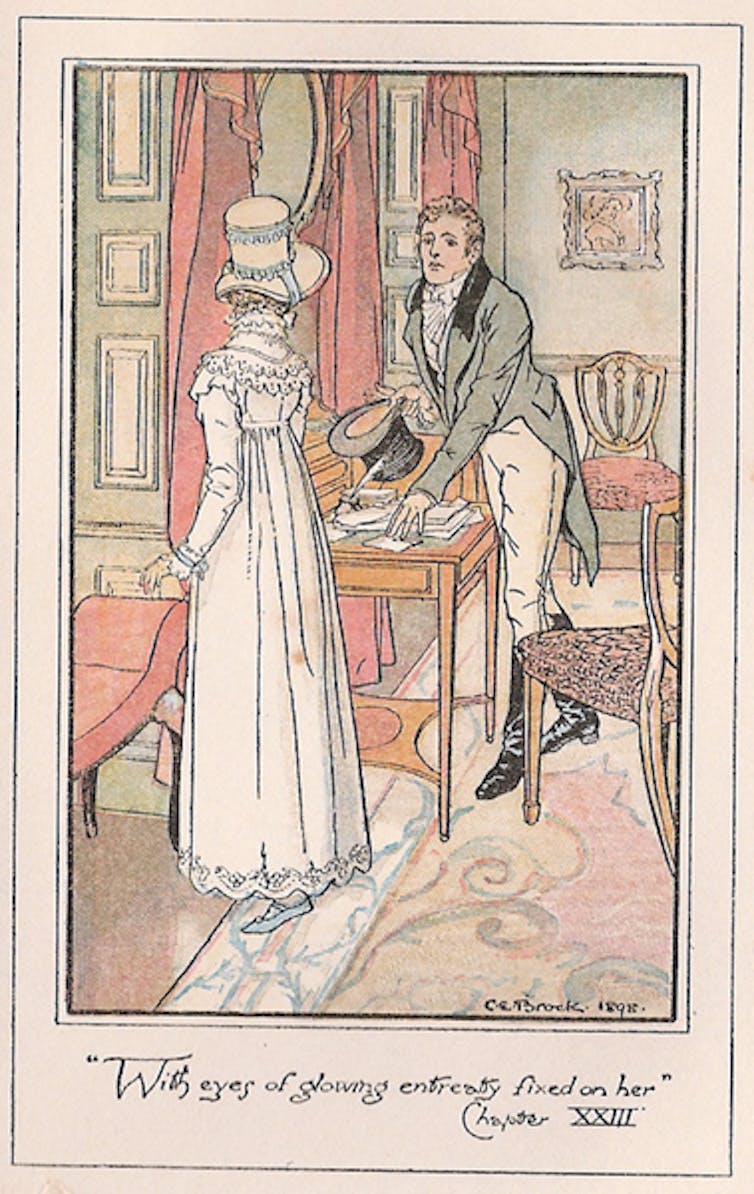
Captain Wentworth shows his letter to Anne, with eyes of glowing entreaty fixed on her.
(C. E. Brock)

Ralph Waldo Emerson objected to Austen’s novels because he found them “imprisoned in the wretched conventions of English society, without genius, wit, or knowledge of the world.”

But Austen knew that love is the very largest concern of life, then as now, and in Persuasion she makes Anne’s whole world hang on a single letter. It is a moment that demonstrates both the superb compression and the enduring appeal of her art.

If Wentworth loves Anne, she has a future that stretches as far as the seas. If he does not, she has only a past that will increasingly consume her. She reads the letter. He does love her. Her joy is inexpressible. So is ours.

What’s more, Austen has contrived to tell both Anne and the reader at the same time, and her passionate affirmation of personal preference and individual desire far transcends the “wretched conventions of English society.”

“You pierce my soul,” Wentworth’s letter reads. “I am half agony, half hope. Tell me not that I am too late, that such precious feelings are gone for ever. I offer myself to you again with a heart even more your own, than when you almost broke it eight years and a half ago.” Anne is overwhelmed.

During the novel she has been transformed, from faded to blooming, from nobody to somebody, from “only Anne” within her family to Wentworth’s “only Anne.”

Persuasion is Austen’s last published work. She began it when she was nearly 40 years old, and when she finished it she was within a year of her death. Perhaps not surprisingly, it is one of her shortest – and it is certainly her saddest – novel.

But it is also her subtlest and most impassioned. “After a long immersion in [Austen’s] work,” British novelist Martin Amis writes, “I find that her thought rhythms entirely invade my own.”

The ConversationFor me, nowhere are Austen’s “thought rhythms” more haunting than in Anne’s conversation with Harville, and Wentworth’s response to her in his letter. More broadly, in its blend of the public and the personal, Persuasion explores both the torment of silence and the value of hope.

Robert Morrison, Professor of English Language and Literature, Queen’s University, Ontario

This article was originally published on The Conversation. Read the original article.

Unknown's avatar

Finished Reading: Leonardo Da Vinci – A Life From Beginning to End, by Hourly History


Leonardo da Vinci: A Life From Beginning to EndLeonardo da Vinci: A Life From Beginning to End by Hourly History
My rating: 3 of 5 stars

View all my reviews

Unknown's avatar

Finished Reading: Aubrey/Maturin Book 10 – The Far Side of the World, by Patrick O’Brian


The Far Side of the World: Aubrey/Maturin series, book 10 (Aubrey & Maturin series)The Far Side of the World: Aubrey/Maturin series, book 10 by Patrick O’Brian
My rating: 4 of 5 stars

View all my reviews

Unknown's avatar

Not My Review: Areopagitica by John Milton (1644)


The link below is to a book review of ‘Areopagitica,’ by John Milton.

For more visit:
https://www.theguardian.com/books/2017/nov/27/areopagitica-by-john-milton-100-best-nonfiction-books-of-all-time-review

Unknown's avatar

Not My Review: Harry Potter (Book 6) – Harry Potter and the Half-Blood Prince, by J. K. Rowling


Unknown's avatar

Not My Review: The Diabolic (Book 2) – The Empress, by S. J. Kincaid


Unknown's avatar

Guide to the Classics: Suetonius’s The Twelve Caesars explores vice and virtue in ancient Rome


File 20171120 18525 184kgg6.jpg?ixlib=rb 1.1
Giovanni Cavino, I primi dodici imperatori Romani (‘The first twelve Roman emperors’), plaquettes produced at Padua, c. 1550.
Wikimedia Commons, CC BY-SA

Caillan Davenport, Macquarie University

In a memorable scene from the classic BBC TV series I, Claudius (1976), three frightened senators are summoned to the palace in the dead of night by the emperor Caligula. Rather than being executed, they are treated to a command performance by Caligula himself, who dances before them dressed in a shimmering gold bikini.

Caligula’s midnight dance routine is the climax of a sequence of horrors and indiscretions committed by the emperor. He has his predecessor suffocated to death with a pillow, executes his cousin because of his irritating cough, and engages in an incestuous relationship with his sister (they’re both gods, you see).

Caligula dances for Claudius and two other senators. Scene from the BBC TV series, I, Claudius (1976).

These outlandish scenes cannot be ascribed to the imagination of the scriptwriter Jack Pulman or to Robert Graves, the author of the original novels I, Claudius and Claudius the God, on which the series is based. The incidents are adapted from Suetonius’s On the Lives of the Caesars, a collection of imperial biographies written in Latin in the second century A.D.

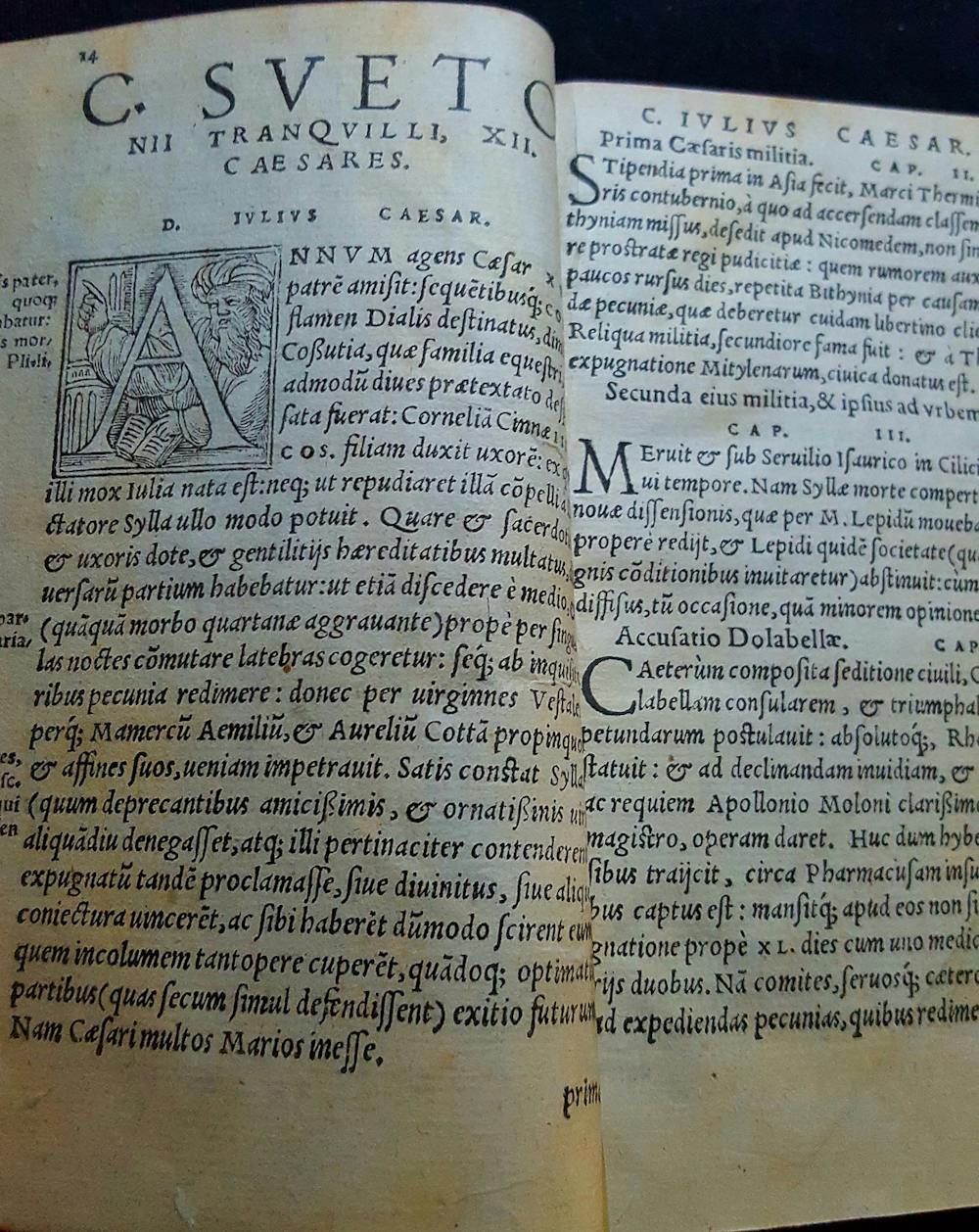
Latin edition of The Twelve Caesars published in 1541.
Wikimedia Commons

Suetonius’s work describes the lives of Rome’s first 12 leaders from Julius Caesar to Domitian – hence it is best known today as The Twelve Caesars. This is the title it bears in the paperback Penguin Classics edition, translated by Robert Graves himself in 1957, and still in print today.

Suetonius’s unforgettable tales of sex, scandal, and debauchery have ensured that his writing has played a significant role in shaping our perceptions of imperial Rome.

The man and the work

Gaius Suetonius Tranquillus was a scholar and intellectual who held administrative positions at the imperial court under the emperors Trajan and Hadrian. He was a prolific author, writing biographies of poets and orators, as well as works on topics as diverse as the games, the Roman year, bodily defects, and lives of famous courtesans.

He probably began to write the Caesars when he was Hadrian’s secretary of correspondence. However, the biographies were only published after Suetonius was dismissed from Hadrian’s service for being too familiar with the emperor’s wife.

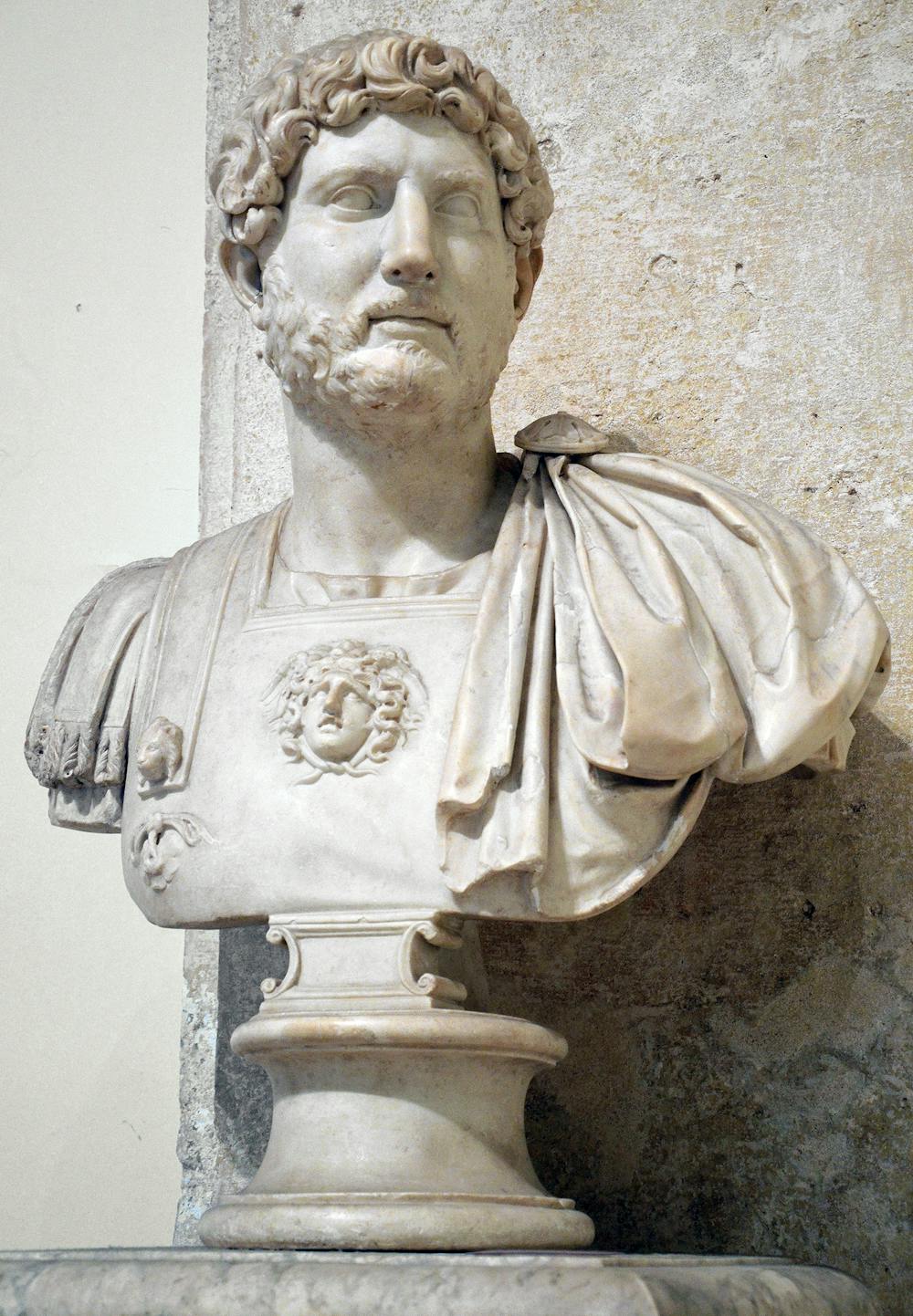
Bust of Hadrian in the Musei Capitolini.
Wikimedia Commons

Political expediency meant that Suetonius wisely avoided writing about Hadrian. Instead The Twelve Caesars includes the Julio-Claudians, Rome’s first imperial dynasty (Julius Caesar, Augustus, Tiberius, Caligula, Claudius, Nero), three short-lived emperors during the civil wars of A.D. 69 (Galba, Vespasian, Otho), and the Flavian dynasty (Vespasian, Titus, Domitian).

The structure of the individual biographies has often puzzled modern readers, who expect Suetonius to tell his story in a linear fashion from birth to death. Although Suetonius usually begins with an emperor’s family and upbringing, the bulk of each Life consists of an assortment of memorable, and sometimes salacious, anecdotes about an emperor’s public conduct and private life.

But this is no mere haphazard catalogue of sex and corruption. Instead, Suetonius tells his readers that he has carefully organized the stories “by categories”. These categories include the emperor’s virtues (such as justice, self-control, and generosity) and his vices (like greed, cruelty, and sexual excess).

Virtues and vices

In the second century A.D., when Suetonius was writing, there was no chance of a return to the Republic, but aristocrats still expected the emperor to behave as if he were merely the most prestigious citizen rather than an autocrat. The stories of virtue and vice in the Caesars are carefully selected to illustrate whether emperors measured up to this standard.

When Suetonius describes an emperor’s ancestors, he highlights how their qualities influenced the ruler himself. Early in the Life of Nero, the reader encounters Nero’s grandfather who staged particularly cruel shows in the arena. This helps to explain the later tales of Nero’s own savagery, because the reader would see that this vice was part of his nature.

Suetonius is fair and evenhanded in his treatment of his subjects. All emperors appear as flawed men with both virtues and vices, but the balance between them depends on the individual ruler. He even gives due credit to the notorious Caligula, who began his reign by publishing the imperial budget and showing generosity to the people. Suetonius then signals a change:

Thus far, it is as if we have been writing about an emperor, but the rest must be about a monster.

This “division” – a statement in which Suetonius clearly separates the anecdotes illustrating virtues from the vices – is a feature of several of his biographies. In Caligula’s case, it is from this point on that we read about his pretensions to divinity, his condemnation of aristocrats to hard labour in the mines, and his sexual immorality.

Emperor Tiberius, played by George Baker, in I Claudius.

The tales of the emperors’ sexual habits constitute some of the most famous passages in Suetonius. He chronicles Tiberius’s sordid behaviour on Capri, detailing how he forced men and women to engage in threesomes, had children perform oral sex on him, and raped young men who took his fancy.

When the Loeb Classical Library, which features the original Latin and the English translation of classical texts on facing pages, published their first edition of Suetonius in 1913, these chapters about Tiberius’s behaviour were left in Latin because they were considered too scandalous to translate. Although they are now translated into English, these graphic tales still have the power to shock and unsettle the reader.

An emperor’s private life and his sexual conduct were fair game because they reflected whether or not he was fit to rule. The same applied to members of his family. Augustus’s daughters were praised by Suetonius for spending their time weaving in his house. (Such gender stereotypes remain with us today, if one recalls the photo shoot of Julia Gillard knitting in Women’s Weekly). When his daughter Julia flagrantly flouted Augustus’s own adultery legislation, Suetonius reports that he had no choice but to exile her. The imperial family had to set standards for the entire empire.

Man or god?

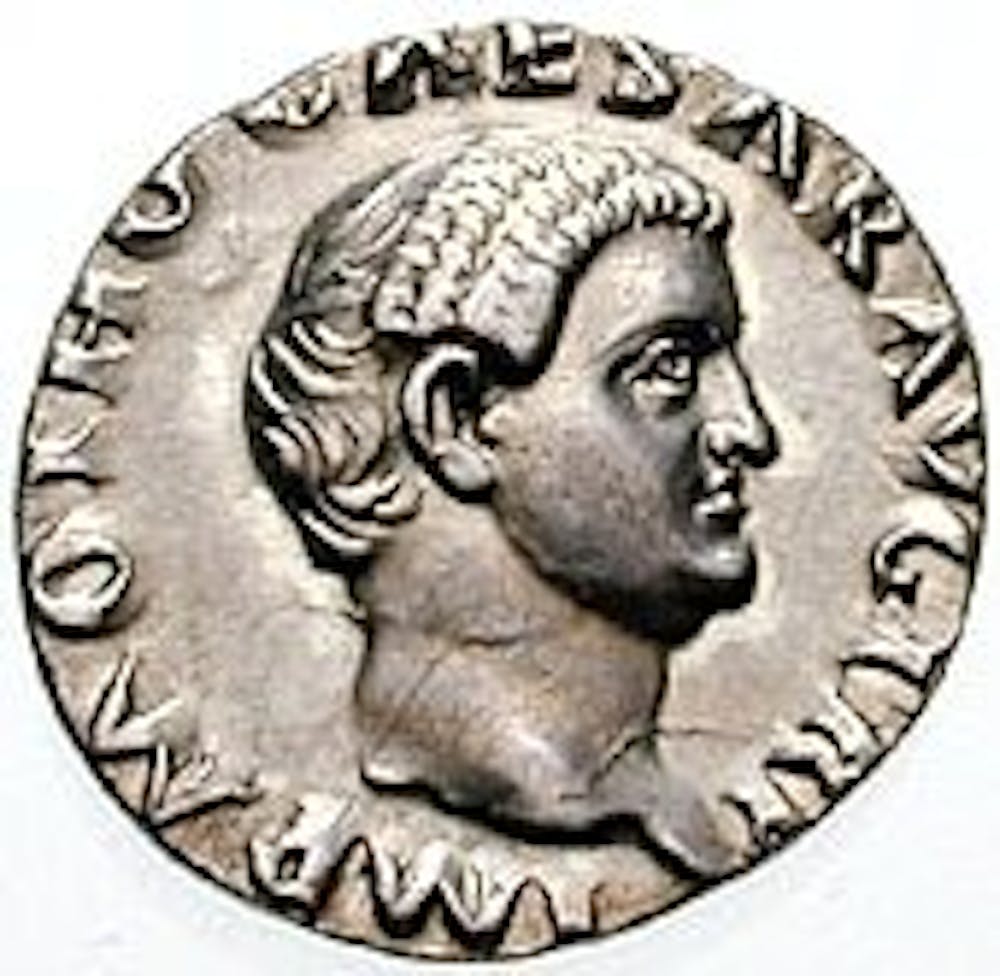
Silver coin of the emperor Otho.
Wikimedia Commons

After the virtues and vices, Suetonius’s Lives usually conclude with a narrative of the emperor’s death and a detailed physical description of his body. Suetonius didn’t hold back in these passages, even pointing out that the emperor Otho sported a terrible wig to hide his bald patch (as his coinage also reveals).

The description of the emperor Nero is particularly memorable:

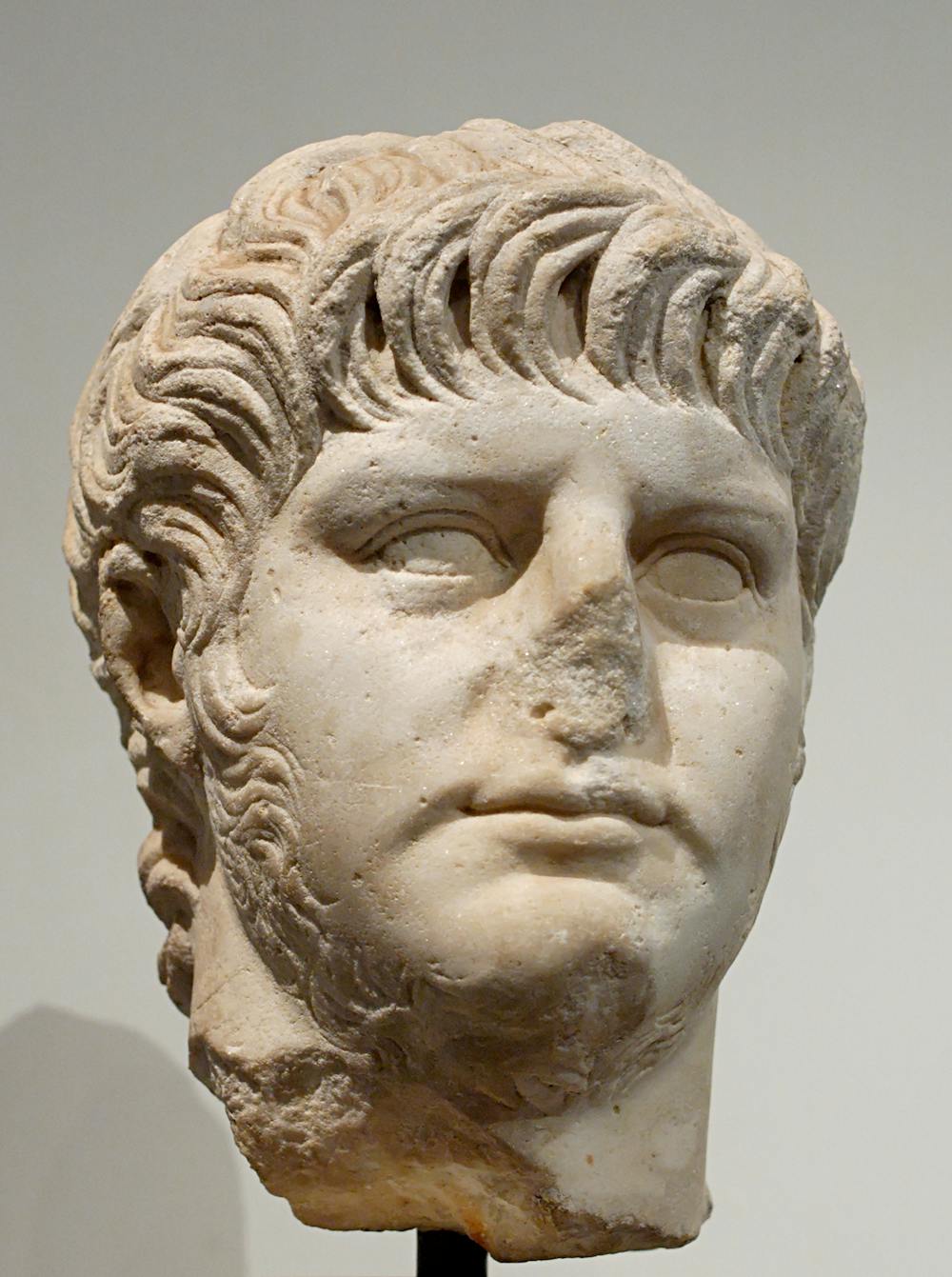
He was of a good height but his body was blotchy and ill-smelling. His hair was fairish, his face handsome rather than attractive, his eyes bluish-grey and dull, his neck thick, his stomach protruding, his legs very thin…

The different body parts were supposed to indicate character traits. Nero’s blotchy skin likened him to a panther (regarded as a deceitful creature); his hair colour suggested courage; the bulging beer belly had connotations of power, but also exposed his devotion to pleasure; his feeble legs indicated both femininity and fear. Nero was thus revealed to be a contradiction.

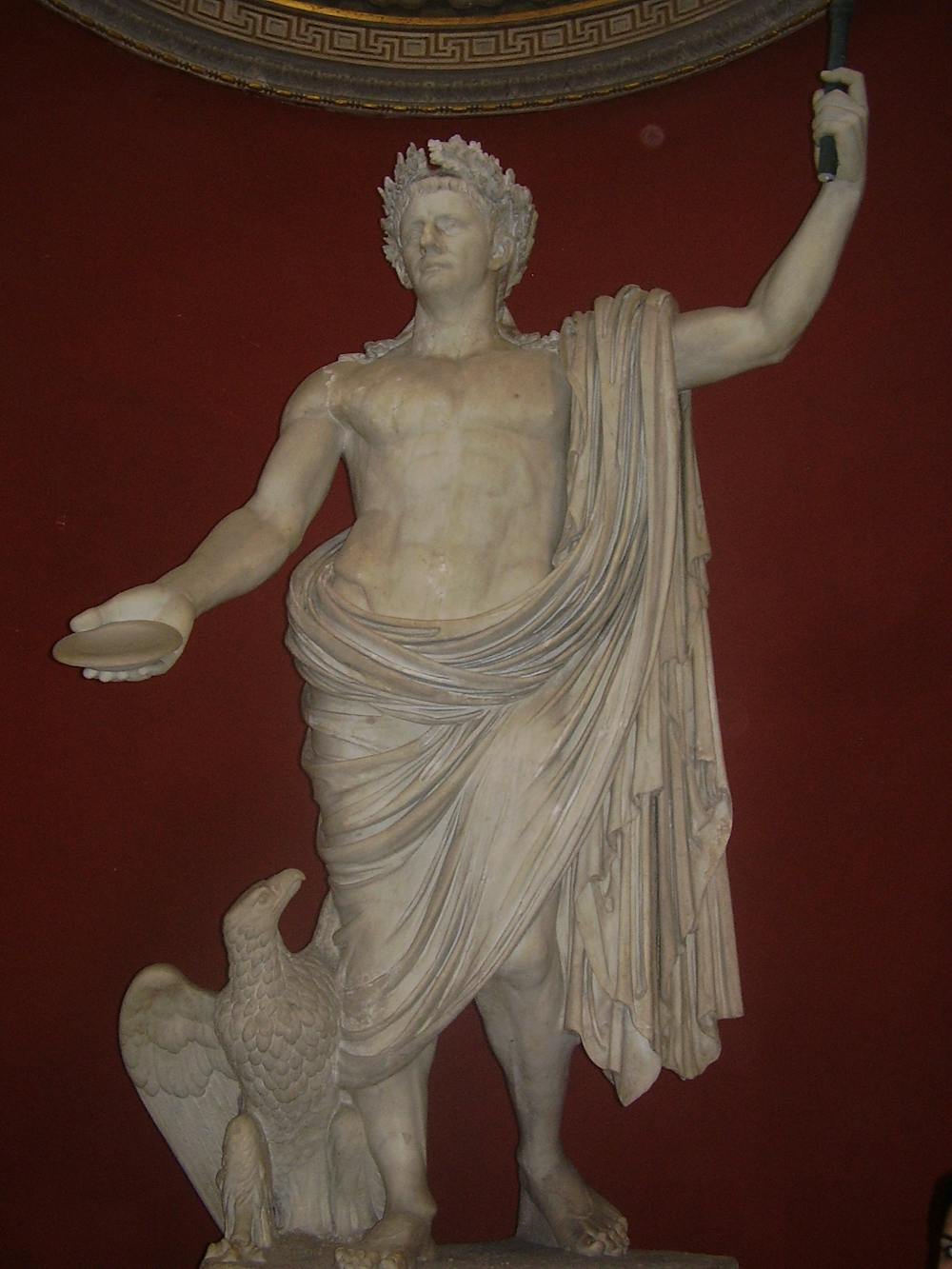
The emperor Claudius as Jupiter, Vatican Museum.
Wikimedia Commons

The descriptions of the bodies are also very funny. They undercut the divine pretensions of emperors, whose statues showed them in heroic nudity with six-packs that demonstrated their virility and likened them to gods. (Once again, not much has changed, as revealed by the images of Vladimir Putin’s shirtless hunting expeditions or Tony Abbott in his budgie smugglers).

Suetonius’s stories about the emperors’ faults and foibles exposed them as human beings. He even collected their famous sayings to shed light on their character – the famous line “as quick as boiled asparagus”, intoned beautifully by Brian Blessed’s Augustus in I, Claudius, is straight out of Suetonius.

His account of the witty sayings of Vespasian shows that the emperor frequently joked about his own economic policies:

When his son Titus criticized him for putting a tax even on urine, he held up a coin from the first payment to his son’s nose and asked him if he was offended by its smell. When Titus said no, he observed: ‘But it comes from urine.’

Vespasian emerges as a rather avuncular figure. He even pokes fun at the deification of emperors, proclaiming in the days before his death, “Oh dear, I think I am becoming a god!”

Laughing at power

But the humour of Suetonius’s Caesars is often double-edged. He tells one story about the time Nero visited his aunt on her death bed, and she lovingly remarked that she would die happy once she had the hairs from the first shaving of his beard. Nero joked that he would shave it off immediately. He then gave his aunt an overdose of laxatives to kill her off and seized her estate for himself.

Head of Nero, with beard, from the Palatine Museum.
Wikimedia Commons

Roman aristocrats reading this tale would probably have laughed, given its absurdly comic elements. But it would have been nervous laughter. For such stories reminded them of the power of the emperor. While they might have chuckled at another’s misfortune, they would have been acutely aware that one day it could be them.

Suetonius’s Caesars is thus more than a haphazard collection of gossip and scandal, but a work that sheds light on the world of the Roman aristocracy and how they lived (and coped) with their emperors. The stories of the emperors’ virtues and vices illustrates what Roman elites considered to be acceptable behaviour by their leaders.

Suetonius’s biographies also cut the emperors down to size, revealing them to be men with human flaws, rather than gods. They offered a necessary means of escapism in a world where imperial fickleness could end one’s career – or one’s life.

The ConversationRecommended translation: Suetonius, Lives of the Caesars, Oxford World’s Classics edition by Catharine Edwards (2008).

Caillan Davenport, Lecturer in Roman History and ARC DECRA Research Fellow, Macquarie University

This article was originally published on The Conversation. Read the original article.

Unknown's avatar

Finished Reading: Bug Out Bag – Build a no-nonsense survival kit to keep your family alive after a disaster or when SHTF, by Bob Clark


Preppers Blueprint: Bug Out Bag: Build a no-nonsense survival kit to keep your family alive after a disaster or when SHTFPreppers Blueprint: Bug Out Bag: Build a no-nonsense survival kit to keep your family alive after a disaster or when SHTF by Bob Clark
My rating: 2 of 5 stars

View all my reviews

Unknown's avatar

Not My Review: Red Rising Saga (Book 2) – Golden Son, by Pierce Brown


Unknown's avatar

Not My Review: Technicolor – Inspiring Your Church to Embrace Multicultural Ministry, by Mark Hearn


The link below is to a book review of ‘Technicolor – Inspiring Your Church to Embrace Multicultural Ministry,’ by Mark Hearn.

For more visit:
https://www.9marks.org/review/book-review-technicolor-inspiring-your-church-to-embrace-multicultural-ministry-by-mark-hearn/