Pick up Gulliver’s Travels expecting a children’s book or a novel and you will be unpleasantly surprised. Originally published as “Travels into Several Remote Nations of the World. In Four Parts … By Lemuel Gulliver, first a Surgeon, and then a Captain of several Ships”, it is one of the great satires in world literature.
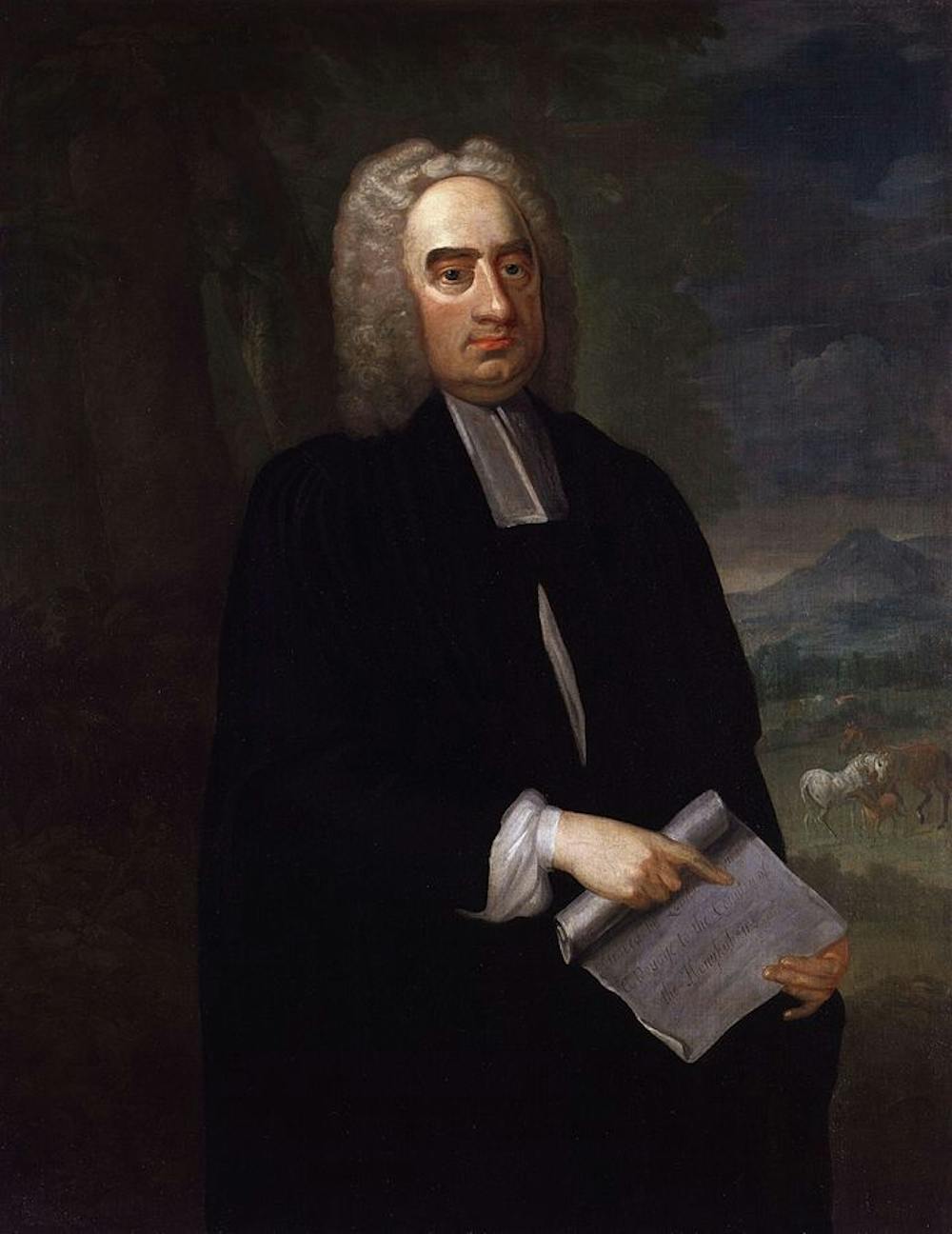
Jonathan Swift by Francis Bindon. Swift is pointing to Part IV of the Travels, Voyage to the Country of the Houyhnhnms. Note the horses in the background. Wikimedia
First published in London in 1726, the Travels was a sensational bestseller and immediately recognised as a literary classic. The author of the pseudonymous Travels was the Church-of-Ireland Dean of St. Patrick’s in Dublin, Jonathan Swift. Swift wrote that his satiric project in the Travels was built upon a “great foundation of Misanthropy” and that his intention was “to vex the world”, not entertain it.
The work’s inventive narrative, exuberant fantasy (little people, giants, a flying island, spirits of the dead, senile immortals, talking horses and odious humanoids), and hilarious humour certainly made the work entertaining. In its abridged and reader-friendly form, sanitised of sarcasm and black humour, Gulliver’s Travels has become a children’s classic. In its unabridged form, however, it still has the power to vex readers.
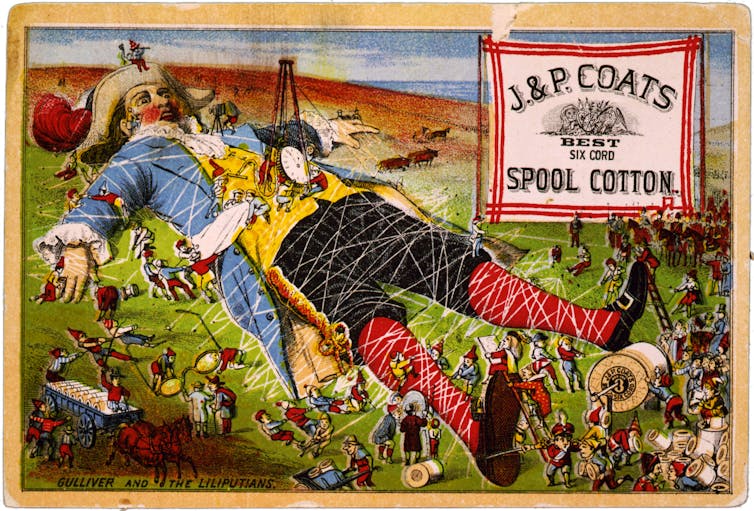
In Part 1 of this four-part satire, Gulliver is shipwrecked among the tiny Lilliputians. He finds a society that has fallen into corruption from admirable original institutions through “the degenerate Nature of Man”. Lilliput is a satiric diminution of Gulliver’s Britain in its corrupt court, contemptible party politics, and absurd wars.
In Part II Gulliver is abandoned in Brobdingnag, a land of giants. The scale is now reversed. Gulliver is a Lilliputian among giants, displayed as a freak of nature and kept as a pet. Gulliver’s account of his country and its history to the King of Brobdingnag leads the wise giant to denounce Gulliver’s countrymen and women as “the most pernicious Race of little odious Vermin that Nature ever suffered to crawl upon the Surface of the Earth”.
In Part III Gulliver is the victim of piracy and cast away. He is taken up to the flying island of Laputa. Its monarch and court are literally aloof from the people it rules on the continent below, and absorbed in pure science and abstraction.
Technological changes originating in this volatile “Airy Region” result in the economic ruin of the people below and of traditional ways of life. The satire recommends the example of the disaffected Lord Munodi, who is “not of an enterprising Spirit”, and is “content to go on in the old Forms” and live “without Innovation”. Part III is episodic and miscellaneous in character as Swift satirises various intellectual follies and corruptions. It offers a mortifying image of human degeneration in the immortal Struldbruggs. Gulliver’s desire for long life abates after he witnesses the endless decrepitude of these people.
Part IV is a disturbing fable. After a conspiracy of his crew against him, Gulliver is abandoned on an island inhabited by rational civilised horses, the Houyhnhnms, and unruly brutal humanoids, the Yahoos. Gulliver and humankind are identified with the Yahoos. The horses debate “Whether the Yahoos should be exterminated from the Face of the Earth”. As in the story of the flood in the Bible, the Yahoos deserve their fate.
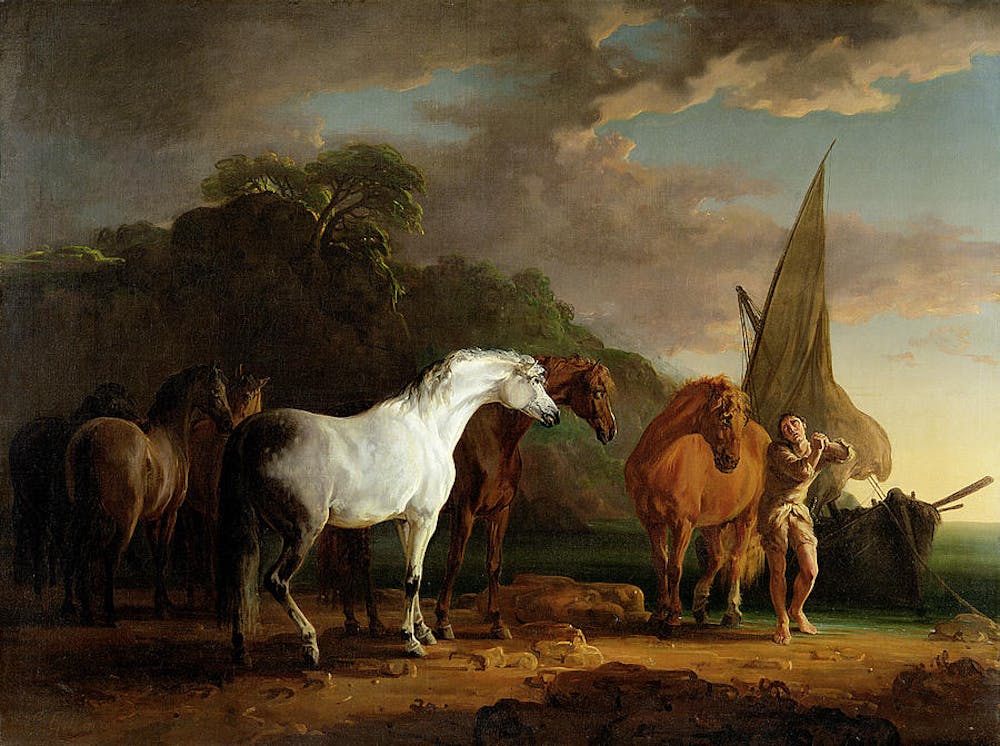
Gulliver taking his final leave of the land of the Houyhnhnms. Sawrey Gilpin, 1769. Wikimedia
The horses, on the other hand, are the satire’s ideal of a rational society. Houyhnhnmland is a caste society practicing eugenics. Swift’s equine utopians have a flourishing oral culture but there are no books. There is education of both sexes. They have no money and little technology (they do not have the wheel). They are authoritarian (there is no dissent or difference of opinion). The Houyhnhnms are pacifist, communistic, agrarian and self-sufficient, civil, vegetarian and nudist. They are austere but do have passions. They hate the Yahoos.
Convinced that he has found the enlightened good life, free of all the human turpitude recorded in the Travels, Gulliver becomes a Houyhnhnm acolyte and proselyte. But this utopian place is emphatically not for humans. Gulliver is deported as an alien Yahoo and a security risk.
Wearing clothes and sailing in a canoe made from the skins of the humanoid Yahoos, Gulliver arrives in Western Australia, where he is attacked by Aboriginal people and eventually, unwillingly, rescued and returned home to live, alienated, among English Yahoos. (Swift’s knowledge of the Aboriginal people derives from the voyager William Dampier, whom Gulliver claimed was his “Cousin”.)
Politics and misanthropy
When it was published, the Travels’ uncompromising, misanthropic satiric anatomy of the human condition seemed to border on blasphemy. The political satire was scandalous, venting what Swift called his “principle of hatred to all succeeding Measures and Ministryes” in Britain and Ireland since the collapse, in 1714, of Queen Anne’s Tory government, which he had served as propagandist.
In its politics the work is pacifist, condemns “Party and Faction” in the body politic, and denounces colonialism as plunder, lust, enslavement, and murder on a global scale. It satirises monarchical despotism yet displays little faith in parliaments. In Part III we get a short view of a representative modern parliament: “a Knot of Pedlars, Pickpockets, Highwaymen and Bullies”.
Gulliver’s Travels belongs to a tradition of satiric and utopian imaginary voyages that includes works by Lucian, Rabelais, and Thomas More. Swift hijacked the form of the popular contemporary voyage book as the vehicle for his satire, though the work combines genres, containing utopian and dystopian fiction, satire, history, science fiction, dialogues of the dead, fable, as well as parody of the travel book and the Robinson Crusoe-style novel.
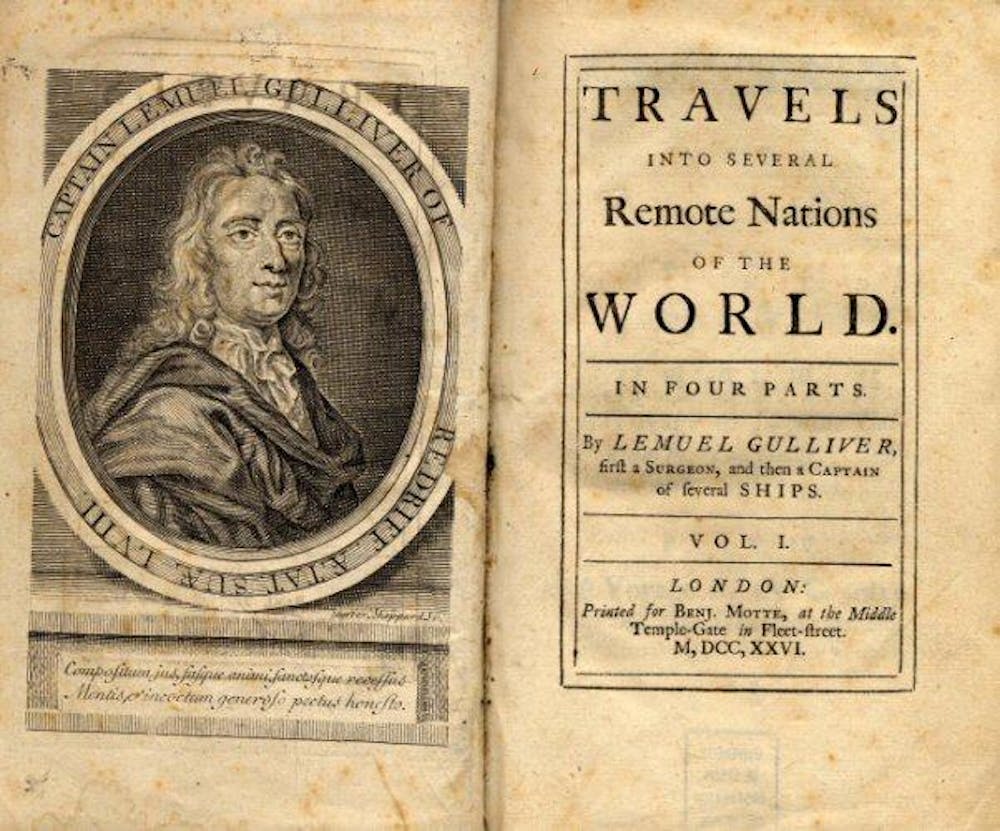
The frontispiece and title page of the first edition of Gulliver’s Travels (1726). Wikimedia
It’s not a book to be judged by its cover. The frontispiece, title page and table of contents of the original edition gave no hint that this was not a genuine travel account. Swift and his friends reported stories of gullible readers who took this hoax travel book for the real thing.
It is also not reader friendly. The revised 1735 edition of the Travels opens with a disturbing letter from Gulliver in which the reader is arraigned by an irate and misanthropic author convinced that the “human Species” is too depraved to be saved, as evidenced by the fact that his book has had no reforming effect on the world. The book ends with Gulliver, a proud, ranting recluse, preferring his horses to humans, and warning any English Yahoos with the vice of pride not to “presume to appear in my Sight”.
Readers might dismiss the unbalanced Gulliver, but he is only saying what Swift’s uncompromising satire insists is the truth about humankind.
In many ways Jonathan Swift is remote from us, but his satire still matters, and Gulliver’s Travels continues to vex and entertain today.
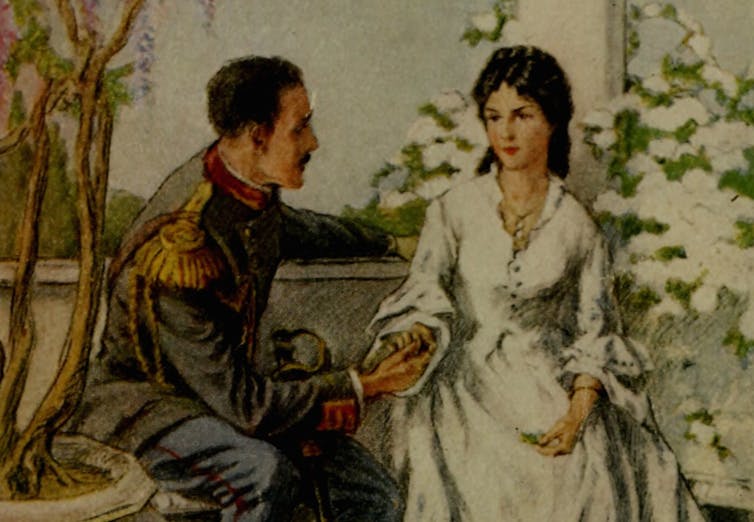
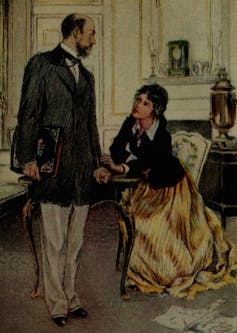
In Leo Tolstoy’s ‘Anna Karenina,’ each character approaches marriage with a different set of expectations – and many succumb to disappointment. Internet Archive Book Images
You can tell a lot about our culture by the way we talk about marriage. Take the upcoming exchange of vows between Meghan Markle and Prince Harry. Press coverage will focus on aspects like the cost of the festivities, the size of the crowds and the fashion choices of the wedding party.
But since marriage represents one of the most important factors in predicting a person’s happiness, this marriage – and all marriages – deserve deeper reflection than the press tends to give them.
Marriage is increasingly described as an economic transaction, with marriage rates dictated by the conditions of the “marriage market” – whether matrimony will improve or worsen one’s financial outlook. It increasingly serves as a “status symbol,” a means for couples to signal their rank by sharing photos of expensive engagement rings and extravagant honeymoons on social media. Scholars also suggest that marriage is becoming less of a lifelong commitment, with spouses entering and exiting more freely based on their individual level of satisfaction.
Beyond status, money and personal gratification, none of these trends delineate what a good marriage should actually look like, and what expectations each partner should have.
Fortunately, one of the greatest novels ever published – Tolstoy’s “Anna Karenina,” which I teach regularly to my ethics students at Indiana University – provides deep insights on why some marriages thrive and others don’t.
The pitfalls of restless desire
“Anna Karenina” may have been published 140 years ago, but the doubts and desires of the characters ring true today.
The novel tells the story of four couples.
Dolly is the devoted mother of many children, while her husband, Stiva, cannot believe that he can be expected to devote his life to his family. The novel opens with a marital crisis precipitated by his infidelity.
Anna is a popular and astute socialite married to an honorable yet rather dry senior statesman, Karenin, who is 20 years her senior. Anna discovers that she longs for more.
Anna falls in love with Vronsky, a dashing cavalry officer who grew up in a wealthy but failed family, with no meaningful family life. Anna eventually leaves her husband for Vronsky, which results in her fall from societal grace.
Kitty is a debutante and Dolly’s younger sister, and Levin is a landowner searching for the meaning of life. Though Kitty initially rejects Levin’s overtures, the two later marry and become parents.
The rich human panoply of the novel cannot be boiled down into a few simple rules for a happy marriage. Yet it brims with insights on the differences between happy and unhappy families.
Consider Anna and her brother Stiva. Both see marriage as a contract into which they can enter or leave at will. Stiva cannot understand how a young red-blooded, convivial man such as himself could possibly find contentment by completely devoting himself to his wife, “a worn-out woman no longer young or good-looking, and in no way remarkable or interesting, merely a good mother.”
Surely life owes him more than that, he thinks.
Anna also finds her highly regimented marriage to Karenin less than satisfying and seeks the adventure of romantic love with Vronksy, a man to whom genuine family life is unknown. But ultimately even the lover of her dreams cannot rescue her from her perpetual dissatisfaction.
Levin is one of the characters who most realizes the richness of marriage. In preparing for his wedding, he “had thought his engagement would have nothing about it like others, that the ordinary conditions of engaged couples would spoil his special happiness; but it ended in his doing exactly as other people did, and his happiness being only increased thereby and becoming more and more special, more and more unlike anything that had ever happened.”
Levin is continually surprised by what he discovers of his wife, of parenthood, and of himself as husband and father.
Family life turns out to be far more fulfilling than he ever imagined.
Disciplined devotion pays off
One of the novel’s central insights is this: Marriage is far more than a relationship that merely fulfills the emotional, romantic and material needs of each partner.
In Tolstoy’s view, the best that partners can hope for from marriage is to be shaped by it in ways that make them better human beings. On the other hand, those who enter marriage thinking that it is all about their own satisfaction – supposing that their spouse and union both exist primarily to bring them pleasure – can expect to endure considerable unhappiness.
Anna, for example, thinks she has the right to be adored by all. When others, including her new life partner, Vronsky, seem to take interest in other matters in life, she is overcome by jealousy.
Another damning Tolstoyan criticism of Anna is her willingness to leave the care of her children to wet nurses and governesses. Though she indeed loves them in some sense, she is so preoccupied with her own needs that she has difficulty focusing on the role of a mother for any extended period of time.
While the novel doesn’t promote arranged marriage, it does suggest that a good union is less about picking your one true love from a crowded field of bad prospects than submitting to the requirements – the discipline, even – of loving your family.
A roving eye and a restless heart can always find something to long for elsewhere. But someone who operates from such a perspective will never grow fully into any relationship – precisely because they can always find others to long for. From Tolstoy’s point of view, such lack of dedication represents a form of immaturity.
The mission of being a spouse and parent, Tolstoy would say, is not to satisfy the longings people bring to marriage, but to allow marriage to develop and deepen our desires, enhancing our devotion to what is truly most worth caring about. To flourish in marriage and family life – no less than in life itself – is to learn to love the very things, such as family, to which good people dedicate their lives. In other words, a good marriage makes us better people.
A brief exchange between Stiva and Levin encapsulates this truth beautifully:
“Come, this is life!” said Stiva. “How splendid it is! This is how I should like to live!”
“Why, who prevents you?” said Levin, smiling.
“No, you’re a lucky man! You’ve got everything you like. You like horses – and you have them; dogs – you have them; shooting – you have it; farming – you have it.”
“Perhaps because I rejoice in what I have, and don’t fret for what I haven’t.”
It’s impossible to get inside of the heads of these couples, but I do wonder if they loved their own beautiful lives and their vision of love more than they loved their spouses and their children.
Like Stiva, Vronsky and Anna, did they give their hearts – above all – to what they saw in the mirror?


 In many ways Jonathan Swift is remote from us, but his satire still matters, and Gulliver’s Travels continues to vex and entertain today.
 Like Stiva, Vronsky and Anna, did they give their hearts – above all – to what they saw in the mirror?
 At the BookShelf


You must be logged in to post a comment.