Unknown's avatar

Silent images speak through time in one family’s story of Poland under the Nazis


File 20181120 161624 8wzrnr.jpg?ixlib=rb 1.1
One of the photographs from Terry Kurgan’s book.
Supplied/Jasek Kurgan

Michael Godby, University of Cape Town

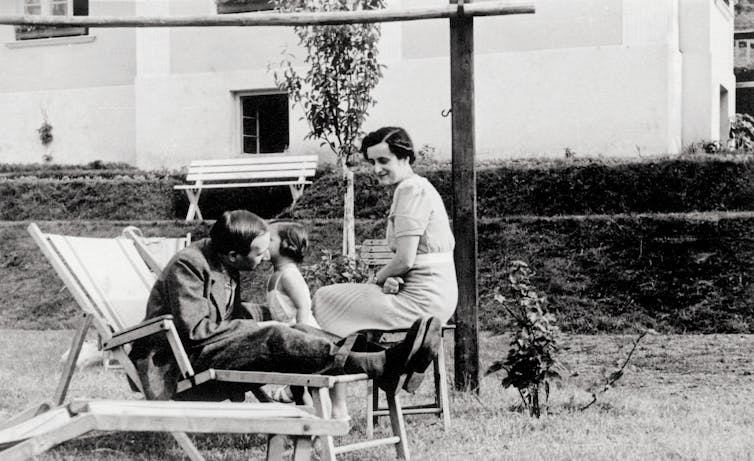
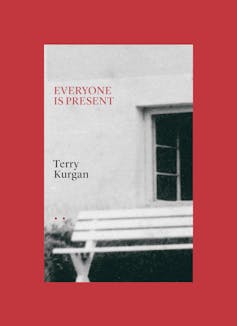
The first photograph in Terry Kurgan’s Everyone is Present shows what appears to be a mid-20th century idyllic scene of a young family at a spa in southern Poland.

It’s a scene that puts one in mind of the reverie in old photographs described by French theorist Roland Barthes in Camera Lucida and the nostalgic fragments used so evocatively by the Anglo-German novelist W.G Sebald in Austerlitz and elsewhere.

But Kurgan, the Johannesburg-based artist, writer and curator, is more forceful in her efforts to wrest meaning from this and other images. She “longs to be able to sit inside this photograph”, as she puts it, to work actively on its subject. She juxtaposes this image with others from the album she inherited from her grandfather, Jasek, to include the rest of the extended family and something of their complicated histories.

And she correlates the album with correspondence with family members and extracts from Jasek’s diary. That woman in the photograph is Jasek’s wife, Tusia, Kurgan’s grandmother. The child is Kurgan’s mother and the man reclining on the deck chair is Doctor Lax, who at that time was Tusia’s lover.

This photograph, she discovers, must have been taken in the summer of 1939, as Kurgan writes, “on the eve of one of the greatest atrocities of the twentieth century”.

In other photographs taken at the spa, people are shown reading newspapers that were likely reporting the threat from Nazi Germany. But there appears to be no reaction to this impending catastrophe. It’s the silence of these images on such matters that drives Kurgan to devise forceful new techniques to unlock their meaning.

She scans the photographs and scrutinises them on her computer screen: clothing, expressions, gestures all take on new significance as their detail is revealed. Objects or, as Kurgan calls them, “stuff”, are discovered and identified in the shadows and revealed as the repositories of intensely personal histories: what happened to the furniture when the apartment was abandoned? What happened to the cat? Did anybody water the flowers?

Connectedness, strife and betrayal

In another bid to get closer to her subject, Kurgan Googles the spa depicted in these early images. It is now trading on the days of its former glory, typified in the furniture and other objects shown in Jasek’s photographs.

The photograph that underpins the second section of the book on the family’s flight from Poland as the Nazis invaded – and were welcomed by a large section of the local population – shows the street below the family’s apartment in the town of Bielsko. It is deserted except for two unknown men who appear to react to Jasek at the window.
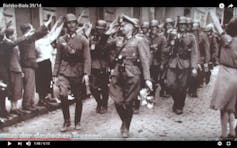
Locals welcome Nazis as they invade Poland.
Supplied

Kurgan uses Google Street View to determine that the neighbourhood has changed very little over the past 70 years. But while Google allowed Kurgan an astonishing proximity to this distant place, it’s the random connection with the two men on the street in Jasek’s photograph that she ultimately finds to be more meaningful and real. She writes:

As social beings, we want to matter, to be noticed, to connect.

In a similar bid for connection, Kurgan regularly elides time when she wants to communicate the horror of the Holocaust, the Polish population’s complicity in this history, and even the lasting influence of previous generations of one’s own family.

She reacts to Jasek’s account of his arrival at Auschwitz – the concentration camp at which more than 1.1 million people were killed during the Holocaust – while it was still an ordinary Polish market town:

This short sentence plummets through the page, through my desk, through this grey concrete floor, and through the deep red Johannesburg earth.

And, on Jasek’s photograph of Roza, formidable mother of his perennially flirtatious wife: “She rebuffs him and ourselves in that split-second moment, and forever, as we gaze at her across more than seventy-five years. Now.”

Kurgan weaves major themes of modern Jewish history around Jasek’s account, in the diary and the photographs, of the family’s perilous flight from Poland via Romania, Turkey, Syria, Iraq, India and Kenya to Cape Town.

She notes repeatedly the different forms of betrayal perpetrated on Eastern Europe’s Jews by the people they had lived among for generations, when endemic anti-Semitism erupted on the back of the Nazi invasions, whether through direct assault, complicity or simply looting. Again, these are the histories of “stuff”.
For the affluent, their flight was not quite comparable to the current waves of migration moving, as Kurgan notes, in the opposite direction into Europe. But the experience of prejudiced bureaucracy, arbitrary closing of borders and abrupt implementation of quotas must have been just as humiliating.

Jasek’s photographs seemingly ignore these awful realities. They focus for the most part on family life with its own versions of strife and betrayal. Indeed, by all accounts, it was impossible for those caught up in it to make sense of this maelstrom.

History is now

In the end, Kurgan herself visited Poland: both the sites of her personal family history and those monuments of evil, the death camps.

Noticing her own reflection in a mirror as she tries with her camera to capture “a molecule of air they might have breathed”, she accepts the impossibility of this “very particular kind of retrieval”.

But that, of course, is the point. History is as much about the questions we ask as the answers it provides. In this book – by turns lyrical, angry, frustrated and forgiving – time collapses. The photographic present joins the past to the present. Everyone is present. Now.

Fourthwall’s production of the book, the quality of its images and the sensitivity of its design provide an excellent vehicle for both the strength and the delicacy of Kurgan’s essay.The Conversation

Michael Godby, Emeritus Professor, University of Cape Town

This article is republished from The Conversation under a Creative Commons license. Read the original article.

Unknown's avatar

Finished Reading: An Act of War by Michael O’Connor


An Act of WarAn Act of War by Michael O’Connor
My rating: 3 of 5 stars

I first read this book at least 20 years ago and I think I read it in a day back then. I probably would have given it 4 stars back then and though I still enjoyed it this time, I don’t think I enjoyed it as much as I did the first time. It was still a good read though – it just didn’t have the polish I now expect from books I would give 4 stars to.

View all my reviews

Unknown's avatar

Book: Are short prime ministerships the new normal?


File 20181106 74754 yhd9jn.jpg?ixlib=rb 1.1
Malcolm Turnbull was the latest prime minister to be ousted before the end of his term in August, 2018.
AAP/Sam Mooy

Benjamin T. Jones, Australian National University

This is an edited extract from Elections Matter: Ten Federal Elections that Shaped Australia (Monash University Press 2018), edited by Benjamin T. Jones, Frank Bongiorno and John Uhr.


In 2004, the Australian Labor Party, led by Mark Latham, was expected either to win or closely contest the upcoming election. Instead, John Howard’s Liberal-National Coalition secured a comfortable victory, increasing its majority in the House of Representatives and securing a majority in the Senate.

Although disappointed, Labor took comfort in the fact that it had taken the coalition five attempts to oust the Hawke-Keating Labor governments. The conventional wisdom was that Australians simply do not change governments quickly. With the turbulent Whitlam years seen as an exception to the rule (and even he secured two successive victories), in post-war Australian politics, long terms in office was an expectation.


Read more:
Moment after moment of madness: Liberals manage the ugliest, messiest leadership challenge in history


This view might now be considered the old normal. Following the landslide Kevin07 victory, many predicted Kevin Rudd would be a long-serving prime minister, perhaps handing the reins to his popular deputy, Julia Gillard, in a third or fourth term. That he did not even see out one full term in office marked a new era in Australian politics.

Rudd’s swift dismissal cannot be explained away by his personal traits or leadership style. With Australia’s first female prime minister at the helm, Labor clung onto power following the hung parliament result of 2010 with support from nominally conservative rural independents Tony Windsor and Rob Oakeshott. Once again, a new prime minister would not see out a full term, with Rudd wrestling back control after a second leadership challenge.

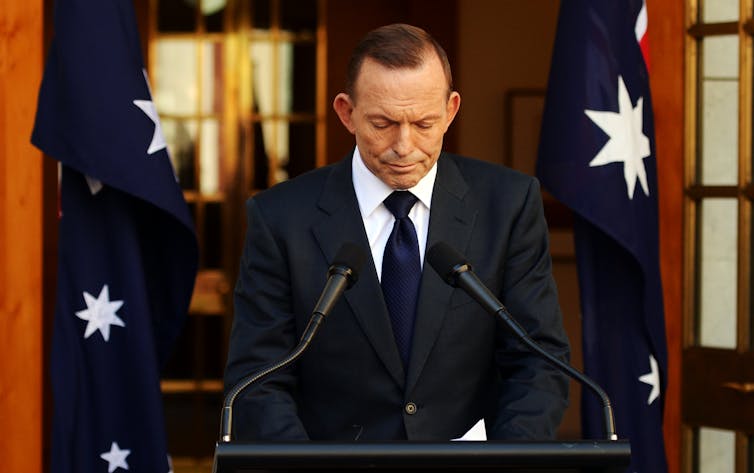
Tony Abbott was defeated by Malcolm Turnbull in a leadership ballot in 2015, following Labor’s pattern of not allowing prime ministers to serve out their terms.
AAP/Sam Mooy

This could perhaps be explained away as a particularly dysfunctional episode of Labor rule, except the Coalition would then follow the same pattern. In 2013, the newly-elected Abbott government promised strong and stable government under Coalition rule. “The adults are back in charge”, he smugly claimed. And yet, Abbott too would fail to see out his first term as prime minister, losing a leadership challenge to Malcolm Turnbull in 2015.

Turnbull won the 2016 election by a single seat in the lower house and the Coalition has consistently trailed Labor in the polls. As with the previous three terms of parliament, the prime minister who claimed electoral victory would not survive till the end.

This is the new normal of Australian political life. The coup against Turnbull marked the fourth consecutive term with a change of prime minister. John Howard in 2004-7 was the last prime minister to serve a full term in office, and even he was plagued by persistent leadership rumours leading to a public promise that he would hand over power to his deputy Peter Costello.

The new normal is marked by electoral volatility. The major parties can no longer take for granted a primary vote in the high 30s. As the Greens, Palmer United, One Nation, and the Xenophon Team, have shown, Australia is more willing than ever to cast large numbers of votes for minor parties as well as independents. It is no longer a truism that Australians do not change government quickly.

The old normal would presume that an incoming federal government will set the national agenda for a decade or more. Especially after the 2010 result, one term governments are entirely conceivable. The most pronounced feature of the new normal is the ease with which a prime minster can be replaced. Dumping a first term prime minster, considered political hubris for so long, is now a regular occurrence.

The BBC dubbed Australia the “coup capital of the democratic world” in 2015. Should Scott Morrison lose the 2019 election, there will have been six prime ministers in the six years since 2013.

Although the new normal represents a profound change, it is far from unprecedented. Australia had three prime ministers in 2013. While this may have seemed historic, it is the fifth time this has happened (1945, 1941, 1939 and 1904).

The early Federation period saw a high turnover of prime ministers. It was only when Billy Hughes took the top job in 1915 that Australia saw its first long-serving prime minister (seven years, 105 days) albeit with three different parties.


Read more:
Grattan on Friday: Morrison ticks the boxes but can’t hide the dysfunction


To the pessimist, the frequent change of prime ministers over the last decade can be seen as evidence of political instability and turmoil. Alternatively, much like Australian politics at the dawn of the 20th century, it could be seen as evidence of the flexibility built into Westminster democracy. It is a system that allows parties and leaders to change without always needing a fresh election. With Australian federal elections already frequent, every three years compared to four in the US or five in the UK, it is perhaps a blessing that a new prime minister does not necessitate a new election.

Kevin Rudd’s changes to the party rules mean it is probable – but by no means assured – that the next Labor government will serve a full term without changing leader. While it is unlikely the ALP will oust their next prime minister, there is no such guarantee from the public now used to a short turn-around of both parties and leaders.

How long the new normal lasts is entirely up to the electorate. The old saying goes that in a democracy, you get the government you deserve. This is particularly true of Australia, with around 95% of the adult population taking part in federal elections. Voters are empowered and elections do matter.The Conversation

Benjamin T. Jones, Australian Research Council Fellow, School of History, Australian National University

This article is republished from The Conversation under a Creative Commons license. Read the original article.
Unknown's avatar

Finished Reading: Throne of Glass (Book 2) – Crown of Midnight by Sarah J. Maas


Crown of Midnight (Throne of Glass, #2)Crown of Midnight by Sarah J. Maas
My rating: 4 of 5 stars

View all my reviews

Unknown's avatar

Not My Review: The Folk of the Air (Book 1) – The Cruel Prince by Holly Black


Unknown's avatar

Not My Review: The Secrets of Moldara by Brianne Earhart


Unknown's avatar

Not My Review: Frankenstein by Mary Shelley


Unknown's avatar

Guide to the classics: Euripides’ Medea and her terrible revenge against the patriarchy


File 20181118 44249 1qa6aiz.jpg?ixlib=rb 1.1
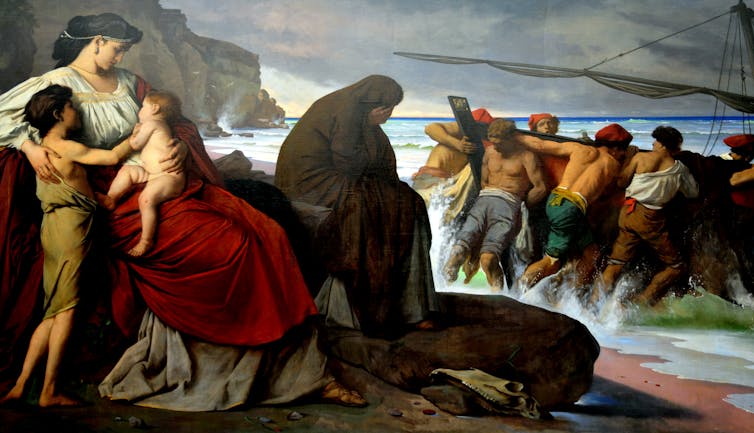
Anselm Feuerbach’s depiction of Medea, circa 1870: the play is particularly cogent today in the context of the #MeToo movement’s assault on patriarchal power.
Wikimedia Commons

Paul Salmond, La Trobe University

The Athenian poet Euripides was the last of the three great Greek tragedians (after Aeschylus and Sophocles) and also the least successful.

Greek tragedies were performed competitively at religious festivals in Athens in honour of the god Dionysus. While 18 of his 90-odd plays have survived, Euripides claimed only four festival victories. One prize was awarded posthumously, indicating that at the Dionysia, as with the Oscars, death could be a handy avenue to success.

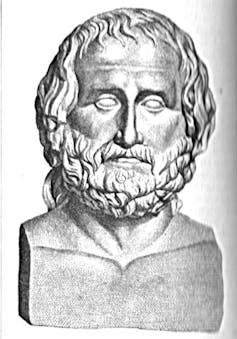
Sculpture of Euripides.
Wikimedia

It’s not difficult to see how Euripides estranged the festival judges. Unlike the intricate plotting of Sophocles, exemplified by the intriguing whodunit devices employed in Oedipus The King, Euripides’ interest lay in the psychological motivations of his characters. Some scholars accordingly describe his plays as more modern than his contemporaries.

Euripides challenged conventions by depicting strong, passionate female characters and cynical, often weak male mythological heroes. He was considered more of a social critic than his contemporaries, who disparaged his emphasis on clever women.

In Aristophanes’ comedy The Thesmophoriazusae, the women of Athens use an annual fertility festival to plot secret revenge on Euripides for his depiction of them as crazed, sex-addicted killers. The central joke is not that Euripides is defaming women in his plays, but rather that he is onto them and must be stopped before he reveals more.


Read more:
Guide to the classics: Thucydides’s History of the Peloponnesian War


The Story

Euripides’ dismissal by some as a misogynist sits uncomfortably alongside his complex and sympathetic female characters. Medea is a case in point: a sorceress and former princess of the “barbarian” kingdom of Colchis, she mourns the loss of her husband’s love, the hero Jason. To further his political ambitions, Jason abandons Medea in order to marry a Corinthian princess.

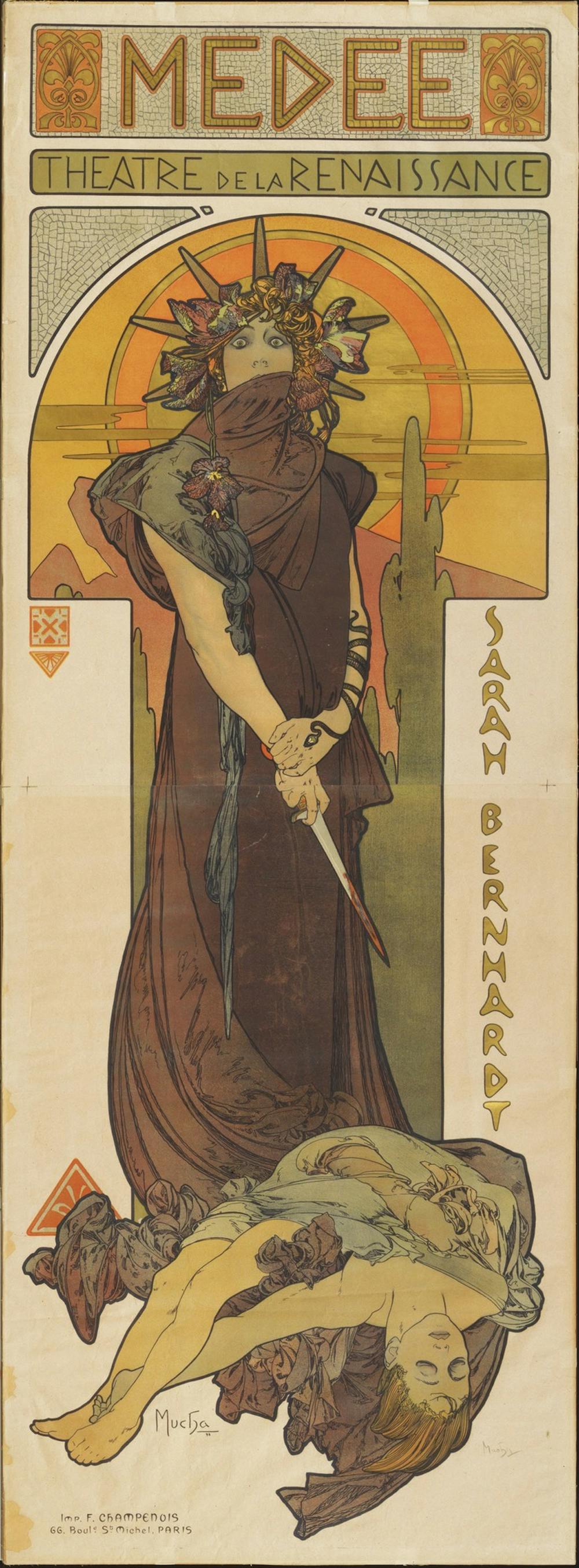
An 1898 poster for the play.

Medea confides her grief to her nurse and the Chorus of Corinthian women who sympathise, but fear her response; and these fears are well-founded. Medea takes horrible vengeance on Jason by murdering his new wife then slaughtering their own children.

The play ends like a brutal thunderclap as Medea escapes to Athens in a dragon-drawn chariot, flanked by the corpses of her sons, mocking Jason’s agony and revelling in her victory.

Jason predicts justice will pursue Medea (“The curse of children’s blood be on you! Avenging justice blast your being!”) but so complete is his defeat, this threat seems empty. Medea has inflicted savage sacrifices to wreak her revenge and now, revealed in all her supernatural splendour, no one can touch her.

The Athenians don’t seem to have responded particularly well to Medea in so far as the festival judges placed it third. This might in part be attributable to poor timing. Medea was performed first in the spring of 431 BC, a few weeks before the Spartan king Archidamus invaded Attica – initiating the 27-year Peloponnesian War that proved catastrophic for Athens. War had been brewing for a decade and in their state of profound anxiety perhaps Athenians were simply in no mood for the horrors Euripides was offering.

But there are other reasons for Medea’s failure. As a barbarian from the wild realm of Colchis (in modern Georgia) Medea would be inherently untrustworthy to an Athenian audience. They might sympathise with her feelings of isolation and homesickness (“Of all pains and hardships none is worse than to be deprived of your native land”) but she remained associated with the Eastern “other” that marched into Greece under the Persian king Xerxes and sacked Athens 50 years previously.

Traditionalists might also have objected to Medea’s sexual politics. In Medea more than his other plays (The Trojan Women excepted) Euripides depicts a world where the steadfastness and bravery of women count for nothing amid the machinations of men (“we women are the most wretched…I’d rather stand three times in the front line than bear one child”).

Artemisia Gentileschi, Medea, circa 1620.
Wikimedia Commons

Medea’s lament may seem admirably subversive to a modern audience but it appears that the festival judges had little appetite for the gender conflict that so fascinated Euripides. It’s worth noting that Euripides’ plays grew in popularity after his death, so it’s likely their “salacious” content enjoyed a better reception outside the formal competition environment.

Despite Euripides’ popularity with modern audiences Medea remains a challenging play. Although scenarios of fathers “avenging” themselves on their wives through killing their children are depressingly familiar to us, the resolve of a mother to destroy her enemies through sacrificing her children is fundamentally distancing.

Medea may be a prisoner to her passion (“Oh, what an evil power love has in people’s lives!”) but she plans her vengeance with cold brutality. Only her female confidants sense with dread what she is up to and who can they tell?

Adaption of the classic

That said, Medea’s remorseless depiction of a woman forced to strike against an oppressive patriarchy did see it embraced by the 1960s counterculture. Pasolini adapted the play in his polarising style in 1969, but Medea’s themes were not borrowed to the extent of other Greek works during the American cinematic Renaissance of the 1970s (Roman Polanski, for instance, used Sophocles’ Oedipus as his canvas for 1974’s Chinatown).

A sympathetic depiction of a grieving mother killing her children to ruin her husband seemed too great a hurdle for filmmakers. Decades later, however, Ridley Scott channeled Medea’s denouement in having Thelma and Louise take violent revenge against the patriarchy and refuse to be taken – “escaping” in their airborne chariot, their male pursuers looking on impotently.

Thelma and Louise take violent revenge against the patriarchy and refuse to be taken – “escaping” in their airborne chariot.

Medea is particularly cogent today in the context of the #MeToo movement’s assault on patriarchal power. Euripides’ fascination with women outscheming their “masters” and striking back lethally springs from an anxiety at the heart of Athenian society.

Medea, Hippolytus and Aristophanes’ comedies seemingly demonstrate that the cloistering of Athenian women did not result from a male assumption they were unintelligent or weak. On the contrary, it reflects a belief in a vicious cycle where the subjugation of women made them intent on revenge, making it a social necessity to oppress them further.

As a modern articulation of Medea’s themes, the play’s central message was distilled to its essence in Clint Eastwood’s 1992 revisionist Western Unforgiven. A “chorus” of prostitutes commission bloody revenge on men who mutilated one of their sisterhood.

When townsmen gather angrily outside the brothel after one of the murders, the group matriarch screams from above “He had it coming! They all have it coming!” To Medea, truer words were never spoken.The Conversation

Paul Salmond, Honorary Associate, Classics and Ancient History, La Trobe University

This article is republished from The Conversation under a Creative Commons license. Read the original article.

Unknown's avatar

Finished Reading: Backyard Organic Gardening – Easily and Effortlessly Create Your Own Organic Gardening Oasis for Optimal Health and Nutrition


Backyard Organic Gardening: Easily and Effortlessly Create Your Own Organic Gardening Oasis for Optimal Health and Nutrition (Seven Steps to a Successful ... Backyard Homestead, Gardening for Beginners)Backyard Organic Gardening: Easily and Effortlessly Create Your Own Organic Gardening Oasis for Optimal Health and Nutrition by Prescott Marshall
My rating: 1 of 5 stars

View all my reviews

Unknown's avatar

Not My Review: Red Rising (Book 3) – Morning Star by Pierce Brown