In Charlotte Brontë’s novel Jane Eyre (1847) the marriage ceremony of Jane Eyre and Edward Fairfax Rochester is spectacularly interrupted by the solicitor Mr Briggs declaring an impediment to the union: the prior marriage of Rochester to Bertha Antoinetta Mason in Spanish-town, Jamaica. Taken then, with others, to see the wife secreted in a third-story windowless room at Thornfield Hall, Jane remembers,
What it was, whether beast or human being, one could not, at first sight tell: it grovelled, seemingly, on all fours; it snatched and growled like some strange wild animal: but it was covered with clothing; and a quantity of dark, grizzled hair, wild as a mane, hid its head and face.
Rochester later explains to Jane that Bertha is “bad, mad, and embruted”, of “pigmy intellect” and “giant propensities” toward the “intemperate and unchaste” which “prematurely developed the germs of insanity” passed on in the maternal line.
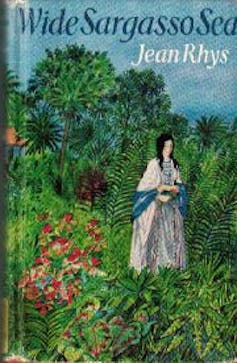
Wide Sargasso Sea was first published in 1966. Wikimedia
Bertha’s mother is a Creole. In the British Caribbean, Creole meant born in the region. Creole was not of itself a racial descriptor. Distinctions were made between white, coloured and black Creoles.
Author Jean Rhys, a white Creole, took umbrage with Brontë’s stereotypical depiction of Bertha. She was “vexed” by Brontë’s “portrait of the ‘paper tiger’ lunatic, the all wrong creole scenes, and above all by the real cruelty of Mr Rochester”.
In writing what she initially thought of as the story of the first Mrs Rochester, published in 1966 as Wide Sargasso Sea, Rhys insists that her character Antoinette Cosway Mason Rochester “must be at least plausible with a past” and that she needs to establish:
the reason why Rochester treats her so abominably and feels justified, the reason why he thinks she is mad and why of course she goes mad, even the reason why she tries to set everything on fire, and eventually succeeds.
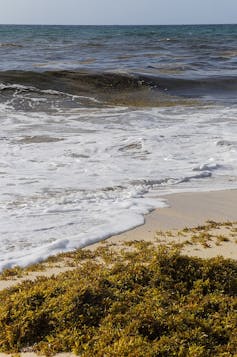
The Sargasso Sea is part of the Atlantic Ocean north-east of the Caribbean. Cut off from ocean currents, it is relatively becalmed and harbours drifts of sargassum seaweed.
In Rhys’s novel, the Sargasso Sea is a symbol of what separates Antoinette Cosway Mason Rochester and Edward Fairfax Rochester: disparate colonial and imperial histories and experiences; Rochester’s visceral racism and disdain for the mixing of cultures; his abhorrence and fear of the tropical landscape; and dispossession of Antoinette.
Rhys was born Ella Gwendolen Rees Williams in Roseau, Dominica in 1890, and lived as an expatriate in England and Europe from 1907 until her death in 1979. Wide Sargasso Sea was her fifth novel.
Her Welsh father William Rees Williams was a government medical officer who had settled in Dominica in the 1880s; her mother Minna was a white Creole whose family had lived for several generations in Dominica. Rhys’s great-grandfather James Potter Lockhart (1774-1837) had owned enslaved people and plantations. Rhys writes in her autobiography Smile Please that as he “was a slave-owner the Lockharts, even in my day, were never very popular. That’s putting it mildly”.
A prequel to Jane Eyre
Told in three voices — those of white Creole, Antoinette Cosway Mason Rochester, the young Englishman she marries, who implicitly reveals his own name to be Edward Fairfax Rochester when he renames her Bertha, and Grace Poole, Bertha’s keeper at Thornfield Hall — Wide Sargasso Sea is a prequel to Jane Eyre.
Internal evidence in Jane Eyre establishes that Brontë’s Rochester and Bertha marry in 1819 and that Jane Eyre returns to the ruins of Thornfield Hall and Rochester in June 1834. Wide Sargasso Sea, though, is set in the late 1830s and the 1840s.
Rhys’s choice of historical setting enables her to draw on and try to work her way through planter class and Lockhart family mythology about the economic and social impact of the abolition of slavery.
Historian and poet Kamau Brathwaite has described plantation slavery cultures as “race-founded & race-foundered”. Rhys’s ancestors, the Lockharts, kept family secrets about the massive debts owed by James Potter Lockhart. The British government paid financial compensation to slaveowners for the freeing of enslaved people. The monies James Potter Lockhart anticipated receiving were paid to his chief creditor in part payment of debt.
In Jane Eyre, Brontë uses Bertha’s monstrosity to question the morality of British divorce law, which keeps Rochester in a marriage in which coverture treats husband and wife legally as one person.
Rhys, rather, exposes the absence of a Married Women’s Property Act in Britain at the time the novel is set, the vitiating reach of the system of primogeniture by which property was inherited by eldest sons, and too convenient use of the criminalisation of obeah. Obeah comprises healing and spiritual practices which draw on African-Caribbean religiosity.
In Wide Sargasso Sea, the Rochester family and Antoinette’s stepfamily organise an arranged marriage between Edward and Antoinette. The Rochesters do this for a £30,000 dowry that will secure the prosperity of a second son and the Masons for kinship links to a landed English family. The Masons do not make a separate financial settlement on Antoinette, leaving her no means if she abandons the marriage. Rhys’s Rochester finds the arranged marriage unmanning.
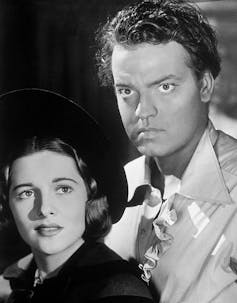
Jane Eyre and Edward Rochester in the 1943 film adaptation of Jane Eyre. Wikimedia Commons
Christophine, rumoured to be an obeah woman, has been both a slave and servant of the Cosway and Mason families and is hired when Antoinette and Rochester honeymoon at Granbois, an estate in Dominica. When Christophine confronts Rochester over his ill-treatment of Antoinette, Rochester threatens to report her to the local police if she does not leave immediately.
The Rochester figure thinks of Antoinette, “Creole of pure English descent she may be, but they are not English or European either”. He is tapping into common British ideas at the time of the degeneration of white people in the tropics, ideas still current into the 20th century.
Brontë’s Rochester’s use of the word “intemperate” to describe Bertha marks her Creoleness as a tropical identity. White Creole degeneracy was seen to be an effect of the tropical climate, the physical and social environment, living in close, domestic proximity to non-white people, and the corrupting influence of slave ownership.
Rhys likens phases of her work on Wide Sargasso Sea to making a “complicated” patchwork quilt: unpicking, cutting, repurposing, and stitching of material as part of a new narrative design.
Part of her countering of Brontë’s characterisation of Bertha is the setting up of similarities between Jane and Antoinette: social dislocation after the deaths of fathers; complex patterns of having surrogate mother figures; education at a girls’ school, Lowood in Jane’s case and a convent in Antoinette’s case after her mother Annette, grieving over the death of a son, is institutionalised as insane; and experiencing prophetic dreams, for example.
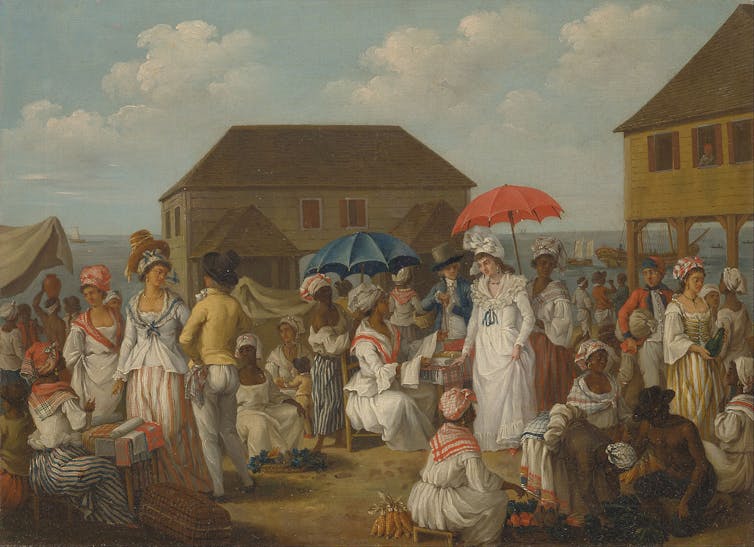
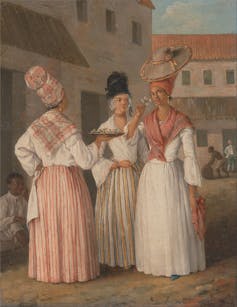
A West Indian Flower Girl and Two other Free Women of Color. Oil painting by Agostino Brunias. Wikimedia Commons
Rhys draws out the limits of the reliability of Antoinette’s and Rochester’s points of view. In Part One, Antoinette’s memories of childhood, the narrative highlights the narrow reach of her social experience and the ways her colonial values and language are shaped by reliance on the outlooks of her mother and her circle. Rochester finds the tropics and the fragility of European imperial enterprise disorienting and threatening. He fears being engulfed by them, by desire for Antoinette’s exoticism, and by the proximities of cultural and racial difference.
In developing the character of Rochester, Rhys draws not only on Jane Eyre, but also on William Shakespeare’s Othello and Macbeth, and Charles Baudelaire’s Le Revenant.
At 76 and in poor health, Rhys won the W.H. Smith Award for Writers and the W.H. Heinemann Award of the Royal Society of Literature for Wide Sargasso Sea. She accepted a CBE in 1978. Rhys insisted that fame and greater financial security from prizes, royalties and writing grants came “too late” in life for her to enjoy fully. At her death Rhys was working on autobiographical vignettes which, edited by Diana Athill, were published in 1979 as Smile Please: An Unfinished Autobiography.
Adaptations of the novel
Scenes from Wide Sargasso Sea were filmed for Sargasso! A Caribbean Love Story (1990), a University of the West Indies initiative. The 1993 Australian film of Wide Sargasso Sea was directed by John Duigan and produced by Jan Sharp. In 2006 Brendan Maher directed a telemovie of Wide Sargasso Sea for BBC Wales.
BBC 2006, Wide Sargasso Sea telemovie.
Rhys’s re-visioning of a classic has inspired writers from around the world to do the same and literary critics to theorise the dynamic of authors from colonial and ex-colonial cultures writing back to European texts and to examine the intersections of the treatment of ideas of racial, gender, sexual and class identities in women’s writing.
Wide Sargasso Sea has been seen, with John Fowles’s The French Lieutenant’s Woman (1969), as originating neo-Victorian literature. Research on Rhys’s larger body of writing has been reshaping the field of New Modernist Studies.
Since the 1980s, Charlotte Brontë and Jean Rhys have often been made and remade, indeed celebrated in each other’s images. “Wide Sargasso Sea has literally wound its way into … subsequent rewritings of Jane Eyre”, comments critic Armelle Parey.
As examples, artist Paula Rego’s early 21st-century lithograph series Jane Eyre was shaped by her reading of Wide Sargasso Sea and Bertha figures are given humanity and a human voice in David Malouf’s libretto for Michael Berkeley’s chamber opera Jane Eyre (2000) and in Coral Lansbury’s Ringarra (1985), a reworking of Jane Eyre in a contemporary Australian setting.
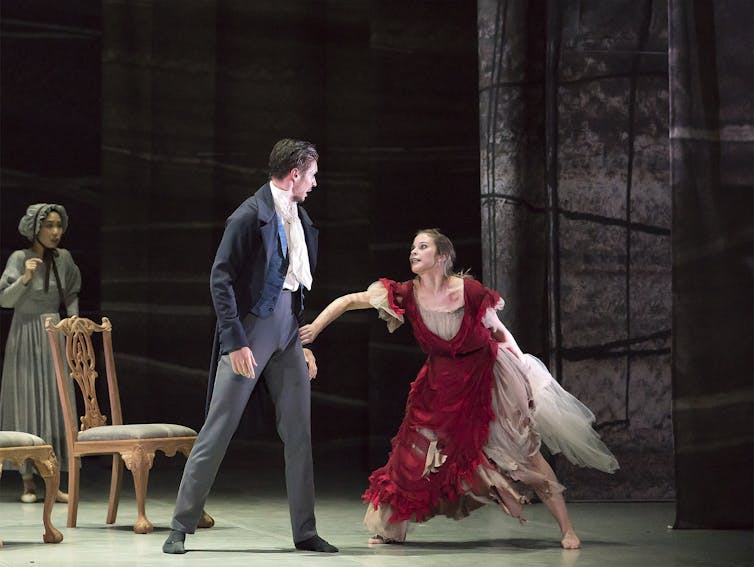
Confined at Thornfield Hall, Rhys’s Antoinette longs for a favorite red dress which powerfully reminds her of her Caribbean home. Bertha Mason now often appears in red dress on stage, as in Polly Teale’s Jane Eyre (1997), which rapidly became the most performed adaptation of Brontë’s novel around the world and the 2015 National Theatre Live production of Jane Eyre broadcast by satellite to cinemas.
Joseph Taylor as Mr Rochester and Mariana Rodrigues as Bertha Mason in Jane Eyre. The Lowry/flickr
As my account of Rhys’s influence suggests, Wide Sargasso Sea has particularly engaged Australian writers, playwrights, filmmakers, sound artists and composers. Barbara Hanrahan’s narrative about Stella Edenbrough and Moak in The Albatross Muff (1977), for instance, is an allusive reworking of aspects of Antoinette’s relationship with Christophine and features colonial fortune-hunting.
Woman in the Attic (1987), by Gabby Brennan and Polly Croke, directed by Peter Freund, and performed by Whistling in the Theatre at the Anthill Theatre in Melbourne, blends adaptations of both Jane Eyre and Wide Sargasso Sea. Paul Monaghan directed and devised Obeah Night, performed at La Mama, Melbourne, in 1993. A combination of physical theatre, opera and spoken text, it is based on Part Two of Wide Sargasso Sea.
Brian Howard’s opera Wide Sargasso Sea was performed by Chamber Made Opera in Melbourne in 1997, directed by Douglas Horton. Jennifer Livett’s Wild Island (2016) reworks both Jane Eyre and Wide Sargasso Sea in one of its plotlines.
Most recently Willoh S. Weiland and Halcyon Macleod’s Crawl Me Blood, a sound and video installation, with a music track devised by Felix Cross, was staged in Hobart and Melbourne in 2018. Set in the Caribbean in 2018, the narrative develops motifs from Rhys’s novel to provoke audiences to think about the racialised legacies of colonialism there and in contemporary Australia.
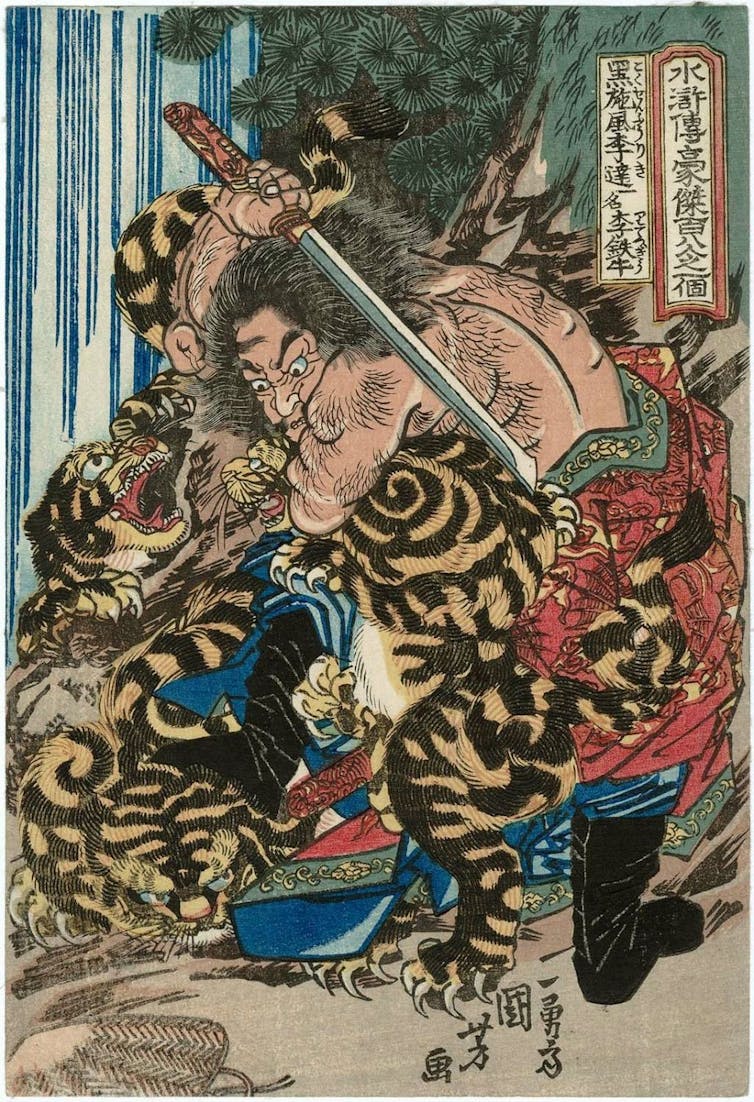
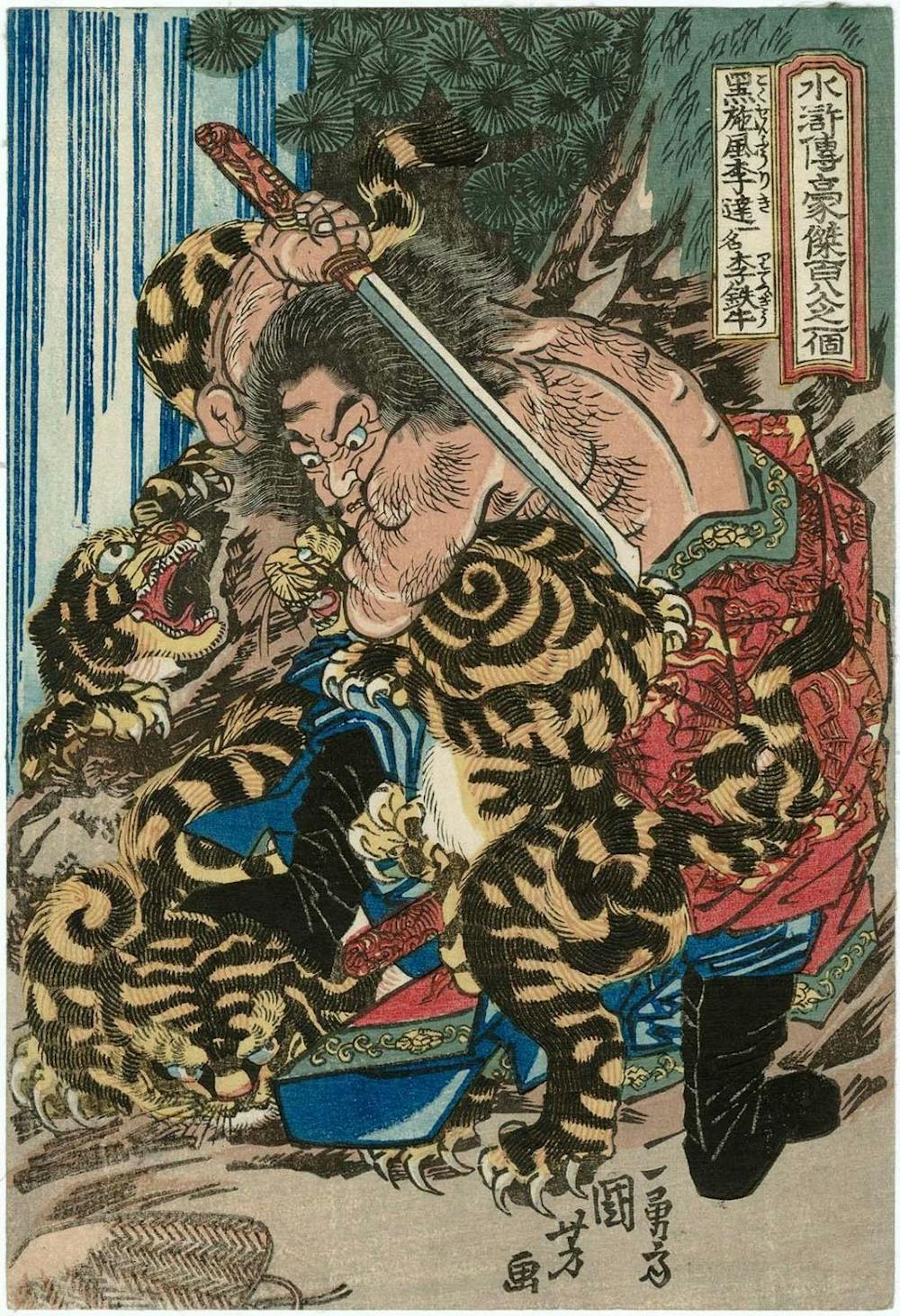
Li Kui (李逵), one of the characters in The Water Margin, battles tigers after they killed his mother. Utagawa Kuniyoshi, between between 1845 and 1850. Wikimedia
The Water Margin, also known in English as Outlaws of the Marsh or All Men Are Brothers, is one of the most powerful narratives to emerge from China. The book, conventionally attributed to an otherwise obscure Yuan dynasty figure called Shi Nai’an, takes the form of a skein of connected tales surrounding various heroic figures who — persecuted, exploited, wronged, or trapped by venal officials — eventually band together in the fortress of Liangshan (Mount Liang), in the present-day province of Shandong.
Its influence has gone far beyond the usual genres of fiction, film, art, and theatre. The stories provide, even today, a point of reference for codes of honour, social and economic networks, secret societies and political movements.
Generations of China’s governments have sought to represent themselves as guardians of an often explicitly neo-Confucian order characterised by a fixed and morally-grounded political and social order constructed of hierarchical relationships. But The Water Margin represents another, equally real and representative, Chinese worldview. In this world, local injustice is the rule, and defence against cruel local authority is a matter of vengeance, stratagem, and violence.
From this universe, itself a highly mediated depiction of the rapidly decaying Northern Song dynasty in the 12th century, derive fictional worlds of errantry, struggle and righteousness that have gone through endless narrative and cinematic iterations.
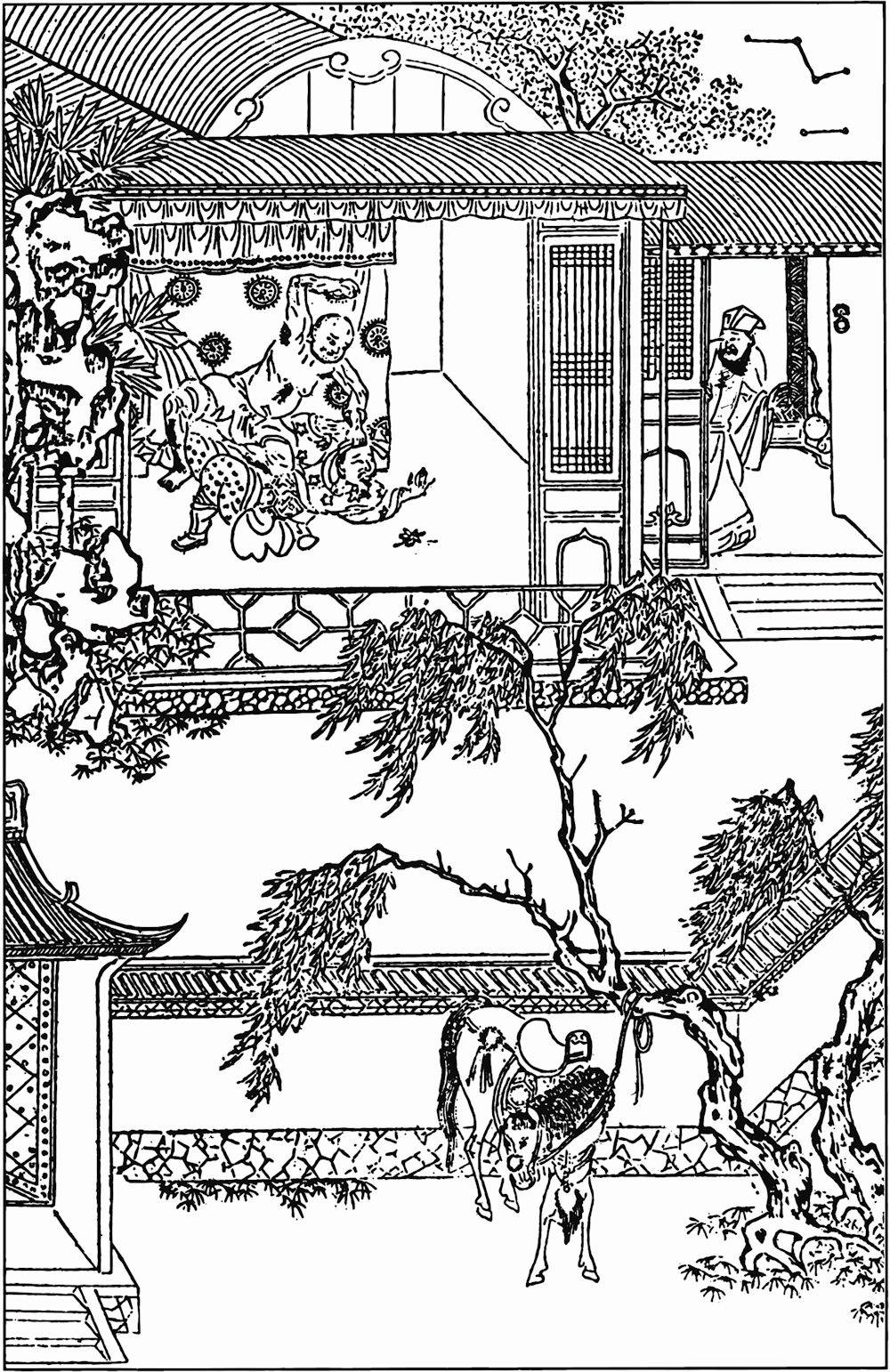
Illustration from The Water Margin. Circa 15th Century. Wikimedia
Of these descendants, the most familiar today are the fictional worlds of Hong Kong writer Jin Yong, which remain the closest thing to a reading list for adolescents in the Chinese world, and the kung fu genre that has been the global calling card of Sinophone film since at least Bruce Lee.
Rebels with a cause
With printed versions dating back to the 14th century, The Water Margin largely follows the adventures of strongmen, innkeepers, footpads, peasants, vagabonds, fishermen, hunters, petty officials and local gentry. Surrounding these protagonists are the thousands of nameless followers and victims who are knocked off or maimed (just as they might be casually dispatched in Homer) in the novel’s thousand-odd pages.
Women, when they (not so very often) appear, are hard-nosed mistresses, pugnacious sisters, hapless wives, strategising helpmeets, or murderous innkeepers (one of whom has hit on Mrs. Lovett’s idea of baking humans into pies a full 800 hundred years before her). This also sets it apart from the mainstream of imperial fiction, which is substantially preoccupied with the passions and travails of high-born, talented women and their ambitious scholar swains, not to mention emperors and generals.
It is only a novel after a fashion: The Water Margin’s text is substantially the record of stories that had already been circulating at the time it was committed to the page. Shi Nai’an’s authorship is little more than a conventional attribution, and the text is far from stable, existing in various versions beginning from the 14th century, two hundred years after the events it depicts. It reached its usual present form in the 17th century.
In the Ming (14th-17th century) and Qing (17th-20th century) dynasties, the bandits of The Water Margin continued to influence all manner of groups operating far from the seat of power, despite periodic attempts to ban the book.
The fact that the villains of the novel are local officials, while the bandits remain at least notionally loyal to the imperial court, has proven an enduring inspiration. Many are the brands of rebellion that have found it practical to be on the other side of the law while retaining a claim to the values of brotherhood, honour, loyalty and patriotism.
Enduring legacy
The plot’s political relevance has never gone away. Having been adopted in the 1930s by reformers as a healthily anti-feudal narrative, it was later deployed in a major 1975 government campaign, in which the leader of the Liangshan bandits in the book, Song Jiang, was criticised for accepting the emperor’s offer of amnesty. Had he not given the game away? And was he therefore not guilty of coexistence with forces inimical to the masses, just as party members, late in the Maoist era, would be guilty of capitulationism if their fervour flagged?
This move, widely interpreted as an effort to head off the fall of the Gang of Four shows how centrally the characters have been retained even in modern and contemporary Chinese consciousness.
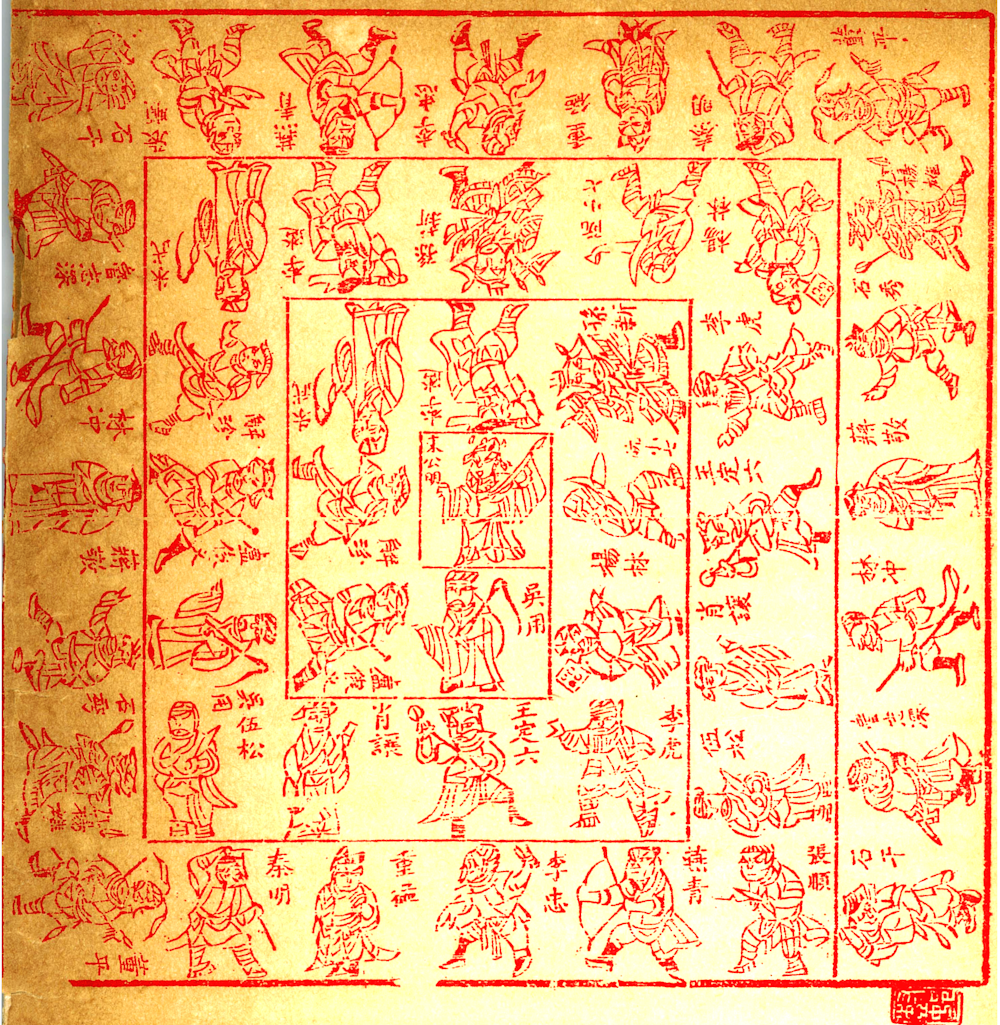
A board for a Sichuan board game, based on The Water Margin. Wikimedia, CC BY-SA
It’s commonplace to lament human transience and contrast it with the immutability of nature. But those going in search of the dense marshlands of Shandong —- where in the novel crafty fishermen might cause unwary inconvenient minor officials to disappear —- will be disappointed. The entire geography of the novel has been altered beyond recognition by river engineering and irrigation.
This of course does not prevent local governments continuing to put up buildings tagged to certain events in the novel, hoping at the same time that the message of righteous rebellion against local authority is never taken too literally. The formidable, impregnable, fortified mountain, Liangshan, rises just short of 200 metres in reality.
The place of The Water Margin has moved almost entirely into the imaginary, and it is the situations, the events, the stratagems and above all the characters – furious and righteous, looking to set the world right – that have left their mark on posterity.






 At the BookShelf


You must be logged in to post a comment.