The Great Gatsby, F. Scott Fitzgerald’s 1925 masterpiece of the Jazz Age, ushers readers into a corrupt but glittering world of cocktails, fast cars, stolen kisses and broken dreams. Status anxiety and conspicuous consumption generate a dazzling, often surreal poetry as the novel unfolds over a single summer in Long Island, New York. Beneath them trembles an ominous sense of malaise.
The novel is narrated in the first-person by Nick Carraway, a well-to-do Yale graduate from the Midwest, whose limited acquaintance with the millionaire Jay Gatsby is the reader’s only window onto the mysterious title character.
Fitzgerald’s editor Max Perkins complained to the author that Gatsby’s characterisation was too vague — that readers “can never quite focus upon him” — but this criticism missed the point. Jay Gatsby is not a man but “an unbroken series of successful gestures”, the product of an age — not unlike today’s culture of Instagrammable celebrity — in which identity is less a matter of innate qualities than of projecting an image.
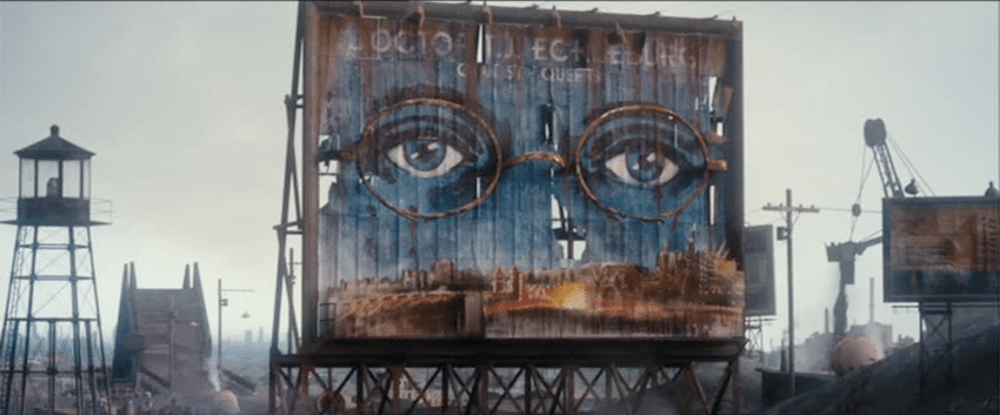
Fittingly, the only God invoked in Gatsby appears on a billboard, in the famous image of oculist Dr J.T. Eckleberg’s gigantic blue eyes looking down on events in admonition.
Oculist Dr J.T. Eckleberg’s all-seeing eyes, here in Baz Luhrmann’s film, look down on events. ResearchGate, CC BY
The Great American novel
Although short in length, The Great Gatsby is widely recognised as an exemplar of that most elusive of literary phenomena: the Great American Novel. It achieves aesthetic greatness as a self-conscious tour de force, the product of Fitzgerald’s desire “to write something new – something extraordinary and beautiful and simple [and] intricately patterned” as he wrote in a 1922 letter to Perkins.
Its American-ness is likewise self-conscious: one of Fitzgerald’s working titles was Under the Red, White, and Blue, and Nick’s account of Gatsby’s rise and fall exposes deep flaws and fissures underlying the American Dream of unlimited social mobility.
Affirming the presence of class prejudice in the land where all men were supposedly created equal, Gatsby constructs a fragile romance across the gulf between old and new money — a gulf that separates Gatsby from his love interest Daisy and her husband Tom Buchanan. Whereas Daisy and Tom come from established families, Gatsby lacks pedigree. The sources of his vast wealth are the subject of much speculation as his colossal mansion dwarfs those of other millionaires with freshly-minted fortunes.
Erosion of orthodoxies
Like many of his modernist contemporaries, Fitzgerald was fascinated by the erosion of old orthodoxies and traditional constraints in the aftermath of the first world war. For women, many taboos on dress and deportment were lifting, and Gatsby’s female characters play sports, dance wildly, and drink and smoke to excess — even in the midst of Prohibition. Yet for all its “spectroscopic gaiety”, such license brings little fulfilment.
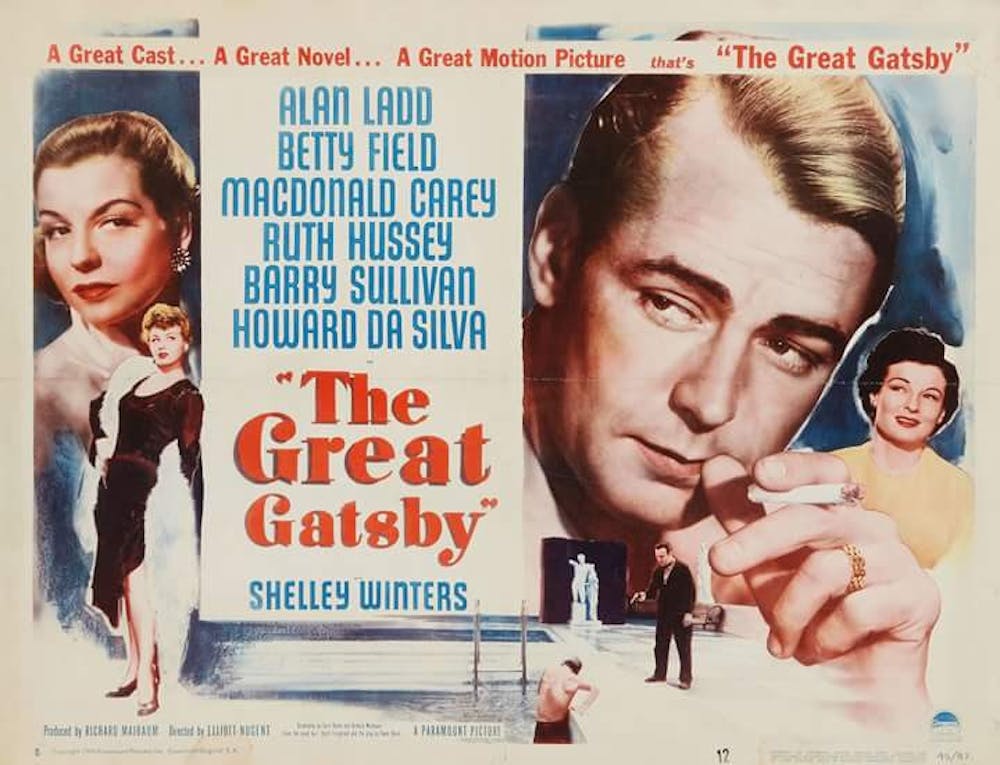
Shelley Winters starred in the 1949 film adaptation. IMDB/Paramount
In Chapter 1, the jaded Daisy expresses a sense of crippling ennui: “I think everything’s terrible anyhow […] And I KNOW. I’ve been everywhere and seen everything and done everything […] God, I’m sophisticated!”
Those with the right connections can afford to be amoral. When Daisy accidentally runs down Myrtle and flees the scene in Gatsby’s “monstrous” car, Tom manages a cover-up, shifting the blame onto Gatsby. As Nick reflects:
They were careless people, Tom and Daisy — they smashed up things and creatures and then retreated back into their money or their vast carelessness […] and let other people clean up the mess they had made.
Social mobility and the question of race
In the year of Gatsby’s publication, US President Calvin Coolidge announced “the chief business of the American people is business”, and in Fitzgerald’s novel it seems that “the pursuit of happiness” — that vague third term in the Declaration of Independence — has been reduced to the pursuit of material success.
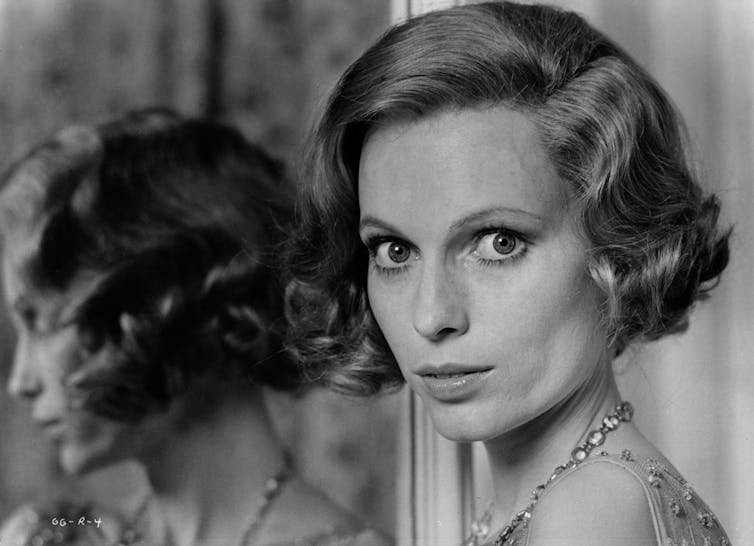
Daisy, played in 1974 by Mia Farrow, is a blue-blooded society belle. IMDB
Even romance and tragedy obey the logic of boom and bust. Nick reports in stockbroking language that Gatsby’s failure “temporarily closed out my interest in the abortive sorrows and short-winded elations of men”, and Gatsby’s love for Daisy — a golden girl whose voice is “full of money” — is as deeply rooted in class and material aspirations as in sexual or personal attachment.
He desires not only Daisy but what winning her would symbolise. Indeed when the penniless Gatsby first met her, Daisy’s social elevation as a Kentucky debutante is said to have “increased her value in his eyes”.
Gatsby’s publication coincided with a high water mark of racism and xenophobia in the United States. The Johnson-Reed Immigration Act of 1924 introduced strict immigration quotas, while the revitalised Klu Klux Klan peaked at four million members in the same year. The novel has drawn criticism for its marginalisation of African Americans: one would hardly know from Fitzgerald’s novel that the Harlem Renaissance was underway. Fitzgerald is credited with naming the Jazz Age, but largely erases its origins.
Nick calls Tom a “prig”, but he too associates race with class difference when the spectacle of “three modish negroes” driven by a “white chauffeur” prompts his reflection that this is a world where “anything can happen … even Gatsby”.
Sensuous prose
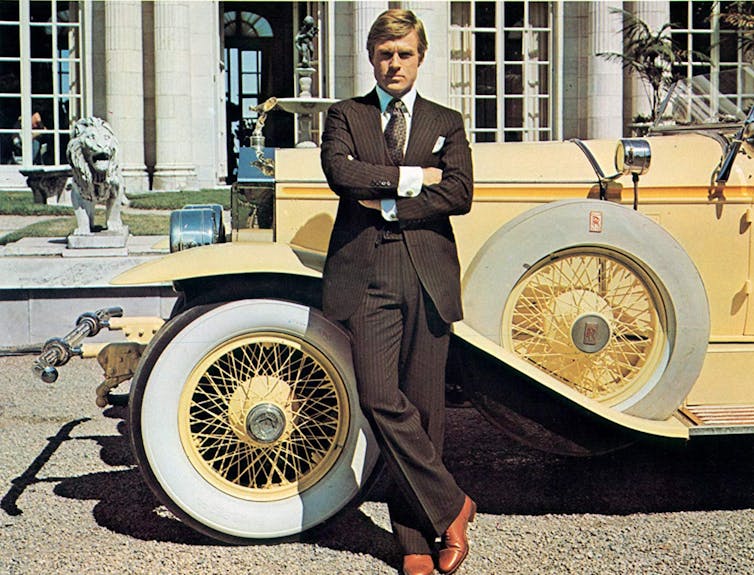
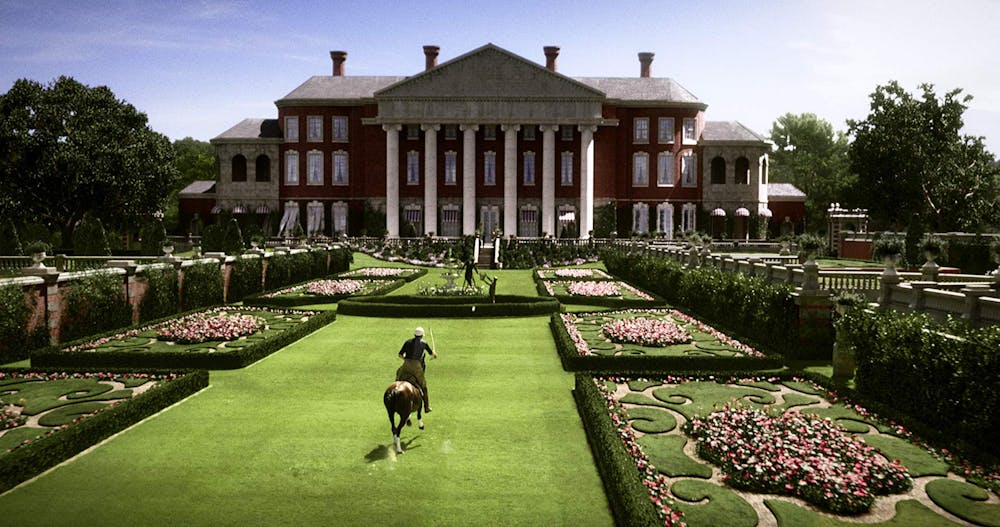
Fitzgerald’s prose is never more richly sensuous than when dealing with the strange alchemy of affluence, and the film adaptations by Jack Clayton (1974) and Baz Luhrmann (2013) struggle to do justice to Fitzgerald’s verbal pyrotechnics.
Even the intense colour and movement of Baz Luhrmann’s Gatsby struggled to match Fitzgerald’s prose.
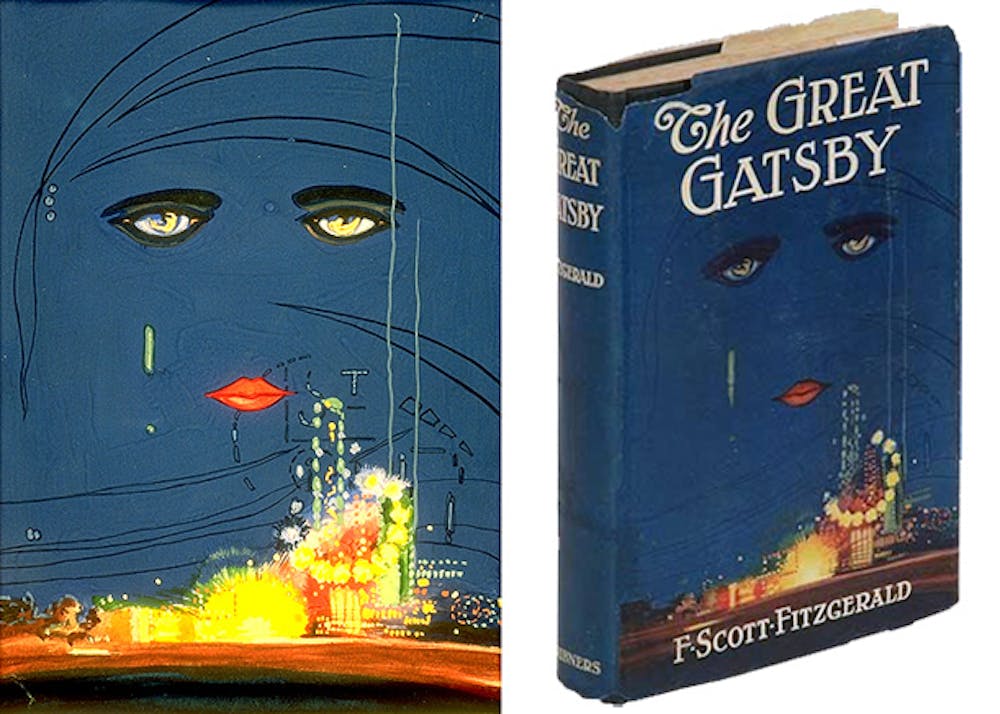
How can one portray “a scarcely human orchid of a woman” sitting in “ghostly celebrity” under a white plum tree, as a Hollywood actress is described? Like the cover of the novel’s first edition, Gatsby’s halls are “gaudy with primary colors”. His parties swell to “yellow cocktail music”, while a “green light” shines from Daisy’s dock across the bay.
At left, Francis Cugat’s original gouache painting for The Great Gatsby. A first edition of the book (right). USC
In the novel’s closing paragraphs, Gatsby’s faith in this green light symbolises the vagueness of an American commitment to an endlessly receding future glory: “tomorrow we will run faster, stretch out our arms farther”, Americans assure themselves, only to find themselves “boats against the current, borne back ceaselessly into the past”.
Indeed, Gatsby’s plan for the future is precisely to “repeat the past” by recovering “some idea of himself that had gone into loving Daisy … I’m going to fix everything just the way it was before”.
Neither Gatsby’s ambitions or the nation’s can stand much scrutiny. Even before his fall, Gatsby’s “dream […] was already behind him” in “the dark fields of the republic”, leaving a “foul dust” in its wake.
Still, what Nick most admires in Gatsby is his “heightened sensitivity to the promises of life” and Fitzgerald implies that this “extraordinary gift for hope” might be the essence of the American Dream.
Rudyard Kipling’s The Jungle Books were first published in 1894 and 1895, and they feature stories about Mowgli, a boy raised by wolves in the Indian jungle. The stories have remained popular and have inspired numerous adaptations – but their attitudes have been questioned by some parents and critics, who see them as a relic of Britain’s colonial past.
Indeed, a classic way of reading the tales is as an allegory for the position of the white colonialist born and raised in India. Mowgli – the Indian boy who becomes “master” of the jungle – is understood to be – as Kipling scholar John McClure interprets it: “behaving towards the beasts as the British do to the Indians”.
The classic account of Kipling, while persuasive in many ways, seems to me to be a bit limited. It misses some of the interesting questions the stories raise about notions of belonging and identity.
The standard account relies on the idea that the human and animal identities within the stories are clearly distinguished from each other and fixed – and that this fixed distinction extends via allegory to white colonial and Indian identities.
Fluid identities
But what happens to our understanding of the stories if we don’t treat the human and animal identities as distinct? I would argue that a species name doesn’t necessarily fix a character’s identity in the reader’s mind’s eye.
For example, Bagheera, the black panther, is described in terms of a series of other animals: he is “as cunning as Tabaqui [the jackal], as bold as the wild buffalo, and as reckless as the wounded elephant”. Attributes that are supposedly intrinsic to one animal can be found in another. Like Bagheera, Mowgli describes himself in terms of other animals: “Mowgli the Frog have I been […] Mowgli the Wolf have I said that I am. Now Mowgli the Ape must I be before I am Mowgli the Buck,” and it is this process of transformation that will lead to the end in which he will become “Mowgli the Man”. In this way he blurs the distinction between himself and the other jungle inhabitants.
This undermines narratives of essential difference between species. If we follow this through with respect to the common allegorical reading that sets Mowgli apart from the animals, it also undermines claims that there are absolute differences between white colonialists and Indian “natives”.
Also take a closer look at the relationship of the child Mowgli to the inhabitants of the jungle and you’ll see the way this complicates accounts of the Jungle Books as straightforwardly imperialist in character.
Belonging
The Jungle Book stories focus a great deal on the issue of belonging, raising questions about the grounds on which one may claim to belong to a particular group or community: is belonging a matter of being born a member of a group, or is it a matter of convention and social agreement?
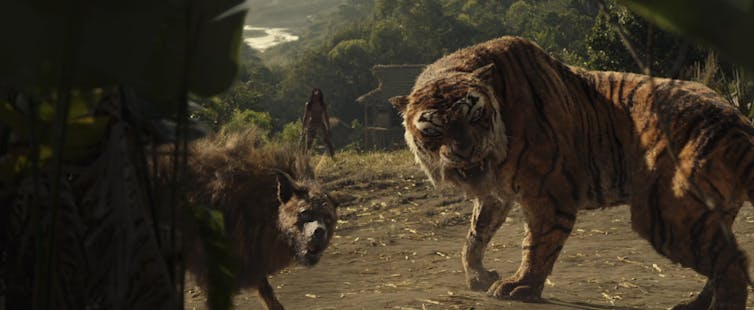
Shere Khan, Mowgli’s implacable enemy. Netflix
Because Mowgli is raised by wolves and initiated into their society he has a hybrid identity. Shere Khan, the tiger, resists Mowgli’s hybrid identity, referring to it as “man-wolf folly”. He claims that his hatred of Mowgli is justified because Mowgli is intrinsically “a man, a man’s child”. On the other hand, Akela, the leader of the wolves, claims kinship with Mowgli on the basis that:
He has eaten our food. He has slept with us. He has driven game for us. He has broken no word of the Law of the Jungle. … He is our brother in all but blood.
For Akela, Mowgli’s belonging is secured by his actions and his conformity with wolf society. Meanwhile, it’s worth noting that the most strident advocate of the idea that identity and belonging are a matter of “blood” is Shere Khan, the villain of the piece.
Nuance and ambiguity
By the end of the first Mowgli story it may seem that those, like Shere Khan, who claim that one’s identity is what one is born to be, carry the day – since Mowgli is cast out of the jungle. Though he speaks of leaving the jungle and going to “his own people”, he also qualifies this with: “if they be my own people” and he also goes on to reassert his claim to be part of the wolf pack when he follows this with the promise: “There shall be no war between any of us in the pack.”
As Daniel Karlin points out in his Penguin Classics edition of The Jungle Books (1987), Kipling changed this in his final collected edition of the stories to: “There shall be no war between any of us and the pack,” and so in the later edition “he already identifies with men”.
Either way, Mowgli does go on to rule the jungle rather than just remain a member of the jungle “family” as seems to be suggested by the recent Disney live-action/CGI film based on the stories. So there are ambiguities there, but a close reading of the Jungle Book stories leads me to feel that there is more to them than an imperialist narrative.
After a century or so during which Kipling has frequently been painted simply as a cheerleader for the “white man” and his burden – and at a time when questions of identity and belonging are particularly relevant for Britain – perhaps it’s time for a more nuanced reading of his classic works that allows their ambiguities and ambivalences to come to the fore.






 At the BookShelf
You must be logged in to post a comment.